
Learn more: Loop Trails Tour Ha Giang
Here’s something most travelers don’t realize: When you’re riding through Ha Giang Loop taking selfies at Ma Pi Leng Pass and Heaven’s Gate, you’re actually inside Vietnam’s first UNESCO Global Geopark.
Yeah, that stunning landscape? It’s not just pretty mountains—it’s a 2,350 square kilometer geological wonder that UNESCO officially recognized in 2010 as globally significant.
But here’s the thing: most people have no idea what that actually means.
I’ve guided hundreds of travelers through Dong Van Karst Plateau, and the conversation usually goes like this:
“Wait, what’s a geopark?”
“Why is it UNESCO-recognized?”
“What makes these rocks special?”
“Is this different from a regular national park?”
Great questions. And honestly? Understanding what you’re looking at makes Ha Giang Loop ten times more interesting.
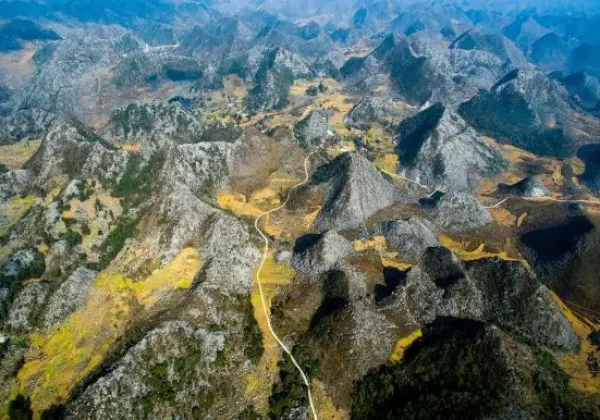
Because when you know you’re riding through 400-500 million year old ocean floor that was thrust up into mountains, when you understand why these peaks look like dragon’s teeth, when you realize the Hmong villages are built on ancient coral reefs—suddenly the landscape isn’t just Instagram-worthy, it’s mind-blowing.
In this guide, I’m going to explain:
Quick answer: Dong Van Karst Plateau is a 2,350km² geological area in Ha Giang featuring 400-500 million year old limestone formations, fossils from ancient seas, and unique karst topography. It’s home to 17 ethnic minority groups living in harmony with the landscape. UNESCO Global Geopark status (2010) recognizes both its geological and cultural importance.

Learn More: Ha Giang Loop Tour
Let me break this down in plain English, because the official descriptions are… let’s say “academic.”
The Simple Version:
Dong Van Karst Plateau = The entire mountainous region in northernmost Ha Giang where you ride the famous loop.
When people say “Ha Giang Loop,” they’re actually talking about riding through Dong Van Karst Plateau Geopark.
The boundaries (roughly):
North: China border (Lung Cu Flag Tower area)
South: Yen Minh District
East: Meo Vac District
West: Quan Ba District
Size: 2,350 square kilometers (about 907 square miles)
That’s roughly the size of Luxembourg or half of Rhode Island. You’re not just visiting a “site”—you’re riding through an entire geological region.
What “Karst Plateau” Means:
Karst: Type of landscape formed from limestone that’s been dissolved by water over millions of years, creating dramatic peaks, caves, sinkholes, and underground rivers.
Plateau: High, relatively flat elevated land. Though Dong Van doesn’t look “flat” when you’re riding switchbacks, geologically it’s an uplifted plateau that’s been carved by erosion.
Simple translation: “Really old limestone mountains that water shaped into weird, spectacular formations.”
Why It’s Called “Dong Van”:
Dong Van is the main town in the region kind of like calling the Grand Canyon “Arizona’s thing.” The karst plateau extends beyond just Dong Van town, but that’s the name that stuck.
Districts included in the Geopark:
Quan Ba
Yen Minh
Dong Van
Meo Vac
If you do the classic 3-day Ha Giang Loop, you’re spending Days 1-2 entirely within Dong Van Karst Plateau Geopark.
When You’re Actually “In” the Geopark:
Entering the Geopark (roughly):
You officially enter when you reach Quan Ba Heaven’s Gate (the famous twin mountains photo spot). That’s the southern entrance to the core Geopark area.
From there through:
Yen Minh
Dong Van
Meo Vac (eastern edge)
All of Ma Pi Leng Pass
You’re IN the Geopark.
When you’re NOT in the Geopark:
Ha Giang City (too far south)
Du Gia area (outside western boundary)
But here’s the thing: Nobody stops you at a gate saying “Welcome to UNESCO Geopark!” There are some signs, information boards at key spots, but mostly you’re just riding through without realizing the significance.
What Makes It a “Global” Geopark (vs Regular Park):
Regular National Park: Protected for nature, wildlife, recreation
UNESCO Global Geopark: Protected for:
Geological significance (rocks, fossils, earth history)
Cultural significance (how humans interact with geology)
Educational value (teaching people about Earth’s story)
Sustainable tourism (using geology to support local communities)
Think of it this way:
Yellowstone = National Park (geysers, wildlife, scenery)
Grand Canyon = National Park (geological, but US system)
Dong Van = Global Geopark (geological + cultural + educational focus)
There are only ~200 UNESCO Global Geoparks worldwide. Dong Van was the first in Vietnam (2010) and only the second in Southeast Asia.
That’s a big deal.
The UNESCO Plaque:
If you’re in Dong Van Old Quarter, there’s an actual UNESCO Global Geopark information center with the official plaque, maps, geological displays (mostly in Vietnamese, some English).
Most tourists walk right past it to get coffee or buy souvenirs.
But if you’re genuinely curious about what you’re riding through, it’s worth 20 minutes.
Learn more: Ha Giang Loop 4 Days 3 Nights
Okay, this is where it gets interesting. Let me explain the geology without putting you to sleep.
The Story: From Ocean Floor to Mountains
500-400 Million Years Ago (Ordovician-Devonian Period):
This area was underwater. Like, deep ocean floor.
The limestone you’re riding on? Ancient coral reefs and marine organisms that lived, died, and accumulated on the sea floor for millions of years. Their calcium carbonate shells and skeletons piled up, compressed, and became limestone.
Think about that: The rocks forming Ma Pi Leng Pass are made of dead sea creatures from 400 million years ago.
350-250 Million Years Ago (Carboniferous-Permian):
More limestone accumulation. Thicker and thicker layers. The Dong Van region was still underwater, but shallower—think tropical shallow seas with coral reefs (like modern-day Great Barrier Reef).
250-65 Million Years Ago (Mesozoic Era):
Tectonic plates started moving. India was slowly crashing into Asia (a collision that’s still happening—it’s what created the Himalayas).
Vietnam got squeezed. The limestone layers that had been sitting flat on the ocean floor started getting pushed, folded, crumpled, and lifted up.
65 Million Years Ago to Present:
The limestone kept rising. Wind, rain, and rivers carved away at it. The softer rock eroded faster, leaving the harder limestone standing as peaks.
Result: The dramatic karst landscape you see today.
Why Dong Van Mountains Look “Different”:
You know how most mountains are smooth-ish and rounded?
Dong Van’s peaks are jagged, vertical, like dragon’s teeth.
Why?
Limestone erodes differently than other rock types.
How limestone karst forms:
Rain absorbs CO2 from atmosphere, becomes slightly acidic
Acidic rain hits limestone, slowly dissolves it (calcium carbonate reacts with carbonic acid)
Vertical cracks (joints) in limestone dissolve faster than solid rock
Over millions of years, the cracks become chasms, the blocks between cracks become towers
This is why karst landscapes look so dramatic—sharp peaks separated by deep valleys.
Examples of famous karst landscapes worldwide:
Ha Long Bay (Vietnam)
Guilin (China)
Krabi (Thailand)
Phong Nha caves (Vietnam)
Dong Van Karst Plateau (Vietnam)
Same rock type, same erosion process, same spectacular results.
The Fossils: Proof of Ancient Oceans
Here’s something cool: Dong Van’s rocks are FULL of fossils.
What you can find (if you look closely):
Crinoids: Ancient sea lilies (they look like plants but are actually animals related to starfish). Super common in Dong Van limestone.
Brachiopods: Ancient clam-like shellfish (not actually related to modern clams though).
Corals: Fossilized coral structures from 400 million year old reefs.
Trilobites: Extinct marine arthropods (look like prehistoric pill bugs). Rarer but present.
Ammonites: Spiral-shelled marine creatures. Occasionally found.
Where to see them:
Option 1: Information Center in Dong Van
They have display cases with local fossils labeled.
Option 2: Rock faces along the road
If you stop and look closely at exposed limestone (road cuts, cliff faces), you’ll see circular/spiral patterns—those are fossils. Most riders zoom past without noticing.
Option 3: Local kids selling fossils
In Dong Van market, sometimes kids sell fossil pieces (20,000-50,000 VND). Ethically questionable (you shouldn’t encourage fossil collecting from protected areas), but they’re real.
Fun fact: Some of the fossils in Dong Van limestone are unique species found nowhere else on Earth. They help scientists understand ancient ocean ecosystems.
The Caves: Underground Karst
Limestone + water doesn’t just create surface peaks—it creates caves.
Dong Van area has extensive cave systems, though most aren’t open to tourists (unlike Phong Nha).
Accessible caves near the Geopark:
Lung Khuy Cave (near Quan Ba): Easy to visit, stalactites/stalagmites, well-lit. Good introduction to karst caves.
Most caves: Unmapped, unexplored, dangerous. Local Hmong/Tay people use some for storage or shelter.
Why this matters: The caves are part of the same karst system. Water flowing underground through limestone creates caves, then resurfaces as springs—that’s how karst hydrology works.
The “Swiss cheese” analogy: Dong Van’s limestone is like Swiss cheese—full of holes (caves, sinkholes, underground rivers) that you can’t see from the surface.
The Geological Timeline (Visual):
Time Period | What Was Happening | Evidence You See Today |
|---|---|---|
500-400 million years ago | Dong Van area underwater, coral reefs growing | Limestone rocks, marine fossils |
400-250 million years ago | More limestone accumulating | Thick limestone layers (100s of meters) |
250-65 million years ago | Tectonic collision, limestone lifted up | Folded, tilted rock layers visible in cliffs |
65 million-present | Erosion carving the landscape | Jagged peaks, valleys, caves |
When you ride through Dong Van, you’re seeing the result of 500 million years of Earth history.
Why Geologists Geek Out About Dong Van:
1. Continuous rock record: Limestone layers from multiple geological periods stacked on top of each other—like reading a book of Earth’s history.
2. Well-preserved fossils: Not just random fossils, but detailed preservation showing ancient ecosystems.
3. Classic karst development: Textbook example of how limestone landscapes form—used in university geology courses.
4. Tectonic evidence: The folded, tilted rock layers show the power of plate tectonics.
5. Active karst processes: Erosion is still happening—you’re seeing a landscape mid-evolution.
This is why UNESCO was interested. It’s not just “pretty mountains”—it’s a geological library.
Learn more: Ha Giang Loop 3 days 2 nights
Okay, so why did UNESCO give Dong Van “Global Geopark” status? What does that actually mean? And should you care?
What UNESCO Global Geopark Actually Means:
UNESCO = United Nations Educational, Scientific and Cultural Organization
They’re the same group that designates:
World Heritage Sites (like Ha Long Bay, Hoi An Ancient Town)
Biosphere Reserves
Memory of the World (historical documents)
Global Geopark = UNESCO program recognizing geological heritage
Started in 2015 (officially), though Geopark network existed earlier.
Requirements to be recognized:
✅ Geological significance: Site must have international scientific importance (not just locally cool rocks).
✅ Clear boundaries: Defined area with management plan.
✅ Protection: Legal protection of geological features.
✅ Education: Programs to teach visitors about geology.
✅ Sustainable development: Tourism that benefits local communities without destroying the geology.
✅ Community involvement: Local people must be part of management and benefit from designation.
Dong Van met ALL these criteria and was recognized in 2010 (as part of the Global Geoparks Network, before it officially became a UNESCO program in 2015).
Why Dong Van Specifically Got UNESCO Status:
The application highlighted:
1. Geological Diversity:
500 million years of rock record
Multiple geological periods represented
Exceptional fossil preservation
Classic karst landscape development
2. Scientific Value:
Research potential (ongoing studies)
Educational importance (geology students visit)
Unique fossil species
3. Cultural Integration:
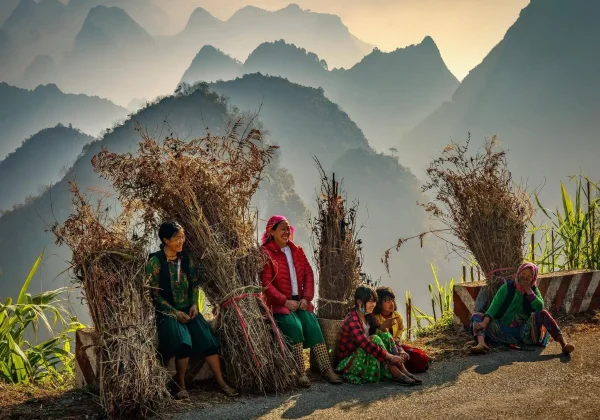
17 ethnic minority groups living in the landscape
Traditional architecture using local limestone
Cultural practices shaped by the geology (terraced farming on karst slopes)
4. Aesthetic Value:
Spectacular scenery (UNESCO doesn’t just care about rocks—beauty matters)
Tourism potential that could economically benefit remote communities
5. Sustainable Development Plan:
Ha Giang Province committed to protecting the Geopark
Plans to use tourism to fund conservation and support local communities
UNESCO said “Yes” in 2010, making Dong Van Vietnam’s first Global Geopark.
What UNESCO Recognition Actually Does:
Practical effects:
✅ International recognition: Puts Dong Van on the global geological map.
✅ Tourism marketing: “UNESCO Global Geopark” sounds impressive, attracts visitors.
✅ Funding access: Easier to get international grants for conservation and development.
✅ Protection: Legal framework to prevent destructive development (mining, quarrying in sensitive areas).
✅ Education requirements: Must maintain information centers, signage, educational programs.
✅ Monitoring: UNESCO checks in periodically to ensure standards are maintained.
What it DOESN’T do:
❌ Lock everything down: This isn’t a museum. People still live here, farm, build houses.
❌ Stop all development: Roads, electricity, schools are allowed (encouraged even).
❌ Ban tourism: Tourism is actually encouraged (sustainable tourism).
❌ Create entrance fees: There’s no “Geopark ticket” to buy.
Think of it as: UNESCO recognition gives Dong Van prestige and protection, but life continues normally for local people.
The Global Geopark Network:
Dong Van is one of ~200 Global Geoparks worldwide (as of 2024).
Other famous ones:
Jeju Island (South Korea) – volcanic landscape
English Riviera (UK) – Jurassic Coast fossils
Stone Forest (China) – karst pinnacles
Hong Kong (China) – volcanic rock formations
Aso (Japan) – active volcano region
In Vietnam:
Dong Van (2010) – Ha Giang karst
Non Nuoc Cao Bang (2018) – Cao Bang, includes Ban Gioc Waterfall
Being in this network means Dong Van is considered globally important for understanding Earth’s history.
Does UNESCO Status Change Your Experience?
Honest answer: Not directly.
What you’ll notice:
Information boards at key locations (Dong Van town, major viewpoints)
Small museum/info center in Dong Van Old Quarter
Occasional signs mentioning UNESCO Geopark
Tour guides might mention it (if they’re good)
What you WON’T notice:
Entrance gates or tickets
Major infrastructure changes
Crowds at “UNESCO sites” (it’s all one big Geopark, not individual sites)
But here’s the thing: Understanding the UNESCO designation makes your visit more meaningful.
When your guide says “This is the Dong Van Karst Plateau Geopark,” and you actually know what that means—that you’re riding on 400 million year old ocean floor, through a landscape so geologically significant it’s globally protected—suddenly those switchbacks feel more special.
Criticism & Challenges:
Real talk: UNESCO designation isn’t perfect.
Challenges Dong Van faces:
1. Tourism boom: Ha Giang Loop popularity has exploded since 2015. More tourists = more environmental pressure (litter, erosion, noise).
2. Infrastructure development: New roads, hotels, restaurants—necessary for tourism, but changes the landscape.
3. Mining concerns: Limestone is valuable (cement industry). There’s pressure to allow quarrying (UNESCO status helps resist this, but pressure exists).
4. Education gaps: Many tourists have no idea they’re in a Geopark. Information could be better.
5. Community benefits: Not clear that local ethnic minorities benefit equally from UNESCO tourism revenue.
UNESCO’s challenge: Balance protection with development, science with tourism, conservation with community needs.
It’s a work in progress.
Learn more: Ha Giang – Cao Bang 5 days 4 nights tour
Here’s where Dong Van gets really interesting: It’s not just geological—it’s cultural.
UNESCO didn’t just recognize the rocks. They recognized how humans have lived on these rocks for centuries.
The 17 Ethnic Minority Groups:
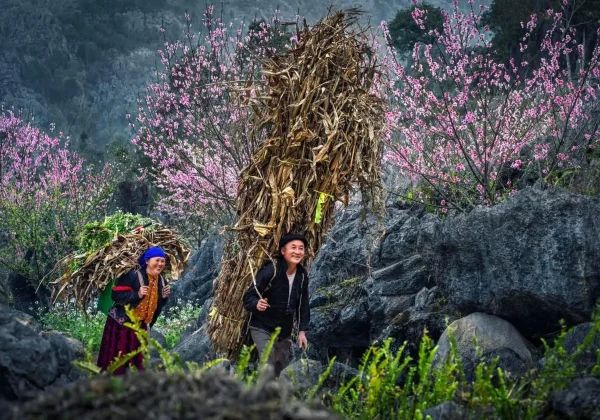
Dong Van Karst Plateau is home to 17 different ethnic groups:
Major groups you’ll encounter:
H’Mong (Hmong): Largest group
Distinctive indigo-dyed clothing
Live at highest elevations
Famous for hemp cultivation and linen weaving (Lung Tam village)
Settled in Dong Van ~300 years ago, migrating from China
Dao (Yao): Second largest
Colorful embroidered clothing, red headdresses
Known for herbal medicine knowledge
Practice terraced farming
Tay: Mostly in valleys
Linguistically related to Thai
Practice wet rice farming
Known for traditional music and poetry
Nung: Similar to Tay
Live in valleys near water
Expert farmers
Known for food culture (banh cuon, grilled dishes)
Lo Lo: Rare, small population
Split into Black Lo Lo and Colorful Lo Lo (based on clothing)
Preserve ancient animist traditions
Live in remote villages
Plus 12 other smaller groups: Giay, Phu La, Co Lao, etc.
How Geology Shaped Culture:
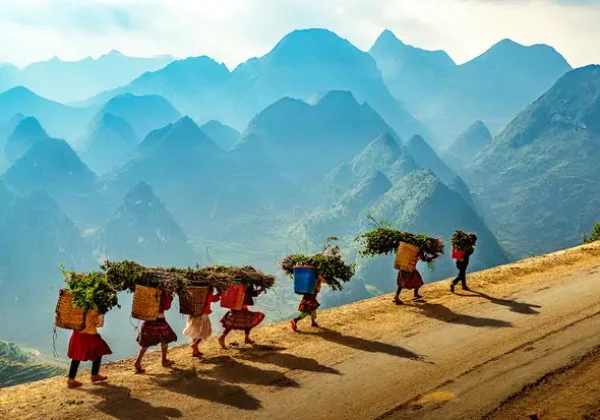
The landscape literally determined how people live:
1. Settlement Patterns:
Limestone karst = limited flat land
→ Villages built in valleys, on slopes, or on small plateaus
→ Houses cluster where water sources (springs from karst) emerge
→ Ethnic groups separated by geography, preserving distinct cultures
2. Architecture:
Abundant limestone = building material
→ Stone houses (especially in Dong Van Old Quarter)
→ Stone walls for terraces
→ Limestone slab roofs (older houses)
→ Stone streets in Dong Van
The buildings are MADE FROM the Geopark rocks.
3. Agriculture:
Rocky karst soil = challenging farming
→ Terraced fields carved into slopes (hundreds of years of work)
→ Corn and buckwheat (not rice) at high elevations (too cold, poor soil)
→ Hemp and flax cultivation (for linen weaving)
→ Medicinal plants foraged from karst forests
The geology dictated what crops could survive.
4. Water Management:
Karst hydrology = underground water
→ Villages located near springs
→ Traditional water collection systems
→ Knowledge of where water emerges (some springs are seasonal)
Finding water in karst landscape is survival skill.
5. Spiritual Beliefs:
Dramatic landscape = spiritual significance
→ Mountain peaks considered sacred (home of spirits)
→ Caves used for spiritual ceremonies
→ Limestone formations incorporated into creation myths
The geology shaped religious beliefs.
Traditional Practices Tied to the Landscape:
Lung Tam Linen Weaving:
What: Hmong women transform hemp (grown on karst slopes) into beautiful linen fabric.
Process (you can watch in Lung Tam village):
Grow hemp on rocky terraces
Harvest, process fibers
Spin into thread by hand
Weave on traditional looms
Dye with indigo (from locally grown plants)
Create intricate batik patterns
Why it matters: This craft is directly tied to the karst landscape. Hemp grows well in poor karst soil. Indigo plants thrive here. The tradition is 300+ years old.
UNESCO recognized this as intangible cultural heritage linked to the Geopark.
Terraced Farming:
What you see: Hillsides carved into hundreds of steps, planted with corn, rice (lower elevations), buckwheat.
How it works: Each terrace catches rainwater, prevents erosion on steep karst slopes.
Age: Some terraces are 200+ years old, maintained across generations.
Why it matters: This is humans adapting to challenging karst topography. Flat land is scarce, so they CREATED flat land by building terraces.
Best time to see: September-October (harvest season, golden terraces).
Pao’s House (Vuong Palace):
What: Grand mansion built in early 1900s by Vuong Chinh Duc, “King of the Hmong.”
Construction: Entirely from local materials—limestone walls, wood beams, tile roof.
Significance: Shows how wealthy locals used karst resources (limestone, timber from karst forests) to build impressive structures.
The architecture blends Hmong and Chinese styles, using the geology as foundation (literally—it’s built on limestone bedrock).
UNESCO’s Cultural Recognition:
UNESCO didn’t just say “Nice rocks.”
They said: “This Geopark demonstrates the interplay between geological heritage and human culture.”
The citation specifically mentions:
Cultural diversity (17 ethnic groups)
Traditional knowledge of living in karst landscape
Architecture utilizing geological resources
Intangible heritage (weaving, farming techniques, spiritual practices)
Sustainable use of the environment by indigenous communities
This is what makes Dong Van special beyond geology—it’s a living, working landscape where people still practice traditions shaped by the rocks beneath their feet.
Modern Challenges to Cultural Heritage:
Real talk: Development threatens traditions.
What’s changing:
Young people leaving for cities (declining traditional skills)
Modern materials replacing stone/wood (concrete houses)
Mechanization reducing hand-weaving (cheaper to buy factory clothes)
Tourism commercializing culture (staged performances vs authentic practice)
Smartphone/internet changing youth culture
UNESCO Geopark status helps by:
Promoting cultural tourism (economic incentive to preserve traditions)
Funding cultural preservation projects
Training young people in traditional crafts
Creating markets for authentic handicrafts
But it’s a race against time. The generation that knows all the old ways is aging out.
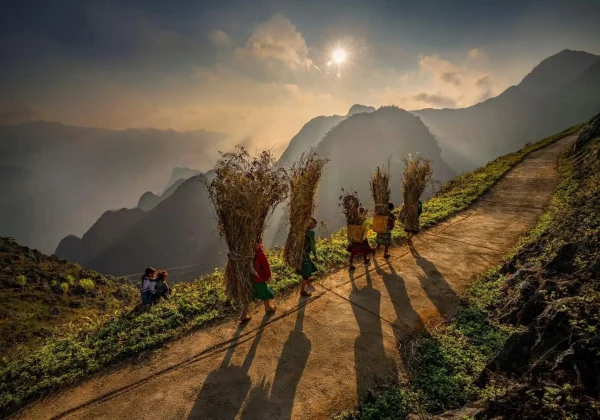
Learn more: Ha Giang Motorbike Rental
Okay, practical stuff. You’re riding through Dong Van Karst Plateau Geopark. What should you actually look for and understand?
The “Must-See” Geological Sites:
1. Quan Ba Heaven’s Gate (Twin Mountains)
Location: Quan Ba District, ~40km from Ha Giang City
What you see: Two cone-shaped limestone peaks rising from valley floor—”Fairy Bosom Mountains.”
Geological significance:
Limestone towers (karst peaks) surrounded by flatter land
These are remnants of a once-continuous limestone layer—erosion removed everything else
Fossils visible in exposed rock faces (if you look closely)
What to understand: These aren’t just random hills. They’re erosional remnants—the “leftovers” after millions of years of dissolving limestone.
Local legend: A fairy mother laid down here to feed her children, and her breasts became these mountains. (Vietnamese folklore is wonderfully imaginative.)
Best time: Morning (8-10am) for soft light, fewer tour groups.
2. Ma Pi Leng Pass
Location: Between Dong Van and Meo Vac
What you see: Road carved into cliff face, 1,000+ meters above Nho Que River canyon.
Geological significance:
What to understand: This road was blasted through solid limestone in the 1960s-70s. The cliff you’re riding on is 400 million year old limestone that used to be ocean floor.
Look for: Light-colored rock layers (limestone), darker layers (shale from deeper water). These alternating layers show changes in ancient ocean depth.
Best experience: Stop at multiple viewpoints. Don’t just drive through—LOOK at the geology.
3. Lung Cu Flag Tower
Location: Northernmost point of Vietnam, near China border
What you see: Vietnamese flag tower on hilltop, 360° mountain views.
Geological significance:
What to understand: Standing here, you’re on an uplifted plateau—this land was once sea floor, now it’s 1,500m+ elevation. The mountains you see stretching to China are all part of the same ancient limestone formation.
Cultural note: The flag tower marks Vietnam’s sovereignty, but geologically, the rocks don’t care about borders—it’s one continuous karst system.
4. Dong Van Old Quarter
Location: Dong Van town center
What you see: 100-year-old stone houses, limestone streets, market.
Geological significance:
What to understand: This isn’t just quaint old town—it’s geology-based architecture. Every building is constructed from the karst plateau itself.
Look for: Fossils in limestone walls (I’ve spotted crinoid fossils in building stones—the builders used fossiliferous limestone without even realizing).
Best time: Morning market (6-9am) for local culture + afternoon for relaxed exploration.
5. Lung Khuy Cave
Location: Lung Khuy village, Quan Ba District (~20km from Quan Ba town)
What you see: Limestone cave with stalactites, stalagmites, chambers.
Geological significance:
What to understand: This cave formed by acidic groundwater dissolving limestone from inside the mountain. The stalactites are limestone re-depositing as water drips (calcium carbonate precipitation).
Time needed: 30-45 minutes. Well-lit, easy paths.
The Cultural Sites (With Geological Connection):
6. Lung Tam Linen Weaving Village
What: Hmong village famous for traditional linen.
Geological connection: Hemp (raw material) grows on karst terraces. Indigo dye plants thrive in karst soil. The craft exists because of the geology.
What to do: Watch weaving demonstrations (usually free, tips appreciated). Buy authentic linen products (scarves 100,000-200,000 VND, larger pieces 500,000-1,000,000 VND).
Why it matters: This is living cultural heritage tied to Geopark geology.
7. Vuong Family Palace (Pao’s House)
What: Grand early-1900s mansion.
Geological connection: Built entirely from local materials—limestone walls, timber from karst forests, clay tiles.
What to see:
Entrance fee: 10,000-20,000 VND (varies)
8. Sa Phin Valley & H’Mong Villages
What: Remote valley with traditional villages.
Geological connection: Valley formed by erosion cutting through karst plateau. Villages built where springs emerge from limestone.
What to observe:
This is humans living IN the Geopark, not just visiting it.
How to Actually LEARN While You’re There:
Most tourists ride through taking selfies without understanding anything. Here’s how to be different:
1. Hire a Good Guide
Ask tour operators: “Does your guide explain the geology and UNESCO Geopark significance?”
Good guides will:
Point out geological features
Explain rock formations
Discuss how locals adapted to karst landscape
Share both scientific and cultural perspectives
Bad guides will:
Just say “Pretty view, take photo”
Not mention UNESCO Geopark at all
Rush through without context
Our Loop Trails guides are trained on basic geology (we’re not geologists, but we can explain the basics).
2. Visit the Information Center
Dong Van Karst Plateau Geopark Information Center
Location: Dong Van Old Quarter
Hours: Usually 8am-5pm (check locally)
Entrance: Free or small fee
What’s inside:
Time needed: 20-30 minutes.
Worth it? YES, if you want to understand what you’re seeing. Most tourists skip it—don’t be most tourists.
3. Stop and Look at the Rocks
When riding past road cuts (where they blasted through rock to make the road):
Look for:
Most people zoom past. Stop. Look. Touch the rocks. You’re touching 400 million years of Earth history.
4. Talk to Locals (If Possible)
Ask (through your guide if language barrier):
You’ll learn more from a 10-minute conversation with a farmer about karst hydrology than from any textbook.
5. Read the Signs
At major viewpoints, UNESCO Geopark has installed information boards (in Vietnamese and English).
They explain:
Most tourists take selfies in front of the signs without reading them.
Don’t be that person. Read the damn sign.
Photography Tips (Geological Focus):
If you want photos that show the GEOLOGY, not just pretty views:
1. Capture rock layers: Photograph cliff faces showing horizontal or tilted stratification—this shows the geological story.
2. Include scale: Put a person in the frame next to massive karst towers—shows the true size.
3. Close-ups of fossils: If you spot fossils in rock faces, photograph them with something for scale (coin, hand).
4. Erosion patterns: Photograph how water has carved the limestone (caves, grooves, dissolved surfaces).
5. Human-geology interaction: Stone houses, terraced fields, limestone walls—show how people use the geology.
These photos will be more interesting than your 47th Ma Pi Leng Pass selfie.
The “Hidden” Geopark Sites (Less Visited):
If you want to go deeper:
Lung Tao Village: Remote H’Mong village with spectacular terraces, minimal tourism.
Sa Phin Valley: Gorgeous valley with rock formations and traditional villages.
Me Pass: Less famous than Ma Pi Leng but equally beautiful karst scenery.
Tham Ma Pass: Winding road through classic karst landscape.
These require asking your guide to include them (or custom tour). Most standard tours stick to the main route.
Final Thoughts: Does Knowing This Change Ha Giang Loop?
Here’s my honest take after guiding 200+ tours:
Most travelers ride Ha Giang Loop and love it without knowing anything about UNESCO Geopark status or the geology.
The scenery is so spectacular that it works on a pure visual level.
But the travelers who UNDERSTAND what they’re seeing—who know they’re riding through 400 million year old ocean floor, who recognize how ethnic minorities adapted to karst landscape, who appreciate the UNESCO recognition—those travelers have a richer experience.
It’s the difference between looking at a painting and understanding the artist’s technique, materials, and historical context.
Both are valid ways to enjoy art. But one is deeper.
So should you care about Dong Van Karst Plateau Geopark status?
Only if you want to. Ha Giang is stunning either way.
But if you’re reading this guide—you probably DO want to understand more.
And that’s what makes travel meaningful: curiosity.
Ready to Experience Dong Van Karst Plateau?
Ha Giang Loop Tour (Rides Through the Geopark):
3-Day Classic Tour
Complete Dong Van Karst Plateau circuit
Ma Pi Leng, Lung Cu, Dong Van, Quan Ba
Guide explanation of geology and culture
Price: $130-155 (Self-Drive/Easy Rider)
5-Day Ha Giang-Cao Bang (Two UNESCO Geoparks!)
See Dong Van Karst Plateau (Ha Giang) + Non Nuoc Cao Bang Geopark
Price: $411-439
Want a Geology-Focused Tour?
Custom tours available with enhanced geological explanation.
👉 WhatsApp Us – Tell us you’re interested in the geological/UNESCO aspects