

Thúy Kiều( Grace) is a travel blogger and content contributor for Loop Trails Tours Ha Giang. She holds a bachelor’s degree in Sustainable Tourism from Vietnam National University, Hanoi, and has a strong passion for exploring and promoting responsible travel experiences in Vietnam’s northern highlands.
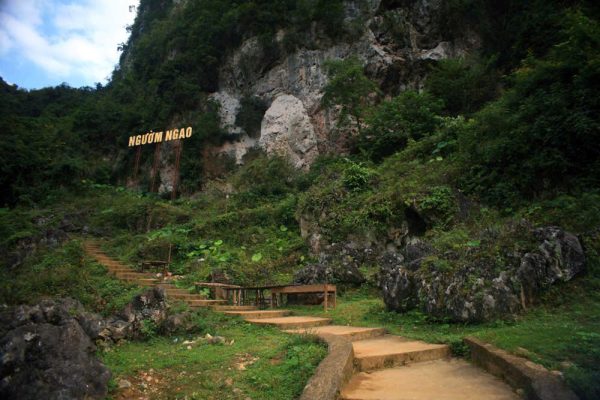
The temperature drops the moment you step through Nguom Ngao Cave’s entrance. Not dramatically, but enough that you notice. Then your eyes adjust to the dim interior, and you realize you’re standing at the threshold of something genuinely massive—a three-kilometer underground system carved through limestone over millions of years.
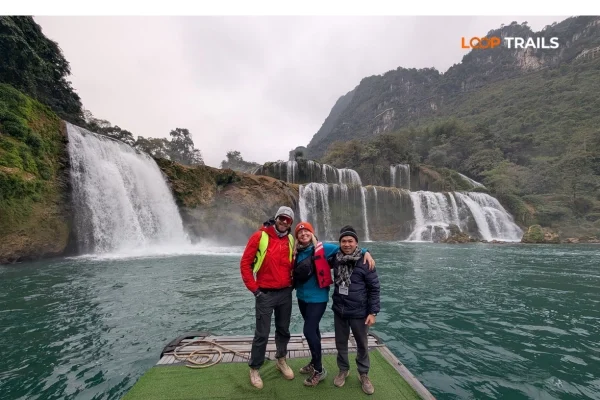
Nguom Ngao sits just 3 kilometers from Ban Gioc Waterfall, Vietnam’s largest waterfall, and while the waterfall gets most of the headlines, plenty of visitors end up spending more time inside the cave. The scale is that impressive. Chambers the size of aircraft hangars, stalactites thick as tree trunks, rock formations that look like frozen waterfalls or curtains of stone.
This isn’t a “quick 20-minute walk-through” kind of cave. The marked tourist route covers about 1 kilometer, but you’ll want at least an hour to really see it. More if you’re into photography or geology. Less if you’re rushing, but rushing here seems like a waste.
Most people visit Nguom Ngao as part of a Ban Gioc Waterfall day trip from Cao Bang City, or as a stop on the Cao Bang Loop. Some fold it into extended Ha Giang to Cao Bang combined routes. Whichever way you approach it, the cave deserves proper time in your itinerary, not just an afterthought tacked onto the waterfall visit.
Learn more: Ha Giang Loop Tours
Learn more: Ha Giang to Cao Bang
Nguom Ngao Cave is a limestone cave system in Gun Hamlet, Dam Thuy Commune, Trung Khanh District, Cao Bang Province. In practical terms, it’s located extremely close to the Ban Gioc Waterfall—about 3 kilometers by road, maybe 5 minutes on a motorbike.
The cave extends roughly 3 kilometers into the mountain, though only about 1 kilometer is developed for tourism with lighting and pathways. That single kilometer contains more dramatic formations than most caves show across their entire length. The system has multiple chambers connected by narrower passages, with ceiling heights that range from just a few meters to over 30 meters in the largest halls.
GPS coordinates put Nguom Ngao at approximately 22.8536° N, 106.7244° E. From Ban Gioc Waterfall’s main parking area, you’ll ride back toward Cao Bang City for about 2 kilometers, then turn right onto a smaller road that leads directly to the cave entrance. Signage exists but isn’t always obvious if you’re not watching for it.
From Cao Bang City, the cave is roughly 85 kilometers north. The ride takes 2.5-3 hours depending on road conditions and how many photo stops you make along the way. The route follows QL34 (National Highway 34) most of the distance before branching onto smaller roads for the final approach.
Most visitors hit Nguom Ngao Cave and Ban Gioc Waterfall in the same day trip from Cao Bang. The two sites are close enough that visiting both is logical, and most tour itineraries structure it this way: waterfall first (it’s further), then cave on the return journey.
“Nguom Ngao” comes from the Tay language. “Nguom” means cave, while “Ngao” translates roughly to “tiger” or refers to the roaring sound. The name stems from the sound of the Quay Son River flowing through parts of the cave system—during heavy rain, the rushing water creates a sound that echoes through the chambers like a tiger’s roar.
Local legend involves the usual mix of ancient kings, hidden treasures, and spiritual guardians that Southeast Asian caves tend to accumulate. The Tay ethnic minority people who’ve lived in this area for generations considered the cave sacred for centuries before it became a tourist site.
The cave was “officially discovered” in the early 1920s by local villagers, though obviously the Tay people knew about it long before that. It opened to tourism in the 1990s after pathways and lighting were installed, but infrastructure remained pretty basic until the 2000s when the Ban Gioc area started attracting serious tourist numbers.
The full Nguom Ngao system has three main entrances: Nguom Ngao (the primary tourist entrance), Nguom Lom, and Ban Thuon. The tourist route uses the Nguom Ngao entrance and exits at Ban Thuon, creating a one-way path through the mountain.
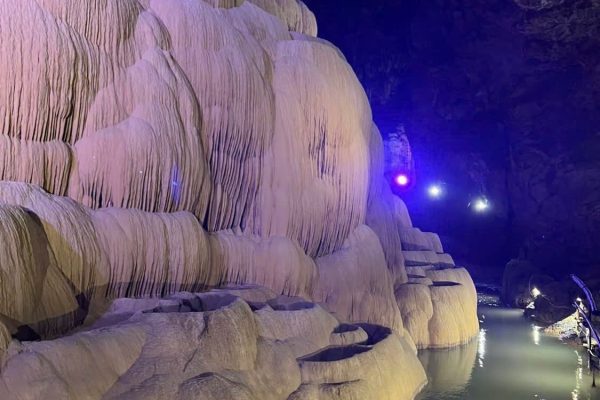
The cave formed through karst processes—acidic water dissolving limestone over millions of years. The result is a complex system of chambers, tunnels, underground streams, and the spectacular formations that make the cave worth visiting. Stalactites hang from the ceiling, stalagmites rise from the floor, and in places where they’ve met and fused, you get massive columns of flowstone.
Water still flows through parts of the cave system, fed by the Quay Son River. You’ll hear it during your walk, and in some sections you’ll see it—dark streams running through side passages or pooling in chambers. The humidity stays high year-round, and temperatures inside hold steady around 18-22°C regardless of outside weather.
Learn more: Explore just the Cao Bang Loop
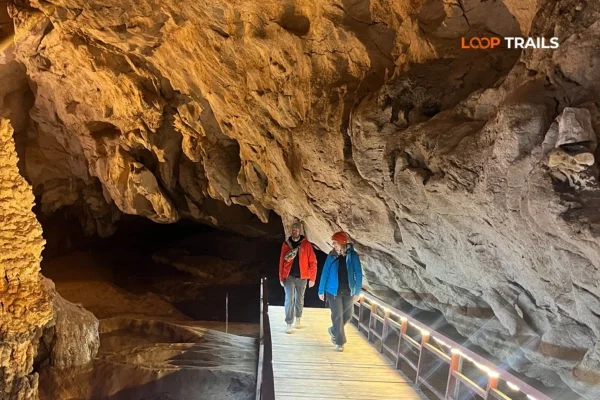
Walking into Nguom Ngao feels like entering a natural cathedral. The first chamber opens up above and around you, and the artificial lighting—installed to highlight specific formations—creates an almost theatrical atmosphere. Some people love this; others find it a bit over-done compared to more “natural” cave experiences.
The cave features several distinct chambers, each with its own character:
The First Chamber serves as an introduction. It’s large but not overwhelming, giving your eyes time to adjust while you get oriented. The path here is wide and well-maintained, with steps and handrails where needed.
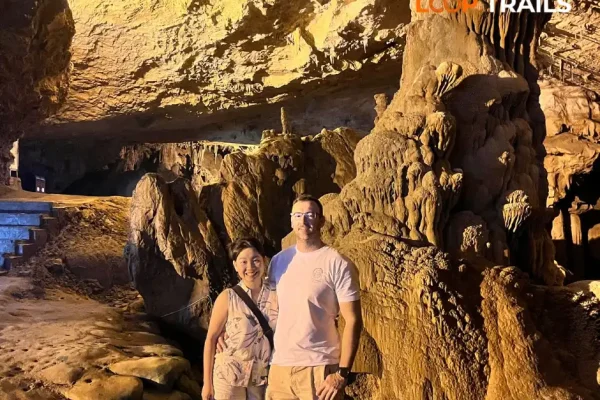
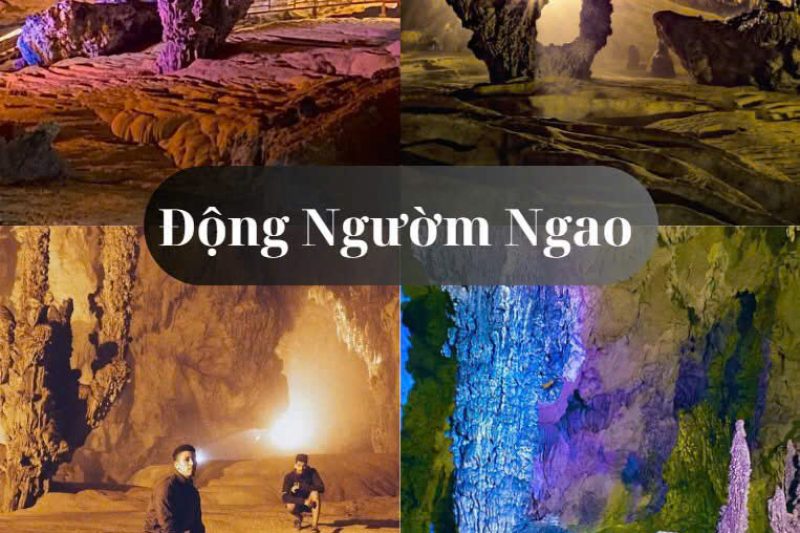
The Column Chamber contains some of the cave’s most photographed formations—massive stalactite-stalagmite columns that have fused over millennia. Some are several meters in diameter and stretch from floor to ceiling. The lighting here tends toward blues and purples, which either enhances or distracts depending on your taste.
The Waterfall Chamber features formations that genuinely look like frozen cascades of water. The flowstone creates rippled, layered patterns that catch the light, and in the right spots you can see the water that’s still actively depositing new mineral layers. This is geology in real-time, just happening too slowly for humans to perceive.
The Cathedral Chamber is the largest accessible space, with a ceiling that disappears into darkness above the lighting. The acoustic properties here are notable—voices echo, and you can hear water dripping from various points throughout the chamber. This is where the cave’s scale really hits you.
Throughout the route, individual formations have been given names based on their appearance: the Lion, the Fairy, the Buddha, etc. Whether you see the resemblance depends on your imagination and how much prompting the guide provides. Some are genuinely suggestive; others require a lot of creativity.
The tourist path is concrete or stone, relatively level, and equipped with handrails at steep or slippery sections. Total walking distance through the cave is roughly 1 kilometer, taking 45-90 minutes depending on your pace and how often you stop.
The route is one-way: you enter at Nguom Ngao entrance and exit at Ban Thuon. This means you can’t simply turn around and walk back if you get tired—you’re committed to the full route once you start. For most people this isn’t an issue, but if you have mobility concerns, understand that you’ll be walking the full distance.
Steps exist at various points—probably a few hundred total throughout the route. None of the individual staircases are particularly long or steep, but they accumulate. Wheelchairs wouldn’t work here. People with moderate mobility issues can usually manage with breaks, but it’s not accessible in the formal sense.
The path stays damp in sections where water seeps through the ceiling or walls. Stone surfaces can be slippery, especially where mineral deposits have created smooth layers. The handrails aren’t decorative—use them where provided, particularly if you’re carrying camera equipment or wearing sandals.
The cave is lit with colored LED lighting installed throughout the tourist route. The colors change from chamber to chamber—sometimes white or warm tones, other times green, blue, purple, or red. This creates dramatic effects but can be challenging for photography if you’re trying to capture “natural” cave tones.
For photography, the lighting is both blessing and curse. The dramatic illumination makes it possible to shoot handheld in many sections, but the color casts require white balance adjustment. Bringing a tripod helps, though managing one on wet stone steps while other tourists are walking past is awkward.
The lighting system occasionally malfunctions or gets turned off during quiet periods. If you arrive and the cave seems darker than expected, ask staff to turn on all the lights. They sometimes conserve power when visitor numbers are low.
Flash photography is allowed, which helps for capturing details the installed lighting misses. However, constant flash from large tour groups gets annoying quickly. Be considerate about when and how often you’re lighting up the cave.
Learn more: Ha Giang Motorbike Rental
The logistics of visiting Nguom Ngao are straightforward, though a few details are worth knowing before you arrive to avoid surprises or wasted time.
Entrance fees typically run around 30,000-40,000 VND per person (roughly $1.25-$1.75 USD). This is significantly cheaper than many other Vietnamese tourist caves, which makes sense given that Nguom Ngao is less developed than places like Phong Nha or Paradise Cave.
The ticket gets you access to the walking route through the cave. It does not include a mandatory guide, though guide services are available for hire at the entrance. More on guides in the next section.
Parking for motorbikes is usually 5,000-10,000 VND. Cars and larger vehicles pay slightly more. These fees are collected at the parking area, separate from the cave entrance ticket.
Prices are subject to local policy changes, particularly around Vietnamese holidays when tourism sites sometimes raise fees temporarily. The numbers above reflect standard rates as of recent reports, but check current pricing when planning your visit.
Official opening hours are generally 7:00 AM to 5:00 PM daily. Unlike some attractions that close for lunch or take random days off, Nguom Ngao stays open consistently throughout the week and year.
That said, staff presence and services (like guide availability) are more reliable during peak hours (8:00 AM – 4:00 PM). Showing up at 6:45 AM might technically work, but you could find yourself waiting for someone to arrive and unlock gates or turn on lighting.
The best time to visit within the day is mid-morning (9:00-11:00 AM) after the earliest tour groups have passed through but before the midday rush. Alternatively, late afternoon (3:30-4:30 PM) sees lighter traffic as most day-trippers have already left.
Inside the cave, time of day doesn’t matter—it’s equally dark whether it’s noon or midnight outside. The temperature stays constant year-round, hovering around 18-22°C with high humidity regardless of external weather.
Guides are available at the entrance but not mandatory. Local guides speak varying levels of English—some communicate well enough to explain formations and legends, others stick mostly to Vietnamese with a handful of English words for key features.
If you hire a guide, expect to pay around 100,000-200,000 VND for the group (not per person). For solo travelers or couples, this can feel steep relative to the entrance fee. For groups of 4-6 people, it’s quite reasonable split among everyone.
What you get from a guide:
What you don’t get:
Many visitors skip the guide and explore independently with no issues. The path is marked, the route is one-way, and you can’t really get lost. If budget is tight or you prefer self-guided exploration, going solo is fine.
Learn more: Cao Bang Loop Tours Vietnam best kept secret
Because the cave’s interior environment stays stable year-round, “best time” is mostly about external factors: getting to the cave, combining it with other attractions, and weather during the rest of your Cao Bang trip.
Inside the cave, you’re insulated from weather. Outside, Cao Bang Province has distinct seasons that affect travel conditions.
October through December offers post-monsoon clarity, comfortable temperatures for riding, and generally good conditions for visiting both Nguom Ngao Cave and Ban Gioc Waterfall. The waterfall runs strong from recent rains, and roads are in decent shape.
January through March brings cooler temperatures—sometimes genuinely cold in the mountains. Mornings can see fog that reduces visibility on the ride to Ban Gioc/Nguom Ngao. Inside the cave, the constant 18-22°C actually feels warm relative to outside air, which is a pleasant reversal.
April through May is arguably ideal. Temperatures are warming but not yet oppressive, landscapes are green, and tourist crowds haven’t peaked. The waterfall still has good flow, and riding conditions are comfortable.
June through September is monsoon season. This doesn’t mean constant rain, but it does mean frequent afternoon thunderstorms, higher humidity, and potential road flooding in low-lying areas. Ban Gioc Waterfall is most dramatic during this period, but getting there safely requires more attention to weather forecasts and road conditions.
The cave itself drains well and doesn’t flood in the tourist sections, so rain doesn’t prevent visits. However, riding to the cave on wet mountain roads is less pleasant and more risky than during dry season.
Vietnamese public holidays see significant domestic tourism in Cao Bang, particularly around Tet (late January/early February) and the April 30-May 1 holiday week. Expect larger crowds at both Ban Gioc and Nguom Ngao during these periods.
Weekends are busier than weekdays, especially Saturdays when Vietnamese domestic tourists make the trip from Hanoi or other cities. If your schedule allows, visiting mid-week (Tuesday-Thursday) gives you quieter experiences.
International tourist seasons (European summer holidays, Australian/New Zealand winter breaks) bring more Western backpackers, but total numbers remain lower than domestic Vietnamese tourism during major holidays.
October-November sees peak tourist traffic overall, combining good weather with Vietnamese holiday patterns and international travelers seeking shoulder-season trips. If you’re visiting then, earlier morning visits help you stay ahead of the crowds.
Most people visit Nguom Ngao and Ban Gioc Waterfall in the same day. The question is which order makes more sense.
Standard approach: Ban Gioc Waterfall first, Nguom Ngao on the return. This works because the waterfall is further from Cao Bang City, so you’re pushing out to the furthest point first, then stopping at the cave on your way back. It also means you’re hitting the waterfall during morning hours when light is often better for photos.
Alternative approach: Nguom Ngao first, then Ban Gioc. This gets you to the cave when it’s quieter (assuming you start early), and you arrive at the waterfall mid-morning when the sun is higher. Some photographers prefer this for waterfall lighting, though opinions vary.
Time allocation: Budget roughly 1-1.5 hours at Nguom Ngao Cave, 1.5-2 hours at Ban Gioc Waterfall, plus 30-45 minutes for lunch somewhere along the route. Total day trip from Cao Bang City runs about 7-9 hours including riding time.
If you’re on a multi-day Cao Bang Loop, you might split these across different days depending on where you’re staying. Some itineraries put Ban Gioc and Nguom Ngao on one day, then visit Pac Bo Cave and other sites the next day.
Learn more: Ban Gioc Waterfall Guide
Getting to the cave requires riding through some genuinely scenic mountain roads. The route is the kind of ride where the journey matters as much as the destination.
This is the most common approach if you’re doing both sites in one trip. From Ban Gioc’s main parking area, head back toward Cao Bang City on the main road (the same route you came in on). After about 2 kilometers, you’ll see signs for Nguom Ngao Cave pointing right onto a smaller road.
The turn can be easy to miss if you’re not watching for it—it comes up fairly quickly after leaving the waterfall area. If you hit the village of Dam Thuy, you’ve gone too far; turn around and look for the sign heading the opposite direction.
From the turnoff, it’s roughly 1 kilometer on a narrow paved road to the cave parking area. The road is decent but watch for occasional potholes and gravel patches, especially after rain.
Total riding time from Ban Gioc to Nguom Ngao: 5-8 minutes. It’s genuinely that close, which is why combining them makes so much sense.
The full ride from Cao Bang City to Nguom Ngao Cave covers approximately 85 kilometers and takes 2.5-3 hours one-way. You’ll follow QL34 (National Highway 34) north toward the Chinese border, passing through small towns, rice fields, and increasingly dramatic karst mountain scenery.
The route is well-signed for Ban Gioc Waterfall, and since Nguom Ngao is on the way, you follow the same directions. Road conditions on QL34 are generally good—it’s a main highway that sees regular maintenance. However, sections can be rough after heavy rain, and landslides occasionally affect the route during monsoon season.
Key towns along the route: Cao Bang City → Quang Uyen → Tra Linh → Trung Khanh → turn toward Dam Thuy and Ban Gioc. The cave is accessed from the same area as the waterfall.
For self-drive riders, the route is straightforward enough that you don’t need a guide. Google Maps works adequately, though offline maps (Maps.me or similar) are smart backup given spotty phone coverage in some sections.
Self-drive motorbike gives you freedom to set your own schedule, stop for photos whenever you want, and explore at your own pace. The trade-off is handling navigation, dealing with your bike if something goes wrong, and missing out on local knowledge that experienced guides provide.
If you’re confident on a motorbike and have ridden in Vietnamese traffic and mountain roads before, self-drive to Nguom Ngao is perfectly feasible. The route isn’t technically challenging compared to something like Ha Giang’s Ma Pi Leng Pass, but it’s still mountain riding with curves, elevation changes, and passing trucks.
Guided tours typically include transport (either as passenger on Easy Rider motorbike or in a van/jeep), entrance fees for major sites, and a driver/guide who handles route finding and provides context about areas you’re visiting. You give up flexibility but gain convenience and local expertise.
For first-time visitors to northern Vietnam or anyone uncomfortable with long-distance mountain riding, guided options make sense. You can focus on enjoying the scenery and cave experience rather than navigating and watching for road hazards.
Cao Bang Loop tours often include Nguom Ngao Cave as a standard stop, along with Ban Gioc Waterfall, Pac Bo Cave, and other regional highlights spread across 2-3 days. This gives you the full Cao Bang experience without needing to plan individual site visits.
Learn more: Ha Giang Cao Bang 5 Days
Vietnam has multiple spectacular caves—Phong Nha, Paradise Cave, Son Doong—so what sets Nguom Ngao apart? A few things make it worth including in your Cao Bang itinerary beyond just “it’s near Ban Gioc.”
Nguom Ngao’s formations aren’t necessarily “better” than other famous Vietnamese caves, but they’re genuinely impressive. The sheer size of some stalactite columns, the variety of flowstone patterns, and the density of formations in the accessible chambers make the cave stand out.
Unlike caves where formations are spread out and you walk long distances between features, Nguom Ngao packs dramatic geology into relatively compact space. Almost every chamber has something worth looking at, and the formations are close enough to the path that you can see detail without binoculars.
The active water flow through parts of the cave means formations are still growing. In geological terms, this is a “live” cave, not a fossil system. You can see wet surfaces where water is actively depositing minerals, and hear dripping water adding new layers to existing formations. The process is slow enough that you won’t see change during your visit, but knowing it’s happening adds dimension to the experience.
Nguom Ngao isn’t Vietnam’s largest cave system—that distinction goes to Son Doong, which is in a completely different league. But among caves accessible to casual tourists without specialized equipment or expedition-level tours, Nguom Ngao ranks well for size and variety.
The developed tourist route at Nguom Ngao (about 1 kilometer) is shorter than Paradise Cave (1-2 kilometers depending on route) but longer than many smaller tourist caves. The chambers are large enough to feel genuinely spacious without being so vast that you can’t see the ceilings or appreciate scale.
Compared to caves in Ha Giang Province (like those near Meo Vac), Nguom Ngao is more developed and easier to explore. Compared to Phong Nha-Ke Bang caves in Central Vietnam, it’s less crowded and less internationally famous, which can be either advantage or disadvantage depending on your perspective.
For the Tay ethnic minority people who’ve lived in this region for generations, Nguom Ngao holds cultural and spiritual significance beyond its geological features. The cave featured in local legends and served various purposes—shelter, storage, spiritual site—long before it became a tourist attraction.
During various conflicts, including resistance against French colonial forces and later wars, caves in this region including Nguom Ngao provided shelter and strategic positions. The cave’s multiple entrances and complex interior made it useful for groups needing to move through the area unseen.
Today, the cave’s importance is primarily touristic and economic for the local community. Entrance fees, guide services, and associated tourism (food vendors, parking, souvenir sellers) provide income to an area that has limited other economic opportunities.
Understanding this context—that the cave exists in a living cultural landscape, not just as a geological curiosity—adds depth to the visit if you’re paying attention.

Learn more: Ha Giang Jeep Tours
Visiting Nguom Ngao doesn’t require specialized caving equipment, but showing up prepared makes the experience better and safer.
Footwear is crucial. The path is damp in sections, with wet stone surfaces that can be genuinely slippery. Closed-toe shoes with good grip are essential—running shoes or hiking boots work fine. Sandals or flip-flops are inadequate and potentially dangerous. I’ve seen people attempt the cave in sandals and watched them slip multiple times on wet stone.
Layered clothing makes sense because you’ll transition from outside temperatures (potentially 30°C+ in summer) to cave temperatures (18-22°C). Bring a light jacket or long-sleeve shirt you can put on inside the cave if needed. The temperature drop isn’t extreme, but combined with high humidity and damp conditions, it can feel cool.
Cash for entrance fees, parking, guide services if desired, and any food/drinks you might want from vendors. There’s no ATM at the cave, and vendors don’t accept cards. The nearest ATM is back in Cao Bang City or possibly in Trung Khanh town.
Water and snacks are smart to carry, though you won’t be able to eat or drink inside the cave itself. Having something available for before/after the visit matters, especially if you’re combining it with Ban Gioc Waterfall in a long day trip.
Small backpack to keep hands free for using handrails and managing cameras. Avoid large bags or suitcases—there’s nowhere to store them, and carrying them through the cave is awkward.
Camera settings: High ISO capability helps since the cave is dim despite artificial lighting. An ISO of 1600-3200 is often necessary for handheld shots. A lens with wide maximum aperture (f/2.8 or wider) makes shooting easier, though you’ll likely stop down a bit for depth of field.
Tripod: If you’re serious about cave photography, a small tripod enables longer exposures that capture more detail and better colors. The challenge is managing a tripod on wet steps while other tourists walk past. A Gorillapod or similar small flexible tripod might be more practical than a full-size model.
Wide-angle lens works best for capturing chamber scale and formation groups. 16-24mm (full-frame equivalent) is ideal. Standard zooms (24-70mm) are versatile enough for most shots.
Lens cloth and protective bag: The humidity inside the cave can fog lenses when you first enter from warmer outside air. Having a cloth to wipe lenses is essential. A waterproof or water-resistant bag protects equipment from dripping water in some chambers.
Phone photography is completely viable if you don’t have a dedicated camera. Modern phones handle low light reasonably well, and the computational photography features can produce better results than you’d expect. Just be careful about holding your phone securely on wet surfaces—drops onto stone are unforgiving.
The cave is generally safe for tourists of average fitness and mobility. The installed path, handrails, and lighting reduce risk significantly compared to undeveloped cave systems. However, a few hazards deserve attention:
Slippery surfaces are the main danger. Wet stone plus smooth mineral deposits creates genuinely slick conditions in sections. Use handrails where provided, watch your step, and don’t rush.
Low ceilings in a few transitional sections between chambers require ducking or careful posture. Watch overhead, especially if you’re tall or carrying a backpack that adds height.
Other tourists create crowding in narrow sections. Large tour groups can bottleneck at popular photo spots. Be patient, don’t push past people on stairs or narrow passages, and communicate if you need to squeeze by.
Humidity and breathing rarely cause issues, but if you have respiratory conditions, the damp air and occasionally musty smell might be uncomfortable. The cave is well-ventilated enough that oxygen isn’t a concern, but the atmosphere is noticeably different from outside.
Emergency exits and facilities are limited. Once you’re partway through the route, your best option is to continue to the exit rather than trying to backtrack. There are no bathrooms inside the cave—use facilities at the entrance/exit areas before and after.
Learn more: Ha Giang Cao Bang by Jeep and motorbike
Nguom Ngao rarely works as a standalone destination—the travel time from any major city makes it impractical for a day trip just to see the cave. Instead, it fits into broader Cao Bang or northern Vietnam itineraries.
The most common approach: day trip from Cao Bang City covering both Ban Gioc Waterfall and Nguom Ngao Cave.
Typical schedule:
This schedule is tight but achievable. Building in extra buffer time makes sense if you want to stop for photos along the route or explore more leisurely.
Where to stay: Most people base in Cao Bang City for this day trip. The city has adequate hotels, guesthouses, and hostels in various price ranges. Booking ahead during peak season (October-November) is smart; other times you can usually find something by arriving.
Cao Bang Loop tours typically run 2-3 days and include:
Sample 2-day itinerary:
Sample 3-day itinerary:
The loop gives you more time to appreciate each location without rushing, and you experience the mountain roads and countryside that make Cao Bang special beyond just the headline attractions.
Some travelers combine the Ha Giang Loop with Cao Bang, creating a 5-7 day northern Vietnam motorbike adventure. This extended route connects two of Vietnam’s most scenic regions and includes both the Ha Giang highlights (Ma Pi Leng Pass, Dong Van) and Cao Bang sites (Ban Gioc, Nguom Ngao).
Basic combined route:
This extended itinerary requires good riding stamina and comfort with multi-day motorcycle journeys. The roads between Ha Giang and Cao Bang aren’t as dramatically scenic as the loop sections, but the combined trip gives you a comprehensive northern Vietnam experience.
Ha Giang + Cao Bang combined tours handle logistics, accommodation booking, and route planning so you can focus on riding and enjoying the scenery. These tours work well for international visitors who want the experience without managing all the details themselves.
Learn more: Ha Giang Loop for Couples
Most issues people encounter at Nguom Ngao are preventable with realistic expectations and basic preparation. Here’s what comes up repeatedly.
Not all Cao Bang tour operators include Nguom Ngao Cave in their Ban Gioc itineraries, or they include it but allocate minimal time. When booking tours, confirm explicitly:
Rock-bottom tour prices often mean rushed itineraries with barely enough time to walk through the cave before being pushed back onto the bus. Spending slightly more for a tour that builds in proper time at each stop makes a significant difference to experience quality.
Independent booking scams are less common at Nguom Ngao than at some tourist sites, but confirm prices before paying anything and get tickets from official entrance booths, not random people in the parking area.
Underestimating how long the cave visit takes is common. “It’s only 1 kilometer” sounds quick, but factor in walking slowly on uneven surfaces, stopping for photos, reading information signs, and potentially waiting for other groups in narrow sections.
Budget at least 1 hour for the cave, preferably 1.5 hours if you want to actually enjoy it rather than rushing through. Trying to squeeze Nguom Ngao into a 30-minute window means you’ll spend more time stressed about schedule than appreciating formations.
Arriving when large tour groups are present (typically 10 AM – 1 PM on weekends) means navigating crowds in narrow passages and waiting your turn at popular photo spots. Earlier or later visits give you more space and quieter experience.
Nguom Ngao is impressive but it’s not:
Understanding what Nguom Ngao actually is—a genuinely impressive, reasonably accessible cave that makes an excellent addition to Cao Bang itineraries without requiring specialized skills or equipment—helps you appreciate it appropriately rather than being disappointed it’s not something it was never meant to be.

Learn more: Ha Giang Loop for Families & Groups
Nguom Ngao fits into several different tour structures depending on how you’re approaching northern Vietnam. Here’s how to think through your options.
Best for:
What’s typically included: Cao Bang Loop tours usually cover Ban Gioc Waterfall, Nguom Ngao Cave, Pac Bo Cave (Ho Chi Minh historical site), Thang Hen Lake, and various viewpoints and villages between. Tours run 2-3 days depending on pace and what sites you include.
Transport is typically Easy Rider motorbike (you ride as passenger with experienced driver) or jeep/van for groups. Self-drive motorcycle rental with suggested itinerary is another option if you’re confident riding independently.
Accommodation in Cao Bang City or near Ban Gioc is included in most tour packages. Quality varies from basic guesthouses to mid-range hotels—confirm what’s provided when booking.
Cost range: Expect $100-180 USD per person for a 2-3 day Cao Bang Loop tour including transport, accommodation, guide, and some meals. Self-drive rental costs less but requires more independent navigation and planning.
Loop Trails Cao Bang Loop tours structure itineraries to give proper time at each major site including Nguom Ngao, use experienced local guides who know current road conditions, and keep group sizes small for better experience quality.
Best for:
What’s involved: Combined tours connect the Ha Giang Loop (usually 3-4 days covering Dong Van, Ma Pi Leng Pass, Meo Vac) with Cao Bang highlights (2-3 days covering Ban Gioc, Nguom Ngao, Pac Bo). The transition day between Ha Giang and Cao Bang adds ~200 kilometers of riding.
This creates a substantial 5-7 day adventure covering northern Vietnam’s two most scenic provinces. You’ll ride well over 500 kilometers total, stay in multiple towns, and see a huge variety of landscapes and cultures.
Effort level: High. Multi-day motorcycle riding in mountains requires stamina, comfort with varied road conditions, and tolerance for basic accommodation in some locations. This isn’t a relaxed vacation—it’s an active adventure.
Cost range: $250-450 USD per person for 5-7 day combined tours depending on accommodation level, group size, and what’s included. This represents good value for the length and comprehensiveness, but it’s a significant time and budget commitment.
Ha Giang + Cao Bang combined tours from Loop Trails handle the logistics of connecting these two regions, book accommodation across multiple provinces, and provide support throughout the multi-day journey so you can focus on the experience rather than planning.
Best for:
What you need:
How it works for Nguom Ngao: Rent a motorcycle in Ha Giang or Cao Bang City, ride to Ban Gioc and Nguom Ngao following GPS or maps, explore at your own pace, return bike when finished. You handle all navigation, accommodation booking, timing decisions, and mechanical issues.
For the specific Ban Gioc/Nguom Ngao day trip, this means:
Cost: Motorbike rental runs $8-15 USD per day depending on bike model. Add fuel (~$10 for the full day trip), entrance fees ($3-5 total for both sites), food, and any accommodation in Cao Bang City before/after. Total cost for a self-drive Ban Gioc/Nguom Ngao day trip from Cao Bang: roughly $30-40 USD.
Loop Trails motorbike rental provides well-maintained bikes, basic instruction if needed, route suggestions with current road condition updates, and 24/7 phone support if you have mechanical issues or questions during your ride.
Decision framework:
Choose Cao Bang Loop tour if you want to focus specifically on this province and have 2-3 days available. This gives you good depth in Cao Bang without the complexity of multi-region routing.
Choose Ha Giang + Cao Bang combined tour if you’re serious about seeing northern Vietnam comprehensively, have the time (5-7 days minimum), and want both regions in one journey.
Choose self-drive motorbike if you’re an experienced rider who values flexibility over convenience and doesn’t mind handling logistics yourself.
If you’re unsure about riding ability or have limited time, starting with a shorter Cao Bang Loop tour makes more sense than committing to an extended combined route.
Learn more: Ha Giang Loop route and itinerary
After covering all the planning details, here are some final observations that don’t fit neatly into other sections but matter for actually having a good visit.
The cave deserves proper time. Rushing through in 30 minutes to check it off your list means missing most of what makes it special. Give yourself an hour minimum, preferably longer if you’re into photography or simply want to absorb the space.
Photography works better without crowds. If you’re serious about cave photos, visiting during off-peak hours (early morning or late afternoon) gives you cleaner shots without people in every frame. Weekend mornings between tour group waves can also work.
The lighting is polarizing. Some people love the colored LED effects; others find them garish. There’s no wrong opinion, but knowing the cave uses artificial colored lighting manages expectations if you’re hoping for purely natural presentation.
Combine with Ban Gioc thoughtfully. Both sites deserve attention, but they’re different experiences. The waterfall is outdoor, active, bright, and scenic. The cave is enclosed, quiet, dim, and geological. Doing both in sequence actually works well because they contrast rather than compete.
Guides add value if they’re good. A knowledgeable, English-speaking guide can significantly enhance the experience with stories, legends, and geological context. A guide who just walks you through pointing at formations you can see yourself adds less value. If you hire a guide, ask about their English level and knowledge before committing.
The exit is not where you entered. This seems obvious once stated, but it catches people off guard. You’ll exit at a different location than where you parked your bike. The walk back to the parking area from the exit is short, but plan for it.
Nguom Ngao won’t change your life or redefine your understanding of caves, but it’s a genuinely worthwhile stop if you’re in Cao Bang Province. The formations are impressive, the scale is substantial, and the proximity to Ban Gioc Waterfall makes inclusion logical for anyone visiting that area.
Set realistic expectations—it’s a well-developed tourist cave, not a wilderness adventure—and you’ll likely come away satisfied with the experience.
Learn more: Ha Giang Loop for Beginers
Entrance fees are typically 30,000-40,000 VND per person (approximately $1.25-$1.75 USD). Parking costs an additional 5,000-10,000 VND for motorbikes. Optional guide services run around 100,000-200,000 VND for the group. Total cost for most visitors is under $5 USD including parking.
Plan for at least 1 hour to walk the tourist route properly, longer if you want to take photos or explore thoroughly. The walking distance is about 1 kilometer, but uneven surfaces, steps, and stops to view formations mean you’ll move slowly. Budget 1-1.5 hours to enjoy the cave without rushing.
No, guides are optional not mandatory. The path is well-marked, one-way, and impossible to get lost on. Hiring a guide provides local knowledge, legends, and assistance with photography spots, but many visitors explore independently without issues. Decide based on your preference and budget
Wear closed-toe shoes with good grip—the paths are damp and can be slippery. Bring a light jacket or long-sleeve shirt since cave temperatures (18-22°C) are cooler than outside air. Long pants are more practical than shorts. Avoid sandals or flip-flops as they’re inadequate for wet stone surfaces
The cave has limited accessibility. The path includes several hundred steps total, uneven surfaces, and no wheelchair access. People with moderate mobility issues can usually manage with breaks and assistance, but the cave isn’t formally accessible for those requiring wheelchairs or with severe mobility limitations.
Yes, photography is allowed and encouraged. The cave has artificial LED lighting installed, but low light levels mean you’ll need high ISO settings or long exposures. Tripods help for serious photography but can be awkward on wet steps. Flash photography is permitted. Phone cameras work adequately for casual shots.
Inside the cave, time of year doesn’t matter since temperature and conditions stay constant. Outside factors make October-December and March-May ideal for visiting Cao Bang generally. Avoid monsoon season (June-September) if possible due to road conditions, though the cave itself drains well and doesn’t flood.
Only about 3 kilometers by road—roughly 5 minutes on a motorbike. The two sites are close enough that visiting both in the same day makes perfect sense. Most itineraries visit the waterfall first (it’s further from Cao Bang City) then stop at the cave on the return journey.
Facilities are minimal. There’s a ticket booth, parking area, and a few small food vendors selling drinks and basic snacks. No formal restaurants or extensive tourist infrastructure. Use restroom facilities at the entrance/exit areas—there are no bathrooms inside the cave itself.
If you’re already visiting Ban Gioc Waterfall, absolutely—the cave is practically on the route and takes minimal additional time. Compared to world-famous caves like Son Doong or Paradise Cave, Nguom Ngao is smaller and less spectacular, but it’s impressive for a regional tourist cave and much more accessible and affordable.
Technically yes, though it’s impractical as a standalone destination. The cave is 85 kilometers from Cao Bang City, requiring 2.5-3 hours of riding each way. Most people visit as part of a Ban Gioc Waterfall day trip or multi-day Cao Bang Loop rather than making a specific single-purpose trip.
No advance booking is required or available for individual visitors. Simply show up during opening hours (7 AM – 5 PM), pay the entrance fee at the ticket booth, and enter. The only exception might be large organized tour groups that coordinate with site staff ahead of time.
Contact information for Loop Trails
Website: Loop Trails Official Website
Email: looptrailshostel@gmail.com
Hotline & WhatSapp:
+84862379288
+84938988593
Social Media:
Facebook: Loop Trails Tours Ha Giang
Instagram: Loop Trails Tours Ha Giang
TikTok: Loop Trails
Office Address: 48 Nguyen Du, Ha Giang 1, Tuyen Quang
Address: 48 Nguyen Du, Ha Giang 1, Tuyen Quang

Facebook X Reddit Table of Contents Learn more: Ha Giang Loop Tours Stand on the road between Trung Khanh and Phục Hòa
Facebook X Reddit Table of Contents Learn more: Ha Giang Loop Tours You’re traveling with three friends. Or maybe it’s four of