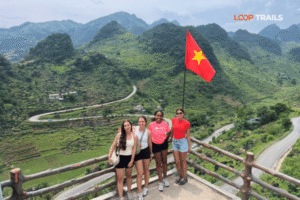

Thúy Kiều (Grace) is a travel blogger and content contributor for Loop Trails Tours Ha Giang. She holds a bachelor’s degree in Sustainable Tourism from Vietnam National University, Hanoi, and has a strong passion for exploring and promoting responsible travel experiences in Vietnam’s northern highlands.

Most people come to Ha Giang for the scenery. The karst peaks, the Nho Que River bending green through Tu San Canyon, the way the road climbs Ma Pi Leng Pass and makes your stomach drop in the best possible way. All of that is real, and worth every kilometer.
But somewhere between the second homestay dinner and your third cup of corn wine, something shifts. You realise the food has been just as memorable as the views. The smoked buffalo hanging above the kitchen fire. The sour cold noodles at a tiny stall in Dong Van. The clay pot of thang co you almost didn’t order at the Sunday market because you weren’t sure what was in it.
This ha giang food guide covers 15 dishes that are genuinely worth seeking out on the loop, plus where to find them, what to expect, and how your tour type affects what ends up on your plate.
Ha Giang sits at the top of northern Vietnam, bordered by China to the north and Yunnan province to the west. The altitude, the climate, and the mix of ethnic minority communities living here for centuries have all shaped a food culture that has almost nothing to do with what you’d eat in Hanoi or Saigon.
The dominant groups in the region, particularly on the Dong Van Karst Plateau, are the H’Mong, Tay, Lo Lo, Dao, and Nung peoples. Each community brings its own cooking methods, its own staple crops, and its own relationship with fire, fermentation, and the mountain landscape.
Corn is the foundation of everything. Rice grows in the valleys, but at high altitude, where rice won’t thrive, corn takes over. You’ll see it drying on rooftops, ground into flour, steamed into cakes, and distilled into the corn wine that appears at every homestay dinner.
Protein comes from mountain streams, raised livestock, and preservation methods that have been used for generations: smoking, fermenting, salting, and drying. A piece of smoked buffalo from above the kitchen fire tastes nothing like anything you can buy at a supermarket, and that’s entirely the point.
Most of what appears in this guide won’t appear on a restaurant menu in the Western sense. You find it at Sunday markets, in homestay kitchens, at small stalls that open at sunrise and close when the food runs out. That’s not a problem. It’s the whole experience.
| Dish | Type | Best Found At | Notes |
|---|---|---|---|
| Thang Co | Stew | Sunday markets | Acquired taste, try it once |
| Men Men | Steamed corn | Homestays | Filling, earthy, H’Mong staple |
| Thit Trau Gac Bep | Smoked meat | Homestay dinners | Intense flavor, dry texture |
| Thit Lon Cap Nach | Grilled pork | Sunday markets | Fatty, smoky, outstanding |
| Ca Suoi Nuong | Grilled fish | Du Gia, riverside stalls | Light and fresh |
| Pho Vit Ha Giang | Duck noodle soup | Ha Giang city, mornings | Morning only, worth the early start |
| Pho Chua | Cold sour noodles | Dong Van, Tay areas | Unusual and addictive |
| Chao Au Tau | Aconite porridge | Dong Van restaurants | Warming, complex, order carefully |
| Banh Cuon | Rice rolls | Morning stalls | Light breakfast option |
| Banh Tam Giac Mach | Buckwheat cake | Markets and roadside | Earthy, slightly sweet |
| Xoi Ngu Sac | Five Color Sticky Rice | Markets, homestays | Visual and delicious |
| Mang Chua | Fermented bamboo | Homestay tables | Sour side dish |
| Ruou Ngo | Corn wine | Every homestay dinner | The happy water |
| Mat Ong Rung | Mountain honey | Markets, roadside | Bring a jar home |
| Xoi Nep Nuong | Bamboo rice | Roadside stalls, markets | Perfect road snack |
If you’re going to eat one thing in Ha Giang that makes you feel like you’ve actually arrived somewhere different, thang co is it.
It’s a H’Mong dish with centuries of history, made from horse meat and offal (including organs and bones) slow cooked in a clay pot with local spices, star anise, cardamom, and the kind of aromatics you can’t quite identify. The pot sits bubbling over a wood fire at the market, filling the whole area with a rich, slightly funky, deeply savory smell.
The flavor is intense. There’s gaminess from the horse meat, depth from the bone broth, and a spice balance that sits somewhere between a Vietnamese pho and a Yunnan stew. For many travelers, the first bite is a moment of recalibration. For many locals, it’s what Sunday morning has smelled like their entire lives.
Where to find it: Meo Vac Sunday Market is the best known source, drawing H’Mong vendors from surrounding villages every Sunday. Dong Van also has a Sunday market. Arrive early. The best thang co tends to run out before noon.
Tips: Don’t ask too many questions before you try it. Order a bowl, find a low plastic stool, and eat it with the corn wine the vendor will almost certainly offer you.
Men men is the H’Mong staple, and once you understand that, it makes sense everywhere you see it. It’s made from corn ground to a coarse flour and steamed until it forms a crumbly, slightly dry mass that holds its shape when pressed. The texture is nothing like the corn you know from a summer barbecue. It’s dense, earthy, and filling in a way that suggests it was designed to sustain people doing serious physical work in cold mountain air. Because it was.
You’ll most likely encounter men men at homestay meals, where it might appear alongside smoked buffalo, pickled vegetables, and whatever the household had to hand. It’s not the most exciting thing on the table, but eating it in a H’Mong household with a view of a stone valley is the kind of thing you remember.
Where to find it: Homestay dinners on the loop, particularly in H’Mong villages in the Dong Van and Meo Vac areas.
Walk into almost any H’Mong household and look up. Above the kitchen fire, hanging in the rafters or propped on a shelf just above the smoke, you’ll see dark, hardened pieces of buffalo meat that have been sitting there for weeks, sometimes months.
Thit trau gac bep translates roughly as “buffalo meat hung above the kitchen.” The smoke from daily cooking gradually dries and cures the meat, infusing it with wood smoke and concentrating the flavors until you have something almost like a very intense, very dry cured meat. The texture is tough and the flavor is powerful. It’s not delicate. It doesn’t try to be.
It appears at homestay dinners sliced thin and served alongside rice or men men. You can also find it in markets, sometimes sold in vacuum packs as a souvenir. The market version is never quite as good as eating it in the house where it was made, but it travels well.
Where to find it: Homestay dinners throughout the loop, particularly in H’Mong communities near Dong Van and Meo Vac. Sunday markets carry it too.
Cap nach pigs are small, lean animals raised in the mountains, allowed to forage freely across steep terrain, and fed on corn, grass, and whatever they find. They’re nothing like factory pigs from a city market. The meat is darker, denser, and has more flavor per gram than almost anything else you’ll eat on the loop.
At the Sunday markets, you’ll see them roasted whole over open charcoal fires, the skin blistered and golden. Vendors hack off portions to order, and you eat it on the spot, usually with sticky rice and a bit of dipping salt. The fat is rendered down to almost nothing. The skin shatters. The meat underneath is deeply porky in a way that good pork is supposed to be.
Where to find it: Meo Vac Sunday Market is the prime location. Dong Van market has it too. Some restaurants in Ha Giang city serve it, though the market version is typically better.
Ha Giang’s mountain streams and rivers are cold, clear, and fast moving. The fish that live in them, particularly the stream fish varieties local to the region, have firm flesh and a clean, almost mineral flavor that reflects the water they came from.
Ca suoi nuong, grilled stream fish, is the simplest preparation. The fish are cleaned, stuffed with lemongrass and herbs, skewered or placed on a wire rack, and grilled over charcoal until the skin chars and the flesh just pulls away from the bone. It’s served with fresh herbs, rice paper, and a dipping sauce that cuts through the richness.
The best version you’ll eat on the loop is in Du Gia, the village that ends Day 3 on the 4 day itinerary. Du Gia sits beside a river, and the fishing families there have been cooking stream fish this way for generations. Some homestays cook it for dinner. Look for small roadside stalls near the river too.
Where to find it: Du Gia village, riverside stalls along the Nho Que River, and homestay dinners in valley villages.
Pho vit is not the pho you know from Hanoi. The broth is made from duck, simmered long enough to reach a deep golden color with a richer, slightly gamier base than the more familiar chicken or beef versions. The noodles are typically wider and softer. The duck meat is served on top, falling off the bone, with herbs and chili on the side.
It’s a morning dish. Stalls open around 6am and often sell out by 9. You eat it at a plastic table on a street corner in Ha Giang city, with a glass of hot green tea, and it wakes you up in exactly the way you need before a day on the road.
Where to find it: Ha Giang city, particularly around the central market area and the streets near Tran Phu. Ask your hostel or guide where the current best stall is, because the landscape of small food vendors shifts
Pho chua is a Tay dish that works especially well as a lunchtime option on a warm afternoon on the loop. It combines cold rice noodles, a sour and slightly sweet dressing, sliced pork or cha lua (Vietnamese sausage), fried shallots, peanuts, and whatever pickled vegetables the cook has available.
It’s tangy, textured, and more complex than it looks in the bowl. The sourness comes from vinegar and sometimes a touch of fermented liquid that gives it a funky background note. It’s usually served at room temperature or slightly chilled.
Where to find it: Dong Van Old Town, Yen Minh, and areas with significant Tay community presence. Some restaurants in Ha Giang city serve it. Ask for pho chua at lunchtime.
Chao au tau is probably the most unusual dish on this list, and the one that requires the most trust. It’s a rice porridge made with the root of the aconite plant (Aconitum), which is naturally toxic and must be processed and cooked correctly to be safe to eat. Properly prepared, the porridge has a slightly numbing, warming effect that the locals say is especially valued during cold mountain nights.
The flavor is earthy and herbal, subtly spiced, and the texture is smooth and thick in the way a well cooked congee is. The warming sensation in your chest and throat is real, and it’s oddly pleasant.
It’s a Dong Van specialty, and you should eat it only at established restaurants in the area that have been making it for years. The well known spots in Dong Van serve it safely and well. Don’t try to find it from a random stall you can’t assess.
Where to find it: Dong Van Old Town. Ask your guide or hostel for a recommended spot.
Banh cuon is found across northern Vietnam, but the Ha Giang version has its own character. The rice rolls are thin and slightly translucent, filled with minced pork and wood ear mushrooms, served with fried shallots, fresh herbs, and a bowl of light dipping broth.
In Ha Giang, you’ll often see them made fresh on the spot: a thin layer of rice batter spread over a cloth stretched across a pot of steaming water, filled, rolled, and slid onto a plate in one fluid motion. It’s satisfying to watch and even more satisfying to eat at 7am before the loop begins.
Where to find it: Ha Giang city in the mornings, near the central market. Yen Minh also has decent banh cuon stalls.
The buckwheat flower fields that bloom across the Dong Van Karst Plateau between October and December have made Ha Giang famous in Vietnam, pulling tens of thousands of visitors during peak season. But buckwheat isn’t just a photo backdrop. It’s a food crop, and banh tam giac mach, buckwheat cake, is what gets made from it.
The cakes are dense, slightly sticky, with a faintly earthy, nutty flavor that isn’t sweet in the way a typical cake is. They’re often grilled or toasted on a pan at market stalls, sometimes drizzled with a little local honey or pressed into flat rounds for eating on the go. The buckwheat flavor is distinctive, slightly bitter at the edges, and once you’ve had one, you’ll understand why locals eat them year round, not just during flower season.
Where to find it: Sunday markets at Dong Van and Meo Vac, roadside stalls throughout the plateau, and sometimes at homestays that make their own.
Five Color Sticky Rice looks almost too good to eat. It’s sticky rice tinted in five different natural colors using plant extracts: typically black from gac fruit or ash, red from a local leaf, yellow from turmeric or ginger, green from pandan, and white from the rice itself. The result is a striking pile of naturally colored rice presented in a wooden steamer basket at markets and celebrations.
The flavor is subtly different in each color, though the differences are gentle. The overall character is what good sticky rice always delivers: slightly glutinous, faintly sweet, and satisfying in a way that plain white rice rarely is. It’s a Tay and H’Mong tradition, made for ceremonies and festivals but available at markets throughout the year.
Where to find it: Sunday markets in Dong Van and Meo Vac, some homestays, and local restaurants in Ha Giang city.
Mang chua, fermented sour bamboo shoots, is less of a dish and more of a constant presence on the loop. It appears as a side dish at almost every homestay meal: fibrous, sour, slightly pungent, and intensely flavored in a way that cuts through rich meat dishes and fatty pork.
The bamboo is harvested when young, then fermented in brine for days or weeks depending on the household and the season. Some versions are mild and just slightly tangy. Others are deeply sour and funky in the way a good kimchi is.
It’s an acquired taste, but one that grows on you. By day three of a loop tour, most people are actively reaching for the mang chua before the other dishes.
Where to find it: Homestay dinners throughout the loop. Sunday markets also sell it, often in ceramic jars.
Ruou ngo, corn wine, is the social glue of the Ha Giang Loop. It appears at every homestay dinner, usually in a repurposed plastic bottle or a clay pot, poured into small ceramic cups by whoever is sitting closest to it.
The flavor ranges from clean and faintly sweet to cloudy, strong, and intensely alcoholic, depending on how long it’s been distilled and who made it. The Loop Trails team and most loop guides call it “happy water,” which tells you everything you need to know about its social function.
You don’t have to drink it. Nobody will pressure you. But sitting around a table in a stone house somewhere in the Dong Van plateau, sharing corn wine with a guide, a homestay family, and a handful of travelers from five different countries, is one of those experiences that doesn’t translate into photos.
Where to find it: Every homestay dinner on the loop. Markets also sell bottles. Alcohol content varies significantly, so if you’re riding the next morning, pace yourself.
Ha Giang’s forests produce some of the best wild honey in northern Vietnam. The bees forage across high altitude meadows, buckwheat fields, and old growth forest, and the result is a honey with a complex, slightly dark flavor that is nothing like the mild supermarket variety.
You’ll see it for sale at Sunday markets, sometimes in rough ceramic pots, sometimes in recycled glass jars. Some sellers carry the entire comb section. The color ranges from amber to almost black depending on the source flowers.
It’s genuinely good, and it’s a practical souvenir because it travels well and doesn’t weigh much. A jar bought at Dong Van or Meo Vac market will remind you of the loop every morning for weeks after you get home.
Where to find it: Sunday markets at Dong Van and Meo Vac, roadside stalls near Lung Cu and Quan Ba, and sometimes at homestays that keep bees.
Xoi nep nuong is sticky rice packed into a section of fresh green bamboo, sealed with banana leaf, and roasted over an open fire until the outside chars and the rice inside steams in the bamboo’s own moisture. When the bamboo is split open, the rice comes away slightly smoky, slightly fragrant from the cane, and with a gentle sweetness from the natural sugars in the bamboo.
It’s a roadside and market snack more than a full meal. You’ll see it at stalls near busy viewpoints and market entrances, sold wrapped in a strip of banana leaf. Eat it while it’s still warm. The smoke and bamboo fragrance fade quickly once it cools.
Where to find it: Sunday markets, roadside stalls near Heaven Gate (Quan Ba), viewpoint pullouts along the loop, and occasionally at homestays that cook them for breakfast.
Planning the loop and not sure which tour is right for you? Loop Trails runs Ha Giang Loop tours in 2, 3, and 4 day formats by motorbike (easy rider and self drive) and by Jeep Wrangler Rubicon. Every tour includes homestay dinners with local food included. See our tour page to compare options, or send us a WhatsApp message with your travel dates and we’ll help you choose.
The food landscape on the loop breaks down by location, and knowing roughly where to look saves time and stomach space.
Ha Giang city: The gateway. Good for pho vit in the morning, banh cuon from street stalls, and stocking up before the loop begins. The city has proper restaurants, small local spots, and the kind of convenience stores where you can grab snacks for the road.
Yen Minh: A midpoint town on Day 1 with lunch options that include pho chua and com binh dan (Vietnamese set meals). Less spectacular than the more remote markets, but reliable and worth a stop.
Dong Van Old Town: The best place for actual sit down meals with local character. Chao au tau is the signature dish here. The old town has a handful of restaurants and small family kitchens that cater to travelers without losing the local quality. Pho chua is also widely available. The Saturday market is worth exploring for street snacks.
Meo Vac Sunday Market: This is the food highlight of the entire loop for many travelers. If your itinerary passes through on a Sunday, plan to arrive hungry and stay for at least an hour. Thang co, thit lon cap nach, banh tam giac mach, mat ong rung, and Five Color Sticky Rice all appear here from vendors who have been coming to this market for decades.
Du Gia: The valley village that closes Day 3 on the 4 day tour. Quieter than Dong Van, very local, and the source of the best stream fish meals on the loop. The homestay dinners here tend to be particularly good.
Homestay kitchens everywhere: The single best food experience on the loop is not at a restaurant or a market. It’s the dinner your homestay family prepares in the early evening, with smoked buffalo, fermented bamboo, rice, corn wine, and whatever else is in the pantry. This is where the real cooking happens, and it’s the kind of meal that stays with you.
Sunday markets in the Dong Van Karst Plateau region are not tourist markets. They’re working markets where H’Mong, Lo Lo, Tay, and other ethnic minority communities come down from their villages to trade livestock, tools, textiles, and food.
The food at these markets is cooked by the vendors for themselves and their neighbors as much as for anyone else. That’s why it’s so good.
The main markets with serious food: Dong Van (Sunday), Meo Vac (Sunday), Khau Vai (Saturday and love market season). The rule is simple: go hungry, go early (before 10am for the best selection), point at things that look good, hold up fingers for how many you want, and pay what you’re asked. Prices at these markets for food are extremely low by any standard. Bargaining at food stalls is not really done.
If your loop tour doesn’t naturally land in Dong Van or Meo Vac on a Sunday, tell your guide. Itineraries often have a degree of flexibility, and most guides understand that the Sunday market is a genuine priority.
On a Loop Trails tour (motorbike or jeep): Meals included are typically breakfast, lunch, and dinner throughout the loop. Lunch stops are at local restaurants along the route chosen by the guide. Dinners at homestays are communal meals prepared by the host family. These are real meals, not tourist versions.
Guides also know where to stop for specific dishes. If you tell your guide you want to try chao au tau in Dong Van or find the best thang co at the Sunday market, that happens. The guide’s local knowledge is, practically speaking, a food concierge service you’d be hard pressed to replicate independently.
Traveling independently or self driving: You have full flexibility but less local knowledge. Sunday markets are easy to navigate, and the food there requires no language skills because you point and they serve. Restaurants in Dong Van Old Town are generally traveler friendly and some have English menus or photos. In smaller villages and roadside stalls, it’s point and eat, which works fine.
Budget for food: independent travelers can eat very well in Ha Giang for under 150,000 VND per meal, often for less. Street snacks and market food are cheaper still. The loop is not expensive to eat on, regardless of how you travel.
The food on the loop gets better the longer you stay, because the most interesting meals happen at homestays on the second and third nights, when you’re deeper into the plateau and further from the tourist trail.
The 4 day 3 night tour is the format that puts you in the right places at the right times: Du Gia on Day 3 for stream fish, Dong Van in the evenings for chao au tau and the old town restaurants, and a genuine chance at the Sunday market if your dates align. This is the tour most travelers who care about food should consider.
The easy rider format puts you with a local guide who can translate, order, and explain what you’re eating. For food specifically, this matters. Your guide will order things you wouldn’t have found yourself, explain the story behind a dish, and tell you whether the thang co at this stall is worth trying or whether the next vendor is better.
The Jeep Wrangler tour is ideal for families, couples, or small groups who want comfort alongside the food experience. You’re not riding a motorbike for eight hours, which means you arrive at meal stops and homestay dinners with more energy and more appetite. The jeep tours include all meals and guide service, and the guides on these tours are the same experienced locals who know where to eat.
If you’re traveling as a couple and want the full food and scenery combination, a private Jeep tour gives you a dedicated guide and the flexibility to spend more time at markets or food stops that genuinely interest you.
For the most immersive food experience with the most local context, the easy rider format wins on depth. For comfort and flexibility, the jeep format wins. Self drive is great if you already know the route and the stops.
Not sure which format suits your group? Contact us on WhatsApp with your travel dates and group size and we’ll match you to the right option.
Yes, for the most part. Homestay meals are prepared fresh and have been served to travelers for years without major issues. For specific dishes like chao au tau (aconite porridge), stick to established restaurants in Dong Van that have a long reputation for preparing it correctly. If you have food allergies, tell your guide before meals
Thang co is a H’Mong slow cooked stew made from horse meat and offal, simmered in a clay pot with spices. It’s one of the most culturally significant dishes in the region, with an intense and gamey flavor that takes some adjustment. Yes, try it: ideally at the Meo Vac Sunday Market where it’s made fresh by H’Mong vendors. Order a small bowl first
Vegetarian eating is possible but requires planning. Men men (steamed corn), banh cuon (rice rolls), Five Color Sticky Rice, mang chua (fermented bamboo shoots), and plain rice with vegetables are all meat free. Homestay meals are typically meat heavy, so if you’re vegetarian, tell your guide in advance. Loop Trails can accommodate vegetarian guests with notice
Happy water is the informal name for ruou ngo, corn wine, which appears at homestay dinners throughout the loop. It’s a locally distilled spirit with an alcohol content that varies by batch. It’s part of the social experience of the homestay and you’re welcome to decline if you prefer not to drink. Just accept the cup, hold it, and enjoy the evening
Corn wine at established homestays on Loop Trails tours is the standard local spirit and is safe to drink in moderate amounts. If you’re riding a motorbike the next morning, pace yourself. Alcohol content is often stronger than it appears
Meo Vac Sunday Market is generally considered the most atmospheric and food rich market on the loop, with the widest range of traditional dishes including thang co, thit lon cap nach, and various sticky rice preparations. Dong Van also has a Sunday market. Both are worth attending if your dates align
Yes. All Loop Trails tours include breakfast, lunch, and dinner throughout the loop. Meals at homestays are communal and prepared by the host family. Lunches are at local restaurants along the route. The food is part of the experience, not an add on
Just leave it on the plate. Vietnamese hospitality doesn’t require you to finish everything, and homestay hosts who regularly receive travelers understand dietary differences. If you have a specific allergy or strong aversion, let your guide know before the meal so they can communicate with the host family
Yes. Mountain honey (mat ong rung), dried bamboo shoots, smoked buffalo in vacuum packs, and corn wine in bottles all travel reasonably well. Check your country’s import regulations for food products before packing. Honey and dried goods are typically fine. Alcohol and meat products may have restrictions
The Sunday markets run year round, but the experience is richest during cooler months (October to March) when the markets are most lively and the smoked and preserved meats are at their best. The buckwheat flower season (October to December) also coincides with buckwheat cake being freshest at the markets. That said, the food on the loop is good in any season
Contact information for Loop Trails
Website: Loop Trails Official Website
Email: looptrailshostel@gmail.com
Hotline & WhatSapp:
+84862379288
+84938988593
Social Media:
Facebook: Loop Trails Tours Ha Giang
Instagram: Loop Trails Tours Ha Giang
TikTok: Loop Trails
Office Address: 54A Tran Phu, Ha Giang 2, Tuyen Quang
Address: 54A Tran Phu, Ha Giang 2, Tuyen Quang
Facebook X Reddit Table of Contents Learn more: Ha Giang Loop Tours Stand on the road between Trung Khanh and Phục Hòa
Facebook X Reddit Table of Contents Learn more: Ha Giang Loop Tours You’re traveling with three friends. Or maybe it’s four of