

Thúy Kiều (Grace) is a travel blogger and content contributor for Loop Trails Tours Ha Giang. She holds a bachelor’s degree in Sustainable Tourism from Vietnam National University, Hanoi, and has a strong passion for exploring and promoting responsible travel experiences in Vietnam’s northern highlands.
Learn more: Ha Giang Loop Tours
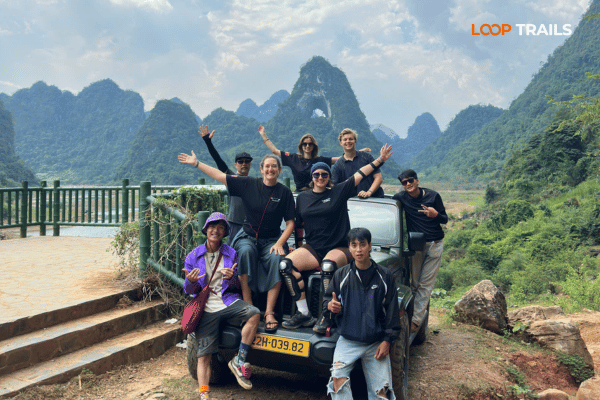
Stand on the road between Trung Khanh and Phục Hòa in Cao Bang province and look up at the right moment. There it is: a mountain with a nearly perfect circular opening near its summit, framing the sky like a lens aimed at the heavens. That is God’s Eye Mountain (Núi Mắt Thần), one of the most visually singular landmarks in northeastern Vietnam, and a spot that stops travelers the first time they see it.
Most visitors come to Cao Bang for Ban Gioc Waterfall and Nguom Ngao Cave, which is completely fair. Those two are spectacular. But God’s Eye Mountain in Cao Bang ends up in every photo album from this province, often because it is impossible not to photograph. The natural rock arch framing the sky is genuinely striking, and the setting, surrounded by limestone karst peaks and terraced paddies, makes the composition even stronger.
This guide covers what God’s Eye Mountain actually is, exactly where it sits, how to get there from different directions, when to visit for the best experience, and how to build it into a tour that makes the most of Cao Bang province.
Learn more: Ha Giang Loop 2 Days 1 Night
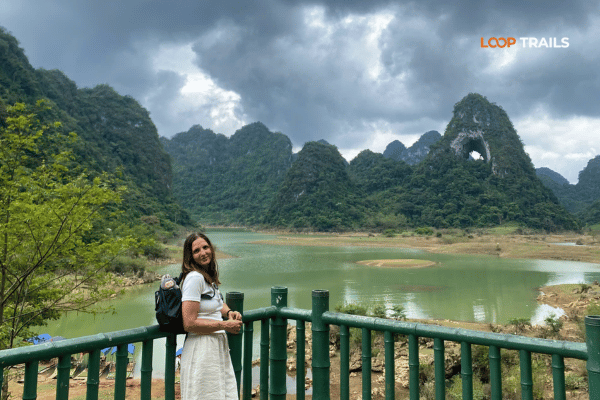
God’s Eye Mountain is a karst limestone peak in Cao Bang province, notable for a large natural circular opening near its summit. Viewed from below or from the road, the hole frames the sky in a nearly complete circle, creating the arresting visual that gave the mountain its name. In Vietnamese, it is called Núi Mắt Thần: Mountain of the God’s Eye.
The formation is entirely geological in origin. Millennia of erosion, water infiltration through porous limestone, and gradual structural shifts in the karst rock created the opening over time. Similar formations exist in scattered locations across Southeast Asia, but this one stands out for the size of the opening, the clarity of the circle, and the dramatic framing provided by the surrounding ridge.
Local Tày and Nùng communities have lived around this mountain for generations. The eye shape carries spiritual resonance in local tradition: the opening is sometimes read as a celestial window, a gaze from above watching over the valley. Whether you engage with the folklore or treat it purely as geology, standing beneath the formation gives most visitors an instinctive sense of scale. It is one of those places that photographs cannot fully capture because the experience is partly physical: the height of the rock, the silence of the valley, the odd perspective of looking up through stone at open sky.
What makes God’s Eye Mountain genuinely interesting from a travel perspective is how little infrastructure surrounds it. There is no entrance gate, no queue, no guided tour script. You arrive, you look up, you walk toward it, and you experience it on its own terms.
Learn more: Ha Giang Loop 3 Days 2 Nights
God’s Eye Mountain sits in Cao Bang province in northeastern Vietnam, in the area accessible from the Trung Khanh and Phục Hòa districts. It falls naturally on the circuit that connects Ban Gioc Waterfall and Nguom Ngao Cave, making it a convenient stop whether you are approaching from Cao Bang city or returning from the waterfall zone.
Most tour routes approach from Cao Bang city or from the Trung Khanh area. If you are already visiting Ban Gioc Waterfall (roughly 90 kilometers northeast of Cao Bang city), God’s Eye Mountain lies along or near the return route depending on the road your guide takes. The two landmarks pair well within a single day.
Getting here independently requires navigation on rural Cao Bang roads. Most roads in this area are paved but narrow, and directional signage for individual attractions is limited. A guide or a downloaded offline map with the Vietnamese place name (Núi Mắt Thần) is genuinely useful here. The mountain is visible enough from the road that a knowledgeable local can point it out, but without prior knowledge it is easy to drive past the best viewing spot
Learn more: Ha Giang Loop 4 Days 3 Nights
Cao Bang province rewards motorbike travelers. The roads around Trung Khanh and Phục Hòa are scenic, paved for most of the route, and manageable for riders with intermediate experience. On a self drive tour, God’s Eye Mountain is reachable by following the road between Cao Bang city and Trung Khanh district. The mountain is visible from the road at the right distance, though knowing exactly where to stop for the best angle makes a real difference.
Road conditions vary by season. The dry season, roughly October through April, offers the most reliable road surfaces. After heavy rain, some rural roads in Cao Bang can develop loose sections or become slippery on inclines. Check local conditions with your hostel or tour operator before heading out independently.
If you plan to ride a rented motorbike in Vietnam, ensure your documentation is in order before departure. You will need a valid home license, a passport, and an International Driving Permit in the 1968 format. The 1949 format IDP is not valid for riding in Vietnam. Riding without the correct documentation risks fines. Regulations and fine amounts can change: confirm the current requirements with your rental provider before your trip.
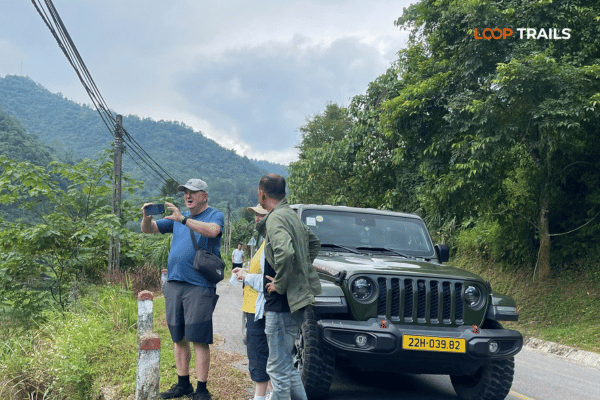
For groups of two or more, a jeep tour handles all navigation and places you at God’s Eye Mountain as part of a planned route. Loop Trails uses the Jeep Wrangler Rubicon for tours in the Ha Giang Cao Bang region: high clearance, air conditioning, and enough space for four adults plus luggage. Your driver knows the roads, the parking points, and the best viewing angles, so you can focus entirely on being present.
Traveling by jeep also makes the border area permit process seamless. Your operator files the permit in advance, so you do not need to manage paperwork independently at a checkpoint.
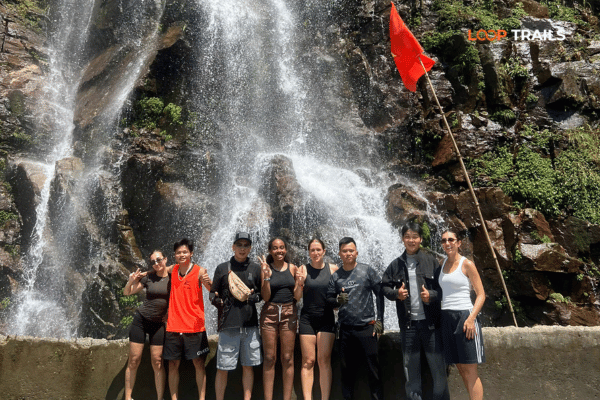
An easy rider guide rides alongside you on a separate motorbike, handling directions and local context while you follow on your own bike, or ride pillion if you prefer not to drive. For God’s Eye Mountain, easy rider tours typically pause long enough for photographs and a short walk toward the viewpoint before continuing to the next stop on the day’s route.
Thinking about Cao Bang? God’s Eye Mountain is one stop on a province full of extraordinary landscapes. Loop Trails’ Ha Giang Cao Bang combined tour builds a full circuit around the region’s best highlights, including Ban Gioc Waterfall, Nguom Ngao Cave, and Phia Thap village. See the full itinerary and pricing on the Ha Giang Cao Bang Tour page.
Learn more: Ha Giang Motorbike Rental
God’s Eye Mountain is not a formal tourist attraction. There is no ticket gate, no queue, and no organized visitor infrastructure at the site itself. You arrive at a stopping point near the base, walk a short distance across uneven terrain, and look up.
The main experience is visual: the circular opening in the rock, framed against the sky. Blue sky with light clouds is the ideal photography condition. Overcast days produce softer, more diffused light that is actually flattering for wide landscape shots, even if the sky color does not cooperate for dramatic images. The mountain itself photographs well under almost any sky because the contrast between the dark rock face and the pale opening holds regardless of weather.
For visitors who want to get closer, a path leads toward the base of the mountain. The ground is uneven limestone: sturdy closed shoes or trail shoes are more practical than sandals if you intend to walk beyond the road viewpoint. The climb into the opening itself is not a standard tourist path. Check with your guide or ask locally before attempting to go higher than the established viewpoint area.
God’s Eye Mountain works best as part of a half day or full day circuit in the Trung Khanh and Phục Hòa area, combined with other stops. Driving specifically to this location as a sole destination is not the right approach: the mountain is a highlight within a route, not a standalone day trip target. Within a well paced Cao Bang itinerary, it takes 20 to 45 minutes and leaves a stronger impression than the time suggests.
Learn more: Ha Giang Cao Bang 6 Days 5 Nights
Dry season (October through April) is the most reliable window. Clear skies, stable roads, and lower humidity make for the best photographs and the most comfortable travel. The light in early morning is particularly good: the sun comes up behind the eastern ridge and illuminates the rock face in a way that gives definition to the circular opening. If your schedule allows, arriving before 9 a.m. is worth the earlier start.
Rainy season (May through September) brings a different version of Cao Bang entirely. The countryside is intensely green, mist drifts over the karst peaks, and the atmospheric conditions can produce genuinely beautiful photography. The tradeoff is wet roads, lower cloud cover that sometimes obscures mountain features, and occasional flooding on rural roads in the lower sections of the province. God’s Eye Mountain is still visible through the rain, but the visual impact softens and the approach roads become less predictable.
October and November are arguably the best months across the broader Ha Giang and Cao Bang region. The rice harvest adds gold terracing to the mountain scenery, temperatures are comfortable for outdoor activity, and Cao Bang is genuinely less crowded than Ha Giang at any time of year. International visitor numbers in Cao Bang remain modest compared to the Ha Giang Loop, which means the experience of driving through Trung Khanh and stopping at a site like God’s Eye Mountain retains a quality that more visited destinations have lost.
Whatever season you choose, plan for the reality that rural northern Vietnam requires flexibility. Checking road conditions, weather forecasts, and any local advisories before setting out independently is straightforward: your hostel, your tour operator, or a five minute conversation with someone who has just come from the area will give you a more accurate picture than any forecast alone.
Learn more: Cao Bang Loop 3 Days best kept secret
God’s Eye Mountain appears on Loop Trails’ Ha Giang Cao Bang 5D4N itinerary on the final active touring day, after leaving Ban Gioc Waterfall and heading back toward Cao Bang city. It sits naturally at the end of a day that also includes Nguom Ngao Cave, Con Nuoc Song Quay Son, Phục Sen paper factory village, and Phia Thap incense village.
Here is how that day typically flows on the 5D4N itinerary:
That sequence places God’s Eye Mountain at the end of the afternoon, which works well for photography because the light angle in the late afternoon illuminates the rock face from a favorable direction. You are not rushed at this point in the day: the earlier stops have covered the heavier sightseeing, and the drive from Phia Thap to God’s Eye Mountain is short.
For travelers who want more time at each stop, the 6D5N version of the Ha Giang Cao Bang tour builds in additional flexibility and allows for spontaneous detours without the group feeling hurried. If Cao Bang is your main interest and you do not want to combine it with Ha Giang, the standalone Cao Bang Loop 3D2N tour covers the province’s major highlights including Ban Gioc, Nguom Ngao, and God’s Eye Mountain as a focused circuit.
Learn more: Nguom Ngao Cave
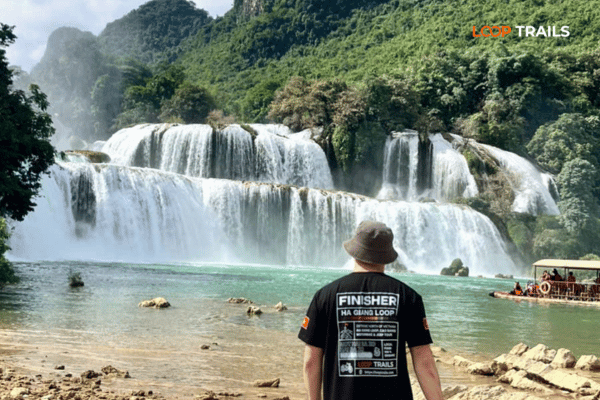
Ban Gioc is one of the largest waterfalls in Asia and the signature attraction of Cao Bang province. It sits on the border between Vietnam and China, and the scale of the falls, particularly during high water months, is impressive by any standard. God’s Eye Mountain is within the same district and pairs naturally with a Ban Gioc visit on a single well planned itinerary day. Most guides include both without rushing either.
Learn more: Ban Gioc Waterfall Guide
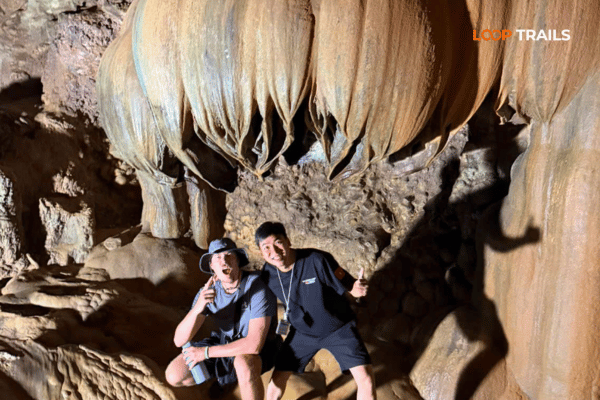
Nguom Ngao is a cave system of considerable scale: wide chambers, dramatic stalactite and stalagmite formations, and theatrical lighting that makes the geology feel almost cinematic. It is consistently described as the most impressive cave in Cao Bang and one of the better cave experiences in northern Vietnam. A visit takes roughly 45 minutes to an hour and pairs naturally with God’s Eye Mountain and Ban Gioc on the same circuit.
Phia Thap is a Nùng village where incense has been produced by hand for generations. A stop here is typically 30 to 45 minutes: enough time to see the production process, observe the bundles of incense drying in village yards, and buy a pack to carry home. It is one of the most photogenic village stops in Cao Bang and adds cultural texture to a day that otherwise focuses on natural landscape.
Pac Bo sits in Ha Quang district and is where Ho Chi Minh lived and worked in the early 1940s after returning to Vietnam. It is a historically significant site with genuine weight to it, not a generic museum stop. On the Ha Giang Cao Bang combined tour, Pac Bo falls on Day 3 rather than the same day as God’s Eye Mountain, but it is part of the broader Cao Bang circuit and gives the province a historical dimension that goes beyond scenery.
Planning a Cao Bang trip? Loop Trails runs private jeep tours and guided motorbike tours that cover all the highlights above in a single well paced circuit. Send a message on WhatsApp to ask about dates, group sizes, and customization options.
Learn more: Ha Giang Loop Easy Rider
God’s Eye Mountain is accessible on all three of Loop Trails’ Cao Bang tour formats. The right choice depends on your group, your experience level, and how much you want to handle logistics on your own.
Jeep tour (private vehicle with driver and guide): Best for couples, families, or groups of two to four who want a comfortable, fully managed experience. Everything is arranged: the driving, permits, pacing, and local knowledge. You experience the landscape without navigating it. God’s Eye Mountain gets the time it deserves, the photo stop is handled, and you arrive in Cao Bang city without any of the logistical friction of independent travel.
Easy rider tour (guided motorbike experience): Best for travelers who want the road feel and direct connection to the landscape that a motorbike provides, without the pressure of navigating unfamiliar roads alone. Your guide rides ahead or alongside, stops at the right points, and provides context for what you are seeing. This format is popular with solo travelers and those who want a personal guide experience.
Self drive tour (your own motorbike with guide support): Best for experienced riders who are confident on mountain roads and have the correct license documentation. You set your own pace and can stop whenever something catches your eye. God’s Eye Mountain is a natural pull over: visible from the road, easy to approach, and worth an unhurried stop.
| Tour | Easy Rider (per pax) | Self Drive (per pax) | Jeep 1 pax | Jeep 2 pax | Jeep 3 pax | Jeep 4 pax |
|---|---|---|---|---|---|---|
| Ha Giang Cao Bang 5D4N | 10,990,000 VND | 10,590,000 VND | 32,990,000 VND | 40,990,000 VND | 46,990,000 VND | 54,990,000 VND |
| Ha Giang Cao Bang 6D5N | 13,990,000 VND | 13,490,000 VND | 37,990,000 VND | 46,990,000 VND | 54,990,000 VND | 63,990,000 VND |
| Cao Bang Loop 3D2N | 6,490,000 VND | 5,990,000 VND | 14,990,000 VND | 19,990,000 VND | 24,990,000 VND | 31,990,000 VND |
Prices include accommodation in shared dormitory, all meals on tour days, guide and driver fees, and entrance fees for included attractions. The border area permit for foreign visitors costs an additional 260,000 VND per person and is required for the Phục Hòa and Trung Khanh areas near the Chinese border. Prices do not include round trip bus transportation from Hanoi, Ha Long, Ninh Binh, or Sapa, and do not include room upgrades from dormitory to private room. Bus options include VIP sleeper, cabin sleeper, and limousine bus: ask when booking.
For groups of three or four travelers, jeep tours often work out to a comparable cost per person versus motorbike tours, with the added benefit of a private enclosed vehicle, luggage storage, and zero navigation responsibility
Learn more: Ha Giang Cao Bang Packing List
Footwear: Bring closed shoes or trail shoes. The approach from the road to the viewpoint involves uneven limestone ground. Sandals are fine for a quick roadside look, but less practical if you want to walk closer to the mountain base.
Camera setup: A wide angle lens or the wide mode on your phone captures both the circular formation and the surrounding karst landscape. Shooting the opening with the sky cleanly framed works best from below and slightly back from the base. Morning light (before 9 a.m.) or late afternoon light (after 3 p.m.) gives the rock better definition than midday sun.
Timing within the day: Late afternoon, roughly 3 to 5 p.m., tends to be when the light falls well on the mountain face. If you have flexibility in your itinerary, this window is worth targeting.
Water and snacks: There are no permanent vendors at the mountain itself. Carry water, particularly if you are visiting between April and September when temperatures are warmer. Your guide or driver will know the nearest food stop.
Respectful behavior: God’s Eye Mountain sits within a landscape that is home to Tày and Nùng communities. Keep noise at a reasonable level, take your waste with you, and avoid marking or disturbing the rock surface. The places that remain accessible and uncrowded over time tend to be the ones that travelers have treated with care.
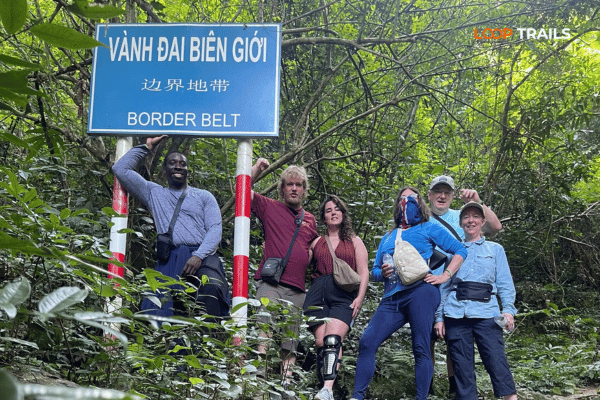
Border area permit: The broader Trung Khanh and Phục Hòa area, where God’s Eye Mountain and Ban Gioc are located, falls within the border zone adjacent to China. Foreign visitors require a border area permit to travel here. This is a standard administrative requirement rather than a complication: Loop Trails handles the permit as part of tour booking. The fee is 260,000 VND per person. Independent travelers should confirm the permit requirement and the process for obtaining it with their hostel or a local tour operator before heading out. Requirements and processing details can change: always check current rules before your trip.
What to wear: Lightweight breathable clothing works for most of the year. From November through February, Cao Bang mornings can be genuinely cold, particularly at elevation. A layer and a light jacket are worth packing regardless of season.
Ready to add God’s Eye Mountain to your Cao Bang itinerary? Loop Trails runs scheduled and private tours that cover Cao Bang’s full circuit, from Ban Gioc Waterfall and Nguom Ngao Cave to Phia Thap village and God’s Eye Mountain. See the Cao Bang Loop Tour page or the Ha Giang Cao Bang Combined Tour page for full itineraries and dates.
Learn more: Pac Bo Historical Site
Most international travelers arrive in Cao Bang either from Hanoi by overnight bus or from Ha Giang after completing the Ha Giang Loop.
From Hanoi, sleeper buses run directly to Cao Bang city with several service classes: VIP sleeper, cabin sleeper, and limousine bus. Journey times vary by departure time and road conditions: check current schedules when booking. The overnight bus is the standard approach, arriving in Cao Bang early morning with the full day available for touring.
From Ha Giang, the Ha Giang Cao Bang combined tour format is the most logical choice for international travelers who want to see both regions. You complete the Ha Giang Loop first, covering the Dong Van Karst Plateau, Ma Pi Leng Pass, Nho Que River, and Du Gia, then continue northeast into Cao Bang without returning to Hanoi. The 5D4N and 6D5N combined tour formats from Loop Trails follow this route, ending the tour in Cao Bang city with onward bus options to Hanoi, Ha Long, and other destinations.
If you are beginning specifically in Cao Bang and do not want to combine it with Ha Giang, the standalone Cao Bang Loop 3D2N tour is a focused option that covers the province’s main highlights in three days: Ban Gioc Waterfall, Nguom Ngao Cave, Phia Thap village, and God’s Eye Mountain, among other stops.
From Cao Bang city at the end of a tour, onward bus connections go to Hanoi, Ha Long, Ninh Binh, and Sapa. Ask your operator to help arrange the bus when booking your tour.
Learn more: Ha Giang Loop by Wrangler Rubicon Jeep
God’s Eye Mountain (Núi Mắt Thần) is a natural limestone formation in Cao Bang province with a large circular hole near its summit. When viewed from below, the opening frames the sky in a nearly complete circle, resembling an eye. It is one of the most photographed geological features in northeastern Vietnam and a regular stop on Cao Bang tour circuits
Yes, with appropriate expectations. The mountain is a striking stop that takes 20 to 45 minutes and photographs extremely well. It works best as part of a broader Cao Bang circuit alongside Ban Gioc Waterfall and Nguom Ngao Cave, rather than as a standalone destination. Most travelers who include it in their itinerary consider it one of the more memorable visual stops in the region
Most visitors spend 20 to 45 minutes at the site: time to approach the viewpoint on foot, take photographs, and absorb the landscape. On a guided tour, your guide will pace this stop according to the rest of the day’s schedule and the group’s preferences
There is no fixed entrance fee as of recent reports. However, fees and access arrangements at natural sites in Vietnam can change over time. Confirm with your tour operator or check locally before arriving
Yes, if you are comfortable on rural Cao Bang roads and have the correct license documentation for motorbike riding. The main practical challenge is finding the precise location without on the ground navigation knowledge: download an offline map with the Vietnamese name Núi Mắt Thần before you go. Many independent travelers find that a local guide makes the Cao Bang circuit significantly more efficient, both for navigation and for understanding the cultural and geological context of what they are seeing
October through April (dry season) offers the most reliable weather, clearest skies, and best road conditions. October and November are particularly good months: temperatures are comfortable, the landscape is lush from recent rains, and the rice harvest adds foreground color to mountain photography. Crowd levels in Cao Bang remain relatively low compared to Ha Giang at any time of year.
Yes. God’s Eye Mountain appears on the Ha Giang Cao Bang 5D4N and 6D5N tour itineraries on the final active touring day. It also falls within the area covered by the Cao Bang Loop 3D2N tour. See the relevant tour pages for full day by day itineraries
The Trung Khanh and Phục Hòa area where God’s Eye Mountain is located falls within the border zone adjacent to China. Foreign visitors generally require a border area permit to travel here. The fee is 260,000 VND per person. Loop Trails handles this as part of the tour booking process. Independent travelers should confirm the current requirement and process with their hostel or a local operator before heading out, as regulations can change
Yes, with appropriate footwear. The main viewing area involves a short walk on uneven limestone ground, which is manageable for most ages. A jeep tour makes the logistics simpler for families: private vehicle, flexible pacing, and no motorbike handling required. The site itself has no steep climbing or technical terrain for the standard viewpoint stop
Ban Gioc and Nguom Ngao are larger scale, longer experiences. Ban Gioc is genuinely one of the most impressive waterfalls in Asia. Nguom Ngao is a cave system that takes 45 minutes to an hour to explore. God’s Eye Mountain is a shorter stop but carries a distinct visual impact that the other two do not replicate. The three work well together on the same day or across two days of Cao Bang touring
Contact information for Loop Trails
Website: Loop Trails Official Website
Email: looptrailshostel@gmail.com
Hotline & WhatSapp:
+84862379288
+84938988593
Social Media:
Facebook: Loop Trails Tours Ha Giang
Instagram: Loop Trails Tours Ha Giang
TikTok: Loop Trails
Office Address: 54A Tran Phu, Ha Giang 2, Tuyen Quang
Address: 54A Tran Phu, Ha Giang 2, Tuyen Quang
Facebook X Reddit Table of Contents Learn more: Ha Giang Loop Tours You’re traveling with three friends. Or maybe it’s four of
Facebook X Reddit Table of Contents Most people come to Ha Giang for the scenery. The karst peaks, the Nho Que River