
Ha Giang Airport: Is There One? How to Get There
Facebook X Reddit Table of Contents If you’ve been researching a trip to Ha Giang and typed “Ha Giang airport” into a

Thúy Kiều (Grace) is a travel blogger and content contributor for Loop Trails Tours Ha Giang. She holds a bachelor’s degree in Sustainable Tourism from Vietnam National University, Hanoi, and has a strong passion for exploring and promoting responsible travel experiences in Vietnam’s northern highlands.
Learn more: Ha Giang Loop Tours
The first time you see a group of H’Mông women walking the roadside near Đồng Văn — silver jewellery catching the light, indigo jackets moving against the grey limestone — you understand immediately why people come back to Ha Giang. Not once. Multiple times.
Ha Giang province in Vietnam’s far north isn’t just dramatic scenery. It’s one of the most ethnically diverse places in all of Southeast Asia. Over 20 distinct ethnic groups live here, many in communities that have occupied these mountains for centuries. They speak different languages, dress differently, grow different crops, celebrate different calendars, and have different relationships with the land.
For travelers, this means something rare: the opportunity to observe and — if you travel thoughtfully — genuinely connect with cultures that haven’t been flattened into a tourist product. Not everywhere. Not always. But more than almost anywhere else in Vietnam.
This guide is practical. It covers who the main ethnic groups are, where you’re likely to encounter them, what the markets and festivals look like, how to buy crafts responsibly, and — critically — how not to be the kind of traveler people in these villages will be quietly glad to see leave.
Learn more: Ha Giang Loop Photography
Vietnam has 54 officially recognized ethnic groups. Around 22 of them have significant populations in Ha Giang. That’s not an accident — it’s geography.
Ha Giang sits at Vietnam’s northern edge, bordering China’s Yunnan province. The rugged karst mountains and deep river valleys created natural barriers between communities for centuries. Groups settled in different altitude bands, different valleys, different slopes. Trade networks formed along specific routes. Cultural practices evolved in relative isolation.
The result is a patchwork of distinct communities that can be separated by just a few kilometres of mountain road — but differ enormously in language, dress, ceremony, and tradition.
The Ha Giang Loop route cuts through the heart of this landscape. The Đồng Lộc plateau, the Mèo Vạc market, the Du Già valley, the villages near Lũng Cú — each of these puts you in contact with different ethnic communities. The trick is knowing what you’re seeing, and approaching it with some basic knowledge rather than generic “local tribe” tourism energy.

Learn more: Hmong Culture in Ha Giang
There are six groups you’re most likely to encounter on the main loop route. Here’s a brief, honest introduction to each.
The H’Mông are the most visible ethnic group in Ha Giang — and across northern Vietnam’s high-altitude regions more broadly. They’re not one homogenous group; there are several subgroups distinguished primarily by the colour and style of their clothing:
The H’Mông have lived in Vietnam’s highest elevations for generations, growing corn, raising livestock, and in some areas cultivating opium in the past (now largely replaced by other crops). Their crafts — particularly indigo-dyed textiles and intricate embroidery — are some of the most recognizable in all of Vietnam.
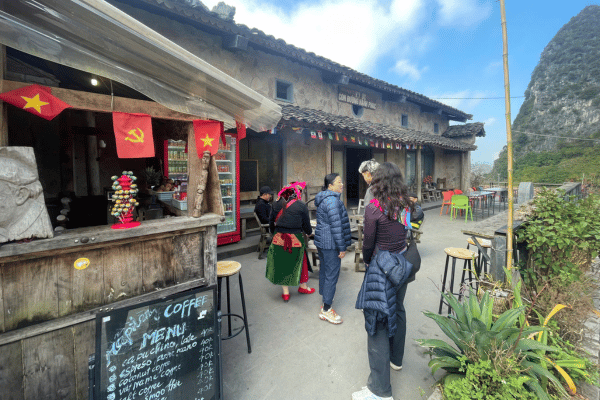
Traditional H’Mông homes are built of rammed earth or stone with heavy wooden beams. In the Đồng Văn area especially, these structures blend naturally into the rocky landscape in a way that looks almost deliberate.
The H’Mông follow both animist traditions and — particularly since the 1980s–90s — significant numbers have converted to Christianity. This shapes village life visibly: you might find small churches next to traditional ceremony houses in the same hamlet.
Learn more: Ha Giang Loop 3 Days 2 Nights
The Tày are one of Vietnam’s largest ethnic minority groups nationally, and they have a strong presence in Ha Giang — particularly in the lower valleys, around Vị Xuyên, Du Già, and the areas between Ha Giang City and Yên Minh.
Tày villages tend to be in more fertile, lower-elevation areas — rice paddies rather than corn terraces. Traditional Tày homes are built on stilts, raised off the ground, with the family living above and storage or animals below. The architecture is elegant and practical.
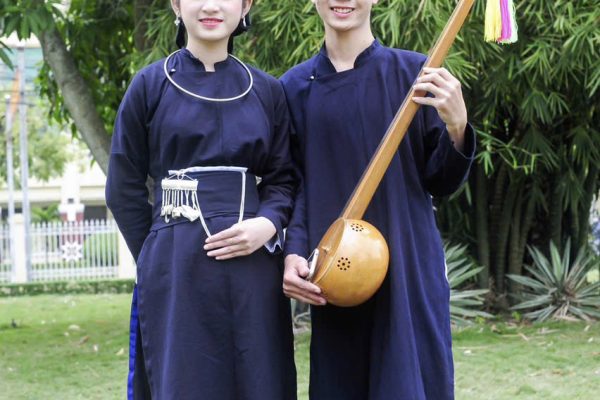
Tày culture has historically been in closer contact with the Kinh (ethnic Vietnamese majority) and with Chinese lowland cultures, so their practices have some overlap with mainstream Vietnamese culture. But their language, textile traditions (particularly brocade weaving), and ceremonial practices remain distinct.
In Ha Giang, Tày communities often run some of the most established community-based tourism operations — the Lung Tam weaving cooperative near Du Già being a well-known example.
Learn more: Ha Giang Cao Bang 5 Days
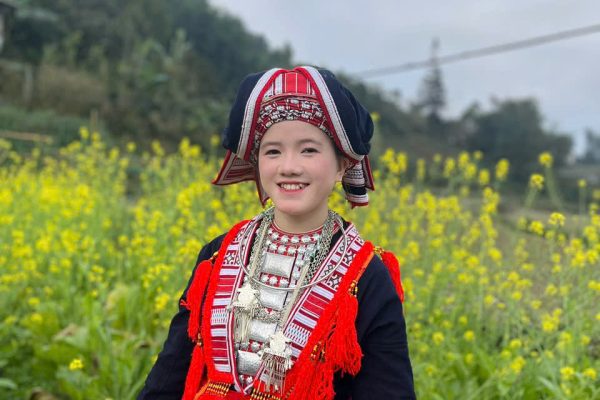
The Dao (pronounced “Zao” in Vietnamese) are immediately recognizable by their headdresses — particularly Dao Đỏ (“Red Dao”) women, who wear striking red turbans or headdresses embroidered in geometric patterns. The red against mountain green or grey rock is something you remember.
In Ha Giang, Dao communities are found across multiple areas — particularly in the forests and mid-elevation zones where they’ve traditionally practised a combination of cultivation and forest management. Dao healing traditions are particularly well-developed; herbal medicine knowledge is passed through generations and Dao herbal baths are now something travelers can experience in several northern Vietnam destinations, though in Ha Giang this is less commercialized.
Dao ceremonies and spiritual practices are tied to an elaborate cosmology — they maintain Taoist-influenced religious texts written in a script called Nôm Dao, and major life events (births, marriages, deaths) involve ceremonies that can last multiple days.
Learn more: Ha Giang Homestay Guide
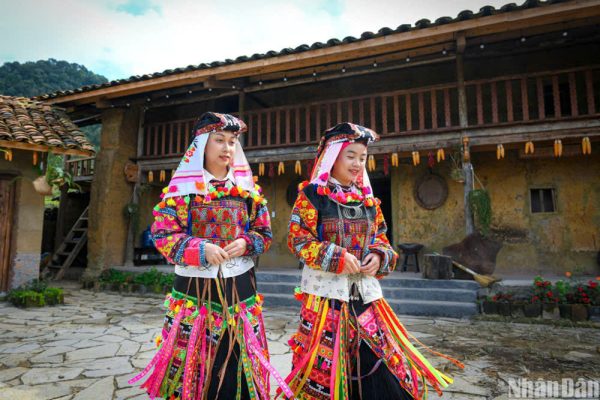
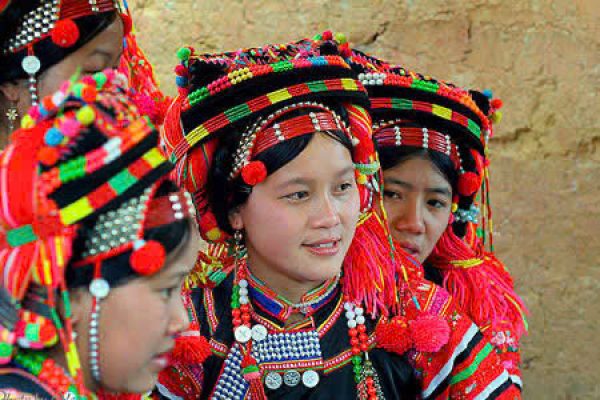
The Lô Lô are one of the smaller ethnic groups in Vietnam — fewer than 5,000 people nationally — with a significant portion of their population concentrated in Ha Giang, particularly around Lũng Cú near Vietnam’s northernmost point.
This makes them worth knowing about specifically if you’re visiting Lũng Cú and the Flag Tower area. Lô Lô villages in this area are some of the most culturally distinct on the entire loop. Their traditional clothing involves vibrant, geometric patchwork embroidery — visually unlike anything else in the region.
Lô Lô communities have their own language (part of the Tibeto-Burman family, linguistically unrelated to Vietnamese), their own ceremonial traditions, and a strong culture of communal bronze drum performances at festivals.
Learn more: Ha Giang Loop 4 Days 3 Nights
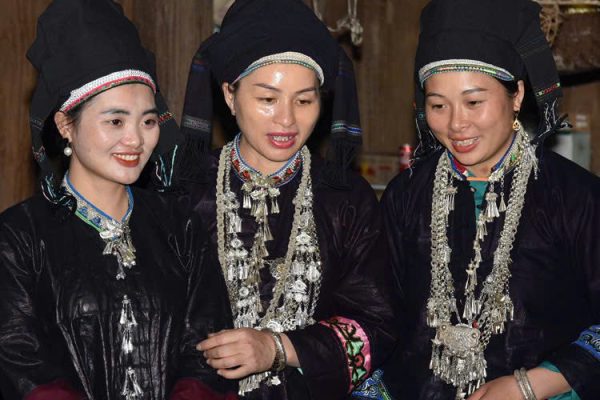
The Giáy (also spelled Giay, sometimes called “Nhang”) are found primarily in the Mèo Vạc area and along the Nho Quế River valley. They’re a smaller group in Ha Giang but worth noting — Mèo Vạc’s famous Sunday market draws significant Giáy participation, and their traditional dress (particularly women’s — floral-patterned jackets in lighter colours compared to H’Mông indigo) helps distinguish them in the market crowd.
Giáy communities tend to live in valley and riverbank settlements, historically relying on paddy cultivation and fishing in the Nho Quế River system.
Learn more: Ha Giang Loop route and itinerary
The Nùng have communities throughout northeastern Vietnam and significant populations in Ha Giang, particularly in the areas bordering Cao Bang province. If you’re traveling a Ha Giang + Cao Bang combined route, you’ll encounter more Nùng communities in Cao Bang itself.
Nùng traditional architecture — particularly the stone-built, tile-roofed houses of some communities — has a distinct visual character. Their brocade weaving tradition uses colours and patterns that differ from both Tày and H’Mông work.
Learn more: Ha Giang Loop for Families & Groups
Here’s a practical map of where the concentrations are:
| Location | Primary Ethnic Groups |
|---|---|
| Ha Giang City surrounds | Tày, Kinh, mixed |
| Vị Xuyên / Thanh Thủy area | Tày, Dao |
| Yên Minh | H’Mông, Tày, mixed market town |
| Đồng Văn plateau & town | Black H’Mông, Lô Lô (in villages), Giáy |
| Lũng Cú area | Lô Lô, H’Mông |
| Mèo Vạc & Sunday market | H’Mông (multiple subgroups), Giáy, Dao |
| Du Già / Lung Tam valley | Flower H’Mông, Tày, Dao |
| Cao Bang (combined route) | Nùng, Tày, Dao, H’Mông |
A few things worth noting about this table: ethnic group presence is not a tourism checklist. These are communities going about their daily lives. The best encounters happen when you’re traveling slowly, with a knowledgeable guide, and approaching with curiosity rather than a camera pointed at someone’s face.
→ A guided Ha Giang Loop tour with a local Easy Rider guide is one of the most effective ways to actually engage with these communities — guides often have family connections or long-term relationships in specific villages. See our Easy Rider and Jeep tour options here.
Learn more: Ha Giang Market Days
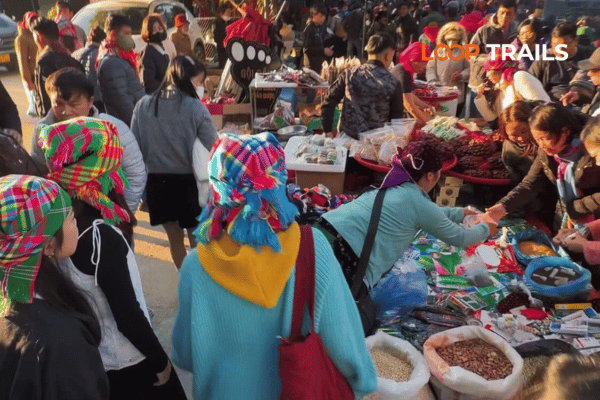
Ha Giang’s ethnic minority markets are one of the genuine highlights of the entire region — and they’re different from the staged “hill tribe markets” you find in some northern Thailand tourist areas. These are working markets: people buying livestock, trading agricultural goods, socializing with people from their own community they might not see for weeks.
The social function matters as much as the commerce. Markets are where young people from different villages meet. Where elders exchange news. Where the week’s livestock trading gets done.
Key markets to know:
A note on etiquette at markets: many travelers treat these like photo opportunities. The people there are primarily not there for your benefit. Buy something. Have something to drink at a stall. Engage with the transaction, not just the camera angle.
Ha Giang’s festival calendar is tied to ethnic minority traditions, lunar calendars, and harvest cycles — which means dates shift year to year. Always verify specific dates with a local source before planning around a festival. That said, some broadly consistent ones:
Khèn (reed pipe) festivals — H’Mông communities hold music and courtship festivals at Tết (Lunar New Year, usually January/February). The khèn — a traditional H’Mông reed instrument — is central, and performances can draw dozens of players simultaneously.
Lồng Tồng (Going to the Field) festival — celebrated by Tày and Nùng communities in the first lunar month of the new year. Involves communal agricultural ceremonies, traditional games, and music.
Lô Lô bronze drum ceremonies — held at major life events and the Lunar New Year in Lô Lô villages around Lũng Cú. Rarely witnessed by travelers outside of organized community visits.
Buckwheat flower season — not a festival exactly, but October–November when the buckwheat blooms turn Ha Giang’s plateau pink and white, H’Mông villages in these areas are at their most visually striking. This is also peak travel season — book accommodation and tours well in advance.
Learn more: Corn wine “Happy Water” in Ha Giang
Ethnic minority food in Ha Giang is genuinely distinct from mainstream Vietnamese cuisine, and trying it properly usually means eating at a homestay or local market stall rather than a tourist-facing restaurant.
Black sticky rice (xôi đen) — made from a locally grown glutinous rice variety, cooked with ash or natural plant dye to achieve its deep colour and nutty flavour. A staple across H’Mông and Tày communities.
Thắng cố — a traditional H’Mông stew, historically made with horse meat and offal, simmered in a large communal pot at markets and festivals. The market stalls at Mèo Vạc serve this. It’s not for the faint-stomached, but it’s one of the most culturally specific foods you can eat in the region.
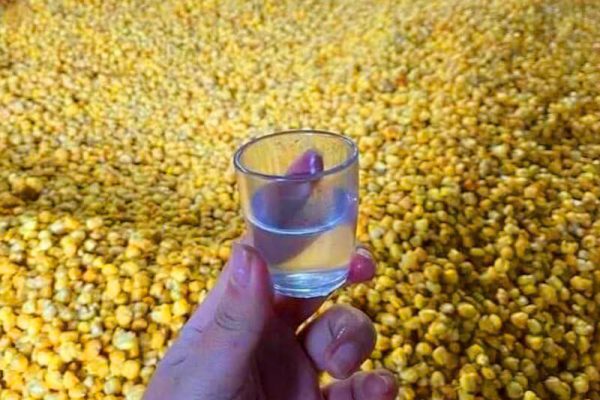
Corn wine (rượu ngô) — distilled from the corn that dominates Ha Giang’s hillside agriculture. Different families make it differently; some versions are smooth, some are firewater. It’s served warm in ceramic cups and is central to H’Mông hospitality — refusing entirely when hosting is happening around you is a cultural signal worth thinking about.
Smoked pork and buffalo — particularly in H’Mông and Dao households, meat is preserved by smoking over the hearth. The flavour is intense and unlike anything you get elsewhere.
Mèn mén — a traditional H’Mông dish of steamed corn flour, coarsely ground. It’s an acquired taste for most travelers — dense, slightly grainy — but it’s the historical staple crop of the high-altitude H’Mông communities who couldn’t grow rice at elevation.
This is where it gets more nuanced, because the craft market in Ha Giang exists on a spectrum from genuinely community-made to mass-produced elsewhere.
What’s worth buying:
What to be skeptical of:
Mass-produced “ethnic” items sold in large tourist-facing shops in Ha Giang City or at popular photo stops often come from wholesale markets in Hà Nội or even China. The batik fabrics in particular — which look H’Mông but are machine-printed — are everywhere. Buying these doesn’t support the communities whose culture they’re visually referencing.
The rule of thumb: if it’s priced like a factory product and sold in volume at a roadside stall catering exclusively to passing tourists, it probably is one. If it’s priced higher, sold by someone who clearly made it, at a village or cooperative — that’s the real thing.
Learn more: Ha Giang Loop for Beginers
This section doesn’t exist to lecture. It exists because Ha Giang’s cultural richness is genuinely fragile — not because communities are passive victims of tourism, but because some forms of tourist behaviour actively erode the dignity and economic independence of local people.
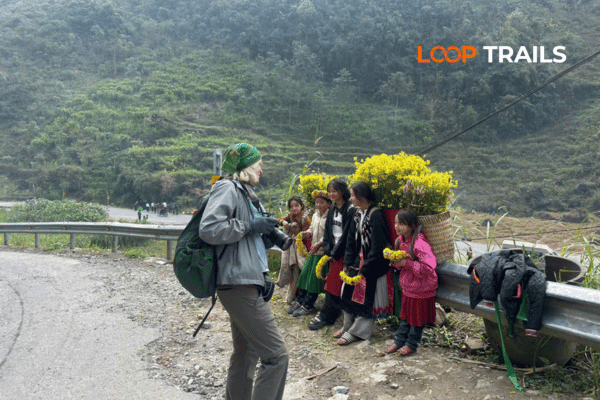
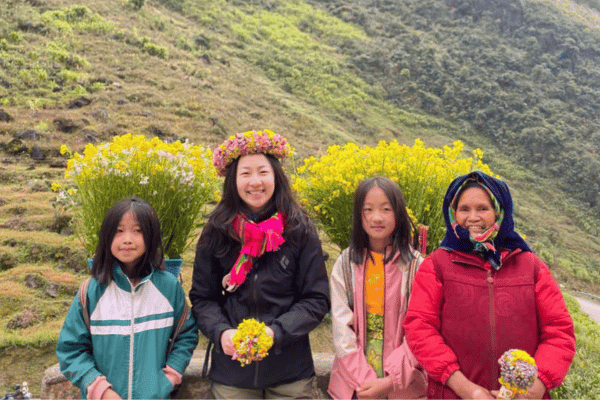
Photography is the biggest one. Ha Giang’s ethnic minority communities — particularly H’Mông women and children — are relentlessly photographed. Some have started charging for photos. Others simply turn away. Many feel they have no choice but to tolerate it. This is not cultural exchange; it’s extraction. The minimum threshold: ask. A gesture, a smile, actual eye contact before pointing a camera. Take no for an answer. Pay if asked.
Children and sweets/money. Travelers who hand out sweets, money, or pens to children at villages are a well-documented problem across Southeast Asian tourism destinations. It creates dependency behaviours, takes children out of school to approach tourist vehicles, and disrupts community dynamics. Don’t do it, even when the intention is kind. If you want to contribute, buy from adult artisans, pay for a homestay, or donate through a verified organization working in the area.
Village visits without a guide or invitation. Walking into a village because it looks photogenic is a thing travelers do. It ranges from fine (in communities accustomed to visitors, where people simply go about their business) to genuinely intrusive (in smaller hamlets where your presence is conspicuous and uninvited). If you’re self-driving and want to explore off the main road, having a local guide significantly changes the dynamic of these encounters.
The “authentic experience” hotel. There’s a growing number of hotels and “cultural experience” businesses in Ha Giang city that package ethnic minority culture as ambiance — staff in costume, decorative crafts, “traditional” performances on command. None of this is the real thing. It’s fine as accommodation; it’s not cultural engagement.
Buy from the source. This comes up again because it matters economically. Buying from the community directly — at markets, cooperatives, homestays — keeps money in villages. Buying from middlemen in the city keeps it out.
Learn more: Ha Giang Jeep Tours
If engaging with Ha Giang’s ethnic minority communities is a priority — not just passing through, but actually understanding something about the people who live here — your choice of how to travel matters.
Easy Rider guided tour: The best option for cultural depth. Your guide is local, often from an ethnic minority background themselves, and has relationships in specific villages across the loop. They speak the languages, know the families, and can navigate encounters that would be awkward or closed off to a solo traveler. You eat at homestays they’ve vetted, visit markets at the right time, and get context in real time.
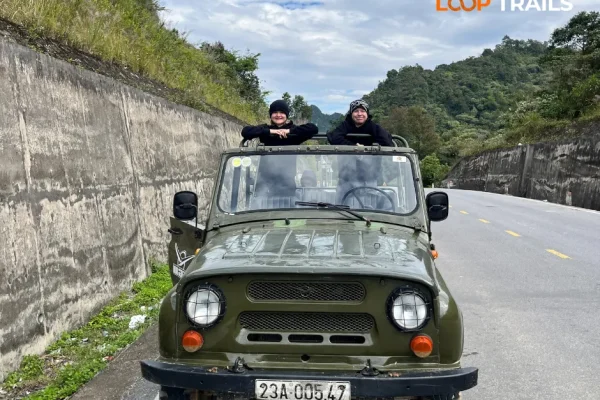
Jeep tour: Excellent for groups and for travelers who want logistical ease without sacrificing the cultural route. A good Jeep guide has the same local knowledge as an Easy Rider guide — the difference is the vehicle, pace, and group dynamic. Jeep tours can also access village roads that aren’t practical on motorbike with luggage.
Self-drive: You get freedom and spontaneity — stopping wherever you want, at whatever pace. The cultural access is more dependent on your own initiative and language skills. You’ll see the same landscape and pass through the same villages; what you won’t have is the translation, context, and warm introductions. Some of the most memorable village encounters happen precisely because a guide made them possible.
None of these is “wrong.” But if you came to Ha Giang specifically for the cultural dimension, a guided tour — Easy Rider in particular — is the option that delivers most reliably.
→ Want to see what an Easy Rider itinerary through ethnic minority country looks like? Check out our Ha Giang Loop tour options. We run small groups, use local guides, and include homestay nights with community families.
Learn more: Ha Giang Loop Solo Travel
Treating ethnic dress as a photo prop. People in traditional clothing are wearing it as part of their daily life — going to market, doing errands, working. It’s not cosplay, and it’s not for your Instagram grid without their knowledge and consent.
Assuming all H’Mông villages are the same. The visual similarity of highland villages on the loop can make it seem like you’re seeing the same thing repeatedly. You’re not. Different hamlets belong to different H’Mông subgroups, different clans, different religious and ceremonial traditions. Ask your guide about the specific community you’re in rather than generalizing.
Expecting English or easy communication. Outside of guesthouses, restaurants, and tourism-facing businesses in the main towns, most ethnic minority villagers speak their own language first, Vietnamese second, and no English at all. This is fine; it’s just reality. A few words of Vietnamese and a lot of patience goes a long way.
Conflating poverty with primitiveness. Ha Giang’s communities are not stuck in the past. They have smartphones, follow social media, have strong opinions about politics and development, send their children to school, and make deliberate choices about how much tourism to integrate into their lives. The “untouched tribe” framing that appears in some travel writing is patronizing and inaccurate.
Visiting only the big market towns and missing the villages. Mèo Vạc and Đồng Văn markets are extraordinary. But the villages between the towns — accessible only by minor roads — are where daily life happens. If you spend all your time at market towns and photo stops, you’re seeing the highlights reel, not the actual cultural landscape.
Buying cheap “ethnic” crafts that fund wholesale traders instead of communities. Covered above — worth repeating because it’s the most common and fixable mistake.
Ha Giang province is home to around 22 of Vietnam’s 54 officially recognized ethnic minority groups. The H’Mông make up the largest ethnic minority population in the province, followed by Tày, Dao, Nùng, and others. The exact figures fluctuate — check current census data for the most accurate breakdown.
The Black H’Mông are the most visible — particularly around the Đồng Văn plateau, Lũng Cú, and Mèo Vạc. Their indigo-dyed clothing and distinctive silver jewellery make them immediately recognizable. You’ll encounter Tày communities more in the lower valley areas near Du Già.
It depends entirely on how you do it. Photographing people without asking — particularly women and children — is widely considered disrespectful. Ask first (a gesture works when language doesn’t), accept refusals, and be prepared to pay a small fee if requested. Landscape and village scene photography is generally less fraught.
For markets and daily village life, any time works. For major H’Mông festivals, visit around Tết (January/February). For the buckwheat flower season and the most vibrant market colours, aim for October–November — but book everything well in advance as this is peak season.
Yes — there are no restrictions on travel to most areas. But culturally sensitive village visits are significantly better with a local guide who has community relationships. If you self-drive, be aware that showing up at a small hamlet unannounced can be intrusive. Stick to market towns and community-facing areas if you’re solo.
Many do, particularly younger generations and those in market towns. In remote villages, especially among older H’Mông community members, the primary language is their own ethnic group language. Some elders speak no Vietnamese at all. This is one practical reason why a local guide adds real value beyond navigation.
Hand-woven H’Mông hemp cloth, handmade embroidery pieces, and brocade from the Lung Tam weaving cooperative are the best purchases — authentic, community-made, and reasonably priced at source. Avoid mass-produced “ethnic” items sold in tourist-facing shops, which often have no actual community connection.
It’s one of the most remarkable markets in Vietnam — H’Mông, Giáy, Lô Lô, and Dao communities converge from surrounding villages to trade livestock, buy goods, and socialize. The animal market section (horses, pigs, cattle) starts very early. Come by 7–8am for the busiest and most authentic atmosphere, and expect to share the space with other travelers by mid-morning.
Certain areas near the Chinese border — including parts of the Đồng Văn plateau and Lũng Cú zone — require a permit for foreign visitors. Requirements and enforcement can change; always verify current regulations before your trip and confirm with your tour operator that permit arrangements are in place. Rules can change — check for latest updates closer to your travel date.
Yes — community homestays in Du Già, Lung Tam, and various villages off the main loop route offer genuine overnight experiences with H’Mông and Tày families. These are usually organized through tour operators or community cooperatives rather than online booking platforms. See our Ha Giang homestay guide for more detail.
H’Mông language is part of the Hmong-Mien language family, unrelated to Vietnamese or Chinese. There are multiple dialects corresponding to the different subgroups (Black H’Mông, Flower H’Mông, etc.). H’Mông has a writing system, though literacy varies by community. Younger H’Mông in Ha Giang generally also speak Vietnamese.
Sapa’s ethnic minority tourism is more developed and more heavily touristed — the experience is more commodified. Ha Giang is rawer, less polished, and the communities you encounter are generally less accustomed to tourism, which cuts both ways (more authentic, but requires more sensitivity). If you’ve done Sapa and want something less packaged, Ha Giang is the next level.

Learn more: Ha Giang Loop Easy Rider
Ha Giang’s ethnic minority communities are not the backdrop to the loop. They are the loop — the reason the landscape feels inhabited rather than empty, the reason the markets are extraordinary, the reason a night in a village homestay can be the best thing you do in Vietnam.
Understanding something about who these people are — even at a surface level before you arrive — makes every interaction more meaningful. You stop seeing “colourful locals” and start seeing H’Mông women whose indigo-dyeing technique has been refined over generations, Lô Lô communities holding onto a language spoken by fewer than 5,000 people, Tày weavers producing fabric on looms their grandmothers used.
That’s what Ha Giang is actually offering. Not just scenery — context.
Travel with curiosity, a decent guide, and the willingness to slow down. The loop will handle the rest.
→ Ready to experience Ha Giang’s cultural landscape properly? Explore our guided loop tours — Easy Rider, Jeep, and self-drive itineraries with local guides who know these communities personally. Or send us a message on WhatsApp and we’ll help you plan the right trip.
Contact information for Loop Trails
Website: Loop Trails Official Website
Email: looptrailshostel@gmail.com
Hotline & WhatSapp:
+84862379288
+84938988593
Social Media:
Facebook: Loop Trails Tours Ha Giang
Instagram: Loop Trails Tours Ha Giang
TikTok: Loop Trails
Office Address: 48 Nguyen Du, Ha Giang 1, Tuyen Quang
Address: 48 Nguyen Du, Ha Giang 1, Tuyen Quang
Facebook X Reddit Table of Contents If you’ve been researching a trip to Ha Giang and typed “Ha Giang airport” into a
Facebook X Reddit Table of Contents Learn more: Ha Giang Loop Tours Most travelers discover Ha Giang through the photos — buckwheat
Facebook X Reddit Table of Contents Learn more: Ha Giang Loop Tours Running out of fuel on a mountain road in northern