
Ha Giang Airport: Is There One? How to Get There
Facebook X Reddit Table of Contents If you’ve been researching a trip to Ha Giang and typed “Ha Giang airport” into a
Thúy Kiều (Grace) is a travel blogger and content contributor for Loop Trails Tours Ha Giang. She holds a bachelor’s degree in Sustainable Tourism from Vietnam National University, Hanoi, and has a strong passion for exploring and promoting responsible travel experiences in Vietnam’s northern highlands.
Learn more: Hmong Culture in Ha Giang
Most people plan their Ha Giang Loop trip around the landscape. The karst peaks, the Nho Que River, the Ma Pi Leng Pass — those are the images that fill travel feeds and trigger the booking impulse. That’s fair. The landscape is extraordinary.
But the travellers who come home with the most vivid memories are usually the ones who arrived during a festival.
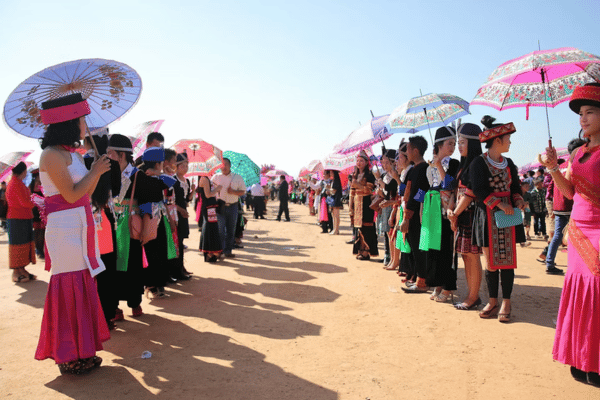
It changes everything. A Hmong New Year celebration in Dong Van district is not a performance staged for visitors. It’s a community event — full traditional dress, music, ritual games, generations gathered together — that happens to be occurring in a landscape you’re passing through. You’re not watching it from behind a velvet rope. You’re in the middle of it.
This guide is for travellers who want to plan their 2026 Ha Giang Loop trip with cultural timing in mind. It covers the major festivals and seasonal events, how the lunar calendar affects exact dates, practical advice for navigating festival crowds, and how to get the most out of the experience.
One important note upfront: many Ha Giang festivals follow the lunar calendar, which means exact dates in the Gregorian calendar shift year to year. This guide provides the best available windows for 2026, but always verify current dates through local sources, your tour operator, or official Ha Giang province tourism channels before finalising your booking. Dates listed here are approximate guides, not guaranteed schedules.
Learn more: Lung Tam Linen Village
Here’s the practical reality: the Ha Giang Loop is beautiful in every season, and the landscape doesn’t care what month you show up. But the cultural experience — the human layer of what makes this region so compelling — is not evenly distributed across the calendar.
Certain windows are simply richer. The Hmong New Year period in the Dong Van plateau area turns a remarkable destination into something that feels genuinely alive in a way that ordinary travel days don’t. The Khau Vai Love Market, held once a year in Meo Vac district, draws people from across the mountains for an event with no real equivalent anywhere else in Vietnam. Buckwheat flower season — not technically a festival, but treated as one by the travellers who chase it — brings a visual transformation to the landscape that lasts only a few weeks.
None of these require you to be a cultural tourism purist. You don’t need to speak Hmong or understand every ritual. What you need is to show up at the right time, move slowly, and be genuinely curious.
The flip side is also real. Peak festival windows mean more visitors, more demand for accommodation, and higher prices in some cases. Understanding the calendar helps you decide whether you want to be in the thick of it or aim for the shoulder periods around a festival that still carry the atmosphere without the full crowd.
Learn more: Ha Giang Adventure
This is worth understanding before you start planning, because it catches a lot of travellers off guard.
Vietnam’s ethnic minority communities — particularly the Hmong, Tay, Nung, Lo Lo, Dao, and Giay groups that populate Ha Giang province — largely follow lunar calendar systems for their traditional festivals. This means that a festival that falls in “late November” one year might fall in “mid-December” the next, or shift earlier into October. The lunar calendar year doesn’t align with the solar calendar, and the drift can be weeks in either direction from one year to the next.
What this means practically:
With that established, here’s the calendar.
Learn more: Ha Giang Loop 3 Days 2 Nights
Approximate window: Late March to mid-April 2026 (3rd month of the lunar calendar, typically the 26th–27th days — check current year lunar calendar for exact date)
Location: Khau Vai commune, Meo Vac district
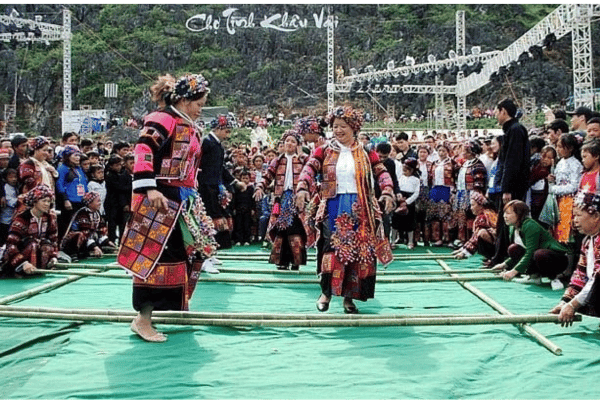
The Khau Vai Love Market is one of the most unusual festivals in Vietnam — and arguably in all of Southeast Asia. Held once a year in a valley in Meo Vac district, it originated as a gathering point for former lovers: people who had been separated by circumstance, family arrangement, or social restriction could return to this market on this specific day to meet, speak, and remember. Partners stayed away out of respect for the day’s purpose.
The tradition has evolved over time, and today’s Khau Vai market is broader than its origin story suggests — it’s a full festival event with music, traditional games, food stalls, and people from multiple ethnic groups (Hmong, Tay, Nung, Giay, Lo Lo, and others) converging in one valley. But the spirit of the original still runs through it. You’ll see older couples meeting with an emotional openness that’s specific to this event. You’ll see traditional courtship music — the leaf instrument, the flute — played by young men for young women in the old style. It’s real in a way that’s hard to explain without having been there.
Practically: Khau Vai fills up fast. Accommodation in Meo Vac town books out well in advance of the market date. If this is on your itinerary, secure your accommodation weeks — not days — ahead. The market itself is a half-day or full-day event; most visitors combine it with a stay of one to two nights in Meo Vac.
Learn more: Ha Giang Loop 4 Days 3 Nights
Approximate window: January to February 2026 (1st–3rd month of the lunar calendar — specific dates vary by village and community)
Location: Widespread across Ha Giang province, most intensely in Dong Van district and surrounding Hmong-majority areas
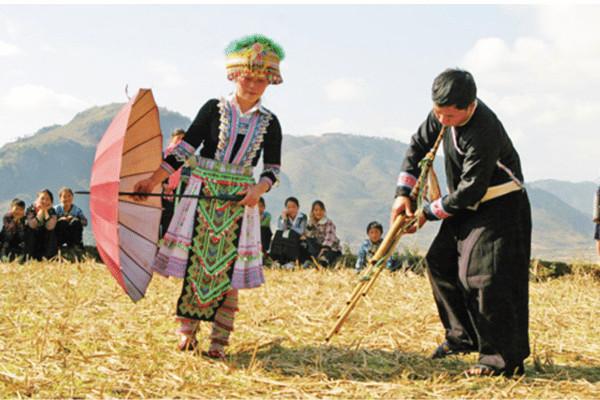
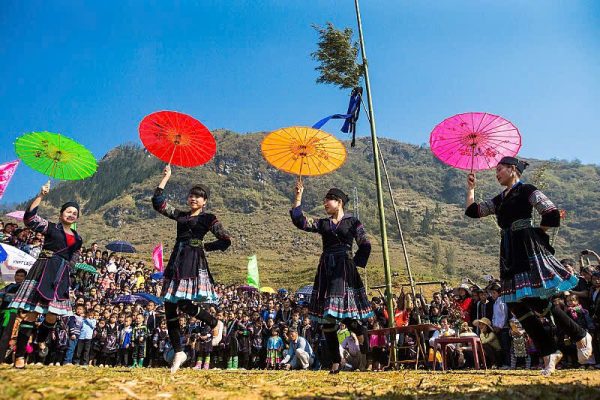
Gau Tao (Gầu Tào in Vietnamese) is the major Hmong spring festival — a celebration of the new year’s beginning that involves ritual tree ceremonies, communal feasting, traditional music and dance, spinning top contests, crossbow competitions, and the performance of khèn (the Hmong bamboo mouth organ) by young men. It’s held in the open, usually in a field or hillside chosen by the community, and it runs across multiple days.
Different Hmong communities in Ha Giang celebrate Gau Tao at slightly different times, so in practice the festival period extends across several weeks in January–February rather than being a single fixed day. If you’re in the Dong Van area during this window, the probability of encountering a Gau Tao celebration in one of the surrounding villages is high.
What to look for: the cây nêu (ritual bamboo pole, often decorated with coloured cloth or offerings) is the visual marker of a Gau Tao site. Traditional dress is at its most elaborate during this period. Khèn music — the layered, droning sound of multiple reeds played simultaneously — is the sound of this festival season.
Note that this window overlaps with Vietnamese Tết (Lunar New Year), which falls in late January or early February 2026. Transport across Vietnam is significantly busier during Tết; book well in advance if your trip dates overlap with this period.
Learn more: Ha Giang Loop 2 Days 1 Night
Approximate window: January to February 2026 (late 1st month of the lunar calendar, typically after Tết)
Location: Tay and Nung community areas — more prevalent in the lower-altitude and valley districts of Ha Giang, also Cao Bang province
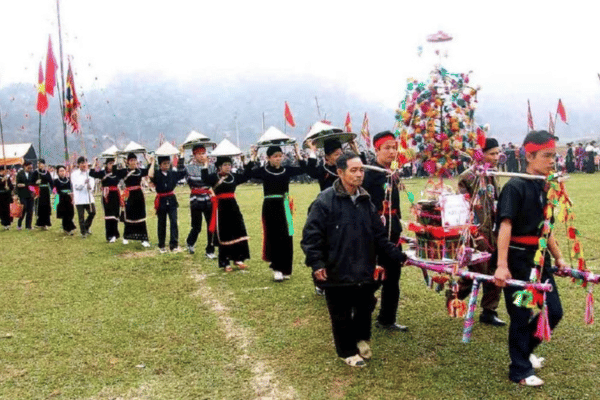
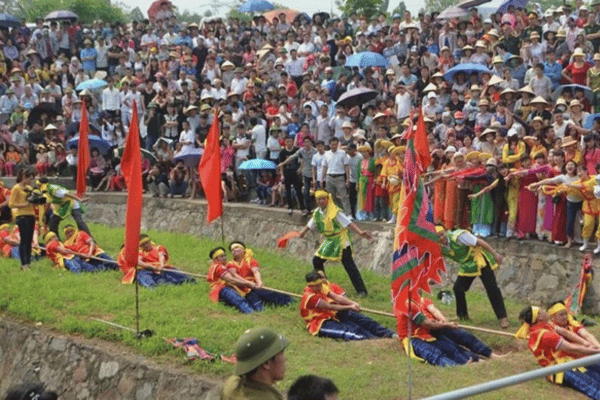
Long Tong (Lồng Tồng) is the agricultural new year festival of the Tay and Nung peoples — a celebration of the farming cycle, asking for good harvests, healthy livestock, and community prosperity in the coming year. It’s held in open fields, which gives it a different spatial quality from mountain-village festivals. The ritual involves ploughing ceremonies, communal offerings, and traditional games including tug-of-war, swinging, and folk singing (hát then).
For Ha Giang travellers, Long Tong is less commonly encountered than Hmong New Year or Gau Tao because the Tay and Nung communities are concentrated in lower areas that are sometimes bypassed on the standard Loop route. If you’re taking a combined Ha Giang and Cao Bang tour, your chances of catching a Long Tong celebration increase significantly — Cao Bang province has strong Tay cultural traditions and several well-known Long Tong sites.
If this is the kind of deep cultural experience you’re looking for, it’s worth considering a [Ha Giang–Cao Bang combined tour] — the cultural range across both provinces is considerably wider than either alone.
Learn more: Ha Giang Loop for Beginners
Approximate window: November to December 2026 (10th–12th month of the Hmong lunar calendar — exact dates vary by community, often a few weeks ahead of Vietnamese Tết)
Location: Dong Van district, Meo Vac district, and Hmong communities across Ha Giang province
This is the festival most Ha Giang Loop travellers have heard of, and for good reason. Hmong New Year (Nào Pê Chầu) is the single most significant cultural event on the annual calendar for Hmong communities across the northern highlands. In Ha Giang province, where the Hmong are the largest ethnic minority group, the celebration is widespread, extended, and genuinely spectacular.
What happens during Hmong New Year:
The celebration runs across multiple days and takes place in different villages on different dates — which means that within the general November–December window, there’s usually a celebration happening somewhere accessible if you’re in the Dong Van area. Ask locally or ask your guide.
Accommodation during Hmong New Year books out very early in peak locations. Dong Van town in particular fills up. Book weeks to months in advance if you want to be in the right place for this.
Learn more: Ha Giang Buckwhet Flowers Season
Approximate window: Mid-October to mid-November 2026 (varies by elevation and year — check Ha Giang local updates as the season approaches)
Location: Dong Van karst plateau — most intensely around Dong Van town, Lung Cu commune, and Sung La valley
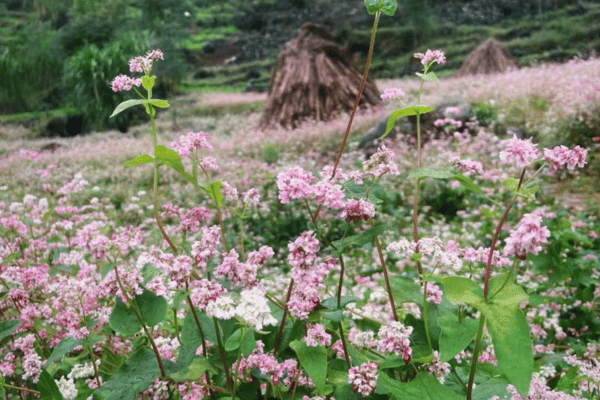
Buckwheat (tam giác mạch) isn’t a native Ha Giang crop, but it’s become inseparable from the region’s identity. After the corn harvest, Hmong farmers plant buckwheat across the terraced fields and hillsides of the Dong Van plateau. When it blooms — a wash of pink and white across the karst landscape — it creates one of the most photographed natural spectacles in northern Vietnam.
It’s not a festival in the organised sense. There are no ritual events, no fixed date, no entrance fee. It’s just a landscape transformation that happens once a year and lasts a few weeks. But the effect on visitors is festival-like: people plan entire trips around it, accommodation in Dong Van books out during the peak bloom, and the density of travellers on the Loop in October–November reflects the pull of this season.
What makes it worth the hype: it’s not just the fields themselves. The buckwheat blooms while the karst peaks are at their most dramatic — clear autumn skies, crisp air, the late-season light. The combination of terrain, light, and floral colour is genuinely extraordinary. Photos from this period are the ones that fill Ha Giang Instagram feeds and make friends ask “where is that?”
Practically: the bloom timing varies by elevation and by year. Higher fields bloom earlier; lower-altitude areas come later. Following Ha Giang local social media or travel groups as October approaches gives you the best real-time read on where the bloom is peaking. Don’t plan around a fixed date — plan around a window and stay flexible.
Learn more: Ha Giang Market Days
Approximate window: Year-round, with Sunday market every week; major heritage events typically March–April and September–October (check Ha Giang province tourism calendar for 2026 specifics)
Location: Dong Van Old Quarter, Dong Van district
Dong Van’s Old Quarter is a UNESCO-recognised heritage site — a cluster of traditional stone and tile-roofed buildings that dates back to the early 20th century, when this area was a significant trading post on the China border route. The buildings are genuinely old and intact in a way that’s unusual in this region.
The Sunday market in Dong Van (separate from the bigger Meo Vac Sunday market) draws ethnic minority communities from the surrounding plateau — a smaller, more intimate version of the same dynamic. If your Loop itinerary has you in Dong Van on a Sunday, the morning market is worth an early alarm.
Periodically, Dong Van district hosts heritage events and cultural shows timed to coincide with tourist season or national celebration periods. These are less predictable than the recurring festivals listed above — check local announcements closer to your travel date for anything specific to 2026.
Learn more: Du Gia Waterfall
Approximate window: Varies — village-level celebrations occur throughout the year
Location: Du Gia district, and villages throughout the Ha Giang Loop route
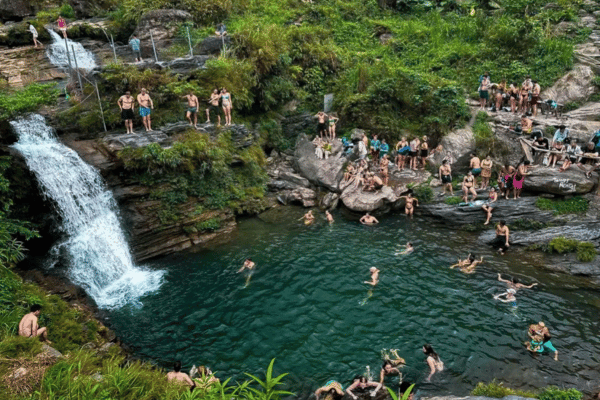
The Ha Giang Loop’s southernmost anchor — Du Gia — and the surrounding district are primarily Tay community territory, with festivals tied to the agricultural and lunar calendar. The Du Gia Waterfall area is famous for its natural beauty, but the surrounding villages host their own celebration cycles that are less visible to travellers than the Dong Van plateau events.
If you’re spending a night in Du Gia (common on the final day of the Loop before returning to Ha Giang City), ask your guesthouse whether there’s anything happening in the surrounding villages. Village-level festivals in this area tend to be genuinely local — small gatherings that aren’t promoted to tourists but can be witnessed respectfully if you happen to be in the right place
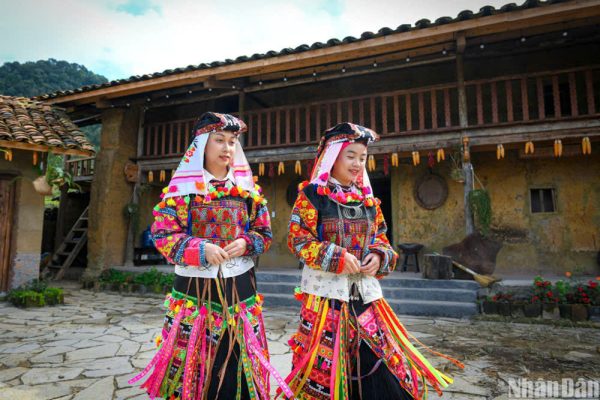
Learn more: Ha Giang Ethnic Minorities
Understanding which group is celebrating what — and why — makes every festival encounter more meaningful. Ha Giang province has one of the highest levels of ethnic diversity in Vietnam, with 19 recognised ethnic minority groups within its borders.
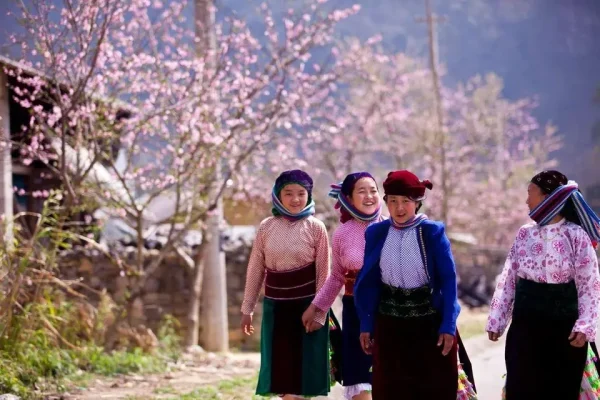
The Hmong are the largest ethnic minority group in Ha Giang, concentrated in the high-altitude areas of the Dong Van plateau and surrounding districts. Their festivals — particularly Hmong New Year (Nào Pê Chầu) and Gau Tao — are the most visible on the Loop and draw the widest traveller interest. Within the Hmong, there are distinct sub-groups (Flower Hmong, Black Hmong, White Hmong) with somewhat different costume traditions and celebration styles.
The Tay are the second-largest group, typically settled in valley floors where wet-rice agriculture is viable. Their festivals (Long Tong, various harvest ceremonies) reflect agricultural cycles. The Tay cultural zone extends strongly into Cao Bang province, which is one reason a combined Ha Giang–Cao Bang trip enriches the cultural picture significantly.
The Nung share close cultural and linguistic ties with the Tay and often celebrate similar festivals. Their communities are found throughout the lowland and mid-altitude areas of Ha Giang.
The Dao (also written Yao) are found in parts of Ha Giang and Cao Bang and have a distinctive tradition of elaborate ceremonial dress — particularly the red-and-white headdresses of the Red Dao (Dao Đỏ) group. Dao festivals and coming-of-age ceremonies are less frequently encountered on the standard Loop route but more visible in the Cao Bang direction.
The Lo Lo, as discussed elsewhere on this site, are one of the smaller groups — concentrated near Dong Van and Lung Cu — with bronze drum traditions and a ritual calendar tied to their animist belief system. Their ceremonies are intimate and not widely broadcast; they tend to happen within the community rather than as public events.
The Pu Peo are one of Vietnam’s smallest ethnic groups, found in tiny numbers in Ha Giang province. Encountering them is genuinely rare; their festivals are essentially unknown to most travellers.
The key takeaway: different groups, different calendars, different celebration styles. The richest cultural experiences on the Ha Giang Loop come from understanding this diversity rather than treating “ethnic minority festival” as a single undifferentiated category.
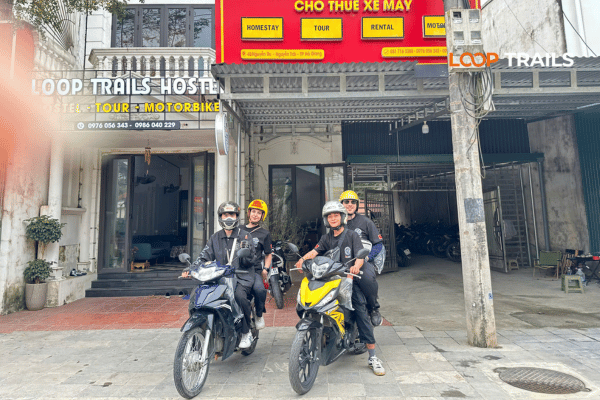
Learn more: Ha Giang Motorbike tour
Festival-timed travel requires a bit more forward planning than a standard Loop trip. Here’s a practical framework:
Step 1: Identify your priority festival or window. If Hmong New Year is the goal, you’re looking at November–December. If Khau Vai Love Market is the priority, you need to hit the third lunar month (late March–April in 2026). If buckwheat flowers are the driver, mid-October to mid-November is your window. Pick one primary target and build around it.
Step 2: Confirm dates as close to your trip as possible. Lunar calendar festivals shift. The windows in this guide are historically reliable but not guaranteed for 2026. Check in with Loop Trails, with Ha Giang travel forums, or with the province’s tourism board as your trip approaches. Dates for major festivals are usually confirmed and circulating locally by 4–6 weeks ahead.
Step 3: Book accommodation well in advance. This is the step most travellers get wrong. During Hmong New Year in Dong Van, during Khau Vai market in Meo Vac, during buckwheat peak in the Dong Van plateau — beds fill up. Not within a few days of arrival, but within weeks or months. If your festival timing is specific, your accommodation booking needs to be equally specific.
Step 4: Build flexibility into your itinerary. Festivals don’t run on traveller timetables. A Hmong New Year celebration might be in full swing in one village while another village is quiet. Having a guide who knows the local calendar and community contacts is invaluable for this reason — they can tell you in real time where the action is on a given day, and adjust the itinerary to match.
Step 5: Adjust your expectations and your posture. Festival-time Ha Giang is busier, louder, more crowded, and more alive than quiet-season Ha Giang. If you’re the kind of traveller who prefers solitude, go slightly off-peak — the week after a major festival rather than during the peak. If you want density and colour and the feeling of a community in celebration, go right into the middle of it.
Planning around a specific festival and need help with itinerary timing? [Reach out to Loop Trails on WhatsApp] — we can help you align your dates and book the right accommodation for your target window.
Learn more: Ha Giang Loop by Jeep for Families & Groups
Festival timing changes which tour format makes the most sense. Here’s a frank breakdown:
Easy Rider guided tour: The best format for festival-season travel, and it’s not close. Your guide has relationships with local communities — they often know when village-level celebrations are happening that aren’t on any tourist calendar. They can take you to a Hmong New Year village event that’s not on the main road, or position you at the Khau Vai market before the crowds arrive. For first-time Ha Giang visitors who want the cultural depth of festival season without the logistical stress of navigating it independently, Easy Rider is the right answer.
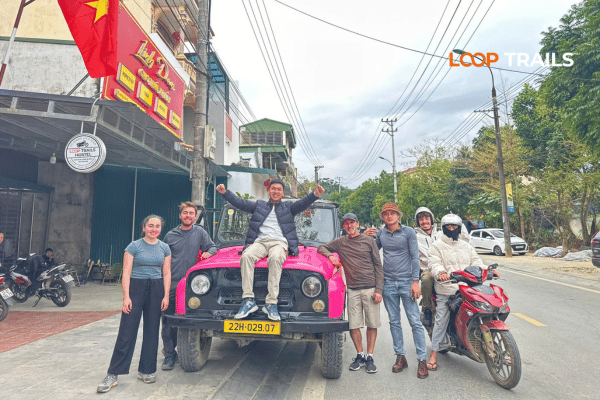
Jeep tour: Excellent for families or small groups visiting during festival season. The jeep can carry the extra gear you might want for cold weather (Hmong New Year and buckwheat season both sit in the cool-to-cold window), and the vehicle flexibility means you can reach village celebrations that aren’t on the standard motorbike-only route. If you want the festival experience without the riding demands of the peak season crowds, jeep tours give you full access without sacrificing comfort.
Self-drive motorbike rental: Festival season on a self-drive requires more planning but delivers maximum freedom. You can follow the celebration from village to village on your own schedule, stay overnight wherever the action is, and adjust in real time. The trade-off is that without local knowledge you’ll miss a lot — the village festivals that aren’t signposted, the community events that happen before or after the main market day. If you’re self-driving during festival season, spend time in local guesthouses asking questions every evening. Guesthouse staff are your best real-time intelligence source.
Explore your options on the [Loop Trails Ha Giang Loop tours page] — all three formats are available for 2026, and festival-season itineraries can be built around your priority events.
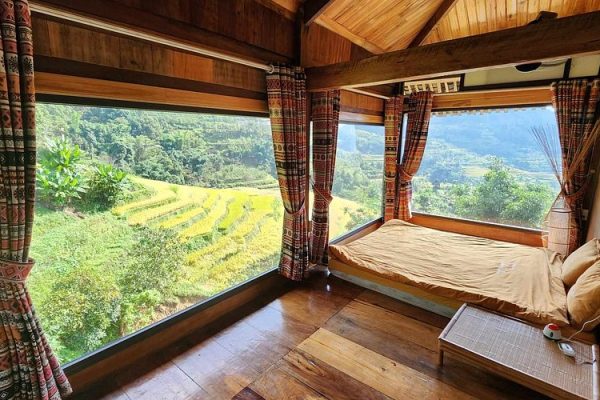
Learn more: Ha Giang Homestay Guide
Book accommodation early — then earlier. For Hmong New Year, Khau Vai, and peak buckwheat season, Dong Van and Meo Vac are the key accommodation choke points. Do not wait until a week before.
Bring cash. Festival periods see higher transaction volumes everywhere. ATMs in district towns can run low during big festival weekends. Arrive with enough cash to cover accommodation, food, market purchases, and any impromptu stops.
Dress with some cultural awareness. Attending a Hmong New Year or Gau Tao celebration is not the same as watching a show. These are community events. Conservative, respectful dress (no sleeveless tops, covered shoulders at minimum) is appropriate. You don’t need to wear traditional clothing — just don’t show up looking like you’re on a beach holiday.
Ask before photographing. Festival season generates extraordinary photographic opportunities — elaborate traditional dress, communal games, ritual events. It also concentrates a large number of camera lenses in a small space. Be selective, be courteous, ask permission for close portraits. The people being photographed during festival season are doing so at high frequency — treat them accordingly.
Understand that not everything is for spectators. Some parts of traditional ceremonies — particularly altar rituals, family events, and certain ritual songs — are genuinely private. If you’re unsure whether you should be watching something, ask your guide or step back.
Respect the no-go zones around the Chinese border. The festivals in Dong Van and Lung Cu areas occur near the border zone. Standard rules about not photographing military infrastructure apply year-round, but it’s worth keeping in mind during the busier festival season when it’s easy to wander without noticing where you’ve ended up.
Night-time temperature during festival season. Hmong New Year and buckwheat season both fall in the cool-to-cold window (November–December). Evening celebrations can continue late into the night outdoors. Bring a warm layer that you can put on at 8pm and not regret.
Know your limits for corn wine (rượu ngô). Sharing drinks is part of Hmong hospitality culture during New Year celebrations. You will be offered corn wine. It’s rude to refuse entirely, but you can take a small sip and set the glass down. The alcohol content is high and the pours are generous. Pace yourself if you have riding to do the next morning.
Don’t negotiate hard at festival market stalls. Khau Vai and the Meo Vac Sunday market during festival period are not tourist markets with inflated prices awaiting bargaining. They’re community markets. Prices are generally fair by local standards. A gentle negotiation is fine; hard bargaining is disrespectful in this context.
Learn more: Ha Giang to Cao Bang
Hmong New Year (Nào Pê Chầu) typically falls in November to December, based on the Hmong lunar calendar. The exact dates for 2026 will shift from previous years — check Ha Giang local sources, your tour operator, or travel forums as November approaches for confirmed dates. Don’t book non-refundable travel around a fixed date without confirming first.
Khau Vai Love Market is an annual festival in Meo Vac district where people gather for a unique celebration rooted in the tradition of former lovers reuniting. It now encompasses traditional music, games, and multi-ethnic community gathering. It falls on the 26th–27th day of the 3rd lunar month — in 2026, that places it approximately in late March to mid-April. Confirm the exact date against the 2026 lunar calendar
Buckwheat is planted across the Dong Van plateau after the corn harvest and blooms in a wave of pink and white across terraced fields and hillsides. It’s not an organised festival — it’s a natural seasonal event that typically peaks from mid-October to mid-November. Exact timing varies by elevation and year. Following Ha Giang travel communities in early October gives the best real-time updates.
Yes — especially for Hmong New Year, Khau Vai Love Market, and buckwheat flower peak. Accommodation in Dong Van and Meo Vac can book out weeks to months in advance during these windows. If festival timing is your priority, treat accommodation booking as urgent, not casual.
Hmong New Year and Khau Vai Love Market are the most visually spectacular — both feature elaborate traditional dress, public gatherings, and outdoor activities that create natural photographic opportunities. Buckwheat flower season offers landscape photography at its best. Gau Tao (Hmong Spring Festival) in January–February is less photographed and can feel more intimate.
Most major Ha Giang festivals are publicly accessible — they happen in open spaces and don’t have entrance fees or exclusive access requirements. Some ritual aspects are more private. Having a local guide significantly improves your experience and helps you navigate what’s accessible to outside visitors and what deserves more distance.
Ha Giang is home to 19 ethnic minority groups. The most commonly encountered festivals belong to the Hmong (Hmong New Year, Gau Tao, Khau Vai), Tay and Nung (Long Tong), and Lo Lo communities. Each has a distinct visual style, ritual content, and calendar.
Yes — festival season is one of the best reasons to do the Loop. The trade-off is higher visitor numbers and the need for advance accommodation booking. If you prefer quieter roads and solo access to viewpoints, go slightly off-peak (early October before buckwheat peaks, or early January after the New Year celebrations wind down). If cultural depth is your priority, go right into the festival windows.
Comfortable, practical clothing with covered shoulders at minimum. You don’t need to dress in traditional clothing, but avoiding beach-casual attire shows basic cultural respect. Layers are essential for November–December festival season — evenings in the Dong Van plateau area are cold.
Your best sources: your tour operator (Loop Trails tracks the festival calendar and can advise for your specific dates), Ha Giang province official tourism channels, and active Facebook or travel forum groups for the region. Local guesthouse staff in Dong Van and Meo Vac are also excellent real-time sources once you’re on the ground.
Generally yes. The outdoor, community nature of these festivals makes them engaging for children — traditional games, music, colourful dress, market stalls. The cold weather of November–December New Year season requires warm clothing for kids. A jeep tour is the most practical format for families during festival season.
Yes. Festival-aligned itineraries require specific knowledge of dates, accommodation availability, and on-the-ground contacts. [Reach out via WhatsApp] with your target window and group details, and we can build a tour or rental itinerary around your festival priority.
Contact information for Loop Trails
Website: Loop Trails Official Website
Email: looptrailshostel@gmail.com
Hotline & WhatSapp:
+84862379288
+84938988593
Social Media:
Facebook: Loop Trails Tours Ha Giang
Instagram: Loop Trails Tours Ha Giang
TikTok: Loop Trails
Office Address: 48 Nguyen Du, Ha Giang 1, Tuyen Quang
Address: 48 Nguyen Du, Ha Giang 1, Tuyen Quang
Facebook X Reddit Table of Contents If you’ve been researching a trip to Ha Giang and typed “Ha Giang airport” into a
Facebook X Reddit Table of Contents Learn more: Ha Giang Loop Tours Most travelers discover Ha Giang through the photos — buckwheat
Facebook X Reddit Table of Contents Learn more: Ha Giang Loop Tours Running out of fuel on a mountain road in northern