
Ha Giang Airport: Is There One? How to Get There
Facebook X Reddit Table of Contents If you’ve been researching a trip to Ha Giang and typed “Ha Giang airport” into a

Thúy Kiều (Grace) is a travel blogger and content contributor for Loop Trails Tours Ha Giang. She holds a bachelor’s degree in Sustainable Tourism from Vietnam National University, Hanoi, and has a strong passion for exploring and promoting responsible travel experiences in Vietnam’s northern highlands.
Learn more: Ha Giang Loop Tours
There’s a specific kind of quiet you find at the far northern edge of Vietnam. Not the silence of emptiness — the opposite, actually. It’s a quiet layered with the sound of a loom working, goats on a stone path, someone calling across a courtyard in a language you don’t recognise at all.
That’s Lo Lo Chai.
Tucked below the Lung Cu Flag Tower in Dong Van district — right at the top of Ha Giang province, barely a kilometre from the Chinese border — Lo Lo Chai is one of the most culturally intact ethnic minority villages on the Ha Giang Loop. It’s not a museum recreation or a staged cultural experience. Real families live here, farm here, celebrate here, and carry forward a tradition that’s thousands of years old.
If you’re planning a Ha Giang Loop trip and you’re trying to figure out what’s actually worth stopping for versus what’s just scenic road — put Lo Lo Chai near the top of your list. Here’s everything you need to know before you go.
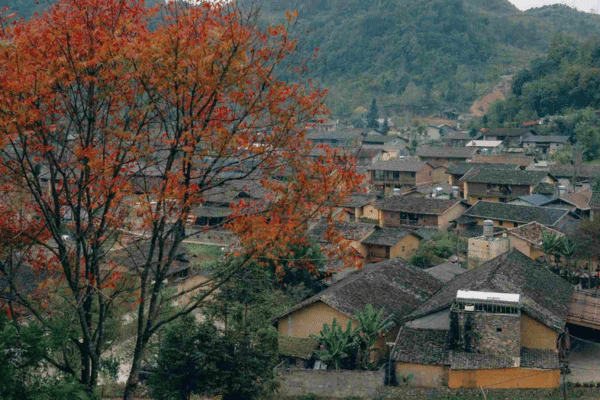
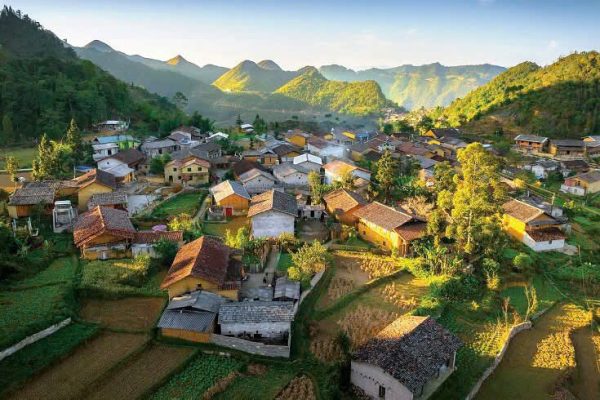
Lo Lo Chai sits in Lung Cu commune, Dong Van district, Ha Giang province — in the very northernmost tip of Vietnam. It’s approximately 24 kilometres north of Dong Van town, and the road climbs steadily before you reach it. The village itself is in a valley bowl, surrounded by terraced fields and dramatic karst peaks that define the whole Dong Van Karst Plateau UNESCO Global Geopark.
The Lung Cu Flag Tower — Vietnam’s most northern point — is literally a short walk uphill from the village entrance. Most visitors combine both in the same stop, which makes sense logistically. But don’t let the flag tower eat all your time. A lot of people spend twenty minutes in the village and miss the actual point. Give yourself at least an hour, ideally two.
GPS coordinates and exact road access will depend on your route direction. If you’re riding the standard Ha Giang Loop counterclockwise (Ha Giang → Yen Minh → Dong Van → Meo Vac → Du Gia → back), you’ll hit Lo Lo Chai and Lung Cu as a northern detour off the main Dong Van–Meo Vac axis.
Learn more: Ha Giang Loop 4 Days 3 Nights
The Lo Lo are one of Vietnam’s 54 officially recognised ethnic groups, and one of the smaller ones — the national population is under 5,000. They’re concentrated almost entirely in the high-altitude northern border areas: Ha Giang, Cao Bang, and Lao Cai provinces.
Their origins are traced to the Tibeto-Burman language family, and linguistically and culturally they’re quite distinct from the dominant Hmong and Dao groups you’ll encounter elsewhere on the Loop. Walking into Lo Lo Chai after spending time in Hmong villages, you’ll notice it immediately — different costume colours, different house styles, different patterns on the textiles.
The community in Lo Lo Chai is primarily Black Lo Lo (Lo Lo Đen in Vietnamese), though you’ll also find Flower Lo Lo (Lo Lo Hoa) in the broader region. Understanding the difference is worth a few minutes.
Learn more: Ha Giang Loop 2 Days 1 Night
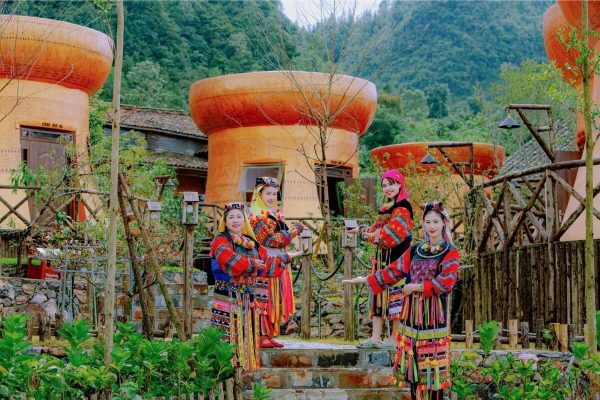
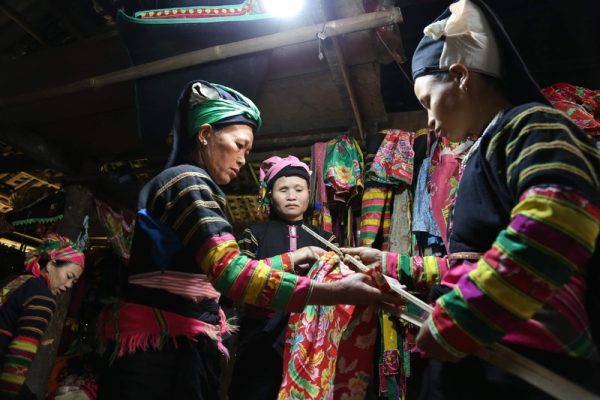
The names refer to costume differences, not to any separate ethnic identity per se. The Black Lo Lo traditionally wear predominantly dark-toned clothing — black or deep indigo as the base — with geometric embroidered panels at the collar, sleeves, and hem. The embroidery is intricate, typically done in red, white, yellow, and green thread in repeating diamond and cross patterns. Women’s everyday dress is layered; festive dress is considerably more elaborate.
The Flower Lo Lo wear more brightly coloured, patchwork-style clothing with broader colour ranges and a more visually complex silhouette. Think of it as the difference between a sober geometric pattern and an explosion of colour — both beautiful, just in different registers.
In Lo Lo Chai specifically, you’re in Black Lo Lo territory. If you want to compare, some broader Dong Van market visits during festival season will show you both.
Lorem ipsum dolor sit amet, consectetur adipiscing elit. Ut elit tellus, luctus nec ullamcorper mattis, pulvinar dapibus leo.
Learn more: Ha Giang Loop for Beginners
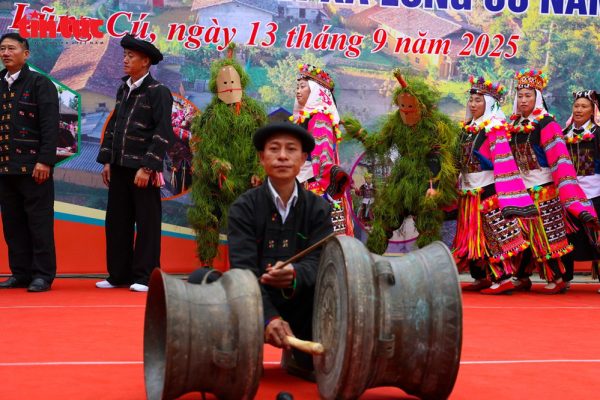
Here’s what makes the Lo Lo genuinely stand apart in the northern Vietnam ethnic mosaic: they are one of the only groups in the region who still maintain a living tradition of bronze drum culture.
Bronze drums (trong đồng) are ceremonial instruments with a history stretching back over two thousand years in Southeast Asia — connected to the Dong Son civilisation and regarded as sacred objects across multiple cultures. For the Lo Lo, the drums are not decorative. They’re used in funerals, harvest ceremonies, and New Year rituals. They’re believed to be inhabited by ancestral spirits, and they’re passed down within families, not sold. If you see one during your visit, treat it accordingly.
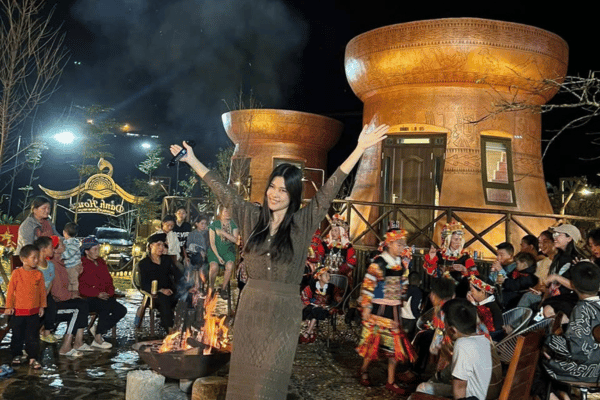
The Lo Lo follow a form of animist belief with ancestor veneration at the centre. Household altars are tended carefully, and certain times of year — Lo Lo New Year, harvest festivals, important family events — are governed by ritual calendars that outsiders rarely get to witness. If you happen to be in Lo Lo Chai during a village ceremony, consider yourself lucky. Watch from a respectful distance unless you’re explicitly invited closer.

Learn more: Lung Cu Flag Tower Guide
Lo Lo Chai is a compact village. There’s no formal entrance fee at the village itself (though Lung Cu Flag Tower charges admission), and you can walk the main lane and secondary paths fairly freely. The village is built in a roughly linear arrangement, with houses set back from the path, separated by low stone walls and small kitchen gardens.
What you’ll see: traditional houses in various states of preservation (some original architecture, some reconstructed or repaired), older women going about their daily work — often weaving or embroidering outside when weather allows — children, livestock, and a communal feel that most heavily-visited tourist spots in Vietnam have long since lost.
What you won’t find: souvenir stalls every five metres, aggressive vendors, or entrance checkpoints at every junction. The commercialisation here is light relative to places like Bac Ha or Sa Pa. It won’t stay that way forever, but for now Lo Lo Chai is still a village first and a tourist site second.
One practical note: the path surfaces are uneven stone and packed earth. Wear shoes with some grip.
Learn more: Ha Giang in September & October
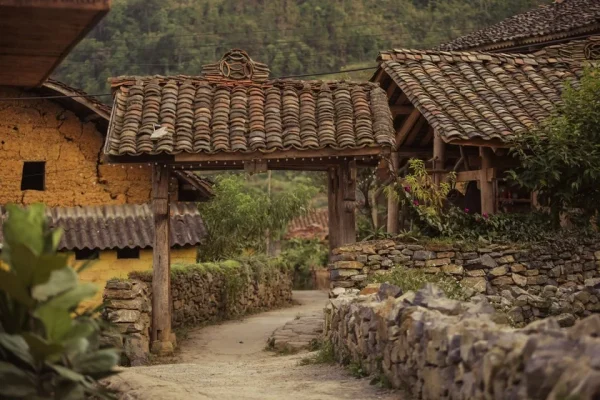
The traditional Lo Lo house is a ground-level structure built with thick rammed-earth or stone walls, timber-frame upper sections, and a heavy tiled or thatched roof. The mass of the walls provides natural insulation against both the cold winters and the hot summers at this altitude (Dong Van sits above 1,000 metres).
The thicker, older walls in Lo Lo Chai are often built from the local grey karst stone — the same rock that dominates the whole Dong Van plateau landscape. Some houses have carved wooden door frames with simple geometric motifs. Courtyards are functional, not decorative: you’ll often find drying racks, firewood stacks, and agricultural tools.
A few households have opened their ground floors as informal homestays or simple guesthouses — more on that below.
A few things worth knowing before you wander in:
Ask before photographing people. This is non-negotiable etiquette at any ethnic minority village in Vietnam, and it matters more here than in higher-traffic spots. A smile and a gesture toward your camera is usually understood. If someone shakes their head or turns away, move on. Older women in full traditional dress are often photographed dozens of times per week — be aware of that dynamic.
Don’t enter a home unless invited. In some villages, households displaying goods or textiles outside are implicitly open to visitors. In Lo Lo Chai, wait for a clear signal — an open door and eye contact is usually enough of an invitation.
Small purchases matter. If someone shows you their weaving or embroidery, buying something (even a small item) is a direct and meaningful form of support. These aren’t cheap mass-produced goods — traditional Lo Lo embroidery is genuinely labour-intensive.
Don’t give sweets or money to children. This is good practice everywhere in rural Vietnam. It creates expectations and dependency that doesn’t serve the community well long-term.
Learn more: Ha Giang Loop for Families & Groups
Weaving and embroidery are living skills here, not performed demonstrations. If you sit quietly near an older woman working a backstrap loom and show genuine interest, you’ll often get an informal lesson — or at least a patient explanation via gesture and expression. The geometric patterns in Lo Lo embroidery are not random; they’re encoded with cultural meaning that’s passed from mother to daughter.
Some homestays or local households have formalised this slightly, offering a short sit-down where you can try the basic motion of a hand loom. It’s not a polished cultural show — which is exactly why it’s worth doing.
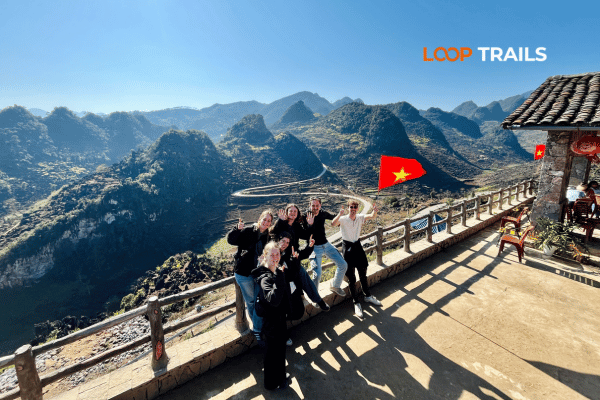
Lung Cu is, technically, the northernmost point of Vietnam — marked by a large flag pole flying the Vietnamese flag on a summit accessible by a steep staircase. On a clear day the views are extraordinary: a patchwork of Chinese farmland on one side, Vietnamese karst plateau on the other, and Lo Lo Chai visible directly below.
The admission fee and opening hours for Lung Cu change periodically — check local updates when you arrive in Dong Van town. The climb takes 15–20 minutes each way from the base. It’s worth doing in the morning before haze builds.
If you’re planning to see both Lo Lo Chai and Lung Cu in one stop, budget around 2.5–3 hours total. Don’t rush the village for the sake of the tower. The tower is impressive but passive. The village is the living thing.
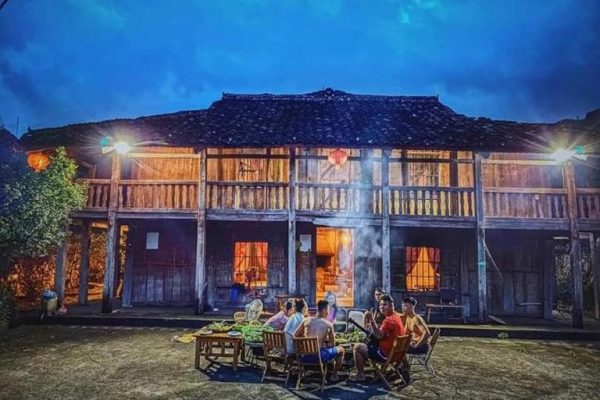
This is, honestly, one of the better overnight options in the whole Dong Van–Lung Cu area. A handful of Lo Lo families have set up homestay rooms — typically simple but clean, with basic bedding, a shared bathroom, and dinner included. Waking up in the village rather than in Dong Van town is a completely different experience: early morning light on the karst peaks, the sounds of the village starting its day, and no crowds whatsoever.
Pricing and availability change — don’t rely on online booking for this. Ask locally when you arrive at Dong Van town, or ask your guide to contact a Lo Lo Chai family in advance. If you’re riding self-drive, the logistics are easy: park your bike, stay overnight, continue toward Meo Vac the next morning.
Thinking about the Ha Giang Loop and not sure which format suits you? [Check out our Loop Trails Ha Giang Loop tours — Easy Rider, Jeep, and Self-Drive options explained.]
Learn more: Ha Giang Loop Weather
Dong Van district is at high altitude and the weather pattern differs from lower Ha Giang. Here’s a realistic breakdown:
October to March (Dry season / Cool to cold): This is peak season for the Ha Giang Loop generally, and for good reason. The roads are drier, the terraced fields turn gold in October–November (buckwheat flowers bloom in roughly October–November across Dong Van — timing varies year to year, check local updates), and the sky tends to be clearer for views. November to January can be genuinely cold at this altitude, especially at night. Bring a proper jacket.
April to September (Wet season): Monsoon rains make the roads significantly more challenging — especially on the approach to Lung Cu and in the karst terrain around Dong Van. Landslides and road closures do occur; check conditions before setting out. That said, the green-season landscapes are extraordinarily lush, and if you ride in clear gaps between rain, the light is often better than dry season. Fewer tourists too.
Lo Lo New Year and festivals: The Lo Lo celebrate their own New Year (based on the lunar calendar) with ceremony, music, and bronze drum performances. The exact dates shift year to year. If this is important to you, research the specific year’s calendar before booking your trip — or ask about it when you arrive. Being in the village during a festival is a genuinely rare and affecting experience.
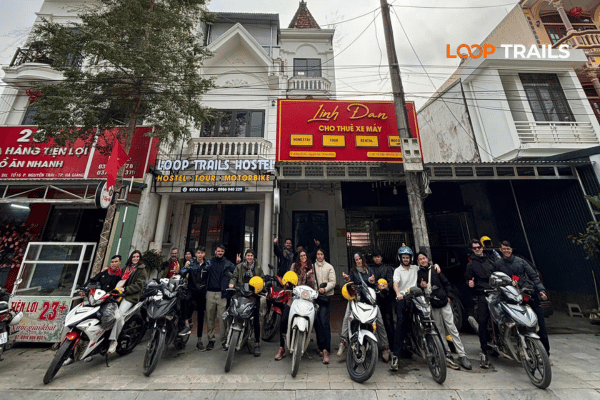
Learn more: Ha Giang Loop Easy Rider
Lo Lo Chai is approximately 150 kilometres from Ha Giang City by road, though the actual riding time is considerably longer than distance suggests — the terrain through Yen Minh and Dong Van is mountain road, not highway.
Most travellers approach it as part of the Ha Giang Loop, not as a standalone day trip from the city. The logical sequence:
Day 1: Ha Giang City → Yen Minh (or Dong Van) Day 2: Dong Van → Lung Cu / Lo Lo Chai → back to Dong Van (or continue toward Meo Vac) Day 3+: Meo Vac → Ma Pi Leng Pass → Du Gia → loop back
If you’re on a guided Easy Rider tour or a jeep tour, your guide handles all the logistics and navigation. If you’re self-riding a rented motorbike, the road to Lung Cu from Dong Van is well-signed but involves a long, winding climb — take it easy, especially in the wet season or if you’re not experienced on mountain roads.
Do you need a local guide to visit Lo Lo Chai? Not strictly required. The village is freely accessible. But a knowledgeable guide can introduce you to families, explain what you’re seeing in real time, and potentially get you into spaces (a traditional kitchen, a demonstration, a brief conversation with an elder) that you simply wouldn’t access alone. It changes the experience significantly.
Learn more: Ha Giang Jeep Tours
This is the question worth thinking through before you book anything:
Easy Rider guided tour: Best if this is your first time in Ha Giang, if you’re travelling solo or as a couple and want a relaxed pace, or if deep cultural stops and local knowledge matter to you. Your Easy Rider guide drives, you’re on the back seat, and you’re free to absorb everything without navigation stress. For Lo Lo Chai specifically, a good guide can facilitate real introductions with local families.
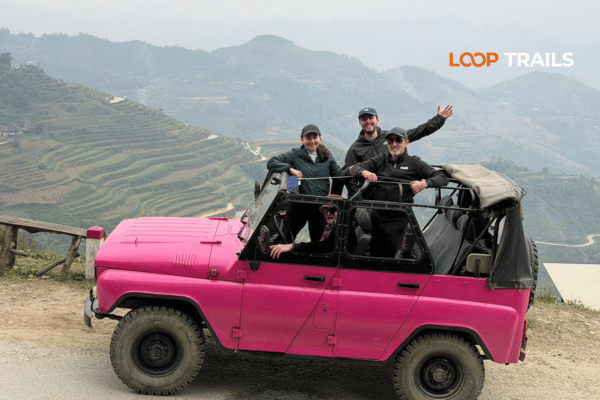
Jeep tour: Best for couples, small groups of 3–4, families with kids, or anyone who wants the Ha Giang Loop experience without riding a motorbike at all. You see everything from a vehicle — comfortable, flexible, and the jeep can carry gear that a motorbike can’t. Also good in the wet season when motorbike riding is more demanding.
Self-drive motorbike rental: Best for experienced riders who want maximum freedom, can handle mountain terrain, and are comfortable navigating independently (or with offline maps). You set the pace, you stop when you want, you stay overnight wherever you choose. Lo Lo Chai overnight homestay is a natural fit for self-drivers. Requires a suitable level of riding confidence and preferably some prior Vietnam road experience.
Explore all three options on the [Loop Trails Ha Giang Loop tours page] — or message us on WhatsApp if you want a personalised recommendation based on your travel dates, group size, and experience level.
Learn more: Ha Giang Road Conditions 2026
Cash is king. Dong Van has ATMs but reliability varies. Bring enough cash from Ha Giang City to cover accommodation, food, and any purchases in Lo Lo Chai. Homestay families won’t accept card.
Layer your clothing. Mornings and evenings at Dong Van altitude are cold for most of the year. A packable down jacket or fleece is genuinely useful even if you’re visiting in September.
Offline maps. Download the Dong Van district area in Maps.me or Google Maps offline before leaving Ha Giang City. Connectivity in the Lung Cu area is patchy.
Fuel up in Dong Van. There are no guarantees of fuel availability between Dong Van town and Lung Cu. Fill your tank before you leave town.
Road permit. Parts of the northern Ha Giang region near the Chinese border are in a controlled zone. Tour operators handle the paperwork for guided tours. If you’re self-driving, your rental provider should advise you on current permit requirements — these rules can change, so confirm before you go.
Photography near the border. Be mindful of what you photograph near the Lung Cu area. The Chinese border is very close; military or border infrastructure is not for photographing. When in doubt, don’t.
Time your Lo Lo Chai arrival. Morning (8–10am) is ideal: the light is better for photography, the village is active before the midday lull, and the main Lung Cu tour groups haven’t arrived yet. Afternoon (3–5pm) is a reasonable second choice. Midday tends to be quiet and harsh-lit.
Learn more: Ha Giang to Cao Bang
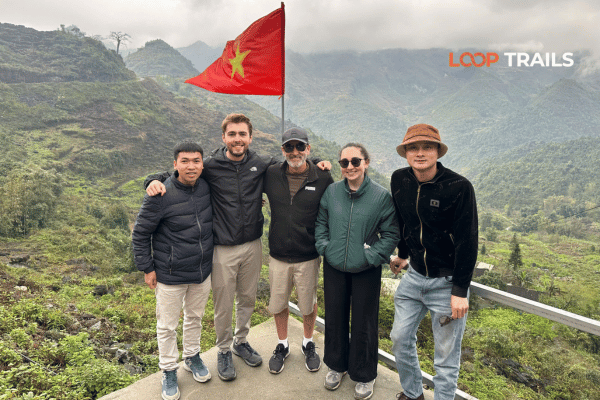
Lo Lo Chai is in Lung Cu commune, Dong Van district, Ha Giang province — about 24km north of Dong Van town, near the Lung Cu Flag Tower at Vietnam’s northernmost point.
The Lo Lo are one of Vietnam’s 54 recognised ethnic minority groups, with a population under 5,000. They speak a Tibeto-Burman language and are known for their distinctive embroidered costumes, bronze drum traditions, and animist belief system with strong ancestor veneration.
The village itself does not have an admission fee. The Lung Cu Flag Tower nearby does charge admission — fees can change, so check locally when you arrive.
Yes. A number of Lo Lo families offer basic homestay accommodation, usually including dinner. Availability and pricing aren’t consistently listed online — ask in Dong Van town or arrange through your guide in advance.
October to March is generally the most comfortable season (dry, clearer skies). October–November is peak for buckwheat flower viewing across the Dong Van plateau. The wet season (April–September) is more challenging on roads but offers lush landscapes and fewer visitors.
No, the village is accessible to independent travellers. But a knowledgeable local guide significantly enriches the experience — they can facilitate introductions, explain cultural context in real time, and access parts of village life that you wouldn’t encounter on your own.
Yes. It’s a residential village, not a remote wilderness. The main practical cautions are road conditions on the approach (especially wet season) and standard travel sensibility. Follow permit requirements for the border zone and don’t photograph military or border infrastructure.
Budget 1.5–2 hours minimum for the village alone. If you’re combining it with Lung Cu Flag Tower, allow 2.5–3 hours total for the stop.
Traditional embroidered items — pouches, purse straps, textile panels — are the most meaningful purchases. Prices are modest and the work is genuinely skilled. These aren’t factory goods.
Ask first — always. A smile and a gesture toward your camera is usually understood. Never photograph someone who indicates they don’t want to be photographed, and be mindful that the people you’re photographing are going about their daily lives, not performing for visitors.
It’s a northern extension from Dong Van town, best visited as part of a 3–4 day Ha Giang Loop. Most itineraries include it as a half-day stop on the Dong Van–Lung Cu route, either the night before or after riding Ma Pi Leng Pass toward Meo Vac.
Technically possible but not recommended. The distance and road conditions make it a 6+ hour round trip just for driving, leaving minimal time in the village. Staying at least one night in Dong Van first makes the visit far more worthwhile.
Contact information for Loop Trails
Website: Loop Trails Official Website
Email: looptrailshostel@gmail.com
Hotline & WhatSapp:
+84862379288
+84938988593
Social Media:
Facebook: Loop Trails Tours Ha Giang
Instagram: Loop Trails Tours Ha Giang
TikTok: Loop Trails
Office Address: 48 Nguyen Du, Ha Giang 1, Tuyen Quang
Address: 48 Nguyen Du, Ha Giang 1, Tuyen Quang
Facebook X Reddit Table of Contents If you’ve been researching a trip to Ha Giang and typed “Ha Giang airport” into a
Facebook X Reddit Table of Contents Learn more: Ha Giang Loop Tours Most travelers discover Ha Giang through the photos — buckwheat

Facebook X Reddit Table of Contents Learn more: Ha Giang Loop Tours Running out of fuel on a mountain road in northern