

Thúy Kiều (Grace) is a travel blogger and content contributor for Loop Trails Tours Ha Giang. She holds a bachelor’s degree in Sustainable Tourism from Vietnam National University, Hanoi, and has a strong passion for exploring and promoting responsible travel experiences in Vietnam’s northern highlands.
Learn more: Ha Giang Loop Tours
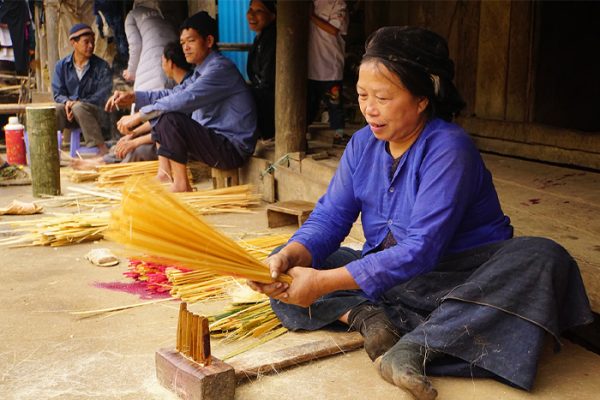
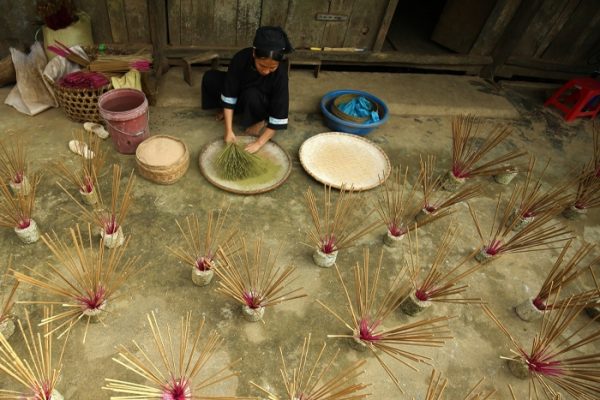
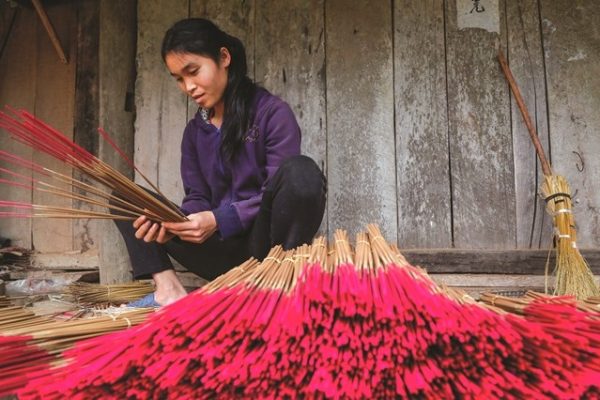
You’ve probably seen the photo without knowing what you were looking at: hundreds of incense bundles fanned out like peacock tails across a courtyard, vivid reds and pinks blazing in the afternoon light, a woman in indigo clothing tending to them like a gardener working with fire. It’s one of the most striking images that comes out of Cao Bang Province, and the place behind it is Phia Thap — a small Tay minority village that has been making incense by hand for generations.
Phia Thap isn’t famous the way Ban Gioc Waterfall is famous. It doesn’t have a ticket booth or a souvenir market or a laminated sign explaining the historical significance in four languages. What it has is a living craft, a community that still practices it daily, and the kind of unhurried, close-up cultural encounter that most travellers are looking for but rarely find.
This guide covers everything you need to know to visit: what the village is, how to get there, what the craft actually involves, how to visit without being a nuisance, and how Phia Thap fits into a broader Cao Bang itinerary.
Learn more: Ha Giang to Cao Bang
Phia Thap is a Tay ethnic minority village located in Quang Uyen District, Cao Bang Province, northeastern Vietnam. The Tay people are Vietnam’s largest ethnic minority group by population, concentrated in the northern highlands, and are known for their stilt house architecture, weaving traditions, and deep agricultural roots in the river valleys and karst lowlands of the northeast.
What makes Phia Thap distinctive within the Tay communities of Cao Bang is its centuries-old tradition of handmade incense production. The village has specialised in making incense sticks — primarily the vivid red and pink sticks (hương or nhang in Vietnamese) used in Vietnamese and Chinese religious practice — for so long that the craft has become inseparable from the community’s identity.
Nearly every household in the village participates in the production in some way, whether in gathering and preparing the raw materials, mixing the paste, rolling the sticks, or managing the drying process. It’s not a demonstration set up for tourists — it’s how the village earns its living.
Handmade incense production has largely been displaced elsewhere in Vietnam and China by industrial manufacturing, which produces cheaper sticks at scale. Phia Thap has maintained the traditional craft for a few intersecting reasons: geographic isolation that slowed industrialisation’s reach, the specific quality of locally available natural ingredients, and a community structure in which the knowledge has been passed from generation to generation as practical livelihood rather than cultural performance.
That combination — a real craft, in a real community, still economically meaningful — is what makes Phia Thap a genuine cultural experience rather than a staged one. The people working on incense when you arrive aren’t doing it because tourists are watching. They’re doing it because there’s a drying cycle to manage.
Learn more: Explore just the Cao Bang Loop
Phia Thap Village is located in Quang Uyen District, roughly between Cao Bang City and the Ban Gioc Waterfall area in Trung Khanh District. Geographically, it sits in the central-eastern part of Cao Bang Province, which makes it a natural waypoint on a route connecting Cao Bang City to the northeastern border area where Ban Gioc is located.
This positioning is part of what makes Phia Thap so easy to incorporate into a Cao Bang itinerary — it’s not a dedicated out-and-back detour, it’s a natural stop on the road between two of the province’s most significant attractions.
From Cao Bang City, Phia Thap is accessible by motorbike on provincial roads heading northeast toward Quang Uyen. The road passes through classic Cao Bang countryside — karst lowlands, rice paddies, river crossings, and small market towns. The drive itself is part of the experience, not just a necessary transit.
The exact time depends on road conditions and how many stops you make. As with all Cao Bang Province roads, check conditions locally before you leave and don’t rely solely on map estimates for arrival times.
The roads in this part of Cao Bang are generally in better condition than the highland mountain roads further north and west. The Cao Bang–Quang Uyen corridor is a travelled route and maintained accordingly. That said, heavy rain can affect sections of the road, and rural Cao Bang roads have their own character — narrow, occasionally unsigned, and with the kind of surface variations that reward attentive riding over confident speed.
For riders unfamiliar with Vietnamese rural roads, or anyone on their first trip to Cao Bang Province, going with a guide who knows the route removes the navigation uncertainty and opens up the cultural context at each stop.
Learn more: Cao Bang Loop Tours Vietnam best kept secret
The incense-making process at Phia Thap is entirely manual — no machinery, no industrial inputs. Understanding roughly what’s involved makes the visit far more interesting than just watching people work.
The incense sticks at Phia Thap are made from a combination of natural materials harvested from the surrounding forests and fields. The core ingredients typically include:
The specific plant species and proportions used vary between families and are considered knowledge passed within households — the Tay equivalent of a family recipe. You’re unlikely to get the exact formula from any one maker, and that’s entirely as it should be.
Mixing the paste. The dry ingredients are combined with water to create a workable paste. The consistency matters — too wet and the sticks won’t hold their shape during rolling; too dry and they crack when drying.
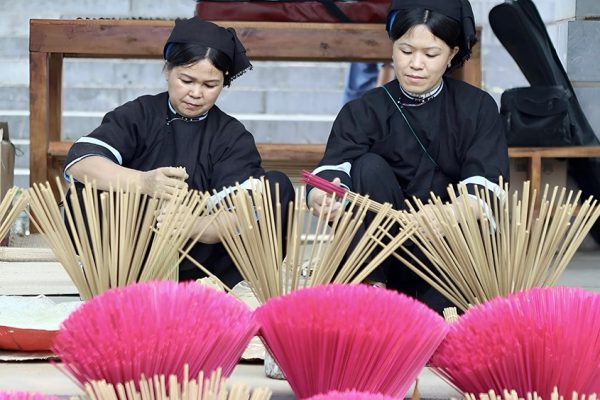
The bamboo core. Each incense stick is rolled around a thin bamboo skewer. The paste is applied by hand, rolled against a flat board in a smooth, practiced motion, and built up in layers to the right diameter. Watch a skilled maker do this and the speed is remarkable — each stick takes seconds, and a good maker can produce hundreds in a morning.
Rolling and shaping. The finished sticks need to be uniform in diameter and length for even burning. This is where experience shows — new makers produce sticks with variations; experienced makers produce near-identical sticks by feel alone.
Natural dyeing. After rolling, the sticks are dipped in natural dye solution — the red and pink that gives Phia Thap incense its visual signature. The colour penetrates the outer layer of the paste while leaving the inner core undyed.
Drying. This is the step that produces the photograph everyone has seen. The freshly dyed sticks are bundled and fanned out across open ground, hillsides, courtyards, and any flat surface that catches the sun. The drying process takes hours to a full day depending on conditions, and the spread of coloured bundles across the landscape creates the visual that has made Phia Thap recognisable even to people who don’t know its name.
During drying, the sticks are turned periodically to ensure even cure. The smell in the village during a drying cycle is extraordinary — not yet the smoke of burning incense, but the raw aromatic materials drying in the sun, something between forest floor and spice market.
The drying display at Phia Thap is not arranged for aesthetic effect. The patterns — radial fans, straight rows, circular spreads — are purely functional, designed to maximise surface area exposure and allow air circulation between bundles. The fact that this also happens to be one of the most visually arresting sights in Cao Bang is incidental.
The scale of a full drying day is striking. Multiple households producing simultaneously means the village during peak production can have hundreds of thousands of sticks drying at once. Colours range from deep crimson to soft rose depending on the dye batch and the wood used. Set against the wooden stilt houses, the green hills behind, and the limestone karst backdrop of Cao Bang, it’s the kind of scene that rewards slow looking rather than a quick shot.
Learn more: Ha Giang Loop 3 Days 2 Nights
Phia Thap is a working village first and a tourist destination second — which means it offers things that no purpose-built cultural attraction can replicate.
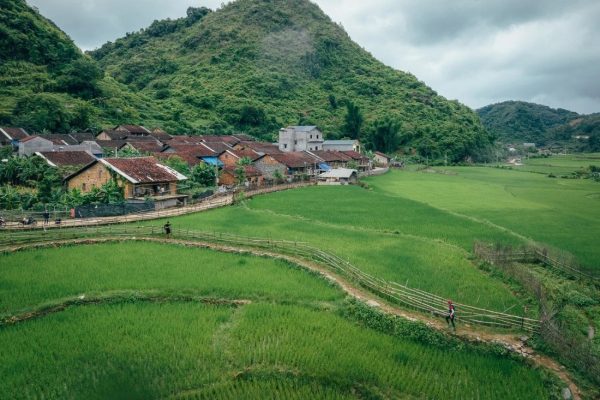
The stilt houses are traditional Tay architecture: built on wooden posts above ground level, with open living areas on the raised floor, storage and animals below, and roof structures that vary in detail between older and newer builds. Walking through the village, you see houses in various states — some original and weathered, some partially modernised, some newly built with a mix of traditional form and contemporary materials.
Village life happens visibly. Women working on incense outside their houses while children play nearby. Older men tending gardens. Motorbikes loaded with material coming in from the fields. The domestic rhythms of a community that isn’t performing for an audience.
The surrounding landscape is Cao Bang’s lowland karst at its most approachable — not the dramatic vertical cliffs of the plateau, but a gentler rolling terrain of limestone hills, paddy fields, and river corridors that feels simultaneously remote and inhabited.
Nearby, small markets in Quang Uyen serve the local community rather than tourists — worth a stop if your timing coincides with a market day, where you’ll see the practical commerce of rural Cao Bang rather than a curated craft market.
Learn more: Ha Giang Loop Weather
The dry season is the optimal window for visiting Phia Thap, for the same reasons it’s the right time for most of Cao Bang: stable roads, clear skies, and the best conditions for the outdoor drying process that defines the village experience.
Within this window:
October to November is the strongest period. The rice harvest has recently finished, the terraced fields in the surrounding area carry the gold and yellow of cut paddies, and the light in the afternoon has that warm-angle quality that makes everything photograph well. Incense production tends to be active, drying conditions are good, and tourist numbers in Cao Bang remain low relative to other regions of Vietnam.
February to April brings warmer temperatures, blooming trees in the highland villages, and generally clear skies. Production continues year-round in Phia Thap — incense is a daily livelihood, not a seasonal one — so you’ll find activity at the village in any season.
December to January is cold in Cao Bang. The village is still active, but drying conditions are slower, fog is common in the mornings, and the landscape has a stripped-back quality that some travellers find beautiful and others find austere. If you go in winter, dress for the cold — the mornings especially can be sharply chilly.
Learn more: Ha Giang in September & October
High humidity and frequent rain make the drying process slower and less predictable in the rainy season, which means you might visit and find fewer incense bundles out to dry than in peak season. The craft continues regardless — incense-making doesn’t stop for rain — but the drying display that’s become the village’s visual signature is less guaranteed.
Roads in this area of Cao Bang are generally manageable in rainy season, but check locally before heading out on any rural road after heavy rain.
Morning is best. The drying typically begins in the morning after the previous day’s sticks have been rolled, and the light in the first half of the day is ideal both for the photographs and for finding the most people actively working. Afternoons are quieter as the drying is underway and attention shifts to other household tasks.
Arriving early — ideally by 8–9 AM — gives you the best combination of active production, good light, and the village going about its day before the warmest part of the afternoon.
Learn more: Ha Giang Loop 4 Days 3 Nights
Lorem ipsum dolor sit amet, consectetur adipiscing elit. Ut elit tellus, luctus nec ullamcorper mattis, pulvinar dapibus leo.
This section matters more at Phia Thap than at a commercial attraction, because you’re visiting people’s homes and workplaces.
Ask before photographing people. The drying incense fields are photogenic and largely fair game — they’re set out in public spaces. Photographing people at close range in or around their houses is a different matter. A smile, a gesture toward your camera, and a pause for a response costs nothing and communicates respect across any language barrier.
Don’t touch the drying sticks. A knock to a drying bundle can collapse hours of careful arrangement. Walk around the spreads, not through them.
Don’t enter houses uninvited. Stilt house interiors are private homes, not museum displays. If a family invites you in — which sometimes happens when a guide is present and can facilitate the conversation — that’s different. But assume the threshold is private until indicated otherwise.
Keep voices moderate. Village life has its own noise level. A group of tourists arriving at volume changes the atmosphere in ways that aren’t always welcome.
Phia Thap incense is available to purchase directly from village households — bundles of sticks in various sizes, natural-dye coloured, with the specific scent profile of the local ingredients. Buying directly from producers is the right thing to do here: it puts money directly into the households you’re visiting, not an intermediary, and it means the incense you take home is the actual product of the craft you’ve just watched.
Prices are low by any international standard. Don’t negotiate aggressively — the margin in handmade incense production is already thin.
The practical consideration: incense sticks are fragile and best transported wrapped. If you’re continuing on a multi-day motorbike trip, figure out how to protect them before you buy more than you can safely carry.
Visiting Phia Thap as part of a guided tour? Loop Trails’ [Ha Giang–Cao Bang combine tours] include cultural village stops like this with guides who can facilitate the conversations and context that make the visit more than a photo stop. [Browse tour options here.]
Learn more: Ban Gioc Waterfall Guide
Phia Thap’s position in central-eastern Cao Bang makes it a natural anchor for a full-day or multi-day itinerary covering the province’s highlights.
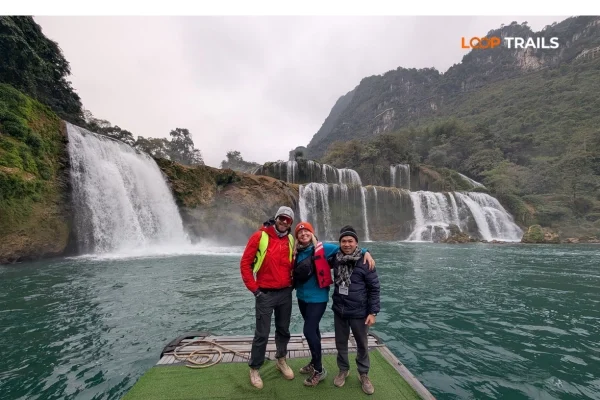
Vietnam’s most spectacular waterfall sits roughly an hour to the northeast of Phia Thap, in Trung Khanh District on the Vietnamese–Chinese border. The falls are at their most powerful in September–October (just after rainy season peak) but are genuinely impressive year-round. Most visitors to this corner of Cao Bang combine Ban Gioc with Phia Thap in the same day or on consecutive days.
If you’re doing both in one day, start at Phia Thap in the morning (for the light and the active production), then continue to Ban Gioc for the afternoon. The return drive gives you the waterfall in softer late-afternoon light.
Learn more: Nguom Ngao Cave
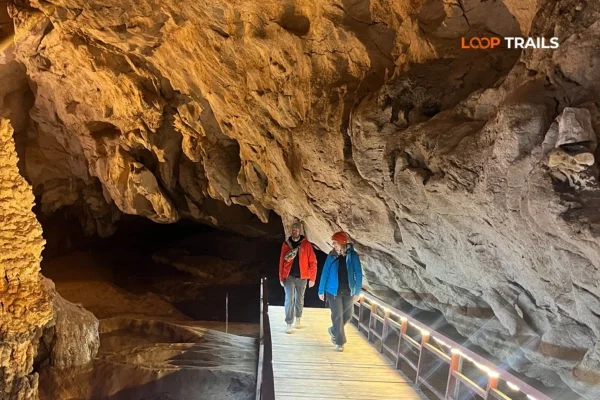
A few kilometres from Ban Gioc, Nguom Ngao is one of the most impressive accessible cave systems in northern Vietnam. The stalactite formations are large-scale and well-lit, and the standard tour route takes about an hour inside. If you’re visiting Ban Gioc, Nguom Ngao is worth adding — the extra time required is modest relative to the reward.
Northeast of Cao Bang City and in a different direction from Ban Gioc, Thang Hen is a chain of highland lakes set against karst peaks. The drive to Thang Hen is itself one of Cao Bang’s scenic highlights, and the lakes in clear weather reflect the surrounding limestone landscape in a way that photographs unlike anything else in the province. Low infrastructure, low crowds — a different register from Ban Gioc’s intensity.
Learn more: Visiting God’s Eye Mountain
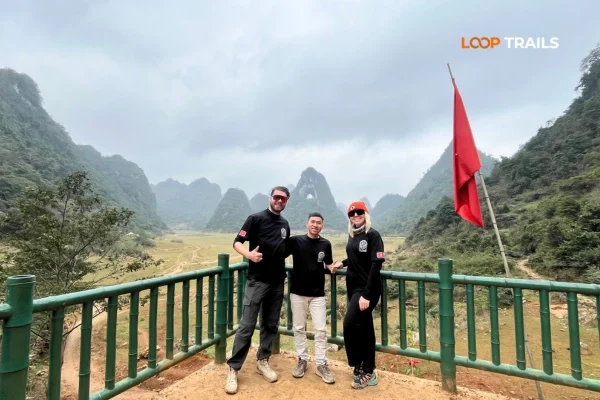
Also in Cao Bang Province, God’s Eye Mountain (Mắt Thần Núi) is a natural circular rock formation — a hole through a limestone cliff — that is as photographically striking as anything in the province. It requires a moderate hike and some navigation effort to reach, but for travellers building a full Cao Bang itinerary, it deserves a slot. See our [God’s Eye Mountain guide] for the full breakdown.
In the western reaches of Cao Bang Province, Phia Oac is high-altitude cloud forest territory — a completely different landscape character from the limestone lowlands around Phia Thap. If you’re approaching Cao Bang from the Ha Giang direction, Phia Oac is a natural addition to the route. Dense forest, colonial-era remnants in the Phia Den tea village below the peak, and almost no tourists.

Learn more: What to wear on Ha Giang Loop?
Phia Thap is signed locally but not heavily promoted in English-language navigation apps. Download offline maps for Cao Bang Province before you leave accommodation, and cross-reference with your guide or guesthouse for the current best approach. The village is in Quang Uyen District — search for that as your general navigation target and ask locally for the specific village access road.
Incense-drying fields: yes, freely. Village environments and streetscapes: yes, with awareness. Close-up portraits of people at work: ask first, read the response honestly. Children: be especially thoughtful. A genuine smile is not the same as informed consent to being photographed.
Very little English is spoken in Phia Thap itself. A Vietnamese-speaking guide makes the visit significantly richer — you can ask questions about the process, understand what household you’re visiting and who they are, and have the kind of exchange that transforms a visual stop into an actual encounter. Phrasebook Vietnamese is welcomed, if imperfect. Silence with a genuine smile communicates a surprising amount.
A minimum of an hour on-site; two hours is better if you want to see the full production cycle from rolling through to drying and have time to wander the village. If you’re combining Phia Thap with Ban Gioc and Nguom Ngao in the same day, build in transition time between stops — distances on Cao Bang roads are consistently longer in practice than on a map.
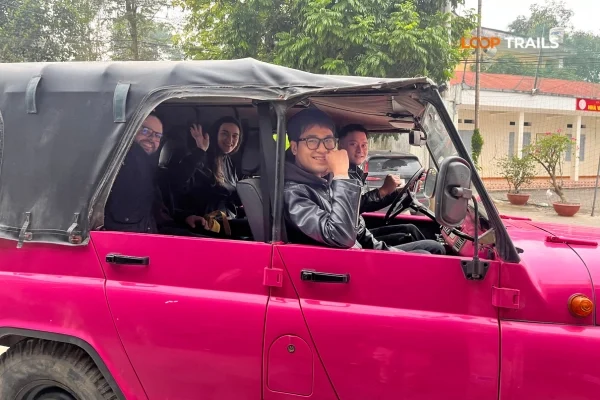
Learn more: Ha Giang Cao Bang Loop Jeep tour Guide
Phia Thap is best experienced as part of a Cao Bang itinerary rather than a standalone day trip. Here’s how the different Loop Trails options cover it:
Ha Giang–Cao Bang Combine Tour This is the most natural fit for Western travellers already planning a Ha Giang trip. The route covers the Ha Giang Loop’s iconic landscape — Dong Van, Ma Pi Leng Pass, Meo Vac, the Nho Que River valley — before continuing northeast into Cao Bang Province. Phia Thap sits on the road to Ban Gioc and can be incorporated as a half-day cultural stop before hitting the waterfall. For travellers who want both the dramatic Ha Giang karst scenery and the cultural depth of Cao Bang, this route delivers both without choosing.
Cao Bang Loop / Dedicated Cao Bang Tour If you’ve already done Ha Giang, or you’re specifically interested in Cao Bang as a destination, a dedicated Cao Bang itinerary gives the province the time it deserves. A well-structured Cao Bang loop can cover Phia Thap, Ban Gioc, Nguom Ngao, Thang Hen, and God’s Eye Mountain across three or four days without rushing any of them.
Easy Rider Guided Tour For cultural stops like Phia Thap, the Easy Rider format has a specific advantage: a local guide who speaks Vietnamese can facilitate actual interaction with the village — conversations with incense makers, context about what you’re seeing, introductions that open doors that a map and a camera can’t. If the cultural encounter matters to you as much as the photograph, Easy Rider is the right choice for this stop.
Self-Drive Motorbike Experienced riders who’ve researched the route and have offline navigation sorted can absolutely get to Phia Thap independently. The roads in this part of Cao Bang are manageable. The trade-off is the language barrier at the village itself — you’ll see the craft and the drying fields, but the depth of the encounter depends on whether you can communicate with the people there. Some travellers are fine with that; others find it limiting.
Not sure which option suits your trip? Loop Trails keeps group sizes small and builds genuine time into cultural stops like Phia Thap — not a ten-minute photo break, but enough time to actually see the village and understand what you’re looking at. [Browse our Cao Bang and Ha Giang–Cao Bang tours] or [send us a WhatsApp message] to talk through the right route for your timeline.
Learn more: Northern Viet Nam Itinerary 2026
It’s easy to skip places like Phia Thap in favour of the headline attractions. Ban Gioc is on every Cao Bang itinerary. Nguom Ngao gets the visitor numbers. Phia Thap doesn’t have the same name recognition, doesn’t promise the same instant visual drama, and requires you to slow down to a pace that some itineraries don’t budget for.
What it offers is something that’s genuinely getting harder to find in northern Vietnam’s increasingly touristed highlands: a living craft, in a living community, practiced daily for economic reasons that have nothing to do with your visit. The incense-making at Phia Thap is not a demonstration. It’s not scheduled around tourist arrivals. It’s how the village works, and you’re welcome to watch and buy while it does.
That kind of unmediated cultural encounter has a different weight than a well-staged attraction. It’s slower, it’s quieter, and it requires more of the traveller — attention, courtesy, curiosity about what’s actually happening rather than just what makes the best photo. But the return on that investment is the kind of travel memory that lasts longer than a waterfall.

Learn more: Ha Giang Cao Bang 5 Days
Phia Thap is a Tay ethnic minority village in Quang Uyen District, Cao Bang Province, known for its centuries-old tradition of handmade incense production. The village is famous for its vivid red and pink incense sticks, made entirely by hand from natural forest materials, and the iconic images of bundles drying in fanned-out arrangements across the village courtyards.
Phia Thap is in Quang Uyen District, Cao Bang Province, northeastern Vietnam. It sits between Cao Bang City and the Ban Gioc Waterfall area, making it a natural stop on the route connecting Cao Bang’s main attractions. Check locally or with your tour operator for the current best access road.
The incense is made entirely by hand using natural materials — aromatic wood powder, bark-based binders, and plant-derived dyes — with recipes passed down through Tay families over generations. No industrial inputs, no machinery. The result is a different product from factory-made incense: more aromatic, slower-burning, and made by a specific community in a specific place.
Yes — buying directly from households in Phia Thap is both possible and encouraged. It puts money directly into the community you’re visiting. Bring cash (Vietnamese dong); card payment is not available. Bundles of sticks in various sizes are typically available.
October to April (dry season) is optimal, with October–November being the strongest window for good light, clear skies, and active production. The incense-making process continues year-round, but drying conditions (and therefore the iconic visual display of bundles laid out in the sun) are best in the dry season.
Budget at least an hour on-site; two hours allows you to see the rolling and drying process, walk the village, and make purchases without rushing. If combining with Ban Gioc and Nguom Ngao in the same day, build in enough transit time — Cao Bang roads take longer than maps suggest.
It’s doable for experienced riders with offline navigation and some Vietnamese, but it’s significantly richer with a local guide who can facilitate interaction with the makers. The village itself is not set up as a tourist attraction, so independent navigation and communication can be limited without language support.
The incense drying fields are the main visual draw and can be photographed freely. For close-up portraits of people working, ask permission first — a smile and a gesture toward the camera gets the message across without words. Treat the village as you would anyone’s workplace: observe, appreciate, ask before you intrude.
It’s a long day trip — Ha Giang to the Cao Bang area involves significant distance on mountain roads. A much better approach is a multi-day Ha Giang–Cao Bang combine tour that covers both provinces over four or more days, allowing time to do Phia Thap properly rather than as a rushed stop at the end of a long drive.
The Tay are Vietnam’s largest ethnic minority group, concentrated in the northern highlands. They’re known for stilt house architecture, weaving traditions, and strong agricultural roots in the river valleys and karst lowlands of northeastern Vietnam. Phia Thap is a traditional Tay community, and understanding even the basics of Tay culture adds real depth to the visit.
Yes — Phia Thap can be included in Loop Trails’ Ha Giang–Cao Bang combine tours and dedicated Cao Bang itineraries. Contact us via WhatsApp or the tour booking page to confirm inclusion and current availability.
Yes, generally — but with the courtesy that any community visit requires. The drying fields and production process are openly visible and photographable. Always ask before photographing people closely, and be especially thoughtful about photographing children. The village is not a tourist attraction built around being observed; behave accordingly and the experience will be better for everyone.
Contact information for Loop Trails
Website: Loop Trails Official Website
Email: looptrailshostel@gmail.com
Hotline & WhatSapp:
+84862379288
+84938988593
Social Media:
Facebook: Loop Trails Tours Ha Giang
Instagram: Loop Trails Tours Ha Giang
TikTok: Loop Trails
Office Address: 48 Nguyen Du, Ha Giang 1, Tuyen Quang
Address: 48 Nguyen Du, Ha Giang 1, Tuyen Quang

Facebook X Reddit Table of Contents Learn more: Ha Giang Loop Tours There’s a version of the Ha Giang Loop that people
Facebook X Reddit Table of Contents Learn more: Ha Giang Loop Tours There’s a moment on the Ma Pi Leng Pass —