

Ha Giang Loop Hidden Gems: Secret Spots Off the Beaten Path
Facebook X Reddit Table of Contents Learn more: Ha Giang Loop Tours There’s a version of the Ha Giang Loop that ends

Thúy Kiều( Grace) is a travel blogger and content contributor for Loop Trails Tours Ha Giang. She holds a bachelor’s degree in Sustainable Tourism from Vietnam National University, Hanoi, and has a strong passion for exploring and promoting responsible travel experiences in Vietnam’s northern highlands.
You’re planning the Ha Giang Loop, bikes are booked, route mapped out—then someone mentions police checkpoints. Suddenly you’re wondering: what happens if I get stopped? Will they check my license? Are there fines? Can they confiscate my bike?
Let’s clear this up. Police checkpoints exist in Ha Giang, but they’re not something to lose sleep over. Most travelers pass through without issues, especially if they understand what to expect and come prepared. This guide walks you through everything: what documents you actually need, what happens during a stop, how to handle fines, and which tour option makes the whole license question disappear.

Learn more: Ha Giang Loop Tours

Learn more: Ha Giang Loop Jeep Tours
Ha Giang province sits along Vietnam’s northern border with China. The region sees a mix of local traffic, commercial vehicles, and thousands of foreign tourists riding motorbikes through some of the country’s most remote mountain passes. Checkpoints serve a few purposes: checking documentation, monitoring traffic in sensitive border areas, and occasionally enforcing safety regulations.
The frequency and strictness of these checkpoints change. Sometimes you’ll ride the entire loop without seeing one. Other times, you might encounter two or three. Enforcement tends to tighten during holiday periods (Vietnamese New Year, national holidays) and occasionally after accidents involving tourists.
You won’t find checkpoints randomly scattered everywhere. They typically appear at a few predictable spots: entering or leaving Ha Giang city, near Quan Ba (Heaven’s Gate area), around Dong Van, and sometimes near Meo Vac. These locations make sense—they’re transition points between districts and natural places to monitor who’s moving through the region.
Border areas near Lung Cu Flag Tower occasionally have more security presence, though checkpoints there focus more on passport checks than motorcycle licenses. The stretch through Ma Pi Leng Pass usually stays clear, since it’s a narrow, winding road where setting up a checkpoint would create more problems than it solves.

Learn more: Ha Giang Loop 4 Days 3 Nights
Here’s the situation: Vietnamese law requires riders to have a valid motorcycle license to operate bikes above 50cc on public roads. For foreigners, this means you theoretically need either a Vietnamese motorcycle license (extremely difficult to obtain as a tourist) or an International Driving Permit (IDP) that specifically includes motorcycle authorization.
The practical reality is more complicated. Many travelers ride the loop without proper licensing and never face issues. Others get stopped at a checkpoint, lack the right documents, and pay a fine. The enforcement is inconsistent enough that you can’t predict what will happen, but you should know the legal requirements exist.
An IDP alone doesn’t make you legal to ride in Vietnam. You need an IDP that lists motorcycle/motorbike authorization, AND it must be paired with your home country’s valid motorcycle license. If your home license only covers cars, adding a motorcycle IDP doesn’t suddenly make you qualified.
Many travelers arrive with car-only IDPs or without IDPs entirely. Some checkpoint officers accept these documents anyway. Others don’t. There’s no consistent enforcement standard, which makes it impossible to guarantee you’ll have zero issues.
If you have a proper motorcycle-endorsed IDP and home license, you’re in the best possible position for self-drive. If you don’t, consider whether potential fines, confiscations (rare but possible), or checkpoint stress is worth the risk. For many travelers, especially first-timers, choosing an Easy Rider or Jeep tour eliminates the question entirely.
Always carry your passport when riding the Ha Giang Loop. Border proximity means passport checks happen more frequently than in other parts of Vietnam. Officers want to see your visa stamps, entry date, and verify your legal status in the country.
Make sure your visa hasn’t expired. Some travelers extend their Vietnam trips and forget to check dates—getting stopped with an expired visa creates much bigger problems than a license issue. Bring the original document, not just a photocopy. Some checkpoints accept copies, but most prefer to see the real thing.
Learn more: Ha Giang Loop 3 Days 2 Nights
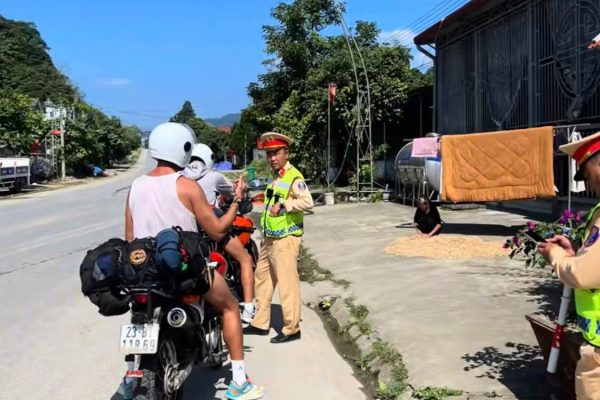
You’re riding along, round a corner, and see orange cones narrowing the road. An officer in uniform waves you to the side. This is what typically happens:
You pull over and turn off your engine. The officer approaches, usually greeting you politely in Vietnamese. If you don’t speak Vietnamese, they’ll likely switch to basic English or use hand gestures. First request: passport. You hand it over. They flip through, check your visa stamp, confirm entry dates.
Next: license. If you have a motorcycle-endorsed IDP and home license, you present both. The officer examines them, sometimes closely, sometimes barely glancing. If everything appears in order, they hand your documents back and wave you through. Total time: 2-3 minutes.
If you don’t have proper documents, the interaction extends. The officer might shake their head, point to a clipboard with fine amounts, or radio another officer who speaks better English. This is when negotiation or payment discussions begin.
Most officers at checkpoints ask the same questions: Where are you from? Where are you going? How long are you staying in Vietnam? These aren’t interrogations—they’re standard questions that help them understand who they’re dealing with. Answer honestly and keep responses simple.
Some officers ask about your tour company or guide. If you’re on an Easy Rider tour, mention your guide’s name or your tour company. Having an organized tour often leads to quicker processing since companies typically communicate with local authorities.
Occasionally an officer asks about your motorcycle: whose bike is it? Where did you rent it? These questions come up more if you’re riding a bike with unclear registration or if there’s been a recent theft report in the area. Show your rental agreement if you have one.
Most checkpoint stops last 3-5 minutes when documents are in order. The officer checks papers, asks a question or two, and sends you on your way. If there’s a backup of several vehicles, add waiting time—you might stand around for 10-15 minutes before reaching the front of the line.
Document issues extend stops. Negotiating a fine, waiting for an English-speaking officer, or trying to contact your tour company can stretch the interaction to 20-30 minutes. In rare cases where more serious violations are suspected, you might wait an hour or longer while they consult with senior staff.

Learn more: Cao Bang Loop Tours Vietnam best kept secret
Fine amounts for license violations vary wildly. Official traffic fines for riding without a proper license range from 400,000 to 800,000 VND (roughly $16-32 USD). However, on-the-spot fines negotiated at checkpoints often land between 200,000 and 500,000 VND ($8-20 USD).
The amount depends on factors: how busy the checkpoint is, whether you’re alone or with a group, your attitude during the interaction, and frankly, the officer’s mood that day. Some travelers report paying 100,000 VND, others 600,000 VND for essentially the same violation.
Group situations sometimes see one fine split among multiple riders without proper licenses. If three people in your group lack documents, the officer might levy a single 500,000 VND fine that you divide three ways rather than charging each person separately.
Here’s the uncomfortable truth: most on-the-spot fines operate in a legal gray area. Official Vietnamese traffic fines require receipts, written documentation, and proper processing. An officer who asks for 300,000 VND in cash and waves you on without paperwork isn’t following official procedure.
That said, refusing to pay often creates bigger problems. Officers can theoretically confiscate your bike, take you to the police station for formal processing, or prevent you from continuing your journey. Most travelers choose to pay the requested amount, take the hassle-free option, and continue riding.
If you push back on an unreasonable fine, stay polite and calm. Sometimes asking for a receipt reduces the requested amount (since a receipt creates an official record). Other times it just prolongs the interaction without changing the outcome. Use your judgment based on the situation.
Receiving an official receipt for your fine is rare at Ha Giang checkpoints but not impossible. If an officer processes everything formally—filling out paperwork, providing a receipt with official stamps, explaining where to pay the fine if not collected on-spot—you’re dealing with legitimate official procedure.
More commonly, fines are collected in cash without receipts. The officer pockets the money or splits it with colleagues. This isn’t how the system is supposed to work, but it’s how things often function in practice. You’re paying to make the problem go away rather than dealing with an official violation on your record.
Whether you demand a receipt is your choice. Some travelers feel better getting documentation even if it takes longer. Others want to move on quickly and accept the informal arrangement. There’s no universal right answer.

Learn more: Ha Giang on September & October
Self-drive motorcycle tours put the license responsibility entirely on you. If you lack proper documentation and get stopped, you handle the consequences. Tour companies rent you the bike but don’t provide legal protection at checkpoints. Some give you a Vietnamese “license” (usually fake) as part of the rental, which can actually make things worse if an officer recognizes it as counterfeit.
Easy Rider tours change the equation. Your guide is a licensed Vietnamese driver operating the motorcycle. You’re a passenger. At checkpoints, the officer checks your guide’s documents, not yours. The license burden shifts away from you entirely. This setup eliminates the biggest stress point for many travelers.
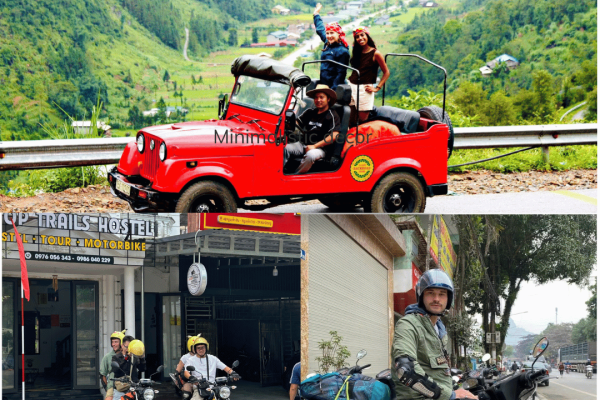
Jeep tours remove the question completely—no motorcycle licenses, no IDP requirements, no checkpoint concerns beyond basic passport checks. You sit in a vehicle with a professional driver who handles all documentation.
Not all tour companies handle license situations the same way. Some provide fake licenses to self-drive customers, thinking it helps. It doesn’t—experienced officers spot fakes immediately, and being caught with counterfeit documents creates worse problems than having no license at all.
Better companies tell customers the honest truth: bring a proper motorcycle-endorsed IDP and home license for self-drive, or choose Easy Rider/Jeep options if you lack documentation. The best companies also maintain relationships with local authorities, so if their clients do encounter issues, a phone call can sometimes smooth things over.
When booking your tour, ask directly about license support. Avoid companies that promise “we’ll handle everything” without explaining how. Choose operators who give you accurate information about the legal situation and help you make informed decisions.
Don’t argue aggressively with officers. Raising your voice, making accusations, or refusing to cooperate escalates situations that could be resolved in minutes. Stay calm, speak respectfully, and remember that the officer has significantly more power in this interaction than you do.
Don’t try to bribe your way out before being asked for a fine. Offering money unprompted can backfire badly—some officers take offense at the assumption they’re looking for bribes. Wait for them to indicate a fine first, then respond appropriately.
Don’t flee from checkpoints. This should be obvious, but every year someone panics, revs their engine, and tries to speed away. That turns a minor document issue into a much more serious problem involving multiple officers, potential arrest, and guaranteed confiscation of the bike.
Don’t use fake licenses. The temptation is understandable—your tour operator offers a “Vietnamese license” as part of the package. But experienced officers know what real licenses look like. Getting caught with a fake creates legal issues beyond a simple fine.
Learn more: Ha Giang Motorbike Rental
Easy Rider tours are Ha Giang’s most popular option for good reason. Your guide rides the motorcycle, you sit behind as a passenger, and license requirements become their problem instead of yours. At checkpoints, officers verify your guide’s documents while you wait. Simple.
Beyond the license advantage, Easy Rider tours offer significant value: guides know the roads intimately, take you to places self-drivers would miss, handle accommodation and meal arrangements, and provide local cultural insights no guidebook can match. You’re not just avoiding checkpoint stress—you’re getting a better overall experience.
Loop Trails offers Easy Rider options for all major routes: Ha Giang Loop 2D1N (3,290,000 VND/person), 3D2N (3,990,000 VND/person), and 4D3N (5,090,000 VND/person). The 5D4N Ha Giang-Cao Bang tour (10,990,000 VND/person) extends the adventure even further, hitting highlights in both provinces with zero license concerns.
Rates include your guide, accommodations in local homestays (dorm-style), all meals, and entrance fees. Bus transfers from Hanoi, Ha Long, Cat Ba, Ninh Binh, or Sapa to Ha Giang (and return) can be arranged separately—VIP sleeper buses run 350,000 VND, cabin sleepers 300,000 VND, depending on route and class.
Self-drive gives you maximum freedom and flexibility. Ride at your own pace, stop wherever you want, take that detour that catches your eye. For experienced riders who have proper licensing, it’s an incredible way to explore the region.
The catch: you need legitimate documentation. A motorcycle-endorsed IDP from your home country plus your original motorcycle license is the minimum. Without these, you’re gambling on whether you’ll encounter checkpoints and how strict enforcement will be during your trip.
Loop Trails offers self-drive options for travelers with proper licenses: 3D2N (3,390,000 VND/person), 4D3N (4,190,000 VND/person), and the 5D4N Ha Giang-Cao Bang route (10,290,000 VND/person). Prices include the motorcycle rental (typically Honda XR150 or similar), accommodations, and basic support. You’re responsible for navigation and handling any checkpoint situations.
If you don’t have the right license but still want to ride yourself, seriously consider the Easy Rider option instead. The cost difference is modest compared to potential fines, confiscation headaches, or having your trip disrupted.
Jeep tours are perfect for travelers who want the scenery without the motorcycle experience—or who simply want zero chance of license issues. You ride in a comfortable 4×4 vehicle with a professional driver who handles all documentation, navigation, and road concerns.
Jeep tours work especially well for families, couples who prefer relaxing together, or small groups where not everyone feels confident on a motorbike. You see the same stunning landscapes—Ma Pi Leng Pass, Dong Van plateau, Nho Que River—without any self-riding requirements.
Loop Trails runs Jeep tours for groups of 1-4 passengers. The 3D2N Ha Giang Loop costs 7,890,000 VND for 1 person, 15,690,000 VND for 2, 18,900,000 VND for 3, or 22,900,000 VND for 4. The 4D3N version runs 10,490,000-28,690,000 VND depending on group size. The 5D4N Ha Giang-Cao Bang Jeep tour starts at 29,890,000 VND for 2 people, scaling to 39,290,000 VND for 4.
These rates cover the private Jeep, driver, accommodations (dorm-style), meals, and activities. Private room upgrades and bus transfers are available at additional cost. For detailed pricing on buses from various cities, check bus options separately—rates vary from 250,000-700,000 VND depending on route and bus class.

Learn more: Ha Giang Loop Self-Driver Guide
Checkpoint experiences vary wildly depending on timing, location, and individual circumstances. A traveler in March 2024 reported riding the entire 4-day loop without encountering a single checkpoint. Another visitor in May 2024 hit checkpoints twice—once near Quan Ba and once entering Dong Van—but had proper documentation and passed through in minutes both times.
A self-driver without proper licensing shared their October 2024 experience: stopped at a checkpoint between Yen Minh and Dong Van, asked for license and IDP, couldn’t produce either, negotiated a 400,000 VND fine, and continued riding within 15 minutes. No confiscation, no major drama, just a fine and a handshake.
An Easy Rider passenger from December 2024 noted their guide was checked twice, but they were never asked for any personal documentation beyond their passport once. They specifically chose Easy Rider after reading checkpoint stories and felt relieved watching their guide handle everything.
Enforcement intensity seems to spike around major Vietnamese holidays. Several travelers reported significantly more checkpoints during the Tet holiday period in late January, with stricter document scrutiny than usual. If you’re planning to ride during Tet, National Day (September 2), or other major holidays, factor in potentially more checkpoint encounters.
Ha Giang’s tourism explosion over the past 3-4 years has led to evolving enforcement patterns. Five years ago, foreign tourists riding without licenses rarely faced consequences. Today, while enforcement remains inconsistent, authorities pay more attention to license issues than they used to.
Some local sources suggest this increased attention follows several accidents involving unlicensed foreign riders in 2022-2023. Whether true or not, there’s definitely a perception among tour operators that checkpoint scrutiny has intensified compared to the pre-COVID era.
That said, “intensified” doesn’t mean “guaranteed problems.” Plenty of riders still complete the loop without issues despite lacking proper documentation. The shift is more about increased chance of being checked rather than guaranteed enforcement.
Not necessarily. Some riders complete the entire loop without encountering checkpoints, while others see multiple stops. You can’t predict with certainty, but knowing they exist and being prepared is important.
No. Many checkpoint stops focus on passport and visa checks, especially near border areas. License checks are less consistent but do happen, particularly at checkpoints specifically monitoring traffic violations.
Legally, no. You need specific motorcycle authorization on your IDP and home country license. Some officers might not know the difference or might not care, but you’re technically riding illegally and risk fines.
Those are almost always fake. Using counterfeit documents is worse than having no documents at all. Experienced officers recognize fakes immediately, and being caught with one creates legal problems beyond simple fines.
Negotiated on-the-spot fines usually range from 200,000-500,000 VND ($8-20 USD). Official fines can be higher (400,000-800,000 VND), but most checkpoint situations result in lower negotiated amounts.
Theoretically yes, though confiscation is rare in practice. Most checkpoint issues resolve with a fine. Confiscation typically happens if you refuse to cooperate, try to flee, or have multiple serious violations.
No. You’re a passenger, not the operator. Your guide’s license covers the motorcycle operation. You only need your passport for identification at checkpoints.
Yes. Jeep tours involve no motorcycle licenses at all. Your driver has the proper documentation for the vehicle, and you’re just a passenger with your passport for identification purposes.
Absolutely not. The Ha Giang Loop is one of Southeast Asia’s most spectacular rides. Checkpoint concerns are manageable with proper preparation or by choosing Easy Rider/Jeep options. Don’t let fear of checkpoints stop you from experiencing this incredible region.
Most officers near tourist areas have basic English or use hand gestures to communicate. In rare cases with serious communication barriers, they’ll find someone who speaks English or use translation apps. Language barriers rarely prevent checkpoint processing.
Enforcement tends to increase during Vietnamese holidays (especially Tet in late January/early February) and occasionally after accidents involving tourists. Summer months (June-August) see more tourism and potentially more checkpoints.
Cash only. Checkpoints don’t have card readers. Keep small denominations of Vietnamese dong available if you’re concerned about potential fines—trying to pay a 300,000 VND fine with a 500,000 VND note might create change-making issues.

Learn more: Ha Giang Cao Bang 5 Days 4 Nights by Jeep
Here’s what matters: Ha Giang is stunning. The limestone karsts, the Ma Pi Leng Pass, the ethnic minority villages, the twisting mountain roads—this region offers one of the world’s great motorcycle adventures. Police checkpoints exist, document checks happen, but thousands of travelers successfully complete the loop every month.
If you have proper motorcycle licensing (IDP with motorcycle endorsement plus home motorcycle license), self-drive away with confidence. If you don’t have documentation but still want to ride yourself, understand you’re taking a calculated risk. Easy Rider and Jeep tours exist specifically to solve the license question while often providing better overall experiences than self-driving anyway.
Choose the option that matches your situation, prepare appropriately, and focus on the incredible journey ahead rather than worrying about checkpoints. The vast majority of travelers—properly licensed or not, self-drive or guided—complete the Ha Giang Loop without major incident.
The mountains are waiting. The roads are spectacular. The experience is unforgettable. Pick your tour style, understand the checkpoint realities, and go ride one of the world’s most beautiful roads.
Ready to book? Loop Trails offers Easy Rider, self-drive, and Jeep options for every itinerary length. Whether you want the classic 3D2N loop or the extended 5D4N Ha Giang-Cao Bang adventure, we’ve got you covered with experienced guides, well-maintained bikes, and local knowledge that makes the difference.
Contact us through WhatsApp to discuss which option works best for your situation, or check current availability for your travel dates. The Ha Giang Loop is calling—checkpoint concerns shouldn’t be what holds you back.
Contact information for Loop Trails
Website: Loop Trails Official Website
Email: looptrailshostel@gmail.com
Hotline & WhatSapp:
+84862379288
+84938988593
Social Media:
Facebook: Loop Trails Tours Ha Giang
Instagram: Loop Trails Tours Ha Giang
TikTok: Loop Trails
Office Address: 48 Nguyen Du, Ha Giang 1, Tuyen Quang
Address: 48 Nguyen Du, Ha Giang 1, Tuyen Quang
Facebook X Reddit Table of Contents Learn more: Ha Giang Loop Tours There’s a version of the Ha Giang Loop that ends
Facebook X Reddit Table of Contents Learn more: Ha Giang Loop Tours There’s a moment, usually somewhere on Ma Pi Leng Pass,

Facebook X Reddit Table of Contents Learn more: Ha Giang Loop Tours There’s a version of the Ha Giang Loop that people