

Thúy Kiều is a travel blogger and content contributor for Loop Trails Tours Ha Giang. She holds a bachelor’s degree in Sustainable Tourism from Vietnam National University, Hanoi, and has a strong passion for exploring and promoting responsible travel experiences in Vietnam’s northern highlands.
The view from Ma Pi Leng Pass gets all the attention—travelers stop their motorbikes, snap photos, and marvel at the Nho Que River hundreds of meters below. What fewer people realize is you can actually get down to that water. Tu San Canyon, carved over millennia by the Nho Que River, offers something Ma Pi Leng’s roadside viewpoints can’t: a chance to experience the landscape from inside it.
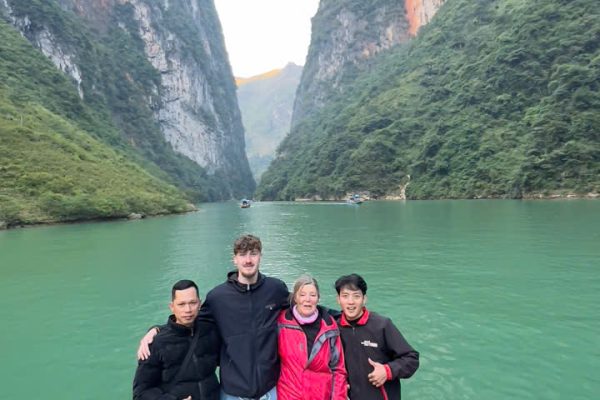
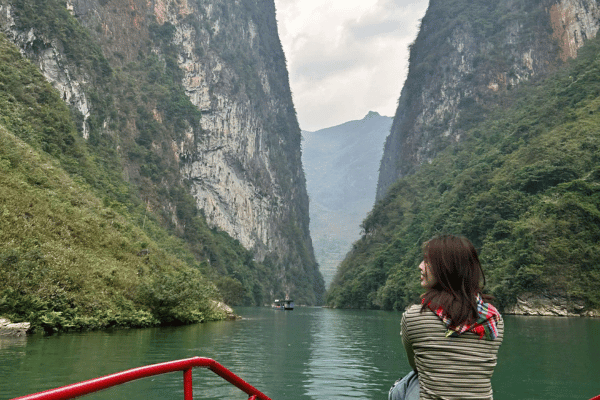
The boat trip on Nho Que River takes you through one of Vietnam’s deepest canyons, with limestone cliffs rising 700-800 meters straight up on both sides. The water shifts from emerald green to turquoise depending on depth and light. It’s quiet down there—engine noise echoes off canyon walls, then fades, leaving just the sound of water and wind. Above you, the Ma Pi Leng Pass road clings to cliff faces, looking even more improbable from below than it does when you’re riding it.
Tu San Canyon sits near Meo Vac, about 20 kilometers from the famous Ma Pi Leng viewpoint. Most Ha Giang Loop itineraries put you in Meo Vac on Day 3, which makes this the perfect add-on if you have a few hours to spare. The boat trip itself takes 45-60 minutes. Getting there, booking a boat, and experiencing the canyon properly needs 2-3 hours total.
This guide covers everything: how to reach Tu San Canyon, what the boat trip actually involves, costs and safety considerations, how to fit it into your Ha Giang Loop schedule, and whether the experience lives up to the hype. Spoiler: for some travelers, the boat trip becomes the highlight of the entire loop. For others, Ma Pi Leng Pass from above is sufficient. We’ll help you figure out which camp you’re in.
Learn more: Ha Giang Loop Tours

Learn more: Ha Giang in September & October
Tu San Canyon is a geological formation where the Nho Que River has cut through limestone karst, creating a gorge with near-vertical walls reaching 700-800 meters in height. The canyon sits in the Dong Van Karst Plateau Geopark, a UNESCO-recognized area in Ha Giang province. At its deepest points, Tu San is one of the most dramatic river canyons in Southeast Asia.
The canyon formed over millions of years as the Nho Que River eroded soft limestone, creating the narrow passage you see today. The river originates in China, flows through Vietnam for about 100 kilometers, then returns to China. The Tu San section represents the deepest and most spectacular portion of the Vietnamese segment.
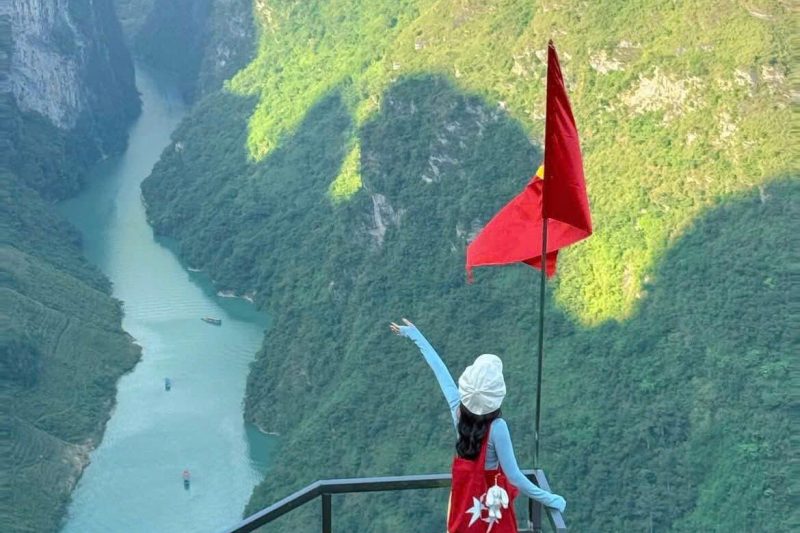
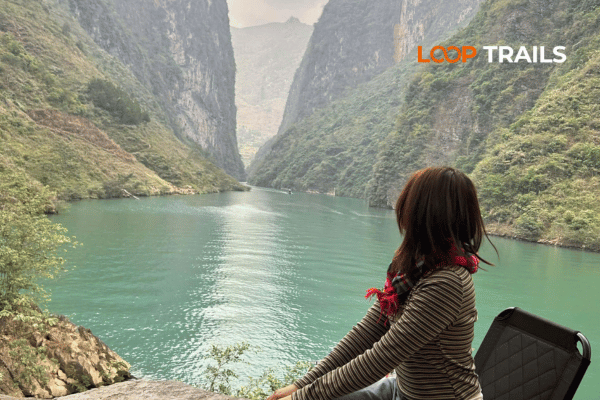
From above—whether you’re on Ma Pi Leng Pass or at designated viewpoints—Tu San appears as a narrow green-blue ribbon far below, dwarfed by surrounding peaks. From the water level, the perspective inverts: the canyon walls dominate, towering overhead and creating a sense of scale that’s hard to capture in photos.
The name “Tu San” translates roughly to “four lakes” or “four pools,” though the exact etymology varies depending on local language (Hmong vs Vietnamese). What matters less than the name is the geography: this is a place where water, stone, and time created something genuinely unique.
Tu San Canyon’s viewing platform was built in recent years to capitalize on growing Ha Giang Loop tourism. The boat trips are newer still—maybe five years of regular operation. This is not a long-established tourist infrastructure. Things are still developing, which means both opportunity (fewer crowds than more famous sites) and uncertainty (services can be inconsistent).
Learn more: Ha Giang Loop Itinerary: 2,3,4,5 days
The Nho Que River’s distinctive color comes from dissolved minerals—primarily calcium carbonate from the limestone—and the depth of the water. In shallow sections, it looks clear or light green. In deeper pools, it shifts to deep emerald or turquoise. When sunlight hits at certain angles, the colors intensify to an almost unnatural brightness.
Water clarity varies seasonally. During dry season (November-April), the river runs clearer and colors are most vibrant. Rainy season (May-October) brings sediment from upstream, turning sections murky brown. The boat trip is still possible during rainy season, but you lose the signature emerald color that makes the Nho Que photogenic.
The river is cold year-round—temperatures rarely exceed 15-18°C (59-64°F) even in summer. This isn’t a swimming destination, though some boat operators will let you dip your hands in the water. The current varies: slow in deep pools, faster in narrower sections. The canyon section used for boat trips is relatively calm, without serious rapids or dangerous currents under normal conditions.
Ecologically, the Nho Que supports fish populations and provides water for downstream agriculture, but the canyon section is too deep and fast for significant human habitation. Small Tay and Hmong villages dot the riverbanks outside the canyon, using the water for irrigation and daily needs.
The river’s role in Ha Giang’s landscape is central—it created the valleys where people live and farm, carved the passes that now carry roads, and shaped the entire region’s geography. Tu San Canyon is just one section, but it’s the most visually dramatic and accessible point where you can experience the Nho Que up close.
Learn more: Ha Giang Cao Bang 5 Days
Tu San Canyon viewpoint and boat dock sit about 20 kilometers northwest of Meo Vac town on the road toward Dong Van. If you’re staying in Meo Vac (the typical Day 3 overnight on the Ha Giang Loop), reaching Tu San takes 30-40 minutes by motorbike.
From Meo Vac center, head west/northwest on QL4C toward Dong Van. You’ll climb out of town, ride through several small villages, and after about 20 kilometers, you’ll see signs for “Tu San Canyon Viewpoint” or “Nho Que River Boat Trip” in English and Vietnamese. Turn right (downhill) and follow the paved road about 2 kilometers to the parking area.
The road to the viewpoint and dock is paved but narrow, with steep sections and tight curves. It descends from the main road down toward river level. Take it slow, especially if roads are wet. Larger vehicles (buses, trucks) can’t access the boat dock, which keeps this area relatively quiet compared to Ma Pi Leng Pass.
Navigation is straightforward. If you’re using Google Maps, search “Tu San Canyon” or “Nho Que River Boat Trip” and the pins are generally accurate. If you’re on an organized tour, your guide will handle routing.
Coming from Dong Van, Tu San Canyon sits along the route to Meo Vac via Ma Pi Leng Pass. It’s about 30 kilometers from Dong Van, roughly 45-60 minutes of riding depending on how many times you stop at Ma Pi Leng viewpoints.
Most travelers experience this direction on Day 3 of the Ha Giang Loop: leave Dong Van morning, ride Ma Pi Leng Pass (stopping repeatedly for photos), reach Tu San Canyon around midday, then continue to Meo Vac for the night.
From Dong Van, head south on QL4C. You’ll climb through switchbacks onto Ma Pi Leng Pass, ride the famous cliff-edge section with Nho Que River below, then descend slightly toward Meo Vac. Before reaching Meo Vac town, watch for Tu San Canyon signs on your left (if coming from Dong Van) and turn downhill.
Tu San Canyon fits naturally into the standard Ha Giang Loop on Day 3:
Morning: Depart Dong Van, ride Ma Pi Leng Pass
Midday: Stop at Tu San Canyon, take boat trip (2-3 hours)
Afternoon: Continue to Meo Vac, check into accommodation
Evening: Explore Meo Vac or rest
This pacing works because Tu San sits directly on the route between Dong Van and Meo Vac. You’re not detouring or backtracking—just adding a stop to what you’re already riding.
Some travelers do Tu San on Day 4 morning before leaving Meo Vac, which works if Day 3 was too packed or weather was poor. This requires staying in Meo Vac overnight and adding the canyon as a morning activity before heading back toward Ha Giang City.
For travelers combining Ha Giang and Cao Bang, Tu San remains part of the Ha Giang section. After Meo Vac, you’d continue east through Du Gia and Bao Lac rather than looping back to Ha Giang City, but the canyon visit itself doesn’t change.

Learn more: Ha Giang Loop 4 Days 3 Nights
Boats operate from a small dock at the base of the access road, about 2 kilometers below the main road turnoff. When you arrive at the parking area, you’ll see a ticket booth and several boat operators waiting for customers.
Boats don’t run on a fixed schedule. They launch when full or when a group pays for a private boat. Peak season (October-November) usually means you’ll find other travelers to share with. Off-season, you might need to pay for the whole boat or wait for others to arrive.
Typical pricing (check current rates as these change):
Prices can be negotiable, especially if you’re booking a private boat or visiting during slow periods. Don’t haggle aggressively—these are local boat operators making modest income, not tourist-trap vendors with inflated margins.
The ticket booth may offer “package” deals including viewpoint entry, boat trip, and sometimes food. Evaluate whether these packages save money or just bundle things you don’t need. Often, paying separately gives you more control.
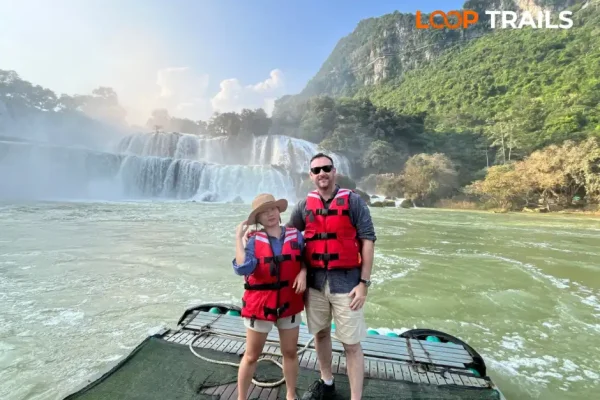
Life jackets should be provided and worn. If the boat operator doesn’t offer them automatically, ask. Safety equipment standards are inconsistent, so inspect jackets before putting them on—make sure straps work and the jacket isn’t just decorative foam.
The Nho Que River boat trip is generally safe under normal conditions, but risks exist:
Weather: Don’t take the boat during or immediately after heavy rain. Water levels can rise quickly, currents strengthen, and debris washes downstream. Boat operators should refuse trips in dangerous conditions, but economic pressure sometimes leads to poor decisions. If conditions look sketchy, skip it.
Life jackets: Wear them. The water is deep (10-20+ meters in sections), cold, and the canyon walls are steep. If you fall in, swimming to shore isn’t straightforward. Life jackets keep you afloat while rescue happens.
Boat condition: Inspect the boat before boarding. Look for cracks in the hull, check that the motor starts properly, and ensure the boat isn’t overloaded. Traditional wooden boats are fine if well-maintained. Sketchy boats with obvious damage or too many passengers are not.
Swimming ability: This isn’t a swimming activity, but if something goes wrong, being comfortable in water helps. Non-swimmers should be especially careful about life jacket fit and boat selection.
Communication: Boat operators often speak limited English. Make sure you understand the trip duration, route, and what happens if you want to return early. Hand signals and translation apps work for basics.
Sun exposure: The canyon provides some shade, but you’re on water in tropical sun for 45-60 minutes. Sunscreen, hat, and sunglasses are essential. Dehydration happens faster than you expect.
Most boat trips complete without incident. The risks are manageable with common sense. If you feel unsafe at any point, trust that instinct and don’t proceed.
The boat departs from the dock and motors upstream into the canyon. The first few minutes, the canyon walls are impressive but not overwhelming. As you penetrate deeper, the cliffs rise higher and the river narrows, creating the signature Tu San experience.
The canyon walls: Vertical or near-vertical limestone faces, gray-brown with patches of vegetation clinging to cracks. Some sections overhang, creating the feeling you’re passing through a tunnel with the top open to sky.
The water: In dry season, the emerald-green color intensifies as depth increases. You’ll see variations—lighter green in shallow sections, deeper blue-green in pools. The water is remarkably clear; you can often see several meters down to rocky bottom.
Ma Pi Leng Pass from below: Looking up, you’ll spot the road carved into the cliff face hundreds of meters above. Tiny motorbikes and vehicles creep along it. From the water, the engineering feat becomes clear—the road is a thin line against massive stone.
Wildlife: Minimal. You might see birds (swallows, occasionally raptors), but this is not a wildlife-viewing destination. The canyon is too deep and steep for much animal activity.
Other boats: During peak hours, you’ll encounter other tour boats. The river is wide enough that this doesn’t feel crowded, though photo opportunities sometimes require waiting for boats to clear the frame.
Sound: The boat motor echoes off canyon walls, creating a rumbling reverb. When the motor cuts (sometimes operators do this for photos), the silence is profound—just wind and water sounds.
The boat typically goes about 2-3 kilometers up-canyon, turns around at a designated point (often a wider section or natural turnaround spot), and returns. Total distance is maybe 4-6 kilometers round trip, covered slowly to allow for photos and sightseeing.
Boat trip itself: 45-60 minutes on the water, depending on how far the operator goes and how many photo stops they make.
Total time at Tu San Canyon:
Realistic total: 2-3 hours from when you turn off the main road until you’re back on it heading to Meo Vac or Dong Van.
Some travelers rush through in 90 minutes (skip viewpoint, get lucky with immediate boat departure). Others stretch it to 3+ hours (wait for boat, take extended trip, spend time at viewpoint). Plan for 2.5 hours and adjust based on actual conditions.
Learn more: Ha Giang Loop Solo Travel
After parking, if you walk uphill instead of down to the boat dock, you’ll reach the main Tu San Canyon viewpoint platform. This is a constructed viewing deck built out from the cliff edge, offering a bird’s-eye perspective of the canyon and Nho Que River below.
Entry to the viewpoint platform costs 20,000-30,000 VND per person (roughly $0.80-1.20 USD, subject to change). The platform extends over the canyon, with glass panels in the floor at the far end. If you’re uncomfortable with heights, the glass section is optional—the regular platform provides the same views.
From the viewpoint, you can see:
Photo opportunities: The viewpoint is designed for dramatic photos—people standing on glass panels with nothing but air beneath them, canyon walls framing the background. It’s Instagrammable, which is both a positive (great shots) and a negative (can feel overly touristy).
Crowds: The platform holds maybe 20-30 people comfortably. During peak season midday, it gets busy and you’ll wait for photo opportunities. Early morning or late afternoon is quieter.
Worth it? If you’re taking the boat trip, the viewpoint adds a complementary perspective—you see the canyon from above and then from inside. The combination gives a fuller understanding of the scale. If you’re skipping the boat, the viewpoint alone is less compelling than Ma Pi Leng Pass viewpoints, which are free and arguably more spectacular.
Along the access road between the main road and the parking area, several informal pull-offs offer canyon views without the entry fee or crowds of the official platform. These aren’t marked or developed—just wide sections of road where you can safely stop your motorbike and look out.
The views from these spots are less dramatic than from the platform (you’re not as far out over the canyon), but they’re free and often completely empty. If you’re on a budget or dislike touristy infrastructure, these work fine.
There’s also a walking trail that apparently leads to other viewpoints, but it’s not well-maintained or clearly marked. Ask locals if you’re interested, but don’t expect a formal hiking path.

Learn more: Ha Giang Cao Bang by Jeep and motorbike
The Nho Que River’s water level and clarity fluctuate significantly throughout the year:
Dry Season (November-April):
Rainy Season (May-October):
For the boat trip specifically, dry season is far better. The color difference is dramatic—rainy season loses the signature emerald water that makes the Nho Que special. If you’re visiting during rainy season, manage expectations or consider skipping the boat in favor of viewpoints.
Peak optimal months: October-November (post-monsoon, before coldest weather), March-April (warming up, pre-monsoon). December-February can be cold but offers excellent water clarity and fewer tourists.
Best light for photos: Mid-morning (9:00-11:00 AM) or mid-afternoon (2:00-4:00 PM) when sun illuminates the canyon without harsh overhead shadows. The canyon’s depth means direct sunlight only hits the water for limited periods, making timing important.
Overcast days: Can actually work well—clouds diffuse light, reducing glare on the water and making colors appear more saturated in photos. The drawback is less dramatic contrast between light and shadow on canyon walls.
Foggy/rainy days: Skip the boat trip. Visibility drops, the experience diminishes, and safety concerns increase. Ma Pi Leng Pass from above is often foggy; check conditions before descending to the canyon.
Wind: Usually not a major factor in the canyon itself (the walls block most wind), but strong winds on the main road can signal weather changes. If it’s extremely windy above, conditions on the river may also deteriorate.
Temperature: The canyon provides some shade, but you’re still in tropical sun on open water. Even in cooler months (December-February), UV intensity is high. In summer (June-August), it gets genuinely hot. Dress accordingly and bring water.

Learn more: Ma Pi Leng Pass
Ma Pi Leng Pass and Tu San Canyon offer different perspectives on the same landscape. Many travelers wonder if both are necessary or if one suffices.
Ma Pi Leng Pass:
Tu San Canyon:
Which is better? Neither. They’re complementary. Ma Pi Leng gives you scale and grandeur—the massive vista, the sense of elevation. Tu San gives you intimacy and detail—the water’s color, the canyon walls up close, the feeling of being dwarfed by cliffs.
If you only have time for one, most travelers would choose Ma Pi Leng Pass because it’s on the route and free. But if you have 2-3 extra hours on Day 3 of your Ha Giang Loop, Tu San adds significant value. The boat trip provides a completely different experience from anything else on the loop.
The ideal approach: Ride Ma Pi Leng Pass in the morning (Dong Van to Tu San), stop at viewpoints, then descend to Tu San Canyon for the boat trip around midday. You get both perspectives in sequence, which creates a fuller understanding of the Nho Que River’s role in shaping this landscape.
Learn more: Ha Giang Loop 3 Days 2 Nights
The standard Ha Giang Loop Day 3 runs Dong Van → Ma Pi Leng Pass → Meo Vac. Adding Tu San Canyon fits naturally:
7:00-8:00 AM: Leave Dong Van
8:00-10:30 AM: Ride Ma Pi Leng Pass, multiple stops for photos
10:30 AM-1:00 PM: Tu San Canyon boat trip and viewpoint
1:00-2:00 PM: Continue to Meo Vac, check in
Afternoon: Explore Meo Vac or rest
This pacing works if you start reasonably early from Dong Van. If you sleep late or spend excessive time at Ma Pi Leng, Tu San gets squeezed out.
Alternative timing: Some tours do Ma Pi Leng Pass early (leave Dong Van 6:00-7:00 AM for sunrise at the pass), which opens up mid-morning for Tu San before crowds build. This requires waking up early but rewards you with better light and fewer people.
If Day 3 is too packed: Some travelers extend to two nights in Meo Vac, using Day 4 morning for Tu San before departing. This spreads the experiences out and reduces rushing.
Meo Vac doesn’t have much to hold travelers beyond one night, but if you’re interested in Tu San and want to avoid packing too much into Day 3, staying two nights works:
Day 3: Dong Van → Ma Pi Leng Pass → Meo Vac (skip Tu San due to time/weather)
Day 4 morning: Tu San Canyon boat trip
Day 4 afternoon: Depart Meo Vac toward Du Gia/Ha Giang City
This gives you a relaxed Day 3 and lets you do Tu San in ideal conditions (early morning light, no rush).
For travelers combining the Ha Giang Loop with Cao Bang, Meo Vac serves as a transition point before heading east. Tu San fits as a final Ha Giang highlight before you shift focus to Cao Bang’s attractions (Ban Gioc Waterfall, Nguom Ngao Cave, etc.).
Learn more: Ha Giang Loop Self-Drive
Easy Rider Tours:
Your guide handles timing, knows the best boat operators, can negotiate prices, and ensures you don’t miss Tu San due to poor planning. Guides also explain what you’re seeing—geological formation, local history, cultural context. For the boat trip specifically, having a guide who speaks both English and Vietnamese helps with booking and safety communication.
The downside is you’re on the guide’s schedule. If they allocate 90 minutes for Tu San and you want 3 hours, that’s tough. Most Easy Rider tours include Tu San, but confirm before booking.
Self-Drive Motorbike Rental:
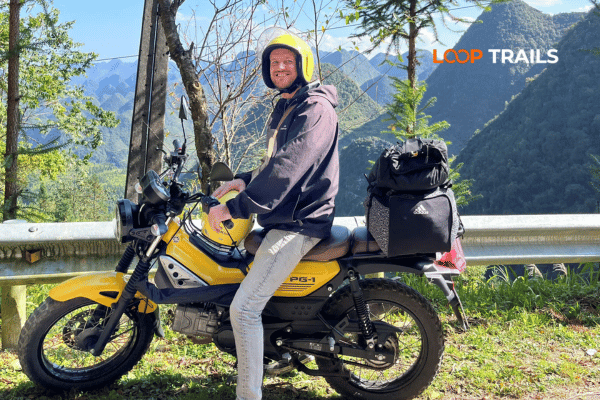
Complete flexibility. You decide when to visit, how long to stay, whether to do the viewpoint or just the boat. If weather is bad when you arrive, you can come back later or the next morning. You’re also free to explore alternative viewpoints or nearby areas at your own pace.
The challenge is you need to handle logistics yourself—finding the turnoff, negotiating boat prices, communicating with operators, managing timing so you don’t arrive too late or run out of daylight.
Jeep Tours:
Similar to Easy Rider in terms of guided experience but less intimate. Jeeps can access the main road but usually drop passengers who want to do the boat trip and pick them up after. This works fine but lacks the immersive quality of arriving by motorbike.
Best for Tu San? Self-drive works well if you’re comfortable navigating and communicating. The turnoff is well-marked, boat booking is straightforward (point at boats, negotiate price), and you don’t need special local knowledge. Easy Rider tours add value if you want cultural context or prefer not to handle logistics. Jeep tours are fine but less adventurous.
If you’re joining an organized Ha Giang Loop tour, confirm Tu San is included in the itinerary. Some 3-day tours skip it for time. If it matters to you, choose a tour that explicitly includes the boat trip or allows enough flexibility for you to add it.

Learn more: Ha Giang Loop Cost & Tips
Boat trip: 50,000-100,000 VND per person shared ($2-4 USD), or 300,000-500,000 VND for a private boat ($12-20 USD). Prices fluctuate based on season, demand, and negotiation.
Viewpoint platform entry: 20,000-30,000 VND per person ($0.80-1.20 USD).
Parking: Usually free or minimal (5,000-10,000 VND / $0.20-0.40).
Photos with life jackets/props: Sometimes boat operators or viewpoint staff offer to take photos with props or specific poses for tips. This is optional; don’t feel obligated.
Total cost for Tu San experience: Budget 100,000-150,000 VND per person ($4-6 USD) to cover boat trip, viewpoint, and incidentals. Bring cash—no card payments.
Prices listed are approximate and subject to change. Always confirm current rates before committing.
Essentials:
Optional but recommended:
What NOT to bring:
For the boat trip:
For viewpoint photos:
General tips:
Learn more: Ban Gioc Waterfall Guide
Visiting during rainy season and expecting emerald water: The Nho Que River’s signature color depends on dry season clarity. May-October, the water is often brown or murky. Manage expectations or plan your loop for October-April.
Skipping Tu San because “we saw the river from Ma Pi Leng”: The view from above and the experience from water level are completely different. If you have time and weather is good, do both.
Not checking weather before descending to the canyon: If it’s foggy or raining, the boat trip loses most of its appeal and may be unsafe. Check conditions from the main road before committing to the side trip.
Arriving too late in the afternoon: Boat operators sometimes stop running by 4:00-5:00 PM, especially if business is slow. Aim to arrive by 1:00-2:00 PM to ensure boats are available.
Negotiating too aggressively on boat prices: These are local operators making modest income. Yes, you can negotiate, but being overly aggressive over the equivalent of $1-2 USD is poor form.
Not wearing a life jacket: Even if you’re a strong swimmer, wear the life jacket. The water is deep and cold, and the canyon walls are steep. If something goes wrong, you want every safety margin.
Bringing too much onto the boat: Leave backpacks and non-essentials locked on your motorbike. Boats are small, and there’s limited space. Just bring camera, water, and sunscreen.
Expecting swimming or other water activities: This is a boat tour, not a swimming hole. The water is too cold and conditions generally don’t allow for swimming. Some operators may let you dip hands in the water, but that’s it.
Forgetting sunscreen: The combination of tropical sun and water reflection leads to severe burns quickly. Even on cloudy days, UV exposure is significant. Apply before the boat trip and reapply after.
Not budgeting enough time: If you allocate 60 minutes for Tu San, you’ll rush through and miss the experience. Block out 2.5-3 hours from when you leave the main road until you’re back on it.
Tu San Canyon and the Nho Que River boat trip represent a side of the Ha Giang Loop most travelers experience from a distance. Ma Pi Leng Pass gives you the postcard view—sweeping vistas, dramatic elevation, the sense of being on top of the world. Tu San gives you the inverse—intimacy, immersion, the feeling of being small inside a landscape that’s been forming for millions of years.
The boat trip won’t work for everyone. If you’re short on time, nervous about boats, or visiting during rainy season when water is murky, skipping it makes sense. But if you have a few hours on Day 3, weather is clear, and you want to experience the Nho Que River up close rather than just photographing it from above, Tu San delivers.
The canyon itself is straightforward—you book a boat, you ride through dramatic scenery for an hour, you get back to shore. What stays with you is the perspective shift. After days of riding mountain passes and viewing valleys from elevation, descending into the canyon and looking up at those same cliffs from water level reframes everything. The passes you’ve ridden, the roads carved into stone, the elevation you’ve climbed—all of it looks different from below.
If you’re planning a Ha Giang Loop and trying to decide whether to include Tu San, here’s the simple answer: if Day 3 allows 2-3 extra hours and it’s dry season (October-April), do it. The boat trip adds a dimension to the Ha Giang experience that Ma Pi Leng alone can’t provide. And if you’re one of those travelers who comes back saying the boat trip was the highlight of your entire loop—and some do—you’ll be glad you made the time.

Learn more: Stay at night in Dong Van Old Town
Tu San Canyon is a deep gorge carved by the Nho Que River in Ha Giang province, with limestone walls reaching 700-800 meters high. It’s one of the deepest canyons in Southeast Asia and accessible via boat trips from a dock near Meo Vac.
Tu San Canyon is located about 20 kilometers from Meo Vac on the road toward Dong Van, directly on the Ha Giang Loop route. Turn off QL4C highway at the marked turnoff and descend about 2 kilometers to the parking area and boat dock.
Shared boat trips cost 50,000-100,000 VND per person ($2-4 USD). Private boats cost 300,000-500,000 VND total ($12-20 USD) for up to 6-8 people. Prices vary by season and are negotiable. The viewpoint platform entry is an additional 20,000-30,000 VND per person.
The boat trip itself takes 45-60 minutes on the water. Total time at Tu San Canyon, including booking, waiting, the boat trip, and optional viewpoint visit, is typically 2-3 hours.
Generally yes, under normal weather conditions. Always wear the provided life jacket, avoid trips during or after heavy rain, and inspect the boat before boarding. Water levels and currents can change rapidly, so follow operator guidance and use common sense.
October through April (dry season) offers the best conditions. Water is clearest, colors are most vibrant (emerald green to turquoise), and weather is stable. November-December and March-April are optimal. Avoid May-October rainy season when water is often murky.
No. The water is deep, cold (15-18°C / 59-64°F), and boat trips don’t include swimming stops. Some operators may let you dip your hands in the water, but this is not a swimming destination.
You can visit independently by motorbike. The turnoff is well-marked, and boat booking is straightforward. Tours offer convenience and local knowledge, but self-drive works fine for Tu San.
Yes, if you have time. Ma Pi Leng offers views from above; Tu San puts you on the water inside the canyon. The perspectives are complementary. If time is limited, Ma Pi Leng is the priority, but Tu San adds significant value if your schedule allows.
Essentials: cash, sunscreen, sunglasses, hat, water, and camera with waterproof protection. Optional: light rain jacket, dry bag for electronics, snacks, and motion sickness medication. Leave heavy bags on your motorbike.
Tu San sits on Day 3 of the standard loop between Dong Van and Meo Vac. Most travelers visit after riding Ma Pi Leng Pass, around midday. Plan for 2-3 hours total to include both the boat trip and viewpoint.
In dry season (October-April), the water is clear and ranges from emerald green to deep turquoise depending on depth. In rainy season (May-October), it’s often murky brown due to sediment. Water temperature stays cold year-round (15-18°C / 59-64°F).
ng thu gọn
Contact information for Loop Trails
Website: Loop Trails Official Website
Email: looptrailshostel@gmail.com
Hotline & WhatSapp:
+84862379288
+84938988593
Social Media:
Facebook: Loop Trails Tours Ha Giang
Instagram: Loop Trails Tours Ha Giang
TikTok: Loop Trails
Office Address: 48 Nguyen Du, Ha Giang 1, Tuyen Quang
Address: 48 Nguyen Du, Ha Giang 1, Tuyen Quang

Facebook X Reddit Table of Contents Learn more: Ha Giang Loop Tours The Ha Giang Loop has a reputation problem with older

Facebook X Reddit Table of Contents The passes get the photos. The homestay nights get the stories. Ask anyone who’s done the