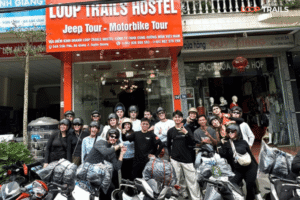


Thúy Kiều( Grace) is a travel blogger and content contributor for Loop Trails Tours Ha Giang. She holds a bachelor’s degree in Sustainable Tourism from Vietnam National University, Hanoi, and has a strong passion for exploring and promoting responsible travel experiences in Vietnam’s northern highlands.
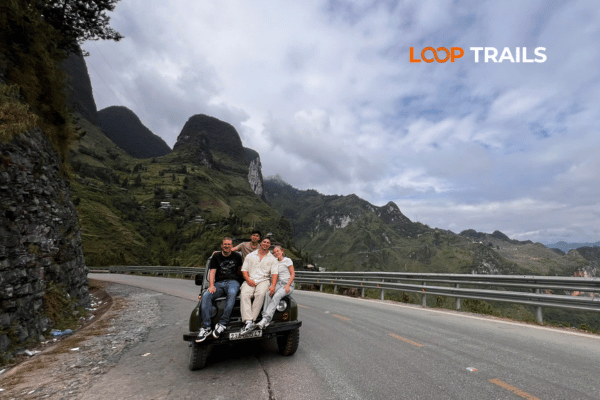
Learn more: Ha Giang Loop Tours
There’s a version of Ha Giang that most travelers miss.
They come for the motorcycle loop — the passes, the rice terraces, the bucket-list photo at Lung Cu Flag Tower. And they get all of that. But what doesn’t always make it into the Instagram reel is the deeper layer: the Flower H’Mong grandmother weaving flax on her porch at dawn, the Lo Lo village chief walking you through the geometry of an ancient stilt house, the card games played by lantern light in a homestay that doesn’t appear on any map.
A Ha Giang Jeep Tour gives you all of it — the epic landscapes and the human stories underneath them — without the physical demands of riding a motorbike for eight hours a day through mountain passes.
It’s the format that works best for families traveling with kids or elderly parents, couples who want to actually be in the same vehicle and have a conversation, and small groups who’d rather share a cold beer in the back of an open-top jeep than shout at each other through helmet visors. And with a knowledgeable local guide who knows which unmarked dirt track leads to a village worth stopping at, you’ll consistently get more out of each day than solo riders do.
This guide covers everything: the real itineraries, the honest pricing, what’s genuinely included, the cultural texture that doesn’t show up on the schedule, and how to pick the right option for your travel style.
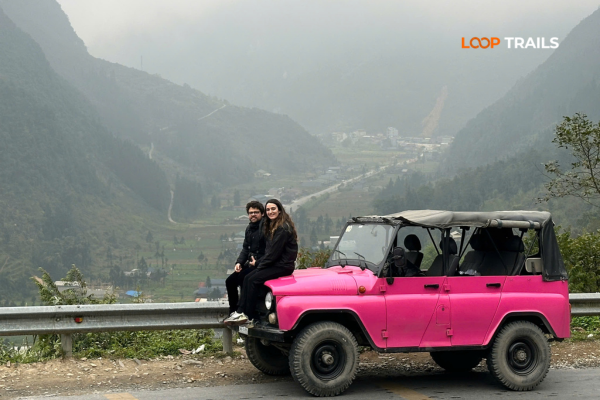
Learn more: Ha Giang Loop for Couples
The Ha Giang Loop is one of the most dramatic road journeys in Southeast Asia. The routes are narrow, the passes are steep, and the weather can shift from brilliant sunshine to thick fog inside thirty minutes. That reality makes a self-drive motorbike an excellent choice for experienced riders — and a genuinely poor one for beginners, people with joint issues, or anyone who wants to spend the day looking at the scenery instead of managing a clutch on a 15% gradient.
The classic open-top jeeps used on the Ha Giang Loop aren’t just practical transport — they’re part of the aesthetic. Rugged, slightly loud, and completely open to the elements, they give you the wind and the smells and the sounds of the plateau without any filter. Your guide sits up front, handles the driving and the navigation, reads the weather, and — crucially — knows which village down that unmarked fork in the road is actually worth a thirty-minute detour.
Here’s who a jeep tour genuinely suits:
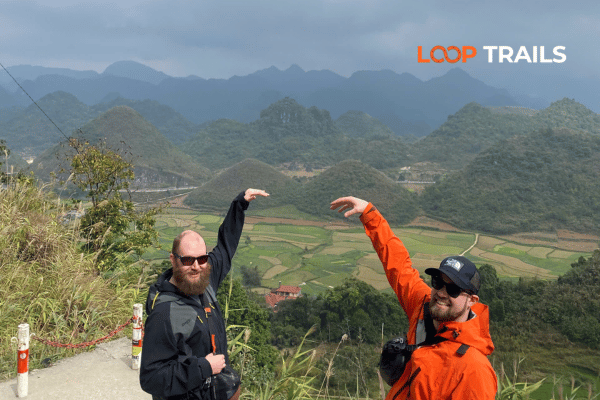
Learn more: Quan Ba Heaven Gate
Loop Trails offers three main jeep tour packages. Prices below are per group (not per person). All tours include dorm accommodation and meals as specified per day (B = Breakfast, L = Lunch, D = Dinner). Not included: private room upgrades and bus tickets to/from Ha Giang.
| Tour | Duration | 1 Pax | 2 Pax | 3 Pax | 4 Pax |
|---|---|---|---|---|---|
| Ha Giang Loop Jeep Tour | 3 Days / 2 Nights | 8,990,000 VND | 16,990,000 VND | 19,990,000 VND | 22,900,000 VND |
| Ha Giang Loop Jeep Tour | 4 Days / 3 Nights | 11,990,000 VND | 22,990,000 VND | 26,990,000 VND | 30,990,000 VND |
| Ha Giang + Cao Bang Jeep Tour | 5 Days / 4 Nights | — | 31,990,000 VND | 36,490,000 VND | 40,990,000 VND |
Quick math for couples: The 4D3N Ha Giang Loop jeep tour at 22,990,000 VND for 2 people works out to roughly 11,495,000 VND per person. For a group of 4, the same tour breaks down to approximately 7,497,500 VND per person — one of the most economical ways to do a fully guided Ha Giang Loop with accommodation and most meals included.
Learn more: Hmong’s Vuong King Palace
Your journey starts the evening before Day 1. Board a sleeper bus from Hanoi and arrive in Ha Giang early the next morning — no wasted travel day, no 5am airport alarm. Check into Loop Trails Hostel, rest, and use the morning to sort your gear and mentally prepare for the days ahead.
08:00 — Breakfast at the hostel, then the Loop Briefing. Your guide walks you through the route, what to expect at each stop, and a few notes on local customs before you head into Flower H’Mong territory. It sounds like admin. It’s actually one of the better parts of Day 1.
09:00 — The jeep rolls out. First major landmark is Bac Sum Pass and the famous Heaven Gate (Cổng Trời), where the road cuts through a gap in the ridge and suddenly the entire Dong Van Karst Plateau spreads out below. On a clear morning, this view alone justifies the trip.
From there, the route pushes deeper into the UNESCO Global Geopark. Stops include:
12:30 — Lunch in Yen Minh, a valley town that feels cooler and quieter than anything further south.
17:00 — Arrive in Dong Van. Check into a local homestay.
Evening — Dinner, local games, traditional music, and rượu ngô (corn wine, known on tour as “happy water”). This is where the actual cultural exchange starts — not on a stage, but around a table.
08:00 — Breakfast and departure from Dong Van.
09:00 — Ma Pi Leng Pass. One of Vietnam’s four legendary mountain passes, and by most accounts the most dramatic. The road is carved directly into the face of a sheer limestone cliff, with the turquoise Nho Que River winding 1,000 meters below through Tu San Canyon — one of the deepest gorges in Southeast Asia. In a jeep, both hands stay free for the whole thing.
10:00 — Ma Pi Leng Skywalk, a trail section that extends out over the cliff edge. The drop below is real. The views are extraordinary.
11:00 — Tu San Canyon viewpoint. The scale of the canyon doesn’t process from photos. It does from here.
13:00 — Lunch, then the route continues through M Pass (named for the shape the road traces when viewed from altitude) and Lung Ho viewpoint.
17:00 — Arrive in Du Gia village, a Tay settlement beside rice fields and a river. The pace drops completely. It’s the kind of place where you realize mid-evening that you haven’t checked your phone in hours.
Evening — Dinner, music, games, happy water. Same format as night one, completely different feel.
08:00 — Breakfast with a rice field view. Honestly, 30 minutes you won’t forget.
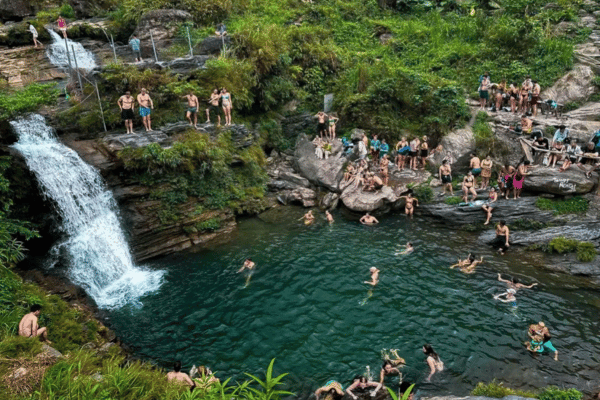
09:00 — Swim in Du Gia Waterfall. Cold, clean mountain water. Bring a change of clothes.
10:30 — Lung Tam linen village, where Tay women practice traditional flax weaving on floor looms. You can watch the full process, try the loom yourself, and buy fabric directly from the weavers.
16:00 — Return to Loop Trails Hostel in Ha Giang. Evening bus south or onward to your next destination.
Learn more: Lung Cu Flag Tower Guide
The extra day adds Lung Cu, Lo Lo Chai village, the Nho Que River boat tour, and the hidden Lung Khuy Cave — and brings the pace down enough that every stop actually breathes.
08:00 — Breakfast and Loop Briefing.
09:00 — Bac Sum Pass. Heaven Gate. First views of the Dong Van Karst Plateau.
12:30 — Lunch in Tam Son Town, slightly deeper into Quan Ba than the 3D2N routing.
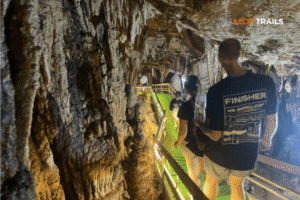
14:00 — Lung Khuy Cave — one of the most beautifully formed caves in the Ha Giang region, almost entirely off the international tourist trail. The interior formations are genuinely spectacular and the cave feels like a discovery rather than a tourist site.
17:00 — Arrive in Yen Minh. Local homestay.
Evening — Dinner, games, traditional music, happy water.
This is the day that separates the 4D3N format from everything shorter.
08:00 — Breakfast and departure.
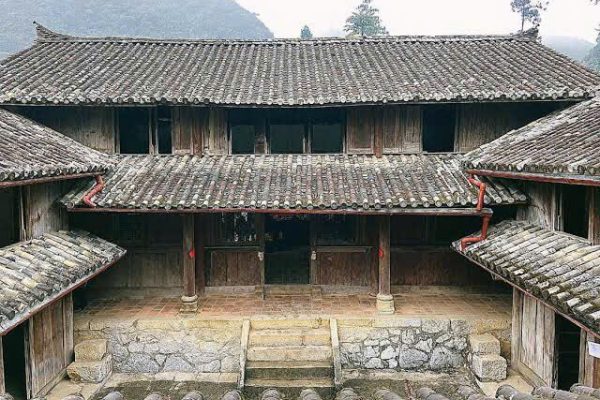
The route crosses the full breadth of the Dong Van Karst Plateau, stopping at Tham Ma Pass, Lao Sa village, Sung La village, and Vuong Palace — the latter being one of the most architecturally distinctive buildings in northern Vietnam, a stone labyrinth that blends H’Mong, Chinese, and French colonial influences.
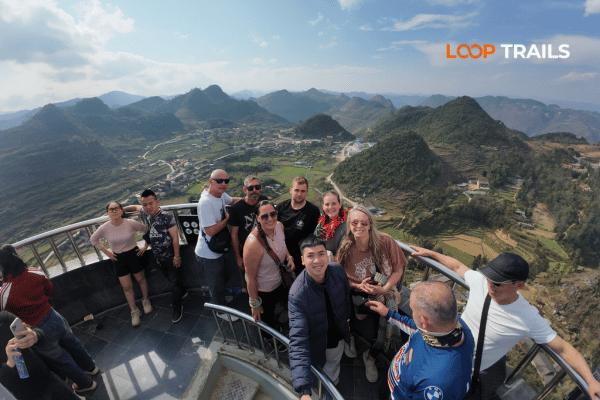
Then comes Lung Cu Flag Tower — the northernmost point of Vietnam. A national landmark, a physically striking structure, and an unexpectedly moving place to stand. Looking north from the observation platform, you’re looking directly into Yunnan Province, China.
12:00 — Lunch in Lung Cu.
14:00 — Lo Lo Chai village. The Lo Lo are one of the smallest ethnic groups in Vietnam, and Lo Lo Chai is widely considered their most beautiful settlement. The stilt houses here use a woodcarving tradition almost entirely distinct from H’Mong architecture, and the village layout feels preserved in a way that’s increasingly rare on the main loop route.
17:00 — Arrive in Dong Van. Local homestay.
Evening — Sunset drinks, dinner, games, music, happy water.
08:00 — Depart Dong Van.
Along the way — Ma Pi Leng Pass. Skywalk. Tu San Canyon.
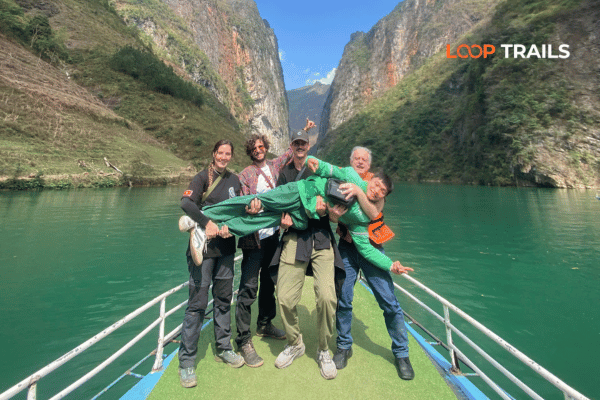
11:30 — Boat tour on Nho Que River. This is the moment that converts jeep skeptics. Looking up from a boat at the canyon walls rising on both sides is a completely different experience from looking down from the pass. Both perspectives are worth having — and this tour gives you both.
13:00 — Lunch in Sung Trai, then M Pass and Lung Ho viewpoint.
17:00 — Du Gia village. Homestay.
Evening — Dinner, games, music, happy water.
08:00 — Breakfast. Rice fields.
09:00 — Du Gia Waterfall swim.
10:00 — Duong Thuong Valley, a highland valley ringed by H’Mong settlements that hasn’t made it into travel magazines yet. The kind of place you’ll struggle to describe when you get home.
12:30 — Lunch in Thai An.
14:00 — Lung Tam linen village and traditional weaving experience.
15:00 — Forest road along the Mien River back to Ha Giang city.
16:00 — Back at Loop Trails Hostel.
Learn more: Tu San Canyon & Nho Que River Boat Trip
This is the flagship. A journey from the limestone peaks of Ha Giang through the remote mountains of Cao Bang Province, ending at one of Southeast Asia’s largest waterfalls. It covers terrain that most Vietnam visitors never reach — and connects two of the country’s most extraordinary landscapes into a single continuous journey.
Same opening as the 4D3N tour: Bac Sum Pass, Heaven Gate, Yen Minh, Dong Van Karst Plateau, Tham Ma Pass, Lao Sa village, Vuong Palace. First night at a homestay in Lao Xa, a village near Dong Van with a character distinctly different from the town center.
09:00 — Depart Lao Xa.
09:30 — Vuong Palace (deeper architectural visit for those interested in the history of the H’Mong king).
11:30 — Lung Cu Flag Tower.
12:30 — Lunch in Dong Van.
13:30 — Ma Pi Leng Pass.
14:00 — Ma Pi Leng Skywalk.
15:30 — Boat tour on Nho Que River through Tu San Canyon.
17:00 — Arrive in Meo Vac for the second night.
Day three is where this tour becomes genuinely unusual. The road from Meo Vac toward Cao Bang is one of the least-traveled routes in northern Vietnam — a long descent through passes that most operators skip entirely.
09:00 — Depart Meo Vac, heading south into Cao Bang Province.
12:00 — Lunch in Bao Lac, a market town at the junction of several mountain valleys.
13:00 — Khau Coc Cha Pass — 15 hairpin turns cut into the mountainside. Entirely unknown to most international travelers. Hike up to the ridge for a view of the full pass below and Xuan Truong Valley spreading out beyond it.
14:00 — Explore Xuan Truong Valley.
15:00 — Na Tenh Pass viewpoint.
16:00 — Pac Bo Historic Site — where Ho Chi Minh returned to Vietnam in 1941 after 30 years abroad. The cave where he lived and worked is preserved, along with the stream he named after Lenin and the mountain he named after Karl Marx. For travelers interested in Vietnamese history, this stop is unexpectedly affecting.
Evening — Stay at Me Farmstay, a working mountain guesthouse above Ha Quang.
09:00 — Depart Me Farmstay.
10:00 — Tra Linh.
11:00 — Lunch in Trung Khanh.
13:00 — Pi Pha Viewpoint at Ngoc Con, a panoramic lookout above the Trung Khanh plateau.
14:00 — Shortcut through countryside roads to Ban Gioc.
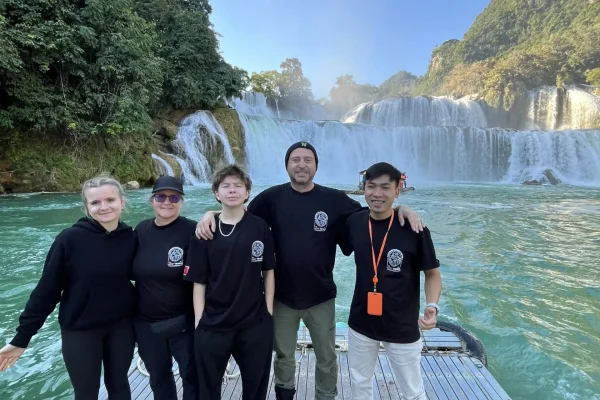
15:00 — Ban Gioc Waterfall — the largest natural waterfall in Southeast Asia (shared with China across the border). Multiple tiers, hundreds of meters wide, surrounded by karst hills. The mist reaches you from 200 meters away. Nothing about it is subtle.
16:00 — Optional swim at Rock Village.
Evening — Stay near Ban Gioc.
09:00 — Nguom Ngao Cave — the largest cave in Cao Bang, with stalactite and stalagmite formations on a completely different scale from Lung Khuy Cave back in Quan Ba.
10:30 — Song Quay River at Con Nuoc.
13:00 — Phuc Sen Paper Factory Village — traditional handmade paper production using ancient Nung techniques, still a working village rather than a performance.
14:00 — Phia Thap Incense Village — Nung craftspeople making incense sticks by hand from forest botanicals. The whole village smells of sandalwood and dried herbs.
15:00 — God’s Eye Mountain (Nui Mat Than) — a peak with a natural oval opening through its summit, one of the most unusual natural formations in Cao Bang.
16:30 — Arrive in Cao Bang City. Evening bus options to Hanoi or other destinations.
Learn more: Ha Giang Loop 4 Days 3 Nights
A note on the per-group pricing model: The jeep tour is priced per group, not per person. This makes it significantly more economical for 3–4 travelers than it first appears. A group of 4 doing the 4D3N tour at 30,990,000 VND splits to roughly 7,747,500 VND per person — competitive with standard Easy Rider motorbike tour pricing, but with a completely different level of comfort and shared experience.
Learn more: Ha Giang Loop 3 Days 2 Nights
The 3D2N covers the core. Ma Pi Leng Pass, Tu San Canyon, Dong Van, Du Gia, the H’Mong cultural stops. If you’re short on time or traveling as a solo and want to keep costs manageable, this is the entry point. It moves at pace but doesn’t feel rushed.
The 4D3N is the complete Ha Giang Loop experience. The extra day adds Lung Cu Flag Tower and the northernmost point of Vietnam, Lo Lo Chai village (genuinely worth the travel), the Nho Que River boat tour, and Lung Khuy Cave. The pace slows, the stops breathe more. This is the format most guides on the ground recommend for first-time visitors to Ha Giang — and it’s the format that generates the most “I wish I’d done this sooner” responses from past guests.
The 5D4N Ha Giang + Cao Bang is for travelers who want to go further. The Cao Bang extension adds a completely different provincial character, new ethnic minority communities (Nung and Tay alongside H’Mong), the Khau Coc Cha Pass (off-map spectacular), Pac Bo historic site, and Ban Gioc Waterfall — one of Southeast Asia’s most impressive natural landmarks that almost nobody combines with Ha Giang in a single itinerary.
All three jeep tours work best for:
Thinking about booking or just have a quick question? [View all Ha Giang Loop Jeep Tours] or message the Loop Trails team on WhatsApp — response time during business hours is usually under an hour.
Learn more: Ban Gioc Waterfall Guide
Here’s the honest reality of doing a guided jeep tour: the schedule is a skeleton. The actual experience is built from what happens between the bullet points.
The jeep stops for a roadside sugar cane juice vendor who’s been sitting at the same hairpin corner for 15 years. Your guide points at a cliff face and explains how the H’Mong people use its shadow to predict the following week’s weather. The homestay host appears after dinner with a bottle of something homemade, pours without asking, and the dinner that was supposed to finish an hour ago somehow becomes three hours of card games and halting, laughing, surprisingly effective cross-language conversation.
None of that is scripted. All of it is real. And the jeep format facilitates it in a way that motorbike touring often doesn’t.
When you’re on a motorbike, you’re isolated inside your helmet, focused on the road, and making an unplanned stop requires pulling over, finding space, removing helmets, and reconvening. In a jeep, pulling over takes three seconds and your guide has already spotted the thing you almost missed. That spontaneity accumulates over days.
Learn more: Explore just the Cao Bang Loop
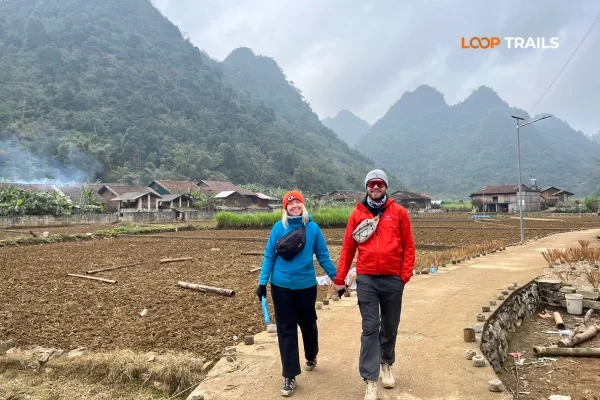
The Ha Giang Loop passes through the traditional territory of at least six distinct ethnic minority groups — Flower H’Mong, Black H’Mong, White H’Mong, Tay, Lo Lo, and Nung, among others. A jeep tour with a guide who has genuine community relationships makes the difference between driving past a village and actually entering it.
Lao Sa village (Day 1 on most itineraries) is built so close to the Chinese border that some houses straddle the physical boundary. The architecture is distinct from anything further south — stone walls, narrow lanes between compounds, structures that date back generations.
Lo Lo Chai village (4D3N tour, Day 2) is one of the most culturally intact settlements in northern Vietnam. Lo Lo people represent one of the smallest ethnic groups in the country, and their material culture — textiles, woodcarving, ceremonial objects — reflects an aesthetic tradition almost entirely separate from H’Mong design.
Xuan Truong Valley (5D4N tour, Day 3) doesn’t appear in most travel guides. A valley surrounded by forested karst hills, populated primarily by Tay and Nung communities, and entirely removed from the standard tourist circuit. The kind of place your guide drives to without announcement and you understand immediately why.
Phia Thap Incense Village (5D4N tour, Day 5) is a working village, not a reconstructed cultural experience. Watching incense being made by hand — dried, bundled, dyed, stacked — over multiple days of production is a completely different encounter than buying a finished packet at a market in Hanoi.
Learn more: Ha Giang Loop for Beginners
Every evening on a Loop Trails jeep tour follows the same broad rhythm — and it’s consistently among the most-mentioned highlights in guest feedback.
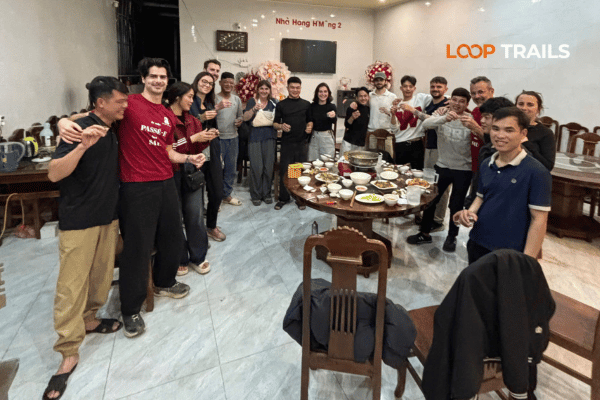
After dinner, the table doesn’t clear. The guide introduces games — card games, drinking games, guessing games played across language barriers using hand signals, props, and a significant amount of creative miming. A speaker appears. Music mixes Vietnamese pop with something much older. The homestay host arrives with a bottle of rượu ngô (locally distilled corn wine, 30–45% ABV) and pours glasses without asking.
This is the “happy water” that appears throughout the itinerary. Participation is entirely optional. No one will pressure you. But the ritual of sharing a glass with your host, your guide, and the people at your table — in a village 1,500 meters above sea level, with the sound of a river outside — is one of the most genuine cultural moments you’ll have in Vietnam. It doesn’t have a hashtag. It’s just what happens here.
The evening format is the same across all tour lengths. On the 4D3N and 5D4N tours, you get more nights of it — and by Night 3, the conversations tend to go somewhere unexpected.
Learn more: Ha Giang Sleeper Bus
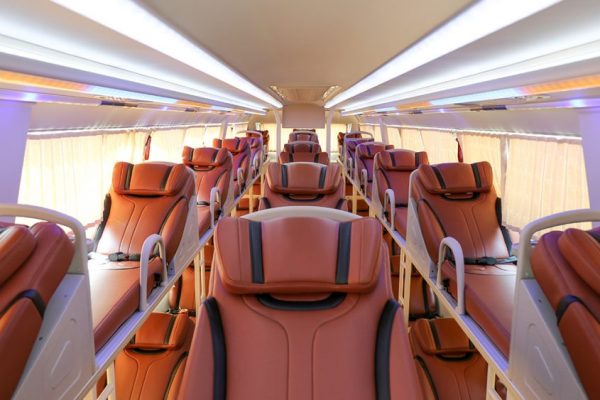
Bus tickets are not included in the jeep tour price, but Loop Trails can arrange them in both directions. Here’s what’s available:
Departure cities: Hanoi, Ha Long, Cat Ba, Ninh Binh, Sapa, and most major northern Vietnam destinations
Arrival/departure: Ha Giang city for Ha Giang Loop tours; Cao Bang city for end of the 5D4N tour
| Bus Type | What It Is |
|---|---|
| VIP Sleeper Bus | Standard overnight sleeper, individual berths, most common option |
| Cabin Sleeper Bus | Semi-enclosed sleeping pods, more privacy than open berths |
| Limousine Bus | Higher-end seating, often available for daytime departures |
| Private Car | Fully private transfer, bookable on request |
For the 5D4N Ha Giang + Cao Bang tour, your return will be from Cao Bang City rather than Ha Giang — worth coordinating when you book. Loop Trails can handle both legs.
Learn more: Ha Giang Packing List
Clothing: Layers are non-negotiable. The Dong Van Plateau sits 1,000–1,600m above sea level and can be 10°C cooler than Ha Giang city at any time of year. Early mornings on the passes are cold even in July. Light rain gear is useful year-round.
Footwear: You’re doing cave visits, a skywalk on uneven terrain, possibly a boat boarding, and a waterfall swim. Closed-toe shoes that can get wet are ideal. Flip-flops are fine for evenings.
Cash: Ha Giang runs on cash almost entirely. ATMs exist in Ha Giang city and in Dong Van town, but nowhere reliably in between. Withdraw before departure on Day 1.
Motion sickness: The mountain passes are genuinely winding. If you’re susceptible, take medication before the overnight bus and have more available for the jeep days. Your guide drives these roads regularly — the experience is smoother than road videos suggest, but prevention is better than the alternative.
Photography: Bring more memory than you think you need. The light on the plateau during golden hour is exceptional. A small tripod or phone stabilizer is useful for canyon views and evening scenes in dim homestay lighting.
Connectivity: Expect no signal for significant stretches of the route. Download offline maps (Maps.me or Google Maps offline areas) before leaving Ha Giang city. This is a feature of the experience, not a flaw.
Travel insurance: The tour includes physical activities — the skywalk, boat tour, cave visits, waterfall swimming. The location is remote. Evacuation from the plateau is not a quick process. Ensure your policy covers adventure travel.
Language: Minimal English outside Ha Giang city and Dong Van town. Your guide handles all communication — with vendors, homestay hosts, at checkpoints, and in emergencies.
Learn more: Ha Giang Loop for Families & Groups
Yes, and it’s often the best format for families. Kids are secured in the vehicle throughout, the pace is flexible, and the cultural stops tend to genuinely engage younger travelers. The boat tour and waterfall swim are particular highlights for kids. Bring appropriate restraints for young children and confirm details with Loop Trails when booking.
All ages. The jeep tour was specifically designed for travelers who wouldn’t be comfortable on a motorbike — including elderly travelers, those with mobility considerations, and mixed-age family groups. There’s no fitness requirement beyond being able to walk on uneven terrain for the cave and skywalk sections.
Yes. The 3D2N and 4D3N tours have solo pricing. The 5D4N Ha Giang + Cao Bang tour requires a minimum of 2 passengers. Solo travelers on jeep tours sometimes find themselves sharing with another small group — confirm the arrangement when booking.
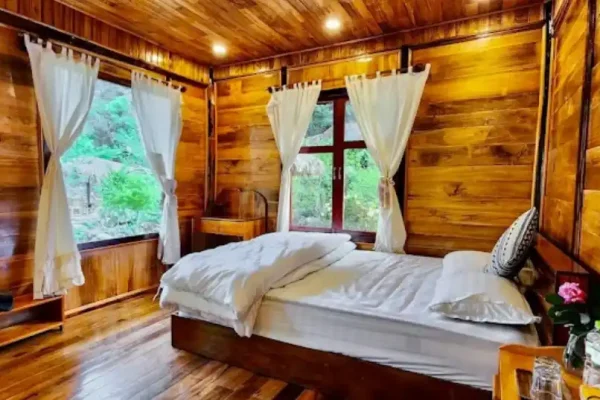
The base price includes dorm accommodation at homestays. Private room upgrades are available at extra cost. Ask Loop Trails for current pricing when you book — it varies by location along the route.
Tours are priced for groups of 1–4 passengers. The vehicle travels with your group only — you’re not combined with strangers from other bookings unless you’ve specifically arranged a group join.
The extra day on the 4D3N adds: Lung Cu Flag Tower (northernmost Vietnam), Lo Lo Chai village, Lung Khuy Cave in Quan Ba, and the Nho Que River boat tour. It also allows a slower pace overall — fewer kilometers per day, more time to actually be at each place rather than just passing through.
No additional permits are required for jeep passengers. Some areas near the Chinese border have informal checkpoints — your guide handles these. Standard Vietnam e-visa is sufficient. Rules can change, so check for updates before travel.
Rượu ngô — corn wine, distilled locally in H’Mong villages, typically 30–45% ABV. It’s shared during evening meals at homestays as part of the hospitality culture. Participation is entirely optional.
September–October (rice harvest season, golden terraces) and March–April (buckwheat and rapeseed flowers in bloom) are peak season for a reason. The dry season from October to April offers clearer skies and more stable road conditions. The rainy season (May–August) brings vivid green landscapes but more fog and occasional disruptions — beautiful in its own way, but less predictable. Rules and road conditions can change seasonally; check for local updates before finalizing dates.
During peak season (September–November, early January before Tết), book 2–4 weeks ahead. Quieter months can often accommodate 1 week’s notice, but earlier is always safer. Contact Loop Trails directly to confirm availability for your dates.
Not mandatory. Strongly recommended. The remote location and active tour components (skywalk, boat, caves, waterfall) mean any medical situation involves significant logistics. Confirm your policy covers adventure travel and remote evacuation before departure.
Within reason, yes — particularly for private group bookings. Additional stops, pace adjustments, dietary requirements, and route variations are all worth discussing with Loop Trails directly before you book. The team is straightforward about what’s possible.
Contact information for Loop Trails
Website: Loop Trails Official Website
Email: looptrailshostel@gmail.com
Hotline & WhatSapp:
+84862379288
+84938988593
Social Media:
Facebook: Loop Trails Tours Ha Giang
Instagram: Loop Trails Tours Ha Giang
TikTok: Loop Trails
Office Address: 48 Nguyen Du, Ha Giang 1, Tuyen Quang
Address: 48 Nguyen Du, Ha Giang 1, Tuyen Quang
Facebook X Reddit Table of Contents Learn more: Ha Giang Loop Tours This is the question that sits in almost every Ha
Facebook X Reddit Table of Contents Learn more: Ha Giang Loop Tours Most people drive past the Quan Ba area twice on