


Thúy Kiều( Grace) is a travel blogger and content contributor for Loop Trails Tours Ha Giang. She holds a bachelor’s degree in Sustainable Tourism from Vietnam National University, Hanoi, and has a strong passion for exploring and promoting responsible travel experiences in Vietnam’s northern highlands.

Learn more: Ha Giang Loop Tours
Somewhere on your first night in a Ha Giang homestay, someone is going to appear with a ceramic jug and two small cups and say something you may not fully understand — but the gesture will be completely clear.
Drink with me.
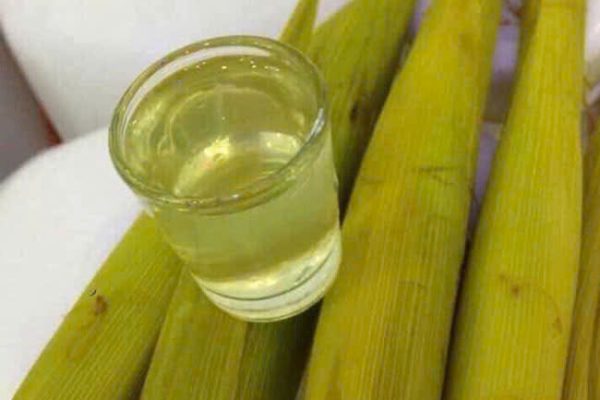
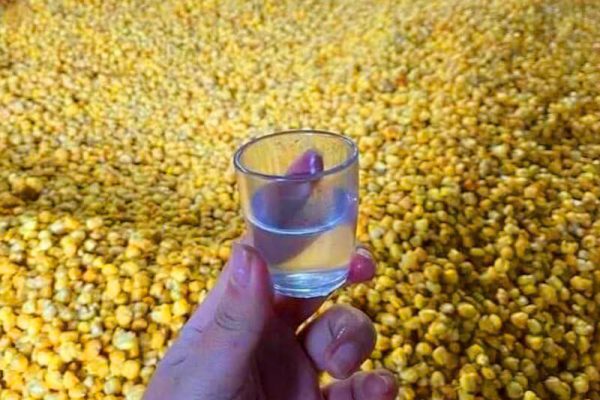
The liquid is pale, slightly cloudy in some versions, water-clear in others. It smells faintly of roasted corn and something wilder underneath. Your host will raise their cup, say something that sounds like “một, hai, ba, dzo!” and drink in one motion. You follow. It’s warm going down, with a burn that fades into something surprisingly smooth.
That’s rượu ngô. Corn wine. What travelers on the Ha Giang Loop have taken to calling — affectionately, accurately — Happy Water.
This guide is for anyone who encountered it and wanted to know more: what it actually is, how it’s made, what the cultural weight behind it really means, and how to drink it without ending up unable to ride the next morning.
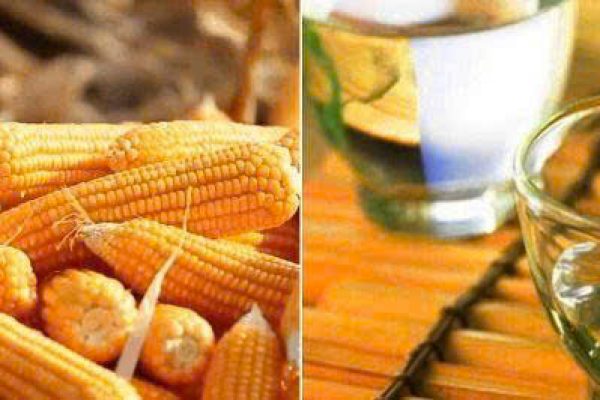
“Happy Water” isn’t an official name. It’s not on any label. It’s the kind of nickname that emerges organically when travelers try to describe something to each other and the usual words don’t quite fit.
The H’Mong and other ethnic minority communities of northern Vietnam don’t call it Happy Water. They call it rượu ngô — literally, corn alcohol — or simply rượu, the generic Vietnamese word for liquor. But travelers started using “Happy Water” somewhere in the accumulated folklore of backpacker routes through Ha Giang, and it stuck, because it captures something true about the drink’s social role.
In H’Mong culture, sharing corn wine is an act of welcome, trust, and goodwill. It appears at every significant moment: markets, festivals, weddings, new year celebrations, the arrival of a guest. Refusing it outright can be read as a social slight, though most hosts understand when a polite “just a little” is offered instead. The happiness it refers to isn’t really about intoxication — it’s about connection. The cup that passes between host and guest, stranger and local, traveler and mountain community.
That’s why people remember it. Not just because it’s strong, but because of the moment it arrives in.
Learn more: Ha Giang in September & October
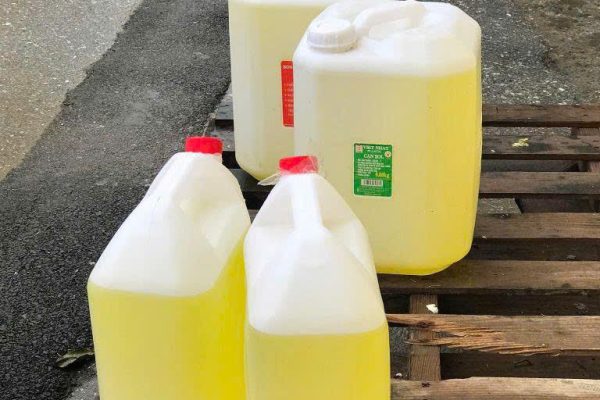
Rượu ngô is a distilled spirit made from fermented corn — not corn beer, not a low-alcohol brew, but a proper distillate. It’s produced across northern Vietnam’s mountainous regions, with Ha Giang — and specifically the Dong Van Karst Plateau — considered home to some of the most distinctive versions in the country.
It is not the same as rice wine (rượu gạo), which dominates lowland Vietnamese drinking culture. It is not sake, not baijiu (though Chinese influence from the border region is real), and not anything close to a Western corn whisky. It is its own thing, shaped by a specific crop, a specific climate, and centuries of community production.
Traditional rượu ngô production is a multi-stage process done largely by hand, often within the household. The broad steps:
1. The corn is dried and milled. Highland corn — typically a tougher, more flavorful variety than lowland sweet corn — is dried after harvest and then coarsely ground. The drying process concentrates flavor.
2. The mash is prepared and fermented. Ground corn is mixed with water and a fermentation starter called men — a cake of yeast and local herbs, sometimes including medicinal plants specific to the region. Different producers use different men recipes, and this is one of the primary variables in the final flavor. The mash ferments for several days to several weeks, depending on temperature and tradition.
3. The fermented mash is distilled. Traditional distillation uses simple pot stills — often handmade from repurposed materials — over a wood fire. Steam rises through the mash, condenses through a cooling system (sometimes just cold water running over a pipe), and drips out as spirit. First runs are high-proof; experienced distillers know when to cut the distillate for the best balance of flavor and strength.
4. The spirit is collected and sometimes aged. Some producers drink it immediately — fresh-run corn wine has a particular raw quality that some people prefer. Others age it in clay pots or simple containers, allowing the flavor to mellow over weeks or months. The best-regarded corn wines from Dong Van and Meo Vac are generally allowed to rest before being sold or served.
What you get is a clear to slightly hazy spirit with a character entirely its own. The production method is close to what’s called “farmer’s whisky” in other cultures — unaged or minimally aged, expressing the raw grain clearly, varying widely between producers because there’s no industrial standardization.
This is the question people ask most, and the honest answer is: it depends significantly on the producer.
At its best — from a skilled household producer or one of the small commercial operations around Dong Van — rượu ngô has:
At its roughest — unaged, from a fresh batch, or from a producer whose process is inconsistent — it can be sharp and acetone-edged, with heat that doesn’t soften. This isn’t dangerous, but it’s not pleasant in large quantities.
The difference between a good bottle and a rough one is real. If you’re offered corn wine that smells strongly of nail polish remover, it’s worth declining or taking only a small courtesy sip.
Home-produced rượu ngô is typically somewhere between 30% and 50% ABV, though without laboratory testing it’s impossible to know precisely. The potency varies between batches and producers. Some of the smoother, aged versions from established producers land in the 38–45% range and feel it. Some rougher home batches are genuinely very strong — higher than the producer may realize.
The practical implication: it’s a full-strength spirit, not a low-alcohol drink. Treat it like you’d treat whisky or vodka, not beer. A small cup is meaningful. A large cup is a statement of commitment. Multiple large cups the night before a mountain road ride is not a good plan.
Learn more: Ha Giang Cao Bang 5 Days
To understand rượu ngô in Ha Giang, you have to understand that it isn’t a party drink. Or rather — it’s not only a party drink. It’s woven into the social fabric of highland minority communities in ways that have no clean Western equivalent.
The weekly markets of the Ha Giang plateau — Meo Vac on Sundays, Dong Van, Yen Minh, Quan Ba — are where corn wine flows most visibly. Vendors set up simple stalls: ceramic jugs, small cups, sometimes just a repurposed bottle and a few mismatched glasses.
Men gather in groups — H’Mong, Tay, Lo Lo, Giay, Dao — and share cups. The market is where communities that live in dispersed mountain villages come together once a week, and corn wine is part of what marks that gathering as social rather than merely commercial. Business is discussed over cups. Old friendships are renewed. Family news is exchanged.
For travelers, the market corn wine experience is accessible and welcoming. Sit down, accept a cup, and you’ve communicated something important: I’m here with respect, not just as a tourist with a camera. That gesture is understood across language barriers.
The best way to experience this properly is with a guide who knows the market and the community. Our Ha Giang Loop tours include market stops with driver-guides who can help you navigate these moments with genuine cultural context — not just a photo opportunity.
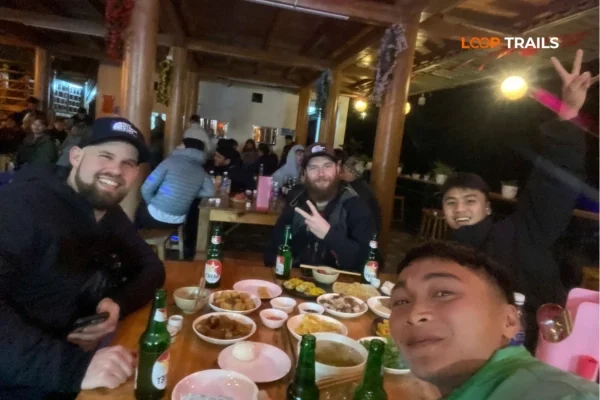
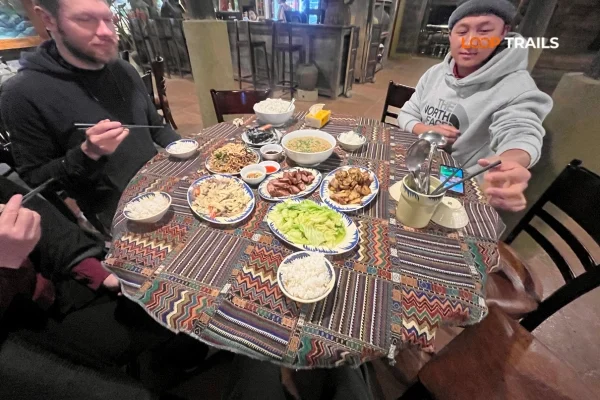
If you’re staying at a homestay on the Ha Giang Loop, the corn wine moment will likely come at dinner. The meal is served family-style — multiple dishes in the center of a low table — and at some point a jug appears.
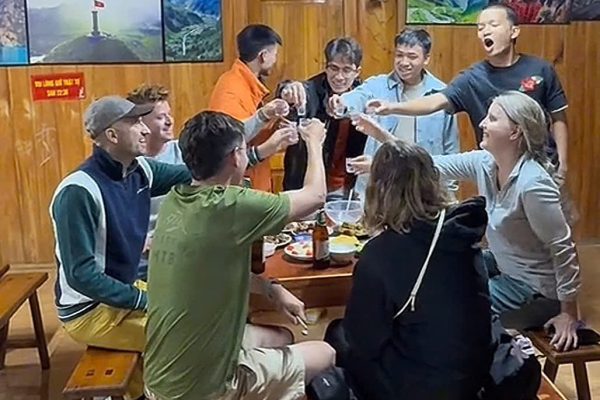
The host pours. They pour for themselves, for you, for whoever’s at the table. There’s a toast — “một, hai, ba, dzo!” (one, two, three, cheers!) is the most common form — and everyone drinks. Then the conversation continues. Then someone pours again.
It’s convivial rather than ceremonial. The atmosphere is warm and relaxed. This is the corn wine experience most travelers remember most vividly — not the taste exactly, but the feeling of being genuinely welcomed rather than commercially hosted.
If you don’t drink alcohol, saying so clearly and warmly is perfectly fine. Many hosts will offer tea instead, without any awkwardness. The gesture of being at the table and sharing the meal is what matters most.
Beyond everyday socializing, rượu ngô has a formal role in H’Mong ceremony. At weddings, the wine is offered to guests in a specific order. At Tết (Lunar New Year) and the H’Mong New Year (which falls on a different date — check local sources for current timing), it’s an essential part of ancestral offerings and family gatherings.
At funerals, corn wine is used in rituals of passage. At agricultural ceremonies marking planting and harvest seasons, it marks the transition between states of work and rest.
Travelers rarely witness these formal ceremonies directly — and nor should they without a genuine invitation. But understanding that this is the depth of context around the cup you’re offered at a homestay dinner changes how you receive it.
Learn more: Ha Giang to Cao Bang
Dong Van is generally considered one of the best towns on the loop for quality rượu ngô. Its position at the heart of the Dong Van Karst Plateau, surrounded by H’Mong communities with long distillation traditions, means the corn wine available here has real character.
Look for small shops selling corked bottles along the old quarter streets. The ceramic jug versions served at guesthouses and restaurants tend to be locally sourced. Ask your driver-guide or guesthouse host which producer they rate — this kind of local knowledge is the difference between a memorable bottle and a forgettable one.
The Dong Van Sunday market is one of the best places to drink corn wine standing up, in company, at 8am, which sounds alarming and is actually one of the more culturally illuminating experiences the loop offers.
Meo Vac’s Sunday market is the other major corn wine event on the loop. The scale and diversity of the Meo Vac market — H’Mong, Lo Lo, Giay, and other communities all converging — means a wider variety of informal producers and styles than you’ll find at a single guesthouse.
There are also small establishments around Meo Vac town proper that sell bottled rượu ngô produced by local families. Quality varies — sniff before you commit to a bottle. Smooth nose, clean roasted corn character: good sign. Sharp acetone edge: pass.
One of the quietly enjoyable things about the Ha Giang Loop is that corn wine appears unexpectedly. A roadside stall with no signage except a jug and some cups. A family waving travelers in for a rest stop who produce wine without any particular ceremony. A market in a village you didn’t know was there.
These spontaneous encounters are some of the best. They’re also the ones where quality is most unpredictable — a small cup to be polite is always fine, but don’t commit to a large quantity from an unknown source at the roadside.
Learn more: Ha Giang Loop 4 Days 3 Nights
Travelers sometimes conflate rượu ngô with other Vietnamese spirits. Here’s a quick distinction:
| Spirit | Base grain | Region | Character |
|---|---|---|---|
| Rượu ngô (corn wine) | Corn | Ha Giang, northern highlands | Roasted, warm, slightly herbal |
| Rượu gạo (rice wine) | Rice | Nationwide | Lighter, cleaner, less complex |
| Rượu cần (tube wine) | Rice/glutinous rice | Central Highlands / some northern groups | Low-alcohol, drunk through a communal tube |
| Rượu sắn (cassava wine) | Cassava | Northern Vietnam | Rougher, very strong, less refined |
Rượu ngô from Ha Giang is generally considered the most interesting of these from a flavor standpoint — at least by the people who’ve tried them all. The corn base gives it a sweetness and body that rice wine lacks, and the mountain herb starters used by highland producers add complexity that industrial spirits don’t have.
It’s genuinely worth paying attention to rather than just drinking quickly to get the experience over with.
Learn more: Ha Giang Loop for Families & Groups
Some practical guidance for people who want to engage genuinely rather than just survive the experience:
Accept the first cup. Even a small sip is enough. Refusing entirely can be awkward; accepting even a courtesy amount communicates respect.
Watch the pour. If your host is pouring generously, you’re allowed to hold your hand over your cup to signal “a little less” — this is understood and not rude.
Match the pace, don’t race it. Local drinking culture in H’Mong communities is convivial and unhurried. People don’t slam shots in rapid succession. Cups are refilled at a conversational pace. You’re allowed to nurse your cup between toasts.
“Một, hai, ba, dzo!” Learn this phrase. Using it correctly when you initiate a toast — usually after you’ve been toasted a few times — is appreciated and usually generates genuine delight.
Know your own limits. The altitude in Ha Giang (the plateau around Dong Van sits at around 1,000–1,600 metres above sea level) affects alcohol tolerance for many people. Drinks hit harder at elevation. What feels like moderate consumption at sea level can be significantly more at altitude. This isn’t a warning to be dramatic about — it’s just useful information.
Don’t ride if you’ve drunk. This is non-negotiable. If you’ve had a proper corn wine evening at a homestay and you’re self-driving the next day, drink water, sleep it off, and start later than planned. The mountain roads on the Ha Giang Loop do not accommodate impaired reaction time.
Store and transport carefully. If you’ve bought a bottle to take with you, make sure it’s sealed properly. Corn wine in a badly corked ceramic jug rattling around in a motorbike bag is a mess waiting to happen.
Learn more: Ha Giang Loop Weather
Short answer: yes, and it makes an excellent souvenir — unusual, locally specific, genuinely meaningful.
The practical considerations:
Buying in Dong Van or Meo Vac is your best bet for quality. Look for properly sealed bottles or ceramic jugs from producers that locals recommend. Your driver-guide is an excellent resource here — they often know specific families or small producers whose corn wine they trust.
Volume for air travel. Liquids rules for carry-on luggage mean any bottle you’re bringing on a plane needs to go in checked luggage. Make sure it’s well-wrapped — bubble wrap or clothing around the bottle, inside a sealed bag in case of leakage. Ceramic jugs are heavier and more fragile than bottles; factor this into your packing.
Alcohol import rules. Most countries allow adults to bring a reasonable quantity of alcohol as a personal import, but the specific allowance varies. Check the customs rules for your destination before you buy three litres of corn wine in Dong Van.
Labeling. Traditional rượu ngô often has no label, no ingredient list, no production date — it’s genuinely artisanal. If you’re going through customs and asked what it is, “corn liquor, Vietnam” is accurate.
Gift potential. A small, well-chosen bottle of Ha Giang corn wine is one of the most interesting souvenirs you can bring back from Vietnam. It’s not something you find at Hanoi airport. It requires you to have actually been there.

Learn more: Ha Giang Cao Bang by Jeep and motorbike
The corn wine experience is real on every version of the Ha Giang Loop — but the depth of it varies significantly by how you travel.
Self-Drive Motorbike You control your own stops, which means you can sit at a market stall as long as you want, accept a cup from whoever offers one, and explore at your own pace. The spontaneous roadside encounters are more likely because you’re moving at a pace that allows them. The trade-off: you don’t have a guide who can translate the cultural context, introduce you to specific producers, or navigate the social nuances of a H’Mong family dinner. The experience is more unmediated — which is great if you’re comfortable with that, and more isolating if you’re not.
If you’re self-driving, our motorbike rental in Ha Giang comes with a route briefing that includes where to stop for the best local food and drink experiences — not just the scenic viewpoints.
Easy Rider Tour This is the best setup for a genuine corn wine cultural experience. Your driver-guide has relationships with homestay families, market vendors, and local producers. They know whose corn wine is actually good versus whose is rough. They can facilitate introductions at markets in a way that feels natural rather than staged. And they can help you understand what you’re drinking — the story of who made it, how, and why it matters.
At the homestay dinner table, having your guide there to translate toasts and explain the ceremony makes the whole experience richer. This is where Easy Rider format earns its place.
Jeep Tour Similar advantages to Easy Rider in terms of guide access. Groups traveling by jeep often find that the homestay dinner becomes a communal event — multiple travelers sharing a table with a guide who can facilitate the conversation. For couples or small groups, the jeep format is comfortable and the food-and-drink experience is fully accessible.
The honest summary: any format gets you the corn wine moment. A guided format — Easy Rider or jeep — gets you the corn wine understanding.
Ready to experience the Ha Giang Loop — corn wine, mountain roads, and all? Browse our tour options or message us on WhatsApp to find the format that fits your group, experience level, and travel style.

Learn more: Ha Giang Loop FAQ
“Happy Water” is a nickname used by travelers for rượu ngô — Ha Giang’s traditional corn wine. It’s a distilled spirit made from fermented corn, produced by H’Mong and other ethnic minority communities across the highland plateau. The name reflects its role in social gatherings and hospitality rather than any official designation.
Generally yes — rượu ngô produced by established household and small-scale commercial producers is safe. The main practical caution is that alcohol content varies and isn’t labeled; some batches are significantly stronger than they taste. If a sample smells sharply of acetone or chemical notes, it’s worth passing. Drinking it in moderation — especially the night before riding — is the sensible approach.
Most rượu ngô falls somewhere between 30% and 50% ABV, roughly comparable to standard spirits like vodka or whisky. Home batches vary; some run hotter. Altitude in Ha Giang also affects how alcohol is processed — many travelers find drinks hit harder on the plateau than at sea level. Treat it as a full-strength spirit, not a light drink.
Dong Van and Meo Vac are widely considered the best spots — both towns have proximity to long-established H’Mong distilling communities and the quality of corn wine available there is generally higher than elsewhere on the loop. The Sunday markets at both towns are the best settings: communal, authentic, unhurried.
No. Politely declining is understood and accepted — particularly if you explain you don’t drink alcohol. Saying “tôi không uống rượu” (I don’t drink alcohol) or gesturing politely while smiling is fine. Most hosts will simply offer tea instead. The hospitality is in the offer, not the obligation.
At its best: roasted corn sweetness in the nose, a clean herbal quality from the fermentation starter, and a long warming finish that’s smoother than you might expect. At its roughest: sharp, acetone-edged, with harsh heat. Quality varies significantly between producers. The better versions from Dong Van are genuinely interesting spirits worth drinking slowly.
Yes. Small-scale producers in Dong Van and Meo Vac sell bottles and ceramic jugs. Pack it carefully in checked luggage for flights — wrap well against breakage and seal against leaks. Check customs allowances for your destination country before buying multiple bottles. It makes an excellent and genuinely unusual souvenir.
Rượu ngô (corn wine) uses corn as the base grain and has a richer, more complex flavor with roasted sweetness and herbal notes from the mountain-herb fermentation starters. Rượu gạo (rice wine) is lighter and cleaner in character. Ha Giang’s corn wine is considered more distinctive — a product of a specific place and culture rather than a generic Vietnamese spirit.
Genuinely, yes. Rượu ngô is embedded in H’Mong and other highland minority culture — markets, festivals, weddings, family gatherings, the arrival of guests. Sharing a cup is an act of welcome and trust. Experiencing it in context — at a homestay dinner or a market, with a guide who can explain what’s happening — adds real depth to what you take away from the Ha Giang Loop.
“Một, hai, ba, dzo!” means “one, two, three, cheers!” in Vietnamese — a countdown to drinking together. It’s the most common toast you’ll hear at Ha Giang homestays and markets. Joining in when your host initiates it is appropriate; initiating it yourself after a few rounds is genuinely appreciated and usually generates warmth and laughter.
Generous pouring is common and reflects hospitality rather than peer pressure. Covering your cup with your hand or holding it up to show it’s still full is understood as “I’m good for now” and isn’t impolite. The social culture around corn wine in H’Mong communities is convivial, not aggressive. Most travelers who’ve engaged genuinely describe it as one of the warmest social experiences of their trip — not an ordeal to get through.
If you’re on a guided tour with a good operator, yes — homestay dinners where corn wine is shared are a natural part of the Loop experience. Market stops are also included on most itineraries, which is where the market corn wine culture is most visible. Ask your operator specifically about homestay meal inclusions and market timing when you book.
Contact information for Loop Trails
Website: Loop Trails Official Website
Email: looptrailshostel@gmail.com
Hotline & WhatSapp:
+84862379288
+84938988593
Social Media:
Facebook: Loop Trails Tours Ha Giang
Instagram: Loop Trails Tours Ha Giang
TikTok: Loop Trails
Office Address: 48 Nguyen Du, Ha Giang 1, Tuyen Quang
Address: 48 Nguyen Du, Ha Giang 1, Tuyen Quang

Facebook X Reddit Table of Contents Learn more: Ha Giang Loop Tours The Ha Giang Loop has a reputation problem with older
Facebook X Reddit Table of Contents The passes get the photos. The homestay nights get the stories. Ask anyone who’s done the