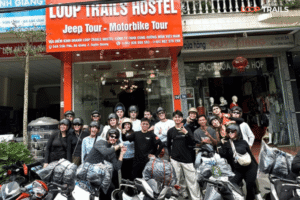


Thúy Kiều (Grace) is a travel blogger and content contributor for Loop Trails Tours Ha Giang. She holds a bachelor’s degree in Sustainable Tourism from Vietnam National University, Hanoi, and has a strong passion for exploring and promoting responsible travel experiences in Vietnam’s northern highlands.
Learn more: Ha Giang Loop 3 Days 2 Nights
Cao Bang Province has two names that every traveler in northern Vietnam eventually hears. The first is Ban Gioc — the waterfall on the Chinese border that stops most people mid-scroll when they first see a photo of it. The second, mostly among travelers with a curiosity for history, is Pac Bo.
Pac Bo is where Ho Chi Minh returned to Vietnamese soil in February 1941 after thirty years in exile — and where he spent months living in a cave, organizing what would become the Viet Minh independence movement. For Vietnamese visitors, it carries profound national significance. For international travelers, it’s something rarer: a genuinely affecting historical site that hasn’t been polished into a theme park experience. The jungle is real, the cave is real, and the sense of place — someone lived here, worked here, changed the course of this country’s history from inside a limestone cavity — comes through without needing any theatrical assistance.
This guide covers what’s actually at Pac Bo, how to get there from Cao Bang, how it fits into a broader northern Vietnam itinerary, and what to expect when you arrive. No political commentary, just practical information for travelers who want to understand one of the more unusual historical sites in Southeast Asia.
Learn more: Cao Bang Loop Tours Vietnam best kept secret
Pac Bo (Pác Bó) is a commune in Ha Quang District, Cao Bang Province, situated near the Chinese border in northern Vietnam. The name “Pac Bo” means “source of the water” in the Tay language — a reference to the small stream that runs through the site, fed by springs emerging from the karst limestone.
The area is now officially designated as Pac Bo Historical and Ecological Relic Site, a nationally protected heritage area administered under Vietnam’s cultural and historical preservation framework. It receives a steady flow of Vietnamese domestic tourists year-round — particularly groups, school trips, and pilgrimage-style visits from revolutionary-era families — and a smaller but genuine stream of international visitors curious about twentieth-century Vietnamese history.
The site sits in a valley surrounded by forested karst mountains, right on the edge of the Cao Bang–China border. The landscape is beautiful in its own right, regardless of the history attached to it. The combination of the two — forest, limestone, stream, and a story with genuine stakes — makes Pac Bo one of the more quietly memorable stops in northern Vietnam.
Learn more: Ha Giang Cao Bang 5 Days
Lorem ipsum dolor sit amet, consectetur adipiscing elit. Ut elit tellus, luctus nec ullamcorper mattis, pulvinar dapibus leo.
Ho Chi Minh left Vietnam in 1911 as a young man named Nguyen Tat Thanh, beginning three decades of travel, political education, and revolutionary organizing across Europe, the Soviet Union, China, and elsewhere. He didn’t return to Vietnamese soil until February 28, 1941, crossing the border from China into Cao Bang Province at Pac Bo — deliberately, strategically, choosing a remote border area where the French colonial presence was minimal and local Tay communities were sympathetic to the independence cause.
He was fifty-one years old when he crossed that border. He had been gone for thirty years.
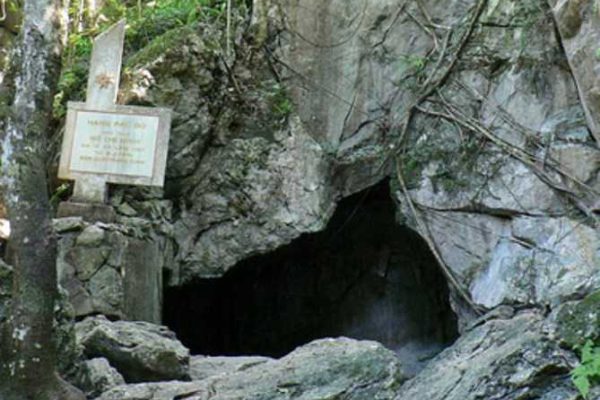
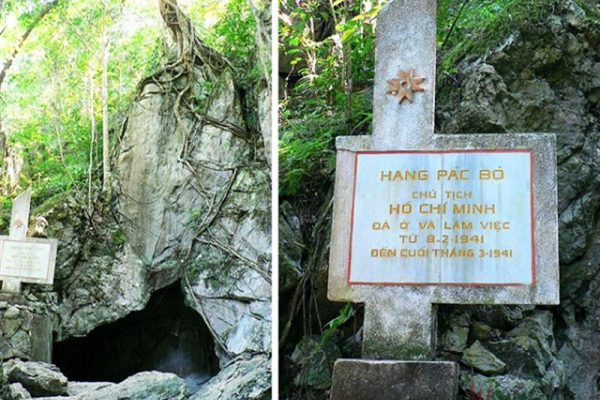
At Pac Bo, he took up residence in a limestone cave — later named Coc Bo Cave — and lived there for several months. He organized the Eighth Plenum of the Indochinese Communist Party, which established the Viet Minh (Viet Nam Doc Lap Dong Minh — the League for the Independence of Vietnam) as the broad-front nationalist movement that would eventually lead the resistance against both French colonialism and Japanese occupation.
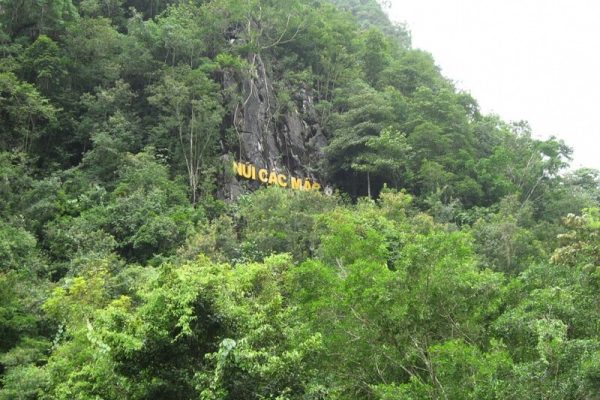
During his time at Pac Bo, Ho Chi Minh maintained a deliberately austere existence. He ate what the local communities ate, moved on foot through the jungle, and worked at a flat rock beside the stream — translating political documents, writing, planning. He named the stream Lenin Stream (Suối Lênin) and the mountain behind the cave Karl Marx Mountain (Núi Các Mác) — designations that were partly ideological signaling and partly, by his own account, practical memory aids for working in the field.
He left Pac Bo after a few months, continuing the organizational work that would eventually lead to the August Revolution of 1945, Vietnamese independence, and a decades-long war that reshaped geopolitics across Southeast Asia. The cave, the stream, the flat rock — all of it remained as he left it.
Understanding this history before you visit doesn’t require any political alignment with what came after. Whatever your views on the conflicts that followed, the image of a fifty-year-old man living in a jungle cave on the edge of a country he hadn’t seen in three decades, organizing a revolution by hand on a flat rock beside a stream, is genuinely striking. Pac Bo makes more sense once you carry that image in.
Learn more: Ha Giang Loop 4 Days 3 Nights
The Pac Bo complex covers a defined area of the valley, with the key historical elements connected by a walking path through forest and along the stream. Here’s what you’ll actually encounter.
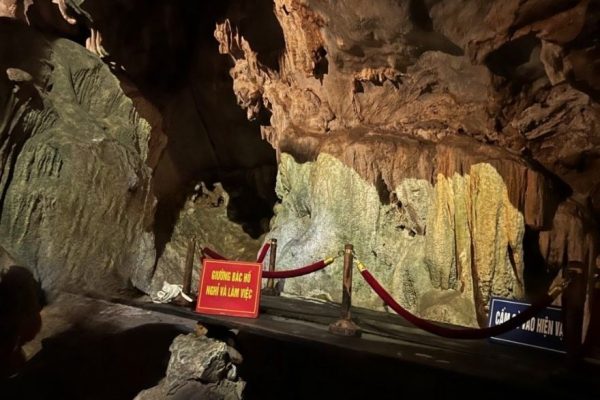
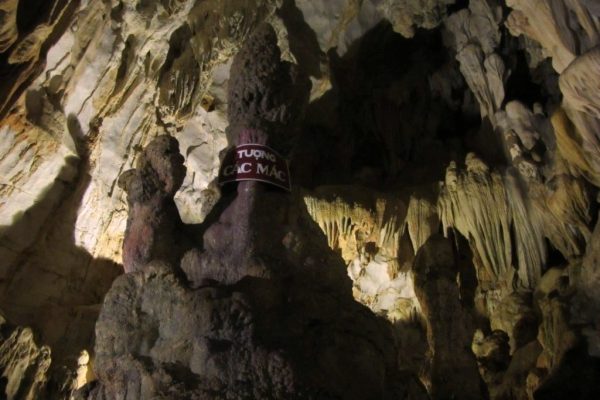
The cave itself is the centerpiece of the site. Coc Bo is a natural limestone cave — not large by cave standards, but atmospheric in exactly the right way. It’s low-ceilinged, cool, and dim inside, with the entrance framed by jungle vegetation that in wet season feels almost aggressive in its greenness.
Inside, the cave is simply presented: a sleeping area, a small workspace setup, and minimal interpretive material. There’s nothing theatrical about it. You’re looking at a cave where a man slept on the ground for months while planning a revolution, and the presentation mostly gets out of the way of that fact.
Photographs inside the cave are generally permitted — verify this with the site attendant when you enter, as rules at Vietnamese heritage sites can be updated.
Learn more: Ha Giang Loop for Beginners
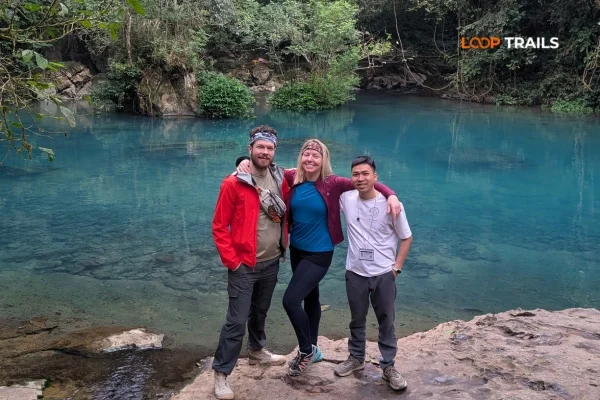
The stream runs alongside the walking path through the site and is genuinely lovely in a low-key way — clear water over rocks, bamboo and forest vegetation on both banks, the sound of water throughout the visit. In wet season it runs fuller and faster; in dry season it’s shallower and more tranquil.
The stream’s name, applied by Ho Chi Minh himself during his stay, is a detail that visitors tend to find either charming or incongruous depending on their frame of reference. Either way, it adds a layer to the visit that you won’t find at most jungle streams in northern Vietnam.
At one point along the stream, there’s a flat rock — the working stone where Ho Chi Minh reportedly sat to write and translate. A replica or preserved version of this is typically indicated with a small marker. It looks exactly like what it is: a flat rock beside a stream. The history attached to it is all the monument it needs.
Learn more: Ha Giang Adventure
The mountain visible above the cave and stream got its name from Ho Chi Minh during the same period. It’s a typical northern Vietnamese karst formation — steep, forested, dramatic in profile from below. There’s a view of it from the walking path that frames cave entrance, stream, and ridgeline together in a single composition, and this is the classic photo angle for the site.
You don’t climb Karl Marx Mountain as part of the site visit — it’s the backdrop, not the destination.
Near the cave, a small hut has been reconstructed to represent the kind of basic shelter Ho Chi Minh used during his time at Pac Bo. It’s a simple bamboo structure on a raised platform — the kind of temporary housing used by highland communities throughout northern Vietnam. The replica is clearly labeled as such; nobody is claiming it’s original.
The value of the hut is contextual: seeing the physical simplicity of the shelter, in the context of the jungle setting, reinforces the conditions under which the organizational work was being done. For visitors with limited context about the Viet Minh period, it adds something.

Learn more: Northern Viet Nam Itinerary 2026
A museum building at the site entrance presents the history of Ho Chi Minh’s time at Pac Bo and the broader Viet Minh period through photographs, documents, maps, and artifacts. The quality of English-language interpretation varies — some exhibits have reasonable English text, others rely on Vietnamese only.
If you can, spend twenty minutes in the museum before walking the site rather than after. The historical context makes the cave, the stream, and the hut more legible once you’ve seen the photographs and timeline. A local guide who can translate and contextualize the exhibits adds substantially to the experience at this particular stop.
Beyond the specific historical markers, the broader valley setting is simply beautiful. Forested karst mountains, the stream through bamboo groves, a small village community near the site entrance — Pac Bo feels like the interior of northern Vietnam rather than a curated attraction, which is partly what makes it work.
Some visitors spend time walking beyond the main site along the stream or on the paths toward the surrounding forest. If you’re with a local guide who knows the area, ask whether there are any extended walking options worth taking.
Learn more: Ha Giang Jeep Tours
Pac Bo is located in Ha Quang District, north of Cao Bang city toward the Chinese border. The road from Cao Bang city runs north through increasingly rural and scenic highland terrain.
By motorbike: This is the most practical and rewarding approach for most travelers. The ride from Cao Bang city to Pac Bo is along roads that are generally in reasonable condition, passing through highland villages and karst landscape. It’s a half-day ride round trip from the city, or can be incorporated into a full day that includes other Ha Quang area stops.
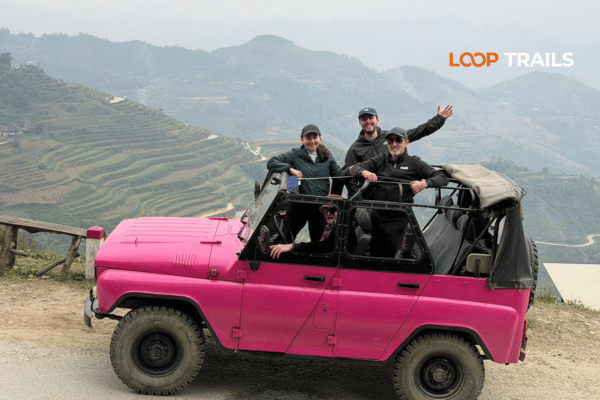
By car or jeep: For travelers doing a Cao Bang tour by jeep, Pac Bo is a standard half-day inclusion. The driver handles parking and can usually wait at the site while you walk.
By bus or shared transport: Public transport options to Pac Bo exist from Cao Bang city but are infrequent and not oriented toward independent tourist schedules. The most practical public transport option is to catch a local bus or xe om (motorbike taxi) from Ha Quang district town, but for most international travelers, a motorbike or guided vehicle is simpler.
A note on distance and time: Road conditions and travel time on this route can vary seasonally. Rather than state specific numbers that may not reflect current conditions, check locally at your accommodation in Cao Bang before setting out — your guesthouse or guide will give you accurate current information.
Learn more: Cao Bang Travel Guide
Most visitors spend between 1.5 and 3 hours at the Pac Bo site itself — museum, cave, stream walk, hut, and a slow look around. The site is not large, and the walking paths are not long.
Where the time varies is in pace and depth:
Pac Bo pairs well with other Ha Quang District stops on the same day — ask locally what else is worth visiting in the area before committing to a single-site day trip from Cao Bang.
Learn more: Ha Giang Loop Weather
Pac Bo is open year-round and is worth visiting in most seasons. A few practical notes by season:
September to November is typically ideal — dry, clear, good road conditions, and the surrounding forest landscape is at its lush post-wet-season best. The stream runs well but not flood-level. Comfortable temperatures for walking.
December to February is cool to cold in the highlands. The site itself is fine to visit, but bring a jacket — the cave especially holds cold air, and the surrounding forest is damp and chilly in winter. The paths can be wet from seasonal rain or frost in the very early mornings.
March to May sees the landscape greening up again after winter, with good conditions for the motorbike ride and a pleasant temperature range for walking the site.
June to August is rainy season. The stream at Pac Bo can run significantly higher in heavy rain periods, and the jungle is at peak density — beautiful but wet. The cave access path can be slippery. Access is generally fine in normal rain conditions, but if there’s been heavy rainfall recently, check locally whether the stream area is safe before visiting. Flash flooding is a risk in narrow valley sites like this during heavy downpours.
In terms of time of day: mornings are best for avoiding the heat in warmer months, and morning light through the jungle foliage around the cave entrance is the most photogenic. The site also tends to be quieter before midday — large Vietnamese tour groups typically arrive mid-morning, so arriving early or in the late afternoon gives a more contemplative experience.
Learn more: Visiting God’s Eye Mountain
Pac Bo fits naturally into any Cao Bang itinerary that’s spending more than two days in the province. For travelers focused purely on Ban Gioc Waterfall with limited time, it may not be essential — but for anyone spending 4+ days in Cao Bang, or anyone with a genuine interest in twentieth-century Vietnamese history, it belongs on the list.
Pac Bo within a Cao Bang Loop itinerary:
A standard Cao Bang Loop typically runs through Ban Gioc Waterfall, Nguom Ngao Cave, Tra Linh (for the weekly market), and the Cao Bang city area. Pac Bo adds a half-day to the northern section of that loop, most naturally slotted as a morning excursion from Cao Bang city before heading south or east toward Ban Gioc.
Pac Bo within the Ha Giang–Cao Bang Combine:
For travelers doing the full combine route — coming from Ha Giang through Meo Vac, Bao Lac, and Nguyen Binh into Cao Bang — Pac Bo represents one of the final significant stops before either returning toward Hanoi or continuing to other destinations. Building a full day in Cao Bang that includes Pac Bo in the morning and city exploration in the afternoon is a comfortable structure.
Sample day plan from Cao Bang City:
| Time | Stop |
|---|---|
| 7:00am | Depart Cao Bang city by motorbike or jeep |
| Morning | Ride north through Ha Quang District |
| ~9:00–9:30am | Arrive Pac Bo — start with museum |
| 9:30am–12:00pm | Cave, Lenin Stream, hut, extended walk |
| 12:00pm | Lunch at local restaurant near site or Ha Quang town |
| Afternoon | Return to Cao Bang city, or continue to additional Ha Quang stops |
Times are illustrative — current road conditions affect actual travel time.
Exploring Cao Bang with a local guide? Our guided tours cover Pac Bo as part of a full Cao Bang itinerary, including the Ha Giang–Cao Bang combine route. [See our Cao Bang Loop Tours →] or [Ha Giang–Cao Bang Combine Tours →]
Learn more: Bao Lac Travel Guide
You’re a history-focused independent traveler with motorbike experience: Self-drive from Cao Bang city is excellent for Pac Bo. The road north through Ha Quang is well-suited for motorbike travel, and the site works well as a solo visit — you can take your time in the museum and on the stream walk without waiting for a group. Bring offline maps.
You want historical context and local knowledge: This is a site where a guide genuinely earns their fee. The Pac Bo story has layers — the Viet Minh period, the border communities who sheltered Ho Chi Minh, the decisions made in this valley that shaped the next forty years of Vietnamese history. A guide who knows this history and can translate the museum exhibits turns a pleasant walk into an actually informative experience.
You’re combining Pac Bo with multiple Cao Bang stops in one day: A jeep tour or guided vehicle makes the day logistically easier. Pac Bo is one of several historically and naturally significant sites in the Cao Bang area, and having a driver means you can move between them without navigating, fueling, or managing timing yourself.
You have only one day in Cao Bang and can’t fit everything: Prioritize Ban Gioc Waterfall and Nguom Ngao Cave on that one day — they’re the province’s signature natural highlights. Add Pac Bo on a second day or save it for a return visit when you have more time for Cao Bang’s historical dimension.
Ready to plan your Cao Bang trip? Browse our [Cao Bang Loop Tours →] for full-circuit guided options, or [message us on WhatsApp] if you want to talk through a custom itinerary. We know these roads well and will tell you straight what’s realistic for your schedule.
Learn more: Ha Giang Loop Easy Rider
Dress code: Pac Bo is a nationally revered historical and political site. Dress modestly — shoulders and knees covered is the baseline expectation, particularly inside the museum and cave areas. This is not enforced uniformly, but it’s genuinely respectful given the significance of the site to Vietnamese visitors.
Photography: Photography is generally permitted throughout the outdoor sections of the site. Inside buildings and the cave, verify with staff before shooting. Be mindful of other visitors — large domestic tour groups may be present, and cutting in front of group ceremonies or formal photo moments at the historical markers is bad form.
English-language materials: The museum’s English interpretation is variable. If reading the exhibit texts matters to your visit, bring a translation app or hire a local guide — the latter is the better option for a site this historically layered.
Entrance fee: Pac Bo charges an entrance fee, though the amount may change. Check current pricing at the gate — don’t rely on figures published online, which go out of date.
Facilities: Basic bathroom facilities are available at the site. There are small food and drink vendors near the entrance area. Don’t expect a restaurant or café inside the complex.
Motorbike riders: The road to Pac Bo approaches the Chinese border — this is a legitimate border zone in Cao Bang, and depending on current regulations, there may be checkpoints or restrictions for foreign travelers on certain roads in the area. Regulations around border zone travel in Vietnam can change; verify current rules with your guesthouse or a local operator before riding independently toward Pac Bo. A local guide or organized tour automatically handles this.
Groups: If you’re visiting with a large group, be aware that the site paths are not wide. Visiting early morning gives you the best chance of moving through the cave and stream area without congestion.
What to combine it with: Ha Quang District has more to offer than Pac Bo alone — ask locally about other historical sites and natural features in the district before planning a single-site day trip from Cao Bang.
Learn more: Nguom Ngao Cave
Pac Bo Cave (also written as Cốc Bó) is a limestone cave in Ha Quang District, Cao Bang Province, where Ho Chi Minh lived for several months in 1941 after returning to Vietnam from thirty years of exile. It’s now part of the nationally protected Pac Bo Historical and Ecological Relic Site.
Pac Bo is where Ho Chi Minh organized the Eighth Plenum of the Indochinese Communist Party and founded the Viet Minh independence movement in 1941. It’s considered one of the most historically important sites in modern Vietnamese history and receives a high volume of domestic pilgrimage-style visits year-round.
Pac Bo is in Ha Quang District, Cao Bang Province, in northern Vietnam near the Chinese border. It’s accessible by road north from Cao Bang city, passing through highland rural terrain and karst landscape.
Pac Bo is roughly 50–55 km north of Cao Bang city by road. Actual travel time depends on road conditions, which can vary seasonally — check locally before setting out. Budget a half day for the round trip from the city, including time at the site.
Lenin Stream (Suối Lênin) and Karl Marx Mountain (Núi Các Mác) are the names Ho Chi Minh gave to the stream and mountain at Pac Bo during his stay in 1941. The names were partly ideological and partly practical memory aids for working in the field. Both remain officially named today and are part of the site visit.
Yes, particularly for travelers with an interest in twentieth-century Asian history or the Vietnam War era. The site isn’t just a political monument — it’s an atmospheric historical place that tells a specific, well-documented story. Visiting with some historical context enhances the experience considerably.
A guide is not required but significantly enhances the visit, particularly for the museum section where English interpretation is limited. A local guide who knows the Viet Minh period can contextualize what you’re seeing in a way that makes the cave, stream, and hut more meaningful.
Technically possible but rushed, and not recommended. Pac Bo is north of Cao Bang city; Ban Gioc is northeast. Doing both in one day means significant driving with limited time at each. Better to give Pac Bo a morning from Cao Bang city on its own day and plan Ban Gioc separately.
Modest clothing — covered shoulders and knees — is appropriate given the site’s national significance and the presence of Vietnamese visitors treating it as a place of respect. Comfortable walking shoes are essential; the paths include uneven terrain near the cave and along the stream.
Yes. The site is open daily throughout the year. Hours can vary, and entrance fees are charged — verify current opening hours and pricing at the gate, as these details update periodically.
Contact information for Loop Trails
Website: Loop Trails Official Website
Email: looptrailshostel@gmail.com
Hotline & WhatSapp:
+84862379288
+84938988593
Social Media:
Facebook: Loop Trails Tours Ha Giang
Instagram: Loop Trails Tours Ha Giang
TikTok: Loop Trails
Office Address: 48 Nguyen Du, Ha Giang 1, Tuyen Quang
Address: 48 Nguyen Du, Ha Giang 1, Tuyen Quang
Facebook X Reddit Table of Contents Learn more: Ha Giang Loop Tours This is the question that sits in almost every Ha
Facebook X Reddit Table of Contents Learn more: Ha Giang Loop Tours Most people drive past the Quan Ba area twice on