

Thúy Kiều (Grace) is a travel blogger and content contributor for Loop Trails Tours Ha Giang. She holds a bachelor’s degree in Sustainable Tourism from Vietnam National University, Hanoi, and has a strong passion for exploring and promoting responsible travel experiences in Vietnam’s northern highlands.

Learn more: Ha Giang Loop Tours
The first time I slept in a Tay stilt house in Du Gia, I woke up at five in the morning to a duck arguing with a rooster directly under my pillow. The wooden floor was warm, the air smelled like rice smoke, and someone had already put a kettle on the fire downstairs. Twelve hours in that village taught me more about the Tay people than three guidebook chapters ever did.
If you’re planning a Ha Giang trip and keep seeing the word “Tay” on itineraries without anyone explaining who they actually are, this guide is for you. We’ll cover who the Tay are, where their villages sit on the Loop, what a homestay actually feels like, when to go, what to pack, and the honest do’s and don’ts that most travel blogs leave out.
Learn more: Ha Giang Loop 2 Days 1 Night
The Tay are the largest ethnic minority in Vietnam after the Kinh majority, with somewhere around 1.8 million people. They are not Thai, despite the spelling. They are not H’mong, despite often living within a few kilometers of H’mong villages. They are their own thing, with their own language (part of the Tai-Kadai family, distantly related to Thai but not mutually intelligible), their own architecture, and their own quietly distinct way of doing life in the northern mountains.
You’ll find Tay communities spread across Cao Bang, Lang Son, Tuyen Quang, Bac Kan, Thai Nguyen, Yen Bai, and Ha Giang. In Ha Giang specifically, they tend to settle in the lower valleys and river plains, not the high karst plateau where the H’mong have built their world. This single geographic fact explains almost everything about how Tay life looks different from the moment you arrive.
Travelers mix these up constantly, so here’s the short version:
When you ride the Loop, you cross between Tay valley villages and H’mong mountain settlements within hours. That contrast is half of what makes Ha Giang feel like five countries stacked on top of each other.
A few things to know before we go deeper:
Learn more: Ha Giang Loop 3 Days 2 Nights
This is the section everyone skips because it’s hard to write without sounding like a museum plaque. I’ll try to keep it concrete.
The classic Tay house is a wooden stilt structure with the living quarters on the upper floor and the ground floor open or fenced. Originally the lower space kept buffalo, pigs, and tools safe from floods and tigers. Today the buffalo are usually elsewhere, but the layout stayed. You sleep upstairs, eat upstairs, and the kitchen sits either in a corner of the main floor or in a separate small building.
The roof is usually palm leaf or terracotta tile, sloping low to keep monsoon rain off. The whole place is mortise and tenon joinery, no nails in the traditional builds. You’ll notice the floor flexes a little when people walk. That’s normal and intentional, and it’s also why you don’t run across a Tay floor.
Compare this to a H’mong house in the same region: H’mong houses sit on the ground, made of rammed earth or wood, low ceilings, designed for cold mountain wind. Two different climates, two different architectures, both elegant in their own way.
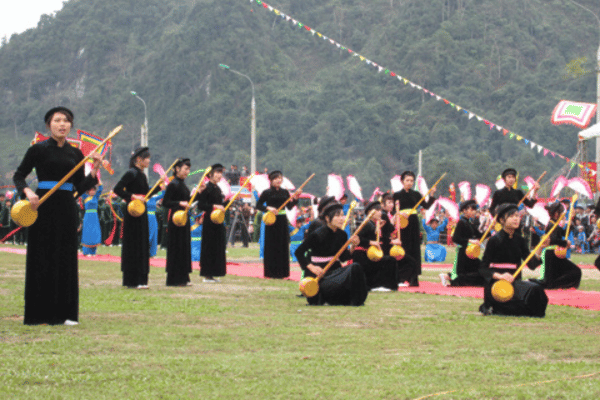
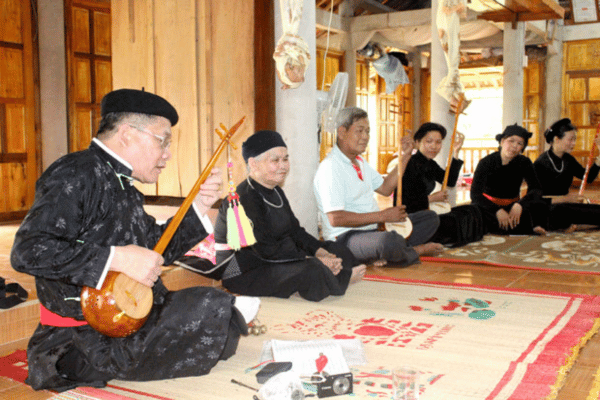
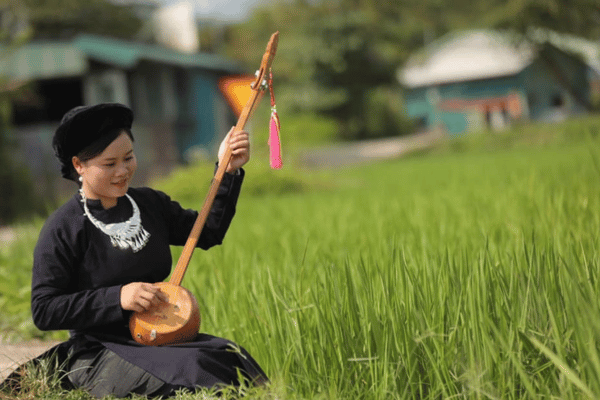
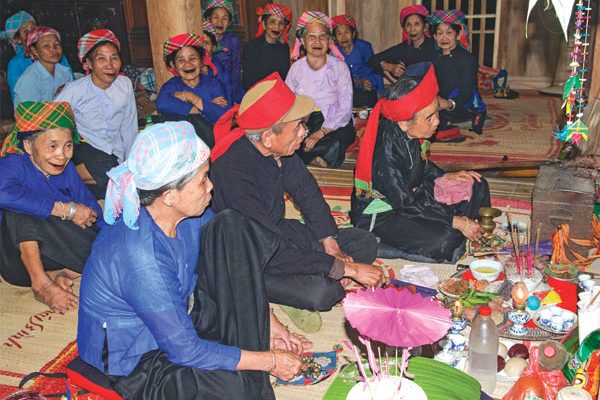
If you stay in a Tay village long enough, you might hear something quite specific: a soft three stringed lute called the Tinh, paired with a singing style called Then. Then is part music, part folk poetry, part ritual. It’s used for blessings, healing ceremonies, and celebrations, and it’s been recognized by UNESCO as an intangible cultural heritage of humanity.
Modern Then performances at homestays are usually a friendly, abbreviated version, not a full ritual. Don’t expect a museum experience. Expect grandmothers in indigo with a gourd lute, kids running through, and maybe rice wine going around. It’s better that way.
Learn more: Ha Giang Loop 4 Days 3 Nights
Compared to H’mong embroidery and Lo Lo silver-heavy outfits, Tay clothing is restrained. The base is hand-dyed indigo cotton. Women wear long simple dresses, sometimes with a cloth belt and a head wrap. Silver jewelry exists but it’s not the centerpiece. The aesthetic is calm, almost monastic next to the visual explosion of a H’mong market.
Many older Tay women still dye their own cloth with locally grown indigo plants. If a homestay host is wearing real indigo, you can sometimes smell it: a faint plant-fermented note that you don’t get from factory dye.
Tay home cooking has some things you should actively ask for:
Compared to a tourist restaurant in Ha Giang City, a family meal in a Tay homestay is simpler, fresher, and dramatically better. This alone is worth the detour.
The big calendar dates:
If you land in Ha Giang in a non festival week, don’t worry. The everyday rhythm of a Tay valley is honestly the best part. Festivals are a bonus.
Learn more: Ha Giang Cao Bang 5 Days 4 Nights
Now the practical part: where exactly do you go?
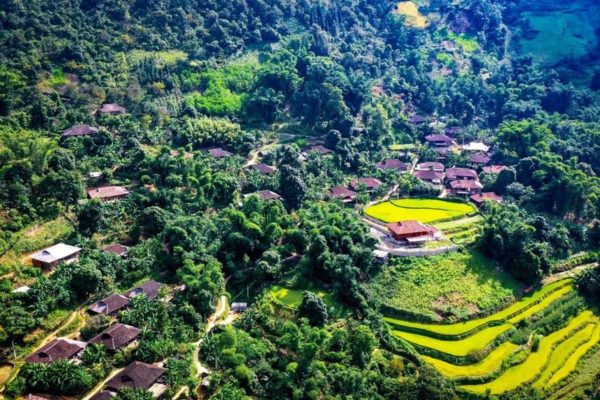
If you ask anyone who’s done the Ha Giang Loop with a guide, “Where did you stay with a Tay family,” they’ll probably say Du Gia. It’s a small valley village in Yen Minh district, about a third of the way around the standard Loop, sitting at the bottom of a long descent off the Mau Due plateau.
Du Gia has become the go-to Tay homestay stop for several reasons:
Most three day and four day Ha Giang Loop tours include a Du Gia overnight. If you’re booking with a guide, this is the most reliable place to actually meet a Tay family without it feeling staged. For travelers who want a tour built around moments like this, our [Ha Giang Loop 3 days tour] is a solid starting point.
East of Ha Giang City and south of the main Loop, Bac Me is a quieter Tay area. Most Loop tours don’t go through here, which is exactly why some travelers like it. You ride along the Gam River valley, past stilt house clusters, fish farming ponds, and a way of life that hasn’t been polished for visitors.
Bac Me isn’t a single village. It’s a district with multiple Tay communities along the river. Going there usually requires a custom itinerary or self-drive routing, since standard tours head north toward Quan Ba and Dong Van instead.
Just south and east of Ha Giang City, the Vi Xuyen district has several Tay villages within thirty minutes of town. These are easier to access if you have only a day or two and don’t want to commit to a full Loop. Examples:
The downside: these communities see a lot more domestic Vietnamese tourism and less international, so the experience can feel different from Du Gia. The upside: you can do them as a side trip without committing to the Loop.
A few less obvious places where Tay culture is visible:
If you want to go deeper into Tay territory by combining Ha Giang with Cao Bang province, our [Ha Giang Cao Bang combine tour] hits both regions in one trip without the brutal Hanoi-Ha Giang-Hanoi backtrack
Learn more: Ha Giang Cao Bang Ba Be Lake 6 Days 5 Nights
Travel content often skips this part. Here’s what to expect on the ground.
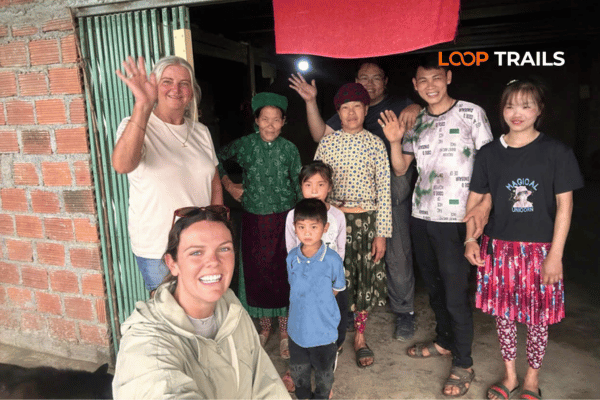
You arrive in late afternoon, usually muddy. You take your shoes off at the bottom of the wooden stairs. The host points you up. Upstairs is a big open room with mattresses lined up along the walls, mosquito nets folded above each one, and a low table in the middle for dinner.
The bathroom is downstairs or in a separate building. Hot water exists in most established homestays now but flow can be unpredictable. Showers are basic but functional. The toilet is usually a Western style sit-down toilet by 2026; squat toilets still exist in deeper villages.
Dinner is family style, served on the floor or at a low table. Multiple shared dishes, rice, soup, sometimes a small grill in the middle. Rice wine appears. The host or guide will toast you. The trick is to sip, not slam, the first round.
After dinner, depending on the homestay, there might be a small Then performance, more drinks, a game with the kids, or just everyone going to sleep early because tomorrow involves more mountains.
A Tay village wakes up at five. Roosters first, then ducks, then someone sweeping the yard. Smoke starts coming out of the kitchen. By six the rice paddies have farmers walking out with hoes or motorbikes. By seven you’ll smell breakfast.
The middle of the day is hot in summer (we’re talking 32–35°C in a humid valley), so work pauses. By late afternoon everyone is back out: tending fish ponds, watering vegetables, kids coming home from school. Evening is for cooking and quiet.
If you stay one night, you see a sliver of this. If you stay two, the village starts to feel like a place rather than a backdrop.
Du Gia in particular has changed a lot in the last few years. There are now dozens of homestays, some of them quite large, some of them more authentic than others. You can still find genuinely traditional stays, but you may need to ask your guide specifically for a family-run small place rather than a 30 bed dormitory operation.
This isn’t a complaint. The tourism income has been transformative for these villages. But it’s worth knowing that a “Tay homestay” can mean anything from sleeping on the floor of a grandmother’s actual house to a hotel-style bunk building behind a stilt house facade. Both have their place. Just know which one you’re booking.
Learn more: Cao Bang Loop 3 Days best kept secret
There are four realistic ways to do this:
Almost any guided three day or four day Loop tour includes at least one Tay homestay night, usually in Du Gia. This is the easiest, most efficient way to experience Tay village life without logistical headaches. You ride or sit in a jeep, the route is figured out, the homestay is booked, dinner is included.
If this is your first time in northern Vietnam, this is probably your move. Pick your mode based on whether you ride or not:
Our [Ha Giang Loop tours] page lays out all the variations.
You can also skip the Loop and go directly to a Tay area for one or two nights. Du Gia, Bac Me, and some Vi Xuyen villages will book you in directly. This works if:
You’ll need either a motorbike (rented in Ha Giang City) or a transfer, since these places aren’t on public transport routes you’d want to use.
If you stay in Du Gia for two nights, the second day is yours to explore on foot or bike. Local homestays rent bicycles cheaply. You can cycle through rice paddies, swim in the waterfall, and walk to neighboring hamlets. This is one of the rare places on the Loop where you can slow down without losing the experience.
Ha Giang’s famous Sunday markets (Dong Van, Meo Vac, Lung Phin) are more H’mong than Tay, but Tay traders show up too. Bac Me district has its own valley markets that lean more Tay. If you can time a market day into your itinerary, do it. Markets are where ethnic minority life still hits its rhythm.
Learn more: Ha Giang Loop Photography Guide
Tay villages sit in valleys, which means the climate is slightly different from the mountain passes above. Expect warmer summers, milder winters, more mosquitos in wet season.
Coming out of Tet. The fields are being prepared. Long Tong festival falls in this window. Weather is cool to mild, sometimes misty. Some early peach and plum blossoms in higher villages. A great window for cultural visits if you can plan ahead.
Hot, humid, lush, occasionally stormy. Rice paddies are bright green. Waterfalls including Thac Du Gia are at their best. The downside: heavy rain can wash out road sections, especially on dirt approaches to villages. Always check current road conditions with your guide; rules and routes can change month to month.
This is also when the Du Gia swim hole is most rewarding. Bring a quick dry towel.
For many travelers, this is the best window. Rice ripens golden, the air clears, the light gets crisp. Tay valley landscapes look like postcards. October in particular is busy with travelers chasing harvest photography. Book homestays ahead.
Quiet, cold, sometimes foggy. Tay valleys don’t get as cold as the karst plateau, but expect single digit Celsius mornings. Some travelers love the moodiness. Others find it bleak. Festival activity is low until Long Tong.
For a longer take on month by month conditions, our [Ha Giang weather guide] goes deeper.

Learn more: Ha Giang Loop by Army Jeep Tours
Most blog posts skip this. It matters more than packing lists.
A few principles that have served me well:
Tipping isn’t culturally required but is increasingly expected at homestays that cater to international travelers. A modest amount for kitchen staff or guides goes a long way. Ask your tour operator what’s appropriate.
If you want to give a gift, buy something locally rather than bringing imports. Homestays appreciate things they can use: fresh fruit, snacks for the kids, rice wine if you’re contributing to dinner. Avoid sweets for very young children; some communities are sensitive about that.
If a host offers handicrafts for sale, don’t haggle aggressively. The margins are thin and the work is real. A small negotiation is fine, but the back-and-forth bargaining style some travelers bring from southeast Asian markets isn’t appropriate here.
If a homestay arranges a Then performance, treat it as you’d treat any music: pay attention, applaud, tip if a basket goes around. Don’t talk through it, don’t film the entire thing on your phone, don’t ask the singers to repeat songs for your camera. They are doing a real cultural practice, abbreviated for guests but still real.

Learn more: Ha Giang Packing list
Beyond your normal Ha Giang Loop gear, a Tay village stay benefits from:
Don’t overpack. Most Loop tours involve transferring your bag between vehicles, and a smaller pack makes you a better guest.
Learn more: Ha Giang Motorbike Rental
I’ll be straight here. There’s no “best” Ha Giang Loop tour, just the right one for what you actually want.
You want an easy rider tour: you sit on the back of a motorbike driven by a local guide. You get full Loop access without the stress of riding. Tay homestay nights are included. This is the most popular choice for solo travelers and couples who don’t ride.
A self drive option with a guide ahead and another behind is what you want. You have the freedom to stop where you like, the safety of a group, and the same homestay nights. Make sure your license is properly recognized; rules change and we recommend checking the latest updates with your operator before you book.
For self drive specifically, our [motorbike rental in Ha Giang] page covers the bike options and what’s included with each rental.
You probably want a jeep tour. Open-air or hard-top jeep, same Loop, same Tay homestay nights, 360° views, no helmet sweat, more luggage space. The pace is similar to the easy rider option but with more comfort. If two or three of you are travelling together, the jeep economics often work out well.
If you have five days or more, combining Ha Giang with Cao Bang gives you a much richer ethnic minority experience: more Tay valleys, plus Nung and San Chay communities further east, plus Ban Gioc waterfall and Phong Nam valley. Our [Ha Giang Cao Bang combine tour] handles the routing so you don’t have to backtrack to Hanoi between provinces.
When in doubt, message us on WhatsApp. We’ll ask three questions about your trip and recommend the option that actually fits. No upsell.
Learn more: Ha Giang Loop Mistake to Avoid
A short list, in no particular order:
Learn more: Ha Giang Loop Hidden Gems
Yes. Tay communities are welcoming and tourist-friendly, especially in established homestay areas like Du Gia. Standard travel precautions apply: watch your belongings, drink in moderation, follow your guide’s advice on weather and roads.
Costs vary by village and season. We’d rather you check current rates with your tour operator than rely on a number that may be out of date. For tour-inclusive options, all meals and the homestay are typically bundled into the trip price.
Yes, if you have a motorbike and some experience navigating in Vietnam. Du Gia and parts of Vi Xuyen are accessible on your own. For deeper or less touristed areas, a guide is strongly recommended.
Most do not, especially older generations. Younger hosts in established homestays often speak basic English or use translation apps. A guide bridges this gap and turns small interactions into real conversations.
In Du Gia and other established homestays, yes, usually. Speed varies. Vietnamese SIM cards with 4G work better in valleys than you’d expect. Don’t expect anything in remote stays.
Absolutely. Tay families are family-oriented and kids are welcome. The shared meal format and the stilt house environment can be a highlight for younger travelers. Just bring mosquito protection and pack patience for the longer driving days.
A homestay is a family-run guest space inside or next to a traditional house. You sleep on mattresses (often shared dorm-style with curtains), eat with the family or other guests, and experience daily village rhythm. A hotel is a hotel.
Yes, in our honest opinion. It’s more developed than five years ago, but the valley itself, the surrounding rice paddies, the waterfall, and the better small homestays still feel right. Pick your homestay carefully and you’ll get the experience.
You can, if you’re in Ha Giang in late January or early February. Dates shift with the lunar calendar. Festivals are community events first, tourist attractions second. Be respectful, ask before photographing, and don’t push to the front of ceremonies.
Not at all. A polite refusal is fine. Most hosts will offer water or tea instead and not make it awkward. The toast culture is real but flexible. If you don’t drink alcohol for any reason, just say so.
Tay homestays are typically in valley stilt houses with warmer, lower-altitude weather and shared-meal traditions on the floor. H’mong homestays are usually in earthen or wooden ground-level houses at higher altitude, colder at night, with their own distinct cuisine. Both are worth doing if you have the time.
Yes. Du Gia is accessible by jeep on the standard Ha Giang Loop routing. The descent road is winding but well-maintained for vehicles. Our jeep tour clients stay in Du Gia on the same standard itinerary as motorbike groups.
Contact information for Loop Trails
Website: Loop Trails Official Website
Email: looptrailshostel@gmail.com
Hotline & WhatSapp:
+84862379288
+84938988593
Social Media:
Facebook: Loop Trails Tours Ha Giang
Instagram: Loop Trails Tours Ha Giang
TikTok: Loop Trails
Office Address: 48 Nguyen Du, Ha Giang 1, Tuyen Quang
Address: 48 Nguyen Du, Ha Giang 1, Tuyen Quang
Facebook X Reddit Table of Contents Learn more: Ha Giang Loop Tours Most people drive past the Quan Ba area twice on

Facebook X Reddit Table of Contents Learn more: Ha Giang Loop Tours The Ha Giang Loop has a reputation problem with older