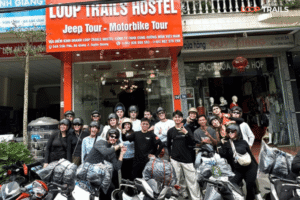


Thúy Kiều (Grace) is a travel blogger and content contributor for Loop Trails Tours Ha Giang. She holds a bachelor’s degree in Sustainable Tourism from Vietnam National University, Hanoi, and has a strong passion for exploring and promoting responsible travel experiences in Vietnam’s northern highlands.

Learn more: Ha Giang Loop Tours
There’s a version of this question that gets asked on every Vietnam travel forum, and it usually goes something like: “Is Ha Giang Loop cheap? I only have $X — is that enough?”
The honest answer is: it depends. Not in an annoying, non-committal way — but genuinely, because the Ha Giang Loop can cost you $120 for four days or $400 for four days, and both of those trips can be excellent. What changes is what you’re paying for, and what experience you’re buying.
This guide breaks down every real cost involved — transport from Hanoi, accommodation, food, motorbike rental, guided tours, fuel, entrance fees, and the things nobody budgets for until they get there. No inflated estimates, no suspiciously low numbers. Just an honest look at what you’ll actually spend.
Learn more: Ha Giang Loop 2 Days 1 Night
If you want a rough number before you dig into the details:
| Travel Style | Estimated Total (4–5 days, excluding international flights) |
|---|---|
| Tight backpacker budget | $120–$170 USD |
| Mid-range independent | $200–$320 USD |
| Guided Easy Rider tour | $280–$450 USD |
| Comfort / private jeep | $400–$600+ USD |
These figures include getting to Ha Giang from Hanoi, accommodation, food, transport on the loop, and a buffer for entrance fees and incidentals. They do not include your Vietnam visa or travel insurance — both of which you should absolutely have sorted before you arrive.
Now let’s break down where every dollar goes.
Learn more: Ha Giang Loop 3 Days 2 Nights
Before we get into line items, it’s worth naming the variables that shift your budget the most:
How you ride. Self-driving a rented semi-automatic is the cheapest way to do the loop. Booking an Easy Rider tour with a local guide costs more upfront but often includes accommodation and meals. A private jeep tour sits at the top end.
Group size. Solo travelers almost always pay more per person than couples or small groups, especially on guided tours where per-person rates drop with numbers.
Season. The Ha Giang Loop runs year-round, but peak seasons (October–November buckwheat flower season, September, late March–April) mean higher demand for guesthouses and occasional price bumps on popular accommodation.
How long you take. A rushed 3-day loop is cheaper in absolute terms but you’ll miss most of it. Four days is the practical minimum. Five gives you breathing room.
Where you eat and sleep. The difference between staying in a family-run homestay and a slightly nicer guesthouse is maybe $5–8 a night — not life-changing. But it adds up over 4–5 nights.

Learn more: Ha Giang Loop 4 Days 3 Nights
Ha Giang City sits roughly 320 kilometres north of Hanoi. Most travellers coming from Hanoi choose one of two options:
Sleeper bus / open bus: The most budget-friendly choice. Overnight buses from My Dinh or Gia Lam bus station run most nights and take 6–8 hours depending on stops. Expect to pay around $8–14 USD per seat. It’s not the most comfortable ride in Vietnam, but it gets the job done and saves you a night of accommodation.
Limousine van (9-seat or 16-seat): More comfortable, faster, and with door-to-door pickup from many Hanoi guesthouses. These typically cost $18–28 USD per person one way and are especially popular with groups who want to sleep on the bus and arrive reasonably rested. Book through your Hanoi hostel, directly with operators, or ask your Ha Giang tour company if they can arrange transfers.
Private car: Obviously the most comfortable, but at $80–130 USD for the whole vehicle one way, it only makes financial sense for groups of 4+. Factor this in if you’re travelling together.
The return journey costs roughly the same. If you’re doing a Ha Giang–Cao Bang combined route, your exit point will be different — something worth planning before you arrive.
Learn more: Ha Giang Cao Bang 5 Days 4 Nights
This is where Ha Giang genuinely surprises people on the budget side. Accommodation is inexpensive compared to most Southeast Asian tourist circuits.
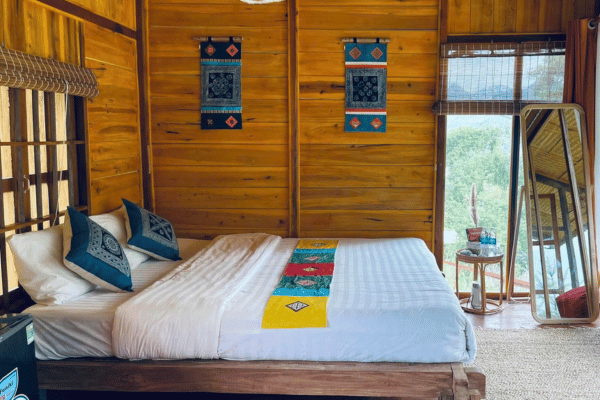
Homestays (basic): The most atmospheric option and the cheapest. Expect wooden rooms, shared bathrooms, maybe a mosquito net and a fan or thin blanket depending on season. Prices range from $4–10 USD per person per night, and many include a simple breakfast or dinner if you ask (or they just feed you anyway — that’s the culture here).
Guesthouses (nhà nghỉ): Simple private rooms with en-suite or shared bathrooms. Generally $8–18 USD per room. Some have hot water. Wifi is hit-or-miss.
Mid-range guesthouses / homestay hotels: A growing category in towns like Dong Van and Meo Vac. Cleaner rooms, reliable hot showers, sometimes air conditioning. $18–35 USD per room. Still basic by Western standards, but genuinely comfortable.
The loop’s main overnight stops are typically: Quan Ba, Yen Minh, Dong Van, and Meo Vac — though different itineraries spread these differently. If you’re self-driving and arrive without a booking during peak season (October buckwheat period especially), accommodation can fill up fast. Book ahead or arrive early in the day.
This is arguably the easiest part of the budget to control, and also the part where you don’t need to cut corners much — because local food on the loop is genuinely good and genuinely cheap.
A bowl of pho or bún bò at a local spot: 35,000–60,000 VND (~$1.40–$2.40)
Com (rice plate with meat and vegetables): 40,000–80,000 VND (~$1.60–$3.20)
A full sit-down meal at a local restaurant (2–3 dishes, sharing): 80,000–200,000 VND per person (~$3.20–$8)
Street snacks, grilled corn, bánh mì: 10,000–30,000 VND
Local bia hơi or bottled beer: 20,000–40,000 VND
Coffee (ca phe trung, ca phe sua da): 20,000–40,000 VND
A realistic food and drinks budget for most travellers — eating well, having a beer or two in the evening, not skipping meals — is $8–15 USD per day. If you’re eating at every street stall you pass and avoiding anything aimed at tourists, you can eat for less. If you’re in the mood for a proper sit-down dinner with a group, you might spend $20 — but that’s pushing it.
One thing worth knowing: in the more remote sections of the loop, between Dong Van and Meo Vac especially, food options thin out. Eat when you see somewhere good. Don’t count on finding lunch at a specific time.

Learn more: Ha Giang Motorbike Rental
Self-driving the Ha Giang Loop is the most popular and most affordable way to do it independently. You rent a bike in Ha Giang City, ride the loop yourself, and return it at the end.
What’s typically available:
For a 4-day loop, rental costs typically run $60–110 USD total for a decent manual bike. Add a deposit (usually returned on safe return of the bike) and check what’s included: some rentals include a rain poncho, basic toolkit, and breakdown assistance. Others don’t. Ask before you sign anything.
A note on licensing: Vietnam’s traffic laws regarding foreign driving licences and required permits can and do change. Check the current rules before you arrive — don’t assume what was true in 2023 is still true now. Your rental shop will tell you what’s required, but it’s worth researching independently too.
The Ha Giang Loop — the standard 4-day route through Quan Ba, Yen Minh, Dong Van, Meo Vac, and back — covers roughly 300–350 kilometres depending on your exact route and any side trips.
Fuel is cheap. A litre of petrol (RON 95) costs around 23,000–26,000 VND at the time of writing — check the current pump price as it fluctuates. Most bikes on the loop average somewhere around 35–50km per litre.
For a full loop on a standard 150cc bike, you’re realistically looking at $4–9 USD in fuel total. It’s not a meaningful line item in your overall budget, but it’s worth knowing: petrol stations are less frequent in remote sections. Fill up whenever you see one. Don’t wait until the gauge is on empty with 60km of mountain road ahead of you.
Learn more: Ha Giang Cao Bang Ba Be Lake 6 Days 5 Nights
This is where budgets vary most significantly, and where getting clarity upfront matters.
Easy Rider tours pair you with a local guide/driver — you ride on the back of their motorbike (or your own alongside them), they know every road, every good stop, and often every family running a guesthouse along the route. The cost typically includes guide fees, accommodation, and most meals, depending on the package.
Pricing varies by operator, group size, and what’s included. As a general guide for Ha Giang Loop Easy Rider tours: expect to budget roughly $60–100 USD per person per day for a quality operator, with the total package cost for a 4-day loop often ranging $240–420 USD per person. Solo travellers pay more than pairs or small groups. Some operators quote by the tour, not per day.
Always confirm exactly what’s included: accommodation standard, meals, entrance fees, and whether fuel and guide accommodation are covered.
Jeep tours offer a different experience — you ride inside a 4WD rather than on a motorbike, which is more comfortable, better for people who don’t want to ride, and well-suited to couples, older travellers, or anyone who wants to cover more ground with less physical exposure. Costs are higher: expect tour packages starting around $350–600+ USD per person for a 3–4 day loop, again depending heavily on group size and inclusions.
Loop Trails offers Easy Rider guided tours, self-drive motorbike rental, and private jeep tours of the Ha Giang Loop. If you want to compare what’s included and get a quote for your dates, check out our [Ha Giang Loop Tours page] or drop us a message on WhatsApp — we’ll give you straight answers, not a sales pitch.
The Ha Giang Loop isn’t Disneyland — there aren’t many paid attractions. But there are a few things worth budgeting for:
Budget $5–15 USD total for entrance fees across a 4-day loop, and you’ll have more than enough.
Vietnam e-visa: Most nationalities can apply online. At time of writing, the fee is around $25 USD for a 90-day single-entry e-visa. This is a one-time cost for your whole Vietnam trip, not loop-specific — but factor it in if you haven’t already. Check the official Vietnam immigration website for current prices and eligibility, as these do change.
Travel insurance: Non-negotiable for Ha Giang. The loop involves mountain riding, remote roads, and occasional medical emergencies. Standard travel insurance covering medical evacuation (important) and adventure activities including motorbike riding costs roughly $3–7 USD/day depending on your provider and coverage. Get it before you fly, and read the policy — some exclude motorbike riding unless you hold the relevant licence for your home country.
SIM card / data: A local Vietnamese SIM with data is cheap — expect to pay around $5–10 USD for a tourist SIM with several GB of data. Signal on the loop is patchy in the deepest valleys but generally workable at overnight stops.

Learn more: Ha Giang to Cao Bang
Here’s how it tends to shake out across a 4-day loop (not including international flights or Vietnam visa):
| Item | Estimated Cost |
|---|---|
| Hanoi–Ha Giang sleeper bus (return) | $18–26 |
| Accommodation (homestays, 4 nights) | $20–36 |
| Food and drinks | $32–50 |
| Motorbike rental (4 days, semi-auto) | $40–65 |
| Fuel | $5–8 |
| Entrance fees + incidentals | $8–15 |
| Total | ~$120–200 |
| Item | Estimated Cost |
|---|---|
| Hanoi–Ha Giang limousine van (return) | $40–56 |
| Accommodation (guesthouses, 4 nights) | $50–100 |
| Food and drinks | $45–70 |
| Motorbike rental (4 days, XR150 or similar) | $70–110 |
| Fuel | $6–10 |
| Entrance fees + incidentals | $15–25 |
| Total | ~$226–371 |
Many Easy Rider packages are all-inclusive or near-all-inclusive. The main add-ons are typically drinks, personal shopping, and tips. Expect to pay roughly:
The per-person cost drops notably with a travel partner. Two people sharing an Easy Rider experience with two guides is significantly better value than going solo.
Learn more: Ha Giang Loop Self-Drive
People agonise over this decision. Here’s an honest breakdown:
Self-Drive
Easy Rider (Guided Motorbike Tour)
Jeep Tour
The “cheapest” option isn’t always the best value. A botched self-drive where you spend two hours fixing a flat on the side of a mountain with no tools and no phone signal is not cheap in any real sense.
Learn more: Ha Giang Loop Easy Rider
Go self-drive if: You have genuine experience riding manual bikes on mountain roads, you’ve ridden in Southeast Asia before, you’re comfortable navigating with offline maps, and you genuinely want the freedom of solo adventure.
Book an Easy Rider tour if: It’s your first time on the loop, you want local insight baked into every kilometre, you’d like accommodation and most meals taken care of, or you’re travelling with someone who wants to share the back seat rather than ride solo.
Choose a jeep tour if: You’d rather not ride at all, you’re travelling with someone who can’t or won’t ride, comfort matters more than immersion, or you’re combining Ha Giang with a Cao Bang extension and want to cover a lot of ground efficiently.
Not sure which fits your trip? Our team at Loop Trails knows this road better than most. Send us a message on WhatsApp and describe your experience level, group size, and budget — we’ll give you an honest recommendation, not a sales push.
Learn more: Ha Giang Loop by Jeep for Families & Groups
1. Underbudgeting the return to Hanoi Most people plan the outbound trip carefully and forget to budget for the return. It costs roughly the same. Don’t blow your last $15 on drinks in Meo Vac expecting the bus home to be free.
2. Not checking what’s included in your tour or rental “Tour price” can mean anything from bare-bones guide + bike to accommodation + all meals + transfers. Read the breakdown before you pay. Ask specifically: does this include accommodation? Meals? Fuel? Entrance fees?
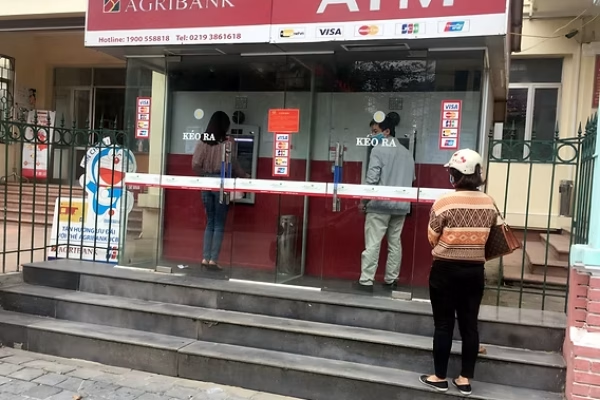
3. Assuming ATMs are everywhere Ha Giang City has ATMs. Some towns along the loop have them. Some don’t, or the machines are unreliable. Go into the loop with enough cash for 2+ days at minimum. More on this below.
4. Skipping travel insurance or getting the wrong kind Standard travel insurance often excludes motorbike riding without the appropriate licence. Read the small print. If you’re renting a bike, make sure you’re actually covered.
5. Paying rack rate during buckwheat season October–November is the most popular time on the loop (the pink and white buckwheat flowers are genuinely stunning). Demand for accommodation spikes. Some guesthouses in Dong Van and Meo Vac are fully booked weeks in advance. If you’re going then, either book ahead or build in flexibility.
6. Tipping guides and expecting it to be optional Easy Rider guides work long days on difficult roads. Tipping is customary and appreciated. Budget an extra $10–20 per person for the trip as a guide tip — it’s not mandatory but it matters.
Learn more: ATM in Ha Giang
Carry cash. The Ha Giang Loop is almost entirely cash-based. Small guesthouses, food stalls, roadside stops — none of these take cards. Even larger guesthouses in Dong Van may not have reliable card terminals.
ATMs in Ha Giang City: There are several ATMs in Ha Giang City — Agribank, Vietcombank, and BIDV are the most reliable for foreign cards. Withdrawal limits vary but are typically 2–5 million VND per transaction. Fees depend on your home bank.
ATMs beyond Ha Giang City: Dong Van town has at least one ATM, but don’t count on it working every time. Meo Vac has some options. In between, there’s very little. Withdraw before you leave Ha Giang City — enough for your full loop with a buffer.
Vietnamese Dong vs. USD: Everything on the loop is priced in VND. You can pay in USD at some tourist-facing businesses, but the exchange rate won’t favour you. Use local currency.
Bargaining: Not really a thing at guesthouses or restaurants on the loop — prices are generally what they are. Some souvenir stalls in Dong Van Old Quarter have more flexibility, but don’t expect dramatic discounts.
Learn more: Ha Giang in September & October
A realistic total budget for a 4-day Ha Giang Loop — including transport from Hanoi and back, accommodation, food, and motorbike rental — is around $130–$200 USD for budget travellers and $220–$370 for mid-range independent riders. Guided Easy Rider tours typically range from $280–$450+ per person for a full package.
Yes — it’s one of the more affordable multi-day experiences in Vietnam. Accommodation and food are significantly cheaper than in tourist hotspots like Hoi An or Da Lat, and there’s no expensive admission-heavy attraction system. Your main costs are transport, lodging, and your riding option.
Technically yes, but it’s tight. You’d need to take the cheapest bus options, stay in the most basic homestays, eat exclusively at local spots, and rent a semi-automatic. There’s no buffer for bike breakdowns or unexpected costs. $130–$150 is a more realistic floor for a comfortable 4-day budget trip.
For first-timers, almost always yes. The local knowledge alone — knowing which road is flooded, which guesthouse has hot water, which bend has the best viewpoint — is worth the premium. The loop is beautiful regardless, but a good guide makes it transformative.
The shoulder months (May–June and late January–February) tend to have lower accommodation demand and more availability, though weather is less predictable. October–November is peak season and costs reflect that. December–February brings cold temperatures, especially at altitude, but the roads are quieter.
There may be a tourist checkpoint fee near the start of the loop for foreign visitors — this has changed over the years, so verify the current situation locally. Beyond that, entrance fees at specific viewpoints (Lung Cu, Cổng Trời) are minimal — a few dollars total across the loop.
Withdraw before leaving Ha Giang City. For a budget self-drive trip, 3–4 million VND ($120–160 USD) in cash should cover 4 days comfortably. For a guided tour where accommodation and most meals are prepaid, you mainly need spending money — 1–2 million VND for drinks, snacks, shopping, and tips.
The main extras not always included in tour packages: alcoholic drinks, personal souvenirs, tips for guides, and any optional detour entrance fees. Confirm what’s included in writing before you book, and budget an extra $20–40 for the above.
No — it’s one of the cheapest line items. A full loop on a standard 150cc bike costs roughly $5–9 USD in petrol. Fill up whenever you see a station in remote sections; don’t let the low cost make you complacent about running out.
Yes, and not just for the mountain riding risk. Medical facilities in Ha Giang are limited if something serious happens, you may need transport to Hanoi. Make sure your policy includes medical evacuation and check that it covers motorbike riding (many standard policies require you to hold the appropriate licence in your home country).
Solo travellers pay the most per person on guided tours. A couple travelling together can often reduce the per-person cost of an Easy Rider tour by 20–30%. Larger groups (3–4) get even better per-person rates, especially on jeep tours where you’re splitting a vehicle.
Yes — a Ha Giang and Cao Bang combined itinerary is popular and genuinely spectacular (Ban Gioc Waterfall, Phia Oac, Pac Bo are all highlights). It adds roughly 2–3 days and proportional costs. Transport logistics change — you’ll typically end the extension in Cao Bang and travel back to Hanoi separately. Contact Loop Trails for a combined route quote.
Learn more: Ha Giang Packing List
The Ha Giang Loop is one of the most rewarding rides in Southeast Asia. Getting the budget right means you can focus on the road, not your wallet — and there’s a lot of road worth focusing on.
If you’re still figuring out which option suits you best, the easiest thing is to just ask. Loop Trails runs Easy Rider guided tours, self-drive motorbike rentals, and private jeep tours from Ha Giang City. We work with small groups, solo travellers, and couples — and we’re genuinely upfront about what’s right for different experience levels and budgets.
Check out our [Ha Giang Loop Tours page] for full itineraries and inclusions, or visit our [Motorbike Rental page] if self-drive is more your style.
Prefer to talk it through first? Send us a WhatsApp message — we’ll respond with real answers, not a booking form.
Ride the Loop. Feel the North.
Contact information for Loop Trails
Website: Loop Trails Official Website
Email: looptrailshostel@gmail.com
Hotline & WhatSapp:
+84862379288
+84938988593
Social Media:
Facebook: Loop Trails Tours Ha Giang
Instagram: Loop Trails Tours Ha Giang
TikTok: Loop Trails
Office Address: 48 Nguyen Du, Ha Giang 1, Tuyen Quang
Address: 48 Nguyen Du, Ha Giang 1, Tuyen Quang
Facebook X Reddit Table of Contents Learn more: Ha Giang Loop Tours This is the question that sits in almost every Ha
Facebook X Reddit Table of Contents Learn more: Ha Giang Loop Tours Most people drive past the Quan Ba area twice on