
Thúy Kiều (Grace) is a travel blogger and content contributor for Loop Trails Tours Ha Giang. She holds a bachelor’s degree in Sustainable Tourism from Vietnam National University, Hanoi, and has a strong passion for exploring and promoting responsible travel experiences in Vietnam’s northern highlands.

Learn more: Ha Giang Loop Tours
By the third day on the Ha Giang Loop, most travelers reach a small mental decision point. You have ridden past dozens of roadside stalls selling jars of dark honey, bundles of dried tea, embroidered pouches, and bottles of clear corn wine. Some of it is excellent. Some of it is mass-produced filler. And there is a real difference between bringing home a jar of authentic mint honey from the karst plateau and bringing home a tourist-tax knockoff that looks the same on a shelf in Hanoi.
This guide is the version of the conversation I wish someone had given me on my first Loop. We will cover the 12 souvenirs actually worth your luggage space, which markets to hit (and on which day), how much to pay roughly, how to tell real from fake, and how to actually get fragile or food items home without drama at the airport.
A note on prices: I am not going to give you exact numbers, because they shift by season and by vendor, and a guide that quotes “100,000 dong for X” goes stale within months. Instead I will give you ranges, what cheap usually means, and what a fair price feels like once you have walked a couple of markets.
Learn more: Ha Giang Loop 2 Days 1 Night
Ha Giang sits on the edge of Vietnam where geography, ethnic diversity, and a slow pace of industrialization have preserved a craft economy that has largely disappeared in the lowlands. The honey actually comes from bees foraging on wild mountain mint. The indigo on Hmong jackets is dyed in clay jars in village courtyards, not imported from a chemical plant. The buffalo smoking over a hearth in a Dao home will end up wrapped in banana leaf and sold at the next Sunday market.
This is not romanticism. It is the practical reason souvenirs from Ha Giang are worth more than the typical magnets and lacquerware you find in Hanoi’s Old Quarter. You are buying something with a real provenance, often a family or village name attached, and the money goes a long way in a community where average income is a fraction of urban Vietnam.
The flip side: because the area has become more popular, there is now plenty of factory-made stuff being sold alongside the real thing, sometimes by the exact same vendor. Knowing what you are looking at matters.
Learn more: Ha Giang Loop 3 Days 2 Nights
If you take home one thing from Ha Giang, make it this. Mint honey from the Dong Van karst plateau holds an official Vietnamese Geographical Indication, which means honey labeled this way is supposed to come from a defined area and a defined source: bees foraging on wild mountain mint (Elsholtzia) that blooms across the limestone highlands from roughly October to December.
The taste is genuinely distinctive. Slightly herbal, slightly cooling, with a darker amber color than most commercial honey, and a finish that is more savory than sweet. Locals use it for sore throats, coughs, and stomach issues, and many travelers swear by it for jet lag recovery.
What to look for:
Best places to buy: Dong Van Sunday market, Meo Vac Sunday market, and a few well-known beekeeping cooperatives near Dong Van that you can visit directly if your guide knows the area.
Learn more: Ha Giang Loop 4 Days 3 Nights
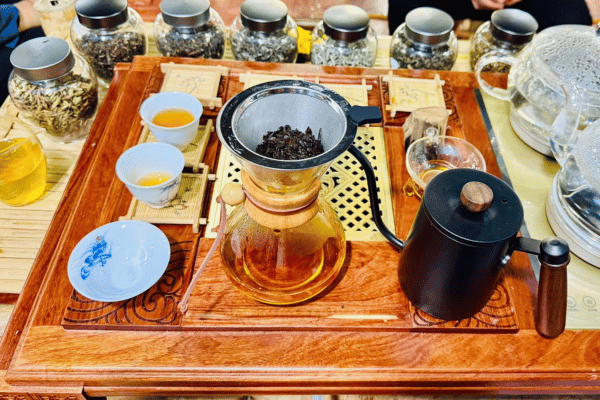
Shan tuyet (“snow mountain”) tea comes from ancient tea trees that grow wild on the slopes of Hoang Su Phi and a few other northern Vietnam highland areas. Some of these trees are well over 100 years old, with thick mossy trunks and leaves covered in fine white down (hence “snow”). The tea is hand-picked, often by women from Red Dao or La Chi communities, and processed in small quantities.
You will see Shan tuyet sold as green tea, lightly oxidized white tea, and sometimes black tea. The green and white versions are the most distinctive: a deep, slightly sweet, faintly smoky flavor that fades cleanly. It is also one of the few Vietnamese teas that gets seriously discussed in international tea circles.
What to look for:
Tam giác mạch (triangular seed) is the pink buckwheat flower that turns the Dong Van plateau into a soft pink carpet from roughly mid October to mid November. The plant has become a small tourism industry of its own, and you will find a surprising number of buckwheat-derived products in Ha Giang:
Of these, buckwheat tea and pillows are the most travel-friendly.
Almost every Hmong, Dao, and Tay village in Ha Giang distills corn wine. It is clear, strong (often 30 to 40 percent alcohol), and traditionally served warm in tiny ceramic cups during meals or ceremonies. Ban Phung corn wine, made in a small village in Hoang Su Phi, has the most established reputation, but excellent corn wine comes from dozens of villages across the province.
Buying tips:
A small ceramic bottle of decent corn wine makes a memorable gift, especially if you can pair it with a story about the village it came from.
Learn more: Ha Giang Cao Bang 5 Days 4 Nights
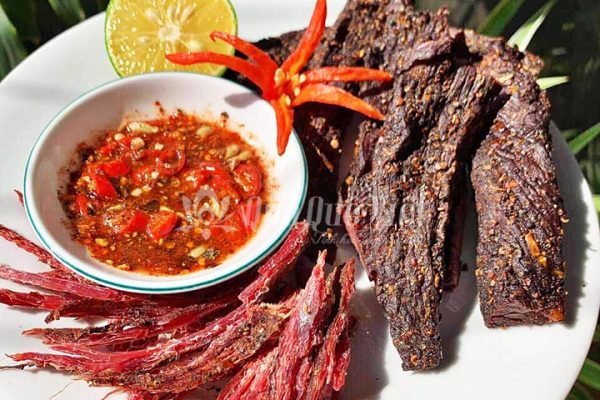
“Thịt trâu gác bếp” literally means “buffalo meat in the kitchen rafters.” It is exactly what it sounds like: water buffalo meat marinated with mountain spices (mac khen pepper, chili, ginger, garlic, salt), hung above the family hearth for weeks until it cures into a deep brown, intensely flavored jerky. Smoked beef and smoked pork versions exist too, but buffalo is the classic Ha Giang version.
You eat it by ripping pieces apart with your hands and pounding them lightly with a wooden mallet to soften the fibers, then dipping in chili-lime salt or chao mac khen. It is excellent with beer, with rice wine, or as a salty snack on a long bus ride home.
What to watch:
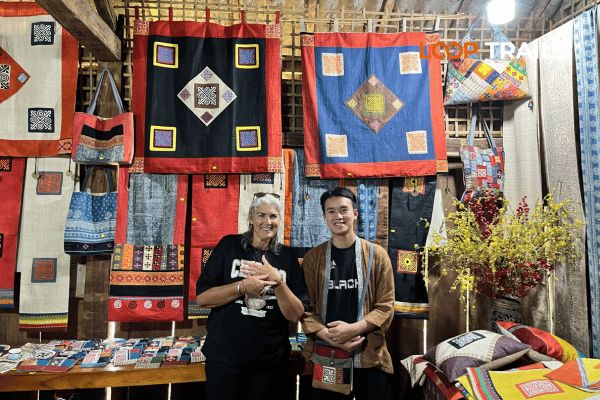
This is where Ha Giang shopping gets genuinely interesting. Hmong and Dao women across the province dye fabric in homemade indigo, which produces a deep blue with a slight violet shift that machine-dyed fabric cannot match. You will find:
The best indigo has a slight irregularity in color and a smell, faintly vegetal and slightly funky, that fades over weeks. Chemically-dyed imitations are perfectly even and odorless.
A practical note: real indigo bleeds when first washed. Wash separately in cold water for the first few cycles, and never dry-clean. If a vendor swears the indigo will not bleed at all, it is probably not real indigo.
Some Hmong subgroups, particularly the Flower Hmong, use a beeswax batik technique to create patterns on fabric before dyeing it indigo. A small heated copper tool (called a “lanjing”) draws lines of melted beeswax onto the cloth, which then resists the dye when the fabric is submerged. After dyeing, the wax is boiled out, leaving white patterns against an indigo background.
This is one of the oldest and most labor-intensive crafts you can buy in Ha Giang. Small panels, table runners, and pillowcases are widely available; full skirts are less common because they take months of work. Prices are higher than plain indigo and they should be, but if you understand the process you will pay it gladly.
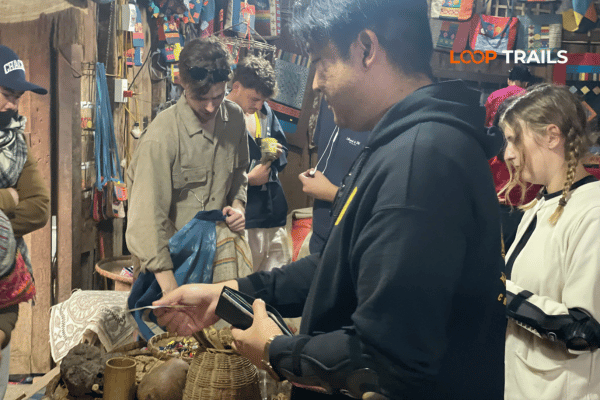
The most travel-friendly textile category. Almost every Hmong, Dao, and ethnic market vendor sells small embroidered items: cross-body bags, pouches, coin purses, scarves, decorative wall hangings. Quality varies wildly. Some are genuine hand work, where you can see slight irregularities in the stitching and the back of the piece has visible loose threads. Others are machine-embroidered or appliquéd from pre-cut fabric.
A small honest hand-embroidered pouch is one of the best gifts to bring home: light, affordable, beautiful, and immediately recognizable as something from Vietnam’s far north rather than a generic Asian souvenir.
Hmong blacksmiths in remote villages still hand-forge knives, machetes, and small farming tools using techniques passed down for generations. The blades are typically high-carbon steel (so they need oiling and proper care; they will rust if neglected), often with simple wooden handles wrapped in metal bands.
Two practical issues:
If you are serious, ask your guide to visit a working Hmong blacksmith village. A real one is a fascinating stop and the price for a directly-purchased knife is often lower than market prices.
Learn more: Ha Giang Cao Bang Ba Be Lake 6 Days 5 Nights
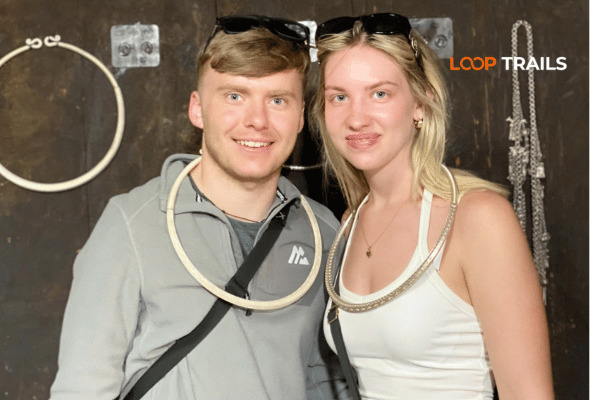
Hmong and Dao silver jewelry is heavy, distinctive, and worn as both ornament and family savings. Necklaces, chest plates, earrings, bracelets, and the carved silver hair pins that hold a Dao woman’s headdress in place are all available at markets.
Two layers to know:
If you want the real thing, ask the vendor to test the silver. A simple way is to drop a small drop of household bleach on a hidden spot; real silver turns black, plated silver does not react. Some market vendors will do this for you if asked politely.
The Hmong khèn is a curved bamboo and gourd reed pipe used at festivals, weddings, and funerals. A full-sized concert khèn is large, fragile, and complicated to play, and a real one made by a master craftsman is a serious instrument, not a souvenir.
The travel-friendly version is a miniature decorative khèn (often 20 to 30 cm long), sold at markets across the Loop. It will not play properly, but it is a beautiful piece of cultural ornament. Small wooden flutes and bamboo whistles are also common and easier to fit in a backpack.
If you actually want a playable khèn, ask a guide or homestay host about visiting a master craftsman; it is worth the detour and you will pay significantly more for a real instrument.
A few practical and increasingly popular items:
These are the souvenirs to fill the gaps in a suitcase with affordable, meaningful items for friends back home.
If this is starting to feel like a lot to keep track of, this is also where having a guide pays off. On a guided Ha Giang Loop tour, your guide knows which markets fall on which day, which vendors are reliable, and which villages welcome a quick shopping detour. If you want to plan your trip around the right markets, explore our Ha Giang Loop tour itineraries or send a quick message to ask which dates align with which markets.
Learn more: Ha Giang Market Days
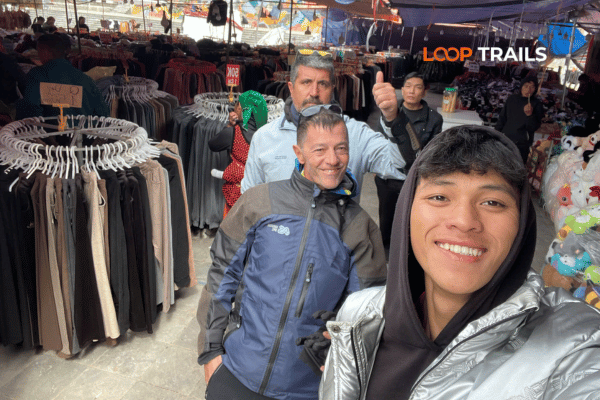
The single biggest factor in souvenir quality and price is where you buy. Roadside tourist stalls between Dong Van and Meo Vac are convenient but the worst value. Sunday markets in the right towns are by far the best.
The biggest, most varied, and most touristed of the Ha Giang markets. Held every Sunday morning in the heart of Dong Van Old Quarter, it pulls in vendors from across the Dong Van karst plateau. You will find honey, tea, smoked meat, textiles, silver, and food stalls all in one walk.
Arrive early. By 7 a.m. it is busy, by 8 a.m. it is packed, and by 11 a.m. most of the best vendors are packing up. The market has both an ethnic-vendor section (mostly older women selling herbs, textiles, and small craft) and a more conventional commercial section. Spend time in the former.
Equally good, less crowded, often more authentic. Meo Vac is a slightly smaller town than Dong Van and the market has a more local, less tourist-focused feel. The livestock section is famous and somewhat overwhelming if you have never seen it; the food stalls are excellent for breakfast (try the thắng cố if you are brave, or pho if you are not).
If you are doing a 3 days Loop tour, your itinerary may put you in Meo Vac on Sunday or Dong Van on Sunday but rarely both. If souvenir shopping matters to you, ask which town your tour overnights in on Saturday so you wake up next to the right market.
The first major market town as you ride north from Ha Giang City. Smaller than Dong Van and Meo Vac, but it falls on Saturday, which makes it a useful first stop for travelers starting their Loop on a weekend. Strong for textiles, basket weaving, and produce; weaker for honey and tea
In the southwest of the province, Hoang Su Phi market runs on Sunday and is the place to buy Shan tuyet tea directly from producers. Easier to find smaller artisan vendors and less tourist-priced than Dong Van. If your itinerary includes a Hoang Su Phi extension, do not miss it.
Convenient but mediocre value. The stalls clustered around the Vuong Family Palace (Sa Phin) and the Lung Cu flag tower are aimed squarely at tourists, with elevated prices and a high proportion of factory-made goods. Fine for a quick souvenir if you missed the markets, not worth a special stop.
A handful of shops in Ha Giang City near the central market sell honey, tea, smoked meat, and packaged souvenirs in clean, vacuum-sealed forms ideal for travelers heading straight to the airport. Prices are slightly higher than the markets but the quality at the better shops is reliable.
A practical tip: if you bought a jar of honey at Dong Van market and you are worried about it surviving the bus ride to Hanoi, drop into a Ha Giang City shop on your way out and buy a second vacuum-sealed pack as a backup.
A small but growing number of cooperatives in Ha Giang sell directly to travelers. These are typically managed by ethnic minority women, with prices that are fair and a share of profits that returns to the community. They are particularly worth seeking out for embroidered textiles, indigo, and traditional crafts where the producer’s livelihood is directly tied to the sale.
Ask your guide for current names. The list shifts as new cooperatives launch and others quietly close, so we will not name specific ones here, but a good guide will know two or three reliable options.
Learn more: Ha Giang Loop Price
Here are honest ranges to calibrate your expectations. These are not promises; they shift with season and vendor.
| Item | Rough range (per unit) |
|---|---|
| Mint honey, glass jar, ~500ml | Low six figures to mid six figures VND |
| Shan tuyet tea, ~100g vacuum pack | Mid five figures to low six figures VND |
| Smoked buffalo, ~250g | Low to mid six figures VND |
| Corn wine, small ceramic bottle | Low five figures to low six figures VND |
| Embroidered pouch or small bag | Low five figures to mid five figures VND |
| Indigo scarf, hand dyed | Low to mid six figures VND |
| Hmong jacket, hand embroidered | Mid six figures to low seven figures VND |
| Hmong hand-forged knife, basic | Mid five figures to mid six figures VND |
| Antique family silver necklace | Highly variable, often into seven figures VND |
| Buckwheat husk pillow | Low to mid five figures VND |
Use this only as a rough sanity check. If a vendor quotes you 5x the upper end of these ranges, walk away or negotiate. If they quote you a tenth of the low end, the item is almost certainly factory-made or fake.
Learn more: Cao Bang Loop 3 Days best kept secret
This is where many foreign travelers get it wrong, and where a little awareness goes a long way.
Bargaining is fine and expected when:
Bargaining is not appropriate when:
A reasonable approach in markets: politely ask the price, smile, propose maybe 70 to 80 percent of the quoted figure, and accept what they counter. If they hold firm, decide whether you want it at that price. Aggressive bargaining over a few thousand dong is, frankly, embarrassing, and locals notice.
For honey, tea, smoked meat, and other food items at established shops or cooperatives, prices are usually fixed and there is no bargaining culture. Pay what is asked.
Learn more: Ha Giang Loop Mistake to Avoid
A short, practical checklist.
Mint honey:
Indigo textiles:
Embroidery:
Silver:
Smoked buffalo:
Corn wine:
Learn more: Ha Giang Motorbike Rental
This is the unglamorous but essential part of souvenir shopping. Nothing kills the joy of bringing home Ha Giang mint honey like having it confiscated at the airport.
Rules vary significantly by country. As a general baseline:
The honest advice: assume your home country has stricter rules than you think. Look up your customs agency’s import rules before you fly. If smoked buffalo is restricted, eat it during your trip or share with friends in Hanoi rather than pack it.
Tea, dried buckwheat products, textiles, jewelry, knives (in checked baggage), and most non-meat, non-honey items travel without issue.
If you are riding a Loop motorbike for two more days after a shopping stop, your packing approach matters.
A small extra dry bag for souvenirs is a smart move. Most rental companies will let you strap one on the back of the bike. Browse our motorbike rental options if you are planning a self-drive Loop and want a setup that can actually fit what you buy.
Learn more: Ha Giang Safety Tips
A few of the most common mistakes travelers make:
Learn more: Ha Giang Loop Easy Rider
Different ways of doing the Loop suit different shopping styles.
| Your trip style | What you can expect to buy |
|---|---|
| 3 days easy rider Loop: guide drives, you sit on the back | You will hit Quan Ba market (Saturday) or Dong Van market (Sunday) depending on routing. Guide knows good vendors. Plenty of room to carry items in saddlebags. |
| 3 days self-drive motorbike: you ride your own bike | Limited cargo space. Focus on small, lightweight items (honey jars, tea, embroidery, soaps). A back dry bag helps. |
| 3 to 4 days jeep tour: no riding, comfortable, weather-proof | Best for shopping. You can buy heavier and more fragile items (full Hmong jackets, framed textiles, ceramic bottles, larger honey jars) without worrying about packing them on a bike. |
| 4 to 5 days Hoang Su Phi extension: cultural focus | Best for tea and textiles. The further you go from the main Loop, the better the price and the more authentic the producer. |
| Ha Giang to Cao Bang combo: 5 days or longer | Adds Cao Bang specialties: bamboo products, smoked meats from Tay communities, and Cao Bang’s own tea and honey. Different vendors, different products, more variety. |
If your priority is bringing home meaningful souvenirs, the jeep option is honestly the most practical. No worrying about glass jars or heavy textiles on a motorbike, and the guide can stop wherever you want. If you would rather have the riding experience and accept some packing limits, easy rider with saddlebags is the sweet spot.
For travelers who want both Ha Giang’s craft economy and Cao Bang’s lesser-known specialties (Phia Oac honey, Trung Khanh chestnuts, Cao Bang smoked meats), the 5 days Ha Giang to Cao Bang combo covers more ground and more market variety than a Loop alone.
Learn more: Ha Giang in September & October

Learn more: Ha Giang Jeep Tours
Souvenir shopping in Ha Giang is one of the small pleasures that turns a Loop from a scenic ride into something you take home with you. If you want a tour that times the right markets, stops at honest cooperatives, and gives you cargo space for everything you find, we can help.
See our Ha Giang Loop tour options or message us on WhatsApp with your dates and we will tell you which markets your trip will hit and which souvenirs are in season.
Mint honey from the Dong Van karst plateau is the single most iconic Ha Giang souvenir, holding an official Geographical Indication. Smoked buffalo, Shan tuyet tea, and Hmong indigo textiles round out the top four.
Most countries allow commercially-packaged honey in checked baggage, but rules vary. Australia, New Zealand, and a few other countries restrict honey imports. Check your home country’s customs rules before you fly.
Mostly no. Roadside stalls between major towns are convenient but offer the worst value and the highest proportion of factory-made goods. Wait for a real market (Dong Van or Meo Vac on Sunday, Quan Ba on Saturday) for better quality and prices.
Sunday. The biggest markets in Dong Van, Meo Vac, and Hoang Su Phi all run on Sunday. If you cannot do Sunday, Saturday works for Quan Ba market in Tam Son.
Mildly, yes, especially at obvious tourist stalls. But not aggressively, and not with older ethnic women selling handmade items at already-low prices. A 20 to 30 percent reduction is reasonable; demanding half off a hand-stitched pouch is not.
Often no. The EU, US, UK, Australia, Canada, and many other countries restrict imports of Vietnamese meat products, even vacuum-sealed. Check before you fly. If it is restricted, eat it during your trip.
In checked baggage, yes, on most international flights. Pack them securely wrapped, and check your destination country’s blade-length rules. Not allowed in carry-on.
Hoang Su Phi is the heartland. Look for tea sold by small cooperatives or producers, vacuum-sealed if you plan to travel. Avoid generic “Vietnamese green tea” labels at touristy shops; ask specifically for Shan tuyet.
Look at the back of the piece. Hand-embroidery shows visible knots, loose ends, and slight irregularities. Machine embroidery has a clean, uniform back, often with a layer of fabric backing.
Sometimes, but quality and authenticity are usually worse, and you miss the whole point of buying directly from the source. A few items (textiles, generic souvenirs) are available in Hanoi for similar prices; honey, tea, and smoked meat are noticeably better at the source.
Yes, and it is one of the better experiences you can build into a Loop. Ask your tour guide to plan a stop at a working indigo dyeing village, a Hmong blacksmith, or a beekeeping cooperative. Direct purchases are often the same price as markets, with the bonus of seeing the process.
No, almost never. Bring cash. ATMs are available in Ha Giang City, Dong Van, and Meo Vac, but smaller towns and villages are cash-only. Withdraw enough for the trip before you leave Ha Giang City.
Contact information for Loop Trails
Website: Loop Trails Official Website
Email: looptrailshostel@gmail.com
Hotline & WhatSapp:
+84862379288
+84938988593
Social Media:
Facebook: Loop Trails Tours Ha Giang
Instagram: Loop Trails Tours Ha Giang
TikTok: Loop Trails
Office Address: 48 Nguyen Du, Ha Giang 1, Tuyen Quang
Address: 48 Nguyen Du, Ha Giang 1, Tuyen Quang
Facebook X Reddit Table of Contents Learn more: Ha Giang Loop Tours Most people drive past the Quan Ba area twice on

Facebook X Reddit Table of Contents Learn more: Ha Giang Loop Tours The Ha Giang Loop has a reputation problem with older