


Thúy Kiều (Grace) is a travel blogger and content contributor for Loop Trails Tours Ha Giang. She holds a bachelor’s degree in Sustainable Tourism from Vietnam National University, Hanoi, and has a strong passion for exploring and promoting responsible travel experiences in Vietnam’s northern highlands.
Learn more: Ha Giang Loop Tours
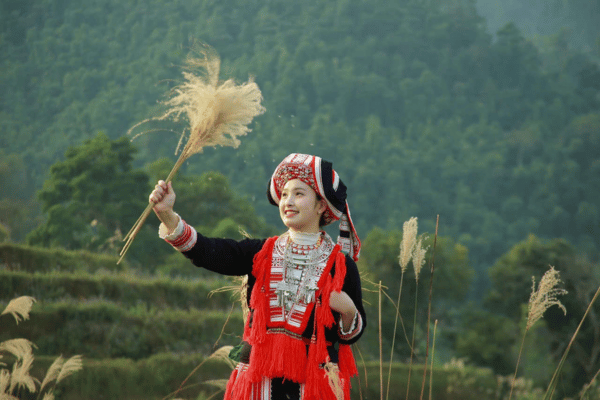
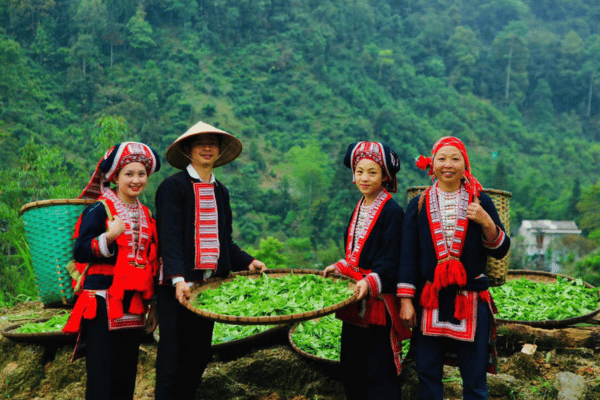
The first time you see a Red Dao woman walking a mountain road in Ha Giang, you stop. The crimson headdress is the size of a small loaf of bread, the indigo jacket carries embroidery that took months to finish, and silver coins ring quietly at the chest. It is not a costume. It is everyday clothing for somewhere around six million people across northern Vietnam, southern China, Laos, and Thailand, and Ha Giang is one of the most rewarding places to actually meet them.
This guide is for travelers who want more than a roadside photo. We will cover who the Red Dao are, where to find their villages in Ha Giang, what their traditions mean, how to visit without being the kind of tourist locals quietly resent, and how to fit a real cultural stop into a Loop trip without turning it into a checklist.
A note before we start: “Red Dao” is one of several Dao subgroups in Vietnam, and the people themselves use their own names in their own language. We use Red Dao here because that is what English speakers and travel guides recognize.
Learn more: Ha Giang Loop 2 Days 1 Night
The Dao (sometimes written Yao in Chinese sources) are one of Vietnam’s 54 recognized ethnic groups, and they are far from a single block. There are several Dao subgroups in Vietnam: Red Dao (Dao Đỏ), Black Dao, White Trousered Dao, Long Tunic Dao, and a handful of others. They share a common ancestral language belonging to the Hmong-Mien family, a shared origin story rooted in the legendary ancestor Bàn Vương, and most importantly a written script called Nôm Dao that uses Chinese characters and is still passed down by village shamans.
What sets each subgroup apart is mostly clothing, dialect, and the details of certain rituals. A Red Dao woman from Hoang Su Phi and a Tien (Money) Dao woman from Tuyen Quang would recognize each other as Dao, but their headdresses, embroidery patterns, and accents would mark them as belonging to different branches.
In Ha Giang specifically, Red Dao make up a meaningful chunk of the ethnic mosaic, sitting alongside the Hmong, Tay, Nung, La Chi, and other groups. They tend to live at middle and higher elevations, not the highest peaks (those belong to the Hmong) but on the cooler upper slopes where forests give way to rice terraces.
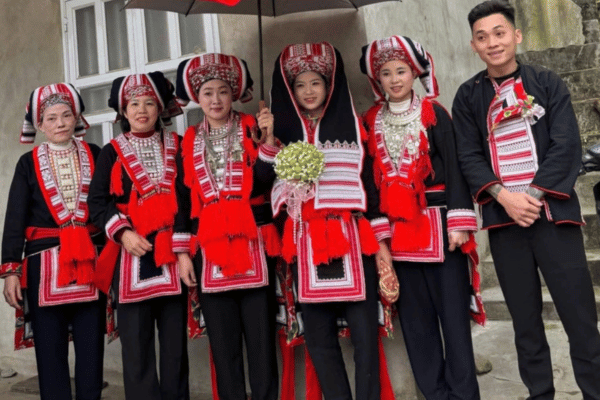
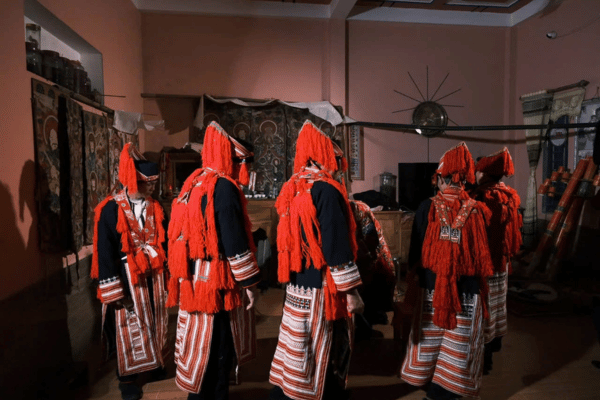
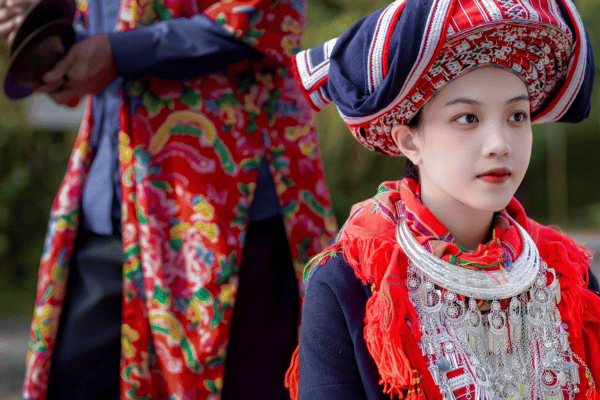
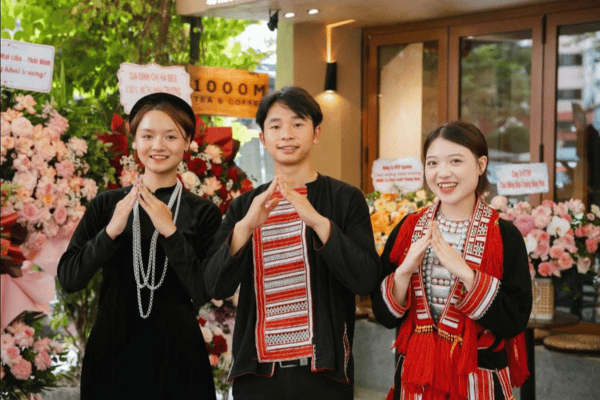
Red Dao women wear a striking red headdress. Depending on the sub-branch and the occasion, it can be a tall folded turban, a flat-topped square, or a more intricate structure decorated with red yarn, tassels, silver, and beadwork. Some older women add a thin band of small bells.
The red is symbolic. In Dao cosmology red ties to the sun, to fire, and to the protective power of ancestors. It is also a marker of identity that, even from a distance across a market, says “I am Dao Đỏ.” Take that headdress away and a lot of the cultural visibility disappears, which is one reason younger Red Dao women still wear it on market days and ceremonies even when they have switched to jeans for working in the fields.
Learn more: Ha Giang Loop 3 Days 2 Nights
If you have looked at a standard Ha Giang Loop map, you have probably seen the route from Ha Giang City to Quan Ba, Yen Minh, Dong Van, Meo Vac, and back. Most Red Dao villages sit either slightly west of this route or deeper into the southwest of the province. To meet them you do not need to go far. You just need to know where to look.
Hoang Su Phi is the single most rewarding district in Ha Giang for Red Dao culture. The terraced landscape that turns gold in late September is largely the work of Red Dao and La Chi farmers over many generations. Villages here cling to ridges between 800 and 1,500 meters, with names like Ban Phung, Ho Thau, Nam Hong, and Phin Ho.
Hoang Su Phi takes a real detour from the classic Loop route. From Ha Giang City you head west and south, not north, and the roads are slower, narrower, and far less trafficked than the main Loop. That is exactly why it has remained more authentically Dao. Tour buses do not go there. You arrive on a motorbike, in a small jeep, or on the back of an easy rider’s bike, and you slow down.
Best time to be in Hoang Su Phi:
Quan Ba district, the first stop on the classic Loop after leaving Ha Giang City, is more often associated with the H’mong, but several Dao communities live in the valleys here too. The well known community-based tourism village of Nam Dam (just outside Quan Ba town) is a Dao village with established homestays. Whether the specific families belong to the Red Dao or another Dao subgroup varies, so if it matters to you, ask before booking. Either way, Nam Dam is a calm, low-key introduction to Dao village life and a very natural overnight on a Loop itinerary.
Yen Minh, between Quan Ba and Dong Van, hides several smaller Dao hamlets in side valleys off the QL4C. Most travelers do not see them because the main road runs through pine forest and rolling hills without obvious settlements. If you ride with a guide who knows the area, a 20 minute detour onto a side road can drop you into a working village where children are doing homework and a grandmother is feeding pigs.
Vi Xuyen district, immediately south of Ha Giang City, has Red Dao populations especially in the highlands east of Tay Con Linh, Ha Giang’s tallest mountain. This area is more difficult to reach independently and is best combined with a Tay Con Linh trek or a deliberate cultural extension to a standard Loop.
Learn more: Ha Giang Loop 4 Days 3 Nights
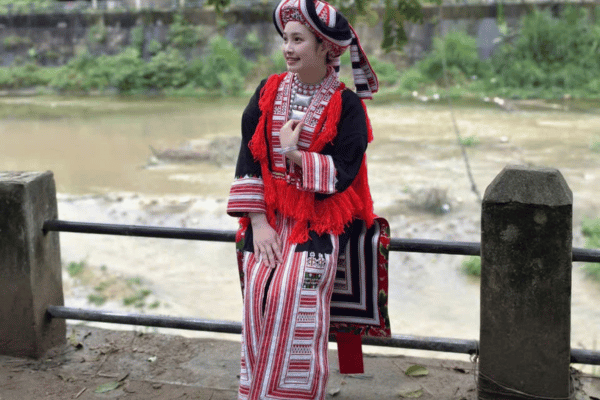
If you spend an hour in a Red Dao market you will notice that no two outfits are quite identical. Embroidery is personal. Patterns are inherited from mothers and grandmothers, sometimes adapted, sometimes copied exactly. Reading the dress is a small craft in itself.
Among Red Dao women in Ha Giang, you will see two common headdress styles:
A young unmarried woman, a married woman, and an older grandmother do not necessarily dress identically. Subtle differences in how silver is worn, how the hair is arranged underneath, and whether certain ornaments are present can mark age and marital status. The shaman class (men who have completed the highest level of Cap Sac, see below) also wear distinct ceremonial robes.
The indigo blue jacket and trousers are dyed at home using leaves from the indigo plant fermented in clay jars, a process that takes weeks and that you can often watch in a working village. The deep, slightly violet-blue you see on Red Dao clothing is not the cheap chemical indigo of mass-market T-shirts. Touch a freshly dyed piece and your fingers will smell faintly of indigo for an hour.
Embroidery is stitched freehand, no patterns drawn beforehand. The most common motifs are stylized representations of trees, dogs (a reference to the ancestral story of Bàn Vương), flowers, and geometric shapes that locals can read like a sentence. A full ceremonial jacket can take six months to a year of evening work and is treated as a family heirloom.
Silver matters enormously. Heavy silver necklaces, earrings, and chest plates are worn for festivals and weddings, and serve as a portable family savings account. Older silver tends to be visibly handmade, with small imperfections that machine-made silver lacks. If you are offered silver as a souvenir, gently ask whether it is family-made or factory; both exist in Ha Giang, and both are sold without much distinction at markets.
Learn more: Ha Giang Cao Bang 5 Days 4 Nights
Of all Red Dao traditions, the one outsiders find most fascinating is Lễ Cấp Sắc, the rite of passage that turns a Dao boy into a recognized adult man within the community. Without going through Cap Sac, a Dao man cannot lead rituals, marry properly, or in some traditions even be properly buried by his community. It is not optional. It is the spiritual backbone of Red Dao identity.
The ceremony has multiple levels, traditionally three, seven, or twelve “lamps” (đèn), with each level granting the initiate more spiritual authority. The first level is what most young men complete, often between ages 10 and 30 depending on family circumstances. Higher levels are reserved for those who become shamans.
A Cap Sac ceremony typically involves:
Whether you can witness a Cap Sac as a traveler is largely down to luck and respect. They happen on family timelines, not tourist schedules, and most happen in winter, between roughly November and February, when farm work slows. If you visit during that season and stay in a homestay, your hosts may casually mention a ceremony happening nearby. If they offer to bring you, accept quietly, bring a small respectful gift, and keep your camera in your bag unless you are explicitly invited to take pictures.
Learn more: Ha Giang Cao Bang Ba Be Lake 6 Days 5 Nights
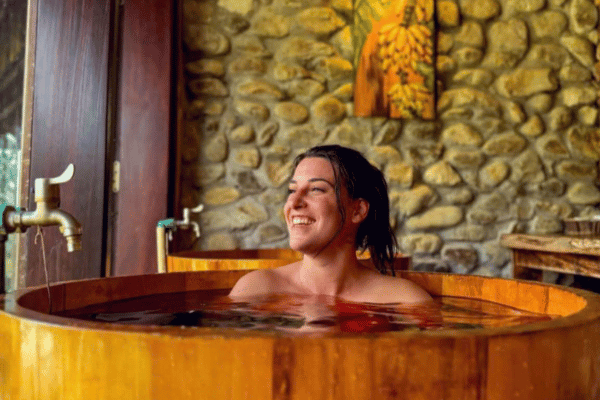
If the Cap Sac ceremony is the most spiritually serious Red Dao tradition, the herbal bath is arguably the most accessible to travelers, and the one that has quietly become a small economic lifeline for Red Dao villages across northern Vietnam.
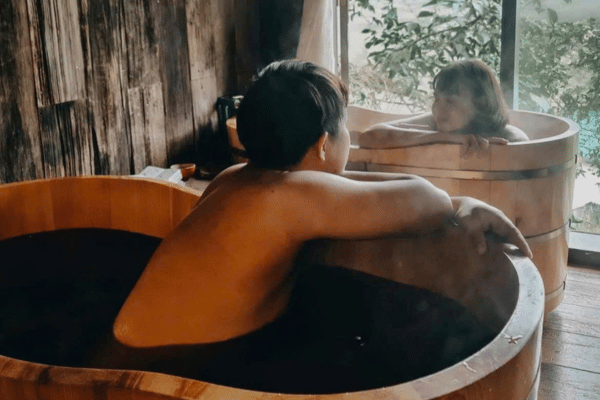
The Red Dao herbal bath (Vietnamese: tắm lá thuốc người Dao) uses a brew of dozens of medicinal plants collected from the surrounding forest, boiled slowly, and poured into a wooden barrel large enough to sit in up to the chest. You soak for around 20 to 30 minutes. The water turns a deep reddish brown and smells like a wet forest after rain.
Learn more: Cao Bang Loop 3 Days best kept secret
Recipes vary by family and by ailment, but a typical brew uses between 10 and over 100 plant species, including:
The empirical effect, regardless of the specific botany, is a deep warming sweat and a kind of post-bath softness in the muscles that feels noticeably different from a regular hot bath. People who ride motorbikes for three days through Ha Giang’s switchbacks tend to crawl out of one of these baths and immediately book another.
The most famous Red Dao herbal bath tradition is associated with Ta Phin near Sa Pa, in Lao Cai province, where it has become a thriving local industry. In Ha Giang, the tradition exists but is less commercialized and less consistently available. Some Red Dao homestays in Hoang Su Phi and Quan Ba offer baths to guests, sometimes by advance request because the bath takes a half day of preparation.
A few honest notes:
Learn more: Ha Giang Loop Photography Guide
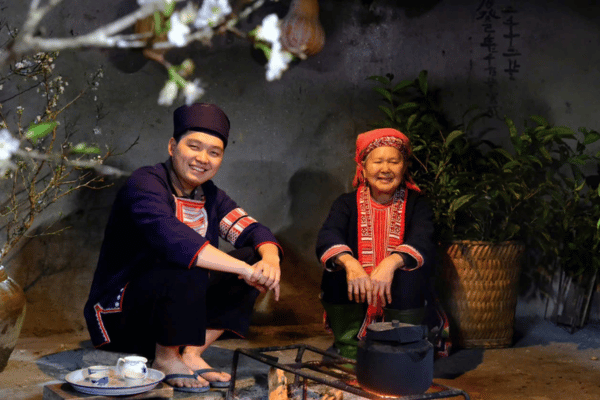
Red Dao houses in Ha Giang are typically built directly on the ground (not on stilts like Tay houses), with walls of rammed earth, wood, or pressed bamboo, and roofs of tile, fiber-cement, or in older villages, palm leaf. The central feature is the hearth, a built-up fire pit in the main room used for cooking, heating, and the slow smoking of meat that hangs from the rafters above.
A typical day starts before sunrise. Women cook breakfast over the hearth, often a simple rice or maize porridge, then head to the fields. Older family members tend to younger children and animals (pigs, chickens, sometimes a buffalo). Men work the harder field labor, hunt or forage in the surrounding hills, or these days drive a motorbike to a nearby town for paid work. Children walk to school, which can be a long walk in the more remote villages.
By late afternoon, families come back together. The hearth is restoked, dinner is prepared, and the day winds down early. By 9 or 10 p.m. most villages are silent. There are no streetlights. The stars are remarkable.
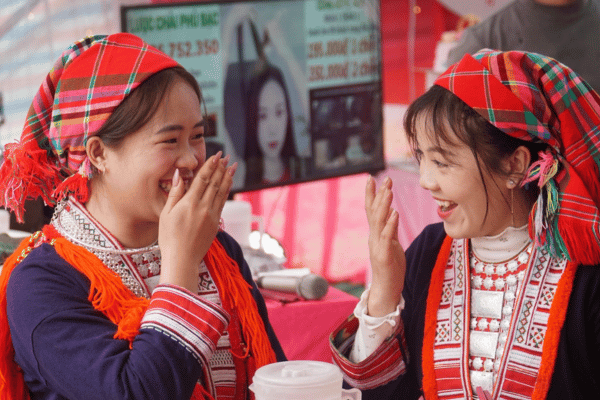
Markets are the heartbeat of Red Dao social and economic life. Different valleys have markets on different days of the week, and traveling between markets is a way Red Dao traders, particularly older women selling herbs, vegetables, embroidery, and silver, earn a living.
Well-known markets in or near Red Dao areas of Ha Giang include:
| Market | Location | Day |
|---|---|---|
| Hoang Su Phi market | Hoang Su Phi town | Sunday (main day) |
| Dong Van market | Dong Van Old Quarter | Sunday |
| Meo Vac market | Meo Vac town | Sunday |
| Pho Bang | Yen Minh district | Saturday (smaller) |
| Quan Ba | Quan Ba town | Saturday |
If you can plan your Loop so that one day falls on a Sunday market, do it. The atmosphere is unlike any organized tourist attraction in Vietnam. Bring small denominations of cash, and buy something even if it is just a bowl of pho from a roadside stall, because your spending is one of the small reasons these markets stay alive.
Learn more: Ha Giang Loop for Beginners
Red Dao spirituality is a layered blend of Taoism, ancestor worship, and older animist beliefs about forest, water, and mountain spirits. There is no central authority and no single sacred book. What holds it together is the household shaman, the senior shaman of the village, and the texts written in Nôm Dao that pass between them.
In a Red Dao home, the most important spiritual object is the ancestor altar, usually placed against the rear wall of the main room facing the door. Offerings of incense, food, and rice wine are made on the first and fifteenth of each lunar month, on the Lunar New Year, and at family events like weddings, funerals, and Cap Sac ceremonies.
Outside the home, forests, springs, and certain rocks are seen as homes of spirits that must be respected. This is why Red Dao villages tend to take forest conservation seriously in their immediate area, and why you might see small offerings (a few rice grains, a folded banknote, a stick of incense) at the base of an old tree or beside a spring. If you walk past one, do not touch it.

Learn more: Ha Giang Food guide
If you stay in a Red Dao homestay, dinner is one of the highlights and tends to be a small parade of dishes set out around the hearth on a low wooden table. Common elements include:
A few things to know:
Learn more: What to wear on Ha Giang Loop?
This is probably the most important section of this guide. Red Dao communities have, on the whole, welcomed travelers warmly for decades. They have also dealt with their share of selfish behavior, from people walking uninvited into homes to take photos to bargaining hard over a 50,000 dong embroidered pouch that took a week to make. A small amount of awareness changes the experience for everyone.
The one rule that matters most: ask first. A simple gesture toward your camera with a questioning look is universally understood. A smile, a nod, and the photo is fine. A turn of the head or a soft “no” and you put the camera down without sulking.
Avoid taking photos of children without speaking to the parent first. Avoid taking photos in homes unless invited. If you take a great portrait of someone, and you have a way to send a printed copy back through a local contact or a guide, do it. The number of Red Dao families with a printed photo of a parent or grandparent on the wall is small, and a returning portrait is the kind of small kindness people remember.

Learn more: Tu San Canyon & Nho Que River Boat Trip
You have options. Here is how to think about them honestly.
The classic Ha Giang Loop (Quan Ba → Yen Minh → Dong Van → Meo Vac → back) passes through a handful of areas where Red Dao communities live, particularly around Quan Ba and Yen Minh. If you join a 3 days or 4 days Loop tour with a guide who actually knows the area, you can request a Red Dao village stop, an overnight in a Dao homestay (Nam Dam is the classic option), or a market timing that catches a Sunday market.
This is the easiest, most logistically efficient option. You see the Loop’s famous landscapes (Ma Pi Leng Pass, Nho Que River, Lung Cu) and you also get a meaningful cultural stop, without having to plan a separate trip.
Browse our Ha Giang Loop Tours (anchor: Ha Giang Loop tours) to see itineraries that include a Dao village overnight.
If your priority is culture more than landscape, the most rewarding option is a Hoang Su Phi extension: either a 4 days or 5 days route that starts in Ha Giang City, heads west and south to Hoang Su Phi, includes one or two nights in a Red Dao homestay, then either returns to Ha Giang or continues to the main Loop.
This is slower, less crowded, and frankly more authentic for cultural travelers. It is not the best option if you have only three days, but for travelers with five days or more in Ha Giang, it is worth the extra time.
| Your priority | Best fit |
|---|---|
| First trip to Vietnam, limited time, want both landscape and a taste of culture | 3 days Loop tour with a Dao village overnight |
| Want serious cultural depth, slower pace, less traffic | 4 to 5 days Hoang Su Phi cultural extension or a Ha Giang to Cao Bang combo |
| Want comfort, no riding, with a guide who explains everything | Jeep tour (open-air) with cultural stops |
| Confident rider, want flexibility | Self-drive rental with a planned itinerary |
| Want maximum cultural immersion in one stay | Stay 2 nights in a single homestay rather than moving every day |
If you want help putting any of this together, send us a message on WhatsApp and tell us how many days you have, how comfortable you are on a motorbike, and what matters most to you. We will tell you honestly whether what you want is realistic and which tour fits.
Learn more: Ha Giang Loop Mistake to Avoid
If you want a practical companion piece, our Ha Giang packing list (anchor: complete Ha Giang packing list) covers exactly what to bring for a Loop trip that includes village overnights.
Learn more: Ha Giang Motorbike Rental
If a Red Dao village stop is part of why you are coming to Ha Giang, tell us at the inquiry stage. We can route a 3 or 4 days Loop tour through Nam Dam, build a Hoang Su Phi cultural extension, or design a custom itinerary that combines Ha Giang and Cao Bang with a focus on ethnic culture. Group sizes are small, guides speak English, and we ride bikes that are actually maintained.
Check our Ha Giang Loop tour options (anchor: Ha Giang Loop tour options) or message us on WhatsApp to start planning.
No. Red Dao and Red Hmong (or Flower Hmong) are distinct ethnic groups. They speak related but different languages from the Hmong-Mien family, wear different clothing, and live at different elevations. The “red” in both names refers to clothing color, not a shared origin.
Yes. Several Red Dao homestays operate legally in Hoang Su Phi, Quan Ba (especially Nam Dam village), and parts of Vi Xuyen. We can include one in your itinerary or recommend a specific stay based on the time of year you visit.
Always ask first. A simple gesture toward your camera is universally understood. Most women are happy to be photographed, especially in markets, but a few will say no, and that has to be respected. Avoid photographing inside homes or near ancestor altars without explicit permission.
Both. The tradition is most famously commercialized in Ta Phin near Sa Pa, but several Red Dao homestays in Hoang Su Phi and Quan Ba offer authentic baths. They usually need to be requested in advance because the brew takes a half day to prepare.
Late September to early October for the golden rice terraces in Hoang Su Phi. Late April to early June for water-filled terraces. November to February is also rewarding because it is festival and Cap Sac ceremony season, but bring warm clothes.
Most Red Dao speak their own Dao language at home. Younger and middle-aged adults usually speak Vietnamese fluently because of school. English is rare. A guide is genuinely useful if you want to have real conversations.
Not at all, as long as you pay fairly. Embroidery and silver sales are important income for many Red Dao families. The thing to avoid is hard bargaining over already low prices on handmade items. If something is hand stitched and you want it, pay close to the asking price.
Most Red Dao villages in Quan Ba, Yen Minh, and accessible parts of Hoang Su Phi can be reached by jeep. Deeper villages, particularly in upper Hoang Su Phi or near Tay Con Linh, may require a final stretch on foot or by motorbike. If you prefer a jeep, tell us at the inquiry stage and we will plan accordingly.
Not on demand. Ceremonies happen on family timelines, mostly between November and February. If you stay in a homestay during that season and a ceremony is happening nearby, your host may invite you. Treat any invitation as a privilege, bring a small gift, dress modestly, and follow your host’s lead on photos.
Simpler facilities (shared bathrooms, basic bedding, sometimes no hot water by Western standards), but a far more meaningful experience: home-cooked meals with the family, conversation around the hearth, and direct exposure to daily village life. We recommend it for at least one night on any Ha Giang trip that values culture.
Yes, broadly. Ha Giang in general is one of the safer regions of Vietnam, and homestay families are protective of their guests. Standard travel awareness applies (do not flash cash, dress modestly in conservative villages, tell someone where you are going).
Not necessarily. A 3 days Loop with a guide who chooses a Quan Ba area homestay (often Nam Dam) gives you an evening in a Dao home, dinner with the family, and a chance to see traditional dress, dyeing, and the hearth. It is not as deep as a Hoang Su Phi extension but it is a real cultural stop.
Contact information for Loop Trails
Website: Loop Trails Official Website
Email: looptrailshostel@gmail.com
Hotline & WhatSapp:
+84862379288
+84938988593
Social Media:
Facebook: Loop Trails Tours Ha Giang
Instagram: Loop Trails Tours Ha Giang
TikTok: Loop Trails
Office Address: 48 Nguyen Du, Ha Giang 1, Tuyen Quang
Address: 48 Nguyen Du, Ha Giang 1, Tuyen Quang
Facebook X Reddit Table of Contents Learn more: Ha Giang Loop Tours Most people drive past the Quan Ba area twice on

Facebook X Reddit Table of Contents Learn more: Ha Giang Loop Tours The Ha Giang Loop has a reputation problem with older