

Thúy Kiều (Grace) is a travel blogger and content contributor for Loop Trails Tours Ha Giang. She holds a bachelor’s degree in Sustainable Tourism from Vietnam National University, Hanoi, and has a strong passion for exploring and promoting responsible travel experiences in Vietnam’s northern highlands.
Learn more: Ha Giang Loop Tours
I went into this trip half convinced the jeep was the soft option. Four months on Vietnamese motorbikes, a partner who rides, a smug little belief that the only way to “really” see the Loop was from the saddle. Then we landed in Ha Giang in mid-October, the rain hadn’t stopped for two days, and my partner threw out her shoulder lifting a backpack onto the night bus.
So we booked a jeep. Open top, no roof, four days, three nights, two passengers, one driver named Tu who pointed at the sky on the morning we left, shrugged, and said in English “today, lucky.” He wasn’t wrong.
This is the diary I wrote each evening from a homestay balcony, slightly edited so you can actually follow it. No drone shots, no sponsored highlights, no pretending the Loop is one big spiritual awakening. Just what four days on the Ha Giang Loop in a jeep actually looks like, and what I’d change if I did it again.
If you want the short version: yes, it was worth it. Yes, four days beats three. And yes, the jeep is a real way to do the Loop, not a consolation prize.
Learn more: Ha Giang Loop 2 Days 1 Night
I’m going to be honest with you because I wish someone had been honest with me. The Loop on a motorbike is fantastic if you actually ride. If you’re a confident rider, used to mountain roads, comfortable with mud and goats and trucks coming around blind corners, take the bike. You’ll have a better time.
But here’s what I noticed talking to other travelers in Ha Giang City: maybe one in four “self drive” backpackers I met had real motorbike experience. The rest learned on a flat road in Hanoi the day before. By day two, half of them had a scraped knee or a bent mirror. The hospital in Yen Minh sees foreigners every week.
The jeep was the right call for us because:
What I gave up: the small thrill of riding it yourself, the freedom to stop literally anywhere. What I gained: full attention on the views, dry feet on day three when it poured, and a guide who answered questions instead of yelling them over wind noise.
If you’re still torn between modes, jump to the Which Loop Trails Option Fits You? section near the end. I broke it down honestly.
Learn more: Ha Giang Loop 3 Days 2 Nights
| What | Detail |
|---|---|
| Route | Ha Giang City > Yen Minh > Dong Van > Meo Vac > Du Gia > Ha Giang City |
| Duration | 4 days, 3 nights |
| Mode | Open top jeep (Russian style, Loop Trails fleet) |
| Group size | 2 of us + driver, joined a small convoy on days 2 and 3 |
| Sleeping | 3 homestays, included in package |
| Distance covered | Roughly 350 km over the whole loop (estimate, not measured) |
| When we went | Mid October, the shoulder of dry season |
| Booked | About 5 weeks ahead through Loop Trails |
A couple of things I want to flag because they confused me before the trip:
The “Loop” isn’t a perfect circle. It’s more of a flat oval with a side branch up to Lung Cu and another down to the Nho Que River. A 3 days tour skips one or two stops. A 4 days tour adds Du Gia, which is the off the main road village most travelers either rave about or skip entirely.
Costs vary by season, group size, and what’s included. We were told upfront what was included (jeep, fuel, driver, all three nights, breakfast and lunch daily, two dinners, entrance fees, boat ride on the Nho Que). I’d rather not quote our exact price here because Loop Trails adjusts seasonally and I don’t want to mislead future readers, so check their Ha Giang Loop tours page for current rates.
Mid trip note: If you’re researching specifically for a 4 days itinerary and want this exact route as a structured package, this is the format Loop Trails runs as their standard 4 days jeep option. Easy to copy or tweak.
Learn more: Ha Giang Loop 4 Days 3 Nights
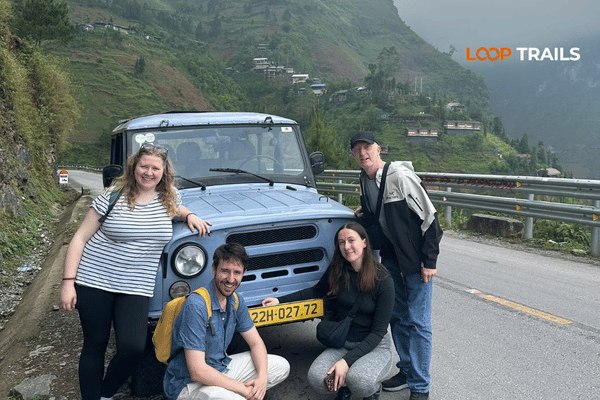
We were picked up from our hostel in Ha Giang City at 8:30. There was a short safety briefing in the office: how the jeep works, what to do if you feel carsick (mention it early, not when it’s bad), where the rain ponchos are stored, and a quick Google Earth flyover of the route. Tu, our driver, introduced himself. He’s been driving the Loop for nine years. His English is functional, not fluent, but he’s got a kind face and the kind of slow nodding patience that I came to appreciate when we started asking the same question for the third time.
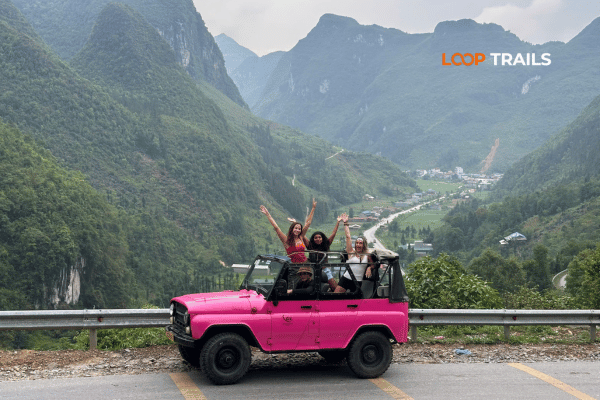
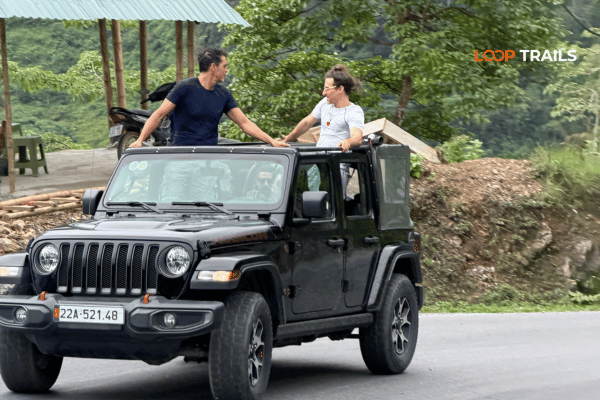
The jeep itself was newer than I expected. Soft canvas roof rolled back, two bench seats in the rear, room for one large bag each plus daypacks. Cold water in a cooler, a small box of dried fruit, two ponchos folded under each seat. Nothing fancy, but nothing felt half done either.
First real stop, about 45 km out of Ha Giang City. Quan Ba Heaven Gate is a viewpoint at the top of a mountain pass. There’s a small concrete platform, a couple of coffee shops, and the famous Twin Mountains view below: two rounded hills sitting in a valley of rice fields. They look more like a pair of upside down bowls than mountains, and yes, locals will tell you the legend about a goddess leaving them behind for her child. Worth the 15 minute stop. Skip the souvenir stalls unless you genuinely want a fridge magnet.
The road up to Quan Ba is your first taste of what the rest of the Loop will feel like: tight switchbacks, occasional cattle, trucks taking up more than their lane, and views that justify all of it.
Learn more: Ha Giang Food guide
We stopped at a roadside restaurant Tu uses regularly. Family run, no English menu, no problem. He ordered for us: stir fried morning glory, tofu in tomato sauce, a small clay pot of pork, plenty of rice. About what you’d expect for a working lunch in the mountains, and it cost roughly what a sandwich in Hanoi would. Good, hot, not photogenic.
If you have dietary restrictions, mention them when you book. Loop Trails passed our “no shellfish” note to Tu in advance and he repeated it back to us, which I appreciated.
This is where the Loop starts feeling like the Loop. Tham Ma Pass is a long, winding climb with maybe a dozen visible switchbacks zigzagging down the valley behind you. There’s a famous photo spot where local H’mong kids in traditional dress will offer to pose with you for a few thousand dong. Some travelers find this charming. Others find it uncomfortable. I’ll let you make your own call: I gave a small amount and didn’t take the photo, but I don’t think there’s a clean right answer.
What I will say is that watching the road behind you fold into itself like a paper snake is one of those scenery moments that justifies four days instead of three. You get to actually sit with it. On a motorbike you’re concentrating. From the jeep you can stand up through the open roof and just look.
We rolled into Yen Minh around 5pm. Our homestay was a wooden stilt house on the edge of town, with a long communal balcony overlooking rice fields. Eight beds in a shared room with curtains for privacy, mosquito nets, a real shower with hot water, clean towels. Dinner was family style: spring rolls, grilled pork, river fish, sticky rice, vegetables, and small cups of “happy water” (local corn liquor) for anyone who wanted to try. I tried. Two cups. That was enough.
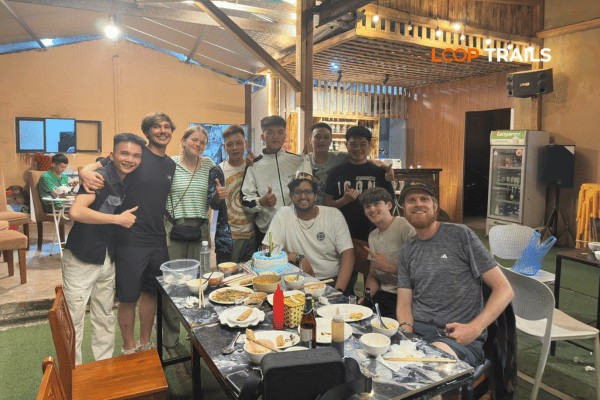
The vibe at a Loop homestay is the part I didn’t expect. By 8pm there were about twelve of us on the balcony from four different countries, swapping stories about the road, terrible budget hostels in Hanoi, and what we’d seen that day. The owner sat with us for a while and answered questions through Tu translating. It’s the kind of slow social evening you can’t really plan for, and it ends up being half the trip.
Learn more: Ha Giang Cao Bang 5 Days 4 Nights
Breakfast at 7:30, on the road by 8. The first 30 minutes were inside a heavy fog bank, the kind that turns the world into a soft grey nothing. Tu drove at a sensible crawl and we passed maybe one motorbike going the other way. By the time we dropped down to Sung La village the fog had burned off and we could see the layered limestone hills around us.
Sung La is a small H’mong village set in a flat valley surrounded by karst peaks. There’s a cluster of traditional rammed earth houses, narrow lanes, and chickens. It was used as the filming location for a well known Vietnamese movie called The Story of Pao, and the “Pao’s House” is now a small paid attraction. It’s fine. The village walk itself is more interesting than the house.
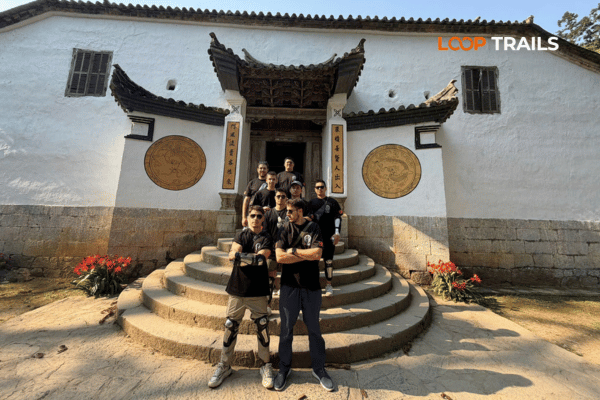
A short drive from Sung La. The Vuong family mansion was built in the early 1900s by a wealthy local clan and is now a small museum. There’s a fee, around the price of a coffee, and a guide if you ask at the entrance. The architecture mixes Chinese, French, and H’mong design and the inside is set up with period furniture and weapons. About 40 minutes is enough. The garden is the best part, especially the row of old pine trees out front.
We had lunch in a small town called Pho Bang area, then made the run up to Lung Cu Flag Tower. Lung Cu is the northernmost point of Vietnam, and the tower marks the spot where Vietnam meets China. There’s a 389 step climb up the hill to the base of the tower, and then more steps inside to a viewing platform. The flag itself is huge, 54 square meters, one square meter for each ethnic group in the country.
I’ll be straight with you: Lung Cu is more meaningful if you understand its symbolism than if you just want a view. The view from the top is decent but not the most dramatic of the trip. The point is standing at the literal edge of the country, looking into another one. We spent about 90 minutes there including the climb.
Learn more: Ha Giang Loop Wrangler Tour
This is the section I’d been waiting for. Ma Pi Leng Pass runs between Dong Van and Meo Vac, climbing along the side of a cliff with the Nho Que River carving its turquoise way through the canyon thousands of meters below. There’s no overstating this pass. It is the reason a lot of people come to Ha Giang.
Tu pulled over at the main viewpoint and we walked out to the edge. The river looked like someone had spilled paint, that unreal blue green you usually only see in tourist photos that turn out to be enhanced. Except this was just it. We stood there for a while. The wind was loud. Nobody in our small group of four jeeps said much for a few minutes, and that’s not a sentence I write often.
There’s a small coffee shop carved into the cliff just past the viewpoint. Egg coffee, ca phe muoi (salt coffee), the usual. Worth the stop if only to sit on the terrace and stare. Avoid weekends if you can: Vietnamese tour buses arrive after lunch and the viewpoint fills up.
We slept in Dong Van that night. The old quarter has a small square where local restaurants spill onto the street with plastic chairs and barbecue stalls. We ate grilled pork skewers, drank cold beer, walked the perimeter twice, and were in bed by 10pm. The H’mong market is open on Sunday mornings and is a real working market, not a tourist set up. If your trip overlaps a Sunday, go.
Learn more: Ha Giang Cao Bang Ba Be Lake 6 Days 5 Nights
After breakfast we drove back along Ma Pi Leng (yes you can see it twice, no it doesn’t get old), then turned off and dropped down a narrow access road to the river. The descent is steep, about 25 minutes of switchbacks, and the road is one of the rougher sections of the trip. This is exactly the kind of section where I was glad to be in a jeep with a driver who knows the road. From inside the jeep it’s a fun bumpy ride. On a borrowed scooter with one day of riding experience it would be genuinely dangerous.
There’s a small pier at the bottom, parking for the jeeps, a couple of food stalls, and a queue for the boats.
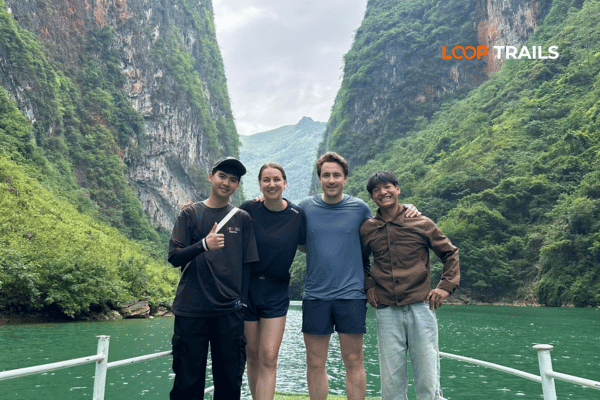
This was the surprise of the trip. The boats are flat bottomed motor launches that hold about 20 people each. The route goes about 4 km upriver and back, into the Tu San Canyon, which is the deepest canyon in Southeast Asia by some measurements. The walls rise nearly vertically on both sides, narrowing as you go, and the water really is that color. Maybe 45 minutes round trip. Not optional in my opinion: do this.
Bring a light layer because it gets noticeably cooler down in the canyon, even when the road above is hot.
Back up the access road (slower going up than down), then a short drive to Meo Vac for lunch. Meo Vac itself is a working town, not a tourist hub, and the lunch was in a place that mostly serves locals. Pho, rice plates, the usual. Solid, cheap, exactly what you want before another long drive.
This is where the 4 days option earns its keep. Most 3 days trips end at Meo Vac and route back to Ha Giang City via a faster road. Du Gia adds a 4 to 5 hour detour into a different valley that almost no big tour buses reach. The road winds through rice terraces, past buffalo grazing in flooded paddies, through villages where kids run alongside the jeep waving until they get tired and stop.
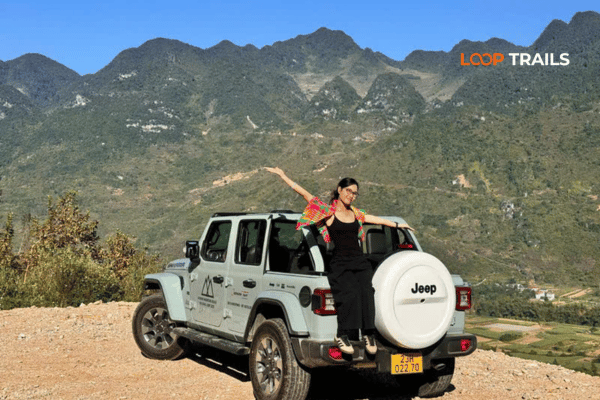
There’s one section where the road climbs over a ridge and the entire valley opens up below you, green and yellow and folded like fabric. Tu stopped without us asking. He’s done this trip enough times to know which 30 second views are worth the brake.
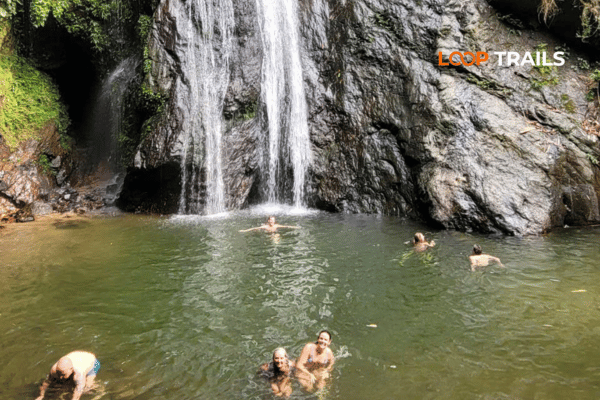
We arrived at our Du Gia homestay around 5pm. The village is set in a quiet valley with a small waterfall a 10 minute walk from the main cluster of homestays. Several travelers were swimming when we got there, and despite my plan to skip the swim and just photograph it I was in the water within 20 minutes. It’s not deep, the pool at the base is maybe shoulder height, and the water was bracing rather than freezing.
Dinner at the homestay was the best meal of the trip. Family style again, but the host’s mother was the cook and you could tell. Smoked pork, mountain greens I couldn’t identify, a stew of sour bamboo shoot and freshwater fish, four kinds of dipping sauces. We sat with travelers from Germany, Argentina, and South Korea. The happy water came out again. I went easy this time.
Learn more: Cao Bang Loop 3 Days best kept secret
Day 4 starts gently. Breakfast at the homestay, then a walk through the village before heading out. If you have time, walk back to the waterfall in the morning light. It’s quieter and the trail is empty.
The road back to Ha Giang City via Du Gia takes you through Mau Due, a stretch where the rice terraces step down the hillsides in long curving lines. Depending on the time of year, the terraces are flooded (silver), green (growing), or golden (just before harvest in late September and early October). We were lucky to be there in the gold week. Tu stopped at three different viewpoints between Mau Due and the next town, two of which weren’t on our itinerary, both of which were better than the official one.
This is the kind of small extra that you don’t realize matters until you’re in it. A driver who likes his job and likes the road will quietly add value all day.
Final lunch was in a roadside cafe about two hours from Ha Giang City. Plain, hearty, fast. By this point we were both starting to feel the trip in our backs and were ready to be back to a real bed.
Tu dropped us at our hostel around 4pm. There was a small “we did it” feeling at the doorstep that I wasn’t expecting from a non motorbike trip. We thanked him, gave a tip (not required, but he earned it), and went straight to a coffee shop to compare phone photos for an hour before passing out.
If you’ve got an evening to spare before your night bus back to Hanoi, Ha Giang City has a few solid coffee places along the river. It’s not a tourist destination in itself, but it’s a fine place to decompress.
Learn more: Ha Giang Loop by Army Jeep Tours
I want to be specific here because most tour descriptions are vague on this.
Comfort: The seats are firm bench style, not plush. After 5 hours you’ll notice your back. The roof folds back, which is great in good weather and a quick shuffle of canvas in rain. The driver’s section is more padded than the rear. None of this is uncomfortable, but it’s not a sedan.
Dust: When you’re behind a truck on a dirt section, dust gets in. A bandana or buff over your face matters. I bought one for a couple of dollars at a stall in Ha Giang City and it was the most useful thing in my pack.
Cold: The mountains are colder than you think, especially Ma Pi Leng in the morning and Du Gia at night. Layers. Always layers.
Rain: When it started pouring on day 3 we put the canvas roof back on, pulled out the ponchos for the open sides, and stayed dry. Not waterproof in a luxury sense, but functional.
Photography: Standing through the open roof to shoot the road behind you is something you can’t do on a motorbike, and it became my favorite thing about the trip. Most of my best photos are from inside the jeep looking out, not from official stops.
The driver question: A good driver makes a 7 out of 10 trip into a 9. Tu knew where the light was best, knew which villages had the friendliest people, knew when to stop talking and when to point something out. If you book through Loop Trails, you don’t get to pick your driver, but their drivers are vetted and most of them have years on the same roads.

Learn more: Ha Giang Packing list
What I brought and used:
What I wish I’d brought:
What I didn’t need:
For the full packing list with notes by season, check the Loop Trails packing guide (link in internal linking plan at the end).
Learn more: Ha Giang Motorbike Rental
This is the section I would have wanted before I booked, so here goes.
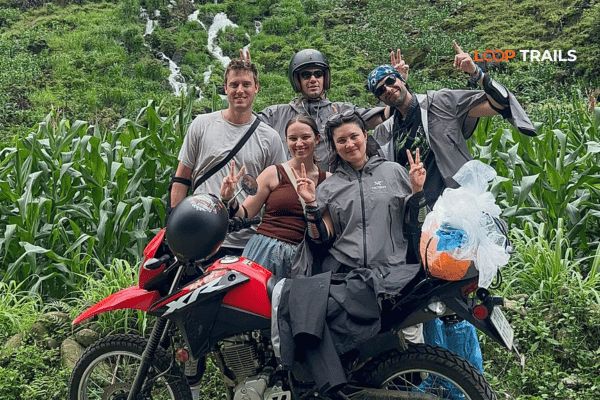
Easy Rider (you on the back, local driver up front, motorbike) Best for: solo travelers who don’t ride, people who want the bike experience without the risk, anyone who wants to talk to a local for four days Worst for: people prone to motion sickness, anyone with a sore back, traveling as a couple where you both want to talk to each other Comfort level: 6/10 Photography flexibility: 7/10
Self Drive Motorbike Best for: experienced riders, solo travelers who want full independence Worst for: people who learned to ride this week, anyone uncomfortable with steep mountain roads or wet conditions Comfort level: 4/10 (it’s a real workout) Photography flexibility: 5/10 (you’ll stop, but not as often as you’d like) Risk: real. Take this seriously.
Jeep (what we did) Best for: couples, families, groups of friends, anyone who doesn’t ride, travelers over 40, anyone who wants to actually look at the scenery Worst for: solo travelers on a tight budget, anyone who specifically wants the wind in their hair feel of a bike Comfort level: 7.5/10 Photography flexibility: 9/10 Weather buffer: best of the three
If you’re still not sure which one fits, the simplest filter is this: if anyone in your group can’t ride or won’t ride, take the jeep. The rest sorts itself out.
You can see all the available options on the Ha Giang Loop tours page, or if you want to ride yourself but skip the tour structure, Loop Trails also runs a motorbike rental service in Ha Giang with newer bikes (XR150 and semi auto) and the full set of safety gear. Message them on WhatsApp for current availability and they’ll get back within a few hours.
Learn more: Ha Giang Loop With Kids
For us, yes, clearly. The 3 days version covers the headline stops: Quan Ba, Tham Ma, Lung Cu, Ma Pi Leng, the Nho Que boat. Those are the postcard moments and they’re all in the shorter trip.
What the 4 days adds is texture. Du Gia is the kind of village where you sit on a balcony in the dark and listen to a stream and realize you haven’t checked your phone in three hours. The drive in and out of Du Gia is the slowest, quietest, least postcard part of the trip and it’s where I stopped feeling like a tourist and started feeling like I was somewhere.
If your total trip in Vietnam is 10 days, do the 3 days. You’ll see the Loop and you won’t regret it.
If you have 12 or more days, do the 4. The extra day pays for itself.
If you’re combining Ha Giang with Cao Bang (Ban Gioc Waterfall, Phia Oac, the karst valleys near Bao Lac), Loop Trails also runs a Ha Giang Cao Bang combine tour which I’m strongly considering for our next trip. Same jeep style, no backtracking through Hanoi between the two.
Ready to book? Most travelers reach out 1 to 3 months ahead because jeep availability is limited and group dates fill up. If you have flexible dates, you’ll always have more options. The fastest way is WhatsApp to the Loop Trails team, they’ll usually confirm within a few hours and can hold a date informally while you sort flights.
Learn more: Ban Gioc Waterfall Guide
Yes, if you go by jeep or easy rider. The roads themselves are mountain roads with sharp turns and occasional rough sections, but with an experienced driver it’s a normal scenic drive. The danger comes mainly from inexperienced self drive riders.
September to November is generally the most reliable window: drier weather, golden rice terraces in late September, comfortable temperatures. March to April is also good for cool weather and flower season. May to August can be hot and wet but the landscape is at its greenest. Rules and conditions change year to year, so check current forecasts closer to your date.
On the 4 days tour we were on the road for roughly 4 to 6 hours per day, with frequent stops broken up by sightseeing, meals, and short walks. It rarely felt like long continuous driving.
Foreign visitors used to need a Ha Giang permit, and policies on this have changed over time. Loop Trails handles any required paperwork as part of the tour booking if applicable, but always confirm permit and visa rules with current official sources before you travel.
Yes, in most cases. Vegetarian, vegan, gluten free, allergies, just tell Loop Trails when you book and they pass the note to the driver and the homestays in advance. Mountain villages can be limited on specialty ingredients so flexibility helps.
Tours generally still run unless conditions are unsafe (typhoon, flooding, landslide risk). For light to moderate rain, the canvas roof and ponchos keep you dry. If a section of road is closed, the driver will reroute. Loop Trails will communicate any major changes with you ahead of time.
Bring cash. Card payment is limited to the Loop Trails office in Ha Giang City. On the road, coffee stops, snacks, drinks, and tips are all cash. Small denominations are much more useful than big notes.
Low effort overall. The most physically demanding parts are the 389 steps up to Lung Cu Flag Tower and a short uphill walk at one or two viewpoints. If you can walk for 20 minutes at a casual pace, you’ll be fine.
Most travelers take a night sleeper bus or a daytime limousine van. It’s roughly a 6 to 8 hour ride depending on traffic and operator. Loop Trails can book your bus for you when you confirm the tour, which saves the bus station scramble.
The open top is a soft canvas roof that the driver can put up in a few minutes if it starts raining. Side panels are open but there are ponchos. You won’t get soaked, but you also won’t be in a sealed cabin.
Yes. Private jeep bookings are the same vehicle without other passengers added in. Best for families, couples who want privacy, or photographers who want full stop and go control. Pricing scales with group size, so it’s most cost effective when you fill the jeep.
Mention it on day 1 so the driver knows to take corners gently and stop more often. Sit in the front seat if you can. Have Dramamine or local equivalent in your daypack. Most people adjust by the second day.
Contact information for Loop Trails
Website: Loop Trails Official Website
Email: looptrailshostel@gmail.com
Hotline & WhatSapp:
+84862379288
+84938988593
Social Media:
Facebook: Loop Trails Tours Ha Giang
Instagram: Loop Trails Tours Ha Giang
TikTok: Loop Trails
Office Address: 48 Nguyen Du, Ha Giang 1, Tuyen Quang
Address: 48 Nguyen Du, Ha Giang 1, Tuyen Quang
Facebook X Reddit Table of Contents Learn more: Ha Giang Loop Tours Most people drive past the Quan Ba area twice on
Facebook X Reddit Table of Contents Learn more: Ha Giang Loop Tours The Ha Giang Loop has a reputation problem with older