


Thúy Kiều (Grace) is a travel blogger and content contributor for Loop Trails Tours Ha Giang. She holds a bachelor’s degree in Sustainable Tourism from Vietnam National University, Hanoi, and has a strong passion for exploring and promoting responsible travel experiences in Vietnam’s northern highlands.

Learn more: Ha Giang Loop Tours
You’ve nailed down your Ha Giang plans. Now you’re squinting at the map, tracing your finger across the squiggly contour lines, and wondering how on earth you’re supposed to get from Ha Giang to Sapa next. The bad news: there’s no high speed train, no direct flight, and no neat little tourist shuttle ferrying backpackers between the two most photogenic corners of Northern Vietnam. The good news: there are four realistic ways to make the connection, and at least one of them is genuinely beautiful.
This guide is the one I wish I had on hand the first time our guests started asking about it. We’ll cover every practical route from Ha Giang to Sapa: the direct overnight sleeper bus, the safer backtrack via Hanoi, the wild overland ride through Hoang Su Phi, and the private transfer options for people who’d rather not deal with bus stations. You’ll see times, trade offs, and the kind of practical detail that doesn’t show up in generic listicles, like what happens when your bus driver decides Bac Ha is a perfectly fine place to swap passengers at 2 a.m.
If you’re stitching together both regions into one Northern Vietnam adventure, this is everything you need to plan it without surprises.

Learn more: Ha Giang Loop 2 Days 1 Night
For most travellers, the direct overnight sleeper bus from Ha Giang to Sapa is the simplest option. It runs at night, takes roughly 10 to 12 hours depending on weather and road conditions, and you wake up close to where you need to be. If you’d rather travel during the day and don’t mind an extra night, going via Hanoi is the most reliable, comfortable route. If you ride a motorbike and your idea of “transport” includes spending two days in rice terrace country, the Hoang Su Phi overland route is the one to take.
Short version:
Now let’s get into the actual detail.
Learn more: Ha Giang Loop 3 Days 2 Nights
Open Google Maps and the distance from Ha Giang City to Sapa town looks deceptively short, somewhere between 270 and 310 kilometres depending on the route. In flat country with a decent highway, that’s a four hour drive. In northern Vietnam, it’s a full day or more.
Here’s why. Both Ha Giang and Sapa sit in the mountainous northwest, but they’re separated by serious terrain: forested ridges, limestone karsts, valleys that the road has to zigzag around rather than cut through. The most direct routes wind across small provincial roads with hairpins, occasional landslides during the rainy season, and the kind of surfaces that make any vehicle, big or small, slow down. There’s no expressway connecting the two cities, and no major airport in between.
That’s why, historically, most travellers were told the only way to connect Ha Giang and Sapa was to backtrack through Hanoi. That advice is outdated. Direct overnight buses now run the route, and if you’re flexible on time and comfort, several other options open up. But the geography is real, and any honest answer to “how long does it take” lands somewhere between 9 hours (fast private transfer, daytime, light traffic) and 24 hours (via Hanoi with a layover).
Knowing this saves you from the most common mistake: trying to do Ha Giang and Sapa as a back to back week with no buffer. Build in at least half a day of travel between the two, ideally a full rest day.
Learn more: Ha Giang Loop 4 Days 3 Nights
Before we dig in, here’s the cheat sheet. Use it to pick a section to read in detail.
| Route | Total Time | Comfort | Relative Cost | Best For |
|---|---|---|---|---|
| Direct sleeper bus | 10 to 12 hours, overnight | Cramped berth, no real privacy | $ | Solo travellers, backpackers, tight budgets |
| Via Hanoi (bus or train) | Around 24 hours including layover | Good, choice of options | $$ | Travellers wanting a rest day in Hanoi |
| Hoang Su Phi overland | 2 days, daytime | Adventurous, you stop and explore | $$ | Riders, photographers, slow travellers |
| Private transfer / limousine van | 8 to 10 hours, daytime | Most comfortable | $$$ | Families, older travellers, time-pressed couples |
Costs change with season, fuel, and operator, so I won’t quote exact numbers that could be wrong by the time you read this. As a rough sense check, the direct sleeper bus is the cheapest, the limousine van sits somewhere in the middle, and a fully private door to door transfer is the most expensive. Always check current rates with whoever you book through.
Learn more: Ha Giang Cao Bang 5 Days 4 Nights
This is the route most backpackers end up taking, and for good reason. It’s the cheapest, it eats up an overnight you’d otherwise have to pay for in a hotel, and it dumps you in Sapa with a full day still ahead of you.
Most direct sleeper buses depart Ha Giang in the late afternoon or early evening, typically between 4 p.m. and 7 p.m. They roll through the night, sometimes via Tuyen Quang and Yen Bai (the longer, smoother route on better roads) and sometimes through Hoang Su Phi and Bac Ha (shorter on the map but slower because of mountain road conditions). Most arrive in Sapa town between 4 a.m. and 7 a.m. Yes, that’s an awkward arrival time. Yes, you’ll be groggy. Yes, most hotels won’t let you check in until noon. Plan to drop your bags, find coffee, and hike the morning away.
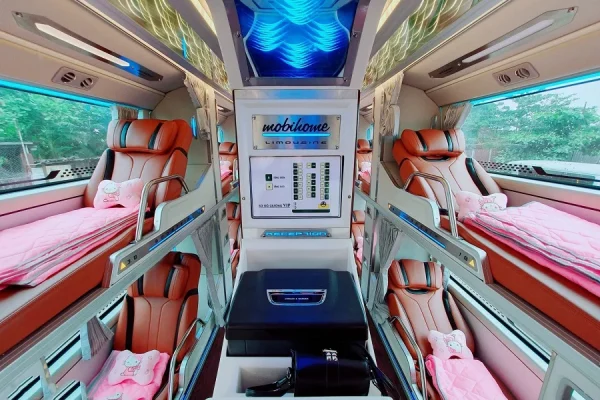
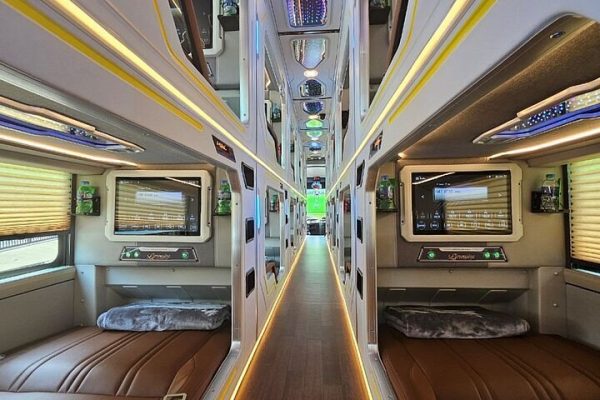
The buses are usually “sleeper” style: three rows of bunks, two levels, with reclining berths shaped vaguely like a chair stuck halfway between sitting and lying. You take your shoes off at the door and they go in a plastic bag. If you’re taller than about 175 centimetres, you’ll be folded. Bring a small inflatable pillow if you actually want to sleep.
Some operators stop once or twice for bathroom and food breaks at roadside restaurants. The food is fine, nothing to write home about. Bring snacks and water you’d actually want to eat at 1 a.m.
Several Vietnamese sleeper bus companies operate the Ha Giang to Sapa connection, and the lineup changes year to year. Most travellers book through their hotel or homestay in Ha Giang, through a tour operator (which often gets you a slightly better rate than walking up to the bus station), or through online booking platforms like Vexere, Baolau, or 12Go. Booking a day or two in advance is usually enough outside of peak season. In peak season (September to November, and around Tet) book three to five days ahead to be safe.
If you’re already on a tour with us, just ask, we can arrange the onward booking when you finish the Loop. It’s the kind of logistics our team handles dozens of times a month and saves you the back and forth with bus stations
Why people pick this option:
Why people regret it:
This route works best if: you’re a budget traveller, you’ve slept on Vietnamese sleeper buses before, you don’t mind arriving somewhere at 5 a.m., and you want to maximise your time at the destination rather than in transit.
Before you commit to a multi day Ha Giang trip and then onward to Sapa, make sure your tour ends on a day when the sleeper bus runs. Most of our 3 days Ha Giang Loop tours (link to tour page) finish in Ha Giang City in the late afternoon, which lines up well with the evening bus departures. The 2 days option leaves you tighter on time.

Learn more: Ha Giang Cao Bang Ba Be Lake 6 Days 5 Nights
Yes, it sounds wasteful to travel all the way back to Hanoi just to head out again. But there’s a reason this used to be the only recommended way, and why a lot of repeat travellers still pick it. It’s the most reliable, most comfortable, and easiest to book route between the two regions.
The Hanoi backtrack makes sense if:
It doesn’t make sense if you’re on a tight schedule and you’d rather lose a night of sleep on the bus than lose 24 hours to a layover.
Once you’re back in Hanoi, you’ve got two ways to reach Sapa:
Sleeper bus or limousine van from Hanoi to Sapa. Most travellers use this option. Multiple operators run buses and small luxury vans throughout the day and night. The journey takes around 6 hours on the new expressway. Limousine vans are pricier than standard sleeper buses but have proper seats, USB ports, and door to door service in some cases.
Train to Lao Cai, then bus or taxi to Sapa. This is the old school option. There’s no train station in Sapa itself, so you take the overnight train from Hanoi to Lao Cai (about 8 to 9 hours), then a 1 hour transfer up the mountain to Sapa. Slower than the bus but it has a certain charm, especially in the soft sleeper carriages. Worth doing once if you’ve never taken an overnight train in Vietnam.
To pull this off cleanly:
Total transit time: about 24 hours, with one daytime stop in Hanoi. Two paid travel legs plus optionally a hotel for half a day. Some Hanoi hotels offer day use rates if you just want a shower and a nap.

Learn more: Cao Bang Loop 3 Days best kept secret
This is the route nobody mentions in the standard travel guides, and the one our regulars keep coming back for. Instead of running south to Hanoi and northwest again, you cut directly westward through the heart of Hoang Su Phi, the rice terrace district that should be on your Vietnam list already if it isn’t.
The classic overland route runs roughly Ha Giang City to Hoang Su Phi town to Xin Man to Bac Ha to Lao Cai to Sapa. Plug it into a map and you’ll see roughly 250 to 300 kilometres of small mountain road, with elevation that drops, climbs, and twists the whole way.
What you actually see:
The cost of this scenery is real road time and a willingness to break the journey into two days rather than crashing through it.
This route splits into two flavours depending on how you travel.
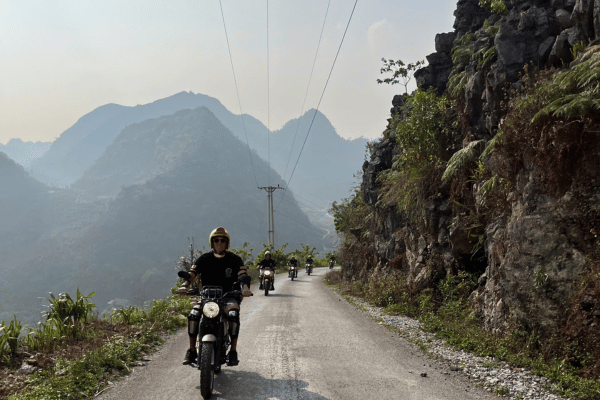
By motorbike (self drive or easy rider): This is the natural extension of a Ha Giang Loop ride. If you’ve already spent three days riding the Loop, your bike skills are warmed up and the Hoang Su Phi roads will feel like familiar territory, just with different scenery. Plan two riding days with one overnight in Hoang Su Phi town or a homestay along the way. The roads here are smaller and rougher than the main Loop, so it’s not a beginner ride. We sometimes arrange this as a custom extension for guests finishing the Loop, with the bike returned in Lao Cai or transported back to Ha Giang separately. Worth asking us about if you’re curious.
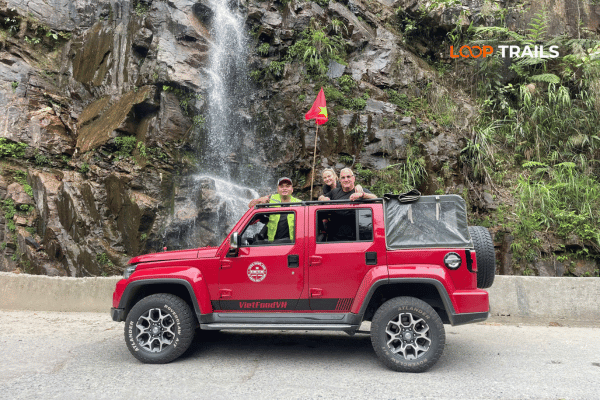
By private jeep or 4WD: The same route, no riding required. Slower than a regular car would be (the roads aren’t built for speed) but you get a comfortable cabin, room for luggage, and a driver who knows where the photo stops are. Two days is the right pace, with an overnight in Hoang Su Phi. This works particularly well for couples or small groups who want the scenery without the physical demands of riding.
If you’re interested in the overland route but you’re not a confident motorbike rider, this is the moment to look at a jeep based tour or even our combined Ha Giang and Cao Bang itinerary for travellers who want extended overland time in the north without leaving the comfort of a vehicle.
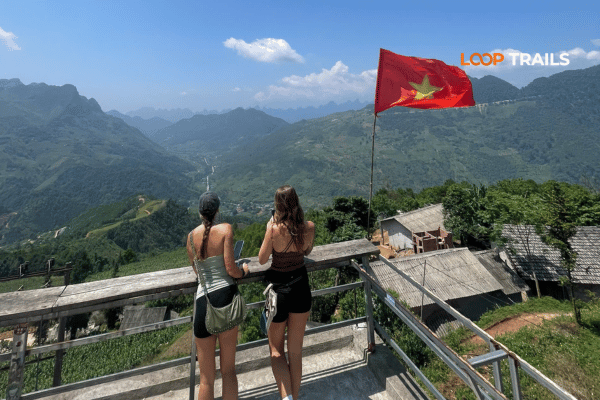
Two days minimum. Three is better if you want to actually explore Hoang Su Phi instead of just passing through. You’ll need accommodation along the way, which means homestays or small guesthouses in Hoang Su Phi town or villages like Thong Nguyen or Nam Hong. Don’t expect luxury, but the views from a Hoang Su Phi homestay porch at sunrise are something else.
This route also means trusting the weather. The roads aren’t dangerous in dry conditions, but heavy rain in summer (June to August) can mean small landslides and slow going. Check forecasts before you commit, and if you book through us we’ll flag any concerns honestly rather than waving you off without warning.
Learn more: Ha Giang Motorbike Rental
If you’ve got the budget and you want the journey done in a single day without sleeping on a bus, this is the cleanest option. A private car or SUV with a driver collects you from your accommodation in Ha Giang and delivers you to your hotel in Sapa, usually in 8 to 10 hours depending on the route taken and how often you stop.
The pros:
The cons:
Some operators run “shared limousine vans” on this route, where you pay a per seat rate but share the vehicle with other travellers. These are more comfortable than a sleeper bus, faster than the local bus, but you still have to deal with fixed schedules and other passengers. A middle ground option worth asking about when you’re booking.
For groups of three or four, splitting a private transfer is often surprisingly affordable and saves you the bus station faff entirely. We can arrange this with vetted drivers, message us on WhatsApp if you want a quote for your specific dates and group size.

Learn more: Ha Giang vs Sapa
Mostly, yes. All four route options run in either direction. A few practical differences to know about:
Most travellers we host actually prefer doing Sapa first and Ha Giang second. The reasoning: Ha Giang feels like a bigger trip, with the Loop, the karsts, and the overnight homestays. Saving it for the back half of your Northern Vietnam itinerary lets you build up to it, and finishing on the Loop is a memorable closer. But there’s no wrong order, and weather plus your flight schedule will often decide for you.
Learn more: Ha Giang Sleeper Bus
Here’s the decision tree we walk through with guests who ask:
Pick the direct sleeper bus if:
Pick the via Hanoi route if:
Pick the Hoang Su Phi overland route if:
Pick the private transfer if:
Still not sure? That’s normal, and it’s exactly the kind of question our team answers daily. Drop us a message on WhatsApp with your dates, group size, and starting plan and we’ll suggest the option that actually fits your situation rather than the option that fits everyone in general.
Learn more: Ha Giang Loop by Army Jeep Tours
These are the rough shapes we see work well for travellers stitching both regions into one trip. They assume you’re starting and ending in Hanoi, which is where almost everyone flies in.
Tight but doable. Works best if you arrive in Hanoi well rested, and if you don’t mind two long bus journeys.
This is the version we’d push you towards if you have the time. Hoang Su Phi as the connector means you get a third “destination” without adding a separate leg, and the overland transition is the highlight rather than a chore.
If you’re after the whole north, our Ha Giang to Cao Bang combo tour handles the trickiest middle section, and you can attach Sapa at either end. This is the deepest version of a Northern Vietnam trip, and the one that comes back with the best photos.
Learn more: Ha Giang Loop Mistake to Avoid
A few patterns we see often, written down here so you can dodge them.
Booking the sleeper bus the same day. In peak season (autumn and around Tet) the popular operators sell out. Book at least two or three days ahead, ideally five.
Assuming the sleeper bus has private cabins. It doesn’t. You’re in an open carriage with rows of berths. If privacy matters, look at the limousine van or private transfer instead.
Underestimating Sapa weather. It’s significantly cooler than Ha Giang, especially in winter and at higher elevation around the Fansipan area. Bring layers even if Ha Giang felt warm.
Trying to do both regions in five days from Hanoi. It’s physically possible but you’ll spend more time on buses than off them. Eight days is the realistic minimum.
Booking a Sapa hotel for the night your bus arrives. If the bus drops you at 5 a.m. and your check in is at 2 p.m., that’s nine hours in limbo. Book the night before so you can drop your bags and use the room when you arrive. Most hotels charge a partial extra night for this, but it’s worth it.
Not asking about luggage. On sleeper buses, big bags go in the under floor storage. If you’ve got valuables you actually want with you, keep a small day bag with you on the berth.
Treating the trip as just transport. If you’re doing the Hoang Su Phi overland, the journey is the experience. Plan it that way, with rest days on either side, not as something to grind through.

Learn more: Ha Giang Packing list
Whichever route you take, a few things make a difference:

Learn more: Ha Giang Loop Easy Rider
Northern Vietnam is generally one of the safer regions for travellers, but there are a few things to be aware of when booking transport between Ha Giang and Sapa.
Use known operators or book through your accommodation. Booking through your hotel, homestay, or tour operator (us, or whoever you’re using) usually gets you a fair price and a recognised company. Walking up to a random bus station counter sometimes ends with you on an older vehicle than you bargained for.
Be cautious of “all in one” deals at street level. Touts offering combined transfers can be legitimate, but the cheap ones sometimes involve switching you onto a different bus halfway, or substituting a smaller vehicle than advertised. Look for written confirmation of the actual operator and vehicle type.
Watch out for vehicle swaps in Bac Ha or Lao Cai. Some direct sleeper buses split or merge passengers in the middle of the night, especially when one bus isn’t full. This is normal and not a scam, but it’s disorienting at 2 a.m. when you’re being moved between buses. Stay with your luggage and keep your phone charged.
Confirm pickup location and time clearly. Hotel pickups for sleeper buses can be vague. Get it in writing, in English if possible, and have your hotel call to confirm the day of departure.
Rules and operator lineups change. Bus operators, route timings, and even the legality of certain transfer arrangements can shift season to season. Check with your tour provider or accommodation for the latest, rather than relying on a blog post (including this one) from six months ago.
If you’re booking with us, all of the above is handled in the background. We use the same handful of operators we trust, we confirm pickups the day before, and we’ll text you if anything changes.

Learn more: Ha Giang Loop Wrangler Tour
Connecting Ha Giang and Sapa isn’t as straightforward as a single highway and a coffee stop, but it’s far from impossible. You’ve got four real options, each suited to a different type of traveller and a different version of the trip. For most, the direct sleeper bus is enough. For travellers with a bit more time or a taste for adventure, the Hoang Su Phi route turns transit into one of the most memorable stretches of your Vietnam trip.
If you’re planning the whole loop and you’d like a hand pulling it together, that’s exactly what we do. Whether it’s a 3 days Ha Giang Loop with an easy rider, a jeep tour for travellers who’d rather not ride, or a custom overland route through Hoang Su Phi to Sapa, we’ll help you build a trip that actually fits your group, your fitness, and your timeline. Drop us a message on WhatsApp and we’ll come back with a real plan, not a generic brochure.

Learn more: Ha Giang Loop With Kids
The direct sleeper bus takes around 10 to 12 hours overnight. Going via Hanoi takes roughly 24 hours including a layover. A private transfer in daylight is 8 to 10 hours. The Hoang Su Phi overland route takes 2 days if you want to enjoy it properly.
Yes. Several operators run direct sleeper buses between Ha Giang City and Sapa town, mostly departing in the evening and arriving early morning. The lineup of operators changes year to year, so check current options when you book.
Either order works, but most travellers find Sapa first then Ha Giang flows better, because the Loop tends to be the bigger emotional payoff and finishing on it leaves a stronger impression. That said, the practical answer is usually decided by flights and weather.
No direct train exists. You can take an overnight train from Hanoi to Lao Cai, then transfer to Sapa, but that requires backtracking to Hanoi first. There’s no rail line through Ha Giang City.
The roads are mountain roads, with winding sections and hairpin turns, but the major operators run them daily without major incidents. Heavy rain in summer can cause delays. If you’re nervous about night driving in the mountains, take a daytime private transfer or go via Hanoi.
Costs vary by season, operator, and exchange rate. The sleeper bus is the cheapest, the limousine van and shared transfer sit in the middle, and a private door to door transfer is the most expensive. Ask whoever you book through for current rates rather than relying on outdated numbers online.
It’s tight but possible. You’d realistically need 7 to 8 days from Hanoi back to Hanoi, with 3 days for the Loop, 2 days for Sapa, and 2 to 3 days for transit. Don’t try it in less unless you’re comfortable spending half your trip on buses.
It’s safe if you’re a competent rider with experience on Vietnamese mountain roads. It’s not a beginner route. The Loop itself is more straightforward than the Hoang Su Phi extension because the main Loop roads are better maintained. If you’re not confident, do this stretch by private jeep instead.
Late September to early November is the sweet spot, with cool weather, clear days, and Hoang Su Phi rice terraces turning gold. March to May is also good. June to August can be rainy and roads are slower. December to February is cold, especially in Sapa, but dramatically beautiful.
Yes. If you book a tour with us we’ll handle the onward transport as part of your trip planning, whether that’s a sleeper bus booking, a private transfer, or a custom overland route via Hoang Su Phi. Message us on WhatsApp with your dates and we’ll send you options.
Contact information for Loop Trails
Website: Loop Trails Official Website
Email: looptrailshostel@gmail.com
Hotline & WhatSapp:
+84862379288
+84938988593
Social Media:
Facebook: Loop Trails Tours Ha Giang
Instagram: Loop Trails Tours Ha Giang
TikTok: Loop Trails
Office Address: 48 Nguyen Du, Ha Giang 1, Tuyen Quang
Address: 48 Nguyen Du, Ha Giang 1, Tuyen Quang
Facebook X Reddit Table of Contents Learn more: Ha Giang Loop Tours Most people drive past the Quan Ba area twice on

Facebook X Reddit Table of Contents Learn more: Ha Giang Loop Tours The Ha Giang Loop has a reputation problem with older