
Ha Giang in November: Buckwheat, Cool Air, Fewer Crowds
Facebook X Reddit Table of Contents Learn more: Ha Giang Loop Tours If you could pick one month to see the Ha
Thúy Kiều (Grace) is a travel blogger and content contributor for Loop Trails Tours Ha Giang. She holds a bachelor’s degree in Sustainable Tourism from Vietnam National University, Hanoi, and has a strong passion for exploring and promoting responsible travel experiences in Vietnam’s northern highlands.
Learn more: Ha Giang Loop Tours
There is a moment on the return leg of the Ha Giang Loop when the mountains ease off and the road flattens through a narrow valley. Rice terraces step down on both sides, and somewhere along that stretch you turn off and park in a village that looks almost too peaceful after four days of passes and cliffs.
This is Lung Tam village in Quan Ba district, and what happens here has nothing to do with the adrenaline of Ma Pi Leng or the history of the Vuong Palace. What happens here is slower, quieter, and in its own way just as remarkable: H’Mong women weaving cloth from hemp plants by hand, using the same techniques their grandmothers used, producing fabric that lasts for decades.
Lung Tam village Ha Giang is a working craft cooperative, not a staged tourist attraction. The looms are real, the dyeing vats are real, and the women you watch weaving are doing it because that is what they do. This guide walks you through the full process, from seed to finished cloth, tells you what you will see when you visit, and explains how to get there whether you are on a loop tour or travelling independently.
Learn more: Ha Giang Loop 2 Days 1 Night
Lung Tam is a small village in Quan Ba district, roughly 45 kilometres from Ha Giang city. It sits in the valley below Quan Ba Heaven Gate, the same viewpoint you pass through on Day 1 of the loop. On the return journey, you come back through that same gate heading south, and Lung Tam is a short detour off the main road before the final run back into the city.
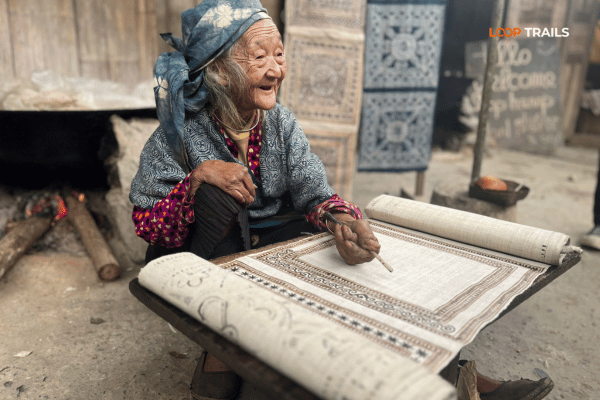
The village is home to H’Mong people, one of the largest ethnic minority groups in northern Vietnam and the dominant culture across the Ha Giang plateau. The women of Lung Tam have been growing hemp and weaving cloth for generations. In the late 1990s, a local cooperative was established to give visitors a place to watch the work and buy finished products, turning a household practice into a small but meaningful income stream for the village.
Learn more: Ha Giang Loop 3 Days 2 Nights
Cloth in H’Mong culture is not simply functional. The patterns on a traditional skirt or jacket carry information about which sub group a woman belongs to, which village she is from, and her social standing. Learning to weave is a rite of passage: young girls begin practising on small looms, and by the time they are adults, the skill is second nature.
Hemp is the preferred fibre because of what it does. The cloth is breathable in summer, insulating in winter, and extraordinarily durable. A well made piece of H’Mong hemp cloth does not wear out quickly. Some families still have garments made by their great grandmothers that remain in use today.
The fabric is sometimes called hemp linen in tourism contexts, and you will see that phrase on signs and product labels around Ha Giang. The linen comparison comes from the texture: hemp cloth has a similar rough, natural feel to European linen, which is made from flax. They are different plants and different fibres, but the finished fabric has some of the same qualities. At Lung Tam, what you are seeing is hemp: the same plant species used for rope and textiles throughout Southeast Asia for thousands of years, grown and processed entirely by hand.

Learn more: Ha Giang Loop 4 Days 3 Nights
The complete journey from hemp seed to wearable cloth takes the better part of a year. Here is each stage.
Hemp is planted in October or November on the terraced slopes above the village. The plants grow fast in Ha Giang’s combination of altitude, rainfall, and cool season sun. By February or March, the stalks are ready to harvest: tall, straight, and fibrous.
Women cut the stalks close to the ground and bundle them. The bundles are left to dry in the sun for several days until the outer layer of the stalk begins to separate. This drying phase is important: it starts the process of loosening the useful inner fibres from the woody core.
Retting is the name for soaking plant fibres in water to break down the natural pectin that binds the fibre to the stem. At Lung Tam, bundles of dried hemp stalks are submerged in streams or water channels for several weeks. The water softens the outer bark and makes it easier to strip away.
After retting, the stalks are removed and left to dry again. At this point, the outer material peels off relatively easily, revealing the long, cream coloured fibre bundles inside.
The fibre bundles are combed through wooden or metal combs to remove debris and separate the individual strands. This process, sometimes called hackling, pulls out short or damaged fibres and leaves long, straight strands that can be spun smoothly.
The combing stage takes patience. The goal is an even, clean bundle of fibre with no clumps or tangles. Shortcuts at this stage show up later in the spinning and weaving as uneven thread.
Spinning is where the loose fibres become thread. At Lung Tam, women spin by hand using a simple drop spindle or a small spinning wheel, twisting the fibres together under tension to create a continuous yarn. The twist is what gives the thread its strength: more twist produces a tighter, stronger yarn; less twist produces something softer and looser.
Spinning is usually done while sitting in a doorway or under the eaves of the house, often while watching children or chatting with neighbours. It is the kind of work that can be done in fragments over many hours without losing the thread, literally and figuratively. A skilled spinner can produce enough yarn for one piece of cloth over several weeks of this kind of casual, ongoing work.
The loom at Lung Tam is a backstrap or frame loom, similar to those used by weaving communities across mainland Southeast Asia. The warp threads are fixed at one end and held under tension either by the weaver leaning back against a strap (backstrap loom) or by a fixed frame.
The weaver passes the weft thread over and under the warp threads with a shuttle, compacting each row firmly before beginning the next. The pattern emerges as the rows build up: different threading sequences in the warp create different textures, and supplementary weft threads woven in by hand add decorative stripes or geometric designs.
Weaving a full length of cloth, enough for a traditional skirt or jacket, takes anywhere from several days to several weeks depending on the complexity of the pattern. The simplest plain weave is the fastest; brocade patterns with detailed geometric figures can take much longer.
Learn more: Ha Giang Cao Bang 5 Days 4 Nights
Freshly woven hemp cloth is stiff and grey green in colour. To whiten it, the cloth is soaked in water and laid flat on the grass in full sun. The combination of moisture, sunlight, and open air gradually bleaches the fabric over several days or even weeks, brightening it toward the natural cream colour you see on undyed H’Mong cloth.
The cloth is also beaten with a wooden mallet during this stage, which softens the fibres and gives the finished fabric more drape and flexibility. This beating is not violent: it is rhythmic, controlled, and aimed at opening up the structure of the weave without damaging it.
Beeswax batik is the most visually striking part of the process and the step that most visitors remember. A woman heats a small pot of beeswax over a flame until it liquefies, then uses a small metal tool, something like a stylus or a pen with a reservoir, to draw patterns directly onto the bleached cloth.
The wax penetrates the fibres and blocks them from absorbing dye. The patterns are drawn freehand from memory, without stencils or printed guides: spirals, geometric borders, diagonal lines, and flower forms that have been passed down through the generations. A skilled beeswax worker can cover a large piece of cloth in an afternoon, but precision requires concentration and a steady hand.
The wax must stay fluid as it is applied, so the work happens quickly. Any hesitation shows in the line.
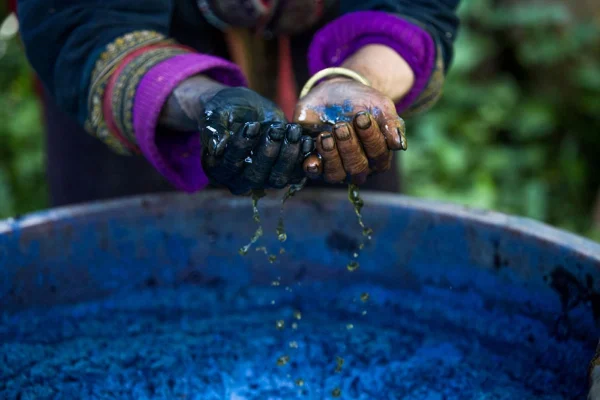
Indigo is a natural blue dye made from the leaves of the indigo plant (Indigofera tinctoria), which is grown in Ha Giang alongside the hemp. The leaves are fermented in water with an alkaline additive (traditionally wood ash lye) to create a dye bath.
The waxed cloth is submerged in the indigo bath and left to soak. When it is removed and exposed to air, a chemical reaction occurs: the dye oxidises and turns from yellow green to the deep, characteristic blue that you recognise as indigo. Multiple dips build up a deeper, richer colour.
Where the beeswax was applied, the indigo cannot penetrate, so when the cloth comes out of the dye bath, those areas remain cream coloured. The contrast between the indigo ground and the wax resist pattern is sharp and geometric, with a quality that cannot be replicated by printing.
The final stage is removing the beeswax. The dyed cloth is boiled in water, which melts the wax and releases it from the fibres. As the wax lifts away, the full pattern is revealed for the first time. The cloth is then rinsed, dried, and lightly beaten again to soften it.
The finished product is dense, deeply coloured, and patterned in a way that is entirely unique: even two pieces made by the same woman on the same loom will have small variations because every line of the batik is drawn by hand.
Learn more: Ha Giang Cao Bang 6 Days 5 Nights
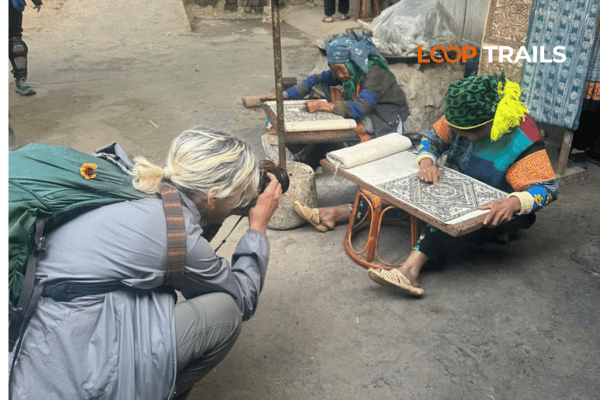
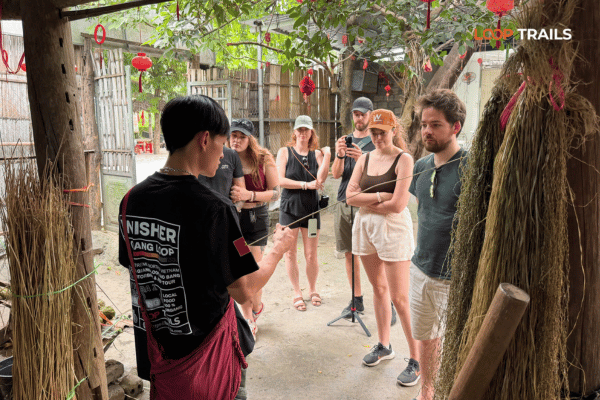
The cooperative at Lung Tam is set up so visitors can walk through the working area and see the different stages in progress. Depending on the time of year and what orders are being filled, you might see women spinning, women at the loom, the bleaching cloth laid out on the grass, or the dyeing process in the vats outside.
The indigo dye vats are particularly worth looking at: the liquid surface has a copper green sheen in certain lights, and the cloth going in pale and coming out deep blue is a satisfying, concrete demonstration of chemistry at work.
Women at the cooperative are accustomed to visitors and will usually let you watch from close range without interrupting their work. Photography is generally welcome: check with your guide if you are unsure, and always ask before photographing a person directly.
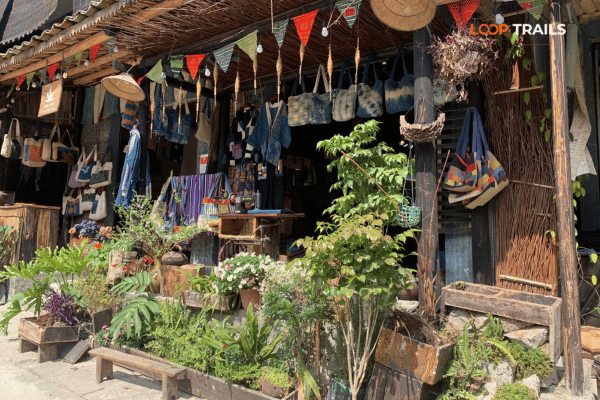
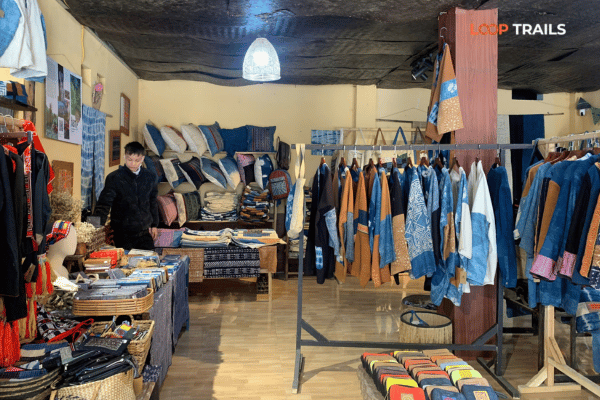
There is a small shop area where finished products are displayed and sold. If you ask, someone from the cooperative can usually explain a stage of the process in more detail, especially if you have a guide who can translate.
Learn more: Ha Giang Cao Bang 6 Days 5 Nights
The products for sale at Lung Tam are made entirely from the hemp cloth produced in the village. Prices vary by size and complexity of the pattern. Common items include:
Scarves: lightweight and long, good for all seasons. These are among the most popular purchases because they pack small and work as a gift.
Small bags and pouches: zippered or drawstring bags made from dyed hemp cloth. Practical and reasonably priced.
Table runners and placemats: flat pieces of woven cloth, often with simple geometric patterns. These travel well and suit people who want something functional rather than wearable.
Cloth by the metre: for people who sew or want to have something made up at home. Sold in natural cream, in indigo, or in dyed shades.
Jackets and skirts: finished garments in traditional H’Mong styles. These are more expensive than the smaller items and require a sizing conversation.
The quality at the Lung Tam cooperative is reliably good. Because the cloth is made in the village by the women who sell it, there is no supply chain markup, and you are buying directly from the maker. Bargaining is not really the culture here: prices are set, and they reflect the labour involved.
If you are on a guided tour, your guide will usually allow 30 to 45 minutes at the cooperative. That is enough time to watch the work, look around the shop, and make a purchase. If you want longer, ask in advance and your guide can usually accommodate.
Learn more: Lo Lo Chai Village
One of the things that surprises people about H’Mong hemp cloth is how heavy it feels compared to cotton or synthetic fabrics. The density of the weave is part of it, but the fibre itself also plays a role.
Hemp fibre is naturally stronger than cotton at the same weight. It becomes softer with washing rather than breaking down, so older pieces often feel better than new ones. The indigo dyeing, done through repeated immersion rather than a single chemical bath, produces a colour that fades slowly and unevenly over time, which is a characteristic that people who know indigo textiles actively seek out.
A scarf from Lung Tam bought on a 2024 loop tour is still going to look good in 2034. That is not a small thing.

Learn more: What to wear on Ha Giang Loop?
Lung Tam is included as a stop on the Ha Giang Loop year round, so in one sense there is never a wrong time to go. That said, the production process has a seasonal rhythm.
The spinning and weaving happen throughout the year, so you can watch looms in operation any time you visit. The bleaching process, which requires extended sun exposure, is most visible from March through September, when dry spells are long enough for the cloth to whiten effectively.
Indigo dyeing happens in batches depending on orders, so it is not guaranteed at any particular visit, but the dye vats are usually present and in use at some point during the week.
If the weather during your visit is good, there is a good chance you will see cloth laid out on the grass outside the cooperative building: a wide expanse of cream coloured fabric drying in the sun is one of the quieter, more meditative images the loop produces.
Learn more: Ha Giang Motorbike Rental
Lung Tam village is a scheduled stop on the final day of the Ha Giang Loop 4 days 3 nights itinerary and the final day of the Ha Giang Loop 3 days 2 nights itinerary. You do not need to plan this independently: your guide brings you there as part of the route back to Ha Giang city.
On the 4 days 3 nights tour, the visit falls after the morning swim at Du Gia waterfall and before the final return to Ha Giang. On the 3 days 2 nights tour, the visit is on the last morning, with Du Gia waterfall and the weaving stop combined before the afternoon return.
If you are renting a motorbike or travelling without a guide, Lung Tam is reachable from Ha Giang city in roughly an hour. Take the main road north toward Quan Ba, pass through Thanh Van, and follow the signs for Lung Tam village off the main road. The cooperative is signposted.
This works well as a half day trip from Ha Giang if you want to visit the village without doing the full loop. The road is good and the drive through the Quan Ba valley is pleasant on its own.

Learn more: Ha Giang Loop by Wrangler Rubicon Jeep
Both the 3 days 2 nights and the 4 days 3 nights versions of the Ha Giang Loop include Lung Tam as a scheduled stop. The 2 days 1 night tour does not include this stop due to time constraints.
If you are deciding between tour lengths and the weaving village matters to you, the 3 days 2 nights tour is the minimum to include it.
Ha Giang Loop 3 days 2 nights:
| Tour type | Price per person |
|---|---|
| Easy Rider | 4,290,000 VND |
| Self Drive | 3,690,000 VND |
| Jeep: 1 person | 17,490,000 VND |
| Jeep: 2 people | 20,990,000 VND |
| Jeep: 3 people | 24,990,000 VND |
| Jeep: 4 people | 28,490,000 VND |
Ha Giang Loop 4 days 3 nights:
| Tour type | Price per person |
|---|---|
| Easy Rider | 5,690,000 VND |
| Self Drive | 4,890,000 VND |
| Jeep: 1 person | 21,990,000 VND |
| Jeep: 2 people | 27,490,000 VND |
| Jeep: 3 people | 33,490,000 VND |
| Jeep: 4 people | 39,990,000 VND |
Prices include dormitory accommodation, all meals on the itinerary, guide fees, and entrance fees. Private room upgrades and bus transfers are priced separately. Foreign visitors require a border area permit (260,000 VND per person), which your tour operator arranges.

Learn more: Tu San Canyon & Nho Que River Boat Trip
The Lung Tam weaving cooperative is genuinely interesting to anyone who is curious about how things are made. You do not need to be a textile enthusiast to find the indigo dyeing or the beeswax batik compelling: they are straightforward processes you can follow with your own eyes, and the results are concrete and beautiful.
That said, it is a quiet stop. There are no demonstrations on cue, no guided presentation in English, and no organised activity. You walk around, you watch, you ask questions through your guide if you have one. If you are travelling with children, they usually respond well to the colours and the hands on visibility of the craft, but there is no structured children’s programme.
For couples and small groups, it is often cited as one of the more memorable stops on the loop, precisely because it is different from everything else: not a viewpoint, not a cave, not a waterfall, but a place where people are making things by hand and you can see the whole chain of production from one end to the other.
Learn more: Ha Giang Packing list
Arrive with cash. The cooperative accepts Vietnamese dong; card payment is not reliably available.
Bring a small bag you are willing to fill. The products are good and reasonably priced, and the regret of not buying something at Lung Tam is a common complaint in retrospect.
Wear comfortable shoes. The cooperative itself is on flat ground, but if you want to walk around the village to see drying cloth on the hillside, the terrain can be uneven.
Respect the working environment. The women are there to work, not to perform. Watch from a respectful distance, ask before touching anything, and do not interrupt someone who is mid row on the loom.
Photography is generally welcome inside the cooperative area. For portraits of individual women, ask first, either directly with a smile and a raised camera, or through your guide.
Learn more: Ban Gioc Waterfall Guide
The Ha Giang Loop is fast. Four days of dramatic passes, high altitude villages, and hard riding leaves very little time to sit still. Lung Tam is one of the places where slowing down actually pays off.
Thirty minutes of watching an H’Mong woman draw beeswax patterns from memory onto a piece of cloth she spent weeks weaving from plants she grew herself is a different kind of travel experience from anything else on the route. It is not spectacular in the way that Ma Pi Leng is spectacular. It is specific, careful, and deeply skilled.
If the loop teaches you one thing, it is that the people who live in these mountains are extremely capable. Lung Tam is where you see one particular kind of capability up close, in the form of cloth that will outlast everything else you buy on the trip.
Ready to book a Ha Giang Loop tour that includes Lung Tam? The 3 days 2 nights and 4 days 3 nights tours both stop at the weaving cooperative. Choose Easy Rider for a local guide on a motorbike, Self Drive if you hold a valid licence, or the Jeep Wrangler Rubicon if you are travelling as a couple or small group and want maximum comfort on the mountain roads.
Learn more: Ha Giang Loop Easy Rider
Lung Tam is an H’Mong weaving village in Quan Ba district, Ha Giang, known for hand woven hemp cloth using traditional methods including beeswax batik and natural indigo dyeing. The village cooperative allows visitors to watch the production process and purchase finished products
Yes. Lung Tam is a scheduled stop on the 3 days 2 nights and 4 days 3 nights Ha Giang Loop itineraries. It falls on the final day of each tour, on the return leg to Ha Giang city. The 2 days 1 night tour does not include this stop
The cooperative sells scarves, small bags, table runners, cloth by the metre, and traditional H’Mong garments. All items are made from locally grown hemp cloth using traditional techniques. Prices vary by size and complexity
No. The fabric is hemp, made from Cannabis sativa grown for fibre. It is sometimes called hemp linen in tourism contexts because of its similar texture to European linen (which is made from flax). The two fabrics are different but share some qualities: durability, breathability, and a natural, slightly rough hand
The full process from planting to finished cloth takes the better part of a year when you count the growing season. The weaving itself takes anywhere from a few days to several weeks depending on the size and pattern. Dyeing and finishing add additional time. Each piece is entirely handmade
The cooperative primarily focuses on production and sales rather than structured workshops. Some guides can arrange a brief demonstration where visitors try a few rows on a loom. If this matters to you, let your guide know in advance and they can check with the cooperative
Beeswax batik is a resist dyeing technique where hot liquid beeswax is applied to cloth before it is dipped in dye. The wax prevents the dye from penetrating the fabric where it has been applied, creating a pattern when the wax is later removed by boiling. At Lung Tam, the patterns are drawn freehand from memory using a small metal tool
From Ha Giang city, drive north on the main road toward Quan Ba, follow signs through Thanh Van, and turn off for Lung Tam village. The drive is roughly one hour in good conditions. The road is paved and manageable on a standard motorbike
The cooperative is open year round. If you want to see cloth being bleached on the grass, visit during the drier months from March through September. Weaving and spinning happen throughout the year. Dyeing batches depend on orders and may not be active during every visit
Yes. The cooperative is on flat ground, the processes are visually clear and interesting, and there is no requirement for physical activity. Children are welcome and the craft tends to hold their attention well. The shop has smaller, affordable items that make good souvenirs.
Contact information for Loop Trails
Website: Loop Trails Official Website
Email: looptrailshostel@gmail.com
Hotline & WhatSapp:
+84862379288
+84938988593
Social Media:
Facebook: Loop Trails Tours Ha Giang
Instagram: Loop Trails Tours Ha Giang
TikTok: Loop Trails
Office Address: 54A Tran Phu, Ha Giang 2, Tuyen Quang
Address: 54A Tran Phu, Ha Giang 2, Tuyen Quang
Facebook X Reddit Table of Contents Learn more: Ha Giang Loop Tours If you could pick one month to see the Ha

Facebook X Reddit Table of Contents Ha Giang in August does not look like the photos most people have in their heads.
Facebook X Reddit Table of Contents Most of the Ha Giang Loop is about the landscape: passes, canyons, karst peaks that go