
Ha Giang Loop Tour Prices 2026: Jeep vs Motorbike, Honestly
Facebook X Reddit Table of Contents Learn more: Ha Giang Loop Tours Every week someone messages us with the same two questions,
Thúy Kiều (Grace) is a travel blogger and content contributor for Loop Trails Tours Ha Giang. She holds a bachelor’s degree in Sustainable Tourism from Vietnam National University, Hanoi, and has a strong passion for exploring and promoting responsible travel experiences in Vietnam’s northern highlands.

Learn more: Ha Giang Loop Tours
Nobody writes about the evenings.
Every Ha Giang article you will find covers the passes, the karst peaks, the turquoise water of the Nho Que River. The mornings get the drama: fog rolling off the plateau before sunrise, the first light touching the stone towers at Dong Van. The afternoons get the highlights: Ma Pi Leng, Lung Cu, the boat trip through Tu San Canyon.
But what happens after the bikes are parked and the daylight fades? What does a night on the loop actually look like?
The answer is one of the least expected things about the whole trip. You ride hard all day through some of the most striking landscape in Southeast Asia. You arrive tired and dusty at a homestay in Yen Minh, or a guesthouse in Dong Van, or a farmstay tucked into the valley at Du Gia. You shower. You sit down. And then, somehow, the evening becomes the part of the trip you remember longest.
This article covers exactly that: what happens after the road ends each day, the culture behind it, and why the evenings on the Ha Giang loop are as much a part of the experience as the passes.
Learn more: Ha Giang Loop 2 Days 1 Night
Before getting into the specifics, it is worth saying something about why the evenings feel different here compared to other places in Vietnam.
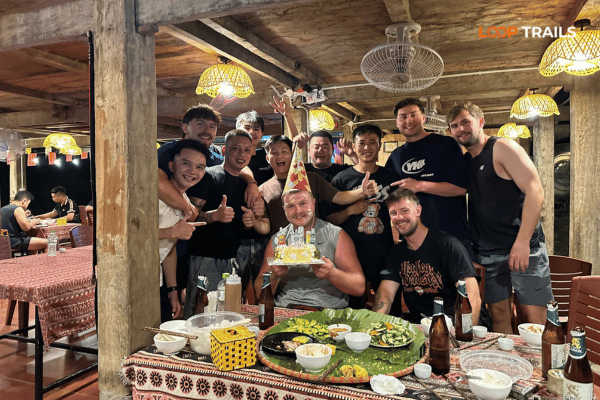
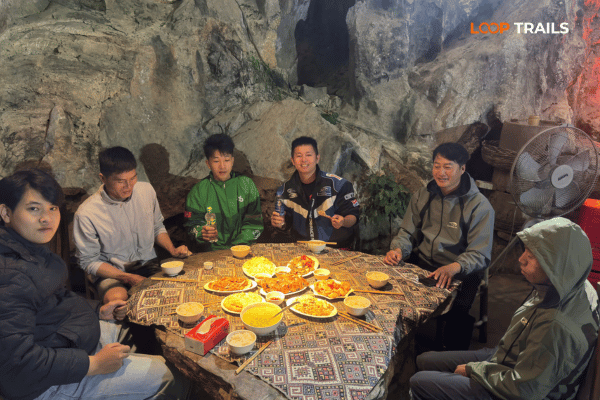
Ha Giang is not a tourist town in the way that Hoi An or Hanoi is a tourist town. There are no cocktail bars with rooftop views. The guesthouses and homestays that line the loop route are family homes and small community businesses. When you sit down to dinner, you are often sitting in someone’s courtyard, at a table that has hosted hundreds of travellers before you but still feels personal.
The guides here almost all grew up on or near the loop. The person who rode with you past Tham Ma Pass today might be the same person playing the Khèn panpipe this evening. That is not a performance for tourists. It is just how evenings here tend to go.
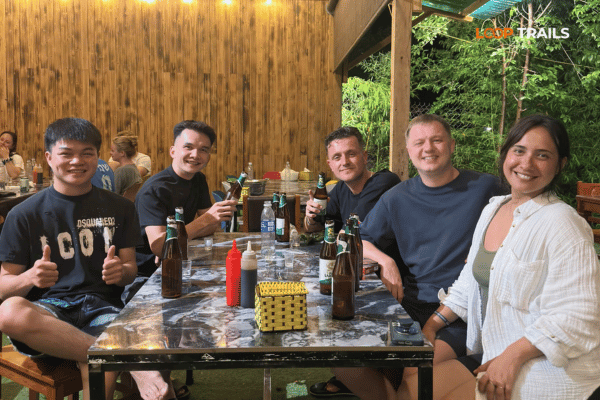
Add to that the particular social chemistry of the loop itself. Solo travellers, couples, small groups from different countries all end up at the same homestays at the end of each day. The road is a great equaliser. You have all seen the same views, survived the same mountain pass, navigated the same plateau dust. By dinner, conversations start easily.
The evenings are not organised entertainment. They are what happens when tired, happy people gather around food, local wine and music in a place that is genuinely welcoming.
Learn more: Ha Giang Loop 3 Days 2 Nights
If you have read anything about the Ha Giang loop, you have probably come across the phrase “happy water”. It appears in every itinerary description. Guests who have done the loop mention it in every review. The question most people ask before they go: what exactly is happy water?
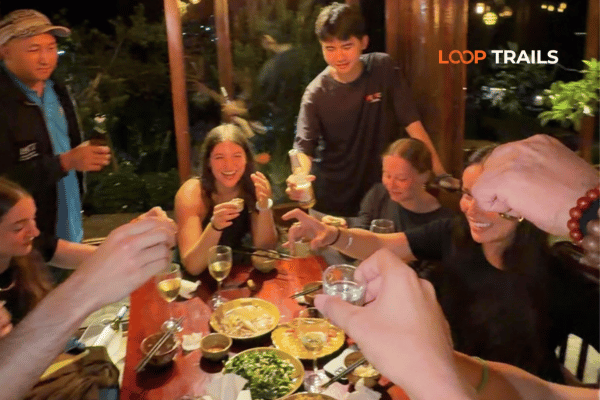
Happy water is the local name for rượu ngô, corn wine distilled from fermented corn. It is made by H’Mong and other ethnic minority families throughout the Ha Giang highlands, often on the same property where you are staying. The flavour varies considerably from family to family and village to village: some batches are mellow and slightly sweet, some are sharp and fierce, almost all of them are stronger than they look in the small cups they come in.
The serving ritual matters as much as the drink itself. Happy water is poured into small ceramic cups or repurposed condensed milk tins and offered around the table. The guide usually leads the toast. The H’Mong word for cheers sounds something like “dzô” but your guide will teach you the right pronunciation and cadence, which typically involves a specific number of repetitions depending on the occasion.
You are not expected to drink heavily or continuously. Nobody is pushing the cup into your hand. The ritual is about sharing and welcome, not about consumption. Many travellers drink two or three small cups over the course of a long evening and feel pleasantly warm by the time the music starts. Some drink more. Some drink none and are equally part of the gathering. The social act is the toast, not the alcohol.
One practical note: corn wine at high altitude hits differently than the same drink would at sea level. If you are not a regular drinker, pace yourself. The views are better in the morning when your head is clear.
Planning your loop? The evening experience is built into every tour we run. Check the Ha Giang Loop Tour page to see which duration fits your travel dates and book directly with us.

Learn more: Ha Giang Loop 4 Days 3 Nights
Traditional music appears at almost every homestay evening on the loop, though the form it takes varies by location and by who happens to be staying that night.
The instrument you are most likely to encounter is the Khèn, a mouth organ made from bamboo pipes of different lengths bound together with beeswax. It is specific to the H’Mong people and the sound is unlike anything you will have heard before: a continuous drone that rises and falls as the player breathes both in and out, circular breathing allowing an unbroken tone. When someone plays the Khèn well, the effect in an enclosed courtyard at night is genuinely arresting.
You might also hear the đàn môi, a small jaw harp that produces a low, resonant vibration by holding it against the lips and plucking a reed while varying the shape of the mouth cavity. Players often use it for communication across distances in the original cultural context, though at homestay evenings it is simply played for the pleasure of it.
Some evenings a guide will sing. The songs are almost always in the local dialect and you will not understand the words, but that rarely matters. The singing tends to be quiet and direct, nothing staged. Someone picks up an instrument or starts a melody and the evening shifts. Conversations slow down. People stop refilling cups and just listen for a while.
If you play an instrument yourself, bring something small. A harmonica, a ukulele, a tin whistle. The exchange is genuine and often the starting point for a long evening. Even if you do not play, bringing a melody on your phone and asking your guide what they think of it can open conversations you would not have expected.
Learn more: Ha Giang Cao Bang 5 Days 4 Nights
The games section of every Loop Trails itinerary is not filler. Games are a real, specific part of how evenings unfold on the loop, and they serve a function: they are a way to spend time together across a language barrier without needing to maintain a conversation.
Spinning top: Traditional H’Mong spinning tops are carved from dense wood, some of them weighted with metal points at the tip, and are thrown with a rope in a technique that takes more skill than it looks. Children who grow up here are expert at it from an early age and will beat you comprehensively without appearing to try. The goal is to keep your top spinning longer than your opponent’s. The gap in skill between a local child and a visiting adult is usually enormous and genuinely funny.
Bamboo rings: A variation of ring toss using bamboo hoops and carved wooden pegs. Simple to understand, harder than it looks at a distance.
Card games: Vietnamese card games vary by region but most guesthouses on the loop have a deck or two. Your guide can teach you a local version of a matching or trick game quickly enough that you are playing badly but enthusiastically within fifteen minutes.
Tug of war and strength games: Some evenings, particularly when there is a larger group of guides and travellers, more physical games emerge. Tug of war is universal. So is arm wrestling. The competitive spirit here is real but good natured.
The games are not compulsory and they are not a show. If you would rather sit and talk and drink your corn wine slowly, nobody will push you into a spinning top contest. But if you engage, you will find that the games dissolve the slight awkwardness that sometimes exists in the early hours of an evening with strangers and replace it with something more relaxed and direct.
Learn more: Ha Giang Food guide
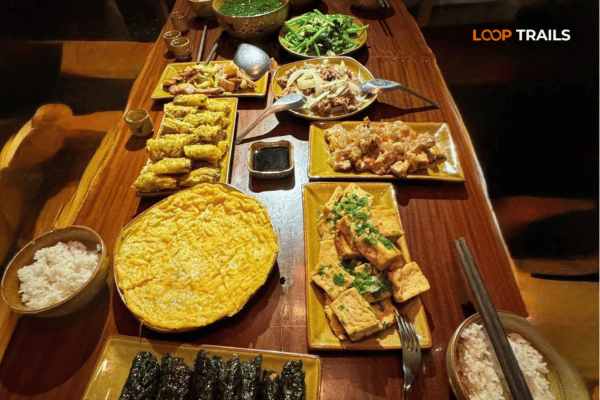
Dinner on the loop is included in your tour price (most evenings are listed as B/L/D in the itinerary: breakfast, lunch and dinner). The food is prepared by the homestay family and cooked from local ingredients.
A typical dinner spread includes rice, two or three vegetable dishes, a pork or chicken preparation, sometimes a dish of river fish, and a soup. The flavours are clean and not heavily spiced. Everything is shared in the middle of the table and you serve yourself. The portions are generous.
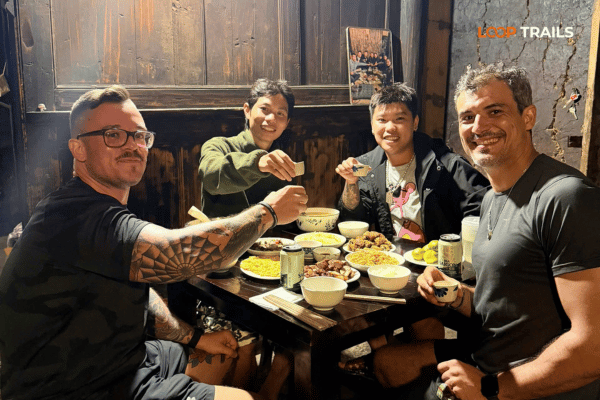
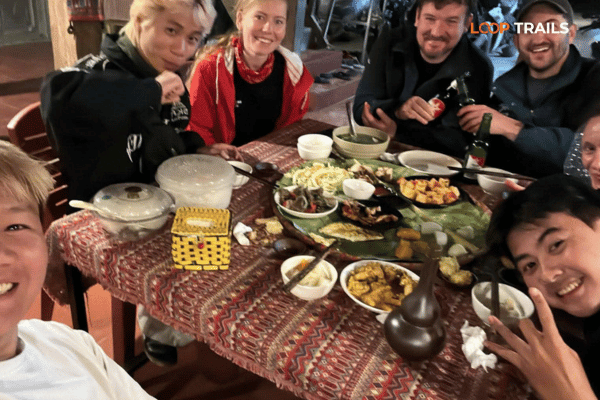
What makes dinner worth writing about is not the food itself, though it is consistently good, but the setting and the pace. You eat slowly. The table is communal. Your guide sits with you and eats with you, which is different from the experience of eating alone at a restaurant table and having a guide who disappears after drop off.
Conversation at dinner tends to range: where are you from, how did you hear about Ha Giang, what surprised you about today’s ride, what does your guide think about the road to Lung Cu at this time of year. By the time the dishes are cleared, most tables have covered a surprising amount of ground.
If you have dietary requirements, let your operator know when you book. Vegetarian options are possible at most homestays with advance notice. Full vegan can be harder to guarantee at every stop, particularly for protein, so discuss in detail before you finalise.
Learn more: Lo Lo Chai Village
The evening experience shifts slightly depending on where you end up each night. Here is what to expect at the main overnight stops on the loop.
The first overnight stop on the three and four day itineraries is in Yen Minh, a small town at the entrance to the Dong Van Karst Plateau Geopark. The homestays and guesthouses here tend to be more town based than rural, though some are on the outskirts with views across the valley.
Evening in Yen Minh is typically the loudest and most social of the loop, partly because it is the first night and energy is high, partly because guests who have just experienced the Heaven Gate, Bac Sum Pass and Lung Khuy Cave are still buzzing. The corn wine appears early and the games often run long.
The second night, in Dong Van old quarter, is different in character. Dong Van is the cultural heart of the loop. The old quarter is a cluster of traditional houses with stone walls and wooden facades that date back generations, and the guesthouse courtyards here have a particular atmosphere.
The itinerary notes a “sunset party” for the Dong Van evening, which is exactly what it sounds like: the group gathers somewhere with a view before dark, drinks arrive, and you watch the light change over the karst plateau before moving to dinner. The music on this evening tends to be more intentional than the first night. Guides know the Dong Van evenings carry weight and they bring more of themselves to them.
The old quarter also has a small handful of local cafes and shops if you want to walk after dinner, though most people find the homestay courtyard enough.
The third night at Du Gia is the most peaceful. Du Gia is a farming valley set between low forested hills and rice terraces. The air is cooler and quieter here than on the plateau. Homestays in Du Gia are farm based, which means you go to sleep hearing the sounds of a working rural community rather than a town.
The Du Gia evening tends to be the most intimate. By the third night, your group has shared two days on the road. Conversation is easier and slower. The music here is often played softly while people sit with their backs against the wall and just breathe for a while. After the exertion of Ma Pi Leng Pass and the boat trip on the Nho Que River, the Du Gia evening feels like a natural exhale.
If you are on the Ha Giang and Cao Bang combined tour, you will also have evenings in Dong Van, Meo Vac and near the Ban Gioc waterfall area. Each of those has its own character, but the core elements carry through: local food, corn wine, music if the moment calls for it, and the particular warmth of people sharing a road.
Learn more: Ha Giang Loop Hidden Gems
Solo travellers are a large part of the loop’s regular guest population. The loop has a reputation among the solo backpacker community in Southeast Asia specifically because the evenings are good. You do not need to manage the anxiety of eating alone or finding someone to talk to. The structure of the tour puts you at the same table as other guests naturally.
What tends to happen over three or four days: you arrive as strangers, share the first dinner slightly carefully, play the first game badly together, wake up the next morning slightly stiff from the ride, and by the end of the second day you are comparing notes on the best viewpoint you stopped at and planning where to go after Ha Giang.
It is not guaranteed. Some groups click faster than others. But the structure of shared meals, shared rides and shared evenings makes connection easier here than almost anywhere else in Vietnam.
Couples also do particularly well on the loop evenings. There is nothing about the social format that requires you to engage beyond what you want to, and the smaller the group at a table, the more time you spend talking to your guide. Some of the best conversations guests report happen at a table of two with one guide and no particular agenda.
Learn more: Cao Bang Loop 3 Days best kept secret
What to bring to the homestay: You do not need much. A light jacket or fleece for evenings, particularly in the cooler months from October through March. The plateau gets cold after dark even when the days are warm. Flip flops or sandals for the guesthouse, since you will take off your riding boots at the door. A small speaker if you want to contribute music. Ear plugs if you are a light sleeper and there are roosters.
On the corn wine: You will be offered it. You can decline. If you drink it, drink slowly and with water alongside. The altitude amplifies the effect. Nobody will think less of you for pacing yourself. The best evenings are remembered clearly.
On photography: Evening scenes are beautiful but low light. If photography matters to you, bring a phone with a good low light mode or a compact camera with a wide aperture. Ask before photographing people, particularly at closer range. Most guides are happy to help you with introductions if you want a portrait.
On bedtime: Mornings on the loop start early. The briefing is usually at eight, which means you are on the road by nine after breakfast. Most evenings naturally wind down before eleven. Staying up long past midnight when you have a mountain pass to cross at first light is a decision with consequences the next afternoon.
Learn more: Ha Giang Cao Bang 6 Days 5 Nights
You come to Ha Giang for the landscape and you leave talking about the people. This is the thing that most guests who have done the loop say when they reflect on the trip, and the evenings are where that shift happens.
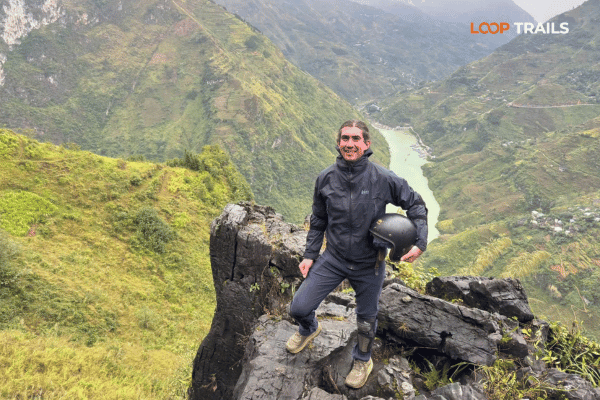
The passes are genuinely spectacular. The views from Ma Pi Leng are unlike anything else in Vietnam. But the specific memory that settles is usually the guide who played a song at Du Gia after everyone thought the evening was winding down. Or the spinning top match in Yen Minh that somehow lasted forty minutes. Or the particular quality of the light in the Dong Van old quarter courtyard at ten at night, with everyone full and unhurried, speaking four different languages and understanding each other well enough.
The evenings are not a programme or an add on. They are the other half of the loop. Plan for them, go in without too many expectations, and let them develop however they will.
Book a tour that includes the evenings. The easy rider, self drive and jeep tour formats all include accommodation and dinner at homestays along the route. See the full Ha Giang Loop Tour options, or browse the Ha Giang Cao Bang combined tour if you want to extend the experience all the way to Ban Gioc. Message us on WhatsApp to check availability for your dates.
Learn more: Ha Giang Motorbike Rental
Happy water is the traveller nickname for rượu ngô, a corn wine distilled locally by H’Mong families throughout the Ha Giang highlands. It is served in small cups as part of the evening gathering at homestays. The strength varies by batch and producer. You are never required to drink it, but participating in the toast is part of the cultural experience
No. The corn wine is shared and celebratory rather than continuous. Most people drink two or three small cups over an evening. The social ritual of the toast matters more than the volume consumed. Guests who do not drink are always welcome and never singled out
What traditional music can you hear on the Ha Giang loop evenings? The most common instrument is the Khèn, the H’Mong bamboo mouth organ with a distinctive circular breathing sound. You may also hear the đàn môi (jaw harp) and sometimes singing in the H’Mong or Tày dialect. Music is not guaranteed at every stop every night but it is a regular part of loop evenings, particularly at the Dong Van and Du Gia homestays
Common games include spinning tops (traditional H’Mong wooden tops thrown with a rope), bamboo ring toss, local card games and sometimes group games like tug of war. The games are informal and participation is voluntary. They are a good way to spend time with guides and other guests without needing a shared language
Yes. Most evenings on the loop itinerary are listed as including dinner (marked D in the itinerary). Dinner is prepared by the homestay family and served communally at the table. Vegetarian options are possible with advance notice. Confirm dietary requirements when booking
Dong Van old quarter has the most atmospheric evening setting on the loop. The guesthouse courtyards in the old stone quarter, the sunset view from the plateau above town, and the fact that most guides reserve their best music and stories for this night make Dong Van evenings consistently memorable. The itinerary describes it as a “sunset party” and it earns the description
Absolutely. Solo travellers are a core part of the loop’s guest community. The communal dinner format and group games structure mean you are naturally part of the evening without having to manage solo dining awkwardness. Many solo guests say the Ha Giang loop gave them some of their best travel connections
A warm layer for cool plateau evenings, comfortable shoes or sandals for the guesthouse, and an open attitude. A small instrument or speaker is a bonus. Ear plugs for light sleepers. You do not need anything elaborate. The evenings provide themselves
The experience is essentially the same across tour formats because the overnight stops and homestay arrangements are the same. All formats eat together, all formats are welcome at the evening gathering. The difference is in how you arrive: by motorbike with your guide beside you, or by jeep with your group. The evening itself is shared regardless
Most evenings wind down naturally between ten and eleven. Mornings start early (usually eight for breakfast and briefing) and the riding is physically tiring. The evenings tend to find their own rhythm and close when people are ready. Nobody is pushing you to bed, but the mountain pass the next morning is a natural alarm
Contact information for Loop Trails
Website: Loop Trails Official Website
Email: looptrailshostel@gmail.com
Hotline & WhatSapp:
+84862379288
+84938988593
Social Media:
Facebook: Loop Trails Tours Ha Giang
Instagram: Loop Trails Tours Ha Giang
TikTok: Loop Trails
Office Address: 54A Tran Phu, Ha Giang 2, Tuyen Quang
Address: 54A Tran Phu, Ha Giang 2, Tuyen Quang
Facebook X Reddit Table of Contents Learn more: Ha Giang Loop Tours Every week someone messages us with the same two questions,
Facebook X Reddit Table of Contents Learn more: Ha Giang Loop Tours The Ha Giang Loop is a road built on bends.
Facebook X Reddit Table of Contents Learn more: Ha Giang Loop Tours If you could pick one month to see the Ha