

Lung Khuy Cave Ha Giang: The Hidden Underground World
Facebook X Reddit Table of Contents Learn more: Ha Giang Loop Tours Most people riding the Ha Giang Loop are focused on

Thúy Kiều (Grace) is a travel blogger and content contributor for Loop Trails Tours Ha Giang. She holds a bachelor’s degree in Sustainable Tourism from Vietnam National University, Hanoi, and has a strong passion for exploring and promoting responsible travel experiences in Vietnam’s northern highlands.

Learn more: Ha Giang Loop Tours
There’s a moment that happens to a lot of remote workers when they first arrive in Ha Giang. They check in, walk outside, look up at the mountains closing in on three sides of the city, and think: wait, I could actually stay here for a while.
Ha Giang is not on the standard digital nomad circuit. It doesn’t show up in the “best cities for remote work in Southeast Asia” lists alongside Chiang Mai, Bali, or Da Nang. There’s no coworking street, no nomad Slack channel with 4,000 members, no rooftop bar with fibre broadband.
What it has is something harder to find: a genuinely beautiful base town in extraordinary mountain terrain, a growing cafe scene with decent WiFi, low costs, and one of the world’s great motorbike routes starting from its doorstep. For remote workers who are done with the well-worn nomad trail and want somewhere that feels like they actually discovered it — Ha Giang is worth a serious look.
This guide covers everything you need to know to work from Ha Giang — honestly, practically, and without glossing over the limitations.
Learn more: Ha Giang Loop Photography
The short answer: Vietnam’s north has been developing fast, and Ha Giang has benefited.
Five years ago, the conversation about remote work in Vietnam mostly centred on Ho Chi Minh City and Hanoi. Three years ago, Hoi An started appearing consistently. Now, travellers who’ve exhausted those options — and there are a lot of them — are moving further afield.
Ha Giang sits in an interesting position. It’s accessible from Hanoi (6 hours by overnight bus), it has a small but established traveller infrastructure built around the Ha Giang Loop tourism industry, and the cost of living is significantly lower than any of Vietnam’s tourist hubs. The town itself has a population of around 70,000, with a mix of Vietnamese lowlanders, ethnic minority communities, and a growing presence of domestic and international tourists.
The nomad appeal is specifically: a small town that’s interesting enough to live in for 2–4 weeks, with world-class adventure on your doorstep for the days you’re not at a desk.
That’s a niche pitch, but it’s a real one.

Learn more: Ha Giang Loop 4 Days 3 Nights
Before anything else: Ha Giang is not a plug-and-play nomad hub. If your work requires rock-solid, fast, consistent internet at all hours, Ha Giang will frustrate you. Infrastructure here is good for a remote mountain town; it’s not Hanoi.
What you’re trading is reliability and urban amenity for scenery, cost, authenticity, and access to the Loop on weekends (or mid-week, if you’re the type who rides at dawn and works afternoons).
The nomads who thrive in Ha Giang tend to:
If you need Zoom calls at specific hours, high-bandwidth uploads, or enterprise-level VPN performance, bring backup solutions and test everything before committing to a long stay.
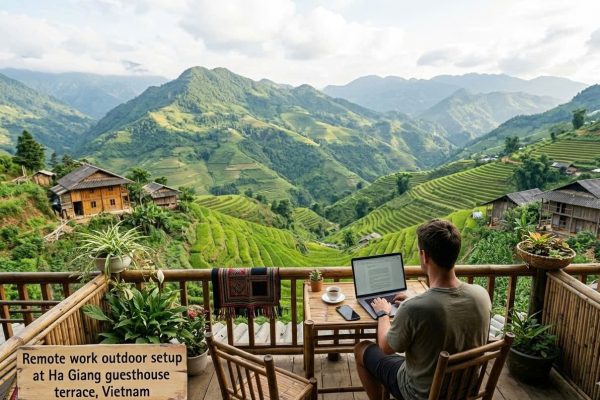
Ha Giang City has functional WiFi in most guesthouses, hotels, and cafes. The quality varies more than you’d find in Hanoi or Da Nang — some places have genuinely reliable broadband, others have connections that work fine for browsing but struggle with video.
A few patterns worth knowing:
Practical recommendation: Don’t rely solely on venue WiFi. Get a local SIM with a good data plan (see below) and use mobile hotspot as your backup. In Ha Giang City, 4G is generally available and reasonably fast — more than adequate for most work needs.
Speeds: expect enough for email, documents, Slack, and light video. Dedicated 4K uploads or large file transfers will need patience or a good connection day.
Learn more: Ha Giang to Cao Bang
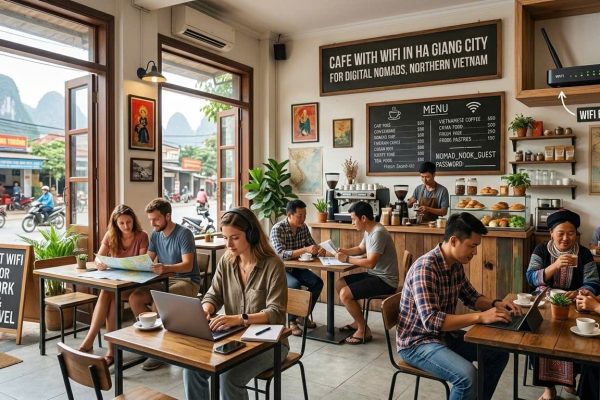
Ha Giang City is small, which means the options are limited compared to a mid-sized Vietnamese city — but a few places are genuinely good for productive work sessions.
The cafe scene in Ha Giang has grown significantly with Loop tourism. Look for cafes that:
Avoid cafes that cater primarily to bus-transfer tourists or quick food stops — they often don’t invest in connectivity because their customers don’t need it.
The town centre and the area around the Loop Trails departure points have the highest concentration of decent work-viable cafes. Scout on your first day — you’ll identify two or three that work for you.
Many mid-range to upper guesthouses in Ha Giang City have lobby areas or rooftop spaces with WiFi that are more work-appropriate than a bedroom desk. Ask your host which areas have the strongest signal. A few properties have explicitly courted longer-staying guests and have setups that reflect it.
Some of the best work setups in Ha Giang aren’t indoor at all — guesthouse garden terraces with mountain views, covered outdoor seating at cafes with reliable electricity. For writers, designers, and anyone who works well with ambient noise and visual stimulus, these can be exceptional environments. Just check signal quality and bring a power bank for days when outlets are scarce.

Learn more: Ha Giang Packing List
For the periods when you’re out of Ha Giang City — riding the Loop, staying in homestays in Dong Van or Meo Vac — your primary connectivity will be mobile data.
What to expect on the Loop:
Practical guidance for nomads on the Loop:
Schedule road days around your work. If you have a client deadline or a morning meeting, don’t plan to be on a remote mountain pass that day. The Loop is best tackled with clear work-free days — ride on days you’ve cleared the schedule, work on town-based days. That rhythm actually works quite well once you’re set up.
Download anything you need to work offline (documents, design files, reference material) before you leave town. Have offline versions of the tools you rely on where possible.
Learn more: Ha Giang Loop with Kids
Ha Giang City is compact enough that neighbourhood isn’t a complex conversation — but there are meaningful differences in where to base yourself depending on your priorities.
Town centre / Nguyen Trai area: Most cafes, restaurants, guesthouses, and tour operators are concentrated here. Convenient for everything, slightly noisier at street level. Best for nomads who want maximum access to amenities and don’t mind a busier environment.
Riverside area: Some quieter guesthouses along the Lo River offer a more relaxed setting. Walking distance to town, but slightly removed from the main tourist drag. Good for nomads who want peace for focused work and don’t mind a 10-minute walk to cafes.
Near the departure point for the Loop: A handful of guesthouses cater specifically to Loop travellers — good for meeting other riders, getting logistics sorted quickly, and being first out the gate in the mornings. Less ideal for settled longer-term work stays.
For most nomads staying 2–4 weeks, the town centre accommodation with good WiFi and walking distance to multiple cafes is the practical sweet spot.

Learn more: Ha Giang Safety Tips
Ha Giang is genuinely cheap by Vietnamese standards — and Vietnam is already cheap by global remote worker standards. This is one of the region’s strongest draws.
Approximate monthly cost breakdown (indicative — check current prices locally):
| Expense | Budget Range | Notes |
|---|---|---|
| Accommodation (guesthouse/room) | Low–moderate | Longer stays usually get discounted rates; ask |
| Food (local restaurants, cafes) | Very low | Local pho, rice dishes, and cafe meals are inexpensive |
| Coffee (cafe work sessions) | Very low | Daily coffee spend negligible |
| Mobile data (SIM) | Very low | Monthly data plans from major networks are affordable |
| Motorbike rental (day trips) | Moderate | Per-day rental when needed |
| Transport (within town) | Very low | Town is walkable; motorbike taxis for occasional trips |
The honest comparison: Ha Giang’s cost of living is lower than Hanoi, noticeably lower than Hoi An or Da Nang, and significantly lower than Bali or Chiang Mai. For nomads with even a modest dollar/euro income, the purchasing power is strong.
The caveat: there are fewer ways to spend money here. No rooftop cocktail bars, no weekend farmer’s markets, no boutique fitness studios. If your lifestyle depends on those things, the cost advantage doesn’t compensate for the absence. If you’re genuinely fine with good coffee, good food, mountains, and motorbike access — the budget case is compelling.

Learn more: Ha Giang Motorbike tour
Here’s the key difference between riding the Ha Giang Loop as a nomad versus as a 5-day tourist: you don’t have to rush.
Most Loop visitors are on tight itineraries — they have a Hanoi flight to catch, a Hoi An booking ahead, a fixed number of days. They ride 100km days, tick the main viewpoints, and leave.
As a nomad based in Ha Giang City for 2–4 weeks, you can treat the Loop completely differently:
The rental motorbike dynamic works well for nomads. Renting by the day or week from a Ha Giang City operator gives you flexibility — ride when it works for you, leave the bike when you’re heads-down on a deadline.
Thinking about a motorbike rental in Ha Giang to ride the Loop at your own pace? Loop Trails has rental options for experienced riders — maintained bikes, local support, and advice on the best routes for your time and experience level. [See motorbike rental options →]
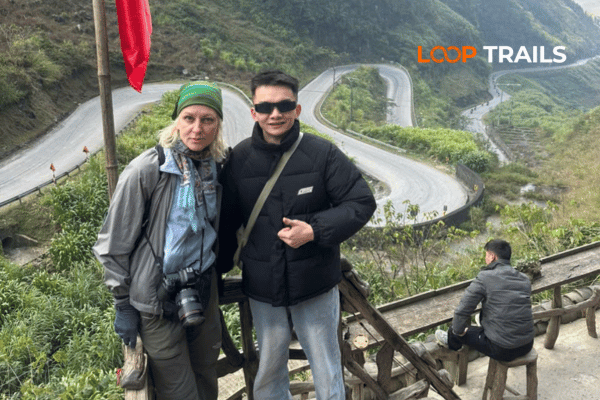
For nomads who aren’t confident self-driving — or who want to experience the full Loop properly before exploring independently — the Easy Rider format remains one of the best ways to do it. One full Loop with an experienced guide, then independent day rides afterward on your own timeline. Best of both.
Learn more: Ha Giang Loop Solo Travel
Two to four weeks is the sweet spot for most remote workers visiting Ha Giang. Here’s a loose framework that tends to work:
This rhythm — arrive, loop, work — gives you the full experience of the region without sacrificing your work output or feeling like you’re always rushing between commitments.
Learn more: Ha Giang Homestay Guide
Most Ha Giang accommodation is priced by night, but longer-stay negotiation is common and expected. If you’re staying 2+ weeks, ask directly for a weekly or monthly rate. Most guesthouses will work with you — they’d rather have guaranteed occupancy than nightly gaps.
Types of accommodation to consider:
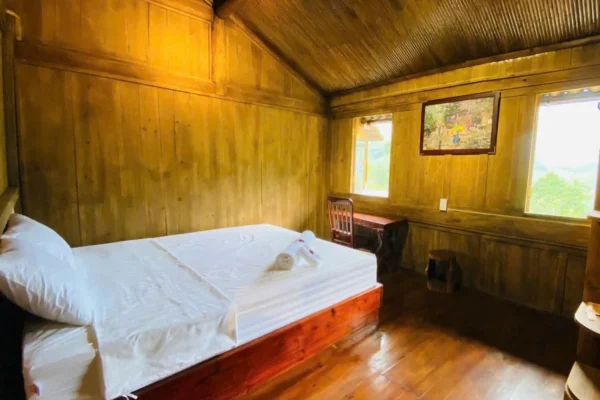
Mid-range guesthouses: The majority of Ha Giang’s accommodation stock. En-suite rooms, air conditioning (though you may not need it at altitude), reliable WiFi on the better properties. Private rooms at reasonable rates. Best choice for most nomads.
Boutique properties: A small number of newer, design-conscious guesthouses have opened in Ha Giang City as Loop tourism has grown. Better aesthetics, more reliable connectivity, slightly higher prices. Worth it if you’ll be working from your room regularly.
Homestays in town: A few families rent rooms long-term in the residential areas. More local experience, often very cheap, but variable WiFi — test before committing to a week.
Outside Ha Giang City: Homestays in villages along the Loop are excellent for a night or two during the Loop itself, but not practical as a work base. Connectivity drops significantly outside town.
A note on negotiation: be respectful and realistic. Ha Giang guesthouses operate on thin margins compared to urban Vietnam. Asking for a fair discount on a 2-week stay is reasonable; hard-bargaining a family guesthouse down to nothing is not the culture here.

Learn more: Corn wine “Happy Water” in Ha Giang
The food scene in Ha Giang is excellent within its lane. Local Vietnamese food — pho, bun bo, com tam, banh mi — is widely available and genuinely good. Ethnic minority cuisine, particularly at markets and village homestays, introduces dishes you won’t find in the south: smoked buffalo, black sticky rice, corn-based dishes, thang co (a traditional local stew — try it before Googling what’s in it).
For daily working life:
What’s missing: Western food options are limited. The occasional pizza or Western-style dish exists in a few traveller cafes, but it’s not reliably good. If you’re cooking for yourself, an Airbnb-style apartment with a kitchen doesn’t really exist as a category here. Most nomads eat local, which is cheap, varied, and fine for weeks at a stretch if you like Vietnamese food.
Corn wine — locally called rượu ngô or “Happy Water” by travellers — deserves a mention. It’s a staple of Ha Giang social culture, served at homestays, markets, and local gatherings. Try it; don’t base your work schedule around it.

Learn more: Ban Gioc Waterfall Guide
Ha Giang doesn’t have a structured nomad community. There’s no dedicated nomad meetup, no coworking space with a community manager organising events, no hostel with a social programme.
What it has is a consistent flow of interesting travellers passing through — mostly people who’ve actively sought out Ha Giang rather than stumbling into it on a bus, which tends to make for better conversations. Tour guides, backpackers on long-term Asia trips, the occasional expat visiting from Hanoi, photographers on specific shoots.
The community that develops happens organically — at guesthouse breakfasts, on shared Loop days, at evening meals in small restaurants. It’s quieter and more real than the manufactured social environments of big nomad hubs.
For nomads who want social depth, the key is to stay long enough for it to develop. A week is too short. Two weeks starts to feel like a place where you have regulars and know whose dogs are whose. Three or four weeks and you’ll genuinely miss it when you leave.

Learn more: Ha Giang Loop Insurance
Lorem ipsum dolor sit amet, consectetur adipiscing elit. Ut elit tellus, luctus nec ullamcorper mattis, pulvinar dapibus leo.
Visa: Vietnam’s e-visa is available to citizens of many countries and allows stays of up to 90 days (single entry or multiple entry options are available — check current rules at the official Vietnam Immigration portal). Vietnam also offers 45-day visa-on-arrival for certain nationalities. Rules change — always check your specific nationality’s current allowance before booking a long stay.
For nomads planning 2–4 weeks in Ha Giang as part of a longer Vietnam trip, the standard e-visa covers this comfortably.
Ha Giang permits for foreign visitors: Certain areas near the Chinese border within Ha Giang Province require a permit for foreign nationals. This applies specifically to some sections of the Loop route — your tour operator or guesthouse will advise, and reputable operators handle this as part of their standard service. Requirements and enforcement can change — check with someone current before your trip.
Practical basics:
Learn more: Ha Giang Safety Tips
Ha Giang City itself is safe by any reasonable standard. Standard urban awareness applies — keep valuables secure, be aware of your surroundings — but petty crime aimed at foreigners is not a significant issue here.
On the Loop:
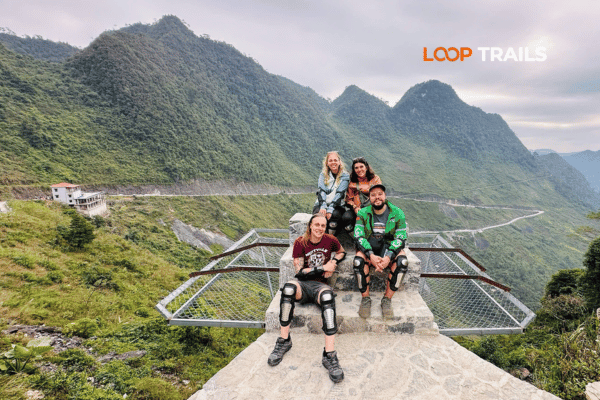
Road safety is the primary consideration for nomads who ride. Mountain roads demand respect regardless of your riding experience. Key rules:
Health: Altitude can affect some people in Ha Giang’s higher sections (above 1,000–1,500m). Nothing at the severity of high-altitude trekking destinations, but headaches and fatigue are possible if you’ve come straight from a lowland city. Give yourself a day to acclimatise before a hard riding day.
Tap water is not safe to drink — bottled water is cheap and ubiquitous. Food from reputable local spots is generally fine; use judgement at markets as you would anywhere.

Learn more: Ha Giang Cao Bang Loop Jeep tour Guide
This is the practical conversion question — and for nomads, the answer depends on your riding experience and how long you’re staying.

Learn more: Ha Giang Loop Self-Drive & Motorbike Rental
The most practical option for nomads staying 2+ weeks who have riding experience. Rent by the day or week, ride when your schedule allows, return when you need to work. Full flexibility, no group dependency, ability to be at Ma Pi Leng at 6am if that’s what you want.
Requires: Genuine riding experience, ideally prior Vietnam riding. The Ha Giang Loop is not the place to learn from scratch on your own.

Learn more: Ha Giang Loop Easy Rider
Do the full Loop once with an experienced local guide — 4 to 5 days — to learn the roads, understand the route, and have the full cultural immersion experience. Then switch to day rental for subsequent explorations. Many nomads find this the best of both worlds: guided depth for the first pass, independence afterward.
Best for: Nomads who aren’t confident self-driving, or want the cultural layer of a great local guide before exploring independently.

Learn more: Ha Giang Jeep Tours
Less common for nomads in the traditional sense — jeep tours are excellent for non-riders and premium travellers, but for a nomad whose appeal to Ha Giang partly involves the motorbike culture, a jeep tour can feel too removed from the experience. That said, if you want to do the Loop once properly without the physical demands, a private jeep tour is a legitimate choice before settling in for longer solo exploration.
Ready to work out the right setup for your stay? Drop Loop Trails a message on WhatsApp — we’re locally based and can tell you exactly what rental or tour format makes sense for your experience level and timeline. [Chat with us on WhatsApp →]

Learn more: What to wear on Ha Giang Loop?
The honest answer is: it depends on what you need from a nomad base.
Ha Giang works well if:
Ha Giang is a harder sell if:
The sweet spot user: A remote worker — writer, developer, designer, consultant — who works mornings, eats local food without complaint, and has been wanting to ride a motorbike through the mountains of northern Vietnam for two years. For that person, Ha Giang is hard to beat.
Loop Trails is based in Ha Giang — not a Hanoi booking platform, not an aggregator. We run tours, rentals, and handle the logistics of the Loop for travellers and remote workers who want to do it properly.
If you’re planning a longer stay and want advice on the Loop, rental options, or what time of year makes the most sense for your work schedule, message us. We’re happy to give you a straight answer without a sales pitch attached.
[Browse Ha Giang Loop Tours →] | [See Motorbike Rental Options →] | [Message us on WhatsApp →]

Learn more: Ha Giang Loop route and itinerary
Ha Giang works well for nomads with async-heavy work who are prioritising experience over infrastructure. WiFi in Ha Giang City is functional — good enough for most work needs — but not as reliable as Hanoi or Da Nang. The real appeal is low cost, extraordinary mountain scenery, and the Ha Giang Loop starting from your front door. Two to four weeks is the ideal nomad stay length.
Internet in Ha Giang City is adequate for most remote work — email, documents, Slack, light video calls — at most cafes and mid-range guesthouses. Speeds vary more than you’d find in major Vietnamese cities, and some venues are significantly better than others. A local SIM with Viettel 4G data as backup is strongly recommended. On the Loop itself, connectivity drops significantly in remote mountain sections.
Ha Giang is one of the cheapest places to base yourself in Vietnam. Accommodation, food, and daily expenses are all significantly below the cost of tourist hub cities like Da Nang or Hoi An. The main added cost for nomads who ride is motorbike rental — factored in, the monthly budget is still competitive with most Southeast Asian nomad destinations. Check current prices locally as costs shift over time.
Yes — and this is actually one of the better models for doing both. The Loop takes 4–5 days if you ride it as a continuous trip. Alternatively, nomads based in Ha Giang City for 2+ weeks can ride it in sections — a day or two at a time — and work on the in-between days. This slower approach often produces a better experience of the region than a rushed full loop anyway.
Driving regulations in Vietnam — including requirements around international driving permits and local licences — are subject to change and vary in enforcement. Check current rules with your rental provider before you book, and consult your country’s official travel advisory. Don’t rely on secondhand online advice for this; rules have shifted over the years.
Viettel generally offers the best rural coverage in northern Vietnam and is the recommended choice for nomads planning to ride the Loop or travel beyond Ha Giang City. Mobifone and Vinaphone are alternatives. All major Vietnamese networks offer monthly data plans at very low cost — buy a SIM in Hanoi or Ha Giang City upon arrival.
Ha Giang City and the Loop are generally considered safe by Vietnam and Southeast Asia standards. Solo female travellers ride the Loop regularly, including solo. Standard awareness applies — as anywhere. For the Loop specifically, Easy Rider guided tours offer an additional safety layer, and many solo female travellers prefer the guided format for their first Loop experience.
October to November is peak season — buckwheat flowers bloom, weather is dry, light is dramatic. March to May is also excellent — good conditions, fewer crowds, terraces greening up. December to February can be cold at altitude but is workable with the right gear. Avoid peak rainy season (July–August) if connectivity and road conditions on riding days matter to your work rhythm.
No dedicated coworking spaces as of this writing. The nomad infrastructure that exists in Hanoi, Da Nang, or Hoi An (formal coworking with hot desks, community events, fast fibre) doesn’t exist in Ha Giang. Cafes with WiFi are the practical alternative — and several are good enough for focused work sessions.
Two to four weeks is the sweet spot. One week is enough to do the Loop but doesn’t give you time to settle into the town and develop a productive work rhythm. Beyond four weeks, you’ll likely want a change of scene — Ha Giang is relatively small and can feel limiting after a month. Two weeks lets you do the Loop, establish a work routine, and still have time for day rides and exploration.
Yes — Cao Bang Province, accessible from Ha Giang, is another outstanding but under-visited part of northern Vietnam. The Ha Giang–Cao Bang combined route takes you to Ban Gioc Waterfall and Phia Oac National Park, among other highlights. Most nomads treat it as an extension trip — a few days out of Ha Giang City — rather than a separate base.
Pack your full work setup (laptop, chargers, headphones for calls), a quality powerbank, a Vietnamese SIM (or buy on arrival), rain gear for mountain weather changes, and warm layers for altitude. Don’t rely on Ha Giang for tech supplies or pharmacy basics — bring what you need from Hanoi.
Contact information for Loop Trails
Website: Loop Trails Official Website
Email: looptrailshostel@gmail.com
Hotline & WhatSapp:
+84862379288
+84938988593
Social Media:
Facebook: Loop Trails Tours Ha Giang
Instagram: Loop Trails Tours Ha Giang
TikTok: Loop Trails
Office Address: 48 Nguyen Du, Ha Giang 1, Tuyen Quang
Address: 48 Nguyen Du, Ha Giang 1, Tuyen Quang
Facebook X Reddit Table of Contents Learn more: Ha Giang Loop Tours Most people riding the Ha Giang Loop are focused on
Facebook X Reddit Table of Contents Learn more: Ha Giang Loop Tours Ha Giang doesn’t have five-star hotels with rooftop pools. There’s

Facebook X Reddit Table of Contents They’re both in the north. They both involve dramatic limestone formations. And if you search “best