
Tipping in Ha Giang: How Much for Guides and Drivers?
Facebook X Reddit Table of Contents Learn more: Ha Giang Loop Tours You are standing in the courtyard of Loop Trails Hostel.
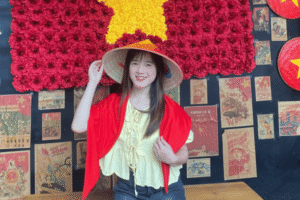
Thúy Kiều (Grace) is a travel blogger and content contributor for Loop Trails Tours Ha Giang. She holds a bachelor’s degree in Sustainable Tourism from Vietnam National University, Hanoi, and has a strong passion for exploring and promoting responsible travel experiences in Vietnam’s northern highlands.
Learn more: Ha Giang Loop Tours
Most people planning the Ha Giang Loop focus entirely on the roads: which pass is hardest, how long each riding day is, whether to go by motorbike or jeep. The food barely gets a mention in most trip reports.
That is a mistake.
Ha Giang Loop food is one of the most underrated parts of the entire experience. Nobody warns you that your first homestay dinner is going to be one of the best meals of your Vietnam trip. Nobody mentions that breakfast at 2,200 meters means a bowl of hot soup with a view of cloud covered karst peaks. Nobody tells you about the corn wine until you are already three cups in and the music has started.
This guide covers everything: what is included in your tour meals, what a typical breakfast looks like in the mountains, what local dishes to order at lunch, what “happy water” actually is, and what to do if you have dietary restrictions.
Learn more: Ha Giang Loop 2 Days 1 Night
Ha Giang is not just a landscape. It is a mosaic of ethnic minority communities, each with its own cooking traditions, staple ingredients, and food rituals tied to the seasons and to mountain life.
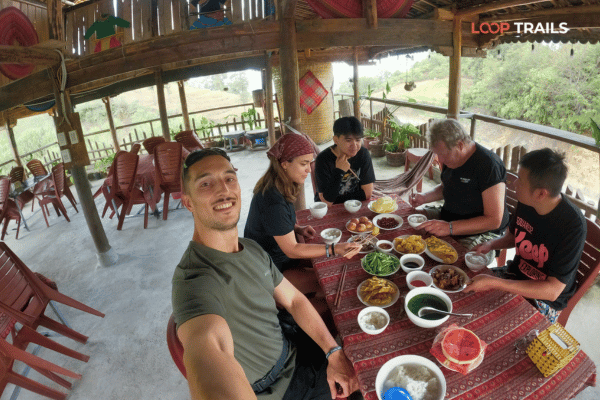
The H’Mong, the Tay, the Dao, the Lo Lo, and the Nung all live across the plateau and valleys of the Loop. When you stay at a homestay in Dong Van, Yen Minh, or Du Gia, the family preparing your dinner has likely grown or raised most of what ends up on the table. Vegetables come from the garden behind the house. Pork comes from their own livestock. Rice comes from the terraced paddies you ride past all afternoon.
That context changes how food tastes. It also means what you eat shifts depending on the season, the village, and the family you stay with. Do not expect a fixed menu. Expect variety, expect dishes you cannot name, and expect to leave the table full.
Learn more: Ha Giang Loop 3 Days 2 Nights
All Loop Trails tours include three meals per riding day. Here is how it works in practice:
Breakfast (B): Served at your homestay or guesthouse before the day’s ride begins. Included on all full riding days.
Lunch (L): Arranged at a local restaurant or canteen in a town along the route. Your guide takes you there directly. Included.
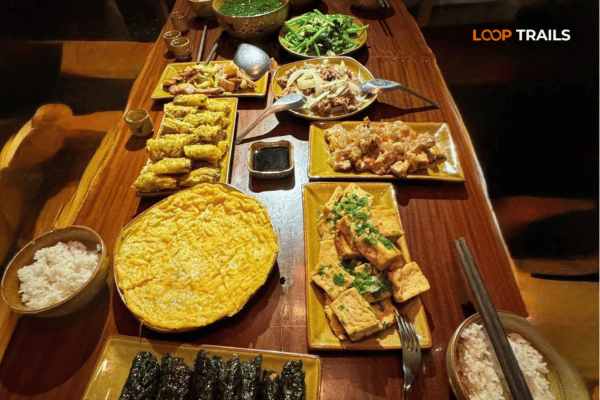
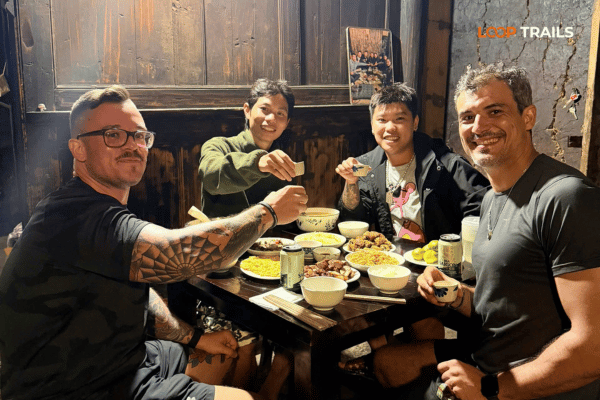
Dinner (D): Prepared at your homestay by the host family. Included, and almost always the highlight of the day.
Each itinerary lists meal coverage using B/L/D notation per day. The table below shows a rough overview:
| Tour | Duration | Meal Coverage |
|---|---|---|
| Ha Giang Loop 2D1N | 2 days, 1 night | B/L/D day 1, B/L day 2 |
| Ha Giang Loop 3D2N | 3 days, 2 nights | B/L/D days 1 to 2, B/L day 3 |
| Ha Giang Loop 4D3N | 4 days, 3 nights | B/L/D days 1 to 3, B/L day 4 |
| Ha Giang Cao Bang 5D4N | 5 days, 4 nights | B/L/D days 1 to 4, B/L day 5 |
| Ha Giang Cao Bang 6D5N | 6 days, 5 nights | B/L/D days 1 to 5, B/L day 6 |
| Cao Bang Loop 3D2N | 3 days, 2 nights | B/L/D days 1 to 2, B/L day 3 |
Day 0 (the overnight bus from Hanoi) is not a meal day. Your first meal on tour is breakfast on Day 1 at Loop Trails Hostel before you ride out.
What is NOT included: snacks you buy at roadside stalls, extra drinks beyond water at meals, beer, coffee from cafes, or any food you purchase independently between stops. These are modest costs and cash only at most places along the route.
If you book through Loop Trails, you will not need to hunt for a restaurant after a long riding day. Everything is arranged.
Curious about what each day looks like in full? Browse the Ha Giang Loop tour options and check the itinerary pages before booking.
Learn more: Ha Giang Loop 4 Days 3 Nights
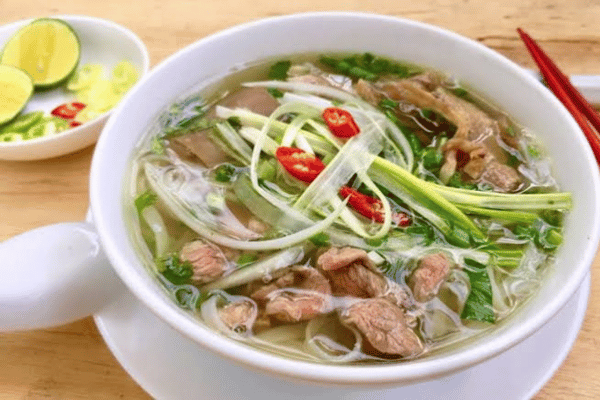
Breakfast in the mountains is simple, warm, and designed around one purpose: fuel before a long day on the road.
At most homestays you can expect a combination of:
In larger towns like Yen Minh and Dong Van, guesthouses often serve a more cafe style breakfast: banh mi (Vietnamese baguette with fillings), pho, or congee (rice porridge). If you stay at a guesthouse rather than a village homestay, your breakfast may lean more toward town cafe food.
One thing that surprises most visitors: there is almost always hot soup at breakfast, even in summer. In the colder months from October through March, that bowl of broth is not optional. It is medicine.
Coffee is available at most stops. In smaller villages it is often instant, but in town guesthouses you will find Vietnamese style drip coffee, strong and dark. If you are a coffee person traveling to very remote areas in the off season, bring a few instant sachets from Hanoi. Nobody will mind.
Learn more: Ha Giang Cao Bang 5 Days 4 Nights
Lunch on the Ha Giang Loop happens in small towns along the route: Tam Son, Yen Minh, Dong Van, Meo Vac, Lung Cu, and on the Cao Bang extension, Bao Lac and Trung Khanh.
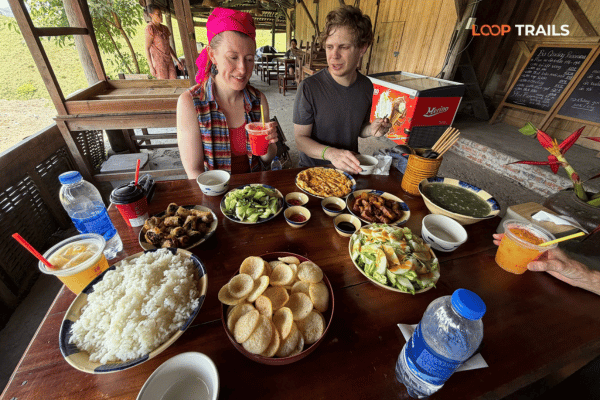
Your guide arranges lunch at a local restaurant they know well. You sit at a shared table and dishes arrive family style: several plates in the center, communal rice, and soup shared around the table.
Typical lunch dishes you will encounter:
Thit lon rang muoi: Pork stir fried with salt and local herbs. One of the most consistent dishes on the Loop, and one of the best.
Rau muong xao toi: Water spinach fried with garlic. You will eat this at almost every meal across the entire route. It is exactly as good as it sounds.
Ca xot ca chua: Fish braised in tomato sauce. Appears more often in valley towns near rivers and during warmer months.
Ga luoc or ga rang muoi: Boiled chicken or salt fried chicken. Free range mountain chicken has a different texture from city farmed chicken: firmer, more flavorful, and considerably better.
Canh chua or canh rau: Sour soup or plain vegetable broth. Always at the table, always worth a second ladle.
Bap nep nuong: Grilled sticky corn, often sold by vendors near popular viewpoints rather than at sit down restaurants. Worth stopping for every single time.
Lunch portions are generous. You will not be hungry when you leave the table. You may also find yourself sitting on plastic stools at a low table surrounded by local workers, which adds considerably to the experience.
Learn more: Cao Bang Loop 3 Days best kept secret
If there is one meal to look forward to on the entire Ha Giang Loop, it is homestay dinner.
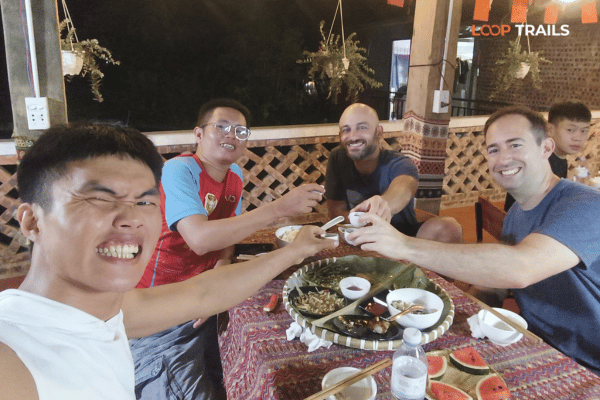
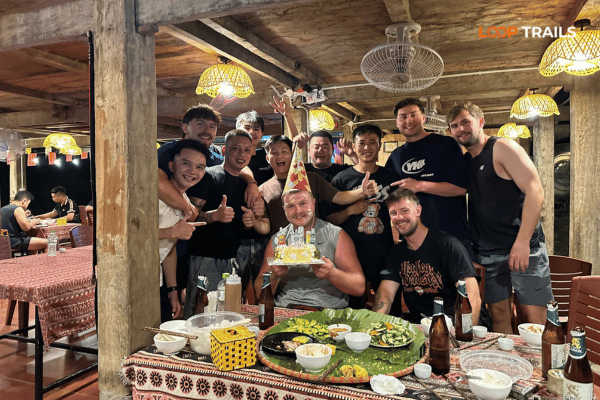
By the time your group arrives at the homestay in the late afternoon, someone has already been cooking for at least an hour. The kitchen runs on open fire or gas burner, the pots are communal sized, and the table is set for everyone staying that night: your group, other guests, and sometimes members of the family.
A typical homestay dinner in Du Gia, Dong Van, or Yen Minh includes:
Steamed rice: In large communal bowls at the center of the table. Help yourself and keep going.
Thang co or a variation: Thang co is the signature dish of the H’Mong people: a stew made from horse or buffalo meat with organs, lemongrass, spices, and time. Traditional versions are intense in flavor and unfamiliar to most foreign palates. Many homestays offer a milder version or substitute with beef or pork stew prepared in a similar style. Try a small amount at least once.
Grilled pork or chicken: Prepared over charcoal or open fire, seasoned with salt, lemongrass, and local herbs. Simple and consistently excellent.
Stir fried mountain vegetables: Bitter greens, bamboo shoots, or wild ferns depending on what is in season. The variety shifts noticeably between spring and autumn.
Claypot dishes: Pork ribs or tofu cooked slowly in clay pots. More common at higher elevation homestays and more frequent during colder months.
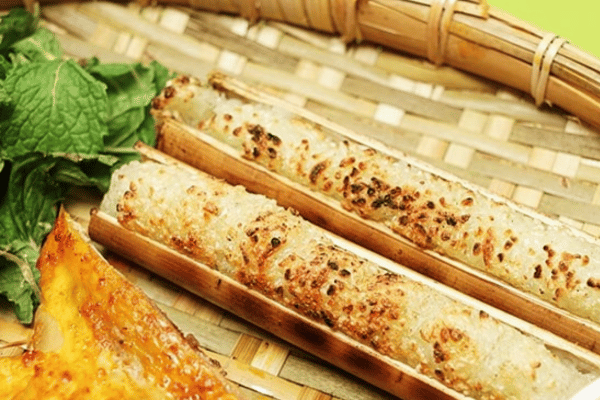
Sticky rice in a bamboo container: Served at the table and eaten with your hands. A staple of H’Mong and Tay cooking.
Pickled vegetables: Fermented mustard greens or sour bamboo shoots often appear as a side, sometimes as a condiment to balance richer dishes.
After dinner, once the plates are cleared, the happy water tends to appear. More on that in the section below.
Learn more: Ha Giang Food guide
The H’Mong are the dominant ethnic group across the Dong Van Karst Plateau, and their food forms the backbone of what you eat for most of the Loop. A few things worth understanding before you arrive:
Corn is central to H’Mong cooking. At elevations where wet rice cultivation is difficult, corn is the historical staple. It appears as grilled corn, sticky corn porridge, corn wine, and corn flour in various preparations. The shift toward rice in recent decades is relatively recent and not universal across the higher villages.
Everything follows the season. The same homestay serves noticeably different dishes in October versus March. In autumn, fresh corn is everywhere. In spring, bamboo and wild mountain greens take over. In winter, preserved and fermented foods become more prominent: sour bamboo shoots, dried meats, and pickled vegetables.
Nothing is wasted. In mountain communities where a whole animal is slaughtered for a meal, every part goes into the pot. This is the origin of thang co and similar dishes heavy in organ meat. If that is not your preference, there is always plenty to eat from the pork, vegetable, and tofu options.
Lo Lo and Tay food: Near Lung Cu and in the valleys closer to Du Gia, the Lo Lo and Tay communities cook quite differently. Tay food leans heavily on freshwater fish, sticky rice preparations, and sour bamboo based dishes. Lo Lo cooking features grilled meats and corn based preparations. Your guide can tell you which community runs the homestay you are staying in that night
Learn more: Ha Giang Market Day
Before you arrive, it is worth knowing a few dishes by name so you can spot them on the route and order with confidence.
Thang co: The most well known H’Mong dish. A stew of horse or buffalo meat with organs, herbs, and spices. Originally prepared for weekly market days when entire communities gathered to cook together in large communal pots. Strong in flavor, strong in aroma, worth trying once.
Men men: A dense corn porridge that was historically the H’Mong staple food before rice became more accessible. Rarely served to tourists today but you may encounter it at traditional homestays. Filling and slightly sour in character.
Pho bo Ha Giang style: Ha Giang beef pho has a slightly different character from Hanoi pho. The broth is often more mineral and earthy, the noodles sometimes thicker, and the herbs shift by season. Have it for breakfast in Ha Giang city on Day 1 before the Loop begins.
Banh cuon: Steamed rice rolls filled with minced pork and mushroom. Available at morning markets in Yen Minh and Dong Van. Light and delicate and easy to underestimate.
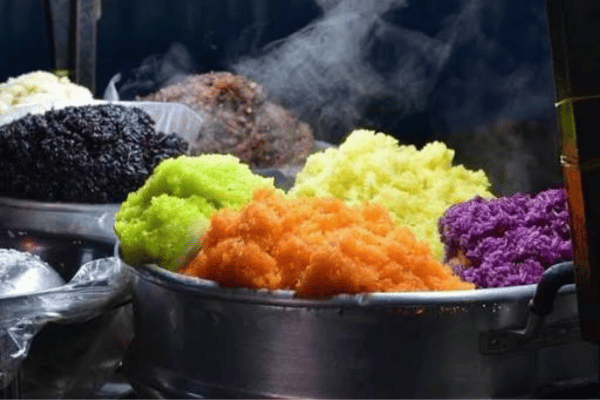
Xoi ngu sac (five color sticky rice): If your tour extends to Cao Bang, this dish is unmissable. Sticky rice dyed in five natural colors using leaves and flowers, served at breakfast or as a snack. It looks remarkable and tastes even better.
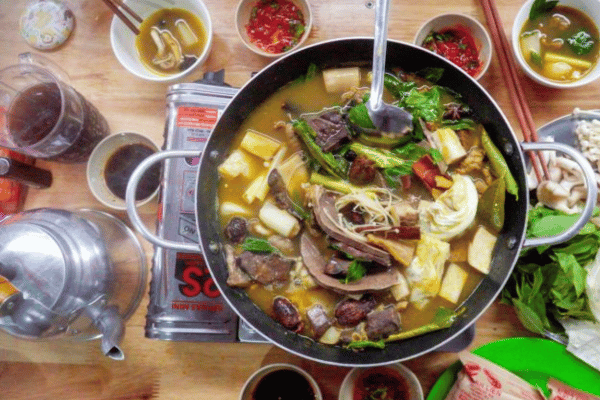
Lau mac khen: A hotpot seasoned with mac khen pepper, a wild berry used extensively across the northern Vietnamese highlands. The flavor is unlike anything you find in southern Vietnamese cooking: faintly citrusy, slightly numbing, deeply aromatic.
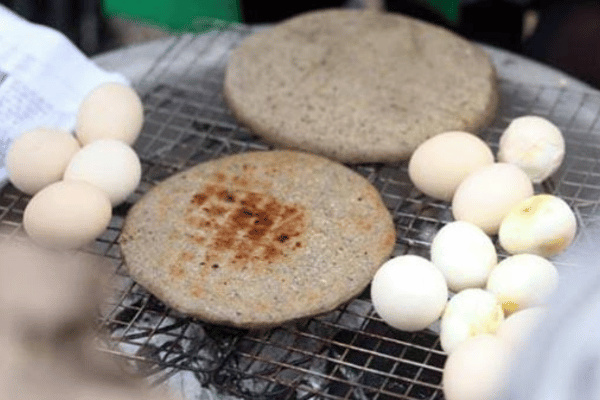
Banh trang nuong (grilled rice paper): Thin sheets of dried rice paper grilled over charcoal, brushed with egg and spring onion, topped with dried shrimp or chili. Sold as street food in Dong Van and Meo Vac.
Bap nuong (grilled corn): Sticky mountain corn grilled over charcoal and rubbed with salt and chili. Sold at roadside stalls near major viewpoints and at market areas. One of the best snacks on the entire trip.
Learn more: Khau Vai Love Market
Between meals, there is plenty to graze on if you keep your eyes open.
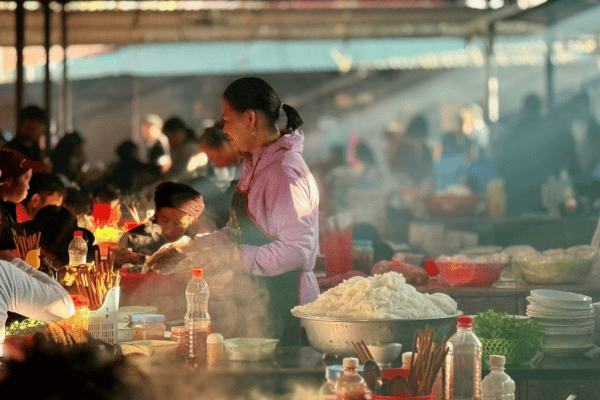
Dong Van Sunday market: If your itinerary passes through Dong Van on a Sunday, the weekly market is worth arriving at early. This is not a tourist market. It is the real thing: H’Mong, Lo Lo, Dao, and other minority communities traveling down from surrounding villages to buy, sell, and eat together. The food section alone is worth the stop: grilled meats, corn dishes, banh cuon, fresh fruit, and small stalls serving thang co from large communal pots.
Roadside corn and fruit vendors: Throughout the Quan Ba and Yen Minh districts, roadside vendors sell seasonal fruit: persimmons, pomelos, and mountain plums depending on the time of year. Prices are very low and cash only.
Chao ngua (horse meat porridge): Available at the Dong Van Sunday market and a few specialist stalls in the area. A niche item, but if you want to eat as locally as possible, this is the most traditional morning dish of the H’Mong plateau.
Banh mi stalls: Not unique to Ha Giang, but worth mentioning because you will walk past them constantly in the larger towns. Vietnamese baguette sandwiches with pate, pickled vegetables, herbs, and your choice of filling. Cheap and satisfying between main meals.
Fresh sugar cane juice: Available at market areas and town centers, pressed to order in front of you. Cold and sweet and exactly right on a hot afternoon.
Learn more: Ha Giang Cao Bang 6 Days 5 Nights
This section matters if you are vegetarian, vegan, or have specific food allergies.
Vegetarian: Possible, but requires clear communication in advance. Homestay cooks are generally not familiar with the Western concept of a fully meatless diet. Saying “khong an thit” (I do not eat meat) may still result in fish sauce, shrimp paste, or pork based broth appearing in dishes. The safest approach: tell your guide clearly before the tour starts and ask them to communicate your needs to each homestay the evening before your stay. Most families will accommodate with egg dishes, tofu, and extra vegetables without any issue.
Vegan: Harder but manageable with enough notice. Ask your guide specifically to request dishes without fish sauce and egg in addition to no meat. Tofu, plain steamed vegetables, and rice are always available. You will eat simply, but you will not go hungry.
Gluten free: The rice based diet of northern Vietnam makes gluten free eating naturally easier here than in many destinations. The main concern is soy sauce in some stir fried dishes and a few sauce preparations. Tell your guide and they can flag this at each meal stop.
Severe allergies: Ha Giang is remote. Medical facilities are limited and emergency response times are not what they are in a city. If you have a severe allergy (nut, seafood, or similar), bring your medication and your EpiPen, and make absolutely sure your guide and each individual homestay understands before every meal. Not just once at the start of the tour.
The key principle in every case: your guide is your translator and your advocate. Give them specific, clear information, in writing if possible. Loop Trails guides can help translate your dietary needs into the right Vietnamese phrases. Check before every meal, every day.
Learn more: Corn wine “Happy Water” in Ha Giang
“Happy water” is the universal informal term for locally distilled corn or rice wine on the Ha Giang Loop. It goes by several names: ruou ngo (corn wine), ruou can (straw wine sipped through bamboo tubes), or simply ruou (the general Vietnamese word for spirits).
Alcohol content typically falls somewhere between 30 and 50 percent depending on the batch and the family doing the distilling. It is usually served at homestay dinner in small ceramic cups or bamboo cups, and the ritual of passing it around the table with your guide and other travelers is one of the most genuinely memorable parts of the trip.
What to expect from the taste:
The corn wine version has a mild, slightly sweet flavor with a clean finish. Rice wine tends to be smoother and lighter. Some families make a version infused with local herbs or honey that is quite pleasant to drink. Others make a version that will make your eyes water. You will not know which kind you are having until you are already having it.
The etiquette:
When the cup reaches you, you drink, you pass, and you refill the next person’s cup before they refill yours. Nobody drinks alone. The Vietnamese toast is “mot, hai, ba, yo” (one, two, three, cheers). Learn it. You will use it repeatedly.
If you do not drink alcohol:
Nobody will pressure you. Say “toi khong uong ruou duoc” (I cannot drink alcohol) and you will be offered tea without any fuss. Vietnamese hospitality is generous, not coercive.
Other drinks along the route:
Learn more: Ha Giang Safety Tips
Ha Giang is not a high food safety risk destination. The cooking is fresh, the ingredients are local and seasonal, and the traditional diet is relatively simple. That said, a few practical notes:
Drink bottled or filtered water only. Tap water in Ha Giang is not reliably safe to drink. Your tour meals come with filtered or bottled water included. Carry a reusable bottle and ask your guide to refill it at each stop.
Wash hands before meals. Most homestays have outdoor hand washing stations near the kitchen. Use them every time.
Be cautious with raw vegetables from street stalls. Cooked food is generally safer than raw salads when you are traveling through remote areas far from medical facilities.
Altitude and alcohol combine unexpectedly. At elevations of 1,500 to 2,000 meters, the same amount of alcohol hits noticeably harder than it would at sea level. The second cup of happy water has a way of becoming the fourth before you realize it. Pace yourself, especially if you are on a motorbike the next morning.
Stomach adjustment is normal. Some travelers experience mild digestive adjustment in the first day or two, simply from a change in diet, water source, and altitude. Bring a small pack of probiotic sachets or oral rehydration salts if your stomach tends to be sensitive during travel.
Learn more: Ha Giang Loop Easy Rider
All Loop Trails tours include meals, but the depth of the food experience varies with tour duration and style.
2D1N tours cover the main scenic highlights but move at a fast pace. You get one homestay dinner, lunches, and breakfast on the final day. It is enough to taste the region but not enough to slow down and really enjoy the cooking.
3D2N and 4D3N tours give you two to three nights at homestays and enough time in the villages to genuinely experience the food culture. The 4D3N is the most popular duration, and for good reason: you have time to pass through Dong Van on the right day for the Sunday market, swim in Du Gia waterfall in the morning, and spend two separate evenings at two different homestays eating two different sets of dishes.
5D4N and 6D5N Ha Giang to Cao Bang tours extend the food journey considerably. You get to experience the distinct cuisine of the Cao Bang region alongside everything you eat on the Ha Giang plateau. The five color sticky rice in Cao Bang and the farmstay cooking near Ha Quang district are food highlights the shorter tours simply do not reach.
Easy rider tours give you more flexibility at meals because your guide is with you directly and can communicate your preferences and any dietary needs at each stop without delay. Jeep tours work similarly: your driver and guide arrange everything for the group and can adapt to requests easily.
Not sure which tour is the right fit? The Ha Giang Loop tours page has full day by day itineraries with exact meal coverage marked. You can also message Loop Trails directly to ask about specific dietary needs or food questions before you book.
Learn more: Ha Giang Motorbike Rental
Yes. All Loop Trails tour packages include breakfast, lunch, and dinner on full riding days. The only things not included are snacks, extra drinks, and anything you buy independently between stops. Check your specific itinerary for exact B/L/D coverage per day
Thang co is the traditional H’Mong stew made from horse or buffalo meat with organs and spices. It has a strong, gamey flavor that some travelers love and others find challenging. Many homestays offer a milder version using pork or beef cooked in a similar style. Try a small amount before committing to a full bowl
Yes, with advance notice. The local diet is heavily rice and vegetable based, so meatless eating is possible. Tell your guide clearly before the tour begins so they can communicate your needs to each homestay. You will eat simply but well
Happy water is the informal name for locally distilled corn or rice wine served at homestay dinners. Alcohol content runs roughly 30 to 50 percent. Sharing a round with your guide and fellow travelers is one of the most memorable parts of the Loop experience. Non drinkers are always welcomed with tea instead
Generally no. Northern Vietnamese and H’Mong cooking is not chili heavy in the way central or southern Vietnamese food can be. Some dishes use mac khen pepper, which has a mild numbing quality, and a few sauces include fresh chili. Overall the food on the Loop is milder than most international travelers expect
Ha Giang city has several good early morning pho spots that open before 7 a.m. Pho bo (beef pho) and bun bo (spicy beef noodle soup) are both common and worth trying. Ask your Loop Trails guide or the hostel staff for the nearest local spot
Yes. Small shops in Tam Son, Yen Minh, Dong Van, and Meo Vac sell packaged snacks, instant noodles, fruit, and drinks. At popular viewpoints like Ma Pi Leng and Heaven Gate near Quan Ba, vendors often sell grilled corn and seasonal fruit. Bring small cash, as most stalls do not have card readers
Water (filtered or bottled) is included at all tour meals. Beer, soft drinks, and extra coffee are your own expense and available in most towns along the route. At homestays in smaller villages, expect tea and water rather than cold drinks and coffee
Generally yes. The food is freshly cooked and the ingredients are local and seasonal. Basic precautions apply: drink bottled or filtered water, skip raw salads from small roadside stalls, wash hands before eating, and pace yourself with the corn wine at altitude
Most travelers say homestay dinner, without hesitation. Something about arriving tired after a long day on the road and sitting down to a table full of food cooked by the family hosting you, sharing it with your group and your guide, and ending the evening with happy water and music, makes the food feel like the point of the trip rather than just fuel between viewpoints
Contact information for Loop Trails
Website: Loop Trails Official Website
Email: looptrailshostel@gmail.com
Hotline & WhatSapp:
+84862379288
+84938988593
Social Media:
Facebook: Loop Trails Tours Ha Giang
Instagram: Loop Trails Tours Ha Giang
TikTok: Loop Trails
Office Address: 54A Tran Phu, Ha Giang 2, Tuyen Quang
Address: 54A Tran Phu, Ha Giang 2, Tuyen Quang
Facebook X Reddit Table of Contents Learn more: Ha Giang Loop Tours You are standing in the courtyard of Loop Trails Hostel.
Facebook X Reddit Table of Contents Learn more: Ha Giang Loop Tours The route from Ha Giang to Cao Bang by Jeep
Facebook X Reddit Table of Contents Learn more: Ha Giang Loop Tours If you are a UK traveler planning to ride a