
Ha Giang Easy Rider: The Complete Guide (2026)
Facebook X Reddit Table of Contents Learn more: Ha Giang Loop Tours There’s a moment, usually somewhere on Ma Pi Leng Pass,

Thúy Kiều( Grace) is a travel blogger and content contributor for Loop Trails Tours Ha Giang. She holds a bachelor’s degree in Sustainable Tourism from Vietnam National University, Hanoi, and has a strong passion for exploring and promoting responsible travel experiences in Vietnam’s northern highlands.
Learn more: Ha Giang Loop Tours
There’s a moment somewhere on Ma Pi Leng Pass — usually around the third hairpin, when the road drops away and the Nho Que River appears a thousand meters below in a color that looks completely wrong for a river — when you understand why people keep coming back to Ha Giang.
The Ha Giang Loop is a roughly 350-kilometer circuit through the far north of Vietnam, threading through limestone mountains, ethnic minority villages, and a UNESCO-recognized geopark that most international travelers have never heard of. It’s Vietnam’s best road trip. Probably one of the best in Southeast Asia, full stop.
This guide covers everything: the route, the costs, how to choose between Easy Rider, self-drive, and jeep options, the best time to go, what to pack, and the practical details that most Ha Giang articles gloss over. No filler, no fabricated stats. Just the real picture.
Learn more: Ha Giang Loop for Couples
The Ha Giang Loop is a mountain road circuit in Ha Giang Province, Vietnam’s northernmost province bordering China. The loop departs from Ha Giang City, heads north and east through the Dong Van Karst Plateau Geopark, hits the key towns of Quan Ba, Yen Minh, Dong Van, and Meo Vac, then swings south through Du Gia village and back to Ha Giang City.
The total distance depends on your route choices, but most loop tours cover 300–400 kilometers over 2–5 days.
Ha Giang Province was only opened to foreign tourists in the early 2000s, which is part of why it still feels less processed than the rest of Vietnam’s tourist trail. There are no beach clubs here, no all-inclusive resorts, no tour buses with LED dashboards. There are mountain passes, corn fields stacked up cliff faces, villages where the mobile signal disappears for hours, and homestays where you fall asleep to the sound of dogs and roosters and not much else.
Learn more: Quan Ba Heaven Gate
Most travelers arrive in Vietnam with a mental image of the country: Hanoi’s Old Quarter, Ha Long Bay, Hoi An’s lanterns, the Cu Chi tunnels, motorbike chaos in Ho Chi Minh City. Ha Giang fits none of these templates.
The landscape is geological and vertical. The Dong Van Karst Plateau is one of only four UNESCO Global Geoparks in Vietnam — a highland plateau of limestone peaks that formed 400–600 million years ago. The rock formations are the oldest exposed geology in Vietnam. When you’re riding through them, that age is palpable in a way that’s hard to explain and easy to photograph.
The people are as distinctive as the landscape. Ha Giang is home to over 20 ethnic minority groups, with H’Mong, Lo Lo, Tay, Nung, and Dao communities making up the majority in different areas of the province. In Dong Van and Meo Vac, Black H’Mong and Flower H’Mong villages sit within sight of the Chinese border. In Du Gia, Tay families farm river valleys and run homestays in traditional stilt houses.
And the food. Corn is the dominant crop on the steep slopes where rice can’t grow, and corn-based dishes — corn wine, corn porridge, dried corn — appear alongside mountain pork, river fish, and foraged vegetables at every homestay table.
Ha Giang rewards slowness. The travelers who love it most are usually the ones who stop more, ride less, and stay an extra night when the homestay family invites them to.
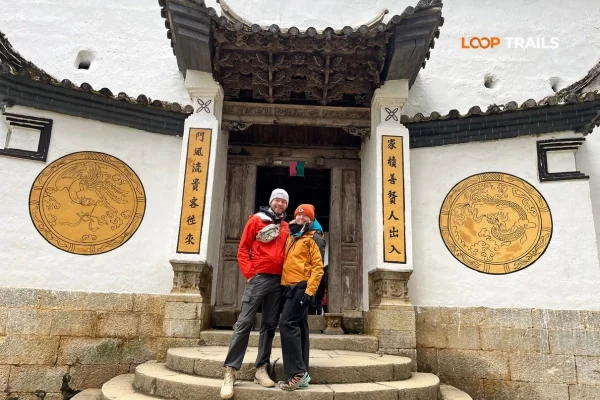
Learn more: Hmong’s King Vuong Palace
| Detail | Info |
|---|---|
| Location | Ha Giang Province, far-northern Vietnam |
| Distance | ~350 km for the full loop |
| Duration | 2–5 days (4D3N is the sweet spot) |
| Start/End Point | Ha Giang City |
| Best Season | March–May, September–November |
| Tour formats | Easy Rider / Self-Drive / Jeep |
| Group sizes | Solo to 4+ (format-dependent) |
| Getting there | Overnight sleeper bus from Hanoi (~5–6 hrs) |

Learn more: Ha Giang in September & October
The loop runs counterclockwise in most tour formats (Ha Giang → Quan Ba → Yen Minh → Dong Van → Meo Vac → Du Gia → Ha Giang). Here’s what each section looks like on the ground.
The first 45 kilometers north of Ha Giang City are the warm-up. The road climbs steadily, the buildings thin out, and by the time you reach Bac Sum Pass, the city is invisible behind you and the plateau has started in earnest.
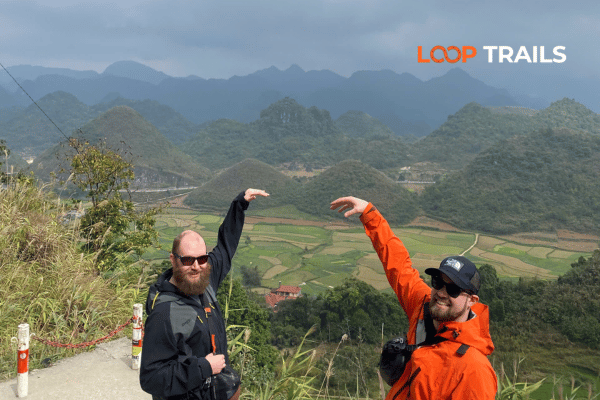
Heaven Gate (Cong Troi) comes first — a mountain saddle where the road passes through a gap in the ridge and the Dong Van Plateau opens up ahead. It’s one of those moments that earns its dramatic name. Below Heaven Gate, the Twin Mountains of Quan Ba (Nui Doi) rise from the valley floor: two rounded limestone mounds, symmetrical and slightly absurd-looking, surrounded by terraced farmland.
Quan Ba Town is the first real stop. Small, relaxed, good coffee. If you’re doing the 4D3N tour, you might stop here for Lung Khuy Cave — the most impressive cave system in the Quan Ba area, rarely crowded and genuinely worth the trek.
This section runs through increasingly open karst country, with villages of Flower H’Mong — identifiable by the bright embroidered clothing women wear even on ordinary weekdays. The road rolls rather than climbs sharply here; it’s one of the more relaxed stretches of the loop.
Yen Minh is the main overnight stop on shorter tours, a functional town with good pho and a Saturday market that draws H’Mong and Nung traders from surrounding villages. If you’re here on a non-market day it’s still worth walking the main street in the evening — it has the kind of quiet provincial atmosphere that feels like the real Vietnam that most tourists miss.

Learn more: Ha Giang Loop for Seniors
The road from Yen Minh into Dong Van climbs through the heart of the geopark. This is where the limestone becomes full-on surreal — peaks stacked in rows, the valleys between them tiny and deep.
Key stops:
Tham Ma Pass — a high saddle with views across multiple valley layers. Consistently stunning, often cloudy in the morning, clear by noon.
Lao Sa village — H’Mong settlement right on the Chinese border. The houses are built of stone and earth in the Chinese-influenced style common to border communities. Fewer tourists than the main towns; more authentic feel.
Sung La valley — a wide agricultural valley between the peaks where H’Mong and Lo Lo communities farm terraced fields. The valley floor is level and green, the peaks around it are not. Stop here rather than rushing through.
Vuong Palace (Dinh Vuong) — the former residence of the H’Mong opium king, built in 1919. A Chinese architect was brought in, and the result is a building that sits architecturally between traditional H’Mong structures and southern Chinese courtyard houses. The story of the Vuong family — their power, their opium trade, their eventual surrender to the communist government — is one of the most interesting in all of northern Vietnam. Spend time here.
Dong Van Old Quarter — a preserved cluster of 19th-century merchant houses built by Chinese traders. The stone and wood architecture is distinct from everything around it. The Sunday market draws ethnic minority communities from across the plateau.
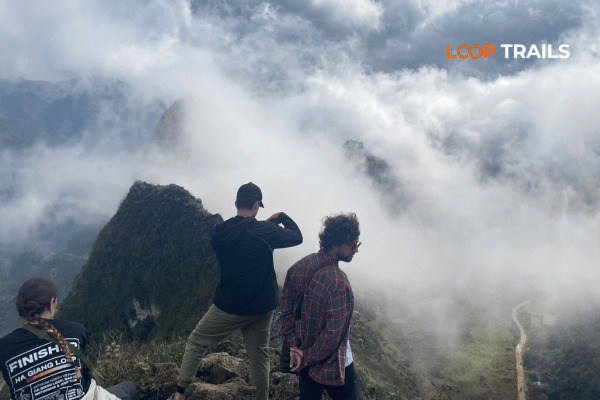
Learn more: Ha Giang Loop Insurance
This is the day.
The road from Dong Van to Meo Vac crosses Ma Pi Leng Pass — one of Vietnam’s four legendary great passes, 20 kilometers of switchbacks carved into sheer limestone cliffs above the Nho Que River. The road was built in the late 1950s by young volunteers who spent two years drilling through solid rock with minimal equipment. Parts of it hang on cliff faces with nothing below but air.
The Ma Pi Leng Skywalk is a cantilevered viewing platform extending from the cliff face, giving an unobstructed view down to the river and across the canyon. It’s the single most photographed spot on the entire loop. Go early if you can — the light is better and the crowds are thinner.
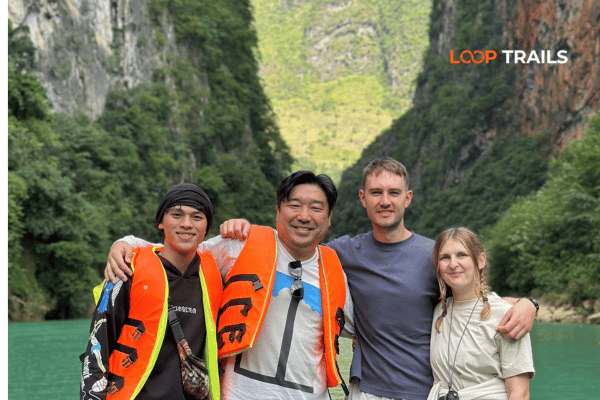
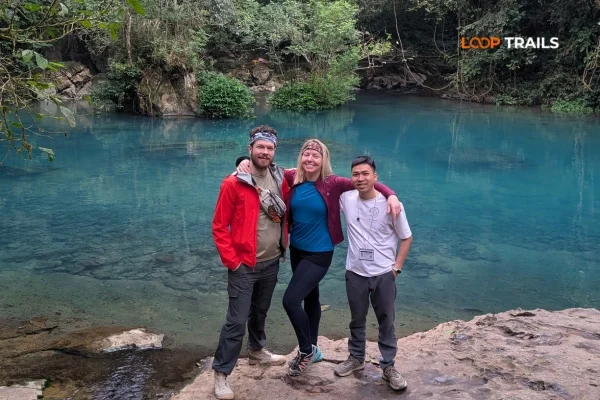
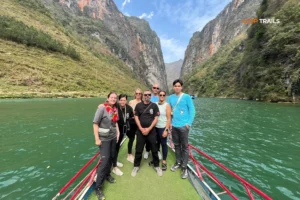
Below the pass, the Nho Que River runs through Tu San Canyon — one of the deepest river canyons in Southeast Asia. The water is an improbable turquoise, clear enough to see the riverbed in the shallows. A boat tour through the narrowest section of the canyon is available from the dock at the base of the pass — roughly 30 minutes of drifting between walls of limestone with nothing visible above but a strip of sky. It’s worth every minute.
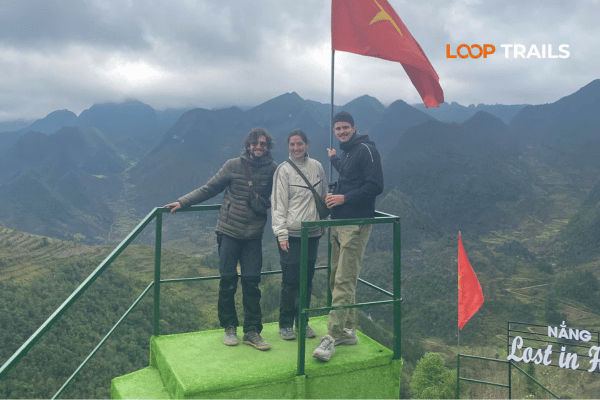
Lung Cu Flag Tower is a detour north from Dong Van, about 25 kilometers to the northernmost tip of Vietnam. The tower sits at 1,700 meters elevation, the Vietnamese flag visible for kilometers. The road to it passes through Lo Lo Chai village — one of the most beautifully preserved ethnic minority villages in the country. The Lo Lo people are a small group, and Lo Lo Chai has maintained traditional architecture and dress better than almost anywhere else in Ha Giang.
Meo Vac Town sits at the bottom of the canyon, smaller and quieter than Dong Van. The Meo Vac Sunday Market is one of the most authentic in northern Vietnam — mostly H’Mong and Nung traders doing actual commerce, not a tourist market.

Learn more: Du Gia Waterfall
This section heads south and west through a different landscape — wider valleys, more agriculture, fewer dramatic peaks. The M Pass (shaped like the letter M when viewed from above) and Lung Ho viewpoint are the main scenic stops. Du Gia village is a Tay community in a peaceful river valley — traditional stilt house homestays, rice paddies, and the Du Gia Waterfall a short walk from the village.
The waterfall is swimmable in the morning before the day’s tour buses arrive. This is one of those small logistical details that makes a significant difference to the experience.
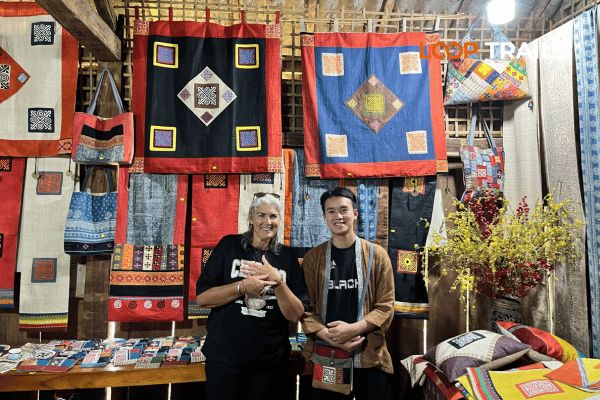
The return section takes you through Duong Thuong valley — a wide H’Mong valley that most tour itineraries breeze through and which deserves slower attention — before passing Lung Tam linen village, where Tay women weave traditional linen fabric on hand looms. You can buy directly from the weavers here. The pieces they produce are genuinely high quality and priced for a Vietnamese market, not a tourist market.
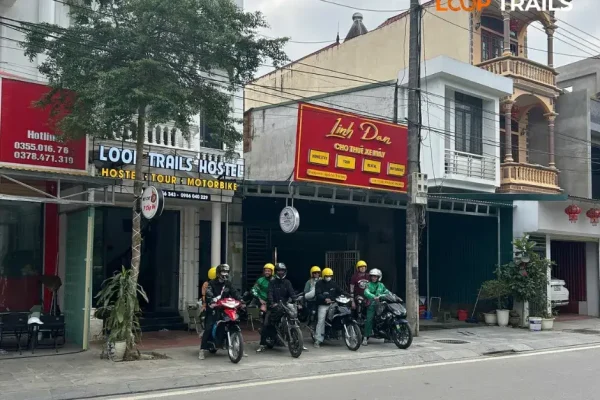
Learn more: Ha Giang Motorbike Rental
There are three main ways to do the Ha Giang Loop, each suited to different types of travelers.
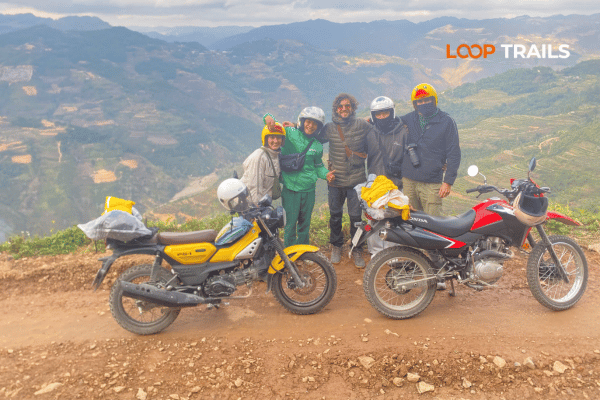
Learn more: Ha Giang Loop Easy Rider
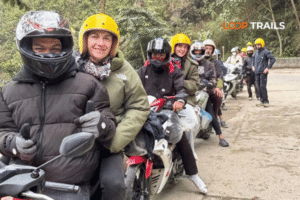
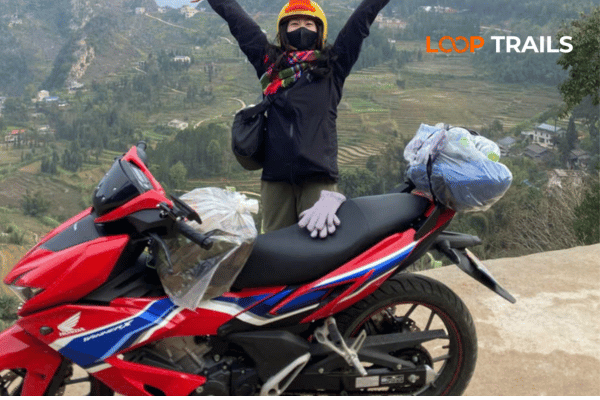
Your guide is the driver. You ride pillion on the back of a motorbike, hands free, eyes on the scenery. The guide navigates, manages stops, handles local interactions, translates menus and village conversations, and — importantly — knows when to stop at a viewpoint that isn’t on any map.
This is the most immersive format for travelers who want to be fully present without managing road logistics. It’s also the best option for solo travelers joining a small group, since you travel as a convoy with other Easy Rider pairs and your guide creates a social dynamic that self-drive and jeep formats don’t quite replicate.
Learn more: Ha Giang Loop Self-Drive
You ride your own motorbike. A guide rides with the group (usually leading or sweeping), but you’re in control of your own machine: your own pace on the straights, your own confidence through the corners, your own stops when something catches your eye.
Self-drive is for experienced riders who want freedom. It’s not for beginners — the Ha Giang Loop includes mountain passes that require competent riding — and it requires proper documentation.
Licensing requirements: To legally self-drive in Vietnam, you need your home-country motorbike license and a valid International Driving Permit (IDP) type 1968. The IDP 1949 is not recognized in Vietnam. Without the correct IDP, you risk fines of 2,000,000–6,000,000 VND if stopped by traffic police. Rules and enforcement can change — always verify current requirements before your trip. → Full self-drive licensing guide
Learn more: Ha Giang Cao Bang Loop Jeep tour Guide
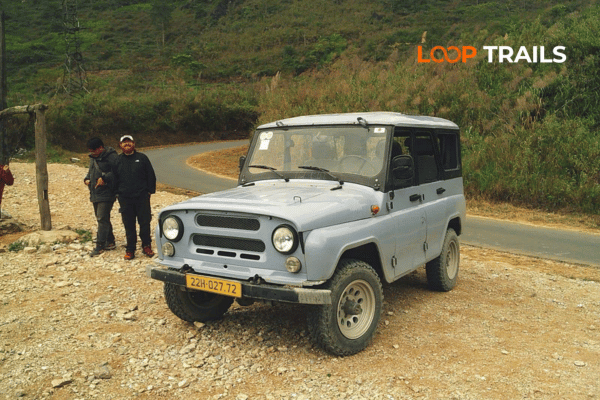
A 4WD jeep with a local driver and English-speaking guide. You sit in a covered vehicle, stop at everything your guide recommends, and focus entirely on the experience without road fatigue. Best for families with children, couples who’d rather not ride, older travelers, or groups of 2–4 who want shared comfort.
The per-person cost is higher for small groups but becomes competitive at 3–4 passengers. → Full Ha Giang Loop jeep tour guide
Learn more: Ha Giang Loop Cost & Tips
All prices in Vietnamese Dong (VND). Motorbike tour prices are per person; jeep prices vary by group size.
| Duration | Easy Rider | Self-Drive |
|---|---|---|
| 2D1N | 3,490,000 | — (no self-drive on 2-day) |
| 3D2N | 4,390,000 | 3,590,000 |
| 4D3N | 5,490,000 | 4,690,000 |
| 5D4N (+ Cao Bang) | 10,990,000 | 10,590,000 |
Ha Giang Loop 3D2N
| Group Size | Total (VND) |
|---|---|
| 1 person | 8,990,000 |
| 2 people | 16,990,000 |
| 3 people | 19,990,000 |
| 4 people | 22,900,000 |
Ha Giang Loop 4D3N
| Group Size | Total (VND) |
|---|---|
| 1 person | 11,990,000 |
| 2 people | 22,990,000 |
| 3 people | 26,990,000 |
| 4 people | 30,990,000 |
Ha Giang + Cao Bang 5D4N Jeep
| Group Size | Total (VND) |
|---|---|
| 2 people | 31,990,000 |
| 3 people | 36,490,000 |
| 4 people | 40,990,000 |
What’s included in all tours: Accommodation (dorm beds), meals per itinerary (B/L/D as marked), guide/driver, vehicle, entrance fees, activities including boat tours and cave treks, evening cultural activities.
Not included: Round-trip bus tickets (Hanoi ↔ Ha Giang or Cao Bang), private room upgrades, personal drinks, travel insurance, tips.
Learn more: Ha Giang Loop 3 Days 2 Nights
The 2-day loop exists. It hits the highlights fast — Ha Giang to Dong Van in a day, Ma Pi Leng and back the next. If your Vietnam itinerary is genuinely tight and this is your only window, it’s worth doing in two days rather than not at all.
But the 4-day loop is where Ha Giang opens up properly.
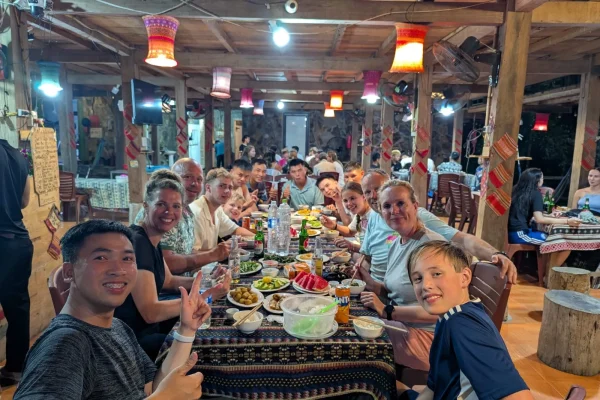
With four days, you get: the slow morning at Lung Khuy Cave, time in Lo Lo Chai village, the Lung Cu detour, a proper boat tour on Nho Que River, a morning swim at Du Gia Waterfall, and an evening at a homestay where the happy water appears before dinner and the music starts after. The pace is human-sized rather than checkpoint-sized.
| Duration | Best For |
|---|---|
| 2D1N | Very tight itinerary, Ha Giang first-timers wanting a taste |
| 3D2N | Good coverage, one long day on the plateau |
| 4D3N | Sweet spot — all main highlights, comfortable pace |
| 5D4N (+ Cao Bang) | Serious adventurers, travelers with extra time |

Learn more: Ha Giang Loop for Families & Groups
You should choose Easy Rider if: This is your first time, you’re traveling solo, you want to focus on the landscape without road stress, or you’re joining a group and want the social dynamic a good guide creates. The 4D3N Easy Rider is the most popular choice for a reason.
You should choose Self-Drive if: You’re a confident, experienced motorbike rider with the right license and IDP. You want control, freedom, and the physical satisfaction of riding the passes yourself. If you’ve ridden mountain roads before, this format feels right. If you haven’t, do Easy Rider first.
You should choose a Jeep Tour if: You’re traveling with family (including kids), you have a couple or group of 3–4 people, you want comfort without sacrificing any of the stops, or you have physical limitations that make pillion or self-drive riding impractical. The jeep format covers every highlight the motorbike tours do.
You should extend to Cao Bang (5D4N) if: You have the time and want to make this a complete northern Vietnam circuit. The Cao Bang leg adds Ban Gioc Waterfall, Nguom Ngao Cave, Pac Po, and several remote passes that most travelers never see. It ends in Cao Bang City rather than Ha Giang, with overnight buses back to Hanoi.
→ See all Ha Giang Loop tour options and book here | → WhatsApp us to ask which format suits your group
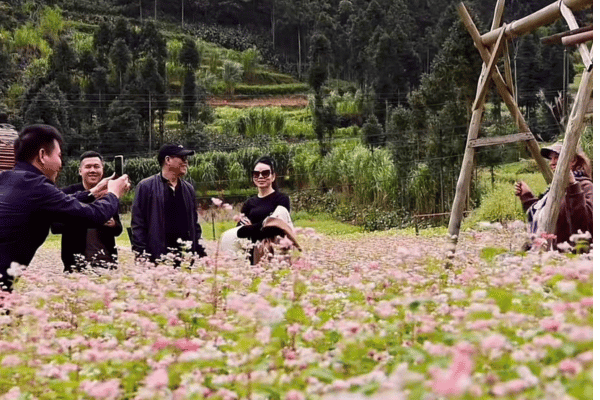
Learn more: Ha Giang Buckwheat Flowers Season
Ha Giang has distinct seasons, and the experience changes significantly depending on when you go.
Buckwheat flowers bloom pink and white across the plateau (particularly around Dong Van and Meo Vac) in late February through March. By April the landscape is green and fresh after winter. Temperatures are cool in the mornings, warm by midday. Visibility is generally excellent. This is one of the two best windows and increasingly popular — book in advance for April and early May.
The rains arrive in earnest. Roads can be affected by landslides and run-off, visibility drops on the passes, and some days are simply wet all day. The landscape is lush and photogenic when it clears, but conditions are genuinely more challenging. Not recommended for self-drive beginners. Tour guides manage the route and have contingency knowledge, so guided tours (Easy Rider or Jeep) handle this season better than solo riding.
The other peak window. Rice terraces turn gold in September–October across Du Gia, Yen Minh, and the valleys approaching Dong Van. The light is longer and softer. October tends to be the best single month for photography. Crowds are higher in October — if you’re doing self-drive and want empty roads, aim for early September or early November.
Cold. At altitude, temperatures drop to near-freezing overnight and sometimes through the day in December and January. Fog sits in the passes for hours some mornings. The buckwheat flowers are gone, the rice is harvested, and the landscape has a stark, stripped quality that some travelers find more interesting than the lush seasons.
Far fewer tourists. If you want Ha Giang without the foot traffic of peak season, winter delivers that — but pack seriously warm layers, and accept that some views will be fog-softened.
Summary:
| Season | Months | Verdict |
|---|---|---|
| Spring | March–May | Excellent. Book early. |
| Rainy | June–August | Passable with guide. Not ideal for self-drive. |
| Autumn | Sept–Nov | Best overall. Peak in October. |
| Winter | Dec–Feb | Beautiful and quiet. Bring warm clothes. |

Learn more: Ha Giang Sleeper Bus
From Hanoi: Overnight sleeper buses depart nightly and arrive in Ha Giang in the early morning — typically 5–6 hours. Buses leave from the My Dinh area in Hanoi. Loop Trails can arrange bus tickets as part of your tour booking.
Bus options include:
From other cities: Buses also run from Ha Long, Cat Ba, Ninh Binh, and Sapa to Ha Giang. If you’re building a northern Vietnam circuit, this flexibility lets you connect Ha Giang to Sapa or the coast without returning to Hanoi.
Getting back: Standard Ha Giang Loop tours end back in Ha Giang City. The 5D4N Ha Giang–Cao Bang tour ends in Cao Bang City, which has its own overnight connections to Hanoi and other destinations.

Learn more: Ha Giang Packing List
This is the mountain north. Pack accordingly.
Clothing:
Practical:
Documents (for self-drive):
Health:
Learn more: Ha Giang Loop 4 Days 3 Nights
The Ha Giang Loop is genuinely safe when approached sensibly. It’s genuinely dangerous when it isn’t. The distinction matters.
Road conditions: The main loop roads are paved throughout. The quality varies — some sections have been newly resurfaced, others have potholes or crumbling edges from seasonal rain damage. Mountain roads narrow in places, particularly on the passes. Oncoming trucks and buses exist; they don’t always slow down. Your guide (if you have one) knows how to handle this.
Common mistakes travelers make:
Riding in rain without experience. Wet limestone roads have minimal grip. If you’re self-driving and it starts raining heavily on a pass, stop and wait. This is not a situation to push through if you’re not comfortable.
Underestimating distance and fatigue. The loop looks shorter on a map than it feels on a motorbike over 4 days. Physical tiredness on mountain roads is a genuine risk factor.
Going without the right license. Traffic police check points exist on the Ha Giang Loop. Riding without an IDP 1968 is not a calculated risk worth taking — the fine range is significant and the process is unpleasant.
Booking the cheapest possible option without checking what’s included. In Ha Giang as everywhere, very cheap tours often mean cut corners on guides, accommodation, and safety margins. Ask specifically what’s included before you book.
Rushing the loop. The 2-day loop is possible. It’s also a lot of kilometers in two days. If you can give yourself 3–4 days, the experience is categorically better.
Learn more: Hmong Culture in Ha Giang
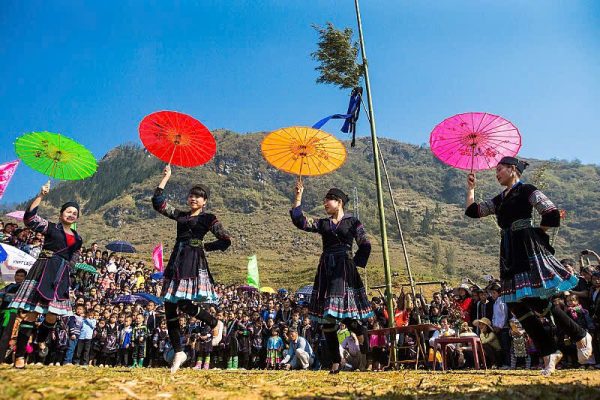
Ha Giang is home to over 20 ethnic groups. The communities you’ll encounter most are:
H’Mong — the dominant group on the plateau, particularly in Dong Van, Meo Vac, and along the border areas. Black H’Mong wear dark indigo clothing; Flower H’Mong are known for their bright embroidery. Corn is their staple crop; rice wine and homemade alcohol are central to hospitality.
Lo Lo — a small but culturally distinct group concentrated around Lung Cu and Lo Lo Chai village. One of the most intact traditional cultures in the province.
Tay — valley-dwelling farmers found throughout the lower elevations, particularly around Du Gia and Yen Minh. Most homestay operators in Du Gia are Tay families. Their architecture (stilt houses over water or raised ground) and cuisine (river fish, sticky rice, bamboo-shoot dishes) are distinct from the H’Mong highland culture.
Lo Lo, Nung, and Dao communities appear throughout the route, each with distinct dress, craft traditions, and village architecture.
Practical etiquette:
Learn more: Cao Bang Loop Tours Vietnam best kept secret
If you’ve done the Ha Giang Loop and want more — or if you have 5 days and want to make a complete northern circuit — Cao Bang Province is the natural next step.
The route continues east from Meo Vac through Bao Lac, crosses into Cao Bang via remote mountain passes including Khau Coc Cha, visits the historical site at Pac Po (where Ho Chi Minh returned to Vietnam in 1941), and ends at Ban Gioc Waterfall — one of the largest waterfalls in Southeast Asia, straddling the Vietnam-China border.
The tour ends in Cao Bang City rather than Ha Giang, with overnight bus connections to Hanoi. You make a complete circuit through the northeast of Vietnam without backtracking.

Learn more: Tu San Canyon & Nho Que River Boat Trip
Yes, with the right format. Easy Rider tours are appropriate for complete beginners — your guide manages everything about the road. Self-drive requires motorbike experience and proper documentation. The loop itself is safe when ridden sensibly; the risks come from overconfidence, poor weather judgment, and inadequate licensing.
Only if you’re self-driving. Easy Rider and jeep tours don’t require a license from passengers. For self-drive, you need your home-country motorbike license plus an IDP 1968 (not 1949, which is not valid in Vietnam). Check the latest requirements before your trip.
An Easy Rider tour means you ride pillion on a motorbike with your guide as the driver. You’re a passenger — your guide navigates, manages the road, and handles all logistics. You get the full motorbike experience without riding yourself. Loop Trails Easy Rider tours include a dedicated guide per person and cover all meals, accommodation, and activities.
Easy Rider tours start at 3,490,000 VND/person for 2 days and go up to 5,490,000 VND/person for 4 days. Self-drive is slightly less. Jeep tours are priced by group size: a 4D3N jeep for 2 people is 22,990,000 VND total. All prices include accommodation, meals, guide, vehicle, and activities. Bus tickets to/from Ha Giang are separate.
Overnight sleeper buses depart nightly and arrive in Ha Giang around 5–6am. Loop Trails can arrange bus tickets when you book your tour. Options include VIP sleeper, cabin sleeper, limousine bus, and private car. Buses also run from Sapa, Ha Long, Cat Ba, and Ninh Binh.
March–May (spring, buckwheat flowers, fresh greenery) and September–November (autumn, golden rice terraces) are the two best windows. October is particularly good for photography. Winter (December–February) is cold and quiet with far fewer tourists. Rainy season (June–August) is challenging for self-drive riders but manageable on guided tours.
The 3-day loop covers the core highlights in a faster pace — it includes Ma Pi Leng, Dong Van, Du Gia, but has less time at each stop. The 4-day loop adds a night in Yen Minh (with Lung Khuy Cave), the Lung Cu detour, Lo Lo Chai village, the Nho Que River boat tour, and a relaxed morning at Du Gia Waterfall. For most travelers, the 4-day is the right choice.
Yes. Easy Rider tours work perfectly for solo travelers — you’re paired with a guide and often join a small group convoy. Self-drive tours also accommodate solos (guide leads the group). The jeep tour for 1 person is available but more expensive per head than the motorbike formats.
Accommodation (dorm beds), all meals listed per day (breakfast, lunch, dinner), guide or driver, all in-tour transport, entrance fees to caves and historical sites, activities (boat tour, cave treks, waterfall swim), and evening cultural activities at homestays. Not included: bus tickets to/from Ha Giang, private room upgrades, personal drinks, and travel insurance.
Yes — on a jeep tour. The jeep format gives families a covered vehicle, flexible stops, and none of the road exposure of motorbike formats. Kids generally love the homestay evenings (games, music, the novelty of sleeping somewhere genuinely different). → Ha Giang Loop jeep tour details
Yes. The 5D4N Ha Giang + Cao Bang tour continues east from Meo Vac through Bao Lac into Cao Bang Province, covering Khau Coc Cha Pass, Pac Po, Ban Gioc Waterfall, and Nguom Ngao Cave before ending in Cao Bang City. → Full Ha Giang to Cao Bang guide
Cash in VND (ATMs are unreliable outside main towns), layers for cold mountain nights, a proper rain jacket, sunscreen, a power bank, and motion sickness tablets if you’re prone to them. Self-drivers add: passport, home license, and IDP 1968. Travel insurance is non-negotiable.
Contact information for Loop Trails
Website: Loop Trails Official Website
Email: looptrailshostel@gmail.com
Hotline & WhatSapp:
+84862379288
+84938988593
Social Media:
Facebook: Loop Trails Tours Ha Giang
Instagram: Loop Trails Tours Ha Giang
TikTok: Loop Trails
Office Address: 48 Nguyen Du, Ha Giang 1, Tuyen Quang
Address: 48 Nguyen Du, Ha Giang 1, Tuyen Quang
Facebook X Reddit Table of Contents Learn more: Ha Giang Loop Tours There’s a moment, usually somewhere on Ma Pi Leng Pass,

Facebook X Reddit Table of Contents Learn more: Ha Giang Loop Tours There’s a version of the Ha Giang Loop that people
Facebook X Reddit Table of Contents Learn more: Ha Giang Loop Tours There’s a moment on the Ma Pi Leng Pass —