

Thúy Kiều (Grace) is a travel blogger and content contributor for Loop Trails Tours Ha Giang. She holds a bachelor’s degree in Sustainable Tourism from Vietnam National University, Hanoi, and has a strong passion for exploring and promoting responsible travel experiences in Vietnam’s northern highlands.
Learn more: Ha Giang Loop Tours
The Ha Giang Loop is a lot of things. It’s mountain passes, ethnic minority villages, terraced corn fields stacked against limestone cliffs, and that one viewpoint at Ma Pi Leng that flattens you the first time you see it. What it isn’t, if we’re being honest, is a waterfall route in the way northern Laos or central Vietnam are waterfall routes.
But there are waterfalls. Real ones. And on a hot, sweaty Loop ride in July, finding the right pool to fall into matters more than almost anything else on the itinerary.
This guide covers the swimming spots and waterfalls that actually exist along (or just off) the standard Ha Giang Loop, when the water is worth getting into, and how to fit them into a 3 days 2 nights or 4 days 3 nights ride without compromising the big-ticket views. It also covers the spots that look incredible on Instagram but where you should probably keep your clothes on.
Learn more: Ha Giang Loop 2 Days 1 Night
The geography matters here. The Ha Giang Loop runs through the Dong Van Karst Plateau Geopark, which is dramatic limestone country: deep canyons, sharp ridges, narrow rivers cut into stone. That landscape produces a specific kind of waterfall. They tend to be:
If you’ve ridden the loops in Pu Luong or Mai Chau, those have wider, more cascading waterfalls. Ha Giang’s are punchier and shorter. The big exception is Du Gia, which is in a different geological pocket south of the main karst zone, and it punches well above its size.
What this means for your trip: pick one or two waterfalls to actually swim at, don’t try to chase every single one, and build them into rest stops between the bigger riding days.
Learn more: Ha Giang Loop 3 Days 2 Nights
Whether a waterfall is worth visiting depends on two things: water volume and water temperature. The Loop’s seasons matter, so here’s the realistic breakdown.
Water levels are coming back up after the dry winter. The pools fill, the smaller cascades start running properly, and air temperatures climb into the high 20s and low 30s Celsius by late May. The water still has a bite when you first get in, but it’s swimmable on a hot afternoon. This is one of the best windows: green rice terraces, manageable rain, and waterfalls that are actually flowing
Hot, humid, and wet. This is the period where jumping into a cold pool feels like religion. Flow is at its strongest, which also means stronger currents below the falls and murkier water after heavy rain. The trade-off is the rainy season. Storms roll through, sometimes hard enough to flood low river crossings or make trails to the falls slippery. Plan your swim stops for late morning or early afternoon, before the typical afternoon rain band rolls in.
A note on safety: never swim in any pool, river, or stream during or just after heavy rain. Flash flows in karst country move fast and they don’t forgive.
The rice harvest happens in mid to late September, and from October onward the air gets clear and crisp. The catch is that by November, daytime highs in the mountains can drop into the low teens Celsius, and by December and January, it can hit single digits. Water temperatures drop with the air. Most travelers in this window don’t swim at all, they just visit the falls to look at them. By February, the smaller cascades slow to a trickle.
So if swimming is a real priority for your trip, ride the Loop sometime between May and early October. Outside of that, treat waterfalls as scenic stops rather than swim stops.

Learn more: Ha Giang Loop 4 Days 3 Nights
If you only have time for one swim on the Loop, this is it. Locals call it Tham Nam, foreigners just call it Du Gia Waterfall, and it’s the reason a lot of 3 days 2 nights tours have been extended to 4 days 3 nights over the last few years.
Du Gia village is southeast of Meo Vac, off the main loop. To reach it you peel away from the classic route after Meo Vac and ride south through Mau Due and Lung Tam, dropping out of the high karst zone into a softer, greener valley. The road has been steadily improved, and most of it is now decent paved riding with a few rough sections through villages.
The waterfall itself is a short ride from Du Gia village, then a five to ten minute walk down a marked path. You park bikes or the jeep at the trailhead and follow the sound of the water.
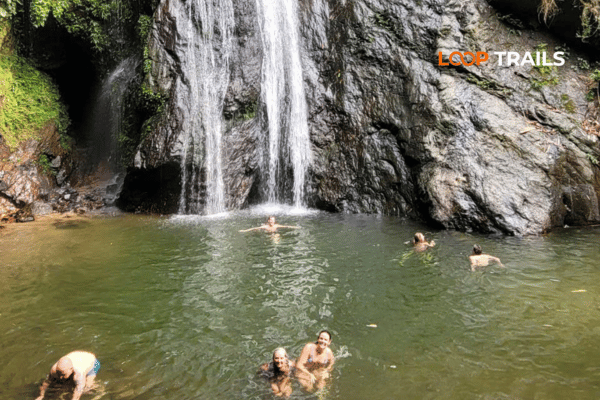
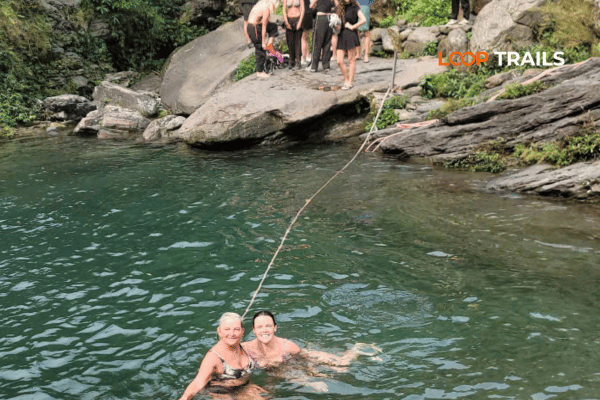
The fall is maybe 15 to 20 meters high, dropping straight down a limestone face into a deep, milky teal pool. The pool is wide enough to swim laps in, and there’s a shallow shelf to one side where you can stand and watch the spray drift across the surface. The whole thing is enclosed by jungle, so even on a hot day the air feels cool down there.
The water is cold. Properly cold, the kind that makes your chest tighten for the first thirty seconds. Then it’s perfect.
From the parking area at the top, there’s a stepped trail of stone and concrete, sometimes with a basic railing. It’s safe enough, but the stones get slick when wet and there’s no real maintenance on a fixed schedule. Wear shoes with grip. Flip flops are a bad idea on the way down. You can swap into them at the bottom for the rocks around the pool.
If you’re not confident on uneven steps, take your time and use the railing where it exists. We’ve had guests in their late sixties make it down fine. You just go slowly.
If you want a tour that builds Du Gia properly into the route rather than rushing past, our 4 days 3 nights Ha Giang Loop tour is structured around exactly this kind of slow morning by the pool.
Learn more: Ha Giang Cao Bang 5 Days 4 Nights
Tien Waterfall, sometimes called Fairy Waterfall or Thac Tien, sits in the Quan Ba district near Heaven’s Gate, the very first major viewpoint on the standard Loop ride out of Ha Giang city.
This is a multi-tier cascade rather than a single drop. It’s set into a forested hillside, with the upper tiers visible from a viewing platform and a marked trail down through bamboo. The total height of the system is larger than Du Gia, but the individual tiers are smaller, so it doesn’t have the same drama as one big plunge.
There’s a small entry fee at the gate, and the trail is built up with stone steps. Locals do swim in the lower pools, but the pools are smaller and shallower than Du Gia, and they’re not really designed for serious swimming. Think of this as a stretch-your-legs stop on Day 1, a place to wander for forty-five minutes and cool your feet, rather than a destination swim.
A real advantage of Tien Waterfall: it’s easy to add to Day 1 of any Loop itinerary without changing your overnight plan. You hit Heaven’s Gate, ride a few minutes further, do the falls, and continue to Yen Minh or Dong Van the same afternoon. It’s a great early energy break before the big riding days kick in.
Learn more: Ha Giang Cao Bang Ba Be Lake 6 Days 5 Nights
If you’re already overnighting in Du Gia, ask your homestay host about the smaller pools further upstream from the main waterfall. There’s a series of natural rock pools along the same river system, less famous, sometimes completely empty of other travelers, fed by the same cold spring water.
These don’t have names that you’ll find on Google Maps. You walk along the river from the village or take a short ride on the bike, and the host will point you to a pull-off. The pools vary in depth. Some are calf-deep, others let you fully submerge.
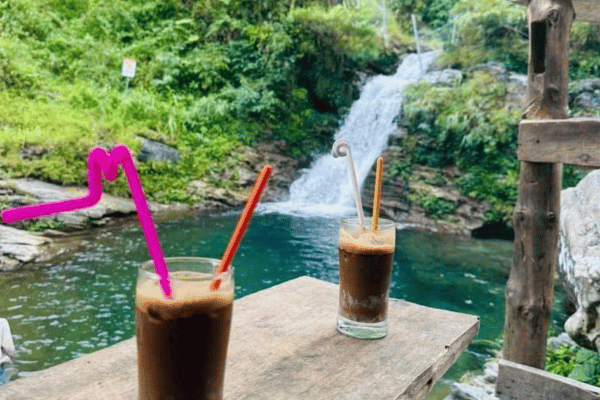
This is the kind of thing that makes Du Gia worth the detour. The main fall is the headliner, but the quieter pools around the village are where you actually end up spending time on a slow afternoon. Bring a book. Eat lunch at the homestay first, then float for an hour.
Learn more: Tu San Canyon & Nho Que River Boat Trip
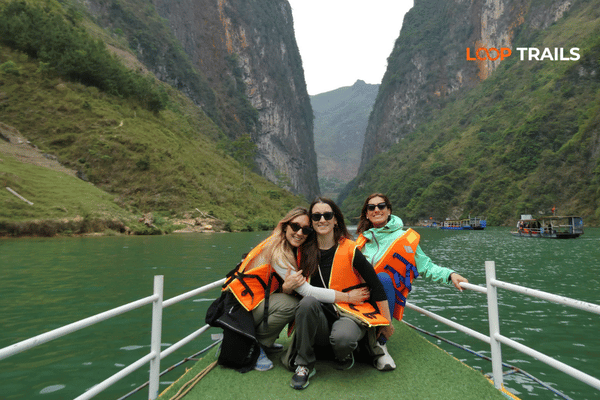
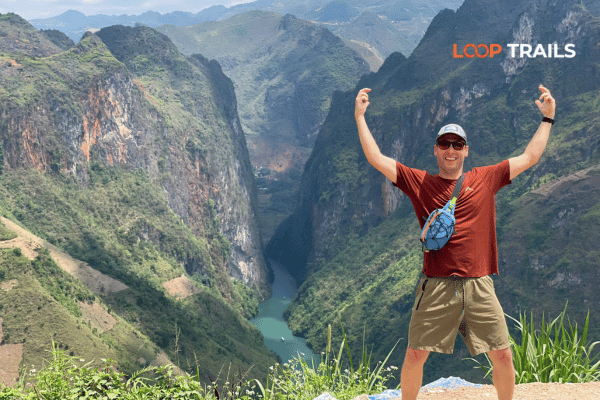
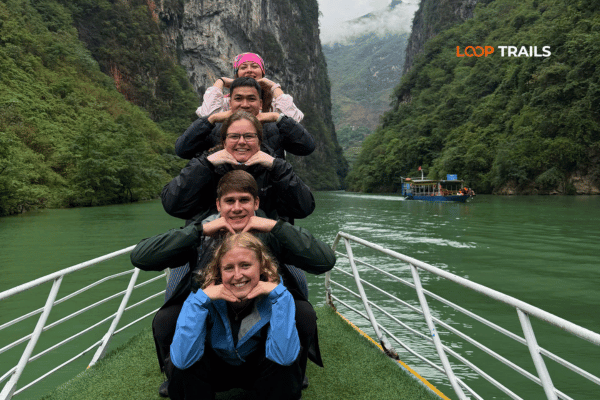
Almost every Loop guide online includes Nho Que River and the Tu San Canyon boat trip. It’s a stunner. From the Ma Pi Leng viewpoint you see the jade-green river ribboning through the deepest canyon in Southeast Asia, and there’s now a developed boat operation that takes visitors down to river level for a roughly 30 minute ride into the gorge.
But here’s the thing: people don’t really swim in the Nho Que. The current is steady, the river is deeper than it looks, and the only access points are designed for boat boarding rather than swimming. You’ll see the occasional traveler dipping their feet at the dock, and that’s about it.
What the boat trip does give you is the closest thing to being in the water without actually being in it. The temperature on the river is a good ten degrees cooler than at the top of the pass. The spray, the shade from the canyon walls, the slow drift through the narrowest section of the gorge: it scratches the same itch.
Two practical notes:
A Ma Pi Leng plus Nho Que boat combo is a classic Day 2 highlight on a standard 3 days 2 nights ride.
Learn more: Du Gia Waterfall
These are the ones travelers ask about after they’ve done the Loop once and want a reason to come back.
Past Dong Van town, before you cross into Meo Vac district, there are several small valleys with seasonal cascades and pools tucked along secondary roads. Xa Phin is one of the villages with the most water in the rainy season. None of these spots are tourist developed. There are no signs, no entry fees, no railings.
You need a local to find them, which makes them a perfect fit for an easy rider tour where your guide actually grew up around here. The pools are small and the falls are modest, but if you’ve already seen the big sights and want something quieter, this is where you go.
On the road sections between Yen Minh and Dong Van, and again between Meo Vac and Du Gia, you’ll cross small bridges over streams that flow year-round. Locals sometimes wash motorbikes or rinse off in these. You won’t swim in them properly, but on a brutal July afternoon, a five-minute splash of cold water on the face and arms is a real reset.
Don’t drink any of this water. It looks clean. It isn’t.
If you want a guide who knows where to stop for these little micro-breaks rather than just hammering through the route, an easy rider tour is the right call. Self drivers often miss them entirely because they’re focused on the road.
Learn more: Cao Bang Loop 3 Days best kept secret
The Loop’s standard itineraries have a specific rhythm, and waterfalls fit into them differently depending on how many days you have
A 3 days 2 nights Loop doesn’t really give you a proper swim. You’re moving too fast. If swimming is important, choose 4 days.
This is the version that turns the Loop from a sightseeing sprint into something more like a real trip. Same big views, plus a real afternoon in the water and a quieter night away from the standard tourist stops. If swimming matters to you at all, choose this routing.

Learn more: Ha Giang Packing list
The Loop is well traveled now, but the waterfalls are still mostly informal. There’s no lifeguard at Du Gia, the trails aren’t maintained on a fixed schedule, and rules can change in any given season.
A short checklist that handles most of what you need:
A few etiquette points that don’t get said often enough:
Stick to the rules and the etiquette and you’ll have a much better time.

Learn more: Ha Giang Motorbike Rental
The Loop offers three main ways to do the ride: easy rider (you’re on the back of a guide’s bike), self drive (you ride yourself), or jeep. Waterfall stops play differently with each one.
The best mode for waterfalls, in our honest opinion. You’re not managing the bike, so you can drink in the surroundings, you don’t have to worry about parking, and your guide knows exactly which roadside stream is worth pulling over for and which one looks better than it is. When you arrive at Du Gia, you walk down empty-handed, swim, walk back up, and your guide handles the rest. If swimming and chill stops are a big part of why you’re doing this trip, this is the right call. Our easy rider Ha Giang Loop tour is built around exactly this pacing.
You get total freedom on stops, which is great if you’re an experienced rider and you want to choose your own pace. The downside is logistical: you’re managing the bike, your luggage, navigation, and your own safety on roads you’ve never ridden. After a long morning of riding, the temptation is to push through to the next overnight rather than detour for a swim. Self drivers also tend to miss the smaller, off-the-route waterfalls because they’re not in the local knowledge that comes with a guide. If you’re going self drive, we’d suggest renting a good bike from a reliable shop and planning your swim stops the night before so you don’t skip them. We rent motorbikes in Ha Giang with bikes maintained for long mountain riding rather than city use.
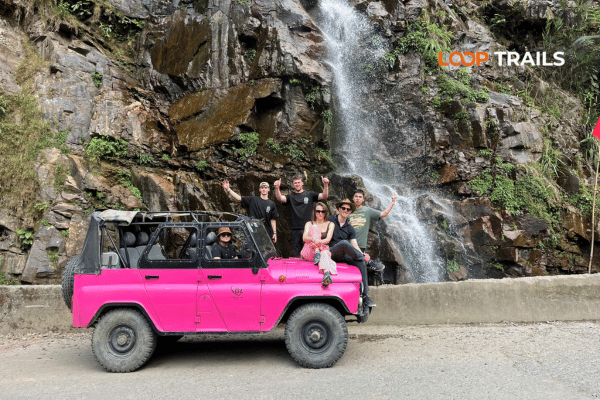
The jeep is the most comfortable way to do the Loop, and it’s hands-down the best mode for older travelers, couples, families, or anyone who doesn’t ride. For waterfalls specifically, the jeep gives you a big advantage: you can change in and out of swim gear in the vehicle, you have somewhere dry to put your stuff, and arriving at Du Gia in a 4WD makes the rough access road a non-issue. If a swim is the highlight of your day, the jeep delivers it with the least friction. Sister brand HaGiangByJeep runs dedicated jeep Loop tours if that fits your trip better.
Learn more: Ha Giang Loop Mistake to Avoid
A few patterns we see year after year. Avoid these and you’ll have a much better day.
Going to Du Gia in the middle of the dry season and expecting a roaring waterfall. From mid-November through March, flow at Du Gia drops noticeably. The pool is still beautiful, but if you came specifically to see a powerful curtain of water, you’ll be a little disappointed. Manage expectations or visit in the wet half of the year.
Trying to swim in the Nho Que River. People still try. The current is real, the river is deeper than it looks, and the boat operators don’t love it. Take the boat, enjoy the canyon, leave the swimming for Du Gia.
Skipping the descent because the stairs look slippery. The stairs at Du Gia look worse than they are. They’re stone, sometimes wet, and if you take your time with proper shoes you’ll be fine. People who turn back at the top almost always regret it once they hear the others coming back up with stories.
Bringing valuables down to the pool with no one watching them. It’s mostly a friendly scene, but unattended phones and wallets at a popular swim spot are a recipe for losing them. If you’re with a guide, leave bags with them. If you’re solo, take a small dry bag in with you.
Booking a 3 days 2 nights Loop and then asking on Day 2 if there’s “time for a swim.” There isn’t, really. The 3 days 2 nights itinerary is a tight sightseeing route, not a relaxation trip. If a swim matters to you, book the 4 days 3 nights upfront.

Learn more: Ha Giang Loop Easy Rider
To pull all of this together, here’s the quick decision tree.
We’re happy to help you figure out what fits. Drop us a message on WhatsApp and we’ll talk through your dates, your group, and how much swimming you’re actually willing to do.
Yes. Du Gia Waterfall is the main one, with a deep swimmable pool below a 15 to 20 meter drop. Tien Waterfall near Quan Ba is smaller and more of a stretch-your-legs stop. Several smaller streams and pools exist around Du Gia village.
Yes, this is the most popular swimming spot on the entire Loop. The pool is deep, the water is cold, and there’s a short trail down from the parking area.
Not really. The river runs through a steep canyon with steady current and limited access points. The standard experience is a boat trip into Tu San Canyon, not a swim.
For most travelers, yes, especially in summer. The detour adds a day to the Loop and gives you the only proper swim of the trip. It’s why most of our extended itineraries go via Du Gia.
May to early October has the best combination of water flow and warm temperatures. From November through March, water levels drop and air temperatures get too cold for swimming for most travelers.
Du Gia Waterfall has typically been free or very low cost to access, with small fees sometimes collected at the trailhead. Tien Waterfall has had an entry fee. Fees and rules can change, so check the latest updates close to your trip date.
Generally yes, but there are no lifeguards. The pool is deep, the rocks around it are slippery, and you should never swim during or just after heavy rain due to flash flow risk. Use common sense.
Not strictly, but shoes with grip are essential for the trail down. Many travelers wear hiking sandals or sport shoes for the descent and switch to flip flops on the rocks around the pool.
Not really. The standard 3 days 2 nights Loop doesn’t go through Du Gia. To include it properly, choose a 4 days 3 nights itinerary.
Ban Gioc is in Cao Bang province, not Ha Giang. It’s a completely different scale, one of the largest waterfalls in Southeast Asia. If a major waterfall is the priority of your trip, look at a Ha Giang and Cao Bang combo tour rather than just the Ha Giang Loop on its own.
A minimum of an hour for the swim itself. Two to three hours if you’re combining the main fall with a lazy afternoon at the smaller pools upstream. Overnighting in Du Gia village stretches that into a full evening at the homestay.
The descent to Du Gia is doable for most people who can manage uneven stone stairs at their own pace. Tien Waterfall is similar. Neither is wheelchair friendly. If mobility is a concern, the jeep tour brings you to the trailhead in comfort, and our guides help guests at their own pace.
Contact information for Loop Trails
Website: Loop Trails Official Website
Email: looptrailshostel@gmail.com
Hotline & WhatSapp:
+84862379288
+84938988593
Social Media:
Facebook: Loop Trails Tours Ha Giang
Instagram: Loop Trails Tours Ha Giang
TikTok: Loop Trails
Office Address: 48 Nguyen Du, Ha Giang 1, Tuyen Quang
Address: 48 Nguyen Du, Ha Giang 1, Tuyen Quang
Facebook X Reddit Table of Contents Learn more: Ha Giang Loop Tours Most people drive past the Quan Ba area twice on

Facebook X Reddit Table of Contents Learn more: Ha Giang Loop Tours The Ha Giang Loop has a reputation problem with older