

Thúy Kiều( Grace) is a travel blogger and content contributor for Loop Trails Tours Ha Giang. She holds a bachelor’s degree in Sustainable Tourism from Vietnam National University, Hanoi, and has a strong passion for exploring and promoting responsible travel experiences in Vietnam’s northern highlands.
Learn more: Ha Giang Loop Tours
Ask anyone who’s ridden the Ha Giang Loop and they’ll tell you the same thing: it doesn’t feel like Vietnam anymore. It feels like the edge of a map — the part where the illustrator ran out of space and just drew mountains until the page ended.
Ha Giang Province sits in the far north, pressed against the Chinese border, and it holds the kind of landscape that takes a few minutes to process the first time you see it. Limestone peaks that rise in rows like teeth. Terraced fields stacked up cliff faces at angles that shouldn’t support agriculture. River canyons so deep the water at the bottom looks turquoise-black from the road. And roads — carved through it all by volunteers with hand drills in the 1950s — that rank among the most spectacular in Southeast Asia.
The best way to experience it is on a motorbike. Not because other formats are bad (the jeep tour is genuinely excellent), but because the Ha Giang Loop is a road first, and a road is felt properly from the seat of a bike. The wind, the altitude, the corners, the sudden drop into a viewpoint that opens up without warning — none of that translates through glass.
This guide covers everything you need to plan a Ha Giang motorbike tour: the two formats (Easy Rider and self-drive), the 2025 prices, the route in detail, licensing requirements, what to pack, and how to figure out which option is right for you.
Learn more: Ha Giang Motorbike Rental
Vietnam has no shortage of motorcycle routes. The Ho Chi Minh Highway runs the length of the country. The Hai Van Pass is famous enough to have a Top Gear episode. But the Ha Giang Loop is in a different category, for a few reasons.
The scale is different. The Dong Van Karst Plateau is a UNESCO Global Geopark — one of four in Vietnam. The limestone formations are 400–600 million years old, and the landscape shows it. You don’t ride through Ha Giang so much as ride across it, with the sense that the geology is older and more permanent than anything you’ve encountered before.
The isolation is different. Mobile signal disappears for long stretches. Vehicles thinning out past Yen Minh. Between Meo Vac and Du Gia, you’ll ride stretches of road where your group is genuinely alone with the mountains. That kind of quiet is rare in modern Vietnam.
The culture is different. Ha Giang is home to over 20 ethnic minority groups. In Dong Van and Meo Vac, Black H’Mong and Flower H’Mong communities live within sight of the Chinese border, farming corn on slopes that seem to defy gravity. Near Lung Cu, the Lo Lo people maintain one of the most intact traditional village cultures in the north. At every homestay on the loop, the evening belongs to traditional music, rice wine, and the kind of hospitality that travelers don’t easily forget.
The road itself. Ma Pi Leng Pass. Twenty kilometers of road blasted through sheer limestone cliff above the Nho Que River — one of Vietnam’s four legendary great passes, arguably the most dramatic. You ride it on a motorbike and you understand immediately why people build bucket lists around it.

Learn more: Ha Giang Loop Easy Rider
All Ha Giang motorbike tours at Loop Trails run in one of two formats. The choice between them is the most important decision you’ll make about this trip.
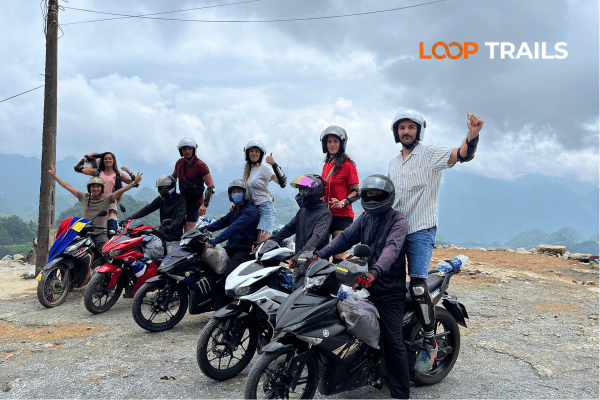
An Easy Rider tour means you ride pillion — you sit on the back of the motorbike and your guide is the driver. You’re a passenger, which means your hands are free (hold on, take photos, point at things), your eyes are up (not on the road), and your brain is focused on the landscape rather than the corners.
Your guide handles everything about the ride: navigation, pace, road awareness, overtaking, mountain weather judgment. They also handle the non-riding logistics — translating at homestays, explaining village customs, choosing when to stop at a viewpoint that isn’t on any official itinerary, negotiating with the occasional traffic police checkpoint.
The Easy Rider format is the most social version of the loop. Each traveler has their own guide and motorbike; groups travel as a convoy. The guide-traveler relationship is central to the experience — over four days in the mountains, you inevitably learn each other’s stories. Many travelers describe their Easy Rider guide as the most memorable person they met in Vietnam.
Easy Rider is ideal for:
Learn more: Ha Giang Loop Self-Drive
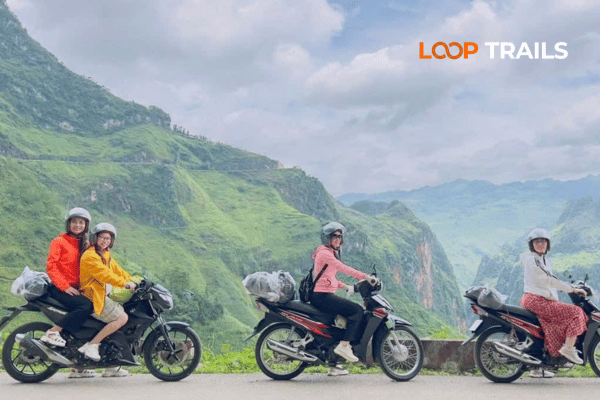
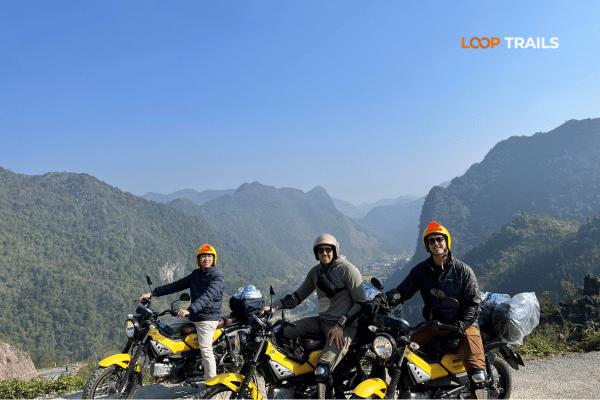
Self-drive means you’re riding your own motorbike. A guide from Loop Trails leads the group (or rides sweep), but you control your own machine — your own pace through the straights, your own confidence through the switchbacks, your own decision-making in the corners.
This is the version for people who came to ride. There’s something categorically different about taking Ma Pi Leng Pass on your own bike versus pillion — the physical engagement, the concentration required, the satisfaction of executing a corner well on a road that demanded you earn it.
Self-drive also gives you more autonomy within the group. Stop when you want, ride at your own pace between checkpoints, photograph what you notice rather than what you’re told to notice.
The trade-off is responsibility. The Ha Giang Loop is not a beginner road. The passes are long and technical by mountain road standards. Trucks and buses exist and don’t always slow down. Rain turns limestone road surfaces slippery with little warning. Self-drive rewards experience; it punishes overconfidence.
Self-drive is ideal for:
Not sure which format fits? → See the full comparison of all Ha Giang Loop tour options or → message us on WhatsApp with your riding experience and we’ll give you a straight answer.
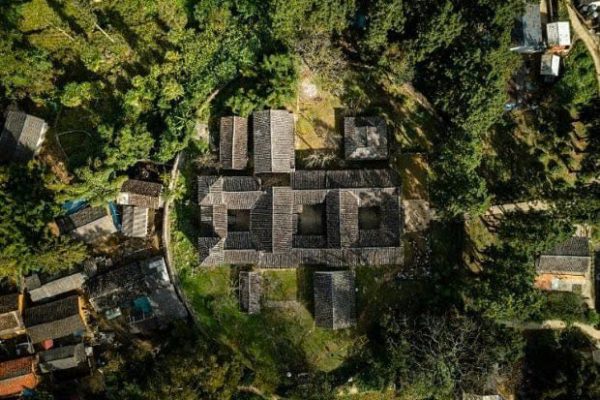
All prices are in Vietnamese Dong (VND) and are per person. Tours include accommodation, meals, guide, and all activities as described.
| Duration | Easy Rider (VND/pax) | Self-Drive (VND/pax) |
|---|---|---|
| 2 Days 1 Night | 3,490,000 | — (no self-drive option) |
| 3 Days 2 Nights | 4,390,000 | 3,590,000 |
| 4 Days 3 Nights | 5,490,000 | 4,690,000 |
| 5 Days 4 Nights (+ Cao Bang) | 10,990,000 | 10,590,000 |
Note on the 2-day tour: Self-drive is not offered on the 2D1N format. The shorter duration covers a lot of ground and the guide-driven Easy Rider format is the safer and more practical choice for that schedule.
What these prices include:
What these prices don’t include:
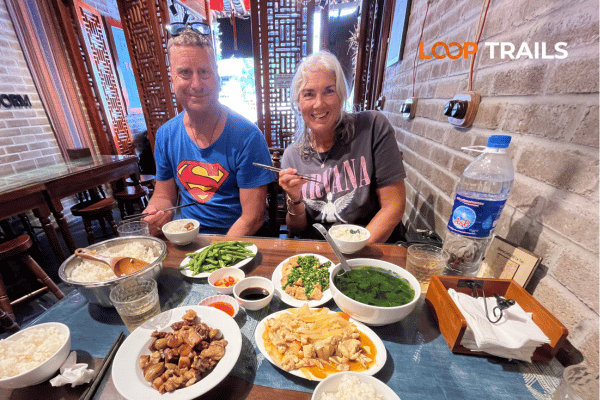
Worth spelling out clearly, because this varies across different operators.
Every Loop Trails motorbike tour includes:
Not included — and worth budgeting for:
Learn more: Du Gia Waterfall
Four options exist. Here’s the honest breakdown.
Learn more: Ha Giang Loop 2 Days 1 Night
Ha Giang → Heaven Gate → Quan Ba → Yen Minh → Dong Van (Day 1). Dong Van → Ma Pi Leng → Meo Vac → back to Ha Giang (Day 2). You hit the headline stops: Heaven Gate, the karst plateau, Ma Pi Leng Pass. You miss most of the depth — no Lung Cu, no boat tour, no homestay in Du Gia, no waterfall.
Best for: tight itineraries where this is the only Ha Giang window. Better to do 2 days than not go at all. But if you can give yourself more time, you should.
Covers the core loop with one more day to breathe. You get Ma Pi Leng, Dong Van, the boat tour on Nho Que River, and a night in Du Gia. Slightly rushed compared to the 4-day pace, but solid.
Best for: travelers with a real but limited window — 3 days gets you the major moments.

Learn more: Ha Giang Loop 4 Days 3 Nights
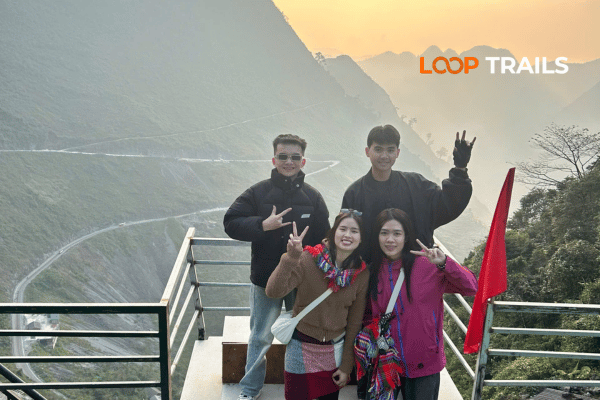
The most popular format. You get everything: Lung Khuy Cave (Quan Ba), Lung Cu Flag Tower, Lo Lo Chai village, the Nho Que River boat tour, Ma Pi Leng Skywalk, Du Gia Waterfall with a morning to actually swim, Duong Thuong valley, and Lung Tam linen village. The pace is human, not checkpoint-driven. This is the format that gives Ha Giang room to work on you.
Best for: most travelers. First-timers, couples, small groups — the 4D3N easy rider or self-drive is the version that earns the stories people tell afterward.
Learn more: Ha Giang Cao Bang 5 Days
You do the Ha Giang Loop and keep going east into Cao Bang Province. The tour ends in Cao Bang City (not Ha Giang), covering Ban Gioc Waterfall, Nguom Ngao Cave, Pac Po historical site, and several mountain passes that most loop itineraries don’t touch. → Full Ha Giang + Cao Bang guide here
Best for: serious adventurers with the time. Cao Bang is genuinely different from Ha Giang, and the combination makes one of the best multi-day routes in northern Vietnam.
Learn more: Quan Ba Heaven Gate
The loop runs counterclockwise in the standard format. Here’s what each section actually looks and feels like.
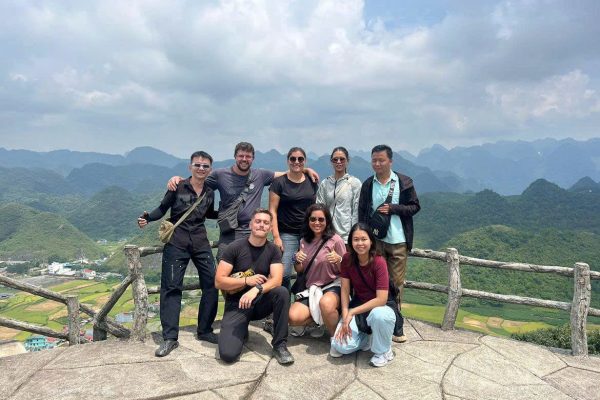
The first hour out of Ha Giang City is the appetizer. The road climbs, buildings thin out, the air cools. Bac Sum Pass is the first real elevation — nothing dramatic yet, but you feel the altitude shift. Then Heaven Gate (Cong Troi): a saddle in the ridge where the road passes through and the Dong Van Plateau opens ahead of you.
The name isn’t hyperbole. From Heaven Gate, you can see the Twin Mountains of Quan Ba (Nui Doi) below — two rounded karst mounds that rise from the valley floor with a geometric symmetry that looks designed rather than geological. The descent from Heaven Gate into Quan Ba is the first moment most riders feel the Ha Giang Loop is something different.
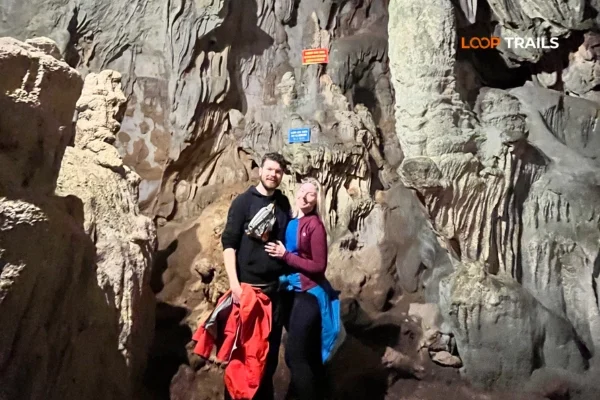
Quan Ba Town is a small, relaxed stop. Coffee, a stretch, the first landscape photos. On the 4D3N tour, Lung Khuy Cave is here — a 45-minute trek leads to the most impressive cave system in the Quan Ba area. Worth every step.
This section rolls through increasingly open karst country. The villages along the road are mostly Flower H’Mong — you’ll recognize the women by the bright embroidered panels on their jackets and skirts, worn even on ordinary weekdays while carrying fuel or selling produce at the roadside.
Yen Minh is the overnight stop on 2-day tours, a functional provincial town with a weekend market and the kind of pho that requires no decision-making because there’s only one kind. On longer tours it’s a lunch stop. The road beyond Yen Minh is where Ha Giang starts getting serious.
Learn more: Lung Cu Flag Tower Guide
The heart of the Dong Van Karst Plateau. The limestone formations are denser here, the peaks sharper, the valleys between them narrow and deep.
Tham Ma Pass offers the first panorama over multiple valley layers — the kind of view where your brain keeps refusing to accept the scale of what it’s seeing.
Lao Sa village sits right on the Chinese border. H’Mong families here built stone-and-earth houses in the Chinese-influenced style common to border communities, and life here has a frontier quietness to it. Few tour groups stop long enough to walk the village.
Vuong Palace (Dinh Vuong): built in 1919 for the H’Mong opium king by a Chinese architect brought up from Yunnan. The building sits architecturally between traditional H’Mong structures and southern Chinese courtyard houses — a unique hybrid that exists nowhere else in Vietnam. The story of the Vuong family is one of the most interesting in northern Vietnam’s history: power, opium, colonial negotiation, eventual integration into the new communist state. Your guide will tell it better than any plaque can.
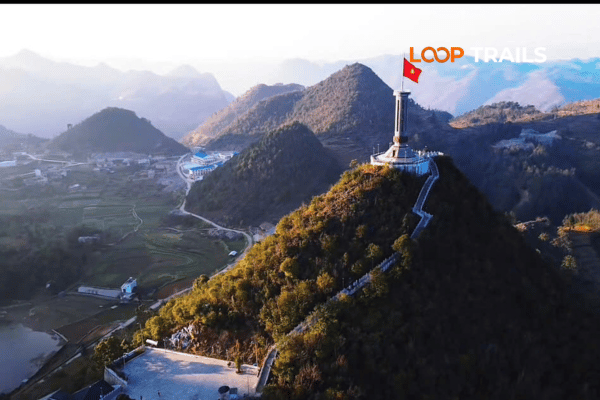
Lung Cu Flag Tower is a 25-kilometer detour north from Dong Van to the northernmost tip of Vietnam. The tower stands at 1,700 meters; the flag is enormous; the road there passes through Lo Lo Chai village, one of the most intact traditional settlements in Ha Giang. Lo Lo people are a small ethnic group, and Lo Lo Chai has preserved its traditional architecture and community structure better than most villages of comparable size in the region.
Dong Van Old Quarter has preserved 19th-century merchant houses built by Chinese traders — stone-and-wood construction, inner courtyards, distinctive facades. The Sunday market draws communities from across the plateau. The town feels genuinely different from anywhere else on the loop.
This is the day the Ha Giang Loop earns its reputation.
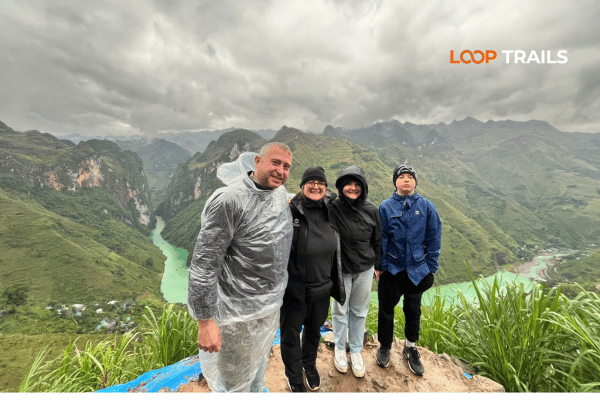
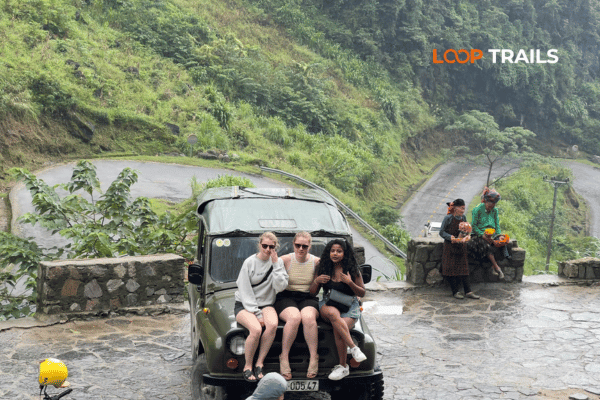
Ma Pi Leng Pass is 20 kilometers of road carved into sheer limestone cliffs above the Nho Que River. Built in the late 1950s by young volunteers over two years, using hand drills and minimal equipment to cut through solid rock. Standing on the road and looking down at the river a thousand meters below in its impossible turquoise, the scale of that effort is hard to fully comprehend.
The Ma Pi Leng Skywalk is a cantilevered viewing platform extending from the cliff face — the best unobstructed view into the canyon and across Tu San Canyon, one of the deepest river canyons in Asia. If you’re riding self-drive, take your time here. If you’re Easy Rider, your guide knows exactly where to park for the best shots.
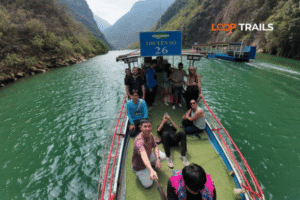
From the base of the pass, a boat tour on the Nho Que River takes you through the narrowest section of the canyon. The walls rise vertically on both sides. The water is clear and green. The canyon is quiet in a way that mountain viewpoints aren’t. This is the moment many Ha Giang travelers say they felt the loop most deeply.
Meo Vac sits at the bottom, a smaller and quieter town than Dong Van. The Meo Vac Sunday Market is the most authentic in the region — actual trade between H’Mong and Nung vendors, not a performance for visitors.

Learn more: Ha Giang Loop for Beginners
The landscape shifts after Meo Vac. Wider valleys, more agriculture, fewer dramatic peaks. The M Pass (shaped like the letter M when viewed from the right angle above) and Lung Ho viewpoint are the main stops. The road quietens as you move south.
Du Gia village is a Tay community in a peaceful river valley — a different ethnic and architectural world from the H’Mong plateau. Tay stilt houses, rice paddy fields, a village rhythm that’s been unaffected by the loop’s tourism in a way that Dong Van’s old quarter hasn’t quite managed.
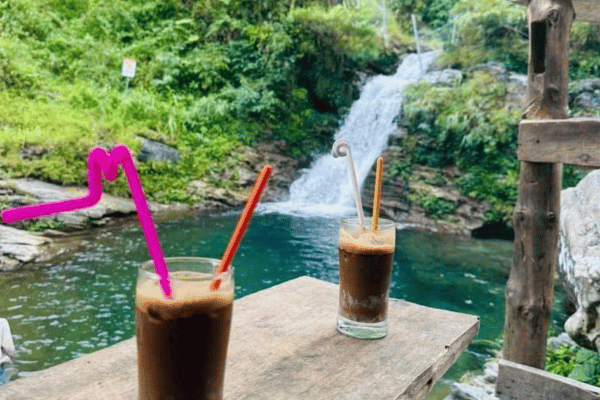
Du Gia Waterfall is a short walk from the village. Get there early — before the tour groups arrive — and you can swim in clear mountain water with no one else around. This is one of those details that sounds small and turns out to be a highlight.
The final stretch loops back through Duong Thuong valley — a wide H’Mong valley that most tour itineraries breeze through and which rewards slower attention. Then along the Mien River forest road through Thai An to Lung Tam linen village, where Tay weavers work traditional looms producing linen fabric. Buy here if you want quality craft and fair prices — this is not a tourist market.
Back in Ha Giang City by late afternoon, in time for the evening bus south if that’s your next move.
Learn more: Ha Giang Loop License
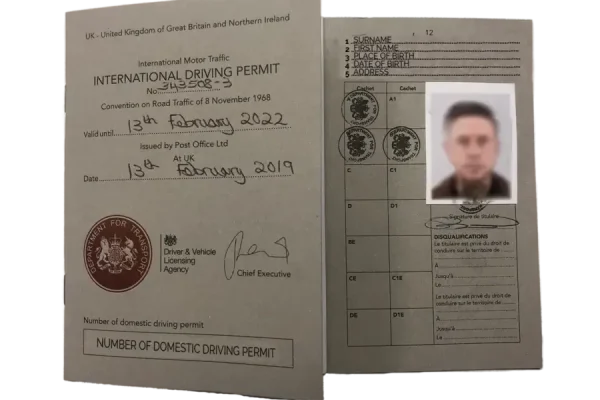
This section is important and worth reading carefully if you’re planning to self-drive.
What you need:
What doesn’t work:
Why it matters: Traffic police conduct checkpoint stops on the Ha Giang Loop. Fines for riding without correct documentation range from 2,000,000 to 6,000,000 VND. The range reflects real variance in how checkpoints are handled; having a guide with you may help with negotiation in some situations, but it doesn’t exempt you from documentation requirements.
Rules and enforcement patterns can change — always verify current requirements with Loop Trails and check your country’s IDP-issuing authority before your trip.
One practical note: the IDP 1968 takes time to process in some countries. Apply well before your trip, not the week before you fly.
Learn more: Ha Giang Cao Bang Loop Jeep tour Guide
Here’s the honest breakdown — no upselling, just a framework.
Choose Easy Rider (2D1N) if: You have a tight itinerary and want the Ha Giang experience in two days. Don’t self-drive on the short format.
Choose Easy Rider (3D2N or 4D3N) if: This is your first time. You’re a solo traveler or couple. You want to be fully present in the landscape rather than managing road logistics. You haven’t ridden mountain roads before or aren’t sure about your confidence level. You want a guide who becomes part of the experience, not just a chase vehicle.
Choose Self-Drive (3D2N or 4D3N) if: You’re an experienced rider with the right license and IDP. You’ve ridden mountain roads before and know your limits. You want control — your pace, your stops, your decisions. You find it frustrating to be a passenger when you could be riding.
Choose Easy Rider or Self-Drive + Cao Bang (5D4N) if: You have five days, want to see both provinces, and don’t want to backtrack. The Cao Bang extension adds Ban Gioc Waterfall, remote Nung and Tay cultural stops, and a circuit that ends in Cao Bang City rather than Ha Giang.
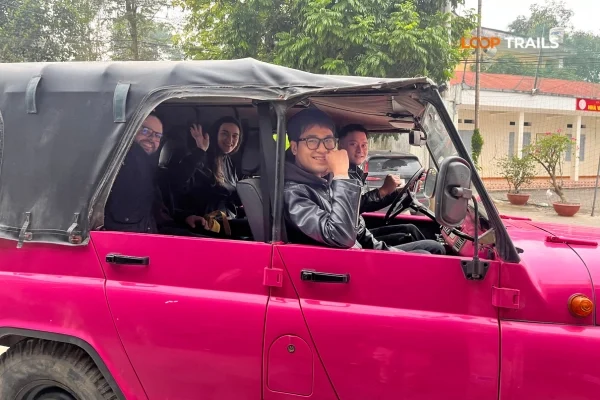
Consider a Jeep Tour instead if: You’re traveling with family (including children), have a group of 3–4 where jeep economics make sense, or have physical limitations that make pillion or self-drive impractical. The jeep covers every stop the motorbike tours do. → Ha Giang Loop Jeep Tour guide
→ View all Ha Giang Loop tour options and book your dates here

Learn more: Dong Van Old Quater at Night
A Ha Giang motorbike tour isn’t eight hours of riding and then sleep. The evenings are a real part of the experience.
Every homestay night runs roughly the same rhythm: arrive, drop bags, wash off the road, reconvene for dinner with your guide and often the homestay family. Dinner is home-cooked mountain food — corn dishes, river fish, wild vegetables, mountain pork, sticky rice. Simple and good in the way that outdoor days make food better.
After dinner, the happy water appears. This is corn rice wine — local homebrew, sometimes infused with local herbs, always offered with the intention of hospitality. Participation is never required. Declining is fine. Accepting a small glass is the polite move, and it leads naturally into the evening’s next part.
Traditional music follows — the homestay host or a local musician plays the khèn (bamboo pan pipe, central to H’Mong music culture) or other traditional instruments. Card games happen. Stories get exchanged. Guides translate and mediate and occasionally disappear to help with the cooking.
These evenings are where the H’Mong and Tay families become people rather than backdrop. Travelers who rush through Ha Giang and stay in hotels miss this entirely.
Learn more: Ha Giang Loop for Families & Groups
Ha Giang is safe for motorbike travel when approached with appropriate judgment. The risks are real but manageable.
What the roads are actually like:
The main loop roads are paved throughout. Quality varies — some sections have been recently resurfaced, others have potholes, edge crumbling from seasonal rain damage, or loose gravel at road repair sections. Mountain roads narrow in places, especially on passes. Oncoming vehicles exist on all passes; trucks and buses don’t always slow. Visibility can drop quickly in morning fog.
Where it gets genuinely demanding:
Ma Pi Leng Pass is the most technically challenging section for self-drivers — not because the road surface is bad, but because it’s narrow, exposed, and long, with oncoming traffic to manage on hairpins. A competent rider handles it without issue. A nervous or inexperienced rider finds it stressful. Knowing which category you’re in before you start is important.
Weather:
Limestone road surfaces become significantly more slippery in wet conditions. If it’s raining heavily on a pass and you’re self-driving, the correct decision is usually to stop and wait. This is not a failure of nerve — it’s basic mountain road judgment. Easy Rider guides make this call for you automatically.
Common mistakes:
Riding beyond your comfort level because you don’t want to admit you’re out of depth. Continuing in rain when you should stop. Not having travel insurance. Riding without the correct license documentation. Starting the loop without telling someone your schedule.
The bottom line:
With a good guide (Easy Rider) or solid experience and the right documentation (self-drive), the Ha Giang Loop is a genuinely manageable road trip through extraordinary scenery. The reputation for difficulty is partially earned and partially inflated. Treat it with respect, not terror.

Learn more: Ha Giang Loop Private Car from Hanoi
From Hanoi (most common): Overnight sleeper buses depart nightly and arrive in Ha Giang City in the early morning — typically around 5–6am. Loop Trails arranges bus tickets when you book your tour.
Bus options:
From other cities: Buses connect to Ha Giang from Ha Long, Cat Ba, Ninh Binh, and Sapa. If you’re building a northern Vietnam circuit, you don’t have to return to Hanoi between legs.
At the end of the tour: Standard loop tours end in Ha Giang City. The 5D4N Cao Bang extension ends in Cao Bang City — overnight buses to Hanoi depart from there as well.

Learn more: Ha Giang Packing List
Riding:
Layering:
Practical:
Self-Drive documents:
Insurance: Travel insurance that explicitly covers motorbike riding and mountain activities. Check the fine print before you buy.
Learn more: Explore just the Cao Bang Loop
The Ha Giang Loop ends back in Ha Giang City. But the road east from Meo Vac doesn’t stop at the loop boundary.
The 5D4N Ha Giang + Cao Bang tour continues through Bao Lac, across some of the most remote mountain passes in northern Vietnam, into Cao Bang Province, and ends at Ban Gioc Waterfall — one of the largest waterfalls in Southeast Asia, split across the Vietnam-China border. Along the way: Khau Coc Cha Pass (15 switchbacks, views across Xuan Truong valley), Pac Po (Ho Chi Minh’s 1941 return site), Nguom Ngao Cave, and the Nung craft villages of Phia Thap and Phuc Sen.
The tour ends in Cao Bang City with overnight bus connections to Hanoi. You complete a full northeast Vietnam circuit without backtracking.
Easy Rider: 10,990,000 VND/person. Self-Drive: 10,590,000 VND/person.
Easy Rider means your guide drives and you ride pillion — hands free, fully focused on the scenery. Self-drive means you ride your own motorbike with a guide leading the group. Easy Rider is for anyone; self-drive requires riding experience and proper licensing.
On an Easy Rider tour, yes — you’re a passenger and the riding is handled by your guide. Self-drive is not suitable for beginners. The Ha Giang Loop includes mountain passes that require genuine riding competence. If you’re unsure about your level, Easy Rider is the right call.
Only for self-drive. You need your home-country motorbike license plus an IDP type 1968 (not 1949, which is not valid in Vietnam). Easy Rider and jeep passengers don’t need any license. Fines for self-driving without correct documentation range from 2,000,000–6,000,000 VND.
Easy Rider tours run from 3,490,000 VND/person (2 days) to 5,490,000 VND/person (4 days). Self-drive is 3,590,000–4,690,000 VND/person for 3–4 days. The 5-day Cao Bang extension is 10,990,000 (Easy Rider) or 10,590,000 VND (self-drive) per person. All prices include accommodation, meals, guide, and activities.
Bus tickets from Hanoi to Ha Giang (and back), private room upgrades, personal drinks, travel insurance, and tips. Loop Trails can arrange bus tickets when you book.
Overnight sleeper bus — about 5–6 hours, departing in the evening and arriving early morning in Ha Giang. Loop Trails arranges tickets in connection with tour bookings. Options include VIP sleeper, cabin sleeper, limousine bus, and private car.
It’s a mountain road, not a highway — it should be treated accordingly. The main loop roads are paved. Self-drive requires real experience and good judgment. Easy Rider tours are managed by experienced local guides. Risks are real but manageable; most problems on the loop come from riders overestimating their comfort level. Travel insurance is non-negotiable.
The 4-day 3-night loop is the sweet spot. It covers all major highlights at a reasonable pace and gives the homestay evenings room to be what they are — a central part of the experience, not just a place to sleep. The 2-day version exists for tight schedules but leaves out a lot.
Yes. Easy Rider tours work well for solo travelers — you have your own dedicated guide and you join a small convoy group. Self-drive solos are also accommodated. Solo pricing is per person as listed above.
March–May (spring, buckwheat flowers, clear skies) and September–November (golden rice terraces, best photography conditions) are the two peak windows. October is the most popular single month. Winter (December–February) is cold but quiet and beautiful in a different way. Rainy season (June–August) is more challenging, especially for self-drive.
Yes — Loop Trails offers motorbike rental in Ha Giang for riders who want to go fully self-guided. → Ha Giang motorbike rental options and prices. Note that independent riding still requires the correct license and IDP.
Yes. The Ha Giang Loop jeep tour covers all the same stops in a 4WD vehicle with a guide. It’s the best format for families, couples who’d prefer not to ride, and anyone with physical limitations. → Ha Giang Loop Jeep Tour guide and prices
Contact information for Loop Trails
Website: Loop Trails Official Website
Email: looptrailshostel@gmail.com
Hotline & WhatSapp:
+84862379288
+84938988593
Social Media:
Facebook: Loop Trails Tours Ha Giang
Instagram: Loop Trails Tours Ha Giang
TikTok: Loop Trails
Office Address: 48 Nguyen Du, Ha Giang 1, Tuyen Quang
Address: 48 Nguyen Du, Ha Giang 1, Tuyen Quang
Facebook X Reddit Table of Contents They’re both in the north. They both involve dramatic limestone formations. And if you search “best
Facebook X Reddit Learn more: Ha Giang Loop Tours Table of Contents There’s a conversation that happens in every hostel common room