

Ha Giang Loop Private vs Group Jeep Tour: Which Should You Book?
Facebook X Reddit Table of Contents Learn more: Ha Giang Loop Tours There’s a moment somewhere on the Ma Pi Leng Pass

Thúy Kiều is a travel blogger and content contributor for Loop Trails Tours Ha Giang. She holds a bachelor’s degree in Sustainable Tourism from Vietnam National University, Hanoi, and has a strong passion for exploring and promoting responsible travel experiences in Vietnam’s northern highlands.
Standing at Vietnam’s northernmost point feels different than you’d expect. There’s no dramatic fanfare, no border gates with flashing lights. Just a tower, a flag, and the quiet understanding that you’ve reached the edge of the country. Beyond Lung Cu Flag Tower, it’s China. Behind you, the rest of Vietnam unfolds in layers of limestone peaks and river valleys.
Most travelers heading to Ha Giang have heard of Ma Pi Leng Pass or the Sunday market in Dong Van. Lung Cu often sits lower on the list, sometimes skipped entirely. That’s a mistake. Not because it’s the most dramatic stop on the Ha Giang Loop—it isn’t—but because the journey there strings together everything that makes northern Vietnam worth the ride: empty roads cutting through minority villages, terraced fields that shift color with the seasons, and views that make you pull over just to stare.
This guide covers everything you need to visit Lung Cu Flag Tower properly. We’re talking road conditions, realistic riding times, what actually happens when you get there, and how to fit it into your Ha Giang itinerary without burning a full day. No fluff, just the details that matter when you’re planning a trip to one of Vietnam’s most remote corners.
Learn more: Ha Giang Loop Tours
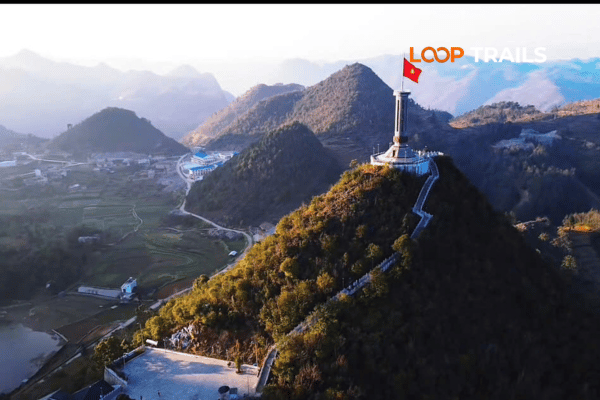
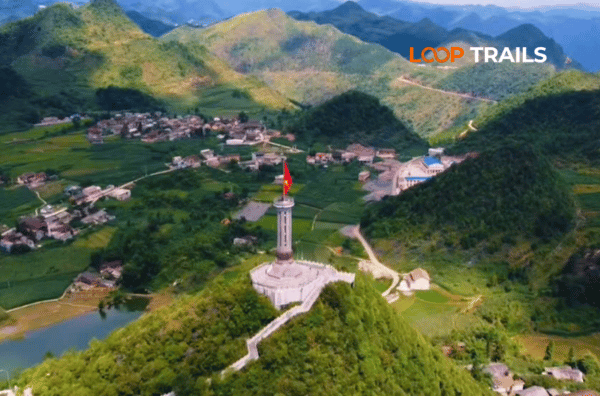
Lung Cu Flag Tower marks the northernmost point of Vietnam, sitting at 23°23′ North latitude in Lung Cu commune, Dong Van district. The tower itself rises 33.15 meters from Rong Hill (Dragon Hill), with a massive Vietnamese flag—54 square meters—flying at the top. On clear days, you can see into China’s Yunnan province. On foggy days, which happen often, the tower disappears into white and you’re left with an eerie sense of being nowhere and everywhere at once.
The current tower dates to 2010, replacing an older structure from the 1970s. It’s a symbol more than a tourist attraction—a marker of national pride in a region where borders have shifted throughout history. The ethnic minorities living around here (mostly Hmong and Lo Lo people) existed long before modern nation-states carved lines on maps.
What makes Lung Cu worth visiting isn’t the tower itself—it’s honestly pretty straightforward. It’s the location. You’re at 1,470 meters elevation, surrounded by karst mountains that look like they’ve been dropped randomly across the landscape. The roads getting here wind through villages where buffalo still plow fields and kids wave at passing motorcycles like it’s the most exciting thing that’ll happen all day.
If you’re doing the Ha Giang Loop, Lung Cu represents the furthest north you’ll go. For some travelers, that matters. For others, it’s just another stop. Either way, it’s only 25 kilometers from Dong Van, so you’re not committing to an epic detour.
Learn more: Ha Giang Loop Itinerary: 2,3,4,5 days
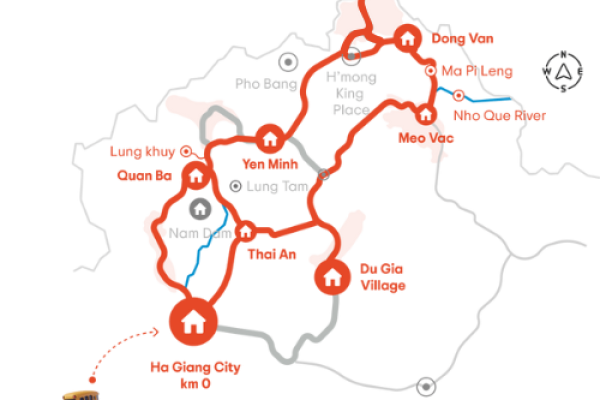
The full ride from Ha Giang City to Lung Cu covers roughly 160 kilometers and takes 6-7 hours if you ride straight through. You won’t ride straight through. Nobody does. The route passes through Quan Ba (Heaven’s Gate), Yen Minh, Dong Van, and finally up to Lung Cu.
Most people break this into a multi-day Ha Giang Loop, hitting Lung Cu on Day 2 or Day 3. If you’re somehow trying to do it as a day trip from Ha Giang City, turn back now. That’s 320 kilometers round trip on mountain roads. You’ll spend the entire day riding and see nothing properly.
The standard Ha Giang Loop itinerary places you in Dong Van for the night, then tackles Lung Cu the next morning before heading to Ma Pi Leng Pass and Meo Vac. This sequencing makes sense—you’re already in the area, the roads connect logically, and you’re not backtracking.
This is the realistic starting point for most visitors. Dong Van to Lung Cu is 25 kilometers and takes 45-60 minutes depending on your riding pace and how many times you stop for photos (you will stop).
The road heads northeast out of Dong Van on QL4C. It’s paved, mostly two lanes, and climbs steadily. You’ll pass through Du Gia, a small town about halfway that has a few shops if you need water or snacks. After Du Gia, the road gets quieter. Fewer villages, more open mountain views, and a sense that you’re genuinely heading toward the edge of something.
Navigation is straightforward. There’s basically one road, and signs point to Lung Cu. If you’re using Google Maps offline, it works fine. If you’re following a guide on an Easy Rider tour, they know the way.
Clockwise Ha Giang Loop: Ha Giang City → Quan Ba → Yen Minh → Dong Van → Lung Cu → Dong Van → Ma Pi Leng → Meo Vac → Du Gia → Bao Lac → Ha Giang City. This is the most common direction and puts Lung Cu early in your loop when you’re still fresh.
Counterclockwise: Less common, but some riders prefer it. You’d hit Ma Pi Leng first, then work your way to Dong Van and Lung Cu later. The road conditions are identical either direction.
Day trip from Dong Van: If you’re based in Dong Van and have an extra morning, riding to Lung Cu and back is manageable. Leave by 7-8 AM, spend an hour at the tower, ride back by lunch. This works if you’ve already done the full loop and want to catch something you missed.
For travelers combining Ha Giang with Cao Bang, Lung Cu fits into the northern section before you head east toward Ban Gioc Waterfall. The routing gets more complex, but the principle is the same—you’re threading together northern Vietnam’s highlights without excessive backtracking.
Learn more: Ha Giang Loop Solo Travel
The road from Dong Van to Lung Cu is paved and maintained reasonably well. It’s not perfect—you’ll hit potholes, especially after rain—but it’s far from the worst roads in the region. If you’ve already ridden from Ha Giang City to Dong Van, you’ve handled harder sections.
The elevation gain is steady but not brutal. You start in Dong Van at around 1,000 meters and climb to 1,470 meters at Lung Cu. The road winds but doesn’t throw tight hairpins at you constantly. Traffic is light. You might see a few other tourists, some local motorbikes, and occasionally a truck hauling goods.
The surface is best in dry season (October through April). During rainy months (May through September), watch for loose gravel and slick spots, especially on corners. Nothing terrifying, but you need to stay aware. If you’re on a semi-automatic bike and this is your first time riding mountains, take it slow. If you’re experienced, the road is actually pretty enjoyable—good pavement, scenic, not too technical.
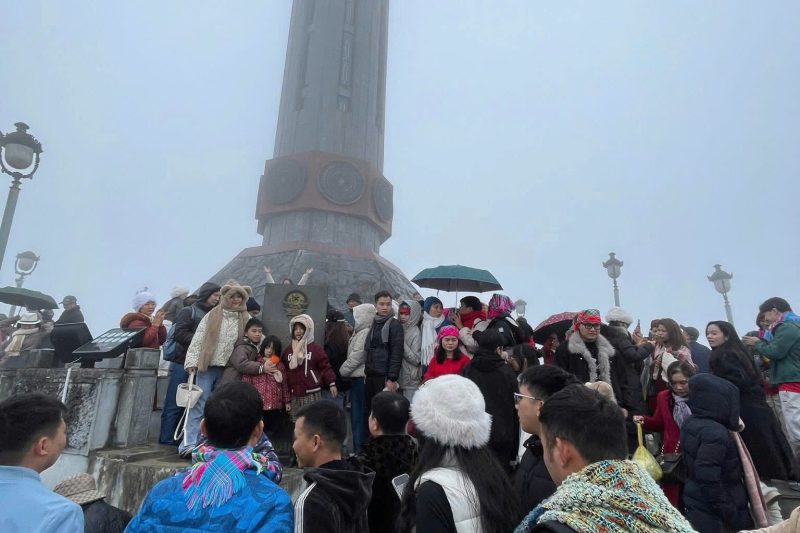
Weather at Lung Cu is unpredictable and changes fast. The elevation and proximity to the border mean fog rolls in without warning. I’ve arrived at the tower on a clear morning and watched it disappear into white within 20 minutes. I’ve also climbed the tower in thick fog and had it lift just enough to catch a view of the valley below.
Best conditions: October through December and March through April. Clear skies, cooler temperatures, and the best visibility for views into China.
Rainy season risks: May through September brings afternoon rain almost daily. Roads get slippery, fog becomes dense, and visibility drops. If you’re riding during these months, start early and aim to reach Lung Cu by late morning before weather turns.
Cold season: December through February can be genuinely cold at this elevation. Temperatures drop to 5-10°C (41-50°F), and wind at the top of the tower cuts through layers. Bring a jacket.
Check the forecast before you ride, but understand that forecasts mean less in the mountains. What you see is what you get.
From Dong Van: 45-60 minutes of actual riding. Add stops, and you’re looking at 90 minutes to 2 hours for the round trip.
Difficulty level: Moderate. The road is paved and the gradients are manageable, but you’re still climbing mountain roads at elevation. If you’re comfortable riding a motorbike in general, you’ll be fine. If you’ve never ridden before and rented a bike in Ha Giang to “learn on the loop,” Lung Cu isn’t where you’ll struggle—but the overall Ha Giang Loop might be more than you bargained for.
Traffic: Minimal. The road to Lung Cu doesn’t lead anywhere else significant, so you’re mostly sharing it with other tourists and locals from nearby villages. No tour buses (the road isn’t suitable), no heavy trucks once you’re past Du Gia.
Fuel: Fill up in Dong Van. There are small shops in Du Gia, but don’t count on finding fuel there reliably. Better to ride with a full tank.
Learn more: Ha Giang Loop for Beginners
Entry to Lung Cu Flag Tower costs 10,000 VND per person (roughly $0.40). You pay at the small gate at the base of the hill. Yes, it’s extremely cheap. No, they don’t always have change, so bring small bills.
The tower is open from 7:00 AM to 5:00 PM daily. Most tourists arrive between 9:00 AM and 2:00 PM. If you want fewer people in your photos, aim for early morning or late afternoon. Sunrise at Lung Cu is stunning if you’re staying nearby, though most accommodations are back in Dong Van.
There’s a small parking area at the base where you leave your motorbike. It’s free and someone usually watches the bikes, but take your valuables with you just in case.
From the parking area, you walk up a stone path and then climb stairs to the tower base. The path is built into the hillside and takes about 5-10 minutes at a casual pace. It’s not steep enough to leave you gasping, but you’re at elevation, so take it easy if you’re not used to thin air.
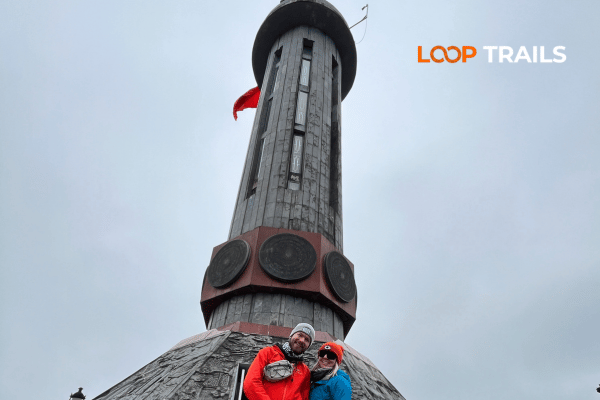
The stairs leading up the tower are narrow and spiral inside the structure. There are 389 steps total. It’s not a difficult climb, but it’s enclosed and can feel cramped if there’s a crowd. At the top, you emerge onto the viewing platform where the flagpole stands.
The platform has safety railings and enough space for 15-20 people comfortably. When it’s busy, it gets tight. You’ll wait your turn for photos at the flag base. When it’s quiet, you have the place to yourself and can spend as much time as you want taking in the views.
From the top of Lung Cu Flag Tower, the view depends entirely on weather. On a clear day, you can see deep into China—rolling mountains, valleys, and the occasional village. The border itself is unmarked from this vantage point; there’s no fence or line, just landscape continuing in every direction.
Looking back toward Vietnam, you’ll see the patchwork of terraced fields, limestone karst formations, and small clusters of homes that make up Lung Cu commune. The Hmong and Lo Lo villages blend into the hillsides, stone houses with tile roofs that have been there for generations.
The flag itself is massive up close—8 meters wide and 6 meters tall, visible from kilometers away when the weather cooperates. It makes a snapping sound in the wind that’s oddly powerful when you’re standing next to it.
If it’s foggy, you see nothing. And that’s okay. There’s something atmospheric about standing at the northernmost point of Vietnam and being unable to see 20 meters in any direction. It feels remote in a way clear days don’t quite capture.
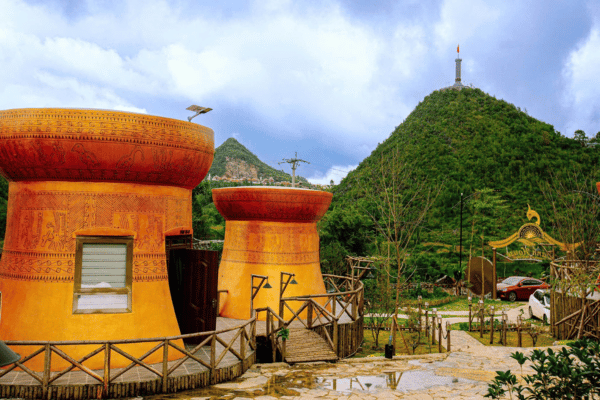
At the base of the tower, there’s a small museum with exhibits about the border region’s history and ethnic minorities. It’s modest but worth 15 minutes if you’re interested. Signage is mostly in Vietnamese, with some English translations.
Learn more: Ha Giang in September & October
The best time to visit Lung Cu Flag Tower aligns with the best time to do the Ha Giang Loop: October through April, with peak months being October-November and March-April.
October-November: Post-monsoon clarity, mild temperatures, and rice terraces turning golden before harvest. This is when you get the clearest skies and most consistent weather. It’s also peak tourist season, so expect more traffic on the Ha Giang Loop overall.
December-February: Cold but clear. Visibility is excellent, but temperatures drop significantly. At Lung Cu, you might face freezing mornings and biting wind at the tower’s summit. Pack warm layers. Fewer tourists during these months, which means quieter roads and more space at the tower itself.
March-April: Warming up, flowers blooming, and good riding conditions. This bridges the gap between cold season and rainy season. Weather is variable but generally favorable.
May-September: Rainy season. Afternoon storms, foggy mornings, and slippery roads. The countryside is lush and green, which some travelers prefer, but you’re gambling on visibility at Lung Cu. If you visit during these months, go early in the day and accept that you might see nothing from the top.
Avoid: Chinese New Year and Vietnamese Tet (late January to mid-February, dates vary). Everything in the region shuts down or gets overcrowded.
Learn more: Ha Giang Loop with Kids
About 3 kilometers before reaching Lung Cu Flag Tower, you’ll pass through (or near) Lo Lo Chai village, home to the Lo Lo ethnic minority. This is one of the smallest ethnic groups in Vietnam, and their traditional homes—built from earth and stone with thatched roofs—are distinct from Hmong architecture.
You can stop and walk through the village, though it’s not set up as a formal tourist site. People here live their lives, and you’re wandering through their space. Be respectful. Ask before taking photos of people, especially children. Some families sell handicrafts—embroidered bags, woven textiles—if you’re interested in supporting local work.
The village itself is small, maybe 20-30 houses spread along the road and hillside. You don’t need a guide, but having someone who speaks Vietnamese helps if you want to learn about Lo Lo culture beyond what you observe.
The road to Lung Cu offers several pull-off points with expansive views. About 5 kilometers past Du Gia, there’s a particularly good overlook where the valley opens up and you can see terraced fields cascading down the mountainside. No signage, just a wider shoulder where people park their bikes.
At the base of Lung Cu hill, before you pay the entry fee, there’s an open area where you can photograph the tower from below with the flag flying above. This angle often works better than photos from the top, especially if it’s crowded up there.
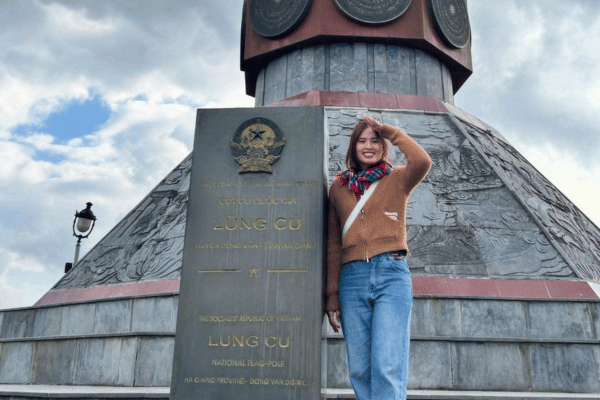
If you’re into the “northernmost point” novelty, there’s a stone marker near the tower inscribed with the coordinates and Vietnam’s national emblem. Standard tourist photo spot, but it’s there if you want it.
Learn more: Ha Giang Loop 4 Days 3 Nights
Timing: 3-4 hours total (including travel and visit time)
Route: Dong Van → Du Gia → Lung Cu Flag Tower → return to Dong Van
Schedule:
This works if you’re spending two nights in Dong Van and have a spare morning. Many travelers use this setup for the Sunday market—stay in Dong Van Saturday night, visit the market Sunday morning, then ride to Lung Cu Sunday afternoon or Monday morning before continuing the loop.
Day 1: Ha Giang City → Quan Ba → Yen Minh (sleep in Yen Minh)
Day 2: Yen Minh → Dong Van → Lung Cu → return to Dong Van (sleep in Dong Van)
Day 3: Dong Van → Ma Pi Leng Pass → Meo Vac (sleep in Meo Vac)
Day 4: Meo Vac → Du Gia → Ha Giang City (or extend to Bao Lac)
This is the standard 4-day loop with Lung Cu included. You tackle it on the morning of Day 3 before heading to Ma Pi Leng. Some tours flip this, doing Ma Pi Leng first thing in the morning and Lung Cu in the afternoon, but morning light is generally better at Lung Cu.
If you’re doing a 3-day compressed loop, Lung Cu often gets cut for time. The 4-day version gives you space to include it without rushing.
Travelers combining Ha Giang and Cao Bang can extend the loop eastward from Meo Vac, passing through Bao Lac and Bao Lam before reaching Cao Bang town and eventually Ban Gioc Waterfall. That routing turns into a 6-7 day journey but connects northern Vietnam’s two most scenic areas without backtracking.

Learn more: Ha Giang Loop Self-Driver
The choice between joining a tour and renting a motorbike for the Ha Giang Loop—including Lung Cu—comes down to riding experience, comfort with navigation, and how much you value flexibility versus local knowledge.
Easy Rider Tours: You ride on the back of a motorbike driven by a local guide. They handle the road, the navigation, the weather, and the logistics. For Lung Cu, this means you show up, climb the tower, and leave when the group is ready. Easy Riders know when to go for best light, where to stop for photos, and can explain the cultural context of villages along the way. This option works well for non-riders, nervous riders, or anyone who wants the experience without the stress.
Self-Drive Motorbike Rental: You rent a bike (semi-automatic or manual) and ride yourself. The road to Lung Cu is straightforward enough that navigation isn’t a real issue—there’s basically one route. You control your schedule, can leave early to beat crowds, and stop wherever you want. The downside is you’re responsible for the bike, the weather, and any mechanical issues. If you’ve never ridden a motorbike in mountains, the Ha Giang Loop in general (not just Lung Cu specifically) presents challenges. Be honest about your skill level before committing to self-drive.
Jeep Tours: For travelers who want to visit Lung Cu but don’t want to ride at all, Jeep tours cover the Ha Giang Loop in 4×4 vehicles. You sit back, enjoy the views, and let someone else handle the driving. Less adventurous, but more comfortable and safer if weather turns bad.
For Lung Cu specifically, any of these options work. The tower itself doesn’t require special access or local connections—it’s open to everyone. The difference is in how you experience the journey getting there.
If you’re considering a Ha Giang Loop tour that includes Lung Cu, make sure it’s explicitly listed in the itinerary. Some 3-day tours skip it for time. Ask before booking.
Learn more: Ha Giang Loop Cost & Tips
Bring cash: The entry fee is small, but there are no ATMs at Lung Cu. Dong Van has ATMs, so withdraw there before heading out.
Layer your clothing: Even if it’s warm in Dong Van, it can be 10 degrees cooler at the tower, especially if wind picks up. A light jacket fits in your backpack and makes the experience more comfortable.
Start early: Morning light is better for photos, crowds are thinner, and weather is generally clearer before afternoon fog rolls in.
Fuel up: Fill your tank in Dong Van. Don’t assume you’ll find fuel easily along the route.
Allow extra time: Even though the ride is short, you’ll want to stop for photos, walk through villages, and take in the scenery. What looks like a 45-minute ride on the map easily becomes 2 hours when you account for reality.
Respect local communities: Lo Lo Chai and other villages near Lung Cu are not theme parks. People live here. Ask before photographing individuals, don’t enter homes uninvited, and if you buy handicrafts, pay a fair price without aggressive haggling.
Check your phone battery: Cell signal is spotty but present at Lung Cu. If you’re using your phone for photos, navigation, or communication, make sure it’s charged.
Don’t rush it: The point of visiting Lung Cu isn’t to check it off a list. Spend time at the top, sit with the view (if it’s clear), and let the remoteness sink in. Ten minutes at the tower doesn’t do it justice.

Learn more: Ha Giang Motorbike Rental
Skipping Lung Cu entirely: Some travelers cut it from their itinerary thinking it’s “just a tower” and not worth the detour. It’s only 25 kilometers from Dong Van. If you’re already there, the ride is part of the experience. The tower might not blow your mind, but the journey and the symbolism of standing at Vietnam’s edge makes it worthwhile.
Going in bad weather and expecting views: If it’s fogged in, you won’t see anything from the top. Check conditions before you ride. If it’s socked in when you arrive, you can either wait (sometimes it clears) or accept that this is how Lung Cu looks today. Don’t let it ruin your trip—it’s not the highlight of the Ha Giang Loop, just a piece of it.
Underestimating the cold: Even experienced travelers get caught off guard by how cold it can be at elevation in northern Vietnam. If you’re visiting November through February, bring warm clothes. Wind chill at the top of the tower is real.
Not carrying water: There are small shops in Du Gia, but they’re not always open or stocked. Bring water from Dong Van.
Riding too fast: The road is good, but it’s still a mountain road with blind corners and occasional livestock. Local kids sometimes play near the roadside. Keep your speed reasonable and stay alert.
Forgetting to enjoy the ride: The tower is the destination on paper, but the 25 kilometers getting there wind through some of the most remote, beautiful landscapes in Vietnam. Don’t fixate on reaching the tower so much that you blow past everything in between.
Not budgeting enough time: If you’re continuing to Ma Pi Leng Pass after Lung Cu, factor in the full round trip. Dong Van to Lung Cu and back to Dong Van takes 2-3 hours minimum. Then Dong Van to Ma Pi Leng is another 30 kilometers of spectacular, slow riding. If you try to cram both into one rushed morning, you’ll miss the best parts of both.
Lung Cu Flag Tower won’t dominate your Ha Giang Loop memories. It’s not Ma Pi Leng, it’s not the Nho Que River, and it’s not the chaotic energy of Dong Van market. But it represents something specific—a geographic endpoint, a place where Vietnam simply stops. The tower itself is symbolic. The landscape around it is the real reward.
If you’re riding the Ha Giang Loop and you’re already in Dong Van, make the trip. Leave early, take your time on the road, stop in the villages, and when you reach the top, take a moment to appreciate how far north you’ve come. Whether it’s clear or foggy, whether you see China or just mist, you’re standing at the edge of Vietnam. That’s worth something.
For travelers planning a loop and wondering if Lung Cu fits—yes, if you have 4 days. If you’re compressing into 3 days and need to choose, prioritize Ma Pi Leng. But if you have the time, Lung Cu adds a layer of completeness to the journey. It’s not about the tower. It’s about going as far as the road takes you, and at Lung Cu, the road runs out.
Learn more: Ha Giang Cao Bang 5 Days
Plan for 2-3 hours total from Dong Van, including the 45-minute ride each way and 1 hour at the tower. If you’re stopping at Lo Lo Chai village or taking photos along the route, add another 30-60 minutes.
You can visit independently. The road is straightforward, well-marked, and doesn’t require special permits or a guide. Tours offer local knowledge and convenience, but self-drive and solo visits are completely feasible.
Early morning (7-9 AM) offers the clearest weather, best light for photos, and fewest crowds. Afternoon fog and clouds are common, especially during rainy season.
The road itself is paved and moderate difficulty, but if you’re a complete beginner, the entire Ha Giang Loop—not just the Lung Cu section—might be more than you can handle. If you’re comfortable on a motorbike in general, Lung Cu is one of the easier sections of the loop.
Entry is 10,000 VND (about $0.40 USD) per person. It’s cash-only, and they don’t always have change, so bring small bills.
On clear days, yes. The view extends into China’s Yunnan province. During foggy conditions, which are common, visibility can drop to near zero. Weather determines what you see.
If you’re already in Dong Van and have a spare morning, yes. If you’re doing a compressed 3-day Ha Giang Loop and need to choose between stops, prioritize Ma Pi Leng Pass over Lung Cu. But if you have 4 days, include both.
Comfortable clothes for riding, closed-toe shoes, and layers. It’s cooler at elevation, and wind at the top of the tower can be strong. Bring a light jacket even if it’s warm in the valley.
No. There’s a small parking area and the tower entrance, but no restaurants or shops at the site itself. Du Gia (halfway between Dong Van and Lung Cu) has a few basic shops. Bring water and snacks from Dong Van.
Most travelers visit Lung Cu on Day 2 or Day 3 of a 4-day Ha Giang Loop. You stay overnight in Dong Van, ride to Lung Cu in the morning, then continue to Ma Pi Leng Pass and Meo Vac. It adds 2-3 hours to your day but doesn’t require major route changes.
It depends on timing. The tower gets busier mid-morning to early afternoon, especially during peak season (October-November). Early morning or late afternoon visits see fewer people. Even when busy, it’s not overwhelmingly crowded—maybe 20-30 people at most.
No. It’s open to all visitors without special permits. You just pay the small entry fee at the gate.
Contact information for Loop Trails
Website: Loop Trails Official Website
Email: looptrailshostel@gmail.com
Hotline & WhatSapp:
+84862379288
+84938988593
Social Media:
Facebook: Loop Trails Tours Ha Giang
Instagram: Loop Trails Tours Ha Giang
TikTok: Loop Trails
Office Address: 48 Nguyen Du, Ha Giang 1, Tuyen Quang
Address: 48 Nguyen Du, Ha Giang 1, Tuyen Quang
Facebook X Reddit Table of Contents Learn more: Ha Giang Loop Tours There’s a moment somewhere on the Ma Pi Leng Pass
Facebook X Reddit Table of Contents Learn more: Ha Giang Loop Tours There’s a version of the Ha Giang Loop that ends
Facebook X Reddit Table of Contents Learn more: Ha Giang Loop Tours There’s a moment, usually somewhere on Ma Pi Leng Pass,