

Lung Khuy Cave Ha Giang: The Hidden Underground World
Facebook X Reddit Table of Contents Learn more: Ha Giang Loop Tours Most people riding the Ha Giang Loop are focused on

Thúy Kiều (Grace) is a travel blogger and content contributor for Loop Trails Tours Ha Giang. She holds a bachelor’s degree in Sustainable Tourism from Vietnam National University, Hanoi, and has a strong passion for exploring and promoting responsible travel experiences in Vietnam’s northern highlands.
Learn more: Ha Giang Loop Tours
You notice the sound before you see anything specific. A rhythmic, wooden clack — steady, unhurried — coming from inside one of the houses as you walk into Lung Tam. Then you turn and see it through an open door: a woman at a loom the size of her living room, moving with the kind of practiced ease that comes from doing something ten thousand times. The fabric building under her hands is dense, geometric, and a shade of deep blue-grey that you couldn’t replicate with a synthetic dye if you tried.
That colour is indigo. That fabric is hemp. And this village — Lung Tam, tucked into the Du Già valley in Ha Giang province — has been producing it for longer than anyone here can trace.
Lung Tam is one of a handful of places in northern Vietnam where traditional H’Mông textile production hasn’t just survived tourism — it’s been organized around it in a way that actually works. There’s a weaving cooperative here that lets you see the process, buy directly from the people who made the cloth, and leave with something that isn’t stamped out of a factory in Hà Nội. That distinction matters more than it might sound.
This guide covers everything you need to make the most of a visit: what Lung Tam is, what you’ll see, what to buy, how to get there, and how it fits into a Ha Giang Loop itinerary.
Learn more: Ha Giang Loop for Beginers
Lung Tam sits in the Du Già valley — a long, green stretch of the Ha Giang Loop that most travelers pass through on their way between Ha Giang City and Yên Minh. The village is near the small town of Du Già (also spelled Du Gia), roughly 40km east of Ha Giang City.
The valley itself is a contrast to the dramatic rocky plateau further north around Đồng Văn and Mèo Vạc. Here, the landscape is lower, softer — rice paddies, banana trees, and rivers cutting between forested ridges. It’s beautiful in a quieter, less Instagram-famous way.
Lung Tam is specifically known for its Flower H’Mông and Tày communities. The weaving cooperative that draws most visitors is run primarily by H’Mông women and is one of the most established community craft enterprises in the entire Ha Giang region.
If you’re doing the Ha Giang Loop in either direction, the Du Già area — including Lung Tam — typically falls on the first or last day of the circuit from Ha Giang City. That positioning matters: some travelers rush through this section to get to the more dramatic northern scenery. Don’t. Lung Tam deserves at least a morning.

Learn more: Hmong Culture in Ha Giang
The village is sometimes called “Lung Tam Linen Village” in tourist literature, and the fabric sold here is often labeled “linen” for international audiences. The more accurate term is hemp cloth — made from Cannabis sativa, the same plant family as industrial hemp, but grown specifically for its fibres rather than any other purpose.
H’Mông communities have used hemp as their primary textile fibre for centuries. It grows well at altitude, processes with relatively simple tools, and produces a fabric that’s durable, naturally antimicrobial, and takes natural dye extraordinarily well — particularly indigo.
The “linen” label persists because international buyers are familiar with linen as a natural fibre category and hemp is still entangled (fairly or not) with associations its textile properties don’t deserve. When you’re at Lung Tam, you’re buying hemp. It looks and feels somewhat like heavy linen, but it’s not the same plant. The distinction matters if you want to describe accurately what you bought.
The cooperative at Lung Tam was established to give local H’Mông and Tày women a structured way to produce and sell their traditional textiles — shifting some of the economic value away from middlemen who would buy wholesale and sell at markup elsewhere.
It’s not a perfectly frictionless system, and it’s not run like a corporation. It’s a community organization operating in a remote mountain village with limited infrastructure. But by the standards of craft preservation in northern Vietnam, it’s one of the more successful examples. The women who work here are producing fabric using traditional techniques, selling it at prices they set, and maintaining skills that are genuinely at risk of being lost.
Several organizations and development initiatives have supported the cooperative over the years. The current iteration focuses on direct sales to visitors and, increasingly, small wholesale orders from ethical fashion and home goods buyers internationally. If you buy here, the money goes to the weavers.
Learn more: Ha Giang Loop for Seniors
One of the best things about visiting Lung Tam specifically is that the production process isn’t hidden. You’re not buying fabric that appeared from a storeroom; you’re watching it get made. Here’s what the process actually involves, so you understand what you’re looking at.
Hemp cultivation happens in the fields surrounding the village — typically planted in spring and harvested in late summer. The stalks are cut, retted (left to partially decompose to loosen the fibres), and then the long bast fibres are stripped from the woody core.
Depending on your timing, you might see this stage in the fields around Du Già. During the harvest season, the village has a particular smell — earthy, slightly musty — from the retting process.
The raw fibre is a pale cream colour at this stage.
Learn more: Ha Giang Loop 4 Days 3 Nights
The fibre is spun into thread by hand — traditionally on a simple drop spindle, though some weavers now use small spinning frames. The spinning process is something older women at the cooperative often do while sitting outside, talking, watching grandchildren. It’s one of those activities that runs parallel to daily life rather than interrupting it.
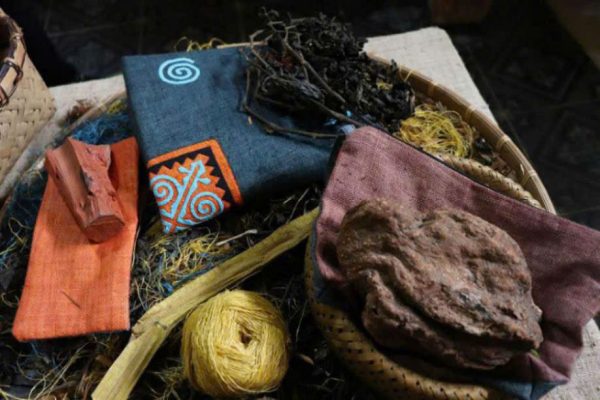
Thread is wound into skeins for dyeing, or kept natural (undyed) for fabric that will use colour contrast in the pattern.
Weaving happens on backstrap looms or — for the larger cooperative output — traditional floor looms. The floor looms produce wider cloth suitable for garments, bags, and home goods. The backstrap looms produce narrower strips that are then sewn together or used for belts and straps.
Pattern-making in H’Mông weaving is done from memory, not from a written pattern or template. Geometric designs passed down through generations — diamonds, zigzags, crosses — are reproduced thread by thread, count by count. This is not something you learn from a YouTube tutorial.
The indigo dyeing is what most visitors remember visually, and for good reason.
Indigo (chàm in Vietnamese) is extracted from the leaves of the indigo plant (Indigofera tinctoria and related species), which H’Mông communities grow specifically for textile use. The leaves are fermented in water to produce a dye bath — a dark, slightly murky vat that smells faintly of fermentation and looks, depending on the stage, like a muddy pond.
Fabric or thread is dipped repeatedly into the dye bath, removed, exposed to air (oxidation is what develops the blue colour), and dipped again. Multiple rounds of dipping and oxidizing build up the depth of colour. A single deep-indigo cloth might be dipped dozens of times over several days.
The fresh-dipped cloth turns from green to blue as it oxidizes in the air — right in front of you. Watching fabric transform colour as it dries is genuinely remarkable the first time.
After dyeing, the cloth is often pounded with wooden mallets to compact the fibres and give it a characteristic sheen. This pounding step is also audible from a distance — a different rhythm from the loom.
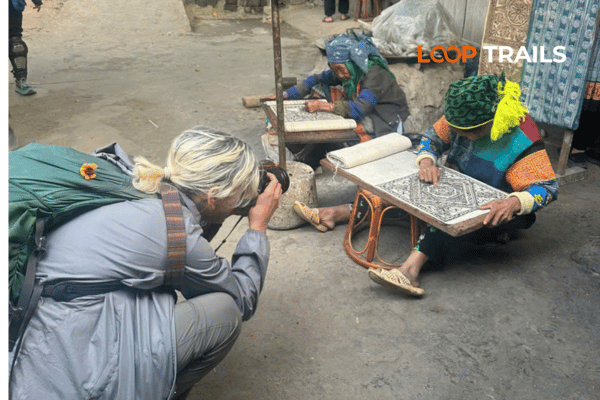
At Lung Tam, you can typically see dye vats maintained by the cooperative and watch or photograph the dyeing process (ask before photographing workers closely).

Learn more: Ha Giang Loop route and itinerary
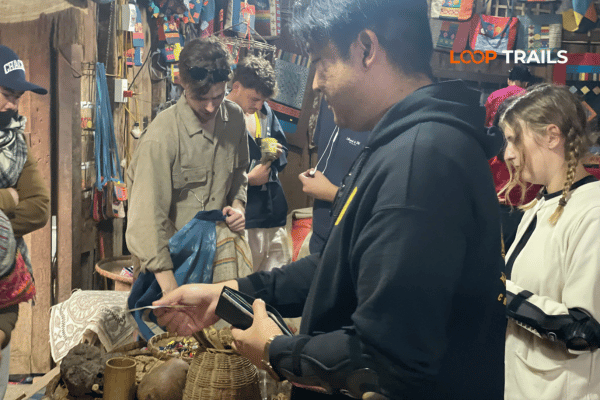
The cooperative’s main building — a wooden structure with an open working area — is where most of the active weaving happens during the day. You can walk in, observe, and ask questions (through a guide if you don’t speak Vietnamese). The women here are accustomed to visitors and continue working rather than performing for cameras.
Spend time watching rather than immediately looking for something to buy. Understanding the process — even superficially — transforms the fabric from a souvenir into something you actually comprehend.
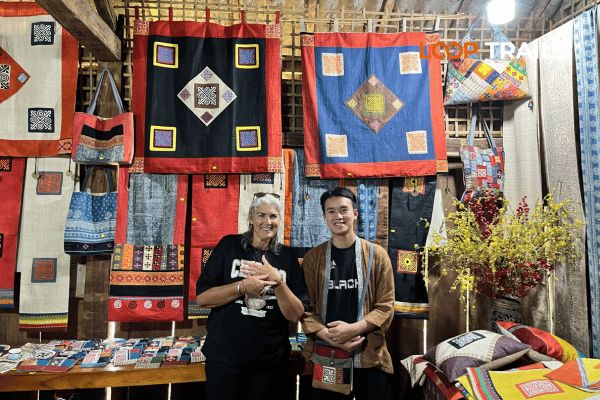
The cooperative has a small shop area adjoining the workshop. Items for sale typically include:
Prices are set by the cooperative. Bargaining aggressively here is not appropriate — you’re buying directly from the makers at a price they’ve agreed on collectively. If something seems expensive relative to what you’ve seen at market stalls in Ha Giang City, remember: the market stall items usually came from a wholesale supplier. These didn’t.
→ If you want a guided stop at Lung Tam built into your itinerary — including time to visit the cooperative and nearby Du Già attractions — check our Ha Giang Loop tour options. Both Easy Rider and Jeep tours can route through the Du Già valley.
Beyond the cooperative, Lung Tam is a working village worth a slow walk. Wooden and bamboo houses, kitchen gardens, children coming home from school on the road in the late afternoon. The Du Già River runs nearby. There’s a small waterfall — Du Già Waterfall — accessible with a short hike, worth the detour if you have an extra hour.
The surrounding valley fields change with the seasons: rice in summer, bare paddies in winter, sometimes buckwheat on the drier hillside plots. If you’re here in early morning, the valley mist is something else.
Learn more: Ha Giang Loop 2 Days 1 Night
Lung Tam is one of the most legitimate places to buy H’Mông textiles in Ha Giang. A few guidelines:
Buy fabric, not fashion. The raw hemp cloth sold by the metre is the best value and the most honest representation of the craft. You can have it made into something at home, use it as a wall piece, or simply keep it. It ages well — the indigo deepens and develops character over time.
Understand the price difference. Authentic hand-woven hemp cloth from Lung Tam will cost more than the visually similar machine-printed fabric sold at tourist shops elsewhere. This is correct. The labour involved — from growing the hemp to the final pounding — represents weeks of work. A fair price reflects that.
Ask about the item’s origin. The cooperative is transparent about what’s made in-house versus what might have come from elsewhere. If you’re uncertain, ask (through your guide or in basic Vietnamese). Most items in the cooperative shop are made on-site.
Smaller items travel well. Hemp pouches, small bags, and embroidered patches pack easily and make the most practical souvenirs. The full bolts of cloth are beautiful but heavy — worth it if you’re checking luggage.
Don’t buy antiques without expertise. Occasionally you’ll see older pieces — worn garments, vintage embroidery panels — sold as antiques. Provenance is complex, pricing is unregulated, and it’s easy to overpay or inadvertently purchase something of cultural significance without understanding what you’re acquiring. Stick to the contemporary craft work unless you have specific knowledge.
Learn more: Ha Giang Cao Bang Loop Jeep tour Guide
Lung Tam village is in the Du Già valley, roughly 40km from Ha Giang City. The route follows National Highway 4C south-east from the city, then branches off toward Du Già.
By motorbike: The most flexible option. The road to Du Già is paved and in generally good condition, though mountain roads require standard attention — blind corners, occasional gravel patches, and local vehicles. Journey time is roughly 1–1.5 hours depending on stops and conditions. Check road conditions before you go, especially after heavy rain. Riding conditions can change — always check local updates.
By jeep or private vehicle: Comfortable and practical, especially for groups or travelers who’d rather not ride. A driver who knows the valley can also point out things you’d miss on your own.
By organized tour: The easiest approach. A guided Easy Rider or Jeep tour that includes Du Già will route through or specifically stop at Lung Tam. Your guide handles navigation, timing, and introductions at the cooperative.
By bus or shared transport: Ha Giang City has minibus services toward Du Già and Yên Minh. Journey times and schedules vary — ask locally for current options and confirm the route passes near Lung Tam specifically.
Lung Tam is typically visited as a stop en route — it’s on the Ha Giang Loop circuit rather than a dedicated day trip destination from the city. Most travelers who visit are either:
Either direction works. The Du Già valley is worth slowing down for regardless of which way you’re traveling.
Learn more: Ha Giang in September & October
The cooperative operates year-round, so there’s no “closed season” for the weaving itself. That said:
September–November is the most popular period for the Ha Giang Loop overall — cooler temperatures, less rain, dramatic autumn light, buckwheat flowers on the plateau. The Du Già valley is lush and green from late monsoon season. Good time to visit.
March–May is the second most popular window — spring flowers on the slopes, milder temperatures than peak summer. Less crowded than autumn, and the valley is particularly photogenic.
December–February is cold — genuinely cold at altitude, especially evenings. Lung Tam sits lower than the Đồng Văn plateau, so temperatures are less extreme, but pack warm layers. Fewer tourists means more time with the cooperative without a crowd.
June–August is monsoon season. Roads in the Ha Giang region can flood or wash out during heavy rain events. Not a reason to avoid it, but requires flexibility and checking road conditions in real time.
The cooperative is generally open during daylight hours on weekdays. Saturdays are typically working days too. Sundays are variable — some weavers attend the Yên Minh or Du Già markets. If you’re specifically timing a visit around cooperative activity, a weekday morning is the most reliable window.
Lorem ipsum dolor sit amet, consectetur adipiscing elit. Ut elit tellus, luctus nec ullamcorper mattis, pulvinar dapibus leo.
Learn more: Tu San Canyon & Nho Que River Boat Trip
The Du Già valley has enough to fill a full half-day beyond the weaving cooperative:
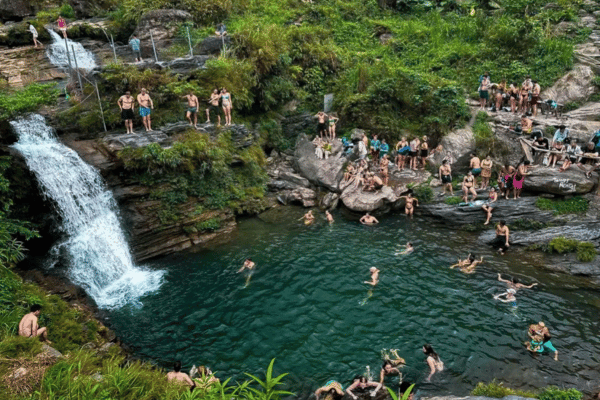
Du Già Waterfall (Thác Du Già) — a multi-tiered waterfall a short walk from the village area. The path involves some uneven terrain; wear decent shoes. Particularly striking after monsoon rain when water volume is high.
Du Già itself — the small town has a market on specific days of the week (verify locally, schedules shift). Worth checking if your timing aligns.
Nho Quế River (upper sections) — the same river that carves the dramatic gorge near Mèo Vạc begins its journey in the highlands north of here. Some sections near Du Già are accessible and very peaceful — a different character from the famous gorge further north.
Local rice wine distilleries — several families in the valley area produce traditional corn or rice wine. A guide can point you to ones that welcome visitors; showing up unannounced is hit or miss.
The loop road itself — the stretch between Du Già and Yên Minh is one of the most underrated on the entire circuit. Quieter than the northern plateau, with river views, forest sections, and fewer tour convoys. Ride it slowly.
Learn more: Ha Giang Loop Self-Drive & Motorbike Rental
Lung Tam is technically accessible by any mode of travel on the loop. But the experience differs significantly depending on how you get there.
Easy Rider guided tour: The best option for a meaningful Lung Tam visit. A good Easy Rider guide from Ha Giang will often have a personal relationship with weavers at the cooperative — meaning you’re introduced rather than just wandering in. They can translate conversations, explain what you’re seeing in the workshop, and help you understand what you’re buying. They’ll also know about timing — whether the dye vats are active that day, whether there’s a particularly skilled weaver working.
Jeep tour: Works well for groups who want logistical ease. A Jeep guide can do everything an Easy Rider guide can do in terms of introductions and context. The vehicle also means you can buy a bolt of fabric without worrying about carrying it on a motorbike.
Self-drive motorbike: You’ll get to the cooperative, you’ll be able to look around and buy things, but without a guide you’re operating at the surface level. If cultural depth at Lung Tam is a priority, guided is better. If you’re content with the visual experience and want to buy independently, self-drive is fine.
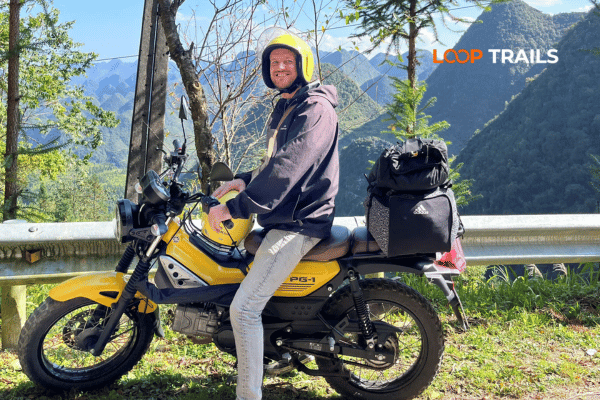
Motorbike rental with your own itinerary: Flexible and popular. You control the pace — which at Du Già specifically is worth something. Renting a reliable motorbike in Ha Giang City and doing the loop independently is a solid option for experienced riders who plan their stops. Just allocate real time for Lung Tam rather than treating it as a five-minute photo stop.
→ Want to build Lung Tam and Du Già into your itinerary? Explore our Ha Giang Loop tours or rent a motorbike in Ha Giang for a self-paced route. Not sure which fits you? Drop us a message on WhatsApp and we’ll help you figure it out.
Learn more: Du Gia Waterfall
Arrive in the morning. The cooperative is most active between 8am and noon. Afternoons can be quieter — some weavers have left for the day, fewer processes are running.
Bring cash in Vietnamese Dong. The cooperative doesn’t have card payment facilities. ATMs in Du Già town are limited in availability — withdraw in Ha Giang City before you head out.
Don’t rush the visit. Budget at least 1–1.5 hours at Lung Tam if you want to see the workshop, walk the village, and browse the shop without feeling pressured. It’s not a big site in terms of area, but it rewards slow attention.
A small purchase is appropriate. Even if you don’t want a large piece of fabric, buying a small item — a pouch, a coaster, a sample of raw hemp — is a way of participating in the cooperative economy that welcomes your visit. You don’t have to buy; the visit itself is fine. But the cooperative runs on sales, not entrance fees.
Photography etiquette. The weavers are used to being photographed, but that doesn’t mean consent is automatic. Make eye contact, gesture toward your camera, accept a head-shake gracefully. Many women at the cooperative are fine with photography; some prefer not. The fabric itself and the process shots are fair game without the same sensitivity as portraits.
Combine with Du Già Waterfall. It’s close, it’s free, it takes less than an hour round trip, and it adds a natural complement to the cultural visit. Wear shoes you don’t mind getting damp.
Ask your guide about the dye vats. Active dye vats are more visually interesting than empty ones. On a good day you’ll see cloth coming out of the bath and oxidizing in the air. On a quieter day the vats are there but inactive. Your guide may know the schedule.
Lung Tam is Ha Giang’s most recognized traditional weaving village — specifically associated with H’Mông hemp cloth production and natural indigo dyeing. It’s home to a weaving cooperative run by local H’Mông and Tày women that produces and sells authentic hand-woven textiles directly to visitors.
It’s often marketed as linen for international buyers, but technically it’s hemp cloth — made from the bast fibres of the hemp plant. Hemp and linen are both natural plant fibres and feel similar, but they come from different plants. The Lung Tam fabric is durable, naturally textured, and takes indigo dye extremely well.
Lung Tam is about 40km east of Ha Giang City in the Du Già valley. You can get there by motorbike (1–1.5 hours), by jeep or private vehicle, or as part of an organized Ha Giang Loop tour. Most loop travelers pass through the Du Già area on day one or the final day of the circuit.
Generally yes, during daylight hours on weekdays. Saturdays are usually working days too. Sundays can be variable — some weavers attend local markets. A weekday morning visit is the most reliable. No booking is required for a visit.
Prices vary by item and are set by the cooperative. Expect to pay more than you would for visually similar factory-made fabric in tourist shops — this reflects genuine handcraft production. The cooperative sets its own prices; aggressive bargaining is not appropriate. Bring Vietnamese Dong cash as card payment is not available.
Yes — the cooperative’s working area is open to visitors, and the weavers continue their work while people observe. The dye vats, spinning, and weaving can all typically be seen. Ask before photographing workers closely.
Raw indigo-dyed hemp cloth by the metre is the most authentic and enduring purchase — it has character that develops over time. For practical souvenirs, small bags, pouches, and scarves made from cooperative fabric travel well and are genuinely handmade.
It’s possible but not the most efficient approach — it’s better experienced as part of the Ha Giang Loop circuit rather than a standalone excursion. If you’re doing the loop, it naturally falls on your route. If you’re based in Ha Giang City and want a half-day trip specifically to the cooperative, that’s doable; combine with Du Già Waterfall to make it worthwhile.
Du Già Waterfall is a short hike away. The Du Già valley has scenic stretches of the Nho Quế River, local markets on specific days, and the loop road toward Yên Minh — one of the quieter and greener sections of the entire circuit. It’s a good area for anyone who wants a lower-key alternative to the dramatic northern plateau.
Yes — the Du Già valley, where Lung Tam sits, is on the main Ha Giang Loop circuit. It’s not a remote detour. Most organized loop tours pass through this area, and it can be included as a planned stop with any tour operator or self-drive itinerary.
Primarily Flower H’Mông and Tày communities. The weaving cooperative draws from both groups, though the hemp textile tradition is most closely associated with H’Mông practice in this area.
Some workshops at the cooperative occasionally offer hands-on experiences — ask when you arrive. This isn’t always available and depends on staffing and timing, but it’s worth asking. Even a short attempt at backstrap loom weaving gives you a different appreciation for the skill involved.
Learn more: Loop Trails Tour Ha Giang
Lung Tam isn’t the most dramatic stop on the Ha Giang Loop. It won’t give you a view that makes you gasp or a road section that makes your hands sweat. What it gives you is something harder to find: genuine craft production, still intact, organized in a way that benefits the people doing the work.
The fabric you buy here carries the actual process in it — the hemp grown a field away, the indigo fermented in that vat outside, the hands that dipped and pounded and wove it into what you’re holding. That’s not marketing language. That’s just what’s true.
If you pass through the Du Già valley and skip Lung Tam because you’re rushing north for the scenery, you’ll probably regret it later. It’s an hour. It’s worth it.
→ Planning the Ha Giang Loop and want to include Du Già and Lung Tam properly in your itinerary? Browse our Loop tour options — Easy Rider and Jeep tours both route through the valley with time built in. Or message us on WhatsApp if you’d like help designing a self-drive route that covers the highlights at your own pace.
Contact information for Loop Trails
Website: Loop Trails Official Website
Email: looptrailshostel@gmail.com
Hotline & WhatSapp:
+84862379288
+84938988593
Social Media:
Facebook: Loop Trails Tours Ha Giang
Instagram: Loop Trails Tours Ha Giang
TikTok: Loop Trails
Office Address: 48 Nguyen Du, Ha Giang 1, Tuyen Quang
Address: 48 Nguyen Du, Ha Giang 1, Tuyen Quang
Facebook X Reddit Table of Contents Learn more: Ha Giang Loop Tours Most people riding the Ha Giang Loop are focused on
Facebook X Reddit Table of Contents Learn more: Ha Giang Loop Tours There’s a moment that happens to a lot of remote
Facebook X Reddit Table of Contents Learn more: Ha Giang Loop Tours Ha Giang doesn’t have five-star hotels with rooftop pools. There’s