
Ha Giang Easy Rider: The Complete Guide (2026)
Facebook X Reddit Table of Contents Learn more: Ha Giang Loop Tours There’s a moment, usually somewhere on Ma Pi Leng Pass,

Thúy Kiều (Grace) is a travel blogger and content contributor for Loop Trails Tours Ha Giang. She holds a bachelor’s degree in Sustainable Tourism from Vietnam National University, Hanoi, and has a strong passion for exploring and promoting responsible travel experiences in Vietnam’s northern highlands.
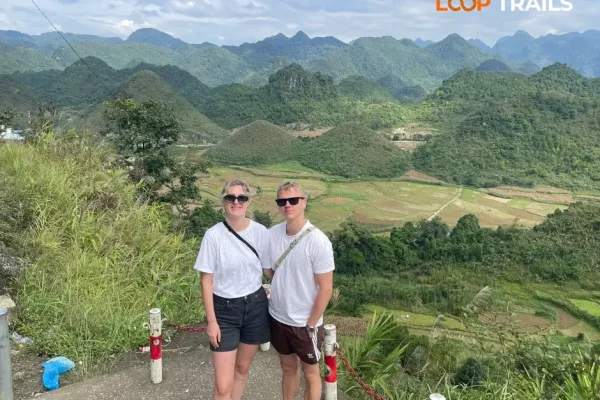
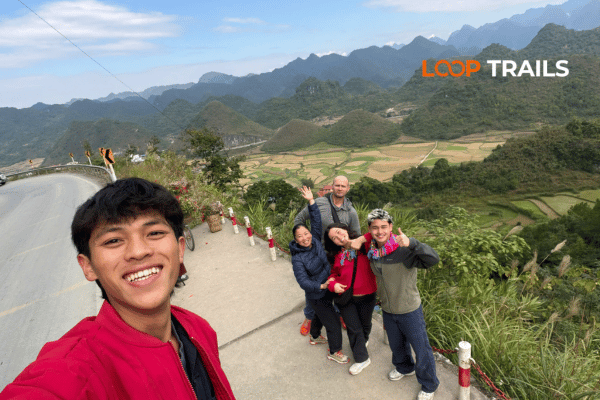
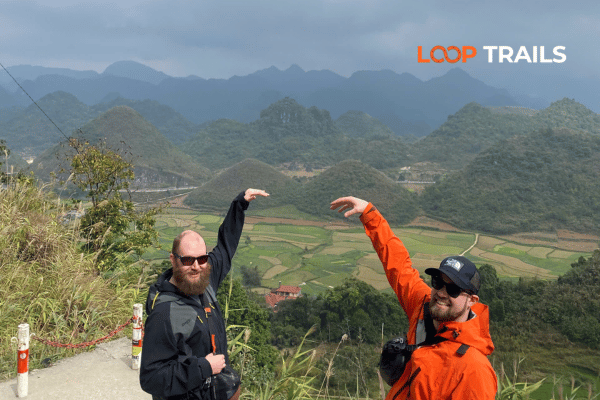
The first time you round that corner on the Ha Giang Loop and see the Twin Mountains rising from the valley floor, it hits different. Most riders stop mid-turn, pull over wherever they can, and just stare. That’s Quan Ba Heaven Gate doing what it does best—making you forget about your itinerary for a solid ten minutes.
Heaven Gate sits about 45 kilometers north of Ha Giang City, right where the landscape starts getting serious. It’s technically the first major viewpoint on the classic loop route, which means it’s also your first real taste of what northern Vietnam has in store. And honestly? It sets the bar pretty high.
This isn’t a place you “do” in five minutes. The viewpoint itself is straightforward enough, but the surrounding area—Quan Ba town, the valleys, the H’mong villages tucked into the hillsides—deserves more attention than most people give it. This guide covers everything: how to get there, what you’re actually looking at, when to visit, and how to fit it into your Ha Giang plans without rushing past one of the loop’s most iconic stops.
Learn more: Ha Giang Loop Tours
Learn more: Ha Giang in September & October
Let’s be clear: you’re probably going to pass Heaven Gate whether you plan to or not. It’s on the main route. But there’s a difference between a quick photo stop and actually experiencing the place.
Heaven Gate marks a geographical and cultural transition. Below this pass, you’re still in relatively gentle terrain. Above it, the landscape turns dramatic—sharp limestone peaks, deep valleys, terraced fields climbing impossible slopes. It’s where the Ha Giang Loop stops being “a nice motorcycle ride” and becomes “the reason you came to Vietnam.”
The view from the top gives you context for everything that follows. You can see the road snaking north toward Yen Minh, the patchwork of rice terraces in the valley, and on clear days, layers of mountains fading into the distance. It’s one of those rare viewpoints where you can actually understand the scale of the landscape you’re about to ride through.
Beyond the view, Quan Ba itself is worth exploring. The town has stayed relatively low-key compared to Dong Van or Ha Giang City. You’ll find a handful of homestays run by H’mong families, a daily market that feels genuinely local rather than tourist-focused, and trails leading to villages where life moves at a completely different pace.
For photographers, Heaven Gate delivers throughout the day. Early morning brings mist filling the valleys. Midday light is harsh but emphasizes the limestone formations. Late afternoon gives you that golden glow everyone’s after. Each visit looks different.
If you’re on a tight loop schedule (the classic 3-day route), you’ll likely hit Heaven Gate on Day 1, which is perfect timing. Your legs are fresh, you’re still excited about every view, and it’s a manageable warm-up before the bigger climbs ahead.
Learn more: Ha Giang Motorbike Rental
Heaven Gate sits at the Quan Ba Pass (Đèo Quan Bạ), roughly 43 kilometers north of Ha Giang City on Highway QL4C. The viewpoint is at approximately 1,200 meters elevation—not the highest point you’ll reach on the loop, but high enough that you’ll notice the temperature drop.
GPS coordinates: 23.0736° N, 104.9614° E (these will get you to the main viewing platform).
The actual “gate” part is a traditional Vietnamese gate structure built at the highest point of the pass. It’s painted in bright colors and hard to miss. There’s a paved parking area just below it, and the main viewing platform extends out from the roadside.
From Ha Giang City, you’re looking at 60-75 minutes of riding, depending on your pace and how many times you stop for photos (which will be often). The road is good quality by Vietnamese mountain standards—fully paved, properly marked, and maintained regularly since it’s part of the main northern route.
Quan Ba town itself sits in the valley below the pass, about 3 kilometers down the northern side. Most people visit the viewpoint first, then continue to the town if they’re staying overnight or need supplies.
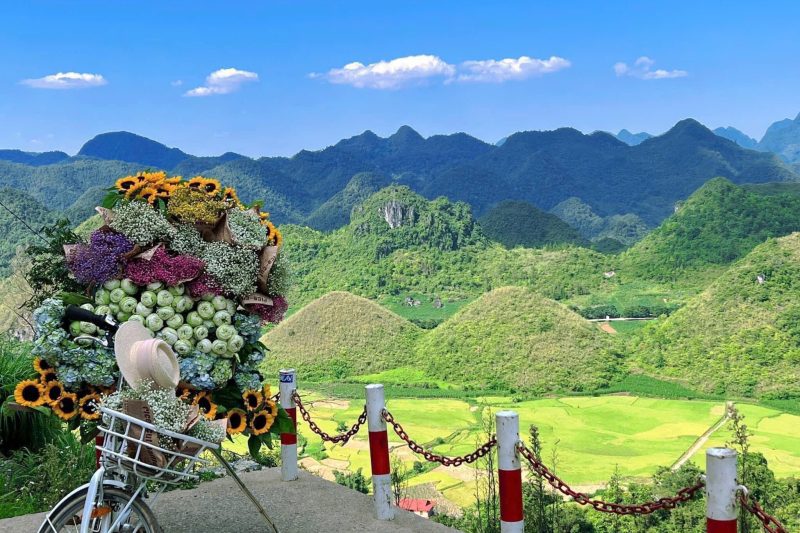
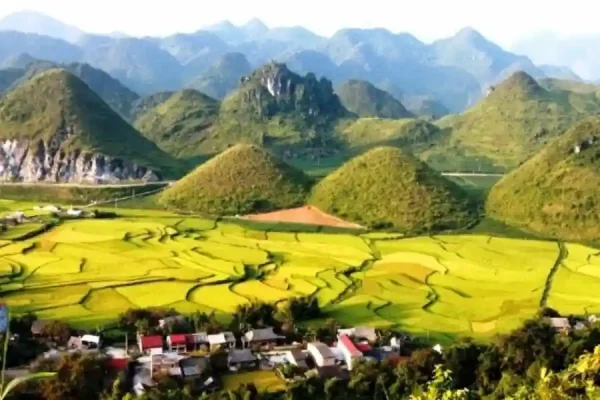
The Twin Mountains (Núi Đôi Cô Tiên) that everyone photographs are actually southwest of the gate, visible from the platform. They’re not part of the pass itself but dominate the landscape in that direction.
One thing that confuses some riders: there are actually multiple viewpoints along this stretch of road. The official Heaven Gate platform is the main one, but you’ll see several pull-off spots where locals sell drinks and snacks, each offering slightly different angles of the valley. The best view is from the main platform, but it’s worth walking 50-100 meters in either direction along the road to see how the perspective changes.
Learn more: Ha Giang Loop for Families & Groups
Local H’mong people call them Núi Đôi Cô Tiên, which translates to “Fairy Bosom Mountains.” Yes, they’re shaped like breasts. The resemblance is not subtle, and it’s the first thing everyone notices, though most guidebooks dance around it with vague descriptions about “twin peaks.”
The legend goes like this: A fairy fell in love with a human and came down from heaven to be with him. When the Jade Emperor discovered this forbidden relationship, he turned her to stone as punishment. The two mountains are said to be her breasts, forever watching over the valley where her lover lived.
It’s a tragic story, and like most mountain legends in this region, it speaks to the deep animist beliefs that H’mong culture is built on. The landscape isn’t just scenery—every rock formation, every unusual peak has a story connecting it to the spirit world.
What makes the Twin Mountains geologically interesting is that they’re limestone karst formations, created over millions of years by water eroding the softer rock and leaving these harder peaks behind. The distinctive rounded shape comes from weathering patterns specific to this type of limestone. The valley between them was likely a river course at some point in the distant past.
From certain angles, especially at sunrise when mist pools in the valley, the mountains look like they’re floating. Locals say the best time to see them is early morning or late afternoon when the light hits the western faces and brings out the texture of the rock.
The surrounding area is primarily used for agriculture. You’ll see terraced fields climbing the lower slopes, corn and rice depending on the season, and small clusters of H’mong houses scattered across the hillsides. During planting and harvest seasons, the valley comes alive with activity—entire families working the fields, traditional clothing bright against the green of the terraces.

Learn more: Ha Giang in September & October
The Ha Giang Loop is rideable year-round, but Quan Ba specifically has seasons where it really shines.
September to November is peak season for good reason. The rice terraces are golden and ready for harvest, weather is stable (mostly dry with clear skies), temperatures sit comfortably in the 20-25°C range during the day, and visibility is excellent for long-distance views. Downside: more tourists, which at Heaven Gate means the platform can get crowded between 10am-2pm.
December to February brings cold weather—genuinely cold, not “tropical cold.” Temperatures at the pass can drop to 5-10°C, especially in the mornings. Mist and low clouds are common, which can completely obscure the view. But when it clears? The landscape is incredible. The air is crisp, the light is sharp, and you’ll have the place mostly to yourself. Pack layers.
March to May is wildflower season in the mountains. The terraces are being prepared for planting, so they’re less photogenic than harvest season, but the hillsides explode with color—peach blossoms, plum blossoms, and wild flowers everywhere. Weather is transitional, which means some perfect days and some wet ones. Bring rain gear.
June to August is monsoon season. It will rain. Maybe not every day, but often enough that you need to plan around it. The upside: everything is incredibly green, waterfalls are flowing, and prices are lower because it’s off-season. The rice terraces are lush but not yet golden. Roads can be slippery, and landslides are possible on this route, though the main highway is usually cleared quickly.
Time of day matters as much as season. Most tour groups and self-drive riders hit Heaven Gate between 10am-2pm because it’s a natural stopping point on Day 1 from Ha Giang City. If you want the platform to yourself, aim for early morning (before 8am) or late afternoon (after 4pm). Sunrise and sunset both offer great light, though sunset is trickier because you’re looking primarily east and south from the viewpoint.
Weather can change fast at this elevation. I’ve seen the view go from crystal clear to completely socked in with fog in under 20 minutes. If you arrive and can’t see anything, wait it out for 30-45 minutes if you have time. The clouds often move through rather than settling in.
Learn more: Ha Giang Loop Self-Driver
You’ve got three main options, each with different trade-offs in cost, comfort, and freedom.
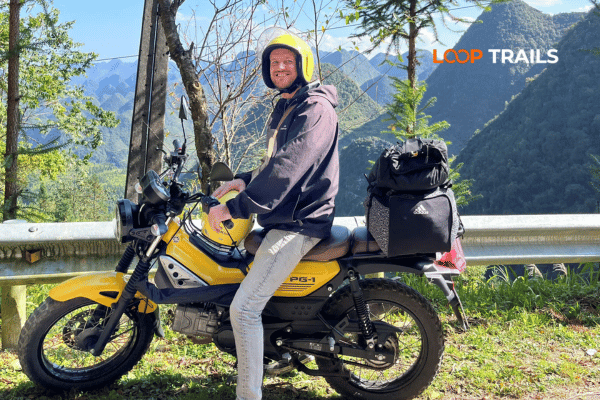
The standard choice for independent travelers. Rent a semi-automatic or manual bike in Ha Giang City, load up your bags, and head north on Highway QL4C. The route is straightforward—you’re following the main road the entire way, and signs point toward Dong Van/Meo Vac (Quan Ba is on the way).
The road from Ha Giang to Quan Ba is one of the easier sections of the loop. It’s fully paved, wide enough for two vehicles in most places, and well-maintained. There are a few tight corners as you approach the pass, but nothing technical. If you can ride comfortably in traffic, you can handle this road.
Expect 60-75 minutes of riding time, not counting stops. You’ll want to stop—there are multiple viewpoints along the way, and the landscape gets increasingly dramatic as you climb.
Rental bikes in Ha Giang typically run 150,000-250,000 VND per day depending on the model. Semi-automatic bikes (Honda Wave, Yamaha Sirius) are cheaper and easier for beginners. Manual bikes (XR150, Win, XR125) offer more power and control but require clutch/gear shifting experience.
Important: Vietnamese law requires a valid motorcycle license. For bikes over 50cc (which is everything you’ll be offered), that means either a Vietnamese license or an International Driving Permit with motorcycle category. Police checkpoints are common on this route, and fines for riding without proper documentation have increased significantly. Check current requirements before your trip.
Fuel is available in Ha Giang City before you leave, and there are several stations along the route plus one in Quan Ba town. A full tank will easily get you to Quan Ba and back if needed.
Learn more: Ha Giang Loop Easy Rider
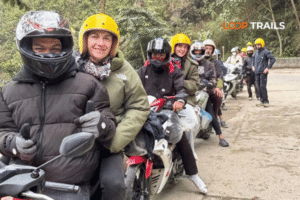
An Easy Rider is a local guide who drives you on the back of their motorbike. You don’t ride—you’re the passenger. This option has gotten more popular as people realize the Ha Giang Loop requires real riding skill, not just “I rented a scooter in Thailand once” experience.
Benefits: your guide knows the roads, can navigate without you thinking about it, handles all the mechanical issues if something breaks, takes you to viewpoints and villages you’d miss on your own, and can explain what you’re looking at in terms of culture and history.
Drawbacks: you’re not in control of the pace, you need to trust your guide’s riding ability (most are excellent, but ask to meet them before committing), and it’s more expensive than self-drive.
Easy Rider guides from Ha Giang to Quan Ba and beyond typically charge $30-50 USD per day depending on the itinerary and group size. This usually includes the guide’s accommodation and meals, though you pay for your own. Most experienced guides speak decent English and can handle bookings for homestays along the route.
For Heaven Gate specifically, a good guide will time your arrival to avoid crowds, know which viewing spots have the best angles, and give you context about the Twin Mountains legend and local culture. Worth considering if riding isn’t your priority.
Learn more: Ha Giang Cao Bang Loop Jeep tour Guide
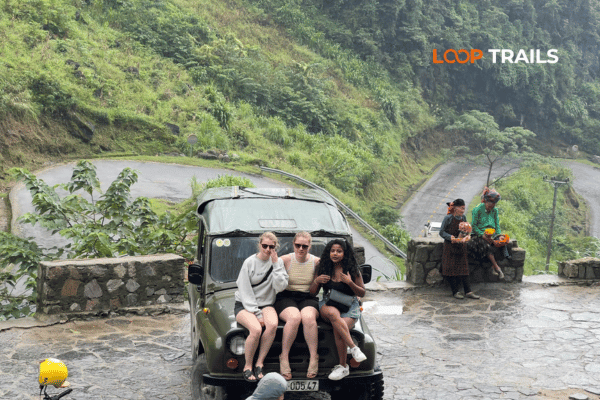
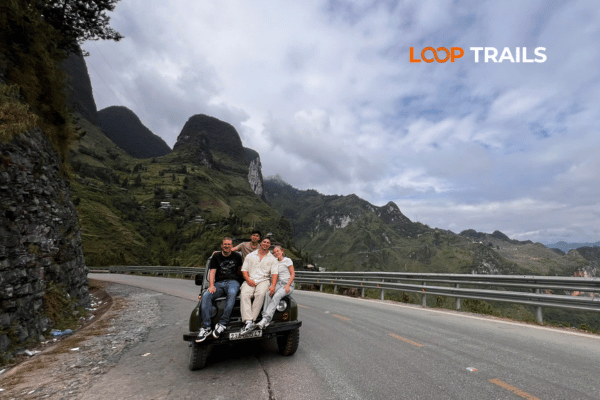
The comfortable option. You’re in a 4×4 with a driver and typically 2-5 other travelers. Jeeps can access all the same routes as motorbikes, and while you lose some of the wind-in-your-face freedom, you gain weather protection, luggage space, and the ability to actually relax and enjoy the views without worrying about the road.
Jeep tours of the Ha Giang Loop typically run 3-4 days and include Ha Giang City pickup, all transportation, most meals, and homestay accommodation. Heaven Gate is a standard stop on Day 1. Expect to spend 15-30 minutes at the viewpoint depending on the group’s interest.
Cost is higher—usually $150-250 USD per person for a full loop—but everything’s handled for you. Good for couples, families, or anyone who wants the experience without the physical demands of riding.
The trade-off is less flexibility. You’re on the group’s schedule, you stop where the tour stops, and you don’t get to explore side roads or linger at places that catch your attention.
For Quan Ba specifically: if you’re considering options, a jeep or Easy Rider makes sense if you’re primarily interested in the scenery and culture. Self-drive makes sense if you want the riding experience itself. There’s no wrong choice—just different priorities.
Learn more: Ha Giang Loop Photography
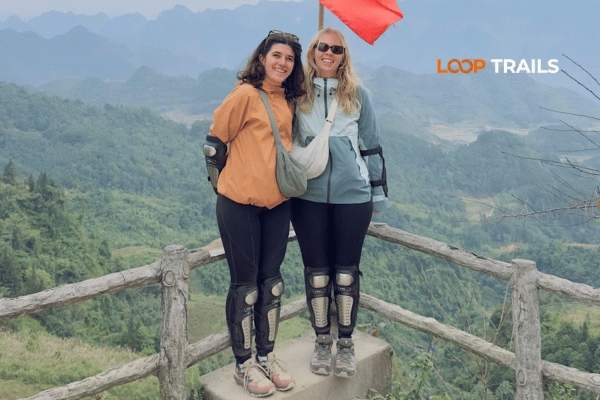
The viewing platform at Heaven Gate is a concrete terrace extending about 20 meters from the roadside, with metal railings and a few weathered benches. It’s not fancy. The architecture is functional Vietnamese tourist infrastructure—built to handle crowds, designed for photos, maintained enough to be safe.
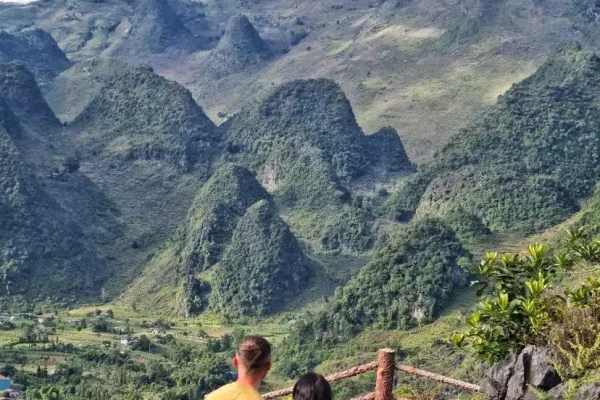
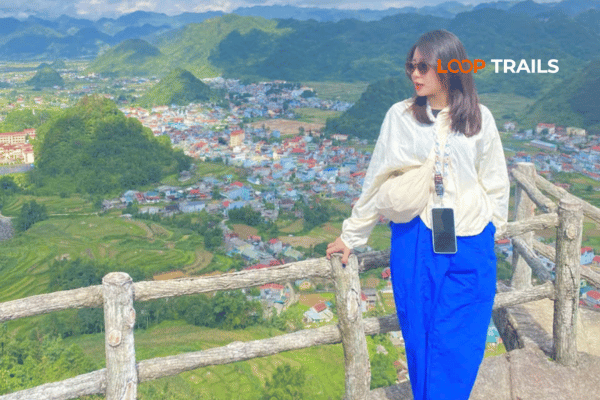
What you’re here for is the panorama. From the platform, you’re looking south and west over the Quan Ba valley. The Twin Mountains dominate the middle distance, rising from the valley floor about 3 kilometers away. Between you and them, the land drops away in layers—terraced fields, patches of forest, clusters of houses with corrugated metal roofs catching the light.
On clear days, you can see 20-30 kilometers across the valley to the mountain ranges beyond. The scale is disorienting. Those mountains that look close? They’re hours away by road. The fields that look tiny? They’re big enough that families spend entire days working them.
The famous Heaven Gate arch sits at the highest point of the pass, painted in red and gold, Vietnamese characters declaring this the “Gate of Heaven.” It’s a popular photo spot. Expect to wait your turn during peak hours.
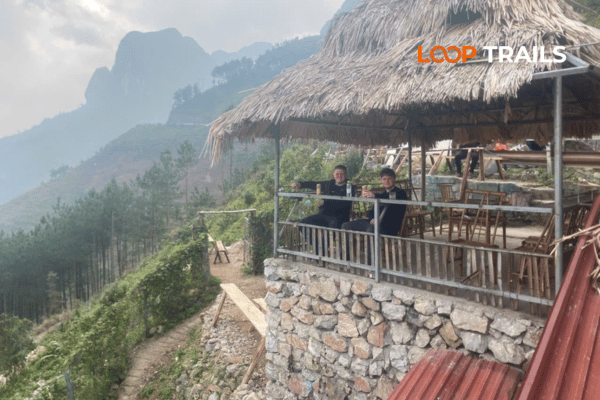
Facilities are basic. There’s a small parking area that fits maybe 20 motorbikes and 4-5 cars. A couple of local vendors set up stalls selling drinks (water, soft drinks, beer), instant noodles, and snacks. Prices are slightly inflated but not unreasonable—expect to pay 15,000-20,000 VND for a bottle of water instead of the usual 10,000.
There are no admission fees. No tickets, no gates, no one collecting money to access the viewpoint. It’s just a pull-off on a public highway.
Bathrooms exist but are squat toilets in rough condition. If you’re particular about restroom facilities, use the ones in Ha Giang City before you leave or wait until you reach Quan Ba town.
Photo opportunities: The classic shot is from the platform looking toward the Twin Mountains with the valley spread out below. For better angles, walk north along the road for 50-100 meters—there are several informal pull-offs where you can shoot without other people in frame. The view looking back south toward Ha Giang is also worth capturing.
Drone pilots: the area is technically open for drone flying (no restricted airspace), but wind can be tricky at the pass. Locals are generally fine with drones as long as you’re respectful about not flying directly over houses or livestock.
How long to spend here: Most people allocate 20-30 minutes—enough time to take in the view, grab some photos, use the bathroom, and have a drink. If you’re really into photography or just want to sit and absorb the landscape, an hour isn’t excessive. The view changes as clouds move through and light shifts.
One thing worth noting: Heaven Gate can be anticlimactic if you’re expecting some kind of Instagram paradise with nobody else around. It’s a popular stop. During high season, there will be other travelers. The view itself lives up to the hype, but the experience is what you make of it.
Learn more: Ha Giang Loop 4 Days 3 Nights
Most travelers treat Quan Ba as a photo stop and keep moving, which is a shame because the town and surrounding area have more to offer than that viewpoint.
Quan Ba town sits in the valley below Heaven Gate, a spread-out collection of concrete buildings, traditional H’mong houses, and working farmland. It’s small—you can walk from one end to the other in 15 minutes—but it’s a real town where people actually live and work, not a tourist creation.
Quan Ba Market operates daily but is most active early morning (5am-9am). It’s a proper local market where H’mong farmers from surrounding villages bring produce, livestock, and handmade goods to sell. You’ll see corn, rice, vegetables, fresh meat (hanging, not refrigerated—this is rural Vietnam), handwoven textiles, and whatever else is in season. It’s not a tourist market, which means prices are real, haggling is expected, and nobody’s trying to sell you souvenir trinkets. Bring cash in small denominations.
H’mong villages scatter across the hillsides around Quan Ba. Several are accessible by motorbike on small paved or dirt roads branching off the main highway. Nam Dam village (about 4km from town) is one of the larger settlements, with traditional wooden houses on stilts and families willing to show visitors around their homes and explain their way of life. Always ask permission before entering someone’s property or taking photos of people. A small gift (fruit, school supplies for kids) is appreciated but not required.
Walking trails connect Quan Ba to nearby villages and viewpoints. The trail from town up to Heaven Gate is about 3 kilometers and takes 60-90 minutes climbing. It’s steep but manageable, and you’ll see terraced fields up close and pass through working farmland. Local kids sometimes offer to guide you for a small fee.
Local food in Quan Ba is simple and good. Several small restaurants along the main street serve phở, bún (rice noodles), cơm (rice plates), and local specialties like thắng cố (a H’mong soup made with horse meat and organs—an acquired taste). Meals run 30,000-50,000 VND. Don’t expect English menus or air conditioning. Do expect generous portions and genuine hospitality.
Homestays in Quan Ba give you direct access to H’mong family life. You’ll sleep in a shared room (usually mattresses on the floor or in simple beds), eat meals with the family, and often end up drinking corn wine while the grandmother tells stories nobody can translate properly. It’s basic—squat toilets, cold or tepid showers, no privacy—but culturally rich. Expect to pay 100,000-150,000 VND per person including dinner and breakfast.
Night sky: If you stay overnight in Quan Ba, get away from town lights after dark. The sky here is genuinely dark, and on clear nights the stars are absurd. The Milky Way is visible to the naked eye. Bring a flashlight for getting around.
If you have time in your loop itinerary, spending a night in Quan Ba town rather than just passing through adds depth to the experience. The viewpoint is spectacular, but the valley life below it is where you’ll actually connect with the place.
Learn more: Ma Pi Leng Pass
The Ha Giang Loop delivers viewpoint after viewpoint, and eventually they start to blur together. Here’s how Heaven Gate compares to the other major spots you’ll encounter.
Ma Pi Leng Pass: The most famous viewpoint on the loop, about 90 kilometers north of Heaven Gate. Ma Pi Leng is more dramatic—sheer cliffs dropping to the Nho Que River, the road carved into the mountainside, genuinely dizzying heights. If Heaven Gate is impressive, Ma Pi Leng is intimidating. It’s the loop’s showstopper. Heaven Gate is the warm-up.
Lung Cu Flag Tower: The northernmost point in Vietnam, marked by a massive flag tower. The view from here is primarily about the symbolism (you’re literally standing at the top of the country) rather than dramatic landscape. It’s worth the detour if you’re a completionist, but purely for scenery, Heaven Gate is better.
Dong Van Karst Plateau viewpoints: Multiple pull-offs along the plateau between Dong Van and Meo Vac offer expansive views of the karst landscape—sharp limestone peaks, deep canyons, terraced fields. These are more abstract and geological than Heaven Gate’s defined composition with the Twin Mountains.
Heaven Gate’s advantage is accessibility and composition. You don’t need to hike or take a side trip—it’s right on the main route. The view has clear focal points (the Twin Mountains, the valley, the terraced fields) that photograph well and are easy to comprehend. It’s beautiful without being overwhelming.
Other viewpoints require more effort or offer different types of beauty. Ma Pi Leng demands respect and gives you vertigo. Lung Cu is about national pride. Dong Van plateau is alien and austere. Heaven Gate is welcoming and scenic in a classic mountain-valley way.
If you’re only doing a quick trip and can only hit one or two viewpoints, I’d still rank Ma Pi Leng higher for sheer impact. But Heaven Gate is a solid second, and for many people, it’s actually their favorite because it’s less intense—you can enjoy it without the adrenaline spike that comes from standing next to a 1,000-meter cliff.
Learn more: Ha Giang Cao Bang 5 Days
Accommodation in Quan Ba breaks down into three categories: homestays, small guesthouses, and one or two slightly more formal hotels. Don’t expect resorts or boutique properties. This is basic mountain-town lodging.
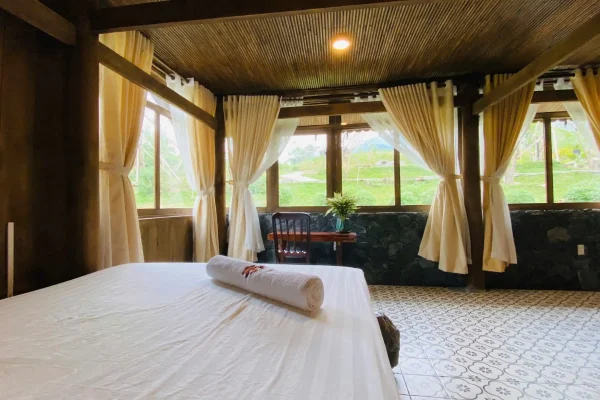
Homestays are the most authentic option and usually the cheapest. You’re staying with a H’mong family in their home, sharing their space and their meals. Rooms are simple—mattresses on wooden platforms or basic beds, shared bathrooms, minimal furniture. Dinner and breakfast are included in the price (typically 100,000-150,000 VND per person per night) and are communal affairs with the family and other guests.
The trade-off for basic facilities is genuine cultural exchange. You’ll learn how corn wine is made, watch traditional textile weaving, hear stories about village life, and probably end up in conversations that push your language skills and patience to the limit. Some homestay hosts speak basic English, others don’t. Hand gestures and translation apps become your friends.
Quality varies between homestays. Some are well-set-up for tourists with cleaner bathrooms and more comfortable beds. Others are just families opening their homes with minimal preparation. Ask other travelers or your tour operator for recommendations if you’re particular about conditions.
Guesthouses in Quan Ba town offer slightly more privacy and better facilities than homestays. Expect private rooms with actual beds, Western toilets (sometimes), and maybe hot water if you’re lucky. Prices run 150,000-250,000 VND per room per night. Breakfast may or may not be included. These places are basic but functional—somewhere to sleep and shower that won’t be an adventure.
Mini-hotels like Quan Ba Hotel or similar properties offer the most comfort available in town. Rooms with attached bathrooms, hot water that actually works, WiFi (spotty but present), and maybe air conditioning or a fan. Expect to pay 300,000-400,000 VND per room. By urban Vietnamese standards these are budget hotels, but in Quan Ba they’re the upscale option.
Booking: Most accommodations in Quan Ba don’t use online booking platforms. If you’re doing a tour or traveling with an Easy Rider guide, they’ll handle reservations. If you’re self-driving, you can either call ahead (if you speak Vietnamese or have someone help), show up and ask around (works fine except during peak season weekends), or have your Ha Giang City hotel/hostel help you book.
During low season (June-August, December-February), accommodation is rarely full. Just show up and you’ll find something. During peak season (September-November), weekends can get busy, especially national holidays. Having a reservation helps.
Staying in Quan Ba vs. pushing on to Yen Minh: Many riders skip Quan Ba entirely and continue to Yen Minh for their first night on the loop. Yen Minh has more accommodation options and is a logical midpoint on the route. The trade-off is you’re adding another 30 kilometers of riding on Day 1. Quan Ba lets you stop earlier, rest, and enjoy the area more thoroughly. Yen Minh is more practical if you’re trying to cover ground efficiently.
No wrong answer. Just depends on your pace and priorities.
Learn more: Ha Giang Loop for Couples
Some things I wish I’d known before my first visit:
Parking: The designated parking area fills up during peak hours. If it’s full, you’ll see bikes parked along the roadside for 100+ meters in both directions. Park legally and fully off the road—traffic still moves through here, including buses and trucks. Lock your bike and take valuables with you.
What to bring: Water (the vendors charge premium prices and might run out during busy periods), snacks if you’re particular about food, sunscreen (zero shade at the viewpoint), a light jacket even on warm days (wind at the pass can be cold), and your camera with charged batteries.
Weather check: If you wake up to fog in Ha Giang City, Heaven Gate will likely be socked in too. Give it a few hours to burn off or be prepared for zero visibility. The weather at elevation changes fast—what’s clear at 8am might be foggy by 10am or vice versa.
Riding safely on the pass: The approaches to Heaven Gate have some tight switchbacks. Take them slowly, especially if you’re new to mountain riding. Watch for gravel or dirt on the road surface from trucks and farm vehicles. If you’re not confident descending on the north side (toward Quan Ba town), take it in first gear and use engine braking. Don’t ride the rear brake constantly or you’ll overheat it.
Interaction with locals: The vendors at Heaven Gate are friendly and not pushy. Buy something if you want it, decline politely if you don’t. Tipping isn’t expected. If you want to photograph people (vendors, farmers working nearby fields), ask permission first. Most people will say yes, some want a small payment (10,000-20,000 VND), some just want to see the photo on your camera screen.
Phone signal: Viettel and Mobifone both have coverage at Heaven Gate. Weaker than in towns but functional for messaging and basic internet. You can post that Instagram photo in real-time if that’s your thing.
Entrance fees and scams: As of my last check, there are no official fees to access Heaven Gate viewpoint. If someone tries to charge you an entrance fee, it’s not legitimate. The only money you should spend is what you voluntarily pay for food, drinks, or souvenirs from vendors.
Timing with tour groups: Most group tours (jeep and Easy Rider) arrive at Heaven Gate between 10am-1pm. Self-drive riders who left Ha Giang City in the morning hit it around the same time. If you want solitude, arrive before 9am or after 3pm.
Bathroom situation: The toilets are rough. If you can wait until Quan Ba town, do that. If you can’t, brace yourself and bring your own toilet paper.
Best photo angles: The standard shot from the main platform is fine but crowded. Walk 50-100 meters north along the road for better angles with fewer people. The viewpoint looking back toward Ha Giang from the north side of the pass (after you’ve gone through the gate and started descending) also offers a different perspective worth capturing.
If the view is obscured: Don’t automatically give up and leave. Fog and clouds move through quickly in the mountains. Wait 20-30 minutes and it might clear. I’ve seen days where the view went from zero visibility to crystal clear in under half an hour.
Respect the landscape: The terraces and fields you’re looking at are people’s livelihoods. Don’t climb fences or walk through crops for photos. Don’t leave trash. The beauty of the Ha Giang Loop depends on the land staying productive and the communities staying healthy.
Learn more: Ha Giang Loop route and itinerary
These are the errors I see travelers make at Heaven Gate and around Quan Ba:
Treating it as a 5-minute photo stop. Yes, you’re on a schedule. Yes, there’s more road ahead. But if you’re rushing through Heaven Gate just to tick a box, you’re missing the point. Twenty minutes minimum. Thirty is better. An hour if you’re really feeling it.
Not checking weather before riding up. If it’s foggy or raining heavily, the viewpoint offers nothing. Monitor conditions and adjust timing if needed. Starting from Ha Giang City at 6am instead of 9am can mean the difference between clear views and complete whiteout.
Riding the pass without proper bike skills. The approaches to Heaven Gate are not technical, but they’re also not flat city streets. If you’ve never ridden a motorcycle before, this is not the place to learn. Either get training in Ha Giang City first, hire an Easy Rider, or take a jeep.
Ignoring the valley and town. The viewpoint gets all the attention, but Quan Ba town and the surrounding area have culture and daily life that’s arguably more interesting than landscape photography. Budget time to explore down there.
Assuming the vendors are trying to rip you off. Prices at Heaven Gate are slightly higher than in towns, but the vendors aren’t running scams. They’re selling drinks and snacks at a remote location where they have to transport everything up the mountain. Pay the asking price or don’t buy anything.
Not bringing layers. Ha Giang City might be warm, but the pass is 1,200 meters up and windy. Temperature can drop 10 degrees or more. A light jacket takes up minimal space in your bag and makes the stop much more comfortable.
Skipping Quan Ba entirely on the assumption there’s “nothing there.” There’s not a lot of tourist infrastructure, true. But there’s a functioning mountain town, a real market, accessible villages, and homestays where you can actually connect with local H’mong culture. For many travelers, these experiences matter more than viewpoints.
Taking unnecessary risks for photos. The railings at Heaven Gate are there for a reason. The drop on the south side of the platform is significant. Every year someone gets hurt or worse trying to get that perfect edge-of-the-cliff shot. The view is spectacular from behind the railing. Stay there.
Underestimating riding time from Ha Giang City. GPS says 43 kilometers. That’s accurate. What GPS doesn’t account for is the dozen times you’ll stop for photos on the way up, the slow pace on mountain curves, and the 20 minutes you’ll spend at the viewpoint. Budget 2-2.5 hours total for Ha Giang City to Quan Ba town including the Heaven Gate stop.
Not having cash. There are no ATMs at Heaven Gate. No card readers. The vendors take cash only. The nearest ATM is back in Ha Giang City or forward in Yen Minh. Bring enough small bills (20,000, 50,000, 100,000 VND) to cover drinks, snacks, and any purchases.
Riding after drinking. Corn wine flows freely in homestays. Beer is cheap and available everywhere. The mountain roads demand complete focus and quick reflexes. Don’t mix the two. If you’re staying in Quan Ba and drinking at night, sleep it off before riding the next morning.
Learn more: Ha Giang Loop 3 Days 2 Nights
Most people doing the classic 3-day Ha Giang Loop hit Heaven Gate on Day 1. Here’s how it typically fits into different itinerary structures:
Day 1: Ha Giang City → Quan Ba → Yen Minh → Dong Van (120-140km total)
You leave Ha Giang City in the morning, ride 40-45km to Heaven Gate (1-1.5 hours), spend 20-30 minutes at the viewpoint, continue through Quan Ba town, and push on to either Yen Minh or Dong Van for the night. Most tours and self-drive riders overnight in Dong Van, which means Day 1 is a long riding day (5-6 hours in the saddle not counting stops).
This schedule works but it’s rushed. You get the Heaven Gate view but don’t explore the area.
Alternative Day 1: Ha Giang City → Quan Ba (overnight in Quan Ba town)
Shorter riding day (45km, 1.5-2 hours), more time to explore the town and nearby villages, relaxed evening at a homestay. Day 2 becomes longer (Quan Ba → Dong Van → Meo Vac → Du Gia), but you’re more rested and have deeper experience of Quan Ba.
With an extra day, you can build in more exploration time. Common structure:
This gives you the full morning in Quan Ba for market visits and village exploration, then proceeds at a comfortable pace through the rest of the loop.
Learn more: Ha Giang to Cao Bang
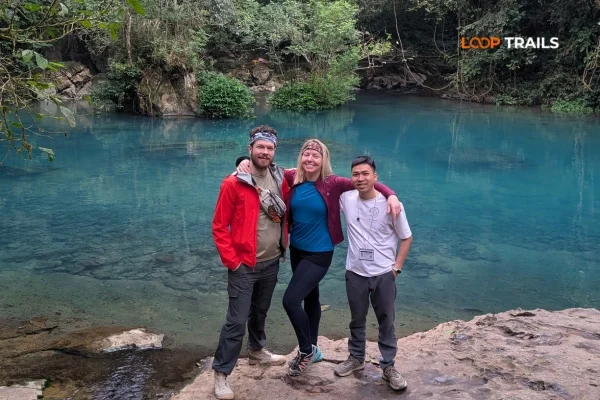
Some travelers extend their trip to include both loops (Ha Giang Loop + Cao Bang Loop). In this case, Quan Ba fits into the Ha Giang portion, and you’d continue from the end of the Ha Giang Loop (usually back to Ha Giang City) and then travel to Cao Bang City to start the second loop covering Ban Gioc Waterfall, Nguom Ngao Cave, and the Cao Bang highlands.
The combined trip typically takes 5-7 days total. Heaven Gate remains a Day 1 stop for the Ha Giang section.
If you’re leaving Ha Giang City:
Most experienced riders and tour operators prefer the early start. You get the best of everything—light, views, solitude—and still have the full day ahead for continuing the loop.
If you’re booking a loop tour that includes Heaven Gate, confirm the itinerary details:
Different operators structure their routes differently. Some rush through Heaven Gate in 15 minutes, others build in time for town exploration. Know what you’re getting.
If you’re riding independently, Heaven Gate is straightforward to navigate to—just follow QL4C north from Ha Giang City. No complex turns or unmarked roads. The main decision is whether to overnight in Quan Ba or push through to Yen Minh/Dong Van.
Factors that should influence this:
There’s no universal “best” itinerary. Match your route to your interests and energy levels
Worth stopping at. Yes, it’s popular and you won’t be alone, but the view genuinely delivers. It’s one of the clearest, most photogenic viewpoints on the loop with the Twin Mountains providing a natural focal point. Overhyped might apply to something disappointing—Heaven Gate isn’t that. Just don’t expect empty wilderness. Expect a beautiful view with other travelers around.
60-75 minutes of actual riding time. Add stops for photos and you’re looking at 1.5-2 hours total. The road is good quality and not technically difficult, so most riders can maintain a steady 40-50 km/h pace on the straights with slower speeds on curves.
Heaven Gate offers the best and most famous view, but the Twin Mountains are visible from multiple points along the road in that area. Both approaching from Ha Giang City and heading north from the pass, you’ll catch glimpses. The town of Quan Ba also has clear views from certain streets and from the surrounding hillsides. Heaven Gate just provides the most dramatic elevated angle.
No official entrance fee as of current information. It’s a public viewpoint on a public highway. The only costs are whatever you choose to spend on drinks, food, or souvenirs from the vendors who set up stalls there. Always check for latest updates as policies can change.
Cooler and windier. The pass sits at about 1,200 meters elevation, which means temperatures run 5-10°C lower than down in Ha Giang City. Wind at the pass can be strong, especially in winter months. If it’s foggy or cloudy in Ha Giang City, Heaven Gate will likely have reduced visibility. Clear days in the city usually mean clear days at the pass.
The road itself is manageable for beginners who have basic motorcycle control skills—balance, throttle control, braking, and turning. It’s paved, well-maintained, and not excessively steep or narrow. However, “beginner” should mean “has ridden a motorbike before and is comfortable with basic maneuvers,” not “never touched a motorcycle until today.” If you’ve truly never ridden, take an Easy Rider or jeep. If you’ve ridden scooters or small bikes before, you can handle this road with caution.
Depends on your pace and interests. Staying in Quan Ba gives you time to explore the town, visit the market, see nearby villages, and experience a homestay. It makes Day 1 shorter and less rushed. Continuing to Yen Minh or Dong Van adds 30-60km of riding but puts you in position for Day 2’s highlights. If you’re interested in culture and don’t mind basic accommodations, overnight in Quan Ba. If you want to cover ground efficiently and prefer slightly better facilities, push to Yen Minh. Both work.
Layers. Start with whatever’s comfortable for riding in Ha Giang City, then add a light jacket or long-sleeve shirt for the viewpoint. Wind at the pass makes it feel colder than the actual temperature. Long pants are more practical than shorts for riding. Closed-toe shoes with good grip (sneakers, hiking shoes, riding boots) are safer than sandals. A hat helps with sun at midday, but make sure it’s secured so it won’t blow away.
The main viewing platform is accessible from the parking area via a short walk on a paved path with gentle slope. No stairs required to reach the standard viewpoint. However, the platform itself has uneven surfaces, and the railing may not meet Western accessibility standards. Getting to Heaven Gate requires either riding a motorbike (not accessible), being a passenger with an Easy Rider (possible if you can mount/dismount a bike), or taking a jeep (most accessible). Once there, the viewing area is reachable without strenuous hiking.
Generally yes, as the area isn’t designated restricted airspace. However, wind at the pass can be tricky for smaller drones. Be respectful of other visitors and locals—don’t fly over people, don’t buzz motorcycles on the road, don’t hover directly over houses or livestock. Vietnamese drone regulations require registration for certain drone weights and commercial use. For recreational flying, most travelers don’t encounter issues, but regulations can change. Check current rules before your trip.
September through November offers the most consistent clear weather and stable visibility. March through May is also good, though you’ll encounter more variable conditions. Avoid June through August if clear views are your priority—monsoon season brings frequent cloud cover and rain that can obscure the mountains for hours or days at a time.
Peak season (September-November) between 10am-2pm can see 30-50+ people at the viewpoint at busy times, especially weekends and Vietnamese holidays. Early morning (before 9am) or late afternoon (after 3pm) reduces crowds significantly. Off-season (December-February, June-August) is much quieter—you might have the platform to yourself or share it with just a handful of others.
Contact information for Loop Trails
Website: Loop Trails Official Website
Email: looptrailshostel@gmail.com
Hotline & WhatSapp:
+84862379288
+84938988593
Social Media:
Facebook: Loop Trails Tours Ha Giang
Instagram: Loop Trails Tours Ha Giang
TikTok: Loop Trails
Office Address: 48 Nguyen Du, Ha Giang 1, Tuyen Quang
Address: 48 Nguyen Du, Ha Giang 1, Tuyen Quang
Facebook X Reddit Table of Contents Learn more: Ha Giang Loop Tours There’s a moment, usually somewhere on Ma Pi Leng Pass,
Facebook X Reddit Table of Contents Learn more: Ha Giang Loop Tours There’s a version of the Ha Giang Loop that people
Facebook X Reddit Table of Contents Learn more: Ha Giang Loop Tours There’s a moment on the Ma Pi Leng Pass —