
Vietnam UNESCO Global Geoparks Explained
Facebook X Reddit Table of Contents Learn more: Ha Giang Loop Tours The first time somebody told me the Ha Giang Loop

Thúy Kiều( Grace) is a travel blogger and content contributor for Loop Trails Tours Ha Giang. She holds a bachelor’s degree in Sustainable Tourism from Vietnam National University, Hanoi, and has a strong passion for exploring and promoting responsible travel experiences in Vietnam’s northern highlands.
Learn more: Ha Giang Loop Tours
You hear about Ha Giang before you get there. Another traveler at a hostel in Hanoi mentions it. A photo appears in your feed — a road carved into a cliff face, thousands of meters of nothing on one side, a river thread of impossible green far below. You file it away. A week later, sitting in the bus on the overnight ride north, you wonder what you’ve gotten yourself into.
Then you arrive, and you get it.
Ha Giang is Vietnam’s final frontier for adventure travelers — the last province before China, the least-visited highland region in the country, and home to a road trip that genuinely belongs on any list of the world’s great journeys. The Ha Giang Loop isn’t just a scenic drive. It’s three to five days of mountain passes, ethnic minority villages, UNESCO-listed karst geology, and evenings at local homestays that feel nothing like a tourist itinerary.
This guide covers everything: how to do the loop, how to choose between motorbike and jeep, what it costs, when to go, and what to expect on the ground. No padding, no generic travel advice. Just what you actually need to plan a Ha Giang adventure properly.

Learn more: Ha Giang Loop for Families & Groups
Most of northern Vietnam’s popular destinations — Sapa, Ha Long Bay, Ninh Binh — have been heavily developed for tourism. That’s not a criticism; they’re popular for good reasons. But they’ve also been polished smooth. The edges are gone.
Ha Giang still has edges.
The province sits at Vietnam’s northern extreme, sharing a long border with China’s Yunnan province. The landscape is dominated by the Dong Van Karst Plateau Geopark — a UNESCO Global Geopark and one of the few such designations in Southeast Asia. The karst geology here is ancient, dramatic, and unlike anything in the rest of Vietnam: grey limestone towers, narrow gorges, and valley floors so far below the road that you can only see them when the cloud clears.
The communities along the loop — H’Mong, Lo Lo, Giay, Tay, Nung — have maintained traditions that are disappearing elsewhere. Village markets, hand-dyed fabrics, wood-and-stone architecture, rice terraces that have been farmed in the same way for centuries. Tourism exists here, but it hasn’t yet overwhelmed the thing it came to see.
That balance won’t last forever. The best time to do Ha Giang is now.
Learn more: Ha Giang Loop for Beginers
The Ha Giang Loop is a roughly 350km circuit through the mountains of northern Ha Giang province. It departs from Ha Giang city, climbs north through Quan Ba and Yen Minh, reaches the remote Dong Van plateau, swings east through Meo Vac, then returns south through Du Gia and back to the city.
The road is real. It is not a smooth tourist highway. Parts of it are narrow single-lane mountain track with sheer drops on one side and rock walls on the other. The famous passes — Bac Sum, Ma Pi Leng, Tham Ma — require full attention whether you’re driving or riding. Trucks come the other way. Cows and goats appear around blind corners. After rain, some sections get slick.
None of that is said to frighten you off. Tens of thousands of travelers do the loop every year without incident. But going in with accurate expectations matters. This is adventure travel — you’re signing up for something that asks something of you.
What you get in return: scenery that makes you stop mid-sentence, a genuine encounter with communities most tourists never reach, and the particular satisfaction of arriving somewhere difficult under your own power (or, in a jeep, at least present for every meter of the journey).
Learn more: Hmong’s King Vuong Palace
There’s no single right way to do Ha Giang. The three main formats each suit different travelers, and understanding the difference matters more than most guides acknowledge.
Learn more: Ha Giang Loop Easy Rider
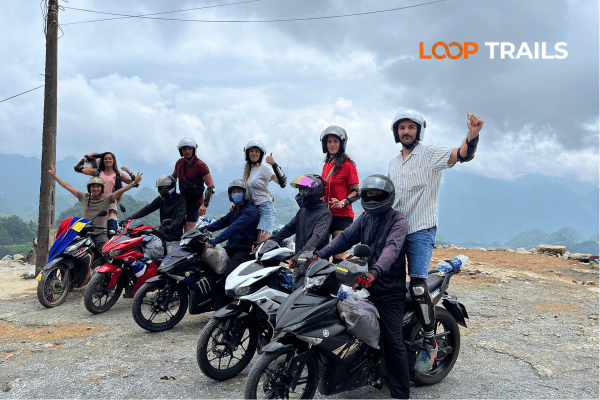
You ride pillion behind a local driver-guide — someone who knows these roads, speaks the languages of the villages you’ll pass through, and handles all the navigation, logistics, and interpretation while you hold on and look.
This is the most immersive format. You feel every turn, every wind change, every gradient shift. You’re low to the road, close to the landscape, with nothing between you and the scenery. When your guide stops to greet a village elder or explain the history of a particular valley, it happens spontaneously — not on a scheduled stop.
The easy rider format is best for solo travelers, those uncomfortable on motorbikes, anyone who wants depth of cultural engagement, and people who are simply willing to hand over control and trust the experience.
Easy rider pricing at Loop Trails:
Learn more: Ha Giang Loop Self-Drive
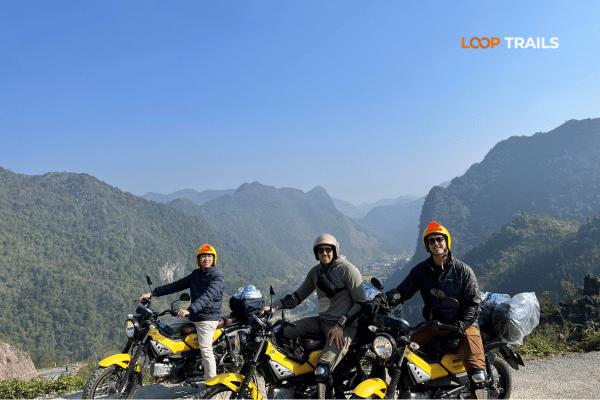
You ride your own motorbike, following a planned route with Loop Trails’ support infrastructure — accommodation pre-booked, guide available for questions, emergency backup in place.
This is the format for experienced riders who want the freedom of the road on their own terms. You stop when you want, stay as long as you like at any viewpoint, and experience the particular satisfaction of navigating Ha Giang’s passes under your own control. The commitment and the reward are both greater.
The self-drive option is not for beginners. The roads are genuinely technical in places — steep grades, loose gravel, hairpin turns, and traffic from trucks and locals who have very different relationships with mountain road etiquette than most Western riders. If you haven’t ridden motorbikes on mountain roads before, this is not the trip to start.
Self-drive pricing at Loop Trails:
(No self-drive option for the 2-day tour.)
Learn more: Ha Giang Jeep Tours
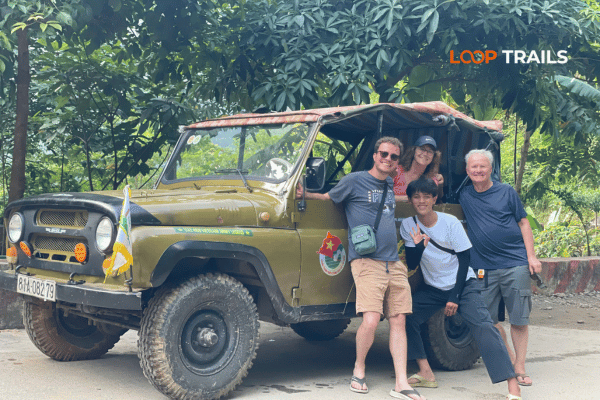
An open-air 4WD jeep, a local driver, and a guide — your whole group travels together in a single vehicle through every pass and valley of the loop.
The jeep format trades the physical intimacy of the motorbike for something different: height, comfort, safety, and togetherness. You sit above the landscape rather than inside it, which means genuinely panoramic views from every pass. You travel as a group — no convoys, no waiting, no splitting up. And when the afternoon rain hits (and it will), you’re the ones who aren’t pulling over.
Jeep tours suit families with children, couples who want to share the experience side by side, groups of 3–4 friends splitting costs, travelers 50 and over, and anyone who simply prefers not to be on a motorbike for six hours a day.
Jeep tour pricing at Loop Trails:
| Tour | 1 Person | 2 People | 3 People | 4 People |
|---|---|---|---|---|
| Loop 3D/2N | 8,990,000 VND | 16,990,000 VND | 19,990,000 VND | 22,900,000 VND |
| Loop 4D/3N | 11,990,000 VND | 22,990,000 VND | 26,990,000 VND | 30,990,000 VND |
| Loop + Cao Bang 5D/4N | — | 31,990,000 VND | 36,490,000 VND | 40,990,000 VND |
Still deciding between options? Check out our Ha Giang Loop Tours page for full details on each format, or drop us a message on WhatsApp — we’ll help you figure out which one fits your group.
Learn more: Ha Giang Cao Bang by Jeep and motorbike
Here’s the honest breakdown:
Choose Easy Rider if: You want full cultural immersion, you’re a solo traveler or pair, you’re not a confident motorbike rider but still want the feel of the road, or you want someone else to handle all the decisions while you absorb the experience.
Choose Self-Drive if: You’re an experienced motorbike rider with mountain road experience, you value complete freedom and spontaneity, and you’re comfortable with the physical demands and inherent risks of riding in remote mountain conditions.
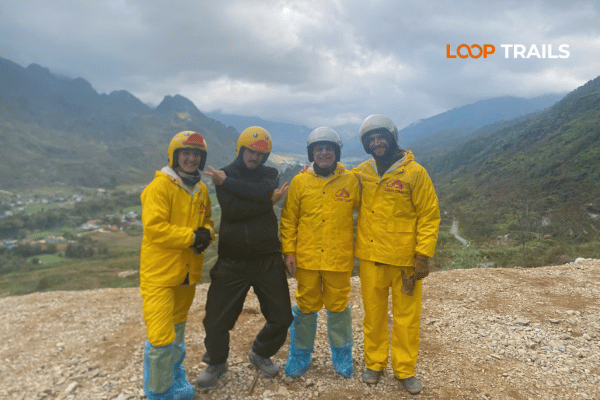
Choose a Jeep if: You’re traveling with family (especially kids), your group has mixed abilities or preferences, you want everyone together in one vehicle, you prefer comfort without sacrificing access to the same landscapes and villages, or you’re 50+ and want the experience without the physical toll.
There’s no wrong answer here. All three formats cover the same ground, visit the same highlights, and stay at the same homestays. The difference is how you experience the journey between stops.
Learn more: Ha Giang Cao Bang 5 Days
The Ha Giang Loop is typically done in 3 or 4 days, but shorter and longer options exist for different travelers and schedules.
2 Days / 1 Night (Easy Rider only) You cover Ha Giang → Heaven Gate → Yen Minh → Dong Van on Day 1, then Ma Pi Leng Pass → return on Day 2. You get the iconic highlights — Heaven Gate, Ma Pi Leng, Dong Van — but the pace is quick and you’ll miss the deeper stops. Best for travelers with very limited time who want a real taste rather than no taste at all.
3 Days / 2 Nights The most popular length. You cover the full loop circuit including Ma Pi Leng, Du Gia Waterfall, Vuong Palace, and Dong Van. One night at a Dong Van homestay, one night at Du Gia. You’ll feel like you’ve done Ha Giang properly. This is the minimum for most travelers.
4 Days / 3 Nights The recommended length for first-timers who want to do it right. The extra day adds Lung Cu Flag Tower (the northernmost point of Vietnam), Lo Lo Chai village, the Nho Que River boat tour through Tu San Canyon, and a slower overall pace that lets you actually breathe at each stop. Most travelers who do the 4-day say they’re glad they didn’t try to rush it into 3.
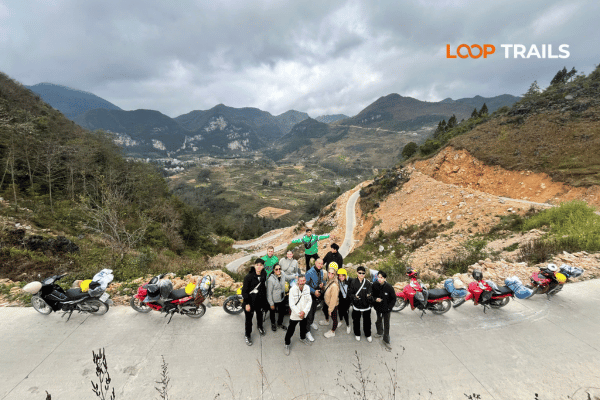
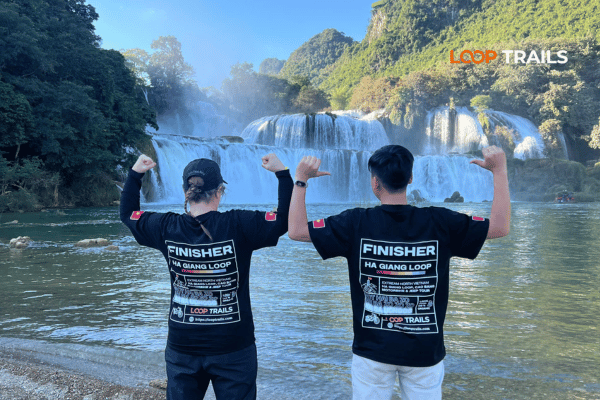
5 Days / 4 Nights: Ha Giang + Cao Bang For travelers with time and appetite for more. After the full Ha Giang Loop, the route continues east through Bao Lac, Ha Quang (with a night at Me Farmstay), and into Cao Bang province for Ban Gioc Waterfall — one of the most spectacular falls in Southeast Asia — and Nguom Ngao Cave. The tour ends in Cao Bang city. Two completely different landscapes in one trip.

Learn more: Quan Ba Heaven Gate
Every day on the Ha Giang Loop has its moments, but some places demand more than a quick photo stop.
The first major pass after Ha Giang city, where the road climbs out of the lowlands and the landscape transforms into something from a different world. From the top, on a clear day, you can see the Twin Mountains of Quan Ba — two round limestone hills rising from the valley floor like something from a myth. The Hmong call them the Fairy Bosom peaks. Whatever you call them, you’ll stop for longer than you planned.
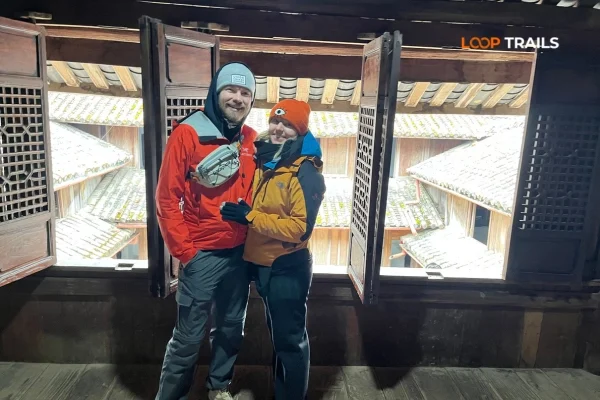
Hidden in Sung La Valley, this former royal residence of the H’Mong king Vuong Chi Sinh was built between 1919 and 1928 by artisans brought from China. The architecture is a hybrid of Chinese, Yunnanese, and H’Mong influences — courtyards within courtyards, carved wooden screens, a maze-like layout designed to confuse invaders. The history of the region, and of opium’s role in it, is everywhere if you ask the right questions of your guide.

Learn more: Ma Pi Leng Pass
The most famous road in Ha Giang, and for good reason. Ma Pi Leng stretches for about 20 kilometers along a cliff edge above the Nho Que River gorge — one of the highest points on the loop and one of Vietnam’s four legendary passes. The drop to the river below is somewhere between 800 and 1,000 meters depending on where you’re standing. The road itself is carved directly into the cliff face, a feat of road engineering that took thousands of workers years to complete.
The Ma Pi Leng Skywalk now extends out over the gorge at the pass’s highest point — a glass-floored viewing platform where you stand above Tu San Canyon and look straight down. It’s either exhilarating or terrifying, often both simultaneously.
Learn more: Tu San Canyon & Nho Que River Boat Trip
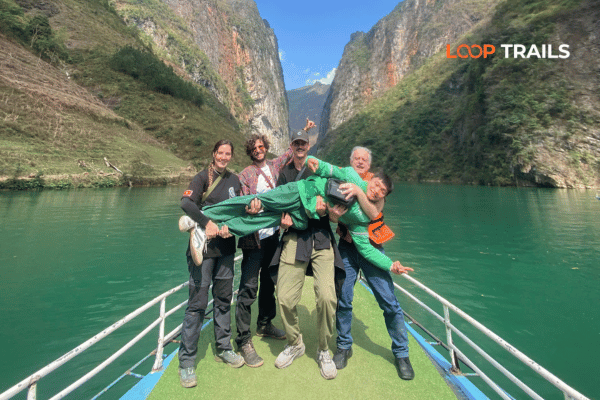
The gorge below Ma Pi Leng is among the deepest in Asia. The Nho Que River runs through it, and the color of the water changes season to season — jade green in dry months, milky turquoise after rain. On the 4-day itinerary, you access it by boat: a short river journey through the canyon walls with the cliffs rising hundreds of meters on both sides. Silence except for the motor. One of those moments that doesn’t translate to a photo.
Learn more: Lung Cu Flag Tower Guide
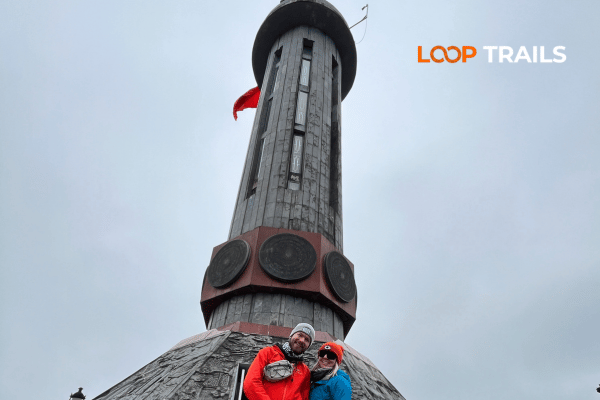
The northernmost point of Vietnam, marked by a 33-meter flagpole flying the Vietnamese flag from the top of Dragon Mountain. The climb takes 15–20 minutes and involves some steps. The view from the top extends into Chinese territory and across the karst plateau in all directions. Worth every step.
Learn more: Ha Giang Loop 4 Days 3 Nights
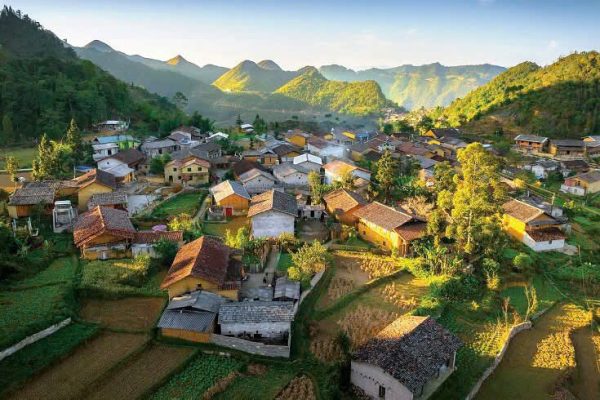
A short distance from Lung Cu, this village of the Lo Lo ethnic minority is one of the most intact traditional communities on the entire loop. The Lo Lo number only a few thousand people in Vietnam — their traditions, language, and distinctive textile work are genuinely rare. The wooden stilt houses, the hand-dyed indigo fabric drying on fences, the sound of the village in the morning — it’s one of those places that stays with you.
Learn more: Du Gia Waterfall
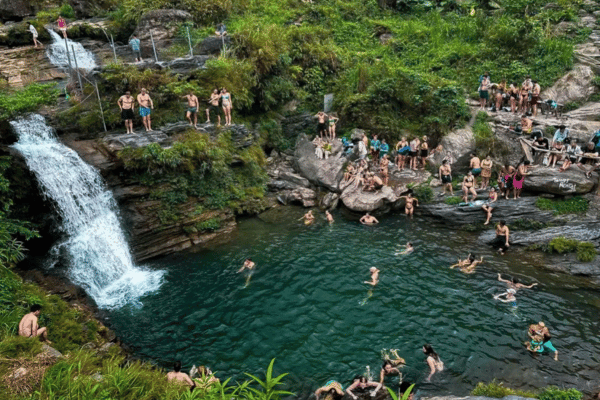
The last major stop before returning to Ha Giang city, Du Gia is a waterfall in a forested gorge near a small village. You can swim in the pool at the base. After days on mountain roads, it’s the best kind of full stop.
Learn more: Cao Bang Loop Tours Vietnam best kept secret
If the Ha Giang Loop is one of Southeast Asia’s great road trips, the Ha Giang–Cao Bang route is something rarer: two completely different landscapes, back to back, in a region almost no overland travelers combine into a single journey.
Cao Bang province sits east of Ha Giang, accessible via a mountain route through Bao Lac that few tourists use. The landscape shifts from Ha Giang’s grey karst towers to Cao Bang’s softer, greener hills and river valleys — different geology, different ethnic communities, different atmosphere.
The highlights of the Cao Bang extension:
Khau Coc Cha Pass — 15 hairpin bends carved into a single mountain, with views over Xuan Truong Valley.
Pac Bo Historical Site — a cave and spring where Ho Chi Minh lived secretly for years during the resistance against French colonial rule. Small, quiet, and surprisingly moving.
Ban Gioc Waterfall — at the Chinese border, this is one of the largest waterfalls in Southeast Asia. The scale only hits you when you’re standing in front of it.
Nguom Ngao Cave — Cao Bang’s most spectacular cave system, with stalactite formations large enough to walk through. Often described as more impressive than Phong Nha by travelers who’ve been to both.
God’s Eye Mountain — a circular limestone peak with a natural hole through the top. Unique geological formation and, frankly, just very strange and wonderful to look at.
The 5-day Ha Giang + Cao Bang tour ends in Cao Bang city, from where overnight buses run to Hanoi and other northern destinations.
For the full itinerary, pricing, and booking details, check out our Ha Giang–Cao Bang Combine Tour page.

Learn more: Ha Giang Sleeper Bus
Ha Giang city is approximately 300km north of Hanoi — a journey of around 5–6 hours by bus. Loop Trails can arrange transport from Hanoi, Ha Long, Cat Ba, Ninh Binh, and Sapa.
Bus options:
The overnight bus makes practical sense for most travelers: you save on one night’s accommodation, arrive rested (or close to it), and get straight to the loop. Loop Trails pre-arranges your check-in at the hostel so you can shower and rest before the Day 1 briefing.
For the 5-day Ha Giang + Cao Bang tour, the journey ends in Cao Bang — buses back to Hanoi and other northern Vietnam destinations depart from there.

Learn more: Ha Giang Loop Cost & Tips
Here’s what you’re actually spending on a Ha Giang trip, assuming you book a supported tour (the most common approach for first-timers):
Tour costs (all-inclusive: accommodation, meals, guide, transport during tour, entrance fees):
Bus to/from Ha Giang: varies by type — ask Loop Trails for current pricing when booking.
Room upgrade (private room vs. dorm at homestays): available at additional cost, ask when booking.
Pocket money on tour: your meals are included, but you’ll want cash for drinks, souvenirs, tips, and any optional extras. Budget around 200,000–500,000 VND per day as a buffer.
Travel insurance: strongly recommended. Check that your policy covers adventure activities and motorbike riding (if self-driving).
Learn more: Ha Giang Loop 3 Days 2 Nights
One of the things that makes the Ha Giang Loop genuinely different from most Vietnam trips is what happens after the riding stops.
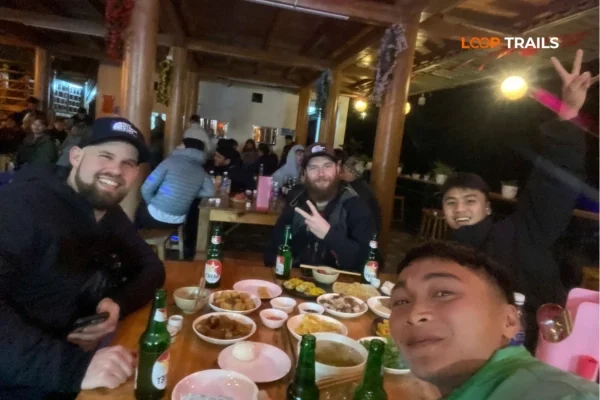
Homestays on the loop are locally owned — family homes in remote villages where a few guest rooms have been added to share the space and supplement the family’s income. They’re clean, simple, and warm. Not luxury. But the experience of sitting at a long table eating food cooked by your hosts while your guide translates the conversation across the rice wine is something that a hotel room can’t replicate.
Food: Expect generous portions of mountain vegetables, river fish (Nho Que catfish is a local specialty), pork, sticky rice, and tofu. If you have dietary restrictions, tell Loop Trails when you book — your guide will communicate to each homestay in advance. Vegetarian is manageable; vegan requires more planning in advance.
“Happy water”: Rice wine, served throughout the evening by your host. It varies wildly in quality and strength from village to village. You’re under no obligation to drink heavily — a small amount to toast the host is culturally appropriate and appreciated. Going hard on night one is a memorable mistake most people only make once.
Evening activities: Not scheduled, not staged. Your guide will often get a card game going, or the homestay family might bring out traditional instruments. At some stops, local cultural performances are organized. The atmosphere is social and genuinely fun.
Learn more: Ha Giang Loop License
This section is important. Read it before you book a self-drive tour.
The Ha Giang Loop roads are genuinely challenging. Steep grades, narrow lanes, loose gravel on switchbacks, and unpredictable traffic (trucks, farm vehicles, livestock) are all normal conditions. The danger is real but manageable with the right preparation and attitude.
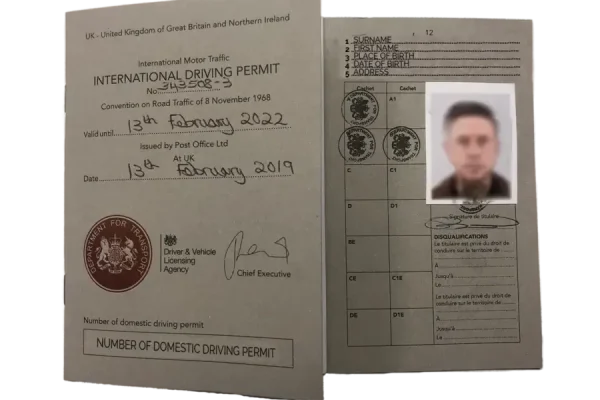
If you want to ride a motorbike yourself in Vietnam, the documentation requirements matter — and they’ve become more actively enforced in recent years.
To ride legally, you need:
The IDP 1949 Convention is not recognized in Vietnam — this catches a lot of travelers off guard, as the 1949 version is what’s issued in some countries (including some parts of the US). Check which version your country issues before assuming you’re covered.
Without the correct documentation, fines can range from 2,000,000 to 6,000,000 VND if stopped by traffic police. If you’re traveling with a Loop Trails guide (easy rider format), the guide can often assist with police communication if an issue arises — but this shouldn’t be relied on as a strategy.
Rules can and do change — verify current requirements with Loop Trails or through official Vietnamese traffic law updates before your trip.
If you’re on an easy rider tour (riding pillion) or a jeep tour (passenger), no driving license is needed. Your driver handles everything.
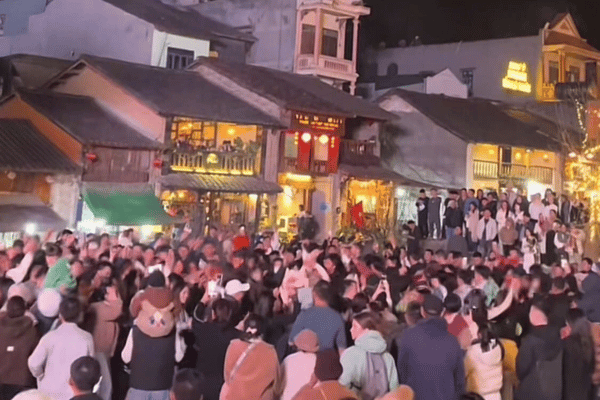
Learn more: Dong Van Old Quater at Night
Ha Giang is worth visiting year-round, but different seasons offer genuinely different experiences.
October–November (Peak Season) The golden buckwheat flower season. Fields of pale pink and white flowers across the Dong Van plateau, harvested after the rainy season for traditional food and drink. Clear skies, cool temperatures, best road conditions. This is when Ha Giang gets its most visitors — book well ahead.
March–April (Second Peak) Cherry blossom and plum blossom season. The loop is quieter than October–November and the light is softer. Still dry enough for good road conditions in most years.
May–August (Rainy Season) The rice terrace season — the terraces are vivid green at their most photogenic, and the landscape is lush in a way the dry months aren’t. Mist and cloud create dramatic atmosphere. But roads get wet and occasionally difficult. Not dangerous if you’re prepared, but demanding.
December–February (Winter) Cold, especially at altitude — Dong Van can drop to near freezing at night. Clear and dry during the day. Fewer tourists than any other season. If you don’t mind layers and are prepared for cold evenings, Ha Giang in winter is beautiful and uncrowded.

Learn more: Ha Giang Packing List
Pack light. You’re on a motorbike or in a jeep — everything you bring has to fit in a bag you don’t mind bouncing around.
Clothing:
Documents (self-drive):
Other essentials:
Learn more: Ha Giang Loop route and itinerary
Underestimating the riding time. Days on the loop are long — often 6–8 hours of movement including stops. If you’re on a motorbike, that’s physically tiring. Pace yourself, take breaks, and don’t push through fatigue on mountain roads.
Assuming ATMs will work between cities. There are ATMs in Ha Giang city, Dong Van, and Meo Vac. They’re not guaranteed to be functional. Bring all the cash you’ll need before you leave Ha Giang.
Renting a bike without checking documentation requirements first. The IDP 1949 vs 1968 issue catches travelers off guard regularly. Sort your documentation before you travel, not the morning of your tour.
Booking a 2-day tour when you have 3 days available. The 2-day option exists for people with genuinely no other choice. If you have an extra day, use it — the loop at pace is a completely different (better) experience than the loop in a hurry.
Skipping the boat tour on Nho Que River. It’s on the 4-day itinerary for a reason. If you’re on a 3-day tour and want to add it, ask Loop Trails whether it can be incorporated. The canyon from water level is one of the best experiences on the entire trip.
Overcommitting to the self-drive option. Ha Giang is not the place to “see if motorbike riding is for me.” If you’re uncertain about your riding experience, take the easy rider option. You’ll see and experience everything — you’ll just have both hands free to hold on.
Learn more: Ha Giang Motorbike Rental
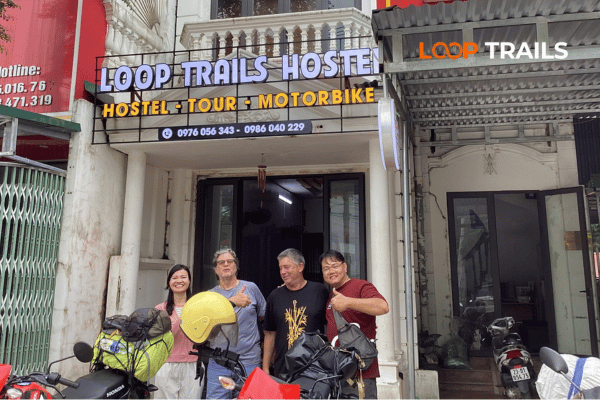
Loop Trails operates small-group tours from Loop Trails Hostel in Ha Giang city. The process is straightforward:
Solo travelers and pairs can often join shared tours at reduced cost — ask the team about current options if you’re traveling alone and watching your budget.
Ready to plan your Ha Giang adventure? Head to our Ha Giang Loop Tours page to see full options, or reach out on WhatsApp to talk through what’s right for your trip.
Yes — real experience on mountain roads, not just city riding. The Ha Giang Loop involves steep grades, tight switchbacks, loose gravel sections, and unpredictable traffic. If you’re uncertain about your skill level, the easy rider format lets you experience the same roads and stops from the back of a motorbike, with a professional driver in front.
On an easy rider tour, you ride pillion behind a local driver-guide who handles all the riding while you focus on the scenery and cultural experience. Self-drive means you ride your own motorbike with Loop Trails’ route support. Same destinations, completely different experience of the journey itself.
Yes, broadly speaking. The loop is well-traveled, Loop Trails guides accompany all tours, and the communities along the route are welcoming to tourists. Standard precautions apply: keep Loop Trails informed of your plans, trust your instincts if something feels off, and ride within your ability level if self-driving.
Technically yes — the road is public and you can hire or bring your own motorbike. But without a guide, you miss most of the cultural depth: the village access, the translations, the understanding of what you’re seeing and why it matters. And in case of a breakdown or incident in a remote area, a guide matters practically. Most travelers who’ve done it both ways say the guided format is worth it.
For easy rider and jeep tours: no specific fitness is needed. You’re sitting for most of the day, with short walks at specific stops (Lung Cu Tower, Ma Pi Leng Skywalk, caves). For self-drive: general physical fitness and core strength help when you’re on a motorbike for 6+ hours. Fatigue on technical roads is a risk factor.
Absolutely. Ha Giang works well as an early-trip experience — it’s a genuine introduction to northern Vietnam’s culture and landscape. Just allow a day in Hanoi to sort logistics (bus tickets, cash, any last gear) before heading north.
All meals as listed in the daily itinerary (B/L/D), accommodation (dorm basis), guide, motorbike or jeep with driver, and entrance fees to included sites. Bus transfers to/from Ha Giang and room upgrades to private rooms are not included in the base price.
Talk to Loop Trails on arrival if you’re considering extending. Subject to availability and how your existing tour is structured, adjustments are sometimes possible. Best to flag this before you start rather than midway through.
The loop operates year-round in all weather conditions. Heavy rain may occasionally require slowing down or briefly sheltering, but full cancellations are rare. Your guide will make real-time calls on pacing and safety. In extreme weather events (rare), Loop Trails will communicate alternatives.
Ha Giang city has normal connectivity. Signal on the loop is patchy to nonexistent in the more remote stretches — most of Dong Van, Meo Vac, and the mountain passes have limited coverage. Some homestays have WiFi. Tell people who might need to reach you that you’ll be offline for stretches — it’s part of the experience.
Contact Loop Trails to ask about current logistics — itinerary options and direction of travel can change based on transport and accommodation availability. Most departures originate from Ha Giang, but it’s worth asking.
Small group sizes, locally knowledgeable guides, transparent pricing, and a hostel base in Ha Giang that serves as a genuine starting point rather than just a booking intermediary. The brand philosophy is adventurous but safe — full access to the loop’s best experiences without cutting corners on preparation or support.
Contact information for Loop Trails
Website: Loop Trails Official Website
Email: looptrailshostel@gmail.com
Hotline & WhatSapp:
+84862379288
+84938988593
Social Media:
Facebook: Loop Trails Tours Ha Giang
Instagram: Loop Trails Tours Ha Giang
TikTok: Loop Trails
Office Address: 48 Nguyen Du, Ha Giang 1, Tuyen Quang
Address: 48 Nguyen Du, Ha Giang 1, Tuyen Quang
Facebook X Reddit Table of Contents Learn more: Ha Giang Loop Tours The first time somebody told me the Ha Giang Loop
Facebook X Reddit Table of Contents Learn more: Ha Giang Loop Tours The first time I rode into Cao Bang I kept
Facebook X Reddit Table of Contents Learn more: Ha Giang Loop Tours Every week someone sends us a message that begins the