


Thúy Kiều (Grace) is a travel blogger and content contributor for Loop Trails Tours Ha Giang. She holds a bachelor’s degree in Sustainable Tourism from Vietnam National University, Hanoi, and has a strong passion for exploring and promoting responsible travel experiences in Vietnam’s northern highlands.

Learn more: Ha Giang Loop Tours
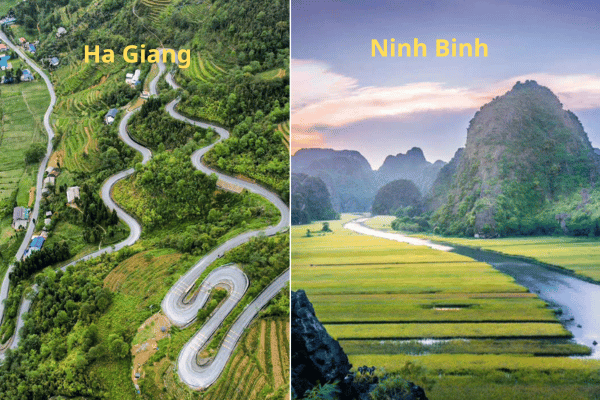
Every traveler planning a trip through northern Vietnam hits a version of this question at some point. You’ve seen the photos of both — the ancient temples and limestone towers of Ninh Binh, the impossible mountain switchbacks and turquoise river of Ha Giang — and now you’re trying to figure out whether you’re visiting one, the other, or somehow both.
The good news: this isn’t actually a close call once you understand what each place is. Ha Giang and Ninh Binh are not interchangeable options for “northern Vietnam scenery.” They offer fundamentally different experiences, at different effort levels, for different kinds of travelers.
This guide breaks both destinations down honestly — what they are, what they’re not, and how to figure out which one belongs in your itinerary.
Learn more: Ha Giang in September & October
Here’s the clearest way to frame it upfront.
Ninh Binh is a compact, accessible destination about 90 kilometers south of Hanoi. It’s built around river boat rides through limestone caves, ancient temple complexes, and some of the most striking karst scenery in mainland Southeast Asia — all of which you can reach by bicycle from a guesthouse in Tam Coc village. There are no remote roads, no demanding physical challenges, no logistics puzzles. You show up, rent a bike, take a boat, climb a viewpoint, eat well, and leave feeling like you’ve seen something genuinely beautiful with minimal friction.
Ha Giang is a 4–5 hour drive from Hanoi into Vietnam’s northernmost province — a UNESCO Global Geopark of rocky limestone plateau, dramatic gorges, ethnic minority villages, and one of the most spectacular roads in Southeast Asia. The Ha Giang Loop is 300+ kilometers of mountain riding that takes 3–5 days to complete properly. It requires either riding experience or the willingness to put yourself in the hands of a local guide. It is remote, occasionally rough, and completely worth it.
These two places attract overlapping visitors — people interested in natural scenery and off-the-beaten-path Vietnam — but they deliver very different versions of that interest. One is a relaxed highlight easily added to any Hanoi trip. The other is a dedicated multi-day expedition that tends to become the most memorable part of a longer Vietnam itinerary.

Learn more: Northern Vietnam Itinerary
Ninh Binh Province is often called Vietnam’s “inland Halong Bay” — not because it’s similar to Halong, but because the geological process is the same: limestone karst formations, some above water and some rising dramatically from flat ground. Here, they emerge from rice paddies, slow rivers, and ancient archaeological sites rather than the sea.
The most visited area is centered around Tam Coc village and the nearby Trang An Scenic Landscape Complex, which is a UNESCO World Heritage Site. The karst towers here are quieter and far less commercialized than Halong Bay, which is a significant reason why travelers who’ve done both often prefer Ninh Binh.
Trang An boat tour — The headline attraction. You board a small rowing boat and spend 2–3 hours drifting through a series of limestone caves and grottoes, past centuries-old temples perched on rocky outcrops, with the karst peaks reflected in the water around you. It’s peaceful in a way that feels earned. The rower is often a local woman who rows with her feet — a technique worth watching.
Tam Coc boat ride — Similar in format to Trang An but shorter, with the boats passing through rice fields rather than dense cave systems. More crowded and tourist-facing, but still beautiful. The river straightens at points and you get wide open views of the karst landscape that feel almost cinematic.
Mua Cave (Hang Mua) viewpoint — A steep climb (around 500 steps carved into the rock face) to a hilltop pagoda and lookout. The panorama from the top — rice paddies, river bends, karst towers in every direction — is the best view in Ninh Binh. Go at sunrise or late afternoon for better light and fewer people.
Hoa Lu Ancient Capital — Vietnam’s capital city in the 10th–11th centuries, before the court relocated to Hanoi. Two well-preserved temple complexes dedicated to the Dinh and Le dynasties sit at the base of dramatic karst cliffs. It takes about an hour to visit and adds real historical texture to the area.
Bich Dong Pagoda — A three-level pagoda built into the rock face of a limestone cliff, accessed through a natural cave. Easy to pair with a Tam Coc visit.
Van Long Nature Reserve — If you want Ninh Binh without any tourist crowds, Van Long delivers. A protected wetland reserve where rowing boats move through pristine karst scenery — you might see endangered Delacour’s langurs on the cliff faces above. Genuinely quiet and beautiful.
Cycling the back roads — Renting a bicycle and riding the small roads between attractions is one of Ninh Binh’s best experiences. The landscape between sites — rice paddies, small villages, water buffaloes, karst towers as a constant backdrop — is as rewarding as the attractions themselves.
Ninh Binh works for a very wide range of travelers precisely because it asks very little of you physically or logistically:
It also pairs well with every other northern Vietnam destination — Hanoi, Sapa, and Ha Giang all work as before or after stops without awkward routing.
Learn more: Ma Pi Leng Pass
Ha Giang Province occupies Vietnam’s far north — a rugged, sparsely populated plateau that shares a long border with China’s Yunnan Province. The landscape here is one of the most geologically striking in Southeast Asia: a UNESCO-listed karst plateau where limestone towers have been worn down into a vast, otherworldly rocky plain, with deep river gorges cutting through it and ethnic minority villages scattered across the heights.
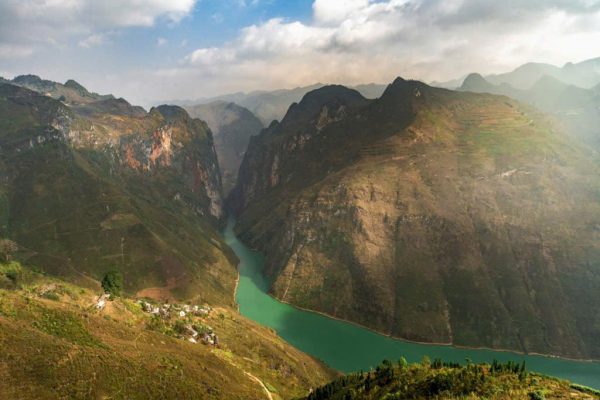
The Ha Giang Loop is the circuit of mountain roads that connects the province’s major landmarks: Ma Pi Leng Pass, the Dong Van Karst Plateau Geopark, the border settlement of Lung Cu with its flag tower marking Vietnam’s northernmost point, the market town of Meo Vac deep in its river valley, and the greener, waterfall-rich Du Gia area on the return route. The Nho Que River — an impossible shade of blue-green — runs through the gorge below Ma Pi Leng, visible from the road hundreds of meters above.
This isn’t a destination you visit the way you visit Ninh Binh. The Ha Giang Loop is the experience — the road itself, the communities along it, the physical sensation of moving through that landscape over several days. Staying in a single town and day-tripping to viewpoints misses the point almost entirely.

Learn more: Tu San Canyon & Nho Que River Boat Trip
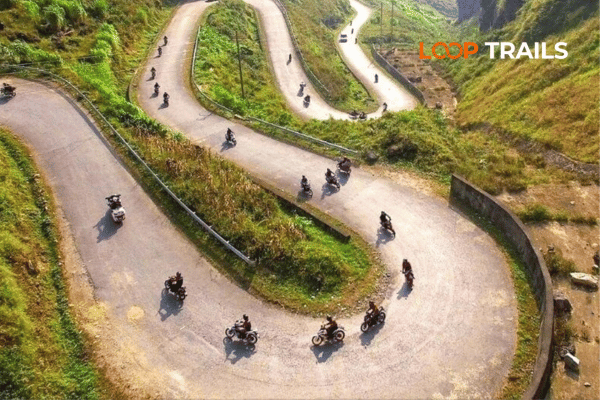
Ma Pi Leng Pass — The centerpiece. A mountain pass carved into a cliff face above the Nho Que River gorge, with switchbacks that drop into a deep canyon of extraordinary scale. Build in at least 30–60 minutes here. Most people end up staying longer.
Dong Van Old Quarter — An old town at 1,000+ meters elevation that feels genuinely preserved: French colonial-era shophouses alongside traditional H’mong stone architecture, surrounded by karst mountains. The Sunday market here draws vendors from across the plateau and functions primarily for locals, not tourists.
Lung Cu Flag Tower — Vietnam’s northernmost point. A hilltop tower with a massive national flag and sweeping views over the border landscape into China. The walk up is short and the symbolism of standing at the edge of the country carries its own weight.
Meo Vac — A small town in a deep valley that serves as one of the loop’s overnight stops. The road descending into Meo Vac from the Ma Pi Leng plateau — watching the valley open up as you drop in elevation — is one of the best moments on the entire route. The Saturday market is among the most authentic in the north.
Nho Que River boat ride — At the base of the Ma Pi Leng gorge, short boat rides on the river give you a completely different perspective on the canyon walls you were standing on top of. The color of the water at close range is even more striking than it appears from above.
Du Gia Waterfall — On the return leg of the loop, the Du Gia valley is lush and green — a visual counterpoint to the bare rocky plateau. The waterfall is a good swimming stop in season.
Quan Ba Twin Mountains — Sometimes called “Fairy Bosom” — twin rounded karst hills rising from the valley floor near Quan Ba town. An unusual and photogenic landscape formation on the approach to the plateau.
Ha Giang has a higher entry barrier than Ninh Binh — not in terms of fitness, but in terms of logistics and commitment:
It rewards patience and slower travel. It punishes people who are rushing to tick boxes.

Learn more: Ha Giang Loop route and itinerary
Both destinations have karst limestone as their geological foundation — but they look and feel almost nothing alike.
Ninh Binh’s karst towers rise from flat river valleys and rice paddies, reflected in calm water, draped in greenery. The scale is intimate — the boat rides bring you close to the formations and the pace is slow. It’s beautiful in a classical, composed way. The light on the towers in late afternoon is extraordinary.
Ha Giang’s karst is a different thing entirely. The Dong Van plateau is bare, rocky, and vast — the formations here have been weathered into a landscape that looks more like the Tibetan borderlands than tropical Vietnam. Then the gorges: Ma Pi Leng is hundreds of meters of vertical drop to the Nho Que River below. The scale is almost disorienting. There are no boats in calm water — there’s a road cut into a cliff face and everything below it.
Winner on raw visual drama: Ha Giang, and it’s not particularly close. Ninh Binh is beautiful; Ha Giang is staggering.
Ninh Binh: 90 km from Hanoi. Buses and trains run multiple times daily. Under 2.5 hours. Accommodation is cheap and plentiful. You can arrive with no pre-planning and have a great experience.
Ha Giang: 300+ km from Hanoi on winding mountain roads. Sleeper bus takes approximately 5–6 hours. The loop itself is another 300+ km once you arrive. Logistics require more thought: guesthouses on the loop are generally fine but need some advance booking in peak season, and the route itself needs a plan — you can’t just “wing it” the same way you can in Ninh Binh.
Winner on accessibility: Ninh Binh by a significant margin.
Ninh Binh: Very low. Boat rides, bicycle cycling on flat terrain, one stiff climb at Mua Cave. Suitable for all fitness levels.
Ha Giang: Low-to-moderate on a guided tour (you’re a passenger on a motorbike or in a jeep). Moderate-to-demanding for self-drivers, depending on experience and the specific road conditions on the day. The effort is mostly mental — sustained concentration on mountain roads — rather than physical exertion.
Winner on ease: Ninh Binh.

Learn more: Vietnam Motorbike Routes Ranked
Ninh Binh has genuine cultural depth — the Hoa Lu ancient capital, the Trang An temples, the living landscape of rice farming communities. But the immediate surroundings of Tam Coc have become increasingly tourist-facing over the years, and some of the “cultural” elements you encounter are designed for visitors rather than reflective of how people actually live.
Ha Giang’s cultural layer is harder to access — it requires more time and ideally a guide who can translate and contextualise — but it’s more intact. The H’mong, Lo Lo, Pu Peo, and Dao communities across the plateau maintain traditions that aren’t primarily oriented around tourism. The markets function for locals. The guesthouses are family homes. Spending four days on the loop gives you a very different relationship with these communities than a boat ride past rice paddies.
Winner on cultural depth: Ha Giang.
Ninh Binh: 1 day (day trip from Hanoi, doable but rushed). 2 days (comfortable, covers all main sites). 3 days (leisurely, allows exploration of quieter areas like Van Long).
Ha Giang: 3 days (minimum for a compressed loop). 4–5 days (recommended, allows proper stops and breathing room). Anything less than 3 days and you’re missing the point.
Winner on time efficiency: Ninh Binh.
Both destinations are among Vietnam’s most affordable. Ninh Binh’s costs (transport from Hanoi, guesthouse, boat tickets, bicycle rental) are very low. Ha Giang’s costs are similarly manageable for self-drivers with a rental bike, but guided tours (Easy Rider or jeep) cost more — and for many travelers, a guide genuinely improves the experience enough to justify it.
Neither destination is expensive by international standards. Ha Giang typically costs more in total simply because you’re there for more days and the tour cost is an additional consideration.
Winner on budget: Ninh Binh (marginally, for a comparable number of days).
| Factor | Ninh Binh | Ha Giang |
|---|---|---|
| Distance from Hanoi | ~90 km | ~300 km |
| Time needed | 1–2 days | 3–5 days |
| Scenery type | Lush karst, river valleys | Rocky plateau, dramatic gorges |
| Physical effort | Low | Low–Moderate |
| Cultural depth | Moderate | High |
| Accessibility | Very easy | Moderate |
| Best for | All traveler types | Adventure-seekers, curious travelers |
| Budget (total trip) | Lower | Moderate |

Learn more: Ha Giang Loop for Families & Groups
Yes — and for travelers with 12–18 days in northern Vietnam, doing both is genuinely recommended. They complement each other rather than overlap.
The most logical sequence: Hanoi → Ninh Binh (2 nights) → return to Hanoi → Ha Giang (4–5 nights on the loop) → return to Hanoi.
Ninh Binh makes an excellent warm-up to the north — it’s easy, beautiful, and gives you a baseline reference point for the karst landscapes that Ha Giang then completely redefines. After four days on the Ha Giang Loop, you’ll look back at Ninh Binh differently: as beautiful, but a gentler, more accessible version of what Vietnam’s limestone country can be.
The opposite direction (Ha Giang first) also works, particularly if your weather window for Ha Giang is the driving constraint (autumn buckwheat season, for example). Starting with Ha Giang and finishing with Ninh Binh creates a pleasant decompression at the end of the trip.
What doesn’t work: trying to combine them in less than a week. Ninh Binh deserves at least a full day, and Ha Giang deserves at least 3. A 7-day budget that tries to fit both in will feel rushed at the Ha Giang end.
Learn more: Ha Giang Loop Easy Rider
If you’re genuinely choosing just one — here’s the honest framework:
Choose Ninh Binh if:
Choose Ha Giang if:
If you genuinely can’t decide: go to Ha Giang. Ninh Binh will still be there. It’s 90 kilometers from Hanoi and accessible on virtually any trip to the north. Ha Giang requires more planning, more time, and more commitment — and for that reason, people who skip it often end up going back to Vietnam specifically to do it. People who skip Ninh Binh rarely feel the same way.

Learn more: Ha Giang Loop Self-Drive & Motorbike Rental
Since Ha Giang is the higher-stakes choice — more planning required, more time, more meaningful if done well — it’s worth addressing how to approach it properly.
Easy Rider (Guided, You Ride Pillion) You sit on the back of a motorbike driven by an experienced local guide who knows every road, stop, shortcut, and story on the loop. You watch the scenery without managing the machine. Your guide handles navigation, chooses guesthouses, can speak with locals, and gives you context that a solo trip simply can’t replicate.
This is the best format for first-time Ha Giang visitors, solo travelers, and anyone who wants the full experience without the burden of being responsible for a motorbike on mountain roads. It’s not a lesser experience — many people who’ve done Ha Giang both ways prefer Easy Rider for exactly the reasons listed above.
Self-Drive Motorbike You rent a bike in Ha Giang City and ride the loop yourself. Maximum freedom — you stop when you want, stay longer where you want, feel every kilometer directly. This is the right choice if you have genuine motorbike experience on mountain roads (not just scooter experience in flat cities — those are different skills).
Always confirm license requirements with your rental provider before going — regulations for foreign riders in Vietnam can change and vary by area.
Loop Trails can help with [motorbike rental in Ha Giang] if you’re going the self-drive route — we’ll make sure you’re on the right bike for the loop, not just whatever’s cheapest.
Jeep Tour A 4WD jeep with a driver takes you through the full loop. All the viewpoints, all the stops, maximum comfort — particularly good for small groups, couples with mixed riding abilities, or anyone who prefers four wheels on mountain roads. The views from a jeep window are the same as from a motorbike; the experience of being in the landscape is slightly different, but no less valid.
3 days: The minimum. You’ll cover the loop but at a pace that doesn’t allow much flexibility for weather delays, unexpected stops, or simply sitting at Ma Pi Leng longer than planned.
4 days: The sweet spot. Enough time to ride the full loop, stop properly at Dong Van, Lung Cu, and Meo Vac, take the Nho Que River boat ride, and still feel like you breathed.
5+ days: If you have the time, the extra days are well spent. Add Quan Ba more thoroughly, explore side roads off the main loop, spend a full morning at a local market, or simply move at a slower pace that lets the place sink in.
Thinking about booking a Ha Giang Loop tour? Loop Trails runs small-group tours in Easy Rider and jeep formats, designed specifically for international travelers. [Browse the Ha Giang Loop tour options here] — or [get in touch via WhatsApp] if you want to talk through what format makes sense for your trip before committing.
Learn more: Ha Giang Loop for Beginners
Getting to Ninh Binh from Hanoi Regular trains and buses run from Hanoi to Ninh Binh throughout the day. Journey time is roughly 2–2.5 hours. Trains are comfortable and punctual. Buses are cheaper and slightly less reliable on timing. Private car or taxi is also available for groups.
Getting to Ha Giang from Hanoi Most travelers take an overnight sleeper bus from Hanoi, departing around 6–7pm and arriving in Ha Giang City late in the evening. This saves a night’s accommodation cost and sets you up to start the loop the following morning. Daytime buses also run but cost you a full travel day. Private car hire is an option for groups.
Accommodation
Best seasons
| Destination | Peak Season | Avoid |
|---|---|---|
| Ninh Binh | Oct–April | July–August (heavy rain) |
| Ha Giang | Sep–Nov (buckwheat), Mar–May (green) | June–August (landslide risk on mountain roads) |
The September–November window is the best overlap for visiting both on a single trip.
Cash Both destinations are predominantly cash-based. Ninh Binh has ATMs in Tam Coc area. Ha Giang City has ATMs — withdraw enough before starting the loop, as ATM availability on the route itself is limited and unreliable.
What to pack (additions beyond standard Vietnam travel)
For Ha Giang specifically:
For Ninh Binh, standard warm-weather Vietnam travel packing is sufficient. Light layers for the boat rides (it can be cool in the caves) and comfortable walking shoes for Mua Cave.
Learn more: Loop Trails Tour Ha Giang website
Ninh Binh is more first-timer-friendly — it’s close to Hanoi, easy to navigate, and requires no special planning. Ha Giang is accessible for first-timers too, but via a guided format (Easy Rider or jeep tour) rather than self-drive. If you only have a few days total in northern Vietnam, Ninh Binh is the pragmatic choice. If you have a week or more, prioritize Ha Giang.
Yes. The jeep tour format covers the full Ha Giang Loop by 4WD vehicle — all the major viewpoints, all the key stops — without any motorbike involvement. It’s increasingly popular and a legitimate way to experience the loop. Easy Rider is also an option if you’re comfortable on a motorbike as a passenger.
There’s no direct connection. The standard route is Ninh Binh → Hanoi (by bus or train, ~2.5 hours), then Hanoi → Ha Giang (sleeper bus, ~5–6 hours departing evening). Allow a day in Hanoi between the two destinations for the connection.
Both offer good local eating at different price points. Ninh Binh is known for com chay (crispy rice cake), goat meat dishes, and eel rice — a distinct local food culture. Ha Giang’s loop stops have simpler, homestyle cooking at guesthouses and roadside spots — pho, thang co (a traditional H’mong broth), corn wine (ruou ngo), and local highland vegetables. Neither is a foodie destination in the Hanoi or Hoi An sense, but both have authentic, memorable local meals.
Yes. They share a geological heritage but feel completely different. Ninh Binh is inland, quieter, bicycle-accessible, and far less commercialized than Halong Bay. The Trang An boat tour in particular feels more peaceful and intimate than most Halong experiences. Many people who’ve done both prefer Ninh Binh.
September to November is peak season for a reason: drier roads, the buckwheat flower bloom in October–November, and exceptional harvest light. March to May is an excellent alternative with vivid green plateau scenery and fewer crowds. June to August brings heavy rains and landslide risk on mountain roads — still possible but requires more caution and flexibility.
Solo travelers do Ha Giang regularly and safely. Easy Rider and jeep tours include a guide, so you’re not truly alone on the road. Solo self-driving is done too, but is better with at least one riding companion in case of mechanical issues or emergencies. The plateau communities are welcoming and there are no significant safety concerns specific to the area beyond general mountain road caution.
Very affordable — guesthouse accommodation in Tam Coc runs from budget to mid-range, boat tour tickets are modest in price, and a bicycle rental for the day is very cheap. Food is inexpensive. Ninh Binh is one of the most affordable overnight trips from Hanoi. Check current prices locally as rates shift seasonally.
For the loop itself — if you’re on a guided tour, booking in advance is strongly recommended, particularly for the September–November peak season. If self-driving, you can be more spontaneous, but guesthouses at key stops (Dong Van, Meo Vac) fill up during the flower season. Ha Giang City guesthouses are generally available without advance booking outside peak weeks.
In total trip cost, yes — primarily because Ha Giang takes more days and a guided tour adds cost. On a per-day basis, Ha Giang is similarly affordable for accommodation and food. The guided tour cost is the main additional expense, and it’s a worthwhile one for most travelers.
Technically yes, but it’s tight. You’d need: 1 night Ninh Binh, 1 travel day through Hanoi, 4 days on the Ha Giang Loop, 1 return travel day. That’s the minimum version and it leaves no buffer for weather delays or slow days. If you have 10–12 days, the combination feels much more comfortable.
Both are boat ride experiences through limestone karst scenery. Trang An is longer, takes you through more caves, includes ancient temple sites, and is a UNESCO World Heritage Site — generally considered the better experience. Tam Coc is shorter, more touristed, and set against rice fields rather than dense cave systems. If you only do one, do Trang An. If you have two days, Tam Coc is worth adding.
Contact information for Loop Trails
Website: Loop Trails Official Website
Email: looptrailshostel@gmail.com
Hotline & WhatSapp:
+84862379288
+84938988593
Social Media:
Facebook: Loop Trails Tours Ha Giang
Instagram: Loop Trails Tours Ha Giang
TikTok: Loop Trails
Office Address: 48 Nguyen Du, Ha Giang 1, Tuyen Quang
Address: 48 Nguyen Du, Ha Giang 1, Tuyen Quang

Facebook X Reddit Table of Contents Learn more: Ha Giang Loop Tours This is the question that sits in almost every Ha

Facebook X Reddit Table of Contents Learn more: Ha Giang Loop Tours Most people drive past the Quan Ba area twice on