
Thúy Kiều (Grace) is a travel blogger and content contributor for Loop Trails Tours Ha Giang. She holds a bachelor’s degree in Sustainable Tourism from Vietnam National University, Hanoi, and has a strong passion for exploring and promoting responsible travel experiences in Vietnam’s northern highlands.

Learn more: Ha Giang Loop Tours
Most people riding the Ha Giang Loop come for the mountains. Ma Pi Leng Pass, the Nho Que River, the limestone karst peaks pressing in from every direction — that’s what fills the Instagram grids and the travel forum posts. And those things are real and worth every kilometer.
But somewhere between Yen Minh and Dong Van, tucked into a valley in the Phong Luu commune, there’s a building that stops you cold in a different way. Not because of its scale, but because of its story.
Vuong Palace — known locally as Dinh Vua Meo, the Palace of the H’mong King — is the former home of the most powerful H’mong family in northern Vietnam. It’s a building that survived colonial occupation, war, political upheaval, and decades of neglect. And it’s still standing, still detailed, still carrying the weight of a history that most visitors only scratch the surface of.
This guide will fix that. Here’s what the palace actually is, what happened there, what you’ll see when you walk through the gate, and how to make it a proper part of your Ha Giang Loop itinerary rather than a ten-minute photo stop.
Learn more: Ha Giang Loop 2 Days 1 Night
The palace was built for and by the Vuong family — specifically Vuong Chinh Duc (also rendered as Vuong Chi Thanh in some sources), who rose to become the de facto ruler of the H’mong people across much of what is now Ha Giang province in the late 19th and early 20th century.
The Vuong family’s power was built, bluntly, on opium. The Dong Van Karst Plateau was — and for a significant period remained — one of the major opium-producing regions in Indochina. Vuong Chinh Duc controlled cultivation, trade, and taxation of the crop across a vast area, accumulating wealth and influence that put him in direct negotiation with both the French colonial administration and the Chinese border authorities.
He wasn’t a king in the formal sense — the Vietnamese term vua (king) attached to his family’s legacy is more honorific than literal — but his authority over the plateau’s H’mong communities was substantial. The French, recognizing that direct administration of these remote highlands was impractical, largely left the Vuong family to govern as they saw fit, in exchange for cooperation on taxation and stability.
Construction of the palace began in the late 1890s and continued into the early 20th century — the exact dates vary in different accounts, so treat any specific year you read (here or elsewhere) as approximate, and check current signage at the site for the official version. What’s not disputed is the scale of the project: the palace took years to complete, involved craftsmen brought from as far as Yunnan province in China, and consumed enormous resources.
This is the part of the story that’s easy to overlook. The 20th century was not kind to traditional architecture in northern Vietnam. War, land reform, collectivization campaigns, and the general upheaval of the revolutionary period erased a great deal of what came before.
Vuong Palace survived — imperfectly, but substantially — partly because of its remote location, partly because of its stone construction, and partly because of deliberate preservation decisions made at various points in the post-war period. It was listed as a national historical and cultural monument by the Vietnamese government, which provided some degree of protection. Restoration work has been carried out over the years, though — as with any old building in a humid mountain climate — ongoing maintenance is a permanent challenge.
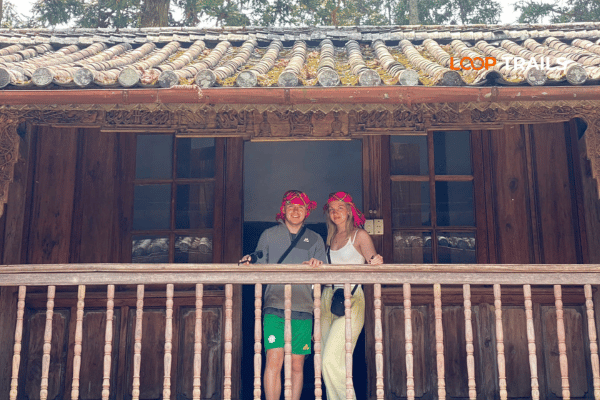
What you see today is real, not reconstructed. The walls are original stone. The carved woodwork is original. The layout and structure are intact. That matters when you’re walking through it.
Learn more: Ha Giang Loop 3 Days 2 Nights
This is what immediately distinguishes Vuong Palace from almost everything else you’ll see on the Ha Giang Loop. It doesn’t look like a Vietnamese building. It doesn’t look like a French colonial building. It doesn’t look like a Chinese manor house. It looks like all three of them at once, and the synthesis is striking.
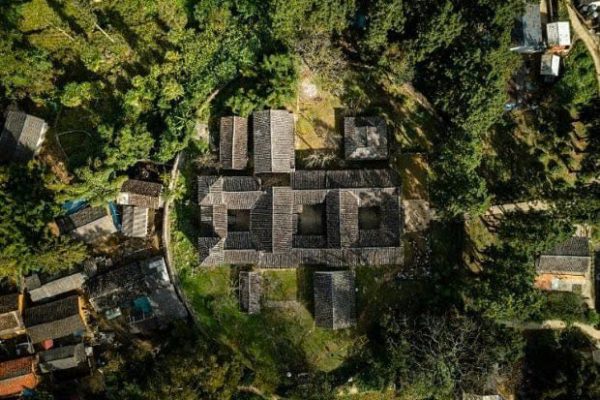
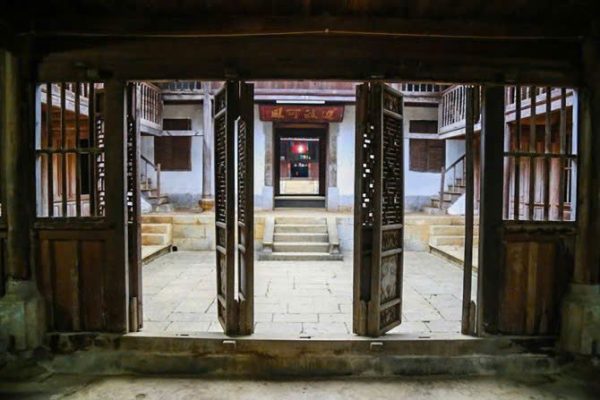
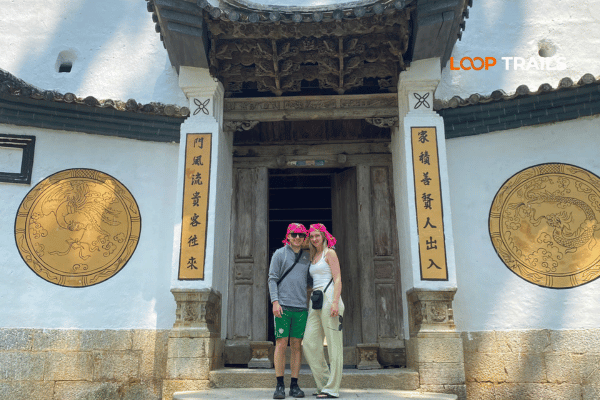
The fundamental layout of Vuong Palace follows the Chinese courtyard house tradition — a series of enclosed spaces connected by gateways, with the main residence set back from the street behind protective outer walls. The spatial logic is Chinese: you move from public to private in stages, each courtyard filtering out a layer of the outside world.
The stone used throughout the palace — grey limestone, fitting for a plateau defined by the stuff — was quarried locally, but the techniques for working it came largely from craftsmen imported from Yunnan. The intricate carved panels, the decorative archways, and the precision of the stonework all reflect Chinese masonry traditions of the period.
The French presence in Indochina left its fingerprints on almost every significant building from this era, and Vuong Palace is no exception. Look at the windows — arched openings with shuttered frames — and the roofline on parts of the structure, where French colonial architectural vocabulary appears alongside the traditional tiled ridgelines.
The Vuong family’s relationship with the French administration required a certain degree of cultural diplomacy. Having a building that read as partly European to French visitors was likely not accidental. It was a statement of sophistication, of playing multiple political games simultaneously.
Underneath and alongside the Chinese structure and French accents, the H’mong artistic tradition is present throughout. The decorative motifs on certain interior panels, the textile elements in the original furnishings (some of which remain), the layout of certain domestic spaces — these reflect the H’mong aesthetic sensibility in ways that the grand exterior gates don’t.
This layering of cultures in a single building is architecturally unusual and historically fascinating. Vuong Palace is, among other things, a physical record of how the H’mong leadership of this period navigated between competing imperial powers. Every carved detail is a negotiation.
Learn more: Ha Giang Loop 4 Days 3 Nights
You approach Vuong Palace through a lane in the valley, and the first thing you encounter is the perimeter wall — substantial stone construction that communicates, immediately, that this is a place of status. The main entrance gate is carved and detailed; take time here before you go through, because the gate itself repays close attention.
The outer courtyard is a transition space — open to the sky, paved, with the main residential complex ahead of you. This is where you’ll find the ticket office and where tour groups tend to pause for orientation. Guards of stone flanking doorways, decorative panels, the layered rooflines rising behind. The geometry of the place becomes clear from here.
The residential core of the palace is a series of connected rooms organized around an inner courtyard. The rooms are relatively dim — the windows are small by necessity, given the defensive function of the outer walls — but your eyes adjust and the detail emerges.
The main reception hall would have been the political heart of the building, where Vuong Chinh Duc received visitors, adjudicated disputes, and conducted the business of running a semi-autonomous territory. The scale is appropriate for that function: large, formal, with the carved wooden altar and ancestral tablets that anchor any significant Vietnamese and Chinese-influenced home of this type.
Moving deeper into the residence, the rooms become more intimate. Sleeping quarters, a kitchen area, spaces that speak to daily life rather than political theater. Some of the original furniture remains. The contrast between the grandeur of the public rooms and the relative simplicity of the private spaces is human and oddly moving.
The palace functions partly as a museum, and there are display cases containing artifacts from the Vuong family period — including items related to the opium trade that was the foundation of their wealth. Pipes, weights, trading implements. The museum doesn’t sanitize this history, which is the right call. The opium economy of the plateau was brutal in many ways, and the Vuong family were its primary beneficiaries.
There are also photographs — period images of the family, of the plateau, of French colonial officials visiting — that provide historical context in a way that no amount of explanatory text quite matches. Spend time with these. They’re a window into a world that ended abruptly and didn’t get to write much of its own account.
Learn more: Ha Giang Cao Bang 5 Days 4 Nights
Vuong Palace is located in Phong Luu commune, Dong Van district, Ha Giang province — roughly 3–4 km from Dong Van town center, set in a valley below the main road. The turnoff is signposted; if you’re riding the loop, you’ll see it as you approach Dong Van from the Yen Minh direction.
The valley setting is part of the appeal. The palace sits in a bowl of karst landscape, surrounded by mountains, in a location that clearly served defensive purposes as much as aesthetic ones. Even the approach, down a winding lane from the main road, has a sense of arrival.
From Ha Giang city, Vuong Palace is approximately 140–150 km, depending on your route. Most travelers visit as part of the Ha Giang Loop rather than as a standalone day trip from the city.
If you’re doing the loop in the standard direction (Ha Giang → Dong Van → Meo Vac), Vuong Palace fits naturally into a Day 4 stop, either en route to Dong Van or as an excursion from Dong Van town. The detour from the main loop road adds minimal distance and is paved.
The road into the valley is suitable for motorbikes; jeeps can also access it. Check current road conditions locally if you’re visiting outside of the dry season.
Entry fees and opening hours apply — check current rates at the site or with your tour operator, as these are subject to change and the figures circulating online are frequently outdated. Budget for a modest fee; this is a managed heritage site, not a free walk-in.
Photography is generally permitted inside the palace grounds, but be respectful in the inner rooms — some areas near the altar and personal family areas merit discretion.
Learn more: Ha Giang Cao Bang Ba Be Lake 6 Days 5 Nights
Best times:
Times to be cautious about:
Learn more: Ha Giang Loop route and itinerary
If you’re doing a [7-day slow travel itinerary on the Ha Giang Loop](internal link), Vuong Palace sits naturally on Day 4 as you travel from Yen Minh to Dong Van. Pull off the main road, spend 1.5–2 hours at the palace (enough to do it properly), then continue to Dong Van for the night.
Alternatively, if you’re basing yourself in Dong Van for two nights — which the slow travel approach recommends — you can visit Vuong Palace as a morning excursion on your exploration day, before heading to Lung Cu in the afternoon. The two sites are complementary: Vuong Palace for the human history, Lung Cu for the geographic and national symbolism.
Vuong Palace is the most significant single historical attraction in the Dong Van area, but it’s surrounded by context that makes it richer:
[→ Planning the full loop? See our Ha Giang Loop tour options — Easy Rider, Jeep, and Self-Drive — and find the right format for your trip.]
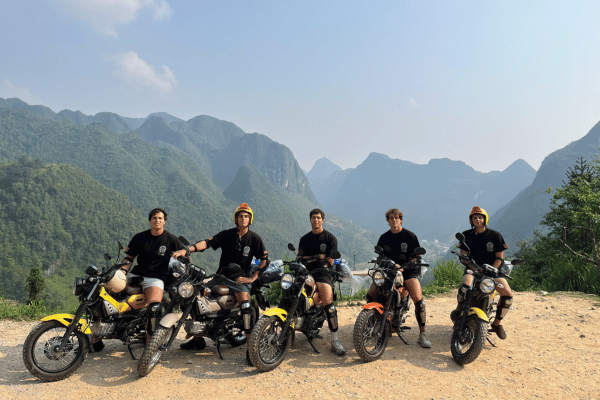
Learn more: Ha Giang Motorbike Rental
If you’re already doing the Ha Giang Loop, Vuong Palace is simply a stop on the route — the question of how you visit the palace is really the question of how you’re doing the loop overall.
Easy Rider tour: Your guide will stop at Vuong Palace as part of the itinerary. The value here is context — a knowledgeable local guide can explain the Vuong family history in ways that the on-site signage (not always well-translated into English) doesn’t capture. If you want to understand what you’re looking at beyond the surface, a guide is worth having at Vuong Palace specifically.
Self-drive motorbike: You have complete flexibility on timing — critical for avoiding the midday crowds. Navigate to the Phong Luu valley turnoff yourself; it’s signposted from the main loop road. Download offline maps for the Dong Van area before you lose good cell coverage. [→ Check our motorbike rental options in Ha Giang for available bikes and current rates.]
Jeep tour: Jeeps can access Vuong Palace without any issue. If you’re doing a loop by jeep, expect this to be a scheduled stop. The jeep approach is particularly practical for groups, as you can carry more people and more luggage and still stop at every major site.
Honest recommendation: If Vuong Palace is specifically important to you — if you want depth on the history, the architecture, the H’mong political context — ask about guide quality before you book. A guide who’s walked you through the palace twenty times knows where to stand, what to point at, and which stories the plaques don’t tell.
Not sure which option fits your trip? [Message us on WhatsApp — we’ll sort it out without the sales pitch.]
Learn more: Ha Giang Safety Tips
Arrive early or late. The palace in the hour after opening or the hour before closing is a different place than it is at midday in October. The light is better, the crowds are thinner, and the silence — the building is genuinely quiet when it’s not full of tour groups — lets you hear your own footsteps on the stone.
Read the plaques carefully. The English translations are imperfect but the information is solid. Take the time. Most visitors spend 20 minutes rushing through; the people who spend an hour come out with a story worth telling.
Look up. The roofline details, the carved ridgelines, the corbels and brackets — H’mong and Chinese decorative carpentry is concentrated above your head throughout the palace. It’s easy to miss if you’re focused on the eye-level displays.
Look at the walls, not just through them. The stone construction of the outer walls is itself a document — the size of the blocks, the precision of the fitting, the way drainage was managed in a high-rainfall mountain environment. Whoever built this knew what they were doing.
Hire a local guide if available. On-site local guides (when available at the palace) are inexpensive and often excellent. They know the family history in a way that distinguishes the documented version from the oral tradition. The oral tradition is usually more interesting.
Pair it with the right meal. The villages around Vuong Palace have small eateries serving H’mong food — corn rice, mountain vegetables, local meat dishes. Eating in the valley before or after your visit is part of the experience and costs almost nothing.
Don’t rush the approach. The lane into the valley, the surrounding farmland, the mountains closing in — this is part of the visit. Pull over before you reach the gates and just look at the setting for a moment. The palace was built in this landscape deliberately.
Learn more: Ha Giang Loop Mistake to Avoid
Is Vuong Palace worth visiting if you’re not interested in history?
Honestly? Yes, but for different reasons. The architecture is visually striking enough to reward a visit on purely aesthetic grounds. The setting — a stone palace in a karst valley — is photogenic in ways that don’t require any historical context. But you’ll get more out of it if you invest fifteen minutes in the backstory before you go.
How long should I spend there?
1.5 to 2 hours is the sweet spot. Less than an hour and you’re doing the highlight reel without the substance. More than two hours and you’re probably re-reading plaques you’ve already read. Budget time for the approach, the courtyard, the main residence, the artifacts, and a quiet sit in the inner area before you leave.
Is it accessible for people with limited mobility?
The palace grounds include uneven stone surfaces, steps, and doorway sills typical of a building of this age. It’s manageable for most visitors but not fully accessible for wheelchairs or people with significant mobility limitations. The outer courtyard and main approach are the most accessible parts.
Can I take photos inside?
Generally yes, throughout the public areas. Use discretion near the altar areas and in the inner rooms — not because of rules, but because it’s a place where a family’s history is actively honored.
Is there food and water available on-site?
There are typically small vendors near the entrance. But don’t count on this for a full meal — eat in Dong Van town before or after. Bring water; the valley walk and the palace exploration are more physical than they look, particularly in warm weather.
Learn more: Lo Lo Chai Village
Vuong Palace (Dinh Vua Meo) is the former residence of the Vuong family, the most powerful H’mong ruling family on the Dong Van Karst Plateau during the French colonial period. Built over several decades in the late 19th and early 20th centuries, it blends H’mong, Chinese, and French colonial architectural styles. It’s now a protected national historical monument and one of the most significant cultural sites on the Ha Giang Loop.
Vuong Chinh Duc (also known as Vuong Chi Thanh) was the patriarch behind the palace. His power derived from control of the opium trade on the plateau, and he operated with substantial autonomy under the French colonial administration. The title “king” (vua) attached to his legacy is honorific — he wasn’t formally recognized as royalty, but his authority over H’mong communities across the region was significant enough that the term stuck.
It’s located in Phong Luu commune, Dong Van district, Ha Giang province — roughly 3–4 km from Dong Van town center, in a valley off the main loop road. The turnoff is signposted. Most Ha Giang Loop travelers pass within a few kilometers of it on the Yen Minh–Dong Van stretch.
It’s a short ride from Dong Van town — roughly 10–15 minutes by motorbike or jeep. The road into the valley is paved and clearly marked. You can easily combine a morning at Vuong Palace with an afternoon exploring Dong Van’s Old Quarter and surrounding sites.
An entry fee applies. Fees are subject to change — check current rates at the site or with your tour operator before visiting. Don’t rely on figures from old blog posts or forums, as they’re frequently outdated.
October and November are peak season for the entire Ha Giang Loop — dry weather, good light, the buckwheat flowers blooming in surrounding valleys. For smaller crowds specifically at the palace, arrive before 9am or after 2pm. March to May is also excellent and significantly less busy.
It’s a genuine hybrid: the structural layout and stonework follow Chinese courtyard manor house tradition, French colonial details appear in the windows and certain exterior elements, and H’mong craft traditions run throughout the interior woodwork and decorative panels. It’s one of the most architecturally unusual buildings in northern Vietnam.
Technically yes — the palace is accessible as a destination — but as a standalone day trip from Ha Giang city, it’s a very long round trip for one attraction. The overwhelming majority of visitors come as part of the loop. If you’re in Ha Giang for the palace specifically, combining it with at least the Dong Van area makes the journey worthwhile.
The palace sits within or directly adjacent to the Dong Van Karst Plateau UNESCO Global Geopark area. The geopark designation covers the broader landscape of the plateau — the geological, cultural, and historical heritage of the region. Vuong Palace is one of the key cultural heritage sites within this context.
Dong Van Old Quarter (historic shophouses, coffee, evening atmosphere), Dong Van Sunday market (ethnic minority traders), Lung Cu Flag Tower (Vietnam’s northernmost point, ~25 km away), and the approach to Ma Pi Leng Pass — all within the Dong Van district. The area rewards two nights rather than one.
Yes — it’s a standard stop on most Ha Giang Loop itineraries. Loop Trails includes Vuong Palace in our Easy Rider and Jeep loop tours, with guides who can provide historical context that the on-site signage doesn’t always cover well in English.
The main access road is paved and in reasonable condition for most of the year. As with any mountain road in Ha Giang, conditions can change with weather — check locally before visiting if you’re riding during or after heavy rain. The road is manageable for standard rental bikes and all types of jeeps.
Contact information for Loop Trails
Website: Loop Trails Official Website
Email: looptrailshostel@gmail.com
Hotline & WhatSapp:
+84862379288
+84938988593
Social Media:
Facebook: Loop Trails Tours Ha Giang
Instagram: Loop Trails Tours Ha Giang
TikTok: Loop Trails
Office Address: 48 Nguyen Du, Ha Giang 1, Tuyen Quang
Address: 48 Nguyen Du, Ha Giang 1, Tuyen Quang
Facebook X Reddit Table of Contents Learn more: Ha Giang Loop Tours This is the question that sits in almost every Ha
Facebook X Reddit Table of Contents Learn more: Ha Giang Loop Tours Most people drive past the Quan Ba area twice on