

Ha Giang Loop: 3 Days or 4 Days? An Honest Comparison
Facebook X Reddit Table of Contents Learn more: Ha Giang Loop Tours This is the question that sits in almost every Ha

Thúy Kiều (Grace) is a travel blogger and content contributor for Loop Trails Tours Ha Giang. She holds a bachelor’s degree in Sustainable Tourism from Vietnam National University, Hanoi, and has a strong passion for exploring and promoting responsible travel experiences in Vietnam’s northern highlands.
Learn more: Ha Giang Loop Tours
You’ve booked your flight to Hanoi, sorted your visa, and found a guesthouse in Ha Giang town. You’re almost ready. Then someone in a Facebook group drops a comment that stops you cold: “There are basically no ATMs once you leave town.”
Is that true? Mostly, yes. But it’s more nuanced than a horror story, and with a bit of preparation, money is genuinely one of the easiest parts of doing the Ha Giang Loop.
This guide covers everything: where ATMs actually are, how much cash to carry, whether your debit card will do anything useful, and the mistakes that leave people borrowing money from strangers at a guesthouse in Dong Van.
Learn more: Ha Giang Loop 2 Days 1 Night
If you read nothing else, read this section.
Ha Giang province is remote. That’s exactly why people come here. The roads carve through limestone karst, rice terraces, and small ethnic minority villages where the nearest town might be an hour away. Digital payment infrastructure simply has not caught up with the scenery.
The vast majority of guesthouses, local restaurants, roadside pho stalls, petrol stations, and market vendors operate on cash only. Not because they’re behind the times. Because that is how the local economy works, and it has worked just fine for a very long time.
Your job, as a traveler, is to arrive in Ha Giang town with enough Vietnamese dong (VND) to cover your entire loop. Full stop.
How much is “enough” we’ll break down shortly. But the mindset shift to make first is this: Ha Giang is not Hanoi. It is not even Sa Pa. Treat cash like fuel — you wouldn’t ride out of town with an empty tank, so don’t ride out with an empty wallet either.
Learn more: Ha Giang Loop 3 Days 2 Nights
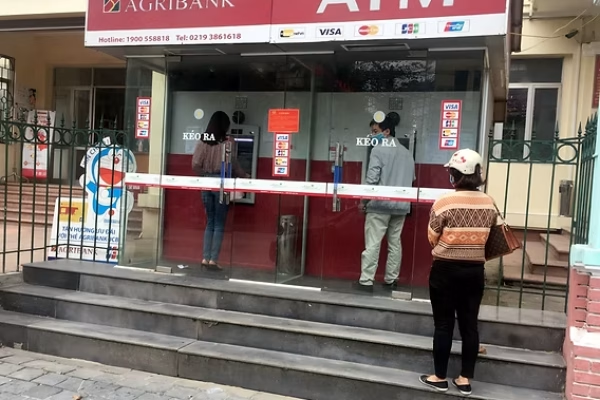
Ha Giang town is the provincial capital and the most developed part of the province. There are ATMs here, run by Vietnam’s main banks: Agribank, Vietcombank, BIDV, and Techcombank are typically represented. They accept foreign Visa, Mastercard, and sometimes Cirrus/Maestro cards.
This is where you want to withdraw everything you need for the loop.
A few practical notes:
The rule: withdraw everything in Ha Giang town. Do not rely on finding cash anywhere else.
People always ask about this, so let’s be specific about what “along the route” actually means.
Yen Minh is a small market town roughly halfway between Ha Giang town and Dong Van. There is at least one ATM here (Agribank has a presence), but availability and reliability are inconsistent. Treat it as a backup option, not a plan. If you happen to pass through and notice your cash is lower than expected, it’s worth trying. Don’t count on it.
Dong Van is the main destination town on the loop and is more developed than most people expect. There is an ATM here (again, Agribank is typically the operator). Some travelers have successfully withdrawn cash in Dong Van. Others have found the machine empty, out of order, or refusing foreign cards on that particular day. It’s a coin flip, and this is not the kind of coin flip you want to lose at 7pm when you’re cold and hungry.
Meo Vac is a larger market town and the other main overnight stop on the classic loop route. Similar situation to Dong Van — ATM infrastructure exists in some form, but reliability is not guaranteed. The famous Sunday markets in this area draw large crowds, which means ATM cash depletes faster than usual.
Beyond these towns, there are no ATMs. The smaller villages, the mountain passes, the viewpoints — nothing. Zero.
It happens to people every week. The ATM in Dong Van has a line, you wait, and then the machine spits out an error message because it’s empty.
Your options at that point are limited:
The cleanest solution, by far, is simply to not be in this situation. Bring enough cash from Ha Giang town.

Learn more: Ha Giang Loop 4 Days 3 Nights
There’s no single answer because it depends on how you travel. A budget backpacker staying in dorm beds and eating pho at market stalls spends very differently from someone who wants private rooms, cold beers at the end of each day, and the occasional proper sit-down meal.
That said, here’s a framework to work with.
Note: prices in Vietnam change, and costs in Ha Giang have been rising as the area becomes more popular. Use these as planning guides and check recent traveler reports for current figures.
Budget traveler (dorm bed, local food, no big splurges): Accommodation, three meals, one or two coffees, and incidentals will typically run you somewhere in the lower range of daily Vietnam travel costs. Ha Giang is still cheaper than Hanoi on most things, especially food and guesthouses in smaller villages.
Mid-range traveler (private room, a mix of local and traveler-oriented meals, a beer or two): Budget roughly double the minimum. Private rooms at nicer guesthouses like those in Dong Van or along the Nho Que River valley can be surprisingly good value but are not free.
Extras to budget separately:
The Ha Giang Loop permit: At the time of writing, foreign travelers are required to register and obtain a permit to travel the loop. This process typically happens in Ha Giang town, often facilitated by your guesthouse or tour operator. There is a fee involved. Check the latest requirements before you go because this is an area where rules and fees do get updated.
Fuel more often than expected: The roads are longer than they look on a map. Ma Pi Leng Pass, the stretches near Lung Cu flag tower, the detours down to the Nho Que River — the distances add up. Budget more for fuel than you think you’ll need.
Guesthouse deposits: Some guesthouses ask for a small cash deposit on arrival, especially for motorbike storage. Tiny amounts but worth knowing.
The “I want one more of those” moments: You will find handwoven fabrics, local honey, and dried goods at Dong Van market or Meo Vac Sunday market. These are genuine, reasonably priced, and exactly the kind of thing you’ll wish you’d bought more of when you get home. Give yourself some wiggle room.
The general guidance: carry more than you think you need. Running out of cash on a mountain road is a fixable problem, but it’s a stressful one. An extra buffer costs you almost nothing if you don’t spend it, and buys you peace of mind for the whole trip.
If you’re still figuring out the logistics of your loop, our Ha Giang Loop tours page covers what’s included, how the itineraries work, and which format suits different types of travelers. Worth a read before you commit to anything.
Learn more: Ha Giang Cao Bang 5 Days 4 Nights
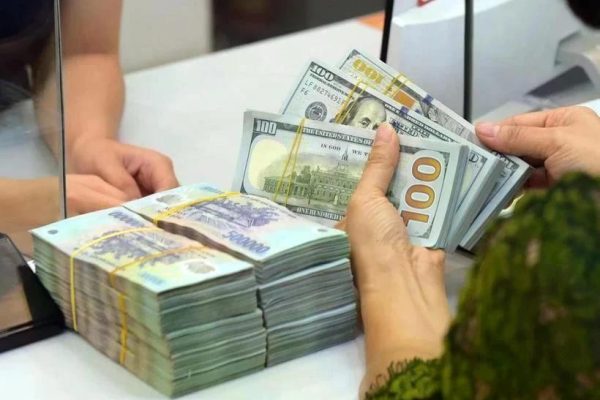
Vietnamese dong is the only currency you should be using on the loop. USD and EUR are sometimes accepted at guesthouses or can be exchanged informally, but the rates you’ll get in a small mountain town are not in your favor.
Where to exchange in Ha Giang town:
Exchange before Ha Giang if you can. Hanoi has the most competitive exchange rates in northern Vietnam, especially around the Old Quarter. If you’re transiting through Hanoi, changing a good chunk of money there and topping up at an ATM in Ha Giang town is often the smoothest approach.
Avoid exchanging in airports. The rates at Noi Bai Airport in Hanoi are notoriously poor. Change just enough for your taxi and sort the rest in the city.
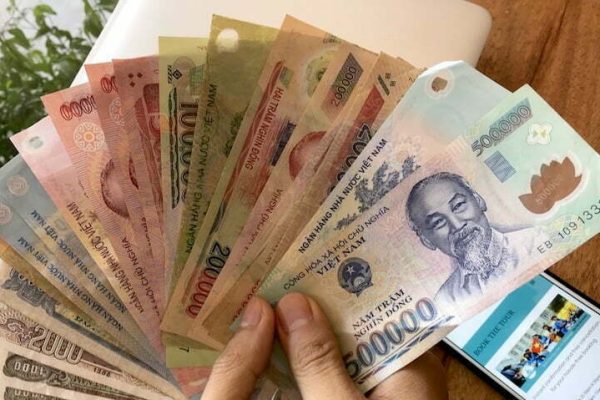
One more thing: large denomination bills (500,000 VND notes) are convenient for big transactions but can cause headaches at small village stalls where change is limited. Try to have a mix of denominations. Ask for some 50,000 and 100,000 notes when you withdraw or exchange.
Learn more: Ha Giang Cao Bang Ba Be Lake 6 Days 5 Nights
The honest answer is: rarely, and not where it counts most.
In Ha Giang town itself, some larger restaurants, the more modern hotels, and convenience-style stores may accept card payment. If you’re spending a night in town before the loop, you might be able to put your accommodation on a card.
Some tour operators, including those who run Ha Giang Loop packages, accept card payment for the tour itself — either online before you arrive or in-person at their office in Ha Giang town. This is worth confirming when you book, because paying for a multi-day tour in cash can require a significant withdrawal all at once.
Everywhere else. Guesthouses in Dong Van, Meo Vac, and Du Gia are almost all cash-only. Local restaurants and pho stalls along the route, cash only. Petrol stations on mountain roads, cash only. Roadside food vendors at passes like Ma Pi Leng, cash only.
There is no workaround for this. Cards are simply not functional infrastructure outside of Ha Giang town and a handful of slightly more developed guesthouses catering to international travelers.
Cards with no or low foreign transaction fees and ATM fee reimbursements (Wise, Revolut, Charles Schwab in the US, Starling in the UK, etc.) are genuinely useful here. You will be making ATM withdrawals, so minimizing fees is worth setting up in advance. Check with your specific provider about their Vietnam compatibility and withdrawal limits.

Learn more: Ha Giang Safety Tips
Vietnam has embraced mobile payments in urban areas. Apps like MoMo and ZaloPay are widely used in Hanoi and Ho Chi Minh City. QR code payments are increasingly common at coffee shops and restaurants in bigger cities.
In Ha Giang? Almost none of this applies.
The vendors and guesthouses you’ll interact with most on the loop are small family-run operations. They are not set up for MoMo. Many areas also have limited or no mobile data signal — spotty at best on the passes, nonexistent in some valleys.
You might encounter a QR code at a café in Ha Giang town or at a more tourist-focused spot in Dong Van, but you cannot plan around it. Think of digital payments as a pleasant surprise when they happen, not a fallback strategy.
Learn more: Ha Giang Photography Guide
Arriving at the loop with only a few hundred thousand dong. This is the most common one. People arrive in Ha Giang town thinking they can “sort money in the morning” before the loop, then their guesthouse checkout takes longer than expected, the ATM has a queue, the machine limit is lower than anticipated, and suddenly they’re riding out with half of what they need. Do it the night before. Do it as soon as you arrive in Ha Giang town.
Relying on the ATM in Dong Van as a safety net. As described above, it is not a reliable safety net. It is a possible backup that may or may not work. Plan to not need it.
Forgetting to account for the permit fee. The loop permit for foreign travelers requires payment. If you show up with exactly enough for your accommodation and food budget, you’ve underprepared. Check current permit requirements and fees before you travel.
Carrying all your cash in one place. Motorbike trips involve falls, wet weather, and bags that occasionally go missing from the back of bikes. Split your cash between two locations: some in your wallet or a small front-pocket pouch, the rest somewhere more secure like a hidden waist belt or a zippered inner compartment of your bag.
Getting large notes and not breaking them. If all your cash is in 500,000 VND notes and you stop at a small village stall for a bowl of bun bo, the vendor probably cannot make change. Break large notes whenever you’re at a bigger town or market.
Forgetting that fuel is cash-only and not budgeting for it. Some riders, especially those doing the loop for the first time, underestimate how much fuel costs over several days of mountain roads. It’s not a huge amount in absolute terms but it adds up, and you’re paying for it in cash at every stop.
Bringing only USD or EUR and expecting to convert easily. You will convert at a poor rate or not at all in some places. Vietnamese dong, withdrawn from an ATM or exchanged in Hanoi or Ha Giang town, is the right move.
Quick note: if the logistics of managing motorbike fuel, permits, cash, and navigation on your own feels like a lot to juggle, that’s exactly what a guided Easy Rider tour takes off your plate. Your guide handles the route, knows every petrol stop, and can troubleshoot situations like a dead ATM faster than you can Google it. See our Ha Giang Loop tour options for what’s included.
Learn more: Ha Giang Road Conditions 2026
The Ha Giang Loop is genuinely one of the safer places in Southeast Asia for travelers. Petty theft and tourist-targeting scams are not rampant here. That said, basic common sense applies anywhere.
Use a money belt or hidden pouch for your travel stash. Not because Ha Giang is dangerous, but because motorbike riding involves physical activity, potential falls, and bags that sometimes slide off or get rained on. Keep your main cash reserve somewhere more secure than a back pocket.
Waterproof your cash. Rain on the Ha Giang Loop is not a gentle drizzle. It can be a full monsoon downpour. A small ziplock bag costs almost nothing and has saved many people from ruined banknotes on a mountain pass.
Don’t flash large amounts. This is general travel wisdom. When you need to pay, take out what you need rather than pulling out your full stack of notes. Less because of theft risk in Ha Giang specifically, more because it’s just a sensible habit.
Keep an emergency note. Tuck away a single note that could cover one night of accommodation or a meal, somewhere separate from your main cash. If something goes wrong and you lose your wallet, this is your get-back-to-town fund.
Tell your bank you’re traveling. Some banks will flag and block transactions from Vietnam if they haven’t been notified. Do this before you leave home. A blocked card at the ATM in Ha Giang town is a fixable problem but a genuinely annoying one.

Learn more: Ha Giang Motorbike Rental
Your money situation on the Ha Giang Loop is pretty much decided by one question: how do you want to do the loop itself?
If you’re doing the loop fully independently (self-drive rental): You’re managing everything yourself, which means the ATM logistics are entirely on you. Withdraw everything in Ha Giang town, carry more than you think you need, and keep a backup stash somewhere safe. You’ll also be handling the permit, fuel, and any unexpected expenses on your own. Totally doable, just requires preparation.
If you’re doing a guided Easy Rider tour or jeep tour: A good tour operator handles a lot of the friction. Your accommodation is pre-arranged, meals are often included or pre-organized, and your guide knows which petrol stations are open and which guesthouses expect cash on arrival. You still need your personal spending cash, but the baseline logistics are smoother. If you’re renting a motorbike through a tour company, clarify upfront what’s included versus what you pay on the road.
If you’re combining Ha Giang with Cao Bang (Ban Gioc, Phia Oac, etc.): The same cash-first principle applies across the entire northern Vietnam highland region. Cao Bang town has ATM infrastructure, but once you’re moving through the karst landscape toward Ban Gioc waterfall or out to Phia Oac mountain, you’re back in cash-only territory.
Our team at Loop Trails can walk you through which format makes the most sense for your group size, riding experience, and travel style. If you’re not sure whether self-drive, Easy Rider, or a jeep tour is the right call, reach out via WhatsApp and we’ll give you a straight answer, not a sales pitch.
Whatever format you choose, sort your cash in Ha Giang town first. Everything else is details.
Learn more: Ha Giang Loop Self-Drive
Yes. Ha Giang town has multiple ATMs from banks including Agribank, Vietcombank, and BIDV. These accept foreign Visa and Mastercard. This is your best and most reliable place to withdraw cash before the loop.
Very rarely and not reliably. Ha Giang town has limited card acceptance at some larger establishments. On the loop itself, almost everything is cash only. Do not plan to use a card beyond Ha Giang town.
There is ATM infrastructure in Dong Van, but it is unreliable for foreign travelers. It may be empty, out of order, or not accepting your card. Treat it as a possible backup, not a plan.
This depends on your travel style and the length of your loop. As a general principle, carry more than you think you need. Budget for accommodation, meals, fuel, the loop permit fee, entrance fees, and a buffer for unexpected expenses. Check recent traveler reports for current price ranges as costs shift over time.
You can exchange at bank branches in Ha Giang town. Rates are better there than at most accommodation or informal exchangers on the route. For the best rates, exchange a larger amount in Hanoi before traveling north.
Options are limited: your guesthouse may exchange a small amount of foreign currency at a local rate, other travelers may help bridge a small gap, or a tour guide can sometimes facilitate solutions. The best answer is to not be in this situation — withdraw enough in Ha Giang town.
No. Roadside petrol stations and fuel stops on the Ha Giang Loop are cash only. Budget for fuel in your cash plan before leaving town.
Generally no. Mobile payments are not widely adopted among the small guesthouses and local vendors on the Ha Giang Loop. Mobile data signal is also unreliable in many areas.
Yes. Inform your bank that you’ll be making ATM withdrawals in Vietnam to avoid your card being flagged and blocked as suspicious activity.
A mix. Large notes (500,000 VND) are fine for paying guesthouses but can create change problems at small roadside stalls. Try to have some 50,000 and 100,000 VND notes for small purchases. Ask for a mix when you withdraw or exchange.
Tipping is not mandatory but is genuinely appreciated, especially for Easy Rider guides who work long hours on demanding roads. If your guide has been great, a cash tip at the end is a meaningful gesture.
Yes, there is a fee for the foreign traveler loop permit at the time of writing. Rules and fees can change, so check current requirements with your guesthouse or tour operator in Ha Giang town and factor this into your cash plan.
Contact information for Loop Trails
Website: Loop Trails Official Website
Email: looptrailshostel@gmail.com
Hotline & WhatSapp:
+84862379288
+84938988593
Social Media:
Facebook: Loop Trails Tours Ha Giang
Instagram: Loop Trails Tours Ha Giang
TikTok: Loop Trails
Office Address: 48 Nguyen Du, Ha Giang 1, Tuyen Quang
Address: 48 Nguyen Du, Ha Giang 1, Tuyen Quang
Facebook X Reddit Table of Contents Learn more: Ha Giang Loop Tours This is the question that sits in almost every Ha

Facebook X Reddit Table of Contents Learn more: Ha Giang Loop Tours Most people drive past the Quan Ba area twice on

Facebook X Reddit Table of Contents Learn more: Ha Giang Loop Tours The Ha Giang Loop has a reputation problem with older