
Ha Giang Loop: 3 Days or 4 Days? An Honest Comparison
Facebook X Reddit Table of Contents Learn more: Ha Giang Loop Tours This is the question that sits in almost every Ha

Thúy Kiều (Grace) is a travel blogger and content contributor for Loop Trails Tours Ha Giang. She holds a bachelor’s degree in Sustainable Tourism from Vietnam National University, Hanoi, and has a strong passion for exploring and promoting responsible travel experiences in Vietnam’s northern highlands.
Learn more: Ha Giang Loop Tours
Most articles about the Ha Giang Loop assume you’re going to throw a leg over a motorbike and disappear into the mountains for three days. That works for plenty of travelers. It doesn’t work for everyone.
If you’ve got a knee that doesn’t love long rides, a partner who refuses to climb on the back of a Honda XR, a kid in the group, parents joining you on their first trip to Vietnam, or you just don’t want to spend your vacation gripping a clutch lever in the rain, doing the Ha Giang Loop by car is a real, practical option. It’s not a downgrade. It’s a different way to experience the same mountains, the same passes, and the same homestays.
This guide is the conversation I have with travelers every week before they book. The route. The timing. What kind of vehicle you’ll actually be sitting in. What it costs. What to pack. The mistakes I see people make every season. I’ll also be honest about what you give up by skipping the bike, because that matters too.
Learn more: Ha Giang Loop 2 Days 1 Night
Let me start with who this option is honestly for.
The car version of the loop is for travelers who want the views, the homestays, the markets, and the cliffside passes, without the physical risk and fatigue of riding a motorbike on mountain roads they’ve never seen before. That’s the majority of the people who message us.
It’s a strong fit if:
What you give up: a bit of that “wind in your face” feeling. Some of the smaller dirt tracks that motorbikes can take. The bragging rights, if that’s your thing.
What you don’t give up: any of the major viewpoints, the food, the homestays, Ma Pi Leng Pass, the Nho Que River boat, the Sunday markets, or the late night beers around a wood fire with your driver and host family.
Learn more: Ha Giang Loop 3 Days 2 Nights
Short answer: yes, and it has been for years.
The main loop road, especially the QL4C and the connecting roads through Yen Minh, Dong Van, and Meo Vac, has been progressively paved and upgraded. Cars travel it daily: locals running supplies, government vehicles, tour vans, and a growing number of private SUVs and 4 seater jeep tours carrying foreign visitors.
A few honest notes:
The roads are narrow in places. When two cars meet on a switchback, one often has to back up to a wider section. Your driver has done this hundreds of times. You haven’t, which is one big reason most travelers don’t try to drive it themselves.
Some smaller side roads, like the descent toward the Nho Que River boat dock at Tu San or certain shortcut tracks between villages, can be rougher. A confident driver in a higher clearance vehicle handles them fine. A low sedan does not.
Landslides and roadwork happen, especially after heavy rain in June through August. Routes can shift on short notice. This is normal. A good operator just adjusts the day’s plan rather than canceling it.
If you’re picturing American interstate driving, recalibrate. If you’re picturing Bolivia’s Death Road, also recalibrate. It’s somewhere in between, closer to a slow, scenic, mountain backroad than anything genuinely dangerous when driven properly.
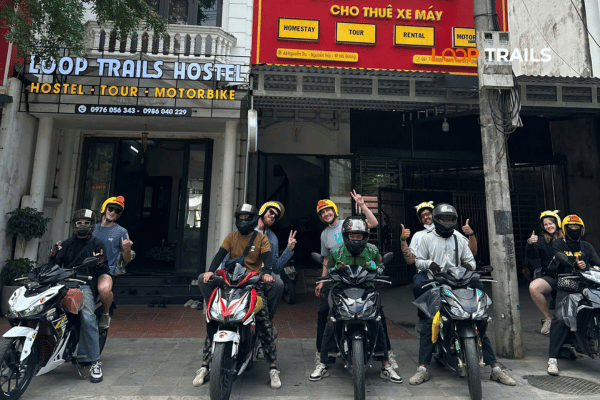
Learn more: Ha Giang Motorbike Rental
Here’s how the main options actually compare.
| Option | Best for | Pace | Comfort | Photo stops |
|---|---|---|---|---|
| Self drive motorbike | Confident riders, solo travelers | Flexible | Tiring | Anywhere |
| Easy rider (passenger on bike) | First time riders, solo travelers wanting a guide | Flexible | Moderate | Frequent |
| Private car with driver | Couples, families, non riders, comfort seekers | Smooth | High | At designated viewpoints |
| Jeep tour (4 seater shared) | Small groups wanting open air feel | Moderate | Moderate | Frequent |
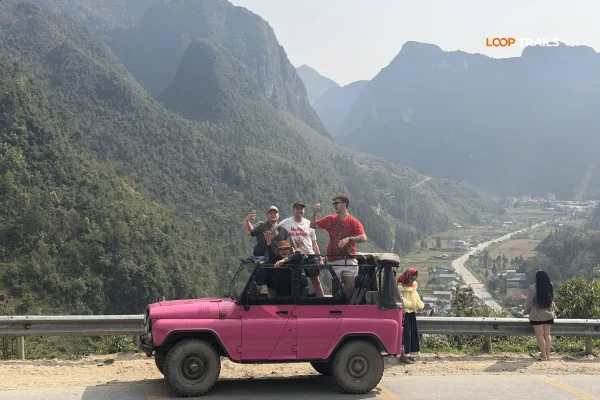
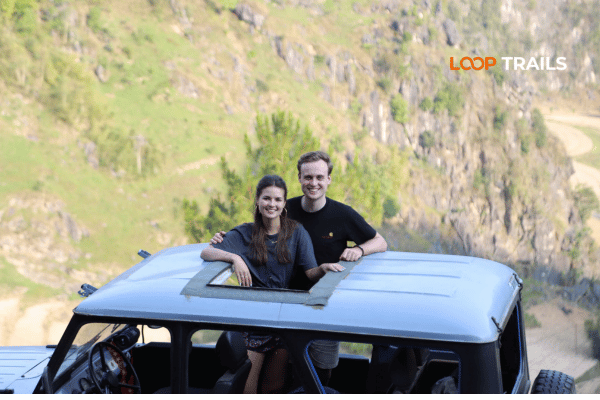
Both the private car and the jeep tour are “by car” in the broad sense. The jeep is the one you’ll see most often on Instagram, with people perched on a back bench and the canvas roof rolled back. A regular SUV is what most families and older travelers choose because it’s quieter, has aircon, and keeps your bags clean.
If you’re already leaning toward a comfortable, no stress trip and just want to see what’s available, take a quick look at the [Ha Giang Loop tours] page. The current departures and group sizes are listed there.
Learn more: Ha Giang Loop 4 Days 3 Nights
The standard motorbike loop runs three to four days. By car, the math is similar, but the rhythm is different. You’re not as tired at the end of each day, so you can either compress the route or stretch it out.
3 days by car. Doable but tight. You’ll feel rushed at Ma Pi Leng and probably skip Du Gia. Best if you only have a long weekend.
4 days by car. The sweet spot for most travelers. Real time at every viewpoint, proper homestay nights in Dong Van and either Meo Vac or Du Gia, time for the Nho Que River boat, and a relaxed last day back to Ha Giang City.
5 or more days by car. For travelers who want to slow down, do a market day (the Dong Van Sunday market or Meo Vac Sunday market), explore the H’Mong villages around Pho Bang, or combine the loop with Cao Bang.
If you only have two days, honestly, do something else. The drive in and out of the region alone eats most of that time, and you’ll spend more hours in the car than out of it.

Learn more: Ha Giang Cao Bang 5 Days 4 Nights
This is the itinerary we run most often for car travelers, with small variations depending on the season and the group.
Pickup in Hanoi early morning. The drive to Ha Giang City takes most of the day on the new expressway and then a winding road through the foothills. Lunch is usually somewhere around Tuyen Quang or Bac Quang, at a roadside place that locals stop at, where the chicken is grilled outside and the rice comes in a bamboo tube.
After Ha Giang City the loop officially begins. The first highlight is Quan Ba Heaven Gate, with a viewpoint over the Twin Mountains and the green valley below. From there it’s roughly another hour to Yen Minh, a small mountain town where you’ll spend the night.
Yen Minh isn’t the most exciting stop on the loop, but it breaks up the drive and the dinner at most homestays here is honest northern Vietnamese cooking: pork, mountain greens, sticky rice, a bit of corn wine if you’re brave.
This is a full scenery day. The road climbs through Tham Ma Pass with its tight switchbacks (the photo spot you’ve seen a hundred times on Instagram is here), drops into Sung La valley with its stone walled H’Mong houses, and stops at the Vuong family palace, the home of an early 20th century H’Mong “king” who controlled the local opium trade. The palace itself is small but the architecture and the story are worth the entrance fee.
Lunch is usually in Dong Van Old Quarter, where there’s a row of century old French era buildings turned into cafes. A coffee in one of these, with afternoon sun coming through the wooden shutters, is one of those small moments people remember from this trip.
Afternoon: Lung Cu Flag Tower, the northernmost point of Vietnam. It’s a climb up several hundred steps, but the view of the Chinese border running through the mountains is worth the breath.
Night in Dong Van. There are proper hotels here as well as homestays, depending on what you booked.
This is the day you came for.
The road from Dong Van to Meo Vac goes over Ma Pi Leng Pass, which most travelers consider the most spectacular stretch of road in Vietnam. The cliffs drop close to a kilometer down to the Nho Que River, which runs an unreal turquoise color through the limestone. There are several pull offs for photos. A good driver will stop at all of them and give you time, not rush you.
About halfway down the pass there’s a turn off down to the Tu San gorge boat dock. The road down is steep and rough in parts, but doable in an SUV. The boat itself runs about an hour, gliding through the narrowest gorge in Southeast Asia, with cliffs rising on both sides. Bring sunscreen and a hat, there’s not much shade, and the reflection off the water amplifies everything.
Back up and over to Meo Vac for the night. If it’s a Sunday, the Meo Vac market the next morning is one of the best ethnic minority markets in the region, with H’Mong, Lo Lo, Tay, and other groups trading everything from pigs to handwoven hemp textiles.
The road from Meo Vac to Du Gia is one of the quieter stretches of the loop, with a long descent through bamboo forests and a stop at the Du Gia waterfall, where you can swim in a clear pool if the weather cooperates.
From Du Gia back to Ha Giang City is the last serious mountain drive. Then it’s back to Hanoi on the highway, usually arriving early evening.
Some travelers prefer to spend the last night in Ha Giang City and drive to Hanoi the next morning, which is gentler on the body, especially after a few days of mountain roads. Worth asking for when you book.
Learn more: Ha Giang Cao Bang Ba Be Lake 6 Days 5 Nights
This catches travelers off guard, so I’ll be specific.
For 2 people, you’re typically in a 4 seater SUV or a 7 seater MPV with empty seats for legroom and luggage. Toyota Fortuner, Hyundai Santa Fe, Ford Everest, or similar in that category.
For 3 to 4 people, the same 7 seater works well, with everyone having a real seat and no one squashed in the back row.
For 5 to 7 people, you’re in a full size 7 seater or split into two vehicles depending on luggage.
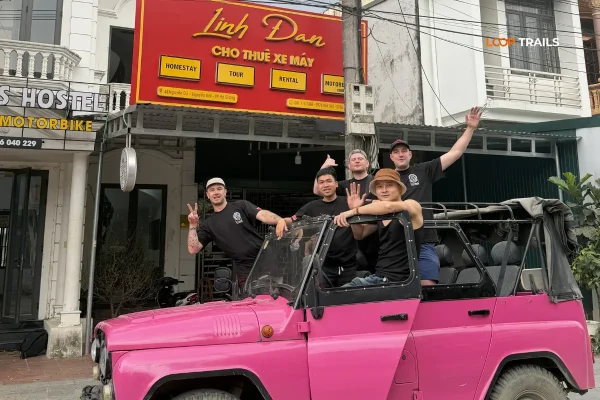
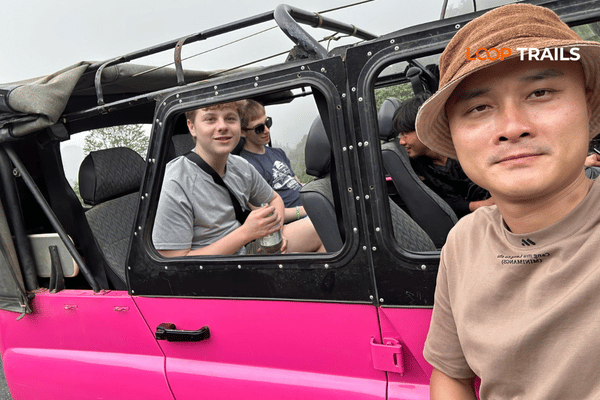
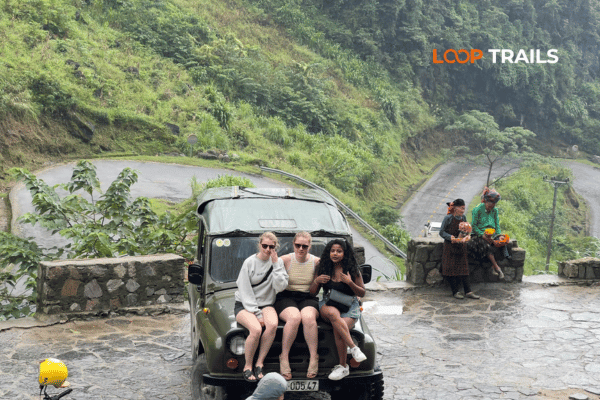
For “jeep tours,” the vehicle is usually a Russian style UAZ or a custom 4WD with bench seating in the back and a removable canvas roof. They’re fun and photogenic. They’re also bumpier and louder than a regular SUV. If you’re prone to motion sickness, the regular SUV is a safer bet.
Two things to ask before you book:
Learn more: Ha Giang in September & October
Ha Giang has four real seasons, and each has its own personality.
October to November is peak season. Buckwheat flowers bloom across the karst plateau in pinks and whites, the rice terraces have just been harvested or are turning gold in the valleys, and the air is dry and cool. Book early because dates sell out.
December to February is cold. Foggy in the mornings, often clear in the afternoons, sometimes frost or rare snow on the highest passes. The plateau looks dramatic but you’ll need real layers. Plum and peach blossoms start appearing in late January, which is its own kind of magic.
March to April is the green up. Terraces are flooded for planting and reflect the sky like mirrors, the karst landscape is at its most lush, and the weather is mild. One of the most underrated seasons in my opinion.
May to early June is hot in the valleys but still pleasant on the high plateau. Rice terraces are bright green.
Mid June to early September is rainy season. Roads can flood, landslides happen, views are often hidden in cloud. Some operators run reduced schedules. Travel is still possible, just unpredictable. If you go, build buffer days.
Late September is harvest season for the rice terraces. The valleys turn gold. This is one of the best times to go if you want classic photos.
Rules and road conditions can change, so check the latest updates before you book a specific date.
If you want help matching the season to the right tour style and group size, the team can walk you through it. The current schedule sits on the [Ha Giang Loop tours] page.

Learn more: Ha Giang Loop Cost & Tips
I’m not going to throw a number at you because prices shift with the season, the vehicle, group size, and inclusions. What I will tell you is what to pay attention to so you don’t get surprised.
A normal Ha Giang Loop by car package usually includes:
What’s usually not included:
When you compare quotes between operators, make sure you’re comparing the same inclusions. A “cheaper” tour that doesn’t include the boat ticket and has you paying for half your meals isn’t actually cheaper, it just looks that way on the booking page.
For current pricing and group sizes, check the live page rather than relying on a number from a blog written six months ago.
Learn more: Ha Giang Homestay Guide
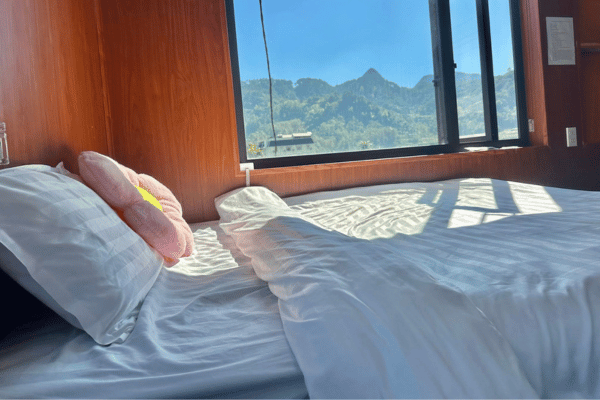
Accommodation on the loop has come a long way in the last few years. There’s now a real range, from basic homestays where you sleep on a mattress on a wooden platform shared with other travelers, to private rooms with hot showers, to legitimate boutique hotels in Dong Van and Meo Vac with valley views.
Most car travelers want, at minimum:
That’s standard on most car based tours. If you specifically want the more atmospheric homestay experience, just say so when you book. Most operators can mix and match: a homestay one night, a hotel the next.
In Yen Minh and Du Gia, options are simpler. In Dong Van and Meo Vac, you have more choice, including a few places with legitimately good restaurants attached.

Learn more: Ha Giang Packing list
Even when you’re not riding, the loop sits at high altitude and the weather changes fast. Bring:
Things you don’t need to bring:
Learn more: Ha Giang Loop Mistake to Avoid
A few things I see travelers regret:
Booking too short a trip. Two days is not enough. You’ll spend most of it in the car getting in and out of the region.
Choosing the cheapest option without checking what’s included. A tour quoted dramatically below market rate usually skips meals, uses older vehicles, or has the driver doubling as the guide with limited English.
Trying to drive yourself. Foreigners are not generally permitted to drive cars in Vietnam without the right local license, and the mountain roads here are not the place to figure that out. Stick to a hired driver. Rules can change, so check the latest before assuming.
Underestimating the weather. Saying it more than once: bring a warm layer. It saves you from buying a tourist priced jacket on day one.
Skipping travel insurance. Even on a car trip. Roads in remote regions, occasional rough sections, the river boat. Cover yourself.
Believing every Instagram post. Some of the “secret” spots are now busy. Some of the “dangerous” sections have been paved. Reality changes faster than the internet.
Cramming too many people into one vehicle. Six adults plus luggage in a single 7 seater is miserable on day three. If you’re a bigger group, two vehicles is worth the extra cost.
Learn more: Cao Bang Loop 3 Days best kept secret
If you have 7 to 10 days, combining Ha Giang with Cao Bang is one of the best moves you can make. The two regions are next to each other and the road between them, while long, takes you through some of the most authentic and least visited parts of northern Vietnam.
Ha Giang has the dramatic karst plateau and the Ma Pi Leng cliff drama.
Cao Bang has Ban Gioc Waterfall on the Chinese border (one of the most photogenic waterfalls in Asia), the Phia Oac mountain area, and a quieter, more rural feel. Fewer tourists, more cows on the road.
By car, this combine route is much more comfortable than trying to do it on a motorbike, because the connecting road between the two provinces involves several long highway stretches that are simply boring on a bike but fine in an air conditioned vehicle with music on.
If that sounds like your kind of trip, the [Ha Giang and Cao Bang combine tour] page has the full route. Or, if you want Cao Bang on its own, that’s also an option through the [Cao Bang Loop tours] page.
Learn more: Ha Giang Loop by Jeep for Families & Groups
Quick decision guide based on what we hear from travelers most often:
Choose the Ha Giang Loop by car (private SUV) if: You’re a couple, family, or small group of friends who want comfort, flexibility on the schedule, and aircon. You don’t want to ride or be ridden on a motorbike. You’re paying for a smoother experience and you want it to feel like one.
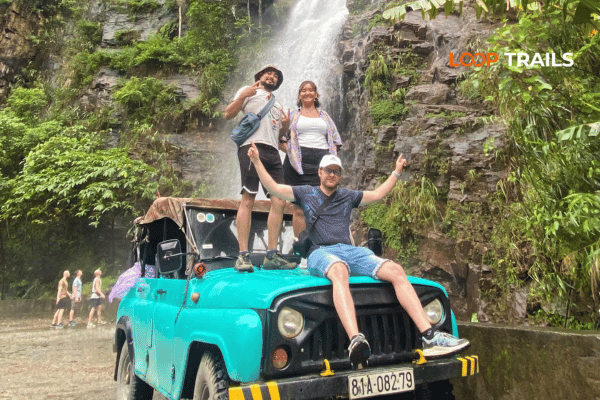
Choose the jeep tour if: You’re a small group of three or four people who want the open air feeling without the risk of riding yourself. You don’t mind some bumps. You like the photos.
Choose the easy rider (passenger on motorbike) if: You’re solo or a couple where both of you are willing to ride pillion, you want the wind in your hair, and you’re physically up for sitting on a bike for six to eight hours a day for three days.
Choose self drive if: You’re an experienced motorcycle rider with a license that’s recognized in Vietnam, you’ve ridden in similar conditions before, and you want full freedom. (And please, wear real gear.) The [motorbike rental in Ha Giang] page has the bikes we trust.
Choose the Cao Bang combine route if: You have at least a week and want a deeper, less touristed experience.
If you’re still not sure, message us. A two minute conversation usually clears it up faster than another hour of reading blog posts.
Learn more: Loop Trails Tour Ha Giang website
Once you’ve decided on the format, the booking flow is straightforward:
For non riders who want the easiest path, the [Ha Giang Loop by car tour] page has the current departures. If you’re combining with Cao Bang, that’s a separate booking flow on the [Ha Giang and Cao Bang combine] page. If you’ve already got plans and just want to rent a motorbike for one segment of your trip, the [Ha Giang motorbike rental] page handles that.
The fastest way to lock in a specific date, especially in October and November, is to message us on WhatsApp. We confirm same day in most cases, and we’ll tell you straight up if a date is full instead of stringing you along.
Learn more: Ha Giang Loop Photography Guide
Yes, with a competent driver. The roads are narrow but paved on the main route, and operators run them daily without incident. The bigger risks are weather and driver fatigue, both of which a good operator manages by choosing experienced drivers and not over scheduling days.
Generally not recommended. Foreigners need the right local license, and the mountain roads are not the place to figure that out. Hire a driver instead. Rules can change, so check the latest updates before you travel.
Most travelers do it in 4 days from Hanoi back to Hanoi. 3 days is possible but rushed. 5 days lets you slow down and add markets or a Cao Bang segment.
Per person, no. A private car is usually more expensive than an easy rider tour. But if you’re 3 or 4 people splitting one car, the per person cost gets close, and the comfort level is much higher.
Yes. We’ve had families with kids as young as four do the loop comfortably. Bring snacks, a tablet for slow stretches, and motion sickness tablets if your kid is prone to it.
For most people, no. The road is wider than it looks in photos and there’s a wall on the cliff side in many sections. If you’re seriously afraid of heights, sit on the inside seat and you’ll be fine.
Yes. Always, for any trip in Vietnam, but especially when heading into mountain regions where medical facilities are limited.
October to November for buckwheat flowers and dry weather. March to April for green terraces. Late September for golden rice. Avoid peak rainy season (mid June to early September) unless you have buffer days built in.
Drivers’ English varies. On most car tours, you’ll have either a separate guide who speaks English alongside the driver, or a driver who handles basic communication. Confirm before booking if English level is important to you.
Yes. Private car tours are flexible. Want an extra night in Dong Van for the Sunday market? Want to skip Du Gia and head straight back? Just tell the operator. Group tours are less flexible because you’re sharing with others.
Routes get adjusted. Your operator will reroute or, in rare cases, swap a day. This is part of why you book with someone who runs the loop weekly, rather than going it alone.
Sometimes yes, sometimes no. Always confirm with your specific tour package before booking, and ask whether the ticket is per person or per vehicle.
Contact information for Loop Trails
Website: Loop Trails Official Website
Email: looptrailshostel@gmail.com
Hotline & WhatSapp:
+84862379288
+84938988593
Social Media:
Facebook: Loop Trails Tours Ha Giang
Instagram: Loop Trails Tours Ha Giang
TikTok: Loop Trails
Office Address: 48 Nguyen Du, Ha Giang 1, Tuyen Quang
Address: 48 Nguyen Du, Ha Giang 1, Tuyen Quang
Facebook X Reddit Table of Contents Learn more: Ha Giang Loop Tours This is the question that sits in almost every Ha
Facebook X Reddit Table of Contents Learn more: Ha Giang Loop Tours Most people drive past the Quan Ba area twice on

Facebook X Reddit Table of Contents Learn more: Ha Giang Loop Tours The Ha Giang Loop has a reputation problem with older