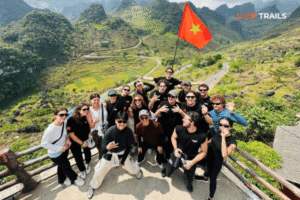


Thúy Kiều (Grace) is a travel blogger and content contributor for Loop Trails Tours Ha Giang. She holds a bachelor’s degree in Sustainable Tourism from Vietnam National University, Hanoi, and has a strong passion for exploring and promoting responsible travel experiences in Vietnam’s northern highlands.
Learn more: Ha Giang Loop Tours
Most people come to Ha Giang for the road. The legendary bends of Ma Pi Leng Pass, the vertical rice terraces stacked above Sung La Valley, the stone plateau of Dong Van stretching into cloud. That’s the pitch, and it’s completely accurate.
But somewhere between the first bowl of Au Tau porridge at 7am and the shared corn wine at a Hmong homestay after dark, something shifts. You realize the food is part of the experience in a way that doesn’t happen on many other routes in Vietnam.
Ha Giang’s cuisine is not polished. It isn’t the refined street food of Hanoi, and it’s nowhere near the tourist-friendly menus of Hoi An. It’s rougher, smokier, stranger in the best possible sense. It comes out of cold winters at 1,500 meters, from ethnic minority communities who have been cooking the same dishes for generations, from animals grazed on highland grass, from grains grown in stone-walled terraces where soil is so scarce that farmers carry it in baskets from the valley.
That’s what makes it worth paying attention to.
The Ha Giang Loop passes through the territory of at least six ethnic minority groups: the Hmong (both Black and Flower varieties), Tay, Dao, Lo Lo, Nung, and Giay. Each group has its own food traditions, fermentation methods, and festival dishes. What you eat in a Tay village near Du Gia will be noticeably different from what lands on the table in a Hmong homestay above Dong Van.
The altitude matters too. At over 1,200 meters on the Dong Van karst plateau, winters are genuinely cold. The cuisine reflects that: heavy soups, smoked meats preserved through the dry season, warming rice wine, and fermented dishes that keep well without refrigeration.
Vietnamese food is already one of the world’s great culinary traditions. But the highlands of Ha Giang Province sit well outside the mainstream. Dishes like Thang Co (a stew of horse meat and organs slow-cooked with a blend of spices) are almost impossible to find outside the northern mountain provinces. The buckwheat flour used to make local pancakes and wine only grows at this altitude. The corn whiskey pressed in the villages around Meo Vac has nothing in common with the plastic-bottle stuff you’ll find in lowland markets.
This is food you cannot eat anywhere else. That’s reason enough to pay attention.
Learn more: Ha Giang Loop 2 Days 1 Night
The Loop covers roughly 350km of mountain roads across 3 to 4 days, depending on your itinerary. Each section has its own food character. Here’s a quick breakdown of what to prioritize at each stage.
Most travelers arrive in Ha Giang City by bus from Hanoi and spend at least one night here before starting the Loop proper. The city has a functioning restaurant scene, which makes it a good place to try dishes in a slightly more comfortable setting before encountering them roadside in rawer form.
What to eat here:
Dong Van is the main town on the karst plateau, about a full day’s ride from Ha Giang City via Quan Ba and the Fairy Breast Mountains. The market here is one of the most culturally rich in northern Vietnam, and the food options are more interesting per square meter than anywhere else on the Loop.
What to eat here:
Learn more: Ha Giang Loop 3 Days 2 Nights
Meo Vac sits at the bottom of the most dramatic section of the Loop, at the base of Ma Pi Leng Pass overlooking the Nho Que River. It’s a bigger market town than Dong Van, with a more chaotic and colorful Sunday market that draws ethnic minority families from villages scattered across the surrounding karst.
What to eat here:
Du Gia is a Tay minority village set in a lush green valley along the Mien River, usually visited on day 3 or day 4 of a full Loop itinerary. The landscape here is softer than the karst plateau: rice paddies, bamboo groves, and limestone cliffs rising above the river. The food reflects the Tay culture: lighter, more vegetable-forward, with excellent freshwater fish.
What to eat here:
Thinking about the Loop? Whether you want a local guide to lead you to the best roadside stalls or prefer the flexibility of self-drive with insider tips in your pocket, Loop Trails has a format that fits. Browse Ha Giang Loop tours and see which option suits your travel style.
Learn more: Ha Giang Loop 4 Days 3 Nights
If you’re building a foodie checklist before you arrive, start here. These are the dishes that define the Ha Giang experience.
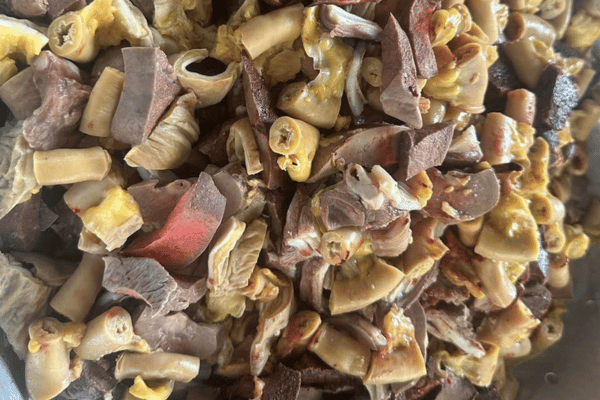
The dish that divides opinions more than any other on the Loop. Thang Co is a Hmong speciality of horse meat (and sometimes buffalo or goat) combined with internal organs: kidney, lung, intestine, liver, cooked low and slow in a large communal pot with a complex spice blend. The name roughly translates as “bowl of soup” in the Hmong language.
The flavor is rich, gamey, and deeply savory. The spice blend includes black cardamom, cinnamon, dried chili, ginger, and a rotation of other aromatics that varies by cook. It’s served in bowls with fresh herbs and eaten at communal wooden tables at market stalls.
It is not for everyone. But if you have any appetite for unfamiliar foods, it’s the dish that will tell you something about Ha Giang that no photograph can.
Where to find it: Dong Van Saturday night market, Meo Vac Sunday market, dedicated stalls in Ha Giang City.
A warming, slightly unusual porridge made from the Au Tau root, which contains alkaloid compounds with mild numbing properties. Vendors have been selling this since the dish became a Ha Giang specialty tied to the province’s identity. The porridge is thicker than most Vietnamese soups, pale grey in color, and faintly bitter with a lingering warmth in the throat and chest.
It’s traditionally eaten as a cold-weather morning meal, though you’ll find it year-round now at Ha Giang City stalls catering to both locals and visitors. Eat it with a fried egg and a cup of strong mountain tea and you’ll understand why it’s considered comfort food at altitude.
A note: Au Tau root in concentrated raw form is toxic. Commercially prepared Au Tau porridge at established stalls is safe because the preparation process neutralizes the harmful compounds. Stick to known vendors rather than experimenting with raw root.
Where to find it: Ha Giang City, near the central market. A few guest houses also prepare it for breakfast.
Learn more: Ha Giang Cao Bang 5 Days 4 Nights
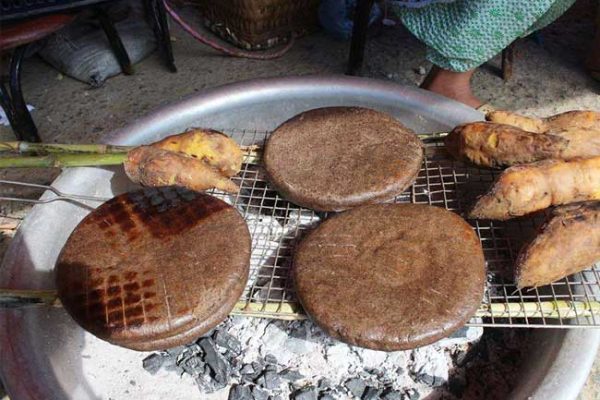
Buckwheat (tam giac mach in Vietnamese, literally “triangular grain”) only grows in the cooler highland climate of Ha Giang Province. The pancakes are thin, made purely from buckwheat flour cooked on a small iron plate over charcoal, and served with local honey, sesame seeds, or condensed milk depending on the vendor. The flavor is more complex than a plain crepe: earthy, slightly bitter, slightly nutty.
The wine made from the same grain is lighter than corn wine and has a faint floral or herbal quality that makes it easy to drink. Small bottles are sold at market stalls and in most guesthouses around Dong Van and Meo Vac.
If you’re visiting during buckwheat flowering season (roughly October to November), the visual experience of fields of small pink flowers covering hillsides adds another dimension to the food: you’re eating something grown here, in this specific landscape, at this specific altitude.
Ha Giang winters are cold and dry, and before refrigeration the traditional preservation method across ethnic minority communities was smoking. Strips of buffalo, pork, or goat are salt-cured and hung over the kitchen fire for weeks or months, slowly picking up smoke from the cooking fire below.
The result is a dense, intensely flavored dried meat unlike anything you’d find in a lowland market. It’s often eaten as a snack with corn wine, sliced thin and chewy, or added to stir-fries and soups for depth. You’ll see it hanging in bundles in guesthouse kitchens and at market stalls throughout the Loop.
The Nho Que River cuts through the deepest gorge in Vietnam, visible from Ma Pi Leng Pass as an unlikely turquoise stripe far below. The river’s cold, clean water produces small but intensely flavored freshwater fish. Typically grilled whole over charcoal with lemongrass and chili, or fried and served with sticky rice.
This is not a complicated dish. But eating grilled river fish with a view of the gorge below is an experience that sits in the memory longer than many fancier meals.
Learn more: Ha Giang Cao Bang Ba Be Lake 6 Days 5 Nights
Corn wine is to the Ha Giang Loop what sake is to a Japanese country inn: you don’t have to love it, but refusing to engage with it at all means missing something important about the culture.
Ethnic minority families in Ha Giang, particularly in Hmong and Lo Lo villages, have distilled corn wine for generations. The product ranges from rough, high-proof firewater to smoother varieties aged briefly in clay jars. It’s offered at homestays, at markets, and at roadside stalls throughout the Loop.
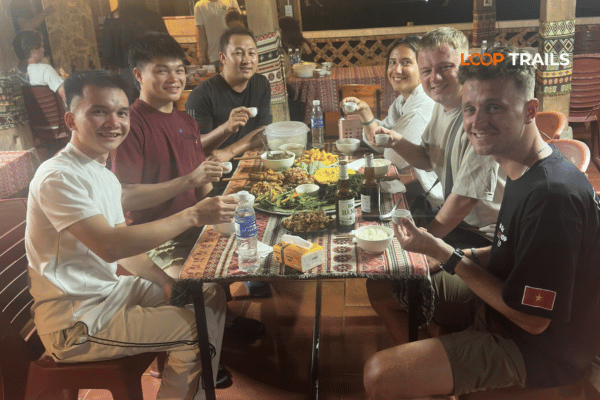
The ritual around it matters as much as the liquid itself: the shared cup passed around the table, the toasts called out in local dialects, the host’s expression when you accept graciously.
Learn more: Ha Giang Food guide
The highland markets in Ha Giang Province operate on a rotational weekly calendar. Different markets fall on different days of the week, which means the day you travel through a given town significantly affects what you experience.
The major markets and their traditional days:
If your itinerary can be adjusted to hit Meo Vac on a Sunday morning, prioritize it. The market is a full sensory experience: live animals, hand-dyed indigo cloth, fresh produce from mountain gardens, and the communal Thang Co vats that draw visitors from across the province.
Ask your tour guide or tour operator whether your Loop dates can be aligned to catch a market day. It’s one of the most worthwhile scheduling adjustments you can make.
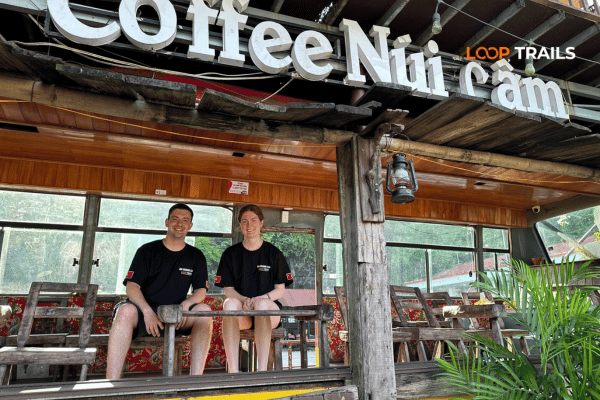
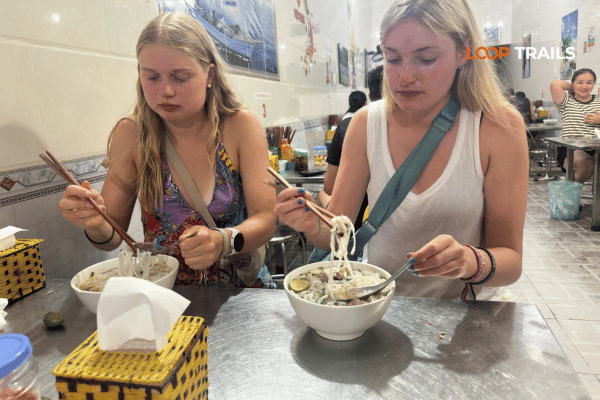
Roadside food culture on the Ha Giang Loop is good and underappreciated. Small wooden stalls appear at most significant junctions and at the base or summit of major passes. The standard offering is simple: pho or bun rieu (crab noodle soup), banh mi, com (rice with 2 or 3 dishes), strong black coffee, and sometimes egg coffee if you’re lucky.
Quality is uneven, and you should expect rustic conditions. But the value is excellent. A breakfast of pho and coffee at a roadside stall in Yen Minh or Pho Bang will cost a fraction of what you’d pay for worse food at a tourist-oriented café.
The trick is following local traffic. A stall with four motorbikes and a table of Hmong men eating breakfast is almost always a better sign than one with a hand-painted sign aimed at tourists.
Learn more: Cao Bang Loop 3 Days best kept secret
This is where the real food happens.
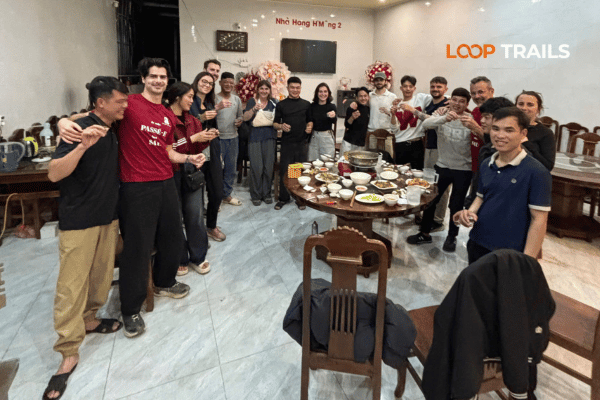
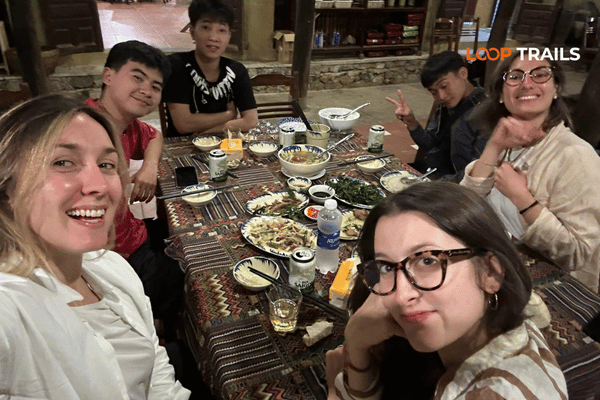
If you’re sleeping at a village homestay (which Loop Trails includes in most of our tour formats), the evening meal prepared by the host family is frequently the best thing you’ll eat on the entire trip. It’s not a performance. It’s what the family eats, adjusted slightly for guests, using whatever is available from the garden, the nearby river, or the local market.
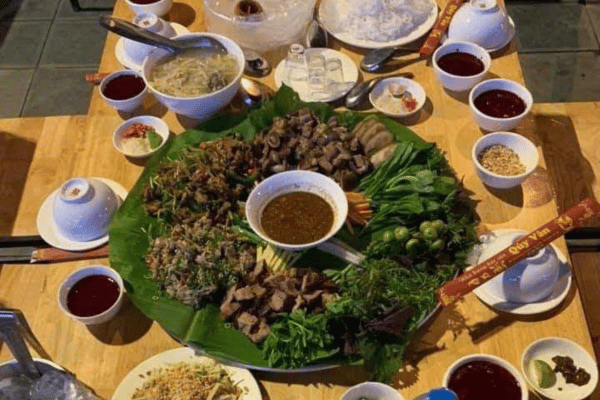
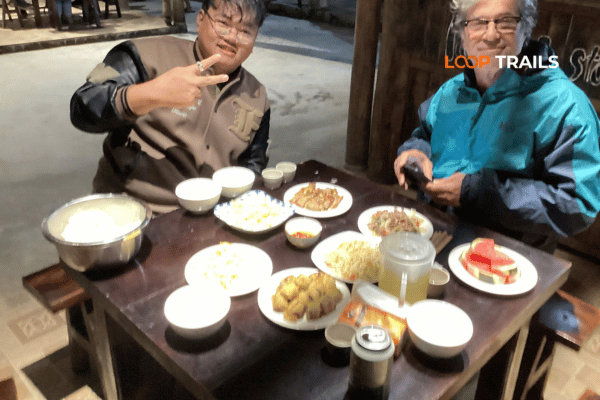
A typical homestay dinner might include: stir-fried morning glory with garlic, a clay pot of pork or chicken, fresh tofu with chili and tomato, a broth soup, sticky rice, and a plate of raw vegetables and dipping sauce. Simple ingredients executed confidently, eaten with chopsticks at a low table shared by travelers from five different countries and the host family’s children.
Don’t eat a big lunch if you know a homestay dinner is coming. It’s worth saving the appetite.
Learn more: Ha Giang Buckwheat Flowers Season
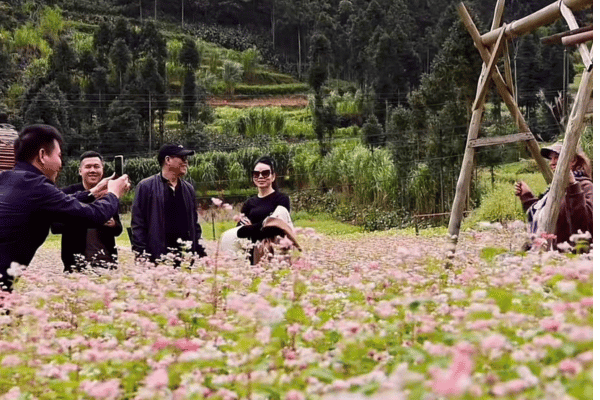
Between roughly October and November each year, buckwheat flowers bloom across the Dong Van karst plateau. The hillsides turn a dusty pink-red. It’s one of the most-photographed natural events in northern Vietnam, and it draws a significant wave of visitors in those weeks.
What most visitors don’t consider is the direct food connection. The buckwheat grain harvested after flowering season is what feeds the local pancake and wine traditions. Visiting during or just after flowering season means the freshest, most abundant buckwheat products: stalls set up specifically to sell pancakes made with newly harvested flour, small-batch wine pressed from the current year’s grain.
If you’re combining a foodie interest with photography, this is the overlap window that makes the most sense. October to November sees good road conditions (post-rainy-season in most years), cooler temperatures, and the highest concentration of buckwheat products at market stalls.
Check conditions before booking, since the bloom timing shifts slightly year to year. A good local tour operator will know the current flowering forecast.
Learn more: Ha Giang Homestay Guide
Ha Giang Loop is doable as a vegetarian, but it requires planning and communication. The highland cuisine is heavily meat-centered, and many broths and sauces contain pork or fish-derived flavors that aren’t always declared.
What generally works without issue:
What’s harder:
If you’re traveling with a Loop Trails guide, they can communicate dietary requirements to homestay hosts in advance. Most host families are genuinely willing to accommodate, especially with 24 hours’ notice.
Vegan travelers will have a more limited experience but a workable one.
There is no established allergy-awareness culture in rural Ha Giang. If you have a severe food allergy, this needs to be communicated proactively and firmly, not assumed from menu reading. Most stalls don’t have menus in the Western sense, and cross-contamination is not something roadside vendors think about.
For celiacs: the main concern is soy sauce (wheat-containing) used in many dishes, and the presence of wheat in some processed snacks sold at market stalls. Sticky rice and rice-based dishes are generally safe. Buckwheat, despite the name, contains no wheat. But kitchen contamination in a shared cooking environment is a real risk.
The safest approach for anyone with a serious allergy is to travel with a bilingual allergy card, communicate through your guide, and pre-arrange meals where possible rather than eating impromptu at stalls.
Learn more: Ha Giang Loop Mistake to Avoid
This is not Bali. Food safety on the Ha Giang Loop is actually reasonably good if you apply basic common sense. The highlands have a cooler climate than the lowlands, which slows bacterial growth. Homestay cooking is fresh-daily, using ingredients the family sourced that morning.
A few practical rules that will keep you comfortable:
Choose cooked over raw. Fully cooked dishes are lower risk than raw salads or unpeeled fruit from roadside stalls. Sticky rice, noodle soups, grilled meats, and clay pot dishes are all generally fine. Raw herbs added as garnish at the table fall in a grey zone.
Drink bottled or filtered water. Tap water throughout the Loop route is not safe to drink. Every homestay and guesthouse should have bottled water available. Don’t brush teeth with tap water if your stomach is sensitive.
Go slow on the corn wine. The local distilled spirits are high-proof and dehydrating. Drinking heavily at altitude in a hot sleeping room while physically exerting yourself on a motorbike the next day is a formula for a rough morning. You don’t need to refuse it, just pace yourself.
Market Thang Co is fine, sketchy stalls are not. Established communal Thang Co vendors at the major markets have been serving this dish for decades. The risk is not higher than eating from any communal pot at a market. Small, poorly-maintained roadside stalls with unclear hygiene are a different story.
Trust your guide’s judgment. If you’re on a guided tour and your guide bypasses a particular stall, they’re probably doing it for a reason. Ask them to explain, and take their advice seriously. They know which vendors are reliable and which had problems last week.
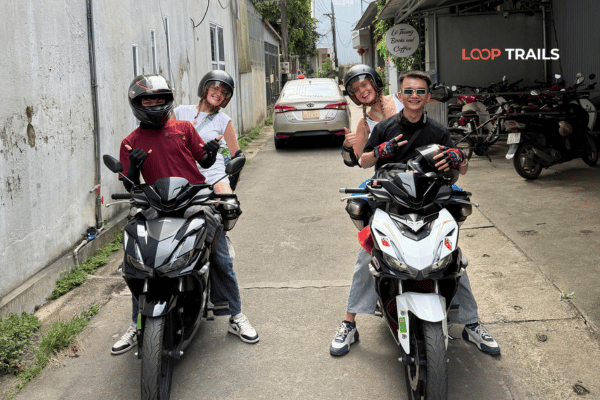
Learn more: Ha Giang Motorbike Rental
This question comes up more often than you’d expect. The answer depends on how much priority you’re putting on the food side versus the driving side.
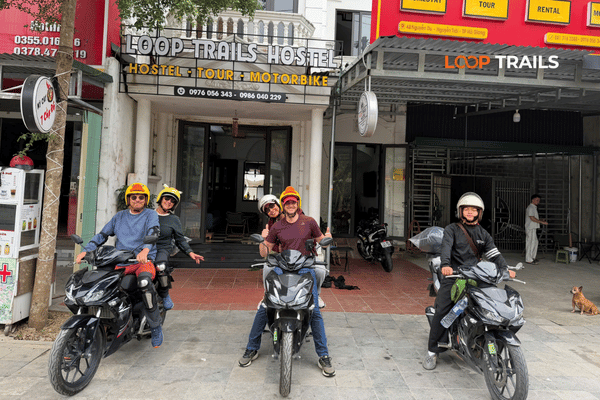
Easy Rider is the most food-friendly format on the Loop. Your guide rides with you (you ride pillion), which means they’re making all the stops, and they know every stall, homestay, and market worth visiting. The best guides on the Easy Rider format are deeply connected to the local food culture: they’ll pull over at a specific roadside stall not because it’s on an itinerary but because the owner is their cousin and the pho is exceptional.
You’ll stop more, eat more, and understand more of what you’re eating. For a foodie-first approach to the Loop, Easy Rider is the top recommendation.
Learn more: Ha Giang Loop Self-Drive
Self-drive gives you maximum flexibility. If you see a stall that looks interesting, you stop. No one is waiting for you. No schedule to catch. You can spend an extra thirty minutes at the Meo Vac market watching the Thang Co vendors instead of being nudged toward the next checkpoint.
The trade-off is that without a guide, you’re navigating the food landscape entirely on your own. You won’t know which stall has been operating for twenty years versus which one opened last month. You won’t have someone to translate your dietary needs to a homestay host. And you might miss the unmarked stall down the alley that makes the best Au Tau porridge in town.
The ideal self-drive foodie traveler is someone who has done some research before arriving, carries a basic Vietnamese phrasebook or food translation app, and is comfortable eating by instinct and pointing.
Learn more: Ha Giang Loop by Army Jeep Tours
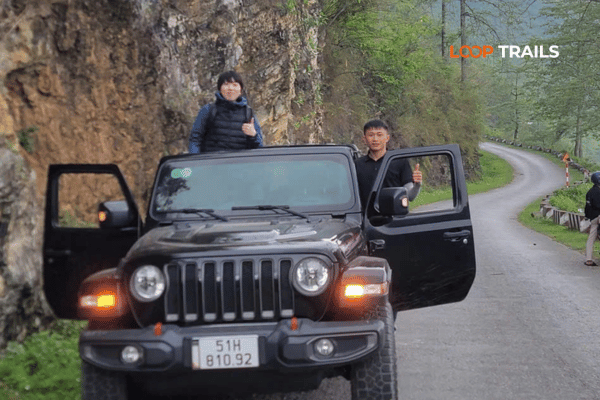
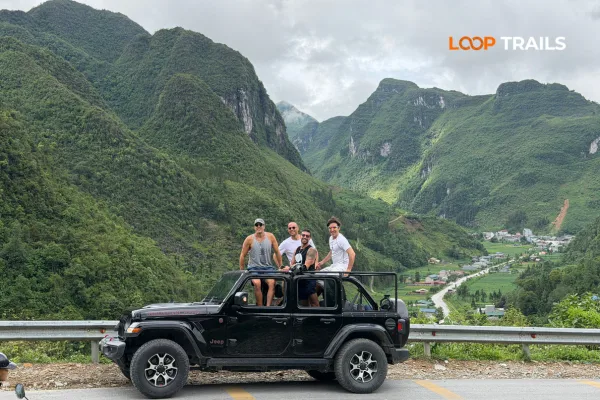
Jeep tours cover the same stops, the same markets, and the same homestays as motorbike tours. You’re not missing food experiences because you’re in a vehicle instead of on a bike. The guide is in the jeep with you, so you still get the local knowledge and the personal recommendations.
Where jeep tours differ is in pacing. You tend to arrive at stops in a more relaxed state, which is actually useful for eating. Arriving at a market after hours on a mountain road can suppress appetite. Arriving comfortably can do the opposite.
For travelers who are older, who have physical limitations, or who simply want to prioritize the culinary experience over the riding experience, a jeep tour is a fully valid approach to the Loop.
Not sure which format is right for you? Loop Trails offers all three options: Easy Rider, self-drive motorbike, and private jeep. We can also help you plan a route that prioritizes market days and food stops. Check tour options here or send us a message on WhatsApp and we’ll help you build the right itinerary.
Learn more: Ha Giang Loop Wrangler Tour
No single month is perfect for everything. Here’s a practical seasonal breakdown focused on the food experience.
October to November
The best overlap of good weather, buckwheat flowering season, and peak market activity. Roads are mostly dry after the rainy season. Homestay hosts are harvesting and preserving foods for winter, which means smoked meats are being prepared, new batches of corn wine are being distilled, and the general energy around food at homestays is high. Slightly cooler temperatures make the heavier dishes like Thang Co and Au Tau porridge feel exactly right.
The downside: this is also peak season overall. Guesthouses in Dong Van fill up quickly on weekends, and market areas are crowded.
December to February
Cold on the plateau, sometimes genuinely cold, with occasional frost above 1,500 meters. The food culture shifts toward its most traditional forms: warming soups, heavy stews, smoked meats, corn wine consumed in volume. If you want the most authentic cold-weather highland cuisine experience, this window delivers it.
Travel conditions can be challenging: fog, cold rain, and occasionally icy roads at higher elevation. This is not the recommended window for first-time riders, but if you’re on a jeep tour or riding with a very experienced guide, the rewards are significant.
March to May
Spring brings improving weather and the plum and peach blossom season (late January to March). The terraces are being planted, which means early-season vegetables are abundant and fresh. This is a lighter food season: more greens, more river fish, less heavy stew. Good for travelers who find the winter dishes too rich.
June to September
Rainy season. The Loop is passable but conditions vary: landslides can close sections of road, and riding on wet mountain passes requires experience. The food scene is fully operational year-round, but some of the best market activity peaks in drier months.
Rules on road conditions and requirements can change seasonally, so always check with your tour operator for current conditions before booking.
Learn more: Ha Giang Loop Coporate Retreat
Thang Co is the dish most specific to this region: a slow-cooked stew of horse meat and organs, traditional to Hmong communities, eaten at market stalls around Dong Van and Meo Vac. Au Tau porridge is the second most distinctive, a warming root-based porridge found almost exclusively in Ha Giang City.
Generally yes, with common sense applied. Established market vendors and roadside stalls that see high local traffic are reliable. Fully cooked foods are lower risk than raw preparations. Drink bottled water and go easy on the corn wine. Traveling with a guide adds a layer of local knowledge about which specific vendors are worth trusting.
It’s possible but requires planning. The cuisine is heavily meat-centered, and many dishes contain meat-based broth or lard even if they appear vegetarian. Sticky rice, tofu dishes, fresh vegetable stir-fries, and buckwheat pancakes are generally safe options. If you’re on a guided tour, communicate your requirements in advance so the operator can brief homestay hosts.
Buckwheat flowers bloom roughly from October to November, with the peak varying slightly year to year depending on elevation and weather. This window is also when buckwheat pancakes and wine are freshest and most widely available at market stalls.
Corn wine (Ruou Ngo) is a locally distilled spirit made from highland corn, produced by ethnic minority families across the Loop region. It ranges from rough high-proof firewater to smoother small-batch varieties. You should try it at least once, ideally at a homestay where it’s offered in the proper social context. Drink slowly and pace yourself.
Yes, but the options are limited compared to Ha Giang City. Both towns have small guesthouses with attached kitchens and a handful of local restaurants. Market days bring the most food activity. For the best eating experience in these towns, stay at a local guesthouse and eat what they cook rather than expecting a restaurant menu.
Not necessarily. Pointing at dishes, following locals, and traveling with a guide who can translate all work well. A few words of Vietnamese and basic food vocabulary help significantly at market stalls. If you have dietary restrictions or allergies, a written Vietnamese translation card is worth preparing before you arrive.
This depends on the tour format. Loop Trails tours include homestay dinners and breakfasts as part of the accommodation arrangement. Lunches are typically at the rider’s discretion during the day’s ride, with the guide recommending specific stops. Check the specific inclusions list for the tour you’re booking.
Most highland markets are at their most active between 6am and 9am. If you’re targeting the Meo Vac Sunday market or the Dong Van Saturday market for food, aim to arrive early. The Thang Co vendors are typically set up by 7am, and by mid-morning the energy begins to wind down.
Less spicy than central or southern Vietnamese food. The highland cuisine uses dried chili in some dishes (Thang Co in particular) but it’s a warming heat rather than an aggressive one. Fresh chili is available as a condiment at most stalls. If you’re spice-sensitive, you’ll generally be fine.
Sealed and dried goods like buckwheat wine in bottles, small-batch corn wine, dried herbs, and packaged local snacks are possible souvenirs. Smoked meats and fresh produce are subject to customs restrictions depending on your destination country. Check import rules for your home country before buying quantities.
Show up at Meo Vac on a Sunday before 8am and look for the largest gathering of local men around a communal pot. The best indicator is always the concentration of local customers. If you’re on a guided tour, ask your guide directly, since they’ll know which specific vendor has been operating the longest in the area.
Contact information for Loop Trails
Website: Loop Trails Official Website
Email: looptrailshostel@gmail.com
Hotline & WhatSapp:
+84862379288
+84938988593
Social Media:
Facebook: Loop Trails Tours Ha Giang
Instagram: Loop Trails Tours Ha Giang
TikTok: Loop Trails
Office Address: 48 Nguyen Du, Ha Giang 1, Tuyen Quang
Address: 48 Nguyen Du, Ha Giang 1, Tuyen Quang
Facebook X Reddit Table of Contents Learn more: Ha Giang Loop Tours Most people drive past the Quan Ba area twice on

Facebook X Reddit Table of Contents Learn more: Ha Giang Loop Tours The Ha Giang Loop has a reputation problem with older