

Thúy Kiều (Grace) is a travel blogger and content contributor for Loop Trails Tours Ha Giang. She holds a bachelor’s degree in Sustainable Tourism from Vietnam National University, Hanoi, and has a strong passion for exploring and promoting responsible travel experiences in Vietnam’s northern highlands.
Learn more: Ha Giang Loop Tours
The first time someone hands you a bamboo cup full of something clear and warm in a village along the Ha Giang Loop, you might not know exactly what you’re holding. The host is smiling. The fire is burning low. Everyone around you seems to be in an excellent mood.
You’re holding corn wine. And you’re about to understand why people here call it ruou ngo or, more affectionately, happy water.
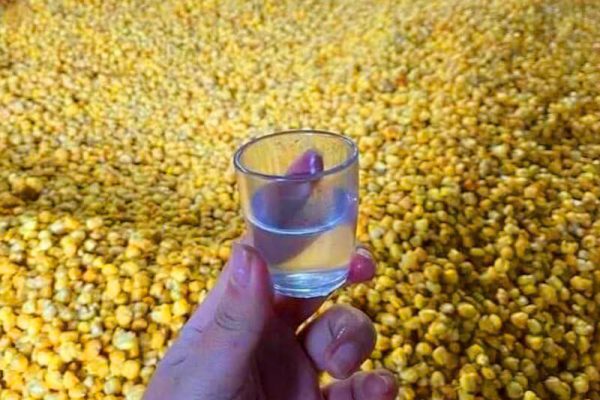
Corn wine (ruou ngo in Vietnamese) is a traditional distilled spirit brewed from fermented corn, produced across the mountain communities of northern Vietnam. It’s not wine in the Western sense it’s a clear, potent distillate, closer in spirit (literally) to a grain moonshine than anything you’d find in a bottle with a label. But calling it moonshine also misses the point. Corn wine in Ha Giang is cultural glue. It’s what you drink when you arrive somewhere, when you close a deal, when you mourn a loss, when you celebrate a harvest.
In the Dong Van Karst Plateau, corn wine is everywhere in homestays, at weekly markets, poured from repurposed plastic bottles into bamboo cups at the side of the road. Among the H’mong, Tay, Giay, and Lo Lo communities who have lived in these mountains for generations, it’s less a drink than a ritual object. And for travelers doing the Ha Giang Loop, it’s one of the most memorable (and sometimes most humbling) encounters of the entire trip.
This guide covers everything you’d want to know: how it’s made, how it tastes, where to try it, how to drink it without causing offense or regret, and how to take some home without your bag smelling like a distillery.
Learn more: Ha Giang Loop 2 Days 1 Night
Ha Giang province is home to more than 20 ethnic minority groups, many of whom have lived in its high valleys and karst peaks for centuries. Corn specifically a local mountain variety with small, dense kernels and high starch content has long been a staple crop here. In the rocky terrain of the Dong Van Plateau, where rice paddies can’t easily grow, corn fills the gaps.
At some point, perhaps hundreds of years ago, communities in this region discovered that fermented corn could be distilled into something that warmed you in the cold, helped the hours pass at long communal gatherings, and made difficult conversations a little easier to start. The practice stuck.
Corn wine is not unique to Ha Giang versions of it are made across northern Vietnam but the specific character of the drink here, shaped by local corn varieties, local water, local yeast cultures, and local distillation methods, makes it distinctive. Travelers who’ve had corn wine in other parts of Vietnam often remark that the Ha Giang version hits differently, literally and figuratively.
Among the H’mong people the most prominent ethnic group in areas like Dong Van, Meo Vac, and the high passes around Ma Pi Leng corn wine carries deep social significance. At weddings, funerals, Tet celebrations, and after a long market day, ruou ngo appears as a matter of course.
Refusing a cup in a H’mong household, depending on the context, can be awkward. Accepting it, even symbolically, signals respect. There’s a whole social grammar around the offer and acceptance of corn wine that travelers would do well to understand before they arrive (more on that below).
In Tay villages more common in lower elevation areas like Du Gia and along the Nho Que River valley rice wine also exists alongside corn wine, and the two are sometimes blended. The Tay tend to use bamboo tubes for serving, and the presentation is often more elaborately ceremonial.
Learn more: Ha Giang Loop 3 Days 2 Nights
Traditional Ha Giang corn wine uses a small number of ingredients, but each matters:
That’s essentially it. No additives, no sugar, no preservatives at least in the traditional version. What you’re drinking when you drink home-brewed Ha Giang corn wine is essentially the pure product of fermentation and distillation, which explains both its charm and its occasional ferocity.
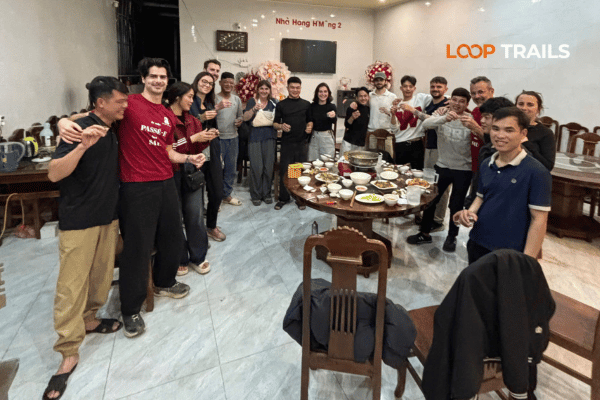
Once the corn is harvested and dried, it’s cooked (usually steamed or boiled), mixed with the men starter, and left to ferment in sealed clay pots or wooden containers for anywhere from a few days to several weeks. The longer the fermentation, generally the more complex the flavor and the higher the alcohol content.
After fermentation, the mash is distilled over a wood fire using a simple still: typically a pot, a lid with a coiled tube running through a cold water bath, and a container at the end to catch the distillate. The first distillation produces a raw spirit that is sometimes redistilled for a cleaner, stronger product.
The resulting liquid is clear to very slightly milky, and the alcohol content varies widely — anywhere from roughly 30% to well above 50% ABV, depending on the batch and the maker. There’s no standardized testing; there’s no label. You ask the family how strong it is and you trust their answer, more or less.
This might sound like wine-snob territory, but it’s relevant: the specific combination of local corn varieties, wild yeast strains in the men, mountain spring water, and even the altitude at which fermentation happens all contribute to a flavor profile that you genuinely cannot replicate at lower elevations or with commercial ingredients.
Travelers who have tried to bring the men starter home to make corn wine themselves almost universally report disappointing results. The place is part of the product. It’s one more reason the Ha Giang Loop is worth doing in person.
Learn more: Ha Giang Loop 4 Days 3 Nights
It depends enormously on the batch.
At its best, Ha Giang corn wine has a clean, slightly sweet entry, a warm rounded body, and a long, gentle heat that spreads through your chest rather than scorching your throat. There’s often a faint graininess to it, a hint of the corn itself, and if the men is particularly aromatic, a subtle herbal quality that’s hard to place but pleasant.
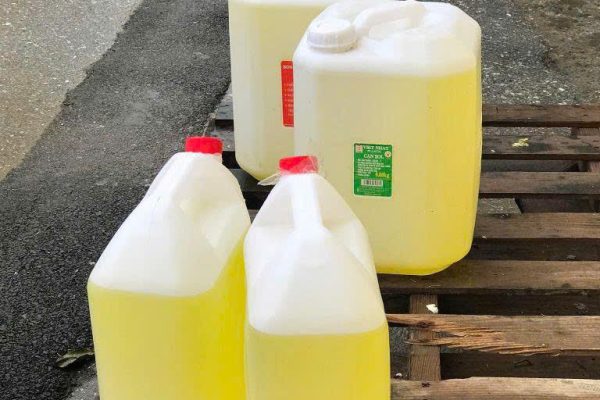
At its most challenging, it can be sharp, acetone-adjacent, and harsh enough to make your eyes water on the first sip. This is usually a sign of either a very young batch, a quick redistillation that wasn’t managed carefully, or occasionally something that’s been sitting in a plastic container too long.
The best way to calibrate your expectations: think of it less like drinking a cocktail and more like drinking something genuinely handmade, with all the variability that implies. Some batches are genuinely delicious. Others are functional. All of them are memorable.
One useful comparison point: ruou ngo is often described as being in the same general family as Chinese baijiu or Korean soju, but with a coarser, more rustic character. If you enjoy those spirits, you’ll probably enjoy good corn wine. If you don’t, the etiquette section below gives you some graceful exit options.
Learn more: Ha Giang Cao Bang 5 Days 4 Nights
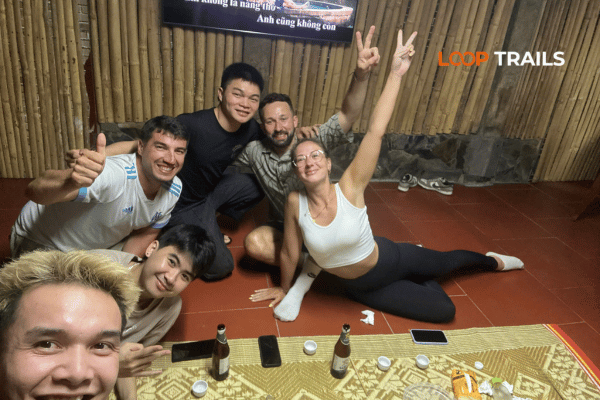
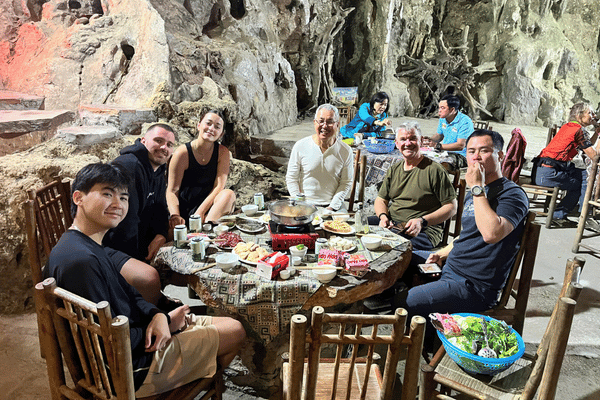
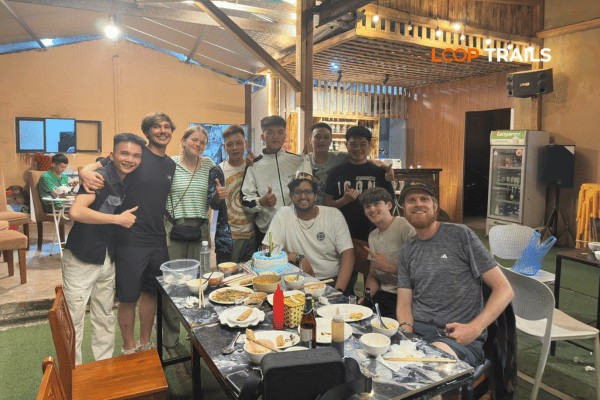
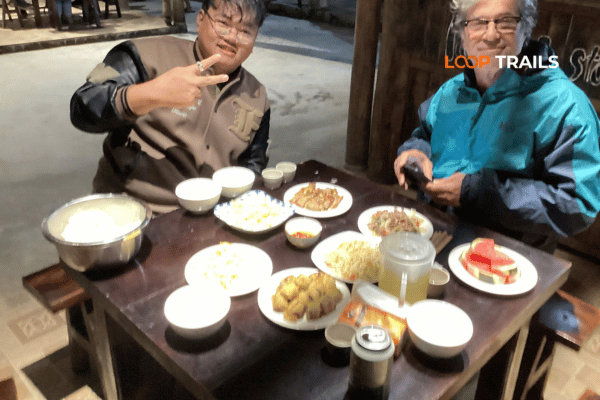
This is the best context. Staying overnight at a homestay particularly in smaller villages off the main road almost always means an encounter with corn wine at dinner. It comes out in a repurposed bottle, or a ceramic jug, and is poured into shared cups or small shot glasses. The atmosphere is part of the experience: fire, food, a family who made this, the mountains outside.
Some of the best homestay experiences for corn wine happen in:
If you’re staying at a well-run homestay on an organized tour, your guide will usually help broker the introduction they know the family, can translate, and can help you read the social situation.
The weekly markets at Dong Van, Meo Vac, and Can Cau are where you’ll see corn wine in a more commercial but still authentic setting. Vendors line up plastic-bottle gallons of locally distilled wine, often selling it by the cup on the spot. Prices are extremely low by any standard.
This is also where you can taste-test before buying a bottle to take home many vendors will let you sample what they’re selling. Don’t be shy about asking; it’s expected.
The Dong Van Sunday Market and the Meo Vac Sunday Market are the most accessible for travelers on the standard Ha Giang Loop route. The Can Cau Saturday Market, near the Chinese border, is smaller but has a particularly traditional atmosphere and excellent variety.
In Dong Van, several small restaurants in the old town sell corn wine alongside local food. The old quarter, with its colonial-era stone houses, has a handful of spots where you can sit at a low table with a bottle of ruou ngo and feel like you’re doing the Ha Giang Loop correctly.
In Meo Vac, the town market area has informal vendors and a few small cafes where corn wine is available. The setting overlooking the Nho Que River valley makes it one of the more scenic places to have a drink on the entire loop.
In Du Gia, homestay culture is strong and corn wine appears regularly at communal dinners. The village sits at a junction between Ha Giang town and the Dong Van Plateau, making it a common first night stop for many loop travelers.
Learn more: Ha Giang Cao Bang Ba Be Lake 6 Days 5 Nights
A few things to know before you sit down with a cup in hand:
The offer is a gesture of welcome. When a host family pours you corn wine, they are extending hospitality. Accepting, even just touching the cup to your lips, is usually enough to honor the gesture. You don’t have to drain it.
Mot, hai, ba yo! This is the Vietnamese drinking call (one, two, three cheers!). You’ll hear it constantly. You don’t have to match anyone’s pace, but participating in the toast is appreciated.
Toasting protocol: In H’mong culture especially, it’s common to touch cups with your elders or hosts before drinking. Watch what others do and mirror it. Nobody expects tourists to know every nuance, but showing that you’re paying attention goes a long way.
Refusals: If you genuinely don’t drink alcohol, explaining clearly “Toi khong uong duoc ruou” (I can’t drink alcohol) is usually understood and respected. Health reasons are the most accepted explanation. Simply waving the cup away without explanation can read as dismissive.
Designated drivers and riders: If you’re self-driving the Ha Giang Loop the next day, being clear about why you’re not drinking will be respected. Local communities understand that road safety matters, especially on roads like Ma Pi Leng Pass.
Corn wine at a homestay dinner has a habit of sneaking up on people. The cups are small, the refills are frequent, and the conversation is good enough that you lose count. A few practical notes:
Pace yourself. Nobody will think less of you for sipping slowly. And a good host will respect you more for staying sharp enough to have a real conversation.
Learn more: Corn wine “Happy Water” in Ha Giang
The weekly markets are the best place to buy corn wine at the most competitive prices. Vendors will often let you taste before you buy, which is the only way to find a bottle you actually like.
A few things to look for:
Some souvenir shops in Ha Giang town and Dong Van sell bottled corn wine with labels, which makes a more presentable gift but is often pricier and not necessarily better. The unmarked stuff from the market, bought from the family that made it, is usually the more interesting bottle.
The practical realities:
Learn more: Cao Bang Loop 3 Days best kept secret
Traditional home-distilled spirits, anywhere in the world, carry a small but real risk of methanol contamination, particularly in batches that haven’t been properly managed. Methanol is produced early in the distillation process and should be discarded (the “foreshots”), but this isn’t always done carefully in informal home production.
The risk in Ha Giang specifically: incidents are rare, but they do occur occasionally across rural Vietnam. This is not a reason to avoid corn wine entirely, but it is a reason to be thoughtful about where and from whom you drink.
Reducing your risk:
When in doubt, traveling with a reputable guide who knows the families and communities along the route adds a real layer of safety here, not just for corn wine but for everything.

Learn more: Ha Giang Motorbike Rental
An Easy Rider tour means riding pillion on a motorbike driven by an experienced local guide. The format has a major advantage for cultural experiences like corn wine: your guide is local, often from one of the ethnic communities in the region, and has personal relationships with the families along the route.
When your guide takes you to a homestay, he’s not a stranger walking through the door. He knows these people. That changes the nature of every shared meal, and it changes the corn wine experience significantly. You’re not a tourist being shown a cultural display; you’re a guest at someone’s table who happens to have been brought by a friend.
Easy Rider is the format we’d most recommend if your goal is genuine cultural immersion rather than just covering ground. The pace is slower, the stops are more personal, and the evenings tend to be more memorable.
Interested in an Easy Rider tour? [Browse our Ha Giang Loop Easy Rider packages] and see which itinerary fits your schedule.

Learn more: Ha Giang Loop by Army Jeep Tours
Jeep tours cover more ground and are better for groups who want comfort without sacrificing access. A good jeep guide has the same local knowledge and family connections as an Easy Rider guide the vehicle is just more spacious.
The corn wine experience on a jeep tour tends to be similarly immersive; you’re still staying at homestays, still eating with local families. The difference is that you’re not spending eight hours on the back of a motorbike before you get to dinner, which some people consider a significant advantage.
For couples and small groups, the Ha Giang jeep tour format is often the sweet spot between comfort and authenticity. You see everything, you eat and drink with the families, and your back survives the trip.
Check out our [Ha Giang By Jeep tour options] for group-friendly itineraries with homestay stays built in.

Learn more: Ha Giang Loop Self-Drive
Self-driving the Ha Giang Loop on a rented motorbike gives you maximum freedom, and that freedom includes stopping wherever you want, eating at whatever roadside stall catches your eye, and buying a bottle of corn wine at the Meo Vac market on a whim.
The trade-off: without a local guide, you’re navigating the cultural nuances of corn wine etiquette more or less on your own. You might stumble into the best corn wine experience of your life at a random homestay, or you might miss out entirely because you didn’t know which families to ask.
Self-drive is a great format for experienced motorcyclists who’ve traveled in Southeast Asia before and are comfortable improvising. If that’s you, the Ha Giang Loop is one of the best roads in the world, and part of what makes it great is exactly the kind of unscripted encounter that corn wine represents.
Thinking about renting a motorbike in Ha Giang? Our [Ha Giang motorbike rental] page covers the options, road conditions, and what documents you’ll need.

Learn more: Ha Giang Loop by Jeep for Families & Groups
| Your Profile | Best Format |
|---|---|
| First time in Ha Giang, want cultural depth | Easy Rider tour |
| Group of 2–4, want comfort + culture | Jeep tour |
| Experienced rider, independent traveler | Self-drive rental |
| Want to combine Ha Giang + Cao Bang | Combined tour (ask us) |
Not sure which fits? Drop us a WhatsApp message and we’ll help you figure out the right itinerary based on your dates, experience level, and what you want to get out of the trip.

Learn more: Tu San Canyon & Nho Que River Boat Trip
Corn wine is not the reason most people come to Ha Giang. They come for the karst peaks of Ma Pi Leng Pass, for the switchbacks above Meo Vac, for the terraced fields around Lung Cu, for the old quarter of Dong Van at sunset. But corn wine, the ruou ngo poured into a bamboo cup by a family you met three hours ago, has a way of becoming one of the things you remember most clearly.
There’s something about sitting around a fire at a homestay in the mountains, a cup of locally distilled spirits in your hand, surrounded by people who have lived in these peaks for generations, that cuts through all the standard traveler noise. It’s not a performance. It’s just how these communities live. And for one evening, you’re invited in.
That invitation is worth accepting thoughtfully. Drink a little, drink carefully, ask about the process, show interest in what went into the cup. That’s the whole etiquette guide, really.
Ha Giang will do the rest.
Ready to experience it yourself? [Browse our Ha Giang Loop tours] or [get in touch via WhatsApp] to start planning. We keep groups small, guides experienced, and itineraries flexible so you actually get to spend time with the people and places that make this region worth the journey.
Corn wine (ruou ngo) is a traditional distilled spirit made from fermented mountain corn, produced by ethnic minority communities across Ha Giang province. It’s clear, strong, and deeply embedded in local culture often called “happy water” by travelers and locals alike.
The alcohol content varies considerably between batches and producers, typically ranging from around 30% to well over 45% ABV. There’s no standardized labeling; if you want to know, ask the person who made it. Treat every cup as potentially strong until you know otherwise.
When consumed in moderation at reputable homestays or established market vendors, corn wine is generally safe. The main risk is methanol contamination in poorly distilled batches, which is rare but real. Trust your nose: if something smells chemically off or too sharp, decline. Traveling with a local guide who knows the community adds an extra layer of confidence.
The weekly markets in Dong Van and Meo Vac (both Sunday markets) are the best places to buy corn wine directly from producers. You can usually taste before buying. Souvenir shops in Ha Giang town also sell bottled versions, though these tend to cost more and vary in quality.
Technically yes, in checked baggage, subject to airline rules on alcohol volume and content. The alcohol percentage of some corn wine may exceed limits for certain carriers. Always check your airline’s specific policy and the import regulations of your destination country before packing it.
At its best: clean, slightly sweet upfront, warm body, with a gentle heat and faint grain character. Some batches have a subtle herbal quality from the fermentation starter. At its roughest: sharp, fiery, and acetone-adjacent. Quality varies significantly by producer and batch age.
The Vietnamese term is ruou ngo, where “ruou” means alcohol/wine and “ngo” means corn. Some travelers also hear it called ruou can (tube wine) in certain contexts, though these are technically different drinks. The affectionate nickname “happy water” is a traveler coinage but widely understood
No. A polite, clear decline is always an option. If you don’t drink alcohol for any reason, saying so directly is respected. Touching the cup to your lips without drinking is also a common compromise that honors the gesture without requiring you to consume anything.
Corn wine is available year-round, but the atmosphere around it is best during festival periods. The H’mong New Year (Giao Thua H’mong, usually November or December by the lunar calendar), the spring harvest season, and the Buckwheat Flower Festival season (October to November) all coincide with particularly lively communal drinking occasions.
The base ingredient is the main difference: corn versus rice. Ha Giang corn wine tends to have a slightly fuller, earthier body compared to rice wine, and the fermentation culture (men) used here is different from lowland rice wine traditions. The mountain terroir also contributes a distinctive mineral quality that’s hard to describe but easy to taste.
Always ask first. A genuine homestay dinner is a personal, family moment not a cultural display for tourist cameras. Most families will say yes if you ask warmly and respectfully, and the resulting photos will be far better for having permission behind them.
The natural pairing is whatever the homestay is serving: thang co (horse meat stew), sticky rice, grilled mountain vegetables, smoked meat. The earthiness of the wine actually works well with the robust, smoky flavors common to highland cuisine. It’s not a delicate pairing situation.
Contact information for Loop Trails
Website: Loop Trails Official Website
Email: looptrailshostel@gmail.com
Hotline & WhatSapp:
+84862379288
+84938988593
Social Media:
Facebook: Loop Trails Tours Ha Giang
Instagram: Loop Trails Tours Ha Giang
TikTok: Loop Trails
Office Address: 48 Nguyen Du, Ha Giang 1, Tuyen Quang
Address: 48 Nguyen Du, Ha Giang 1, Tuyen Quang

Facebook X Reddit Table of Contents Learn more: Ha Giang Loop Tours Most people drive past the Quan Ba area twice on

Facebook X Reddit Table of Contents Learn more: Ha Giang Loop Tours The Ha Giang Loop has a reputation problem with older