


Thúy Kiều (Grace) is a travel blogger and content contributor for Loop Trails Tours Ha Giang. She holds a bachelor’s degree in Sustainable Tourism from Vietnam National University, Hanoi, and has a strong passion for exploring and promoting responsible travel experiences in Vietnam’s northern highlands.

Learn more: Ha Giang Loop Tours
Most travelers come to Cao Bang for the waterfall. Then someone mentions a cave near the Chinese border where a man hid in 1941 and quietly started a revolution, and the trip changes shape. That cave is Pac Bo, and it sits inside one of the most important historical sites in Vietnam, tucked into a fold of jungle and limestone about an hour and a half north of Cao Bang city.
Here is the honest version up front. Pac Bo is not a big attraction in the theme park sense. There are no light shows, no entry queues that eat your morning, no gift megastore. It is a quiet place built around a small cave, a stream the color of clean glass, and a piece of national history that still means a great deal to Vietnamese people. For a lot of foreign visitors that turns out to be the appeal. The jungle is real, the cave is real, and the feeling of standing where the modern country began arrives without anyone needing to stage it for you.
This guide covers what Pac Bo actually is, what you will see when you get there, how to reach it, what to expect on the ground, and how it slots into a wider loop through Cao Bang or a longer Ha Giang and Cao Bang trip.
Learn more: Ha Giang Loop 2 Days 1 Night
To understand why Vietnamese visitors arrive here almost in a hush, you need a little background. You do not need a history degree, just the shape of the story.
In 1911 a young man named Nguyen Tat Thanh left Vietnam by ship from Saigon. He spent the next thirty years abroad, in Europe, the Soviet Union, China and elsewhere, working, studying, and slowly becoming the political figure the world would later know as Ho Chi Minh. He did not set foot on Vietnamese soil again until early 1941.
The place he chose to come back to was Pac Bo. On 28 January 1941, which fell on the second day of the Lunar New Year, he crossed the border from China at a stone marker known as milestone 108 and walked into Cao Bang with a small group of comrades. He was fifty one years old and had been gone for three decades. He picked this remote corner on purpose. It was far from the eyes of the French colonial authorities, close enough to the border for a quick exit, and the local Tay and Nung communities were sympathetic to the cause.
For the first ten days or so he stayed in the home of a local family. Then, around 8 February, he moved into a small limestone cave that the Nung people called Coc Bo, which means something close to “headwaters” or “the source of the water.” He even marked the date on the cave wall. He lived and worked out of that damp little space, and it became the headquarters for everything that followed.
Two details from those years tend to stick with people. First, he renamed the landscape around him after his political heroes: the stream beside the cave became Lenin Stream, and the mountain above it became Karl Marx Mountain. Second, it was here, at a jungle hut called Khuoi Nam a short walk from the cave, that the Eighth Plenum of the Indochinese Communist Party was held in May 1941. That meeting created the Viet Minh, the independence movement that would go on to lead the resistance and, eventually, the August Revolution of 1945.
There is one more marker that surprises visitors. Pac Bo is also the symbolic starting point, Kilometer Zero, of the Ho Chi Minh Trail, the supply route that ran more than three thousand kilometers south toward Ca Mau. You can stand at the monument that marks it.
Here is the same story as a quick timeline:
That is the weight the place carries. Now for the part that makes it a genuinely lovely half day even if revolutionary history is not your thing.
Learn more: Ha Giang Loop 3 Days 2 Nights
The site is compact and easy to walk. A path follows the stream from the entrance area up to the cave and back, and most of what matters is strung along that route. Here is what you will pass.
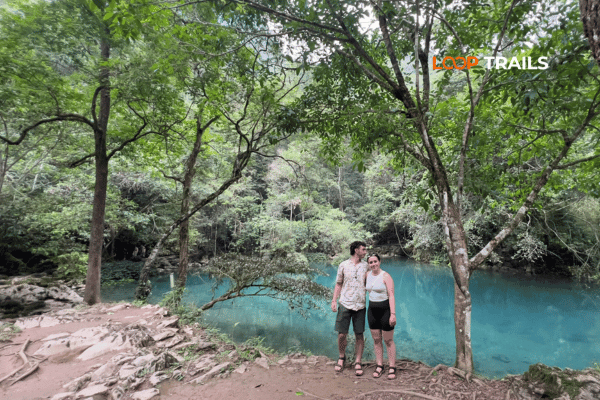
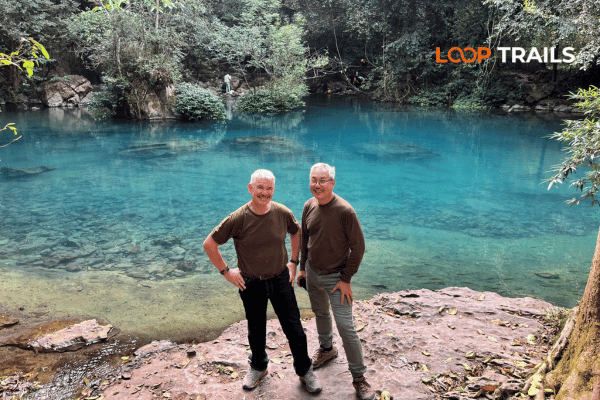
This is the showstopper, and most people are not ready for it. Lenin Stream runs an almost unreal shade of blue green, clear enough that you can watch fish hang in the current and see tree roots and stones on the bottom as if through glass. It is at its most vivid where the water springs out of the rock near the cave. On a bright day it genuinely looks color corrected, and it is not. Photographers love the stretch where the stream curves past the limestone.
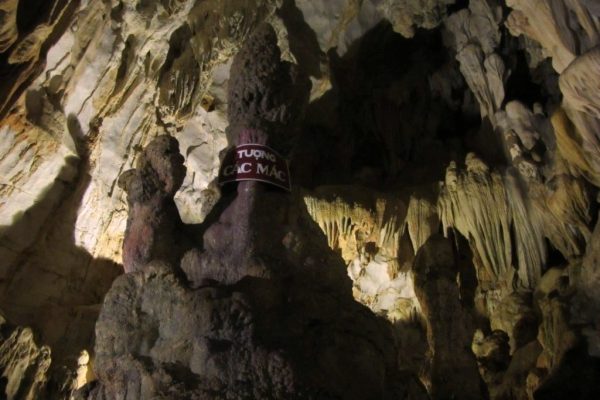
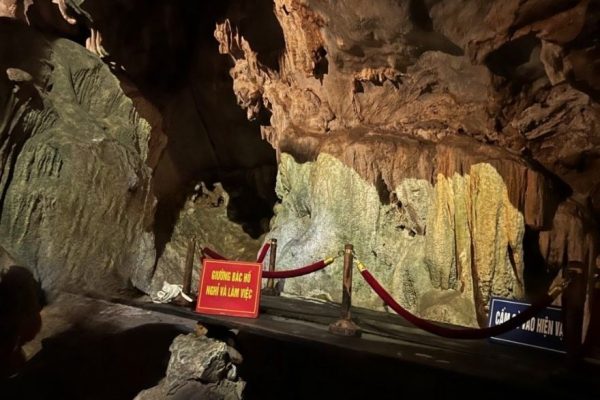
A short set of stone steps off the main path leads up to the cave itself. Do not expect a cathedral. It is small, roughly the size of a modest room, and that is exactly the point. Inside you can see the simple wooden plank Ho Chi Minh slept on, the spot where a small fire was kept, and the stone slab he used as a work table. There is a cool, still quality to the air in there. Knowing that a man planned a country’s future from this damp little pocket of rock does something to the way you look at it.
Near the water there is a flat stone where, according to the histories, Ho Chi Minh often sat and worked, including on his Vietnamese translation of the history of the Soviet Communist Party. It is an unremarkable looking rock until you know what it is, which is sort of the theme of the whole site.
Look up from the stream and the limestone rise above you is Karl Marx Mountain. A little further around you will find the reconstructed Khuoi Nam hut where the Viet Minh was founded. Closer to the entrance there is a small museum and exhibition area with photographs and artifacts that fill in the story, a shrine dedicated to Ho Chi Minh, and the Kilometer Zero monument for the Ho Chi Minh Trail. The milestone 108 border marker is part of the wider site as well.
A quick map of the site in your head:
| Stop | What it is | Roughly how long |
|---|---|---|
| Museum and exhibition | Photos, artifacts, the story laid out | 20 to 30 minutes |
| Lenin Stream | The blue green water, best photos | As long as you like |
| Coc Bo Cave | The actual cave, sleeping plank, stone table | 10 to 15 minutes |
| Stone work table | Where he sat and wrote | A quick stop |
| Khuoi Nam hut and Km 0 | Viet Minh founding site, trail monument | 15 minutes |
You can see all of it properly in two to three hours without rushing.
Learn more: Ha Giang Loop 4 Days 3 Nights
Pac Bo sits in Truong Ha commune, in the Ha Quang area of Cao Bang province, right up against the Chinese border. From Cao Bang city it is around 50 kilometers to the north, which works out to roughly an hour and a half of driving on mountain roads. From Hanoi you are looking at about 315 kilometers, or somewhere in the range of six to seven hours by road, so almost nobody comes straight from the capital in a day. You base yourself in Cao Bang first.
Once you reach the site, the entrance area is where vehicles stop. From the gate you can walk the path to the stream and cave, and there is usually an electric buggy you can pay for if you would rather ride part of the way in. Pay for that on site.
There are three realistic ways to actually do the journey from Cao Bang.

Learn more: Ha Giang Cao Bang 5 Days 4 Nights
If you are already riding in northern Vietnam, the run out to Pac Bo is a pleasant one and you keep full control of your own day. You can stop for photos, leave when you want, and link it with other Cao Bang stops at your own pace. This suits confident riders who are comfortable on mountain roads and have the right paperwork sorted. If you need wheels for this part of the trip, our motorbike rental in Ha Giang page covers what we offer and how it works, and we can advise on rules, which do change, so check the latest before you ride.
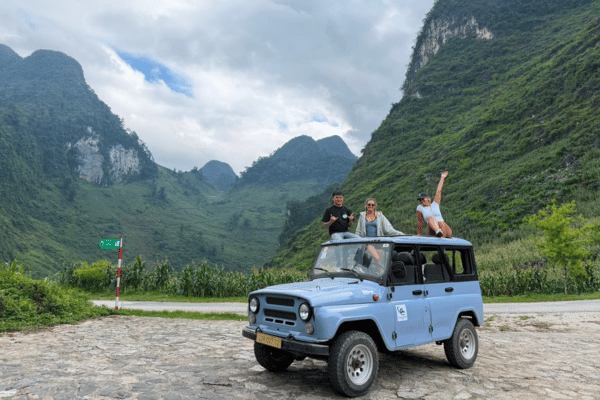
Not everyone wants to ride, and the road out to the border is a long way to do on a scooter if two wheels are not your thing. A private car or jeep with a driver is the comfortable option, especially for couples, families, or anyone visiting in the wet season when the roads can get slick. You sit back, someone who knows the route handles it, and you arrive fresh.
Honestly, the easiest way for most foreign travelers is to let Pac Bo be one stop on a guided Cao Bang circuit, or part of a longer trip that pairs Ha Giang with Cao Bang. The logistics, the driver, the timing, and the connections between sights are all handled, and you get the history explained rather than read off a sign. More on how that fits together below.
Planning to base in Cao Bang and string a few sights together? Our Cao Bang loop tours build Pac Bo, Ban Gioc Waterfall and the cave country into one clean route, so you are not piecing transfers together yourself.
Learn more: Ha Giang Cao Bang Ba Be Lake 6 Days 5 Nights
A few things that make the visit smoother.
One thing matters more than any of the above. This is a place of real national reverence for Vietnamese people, closer in spirit to a memorial than a photo stop. At the cave and the shrine, keep your voice down, dress modestly, and be respectful with photos. And as tempting as that impossibly clear water looks, Lenin Stream is not a swimming hole. Treat it as the protected memorial it is, admire it, photograph it, and stay out of it.
As for timing across the year, the water tends to look its clearest in the drier months, and heavy rain can cloud it and make the roads harder going. Weather in the far north shifts though, so check conditions close to your dates rather than trusting any fixed rule.
Learn more: Cao Bang Loop 3 Days best kept secret
Almost nobody travels all the way to this border just for the cave, and you should not either. Pac Bo is one piece of a genuinely rich corner of the country, and the smart move is to build a couple of days around it.
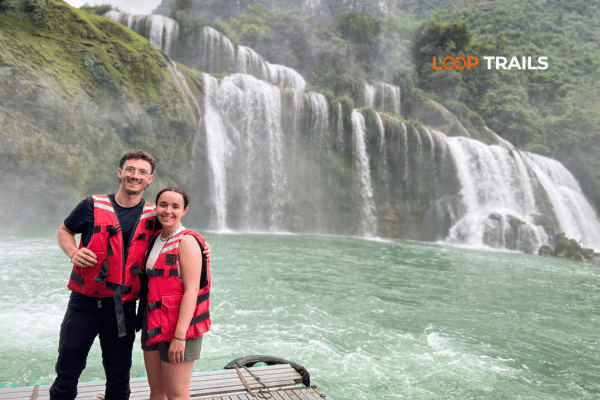
The obvious pairing is Ban Gioc Waterfall, the wide tiered falls on the Chinese border that are the headline sight of the whole province, usually combined with the Nguom Ngao Cave nearby. Add Thang Hen Lake and the high pine country around Phia Oac and you have a proper Cao Bang circuit with Pac Bo as the historical anchor. These sights are spread out, so a base in Cao Bang and a sensible route between them beats trying to freelance it.
The bigger picture, and the way a lot of our guests do it, is to combine Cao Bang with the famous Ha Giang Loop. You ride or drive the Loop first, with its passes and the high road along the Ma Pi Leng above the Nho Que River, through Dong Van and Meo Vac, then continue east, often by way of Bao Lac, into Cao Bang for Ban Gioc and Pac Bo. It turns two separate trips into one continuous run across the top of Vietnam, and it is one of the best stretches of road travel in the country.
If that sounds like your kind of trip, our Ha Giang and Cao Bang combined tours are built exactly for this, linking the Loop and the Cao Bang sights without you having to solve the transfers in between. Pac Bo usually lands as a calm half day in the Cao Bang section, a quiet counterweight to the big scenery on either side of it.

Learn more: Ha Giang Motorbike Rental
Quick decision guide, because the right answer depends entirely on the kind of traveler you are.
Not sure which fits? Tell us your group, your dates, and whether anyone wants to ride, and we will point you to the right option. You can reach us any time on our contact page.

Learn more: Ha Giang Loop by Army Jeep Tours
Nothing here is a scam, just the handful of things that trip people up.
Learn more: Cao Bang Travel
If you like history with a real sense of place, or you simply enjoy quiet natural spots away from the crowds, yes, easily. It is not a thrill ride and it does not pretend to be. It is a calm, genuine, slightly humbling couple of hours, anchored by a stream that looks unreal and a cave where the modern country quietly began. Paired with Ban Gioc and the rest of Cao Bang, it rounds out one of the most rewarding regions in the north.
The catch is logistics. It is far, the roads take time, and the sights are scattered. That is exactly the part worth handing off. If you would rather spend your energy on the experience than on routing and transfers, let us build Cao Bang, Pac Bo included, into a trip that just works. Have a look at our Cao Bang loop and Ha Giang and Cao Bang combined tours, or message us on our contact page with your dates and we will sort the rest.
Learn more: Ha Giang Loop Coporate Retreat
Pac Bo is in Truong Ha commune, in the Ha Quang area of Cao Bang province in far northern Vietnam, right on the border with China. It is about 50 kilometers north of Cao Bang city.
From Cao Bang city it is roughly 50 kilometers, about an hour and a half of driving. From Hanoi it is around 315 kilometers and six to seven hours by road, so most people stop in Cao Bang first rather than coming straight through.
It is very cheap, in the region of 20,000 VND, well under a dollar. Bring small cash and check the current rate on the day, as prices can change.
Roughly 8 in the morning until 5 in the afternoon. Confirm current hours before making a long drive, especially around public holidays.
Two to three hours is plenty to walk the stream, see Coc Bo Cave, visit the museum and reach the Kilometer Zero monument without rushing.
No. The water is beautifully clear but Pac Bo is a national memorial site, not a swimming spot. Admire it and take photos, but stay out of the water.
Many foreign visitors enjoy it precisely because it is quiet, real, and not over commercialized. The history is fascinating once you know it, and the stream and jungle setting are genuinely lovely.
The water usually looks clearest in the drier months, and heavy rain can cloud it and make the roads harder. Weather in the far north changes a lot, so check conditions close to your travel dates.
Yes, and most people do. Pac Bo and Ban Gioc are the two headline stops in Cao Bang and pair naturally, usually with Nguom Ngao Cave nearby. A car or guided tour makes combining them easy.
You can visit independently, but signage and English information are limited, so a guide adds a lot of context. Visiting as part of a guided Cao Bang tour also removes the driving and routing.
The popular way is to ride or drive the Ha Giang Loop, then continue east, often via Bao Lac, into Cao Bang for Ban Gioc and Pac Bo. Combined Ha Giang and Cao Bang tours handle the whole route in one trip.
Ban Gioc Waterfall, Nguom Ngao Cave, Thang Hen Lake and the high country around Phia Oac are all part of the wider Cao Bang circuit and pair well with a Pac Bo visit.
Contact information for Loop Trails
Website: Loop Trails Official Website
Email: looptrailshostel@gmail.com
Hotline & WhatSapp:
+84862379288
+84938988593
Social Media:
Facebook: Loop Trails Tours Ha Giang
Instagram: Loop Trails Tours Ha Giang
TikTok: Loop Trails
Office Address: 48 Nguyen Du, Ha Giang 1, Tuyen Quang
Address: 48 Nguyen Du, Ha Giang 1, Tuyen Quang
Facebook X Reddit Table of Contents Learn more: Ha Giang Loop Tours This is the question that sits in almost every Ha
Facebook X Reddit Table of Contents Learn more: Ha Giang Loop Tours Most people drive past the Quan Ba area twice on