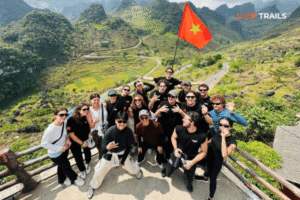

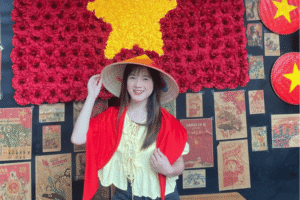
Thúy Kiều (Grace) is a travel blogger and content contributor for Loop Trails Tours Ha Giang. She holds a bachelor’s degree in Sustainable Tourism from Vietnam National University, Hanoi, and has a strong passion for exploring and promoting responsible travel experiences in Vietnam’s northern highlands.
Learn more: Ha Giang Loop Tours
Most travellers finish the Ha Giang Loop, hand the bike back, and climb onto a night bus feeling like they left something unfinished. They usually did. East of Meo Vac the mountains keep going, the traffic thins to almost nothing, and the grey limestone slowly turns green and wet until it falls off a cliff at Ban Gioc on the border with China.
This Ha Giang Cao Bang itinerary covers 6 days and 5 nights in one continuous line: Ha Giang City to Lao Xa, Meo Vac, Ha Quang, Ban Gioc, Cao Bang City, and out through Phia Oac to Ba Be Lake. No backtracking, no repeated roads, and no return to the town you started in. It is exactly the route we run at Loop Trails, written out with the real shape of each day so you can judge whether it fits your holiday.
One note on names before we start. Ha Giang was folded into Tuyen Quang province in the 2025 administrative reorganisation, so you will see both names on paperwork and maps. Everyone on the ground still says Ha Giang, and so does this guide.
Learn more: Ha Giang Loop 2 Days 1 Night
The honest answer is contrast. Ha Giang is dry, vertical and dramatic: bare karst, villages balanced on ridgelines, roads that feel carved rather than built. Cao Bang is softer and wetter: rice valleys, rivers the colour of jade, caves, waterfalls with real water in them. Ride one and you get a great trip. Ride both back to back and you finally understand what the northern border of Vietnam actually looks like.
There is a practical reason too. Almost everybody who comes to Ha Giang rides the same loop in the same direction and sleeps in the same three towns. The moment you turn east from Meo Vac, the volume drops. You will still meet other travellers at Ban Gioc and Ba Be, but the roads in between are mostly yours.
This route suits you if: you have about a week in the north, you are happy with six consecutive travel days on winding mountain roads, you want the famous viewpoints and the quiet ones, and you would rather finish somewhere new than circle back to the start.
Look at something shorter if:
Learn more: Ha Giang Loop 3 Days 2 Nights
| Day | Route | Sleep | Riding load | What defines the day |
|---|---|---|---|---|
| 0 | Hanoi to Ha Giang, night sleeper bus | On the bus, then rest at Loop Trails Hostel | None | Arrive early, shower, briefing |
| 1 | Ha Giang to Lao Xa via Quan Ba and Yen Minh | Homestay in Lao Xa | Moderate | Bac Sum Pass, Heaven Gate, Tham Ma Pass |
| 2 | Lao Xa to Meo Vac via Lung Cu and Dong Van | Hotel in Meo Vac | Moderate | Vuong Palace, flag tower, Ma Pi Leng, Nho Que boat |
| 3 | Meo Vac to Ha Quang via Bao Lac | Me Farmstay, Ha Quang | Long | Khau Coc Cha pass, Xuan Truong valley, Pac Bo |
| 4 | Ha Quang to Ban Gioc via Tra Linh and Trung Khanh | Stone village near Ban Gioc | Moderate | Pi Pha viewpoint, back roads, the waterfall |
| 5 | Ban Gioc to Cao Bang City via Quang Uyen | Hotel in Cao Bang City | Light | Nguom Ngao cave, Quay Son River, incense village |
| 6 | Cao Bang to Phia Oac and Ba Be Lake | Sleeper bus to Hanoi | Moderate | Cloud forest, bamboo, boat trip, two caves |
The timings in this article are the planned shape of each day, not a promise. Weather, roadworks and how long your group spends taking photographs all move them around, and a guide who never adjusts the plan is a guide you do not want. Ask each morning for a realistic finish time and work backwards from there. Nobody enjoys the last hour when it happens in the dark.

Learn more: Ha Giang Loop 4 Days 3 Nights
The trip starts with a sleeper bus out of Hanoi in the evening. You get a flat bunk, a blanket, and a driver who knows the road better than you would like at that hour. It saves you a night of accommodation and puts you in Ha Giang City early in the morning, which is why almost everyone does it this way.
You arrive, check in at Loop Trails Hostel, and get a few hours to shower, sleep properly and eat before anything begins. Do not treat this as wasted time. The people who skip it and try to ride the same morning are the people who are exhausted by day 2.
If buses and you do not get along, take a daytime limousine van instead and sleep in Ha Giang City the night before. Schedules and operators change constantly, so check current departures rather than trusting any blog post, this one included. Tell us your arrival time before you buy the ticket, because some arrivals line up with the start of the tour and some do not.
Learn more: Ha Giang Cao Bang 5 Days 4 Nights
Three things, none of them optional.
Leave your big bag in Ha Giang City. The hostel stores luggage while you ride, and on this route your main bag can travel by road to meet you at the end if that is arranged in advance. Ask before you assume.
Card payments are unreliable outside the bigger towns. Draw cash in Ha Giang City and top up in Cao Bang City on day 5. Homestays, roadside food and fuel are usually cash only. A Vietnamese SIM or eSIM helps: coverage is decent in towns, patchy in the valleys, briefly nonexistent on the high sections. Download offline maps before you leave Hanoi.
You do not need to be an athlete, but you do need tolerance for long days, cold wind at altitude and a body that aches on day 3 whichever seat you are in. There are short hikes built in too: the Ma Pi Leng Skywalk, the climb at Khau Coc Cha, the viewpoint above Ngoc Con. None are technical, all involve steep ground. Anyone with knee, back or neck problems should say so in advance.
This is the biggest structural difference between the Ha Giang Loop and the Ha Giang to Cao Bang route. A loop ends where it started, so the vehicles go home by themselves. This route ends hundreds of kilometres away at Ba Be, which means somebody has to bring them back.
If you rent independently, that arrangement is yours to solve, and most rental shops in Ha Giang will not let you simply leave a bike in another province. On a combined tour the return logistics sit inside the price, and you finish at Ba Be with nothing to organise except your seat to Hanoi. Ask about this before you pay a deposit anywhere.
Rather not organise all of this yourself? Our Ha Giang to Cao Bang combined tour runs this exact route with transport, homestays, guides and the one way vehicle logistics already handled. Send us your dates on WhatsApp and we will tell you honestly whether 6 days is right for your group.
Learn more: Cao Bang Loop 3 Days best kept secret
08:00 Breakfast and the Loop briefing at Loop Trails Hostel. This is not a formality. It is where bikes get matched to riders, hand signals get explained, luggage gets strapped properly, and somebody realises their phone mount does not fit. Pay attention here and the next six days are smoother.
09:00 Wheels turning. The road out of Ha Giang City follows the river before it starts climbing at Bac Sum Pass, the first proper set of switchbacks of the trip and a good early test of whether your riding position is comfortable. Fix it now rather than at lunchtime.
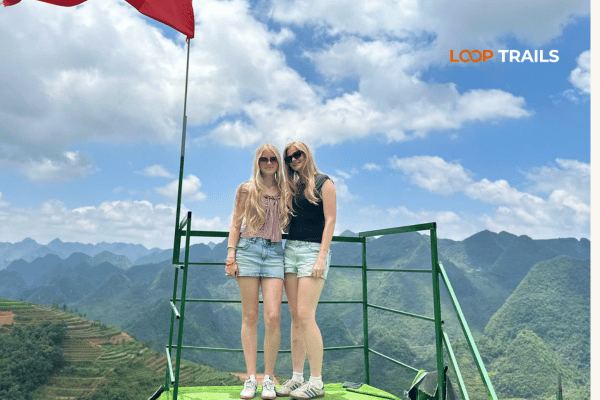
Above Bac Sum comes Heaven Gate at Quan Ba, where the road tops out and the valley of Tam Son opens up below with the twin hills the guidebooks call the Fairy Bosom. It is a tourist stop and it is worth it. Give it fifteen minutes, then get moving, because the better riding is further north.
12:30 Lunch in Yen Minh. A functional town rather than a pretty one, which is fine: fuel up here, eat properly, and let the group reset.
The afternoon is the one that changes people’s minds about what Vietnam looks like. You are riding across the Dong Van Karst Plateau Geopark, a UNESCO Global Geopark, where corn grows in every pocket of soil between the rocks and villages appear to be glued to the hillsides. The road climbs the famous switchbacks of Tham Ma Pass, then runs through the valley of Sung La toward Lao Xa, a H’Mong village tucked under the ridges near the Chinese border. Vuong Palace, the old residence of the H’Mong king, sits right in this area, and depending on how the day is running your guide will fit it in this afternoon or first thing tomorrow morning.
17:00 Arrive in Lao Xa and check into the homestay. This is the night that people talk about afterwards. Dinner is communal and there will be more food than your group can finish. There are usually local games, someone brings out traditional music, and at some point a bottle of corn wine appears, which everyone here calls happy water. Joining in is part of the experience. Declining politely is completely acceptable, and any decent guide will make that easy for you.
Day 1 in one line: two famous passes, one plateau that does not photograph as big as it feels, and a village night you did not plan for.
Learn more: Hmong’s King Vuong Palace
The biggest day of the Ha Giang half, and the one most people came for.
08:00 Breakfast in the village while the mist burns off the ridges.
09:00 Check out and back on the road.
09:30 Vuong Palace at Sa Phin, if you did not visit yesterday. It is a compound of stone, timber and tiled roofs built for the H’Mong king Vuong Chinh Duc, with pine trees at the gate and a lot of history in the walls about opium, power and the border. Give your guide twenty minutes to explain it properly. Without the context it is just an old house.
11:30 North to the Lung Cu flag tower, the marker at the northernmost point of the country. There are steps up to the base and a view over two countries from the top. Some travellers find it a touch ceremonial and would rather be riding. It is easy to shorten if the group is running late.
12:30 Back down to Dong Van for lunch. The old quarter here is worth a walk if you have twenty minutes to spare: a small square, century old shopfronts, coffee served in buildings that were trading posts long before tourism arrived.
13:30 Ma Pi Leng Pass, one of the four great passes of Vietnam and the reason half of you booked this trip. The road runs high along the wall of a gorge with the Nho Que River at the bottom of it. Use the pullouts that have real parking space rather than stopping on a blind curve, and keep your helmet on while you walk around, because the trucks up here cannot see much.
14:00 The Ma Pi Leng Skywalk, a walking path along the cliff that gets you away from the road and the vehicles. It is short but exposed in places, so take it slowly and watch where you put your feet rather than your camera.
15:30 Down to the pier for the boat trip on the Nho Que River through Tu San Canyon, often described as the deepest canyon in Southeast Asia. The access road is steep, the boat runs between vertical rock walls, and the water on a clear day is the colour people accuse of being edited. Boats do not run when the river or the weather is against them, so treat this one as weather dependent rather than guaranteed.
17:00 Into Meo Vac and a hotel for the second night. Hot shower, cold drink, proper bed. After a homestay floor, most groups are quietly delighted.
Day 2 in one line: history in the morning, the most famous road in the north after lunch, and a canyon from the water before dinner.
Learn more: Best time to visit Cao Bang
This is the day the trip changes character. You leave Ha Giang behind, and by evening you are in a part of Cao Bang that most visitors to Vietnam have never heard of.
08:00 Breakfast and a slow start at the hotel. Enjoy it, because this is the longest day of the six.
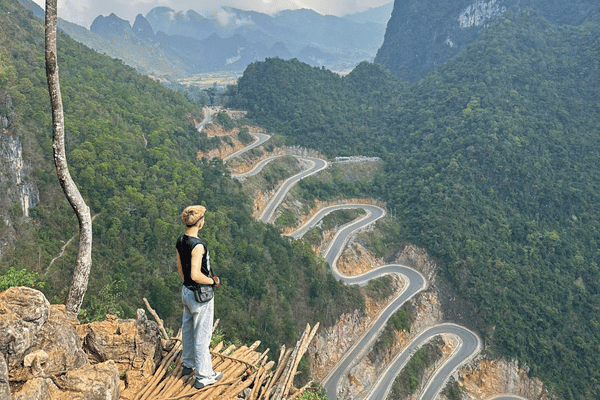
09:00 On the road east. The route strings together one pass after another through border country: long empty curves, river valleys opening below, and very little traffic. You cross into Cao Bang province without much ceremony. The riding is not technically harder than Ma Pi Leng, just longer, so pace yourself and drink water even when the air is cold.
12:00 Lunch in Bao Lac, a small riverside town that exists for the people who live around it rather than for visitors. Good simple food, a rotating market that draws people down from the villages, and the sense that someone turned the volume down.
13:00 Khau Coc Cha pass, the one locals call the pass of 15 levels. The road folds back on itself over and over up the mountainside, and there is a short hike to a viewpoint where you can see the whole stack of switchbacks at once with Xuan Truong valley spread out beyond it. It is the most photographed road in Cao Bang and it still feels like a secret compared to Ma Pi Leng.
14:00 Down into Xuan Truong valley itself. Quiet, green, terraced, and a completely different rhythm to the plateau you rode yesterday.
15:00 A stop at Na Tenh pass to stretch and look back at where you came from.
16:00 Pac Bo, the historical site near the border in Ha Quang where Ho Chi Minh returned to Vietnam in 1941 and lived in a cave beside a stream he named Lenin. Whatever your politics, it is a genuinely peaceful spot: clear water, limestone, forest, and a short easy walk. It also explains a lot about why this specific corner of the country carries the weight it does in Vietnamese history.
Evening: check in at Me Farmstay for the third night. Farmstay food, quiet, and the sound of nothing much at all.
Day 3 in one line: the longest ride of the trip, paid back with a pass that stacks 15 times and a valley almost nobody photographs.
Learn more: Ban Gioc Waterfall Guide
09:00 Leave Me Farmstay after a slow breakfast.
10:00 Through Tra Linh, lake and karst country where the valleys are wide, the limestone towers stand alone in the fields, and the light in the middle of the morning is usually excellent.
11:00 Lunch in Trung Khanh, the district that produces the chestnuts every Vietnamese person mentions the moment you say Cao Bang. If it is autumn, buy some.
13:00 The hike to the Pi Pha viewpoint at Ngoc Con. It is short, it is steep, and it puts you above the Quay Son River valley looking down on rice fields and river bends. Bring water and take your time on the way up.
14:00 The best riding of the Cao Bang half: a shortcut on country roads through Trung Khanh toward the falls, past bamboo, buffalo, water wheels and villages that see very little traffic. This stretch is the reason a two wheeled or open sided vehicle beats a coach on this route.
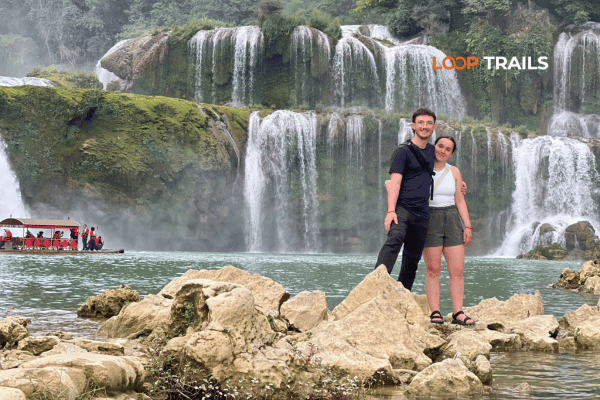
15:00 Ban Gioc waterfall. It sits on the border river with Vietnam on one bank and China on the other, and it is broad rather than tall: a tiered curtain of water across a wide limestone shelf with a green pool below. Bamboo rafts take visitors close enough to feel the spray, and a path climbs to the pagoda on the hillside above for the wide view over the whole valley.
How big it looks depends on the season. Biggest flow in and after the rainy months, lower but often clearer and greener water later in the dry season. Both versions are worth the trip.
16:00 Optional swim near the stone village if the weather and the water are right. After four days on the road it is the best cold shower you will get.
17:00 Check into the stone village near Ban Gioc for the last night on the road. Tay houses built from stacked river rock, insects instead of traffic, and a valley that goes properly dark. Rooms here are limited and fill early in peak months, which is one of several reasons to book this trip in advance rather than improvise it.
Day 4 in one line: back roads, a viewpoint you have to earn, and a border waterfall at the end of them.
Learn more: Nguom Ngao Cave
The gentlest day of the six, and the most varied.
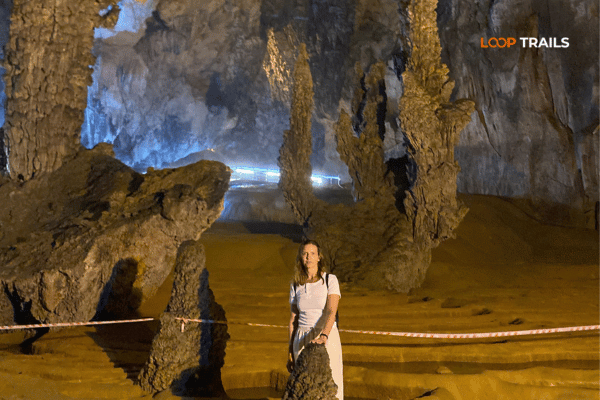
09:00 Nguom Ngao cave, one of the largest and best known cave systems in Cao Bang, a short ride from the falls. A lit walking route runs through the chambers, and it is a good use of the middle of the morning when the light outside is flat anyway. It is cool inside and the floor is wet in places, so wear shoes with grip.
10:30 The Quay Son River at Con Nuoc, where the river steps down over rock shelves through bamboo and rice fields. Green water, shade, and one of those places where the group stops for ten minutes and stays for thirty.
14:00 Phia Thap incense village, where Nung families make incense sticks by hand from bamboo, bark and sawdust, then dry them in fans of red and yellow outside the houses. Ask before photographing people at work, and buy a bundle if you enjoyed the visit. It costs very little and it goes straight to the household.
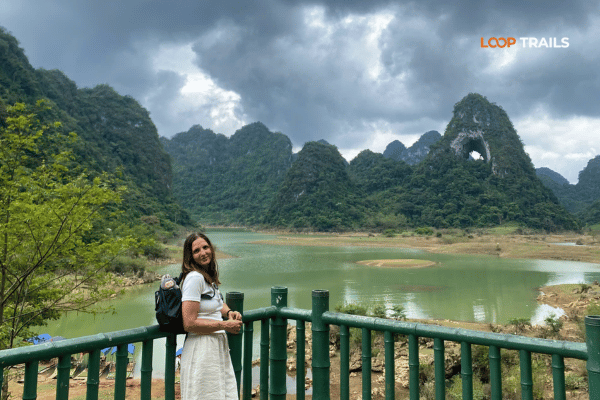
15:00 God’s Eye Mountain, the limestone ridge with a hole punched clean through it above a plain where horses graze. In the dry season the lake bed below becomes grassland. It photographs unlike anywhere else on this route, and it is the last landscape of the Cao Bang half.
16:30 Arrive in Cao Bang City: proper hotels, ATMs that work, a night market and restaurants where you can order something other than a set dinner. This is where the 5 days version of the trip ends, with an evening bus to Hanoi. On the 6 days version you sleep here and keep going in the morning.
Day 5 in one line: a cave, a river, a craft village and a mountain with a hole in it, all before dinner in a real city.
Learn more: Visiting God’s Eye Mountain
The last day is a nature day, and it is the one people underestimate when reading the itinerary.
08:00 Breakfast in Cao Bang City, check out, repack.
09:00 West toward Phia Oac National Park, climbing into pine and moss forest that is almost permanently in cloud. It is the coldest place on the route, cold enough that frost sometimes appears here in deep winter, and there are the shells of French era villas from when this was a hill station. Bring the warm layer you have not needed since the plateau.
11:00 A walk in the bamboo forest at Nguyen Binh. Green light, no engine noise, and a good place to stretch legs that have been on a bike for five days.
12:00 Lunch in the Ba Be area as the landscape opens into lake country.
13:00 The boat trip on Ba Be Lake, the largest natural freshwater lake in the country, ringed by limestone mountains covered in rainforest. After six days of engines, an hour of water and birdsong lands differently than it would on day 1.
14:00 Puong Cave, a limestone tunnel with the river running straight through it, entered by boat. The scale of the entrance is the thing.
15:00 Hua Ma Cave, higher up, reached by steps, and full of chambers and stalactites lit for visitors.
16:00 The tour ends at Ba Be. From here you board a sleeper bus back to Hanoi. Book that seat in advance rather than at the counter, and check current schedules, because departures from this area are fewer than from a city.
Day 6 in one line: cloud forest, bamboo, a lake and two caves, and then the long quiet ride back to Hanoi
Learn more: Ha Giang Motorbike Rental
Same route, same stops, three completely different trips. This is the decision that most affects whether you enjoy the six days, so be honest rather than optimistic.
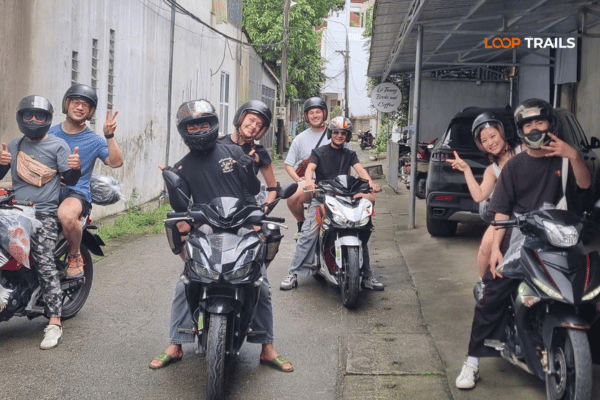
You ride your own bike with a guide leading the group. Maximum freedom, maximum responsibility, and the version experienced riders love.
Choose it only if you ride regularly at home, you are comfortable with a manual or semi automatic gearbox, and you hold a valid licence. Six days of mountain passes is not the place to learn, and a rider struggling by day 3 slows and worries everyone else.
You sit behind a local driver who rides while you look around. It is the most popular choice on this route and there is nothing second class about it. You still feel the road, you stop wherever the group stops, and you get someone who knows exactly which curve has gravel on it.
It also means you shoot photos all day and arrive at the homestay with energy left. Pillion seats are tiring in their own way, so bring a cushion if you know your body.
A vehicle for your group with a driver, roof on or off depending on the weather. This is the choice for non riders, families, travellers who want luggage beside them, and anyone who does not fancy six days exposed to whatever the sky is doing.
Same stops, same schedule, slightly higher seat. On this route the jeep has one extra advantage: the long day between Meo Vac and Ha Quang is far easier when you can talk, stretch out and stay dry.

Learn more: Ha Giang Loop by Wrangler Rubicon Jeep
| If this is you | Take this |
|---|---|
| Confident rider with a valid licence and real experience | Self drive |
| Never ridden, or ridden a scooter twice on holiday | Easy rider or jeep |
| A couple who want to talk to each other all day | Jeep |
| Travelling with parents, kids, or anyone with back problems | Jeep |
| Riding in the wet months and you hate being wet | Jeep |
| Want the classic backpacker version with the most freedom | Self drive |
| Want the classic experience without the risk | Easy rider |
| Photographer who wants to stop constantly | Easy rider or jeep |
Mixed groups are normal. A couple where one rides and one does not, a family with two riders and two in the jeep, four friends where only one has a licence: all workable, and we arrange it regularly.

Learn more: Ha Giang to Cao Bang
We do not publish one number in a blog post, because it moves with the season, the group size and the style you pick, and a stale price helps nobody. What is useful is knowing what you are actually paying for, so you can compare quotes properly.
When you compare two operators, ask both the same questions: what is included on each night, who pays entrance fees, what happens if weather forces a change, and what the cancellation terms are. A quote that is 15 percent cheaper and excludes four items is not cheaper.
Current pricing for every style of this route sits on the tour page, and if your dates or group are unusual, a WhatsApp message gets you a straight answer faster than a form.
Learn more: Ha Giang in September & October
Northern Vietnam does not have one perfect month, it has trade offs.
| Period | What it feels like | Watch out for |
|---|---|---|
| September to November | The most popular window. Drier air, big views, rice turning gold early in the period and buckwheat flowering in Ha Giang later in it | Rooms book out fastest, especially at weekends |
| December to February | Cold, clear light on good days, cloud sitting below the passes. Phia Oac is genuinely cold | Serious cold at altitude, short daylight, dense fog on some mornings |
| March to April | Blossom season, rising temperatures, green returning to the valleys | Changeable weather and heavy showers |
| May to August | Green and full. Rice at its most alive and the biggest water at Ban Gioc | The wet months: rain, humidity, slippery surfaces, and landslides that can close a road temporarily |
None of that is a reason to cancel. It is a reason to pick the right style for your dates. A jeep in July is a very different day to a motorbike in July, and an extra fleece in January costs nothing. Mountain weather ignores forecasts, so stay willing to swap the order of two stops.
Learn more: Ha Giang Road Conditions 2026
Straight talk, because this section matters more than the pretty ones.
The roads here are mostly sealed and mostly in decent condition, and they are still mountain roads. Expect blind curves, gravel where a slope has been repaired, trucks that need the full width, and animals that appear without warning.
What keeps people safe is boring and effective:
Medical care is basic outside the provincial hospitals, and getting from a village to a hospital takes time. That is exactly why the insurance conversation earlier matters. Tell your guide about any condition or allergy on day 1, and if you ride yourself, check tyres, brakes, lights and chain every morning.
Learn more: Ha Giang Loop Mistake to Avoid
Most trips go smoothly. The ones that do not usually go wrong for the same handful of reasons.

Learn more: Ha Giang Packing list
Keep it to one small bag that straps to a bike or slides into a jeep footwell.
Clothing
Practical
Leave the hard shell suitcase and the sixth change of clothes in Hanoi.
Learn more: Ha Giang Loop Hidden Gems
The tour finishes at Ba Be in the late afternoon of day 6, and the standard move is a sleeper bus back to Hanoi that evening. Departures from the Ba Be area are less frequent than from a city, so book the seat before day 6 rather than on the day, and check current schedules, which change with the season.
Travellers who are not in a hurry add a night at Ba Be instead of leaving straight away: a stilt house by the water, a swim, a slow morning. If your dates allow it, it is the best possible full stop to this trip.
Ready to stop planning and start riding? Send us your dates, your group size and whether you want to ride yourself, sit behind a driver or take the jeep. We will come back with a straight answer, including exactly what is included on every one of the five nights. Message us on WhatsApp, or open the tour page for this 6 days route to check current availability.
Learn more: Ha Giang Border Area Permit 2026
Six days is the complete version. It is not the only one.
Yes, as long as you accept it is a travelling trip rather than a relaxing one. Six days covers the Loop highlights, the main Cao Bang sights and Ba Be without doubling back. A seventh day mostly buys rest, not scenery.
If you ride yourself, you need a licence valid in Vietnam for the vehicle you are on, and insurance that covers it. Rules on foreign licences and international permits are specific and can change, so check your own situation before booking self drive. If you do not have one, take the easy rider or jeep option, which most guests do anyway
Not on your own bike. The passes, the daily distances and the weather make this a poor place to learn. As a pillion passenger with an experienced local driver, or in a jeep, it suits almost anyone in reasonable health.
Yes. The jeep version covers the identical route, stops and timings. You miss nothing except the wind in your face, and on a wet day that is not a loss.
Five nights: a H’Mong homestay in Lao Xa, a hotel in Meo Vac, Me Farmstay in Ha Quang, a stone village near Ban Gioc, and a hotel in Cao Bang City. Homestay nights are usually shared rooms. Ask which nights can be private.
An overnight sleeper bus from Hanoi gets you into Ha Giang City in the early morning, where you rest at Loop Trails Hostel before the tour starts. At the other end, a sleeper bus runs from Ba Be back to Hanoi on the evening of day 6. Book both in advance and check current schedules.
September to November is the most reliable window for weather and views. December to February is cold but often beautifully clear. The summer months are green and full but wet. There is no bad month, only a right style for each month.
No. Boats through Tu San Canyon do not run when the water level or the weather is against them, and queues can be long in peak season. Your guide will make the call on the morning of day 2, and there is always an alternative use of the afternoon.
Yes, with notice. Homestay and farmstay kitchens are small and buy locally, so telling us a week ahead makes a real difference compared with telling the cook at seven in the evening.
The trip runs. Guides reorder stops, swap viewpoints for indoor sights like Nguom Ngao or Hua Ma, and slow the pace. Heavy rain can close a road temporarily, in which case there is usually an alternative route. If you travel in the wet months and hate being wet, book the jeep.
Once your travel dates are confirmed, book as soon as you can. Most guests book one to three months ahead. Jeep availability is limited compared with motorbikes, and rooms near Ban Gioc are limited in peak season, so early booking lets us arrange everything properly.
Contact information for Loop Trails
Website: Loop Trails Official Website
Email: looptrailshostel@gmail.com
Hotline & WhatSapp:
+84862379288
+84938988593
Social Media:
Facebook: Loop Trails Tours Ha Giang
Instagram: Loop Trails Tours Ha Giang
TikTok: Loop Trails
Office Address: 54A Tran Phu, Ha Giang 2, Tuyen Quang
Address: 54A Tran Phu, Ha Giang 2, Tuyen Quang
Facebook X Reddit Table of Contents Learn more: Ha Giang Loop Tours Most people drive past the Quan Ba area twice on

Facebook X Reddit Table of Contents Learn more: Ha Giang Loop Tours The Ha Giang Loop has a reputation problem with older