
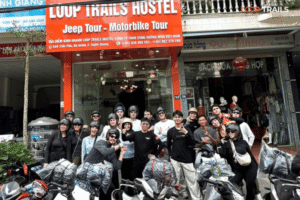
Ha Giang Loop Guides: Meet the Loop Trails Team
Facebook X Reddit Table of Contents Learn more: Ha Giang Loop Tours The guide sitting in front of you on a motorbike,

Thúy Kiều (Grace) is a travel blogger and content contributor for Loop Trails Tours Ha Giang. She holds a bachelor’s degree in Sustainable Tourism from Vietnam National University, Hanoi, and has a strong passion for exploring and promoting responsible travel experiences in Vietnam’s northern highlands.
Learn more: Ha Giang Loop Tours
Most travelers booking the Ha Giang Loop do not even realize this is a decision. You pick your duration, you pick your tour style (easy rider, self drive, jeep), and you assume the route is fixed. For guided tours with most operators, it is: the itinerary runs a specific direction and you follow it. But for self drive riders planning independently, or for anyone who wants to understand why guided tours go the way they go, the direction question is worth a proper answer.
This is it.
Learn more: Ha Giang Loop 2 Days 1 Night
The Ha Giang Loop is not a perfect circle, but it is a complete circuit starting and ending in Ha Giang city. The two main roads that form the loop are National Road 4C running north through Quan Ba toward Dong Van, and the eastern return road running south from Meo Vac through Du Gia back to Ha Giang.
Anticlockwise (the standard direction): Ha Giang → Quan Ba → Yen Minh → Dong Van → Lung Cu → Ma Pi Leng Pass → Meo Vac → Du Gia → Ha Giang. You go up the western road first and return down the eastern road. On a map with north pointing up, this traces a path that goes up on the left side and comes back down on the right side, which is anticlockwise.
Clockwise (the reverse): Ha Giang → Du Gia → Meo Vac → Ma Pi Leng Pass → Dong Van → Lung Cu → Yen Minh → Quan Ba → Ha Giang. You take the eastern road out first and return via the western road. Everything you experience in the standard direction, you experience in reverse order.
The loop is roughly 350 km depending on which detours you include. Both directions cover the same total distance and the same key landmarks. The question is what you see first, what you see last, and how you experience the landmarks in between.
Learn more: Ha Giang Loop 3 Days 2 Nights
The anticlockwise route is what the majority of tour operators run, and it is the direction that the Loop Trails itineraries follow. Here is why it became the standard.
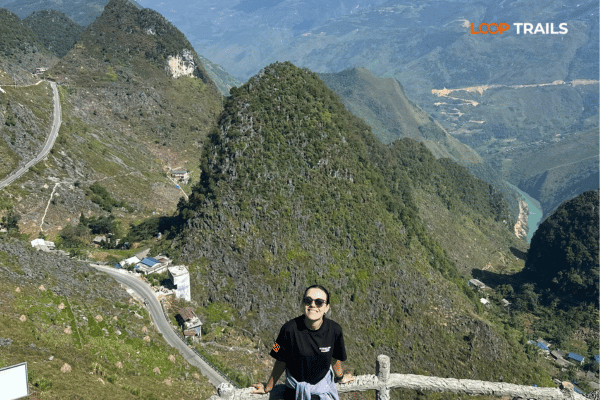
You leave Ha Giang heading north on Road 4C. The road climbs steadily. Within the first hour you are already gaining serious elevation, and by the time you reach Bac Sum Pass and the first major viewpoint, the Dong Van Karst Plateau opens up below you. Heaven Gate at Quan Ba sits at around 1,500 meters: the two conical limestone peaks that give it its name look exactly as they should from this angle, seen from above with the valleys spread out behind them.
From Quan Ba the route continues northeast through Yen Minh. The town itself is quiet but the road between Yen Minh and Dong Van is some of the most consistently beautiful stretch of the entire loop: pine forest, karst formations, and villages that feel genuinely off the tourist trail. By the time you reach Dong Van and check into your homestay, the landscape has already shifted several times.
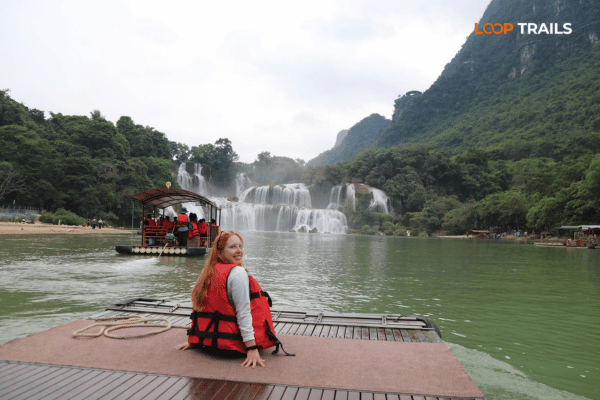
Day 2 in the standard direction takes you north to Lung Cu, the flagpole marking the northernmost point of Vietnam, then back through Dong Van and east along the legendary Ma Pi Leng Pass. The pass road climbs along the edge of the Nho Que River gorge, one of the deepest canyons in Southeast Asia. The skywalk extends out over the cliff and Tu San Canyon drops away below. From the skywalk, the road continues east and begins its descent toward Meo Vac. The boat tour on the Nho Que River is typically done from the Meo Vac side after the pass.
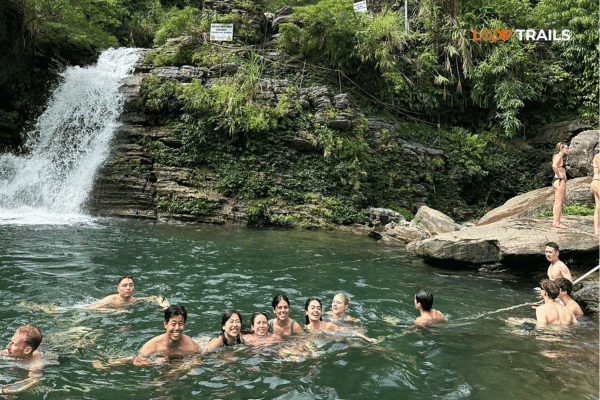
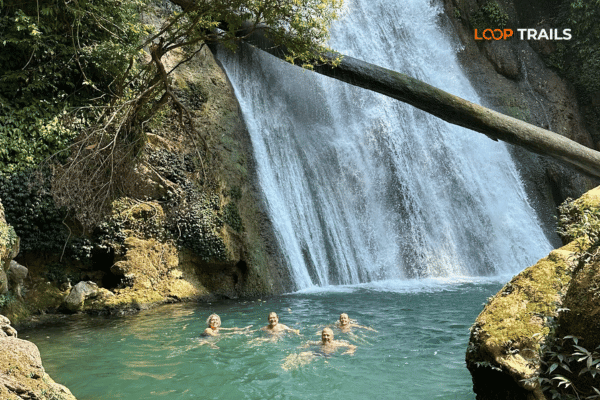
The final section runs south from Meo Vac through Du Gia, where the homestays are set in rice fields and the morning waterfall swim has become one of the most talked about moments on the entire loop. The return to Ha Giang from Du Gia follows a quiet valley road along the Mien River.
Learn more: Ha Giang Loop 4 Days 3 Nights
Going clockwise means you leave Ha Giang heading south and east toward Du Gia first. The landscape is gentler on this side: rice terraces, river valley roads, and the Du Gia waterfall relatively early in the trip. For riders who want to ease in rather than immediately climb, this has some logic.
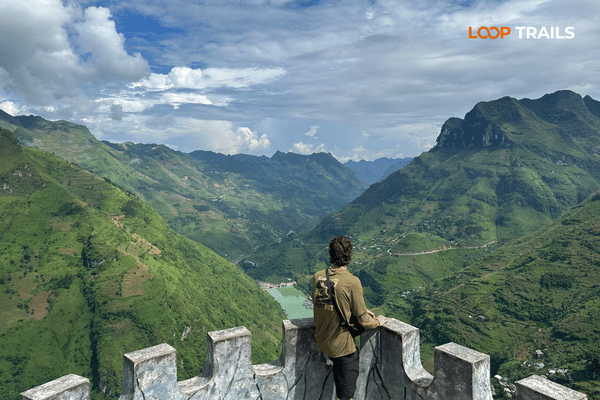
The experience of Ma Pi Leng changes significantly in this direction. Instead of descending from the Dong Van plateau toward Meo Vac (which puts the canyon views to your right as you come down), you are climbing from Meo Vac toward Dong Van. The pass is still extraordinary: no direction makes it ordinary. But the visual drama unfolds differently. You approach the skywalk coming uphill, which means the canyon opens up as you gain height rather than as you descend.
After Ma Pi Leng, the clockwise route takes you into Dong Van and from there north to Lung Cu, then back through Dong Van and westward toward Yen Minh, Quan Ba, and finally Heaven Gate as the final major stop before returning to Ha Giang.
The Quan Ba finish in the clockwise direction is one of the reasons some riders prefer it. Heaven Gate from this approach (coming from the north, descending toward Ha Giang) offers a different perspective than the classic view. Some riders find it a satisfying final vista before the end of the loop. Others miss the iconic overhead view of the twin peaks that the anticlockwise approach delivers from the first day.
Learn more: Ha Giang Cao Bang 5 Days 4 Nights
Ma Pi Leng is the centerpiece of any Ha Giang Loop debate about direction, and for good reason. It is one of Vietnam’s four legendary mountain passes, and the section overlooking Tu San Canyon is genuinely unlike anywhere else in the country.
The road across the pass runs roughly east to west (connecting Dong Van to Meo Vac, or Meo Vac to Dong Van depending on which way you’re going). The canyon drops to the north of the road.
Anticlockwise approach (Dong Van → Meo Vac): You’re traveling east, which means the canyon is to your left as you ride. For most of the descent, you have clear sightlines into the gorge. The Ma Pi Leng Skywalk is approached from the western entrance. Many riders and guides report that the views opening up on the descent toward Meo Vac feel more dramatic because the scale of the canyon reveals itself progressively as the road winds east.
Clockwise approach (Meo Vac → Dong Van): You’re climbing west, with the canyon to your right. The skywalk is approached from the eastern entrance. The climb reveals different angles on the gorge. Some photographers prefer the light conditions of a morning approach from this direction, particularly in the early months of the riding season.
Neither approach makes the pass less impressive. If you ride it in the afternoon in hazy conditions, direction matters less than weather. If you ride it in sharp morning light, both approaches have real photographic merit. The anticlockwise descent toward Meo Vac is the more commonly described “classic” experience, largely because most riders have done it that way.
Learn more: Quan Ba Heaven Gate
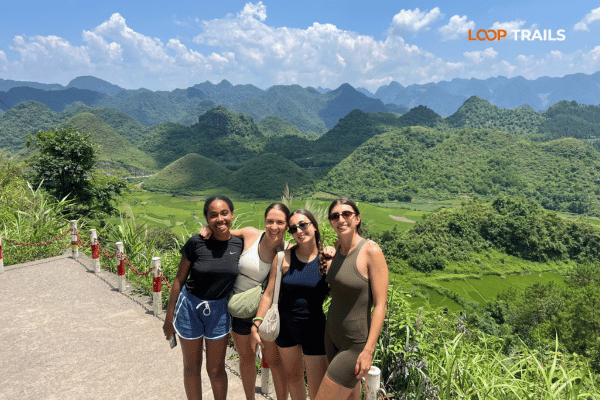
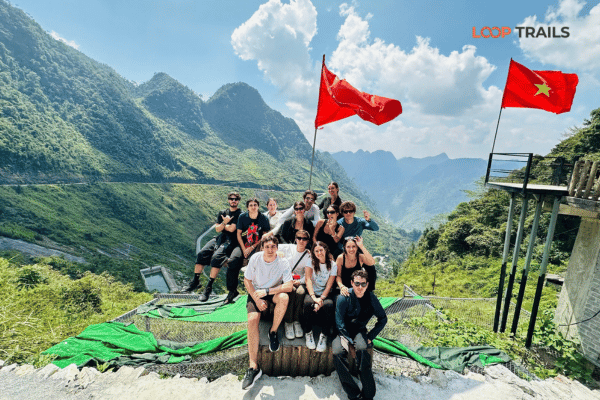
Heaven Gate at Quan Ba is the first major viewpoint in the anticlockwise direction. You arrive from below, climbing to the gate and looking out from above. The twin conical mountains (the “fairy boobs” as they’re locally nicknamed, which explains some of the other names for this viewpoint) are visible below you and to the northwest.
In the clockwise direction, you arrive at Quan Ba from the north, having already done Dong Van, Lung Cu, and Ma Pi Leng. The view at Heaven Gate is the same geography, but you are approaching from above and descending toward Ha Giang. The framing is different and some travelers find the anticlockwise approach, arriving from below and looking out over the full karst plateau for the first time, more visually impactful as a “welcome to the Geopark” moment.

Learn more: Hmong’s King Vuong Palace
The valley road between Yen Minh and Dong Van passes through Sung La, where Vuong Chin Duc’s former palace sits in a protected valley. In the anticlockwise direction you are approaching the palace from the west (from Yen Minh), and the valley opens up as you ride in. In the clockwise direction you approach from the east (from Dong Van).
The palace itself is the same in both directions. The valley approach in either direction gives you a sense of why the H’Mong king chose this location: protected on all sides, with the ornate Chinese influenced architecture sitting incongruously in a landscape of terraced fields. The anticlockwise approach pairs this stop naturally with Tham Ma Pass before it.
Learn more: Ha Giang Cao Bang 6 Days 5 Nights
Here is a practical consideration that most articles on this topic skip over: the Ha Giang Loop has a dominant traffic direction. The overwhelming majority of tour groups, guided riders, and independent travelers go anticlockwise. This creates a particular dynamic on the road.
Going anticlockwise: You are traveling in the same direction as most other riders. On narrow mountain roads, this means the bikes you encounter coming toward you are locals, supply trucks, and the rare independent traveler going the other way. The road feels relatively clear in your direction. At homestays, you tend to arrive with others at roughly the same time, which is either good (communal evenings with multiple travelers) or more crowded depending on your preference.
Going clockwise: You are going against the flow. Every tour group, every easy rider convoy, every pack of self drive bikes you encounter will be coming toward you on the opposite side of the road. On narrow passes this is fine: Ha Giang mountain roads are used to mixed traffic. But it does mean you will be navigating around oncoming groups more frequently. At homestays, you may arrive out of sync with the standard booking flow, which can occasionally create logistics issues at smaller places that host groups going one direction only.
For self drive riders who value solitude and open roads: clockwise has a genuine advantage at popular viewpoints and passes. You will often be among fewer people at the skywalk, at Heaven Gate, and at the Lung Cu flagpole because you are there at a different time relative to the main tour traffic.
Learn more: Ha Giang Loop Photography Guide
The Ha Giang Loop is one of the most photographed motorcycle routes in Southeast Asia. If your priority is photography, direction and timing interact in ways worth thinking through.
Ma Pi Leng Pass in morning light (before 10:00): Going clockwise means you approach from Meo Vac in the morning, climbing with the early light behind you. Going anticlockwise means you arrive at Ma Pi Leng after departing Dong Van, typically mid to late morning depending on your itinerary. The morning light on the canyon walls is striking regardless of direction.
Nho Que River from the pass: The deep turquoise of the Nho Que is best captured when the sun is high enough to penetrate the canyon. This typically means midday to early afternoon is better than early morning for the river color to show. Most anticlockwise riders hit this window naturally on the way down to Meo Vac.
Heaven Gate at Quan Ba: This viewpoint tends to be clearer in the morning before clouds build over the plateau. Anticlockwise riders arrive at Quan Ba in late morning of Day 1, which usually works well. Clockwise riders arrive here in the afternoon of their last day, which can catch clouds.
Lung Cu Flag Tower: There is no significant directional advantage here. The tower is a short detour from Dong Van and is visited as a side trip in both directions.
Sung La Valley and terraced fields: The light in the valley is best in the morning, and anticlockwise riders typically pass through Sung La in the afternoon of Day 1 (after Quan Ba and Yen Minh). Clockwise riders pass through in the morning, which some photographers prefer for the terraced field shots.
No direction is objectively superior for photography across all conditions. The light you get depends more on the time of year, the season, and the weather on any given day than on whether you went left or right first.
Learn more: Ha Giang Loop Hidden Gems
For a 2 day 1 night tour, the loop is not completed: the itinerary covers the core section (Ha Giang → Quan Ba → Dong Van → Ma Pi Leng → Meo Vac) without the Du Gia return, or returns directly from Meo Vac back to Ha Giang via a different road. In this case the direction is essentially fixed by the tour design: you go anticlockwise as far as the itinerary runs.
For a 3 day 2 night tour, the standard anticlockwise direction covers: Quan Ba on Day 1, Dong Van area on Day 1 or Day 2, Ma Pi Leng and Meo Vac on Day 2, Du Gia on Day 2 night, and the return through Du Gia waterfall and Lung Tam linen village on Day 3. This works well in the anticlockwise direction and the itinerary is designed for it.
For a 4 day 3 night tour, the anticlockwise direction adds Lung Cu on Day 2 and a boat tour on the Nho Que River. The extra day allows for a more relaxed pace through the Dong Van area before hitting Ma Pi Leng on Day 3.
For self drive riders planning their own 4 or 5 day itinerary: both directions are workable. The considerations above apply.
Planning the Ha Giang Loop? Loop Trails runs guided easy rider, self drive, and Jeep Wrangler Rubicon tours in the anticlockwise direction, with itineraries from 2 to 6 days. Compare formats and durations on the Ha Giang Loop tours page.
Learn more: Cao Bang Loop 3 Days best kept secret
The honest answer depends on how you are doing the loop.
For easy rider and jeep tours: You will go anticlockwise. This is what virtually all professional guides and operators run, and for good reason: the homestay network, the guide familiarity with road conditions at specific times of day, and the cumulative experience of years of running tours in this direction all point the same way. You do not need to think about this decision.
For self drive riders doing a full loop: The anticlockwise direction is the safer default for most travelers. The roads are well understood in that direction, the homestays expect you, and your experience of each landmark follows a natural escalation: from the gentler Quan Ba section at the start to the drama of Ma Pi Leng and Lung Cu in the middle. If you are an experienced rider looking to avoid groups and have more space on the road, the clockwise direction has genuine appeal.
For photographers with a specific focus: If morning light at the Sung La Valley terraces is your priority, clockwise gets you there at the right time. If the descent into Meo Vac at Ma Pi Leng with the full canyon spread below you is the shot you want, anticlockwise delivers it. For most travelers, neither direction is clearly superior for photography.
For first time Vietnam motorbike riders: Go anticlockwise with a guide. This is not the loop to work out road conditions and route finding as you go. The anticlockwise guided tour gives you the best support infrastructure, the most experienced guides on the most familiar roads, and the most tested itinerary.
| Anticlockwise | Clockwise | |
|---|---|---|
| Standard direction | Yes | No |
| Guided tour default | Yes | Rarely |
| Crowds at viewpoints | More (same direction) | Fewer |
| Ma Pi Leng approach | Descent toward Meo Vac | Climb from Meo Vac |
| Heaven Gate timing | Morning of Day 1 | Afternoon of last day |
| Homestay logistics | Fully set up | Can vary |
| Best for | Guided tours, first timers | Experienced self drive |
Learn more: Ha Giang Motorbike Rental
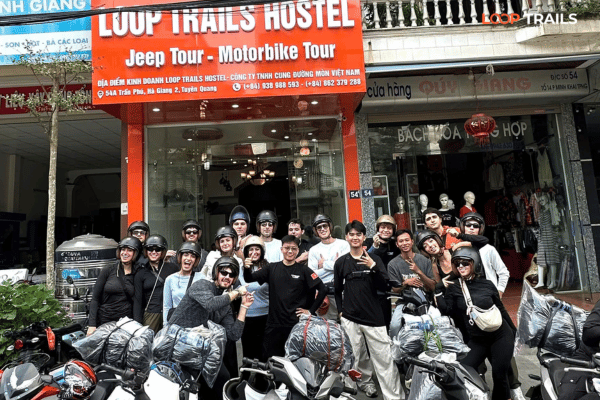
Loop Trails runs all guided tours (easy rider, self drive support, and Jeep Wrangler Rubicon) in the anticlockwise direction. The itineraries are built around this direction for several reasons: the homestays along the route are selected and established in this flow, the guides know the roads, the traffic timing at each key stop, and the points in the day where light and weather are most likely to cooperate. The 4 day 3 night itinerary, for example, is specifically structured so that the Ma Pi Leng Pass and the Nho Que River boat tour fall on Day 3, when the group has built up to it from two days of progressively dramatic scenery.
For self drive guests, Loop Trails can advise on both directions. If you have a specific reason for preferring clockwise (a photography priority, a desire to avoid group traffic, a schedule that works better this way), that is a conversation worth having before you book.
Interested in the Ha Giang Loop? See the full range of tours at Loop Trails: easy rider from 2 days, self drive, and Jeep Wrangler Rubicon for groups and families. Drop a message on WhatsApp if you have questions about routes or timing.
Learn more: Ha Giang Loop by Wrangler Rubicon Jeep
Anticlockwise is the standard: Ha Giang → Quan Ba → Yen Minh → Dong Van → Lung Cu → Ma Pi Leng Pass → Meo Vac → Du Gia → Ha Giang. The vast majority of tour operators, guides, and independent travelers follow this direction
Yes. For self drive riders planning their own itinerary, clockwise is a viable option. Most guided tours do not offer the reverse direction as a standard option, but it is worth asking your operator if you have a strong preference
Both directions have photographic merit at different landmarks. The anticlockwise descent of Ma Pi Leng toward Meo Vac is widely described as the more dramatic approach, and Heaven Gate at Quan Ba is typically better in the morning light that anticlockwise travelers experience on Day 1. That said, light conditions depend far more on weather and season than on direction alone
Yes, to a degree. Going anticlockwise means you arrive at viewpoints alongside other tour groups. Going clockwise means you are out of sync with most traffic and may encounter fewer groups at popular spots like the Ma Pi Leng Skywalk and Lung Cu
Anticlockwise homestay logistics are fully established: operators have built relationships with hosts along this route and bookings flow smoothly. Clockwise travelers may encounter occasional availability issues at smaller homestays set up for the standard direction
The full loop is roughly 350 km. Most guided tours cover it in 3 to 4 days, with 2 day options covering the core Dong Van and Ma Pi Leng section without the full Du Gia return. See the Loop Trails tour pages for itinerary details by duration
The 2 day 1 night tour covers the section from Ha Giang to Meo Vac (anticlockwise), essentially the first half of the full loop. Some self drive riders do an out and back to Ma Pi Leng without completing the circuit. Most travelers who come specifically for the Ha Giang Loop aim for at least 3 days to see the key landmarks properly
The Ha Giang to Cao Bang combined tours (5 or 6 days) do not loop back to Ha Giang: they end in Cao Bang. These are linear routes and the direction question does not apply in the same way. The Ha Giang section of these tours runs anticlockwise as far as Meo Vac, then continues east toward Bao Lac and Cao Bang
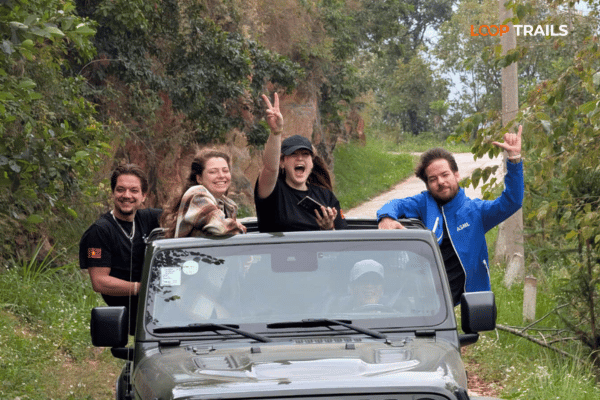
Yes. Jeep Wrangler Rubicon tours through Loop Trails follow the same anticlockwise direction and the same itinerary structure as the motorbike tours. The route is essentially identical: the vehicle changes, not the direction or the landmarks
Occasionally. If a section of road is temporarily closed due to landslides or flooding (which can happen during and immediately after the rainy season), guides and operators may adjust the order of stops. This is rare but worth mentioning if you are traveling during or just after the peak rain months. Always check current road conditions with your operator before departure
Contact information for Loop Trails
Website: Loop Trails Official Website
Email: looptrailshostel@gmail.com
Hotline & WhatSapp:
+84862379288
+84938988593
Social Media:
Facebook: Loop Trails Tours Ha Giang
Instagram: Loop Trails Tours Ha Giang
TikTok: Loop Trails
Office Address: 54A Tran Phu, Ha Giang 2, Tuyen Quang
Address: 54A Tran Phu, Ha Giang 2, Tuyen Quang
Facebook X Reddit Table of Contents Learn more: Ha Giang Loop Tours The guide sitting in front of you on a motorbike,
Facebook X Reddit Table of Contents Learn more: Ha Giang Loop Tours You are standing in the courtyard of Loop Trails Hostel.
Facebook X Reddit Table of Contents Learn more: Ha Giang Loop Tours The route from Ha Giang to Cao Bang by Jeep