


Thúy Kiều (Grace) is a travel blogger and content contributor for Loop Trails Tours Ha Giang. She holds a bachelor’s degree in Sustainable Tourism from Vietnam National University, Hanoi, and has a strong passion for exploring and promoting responsible travel experiences in Vietnam’s northern highlands.

Learn more: Ha Giang Loop Tours
If you’ve already done Ban Gioc Waterfall, walked through Nguom Ngao Cave, and seen what the eastern karst country looks like, the natural next question is how you get to Ha Giang from here without backtracking through Hanoi.
The honest answer: it depends on what you came for. There’s a direct mountain route through Bao Lac that’s one of the most underrated rides in northern Vietnam, but the public transport options on it are thin. There’s the safer, longer way back through Hanoi, which works but adds a day. And there are a couple of in-between options most travelers don’t realize exist.
This guide covers all of them. We run trips through this corridor every week, in both directions, so what follows is the version we tell our customers when they ask, not the version that gets copied between travel blogs.

Learn more: Ha Giang Loop 2 Days 1 Night
If you only want the short answer, here it is.
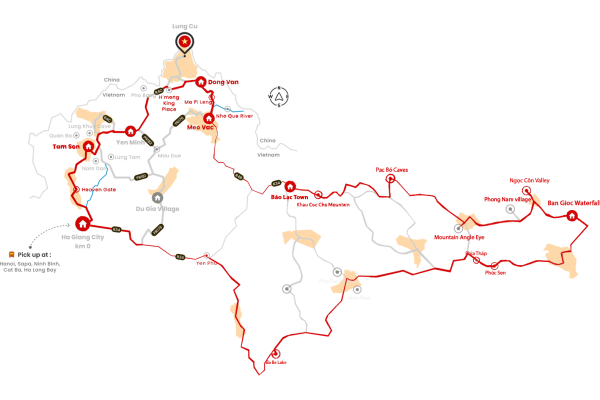
The direct mountain route from Cao Bang City to Ha Giang City runs roughly 280 to 330 km depending on which roads you take. It passes through Bao Lac, drops into Meo Vac, climbs over Ma Pi Leng Pass, and continues through Dong Van back down to Ha Giang City. Driving time is around 8 to 11 hours of pure motoring with no real stops, but nobody actually does it that way. Real travelers spread it across 2 or 3 days because the scenery deserves it and the mountain riding is genuinely tiring in one push.
There is no daily public bus that runs this exact route end-to-end. There are buses on individual segments, fragmented schedules, and the Hanoi loop-around for travelers who don’t want to do the mountain crossing. Private transport, motorbike, or a tour are the cleanest options.
If your priority is speed: go via Hanoi. If your priority is the experience: take the Bao Lac route, ideally over 2 to 3 days.

Learn more: Ha Giang Loop 3 Days 2 Nights
A few patterns. The biggest one is the reverse-direction combo loop. Travelers fly into Hanoi, do Cao Bang first (Ban Gioc, Nguom Ngao, sometimes Pac Bo), and then continue west into Ha Giang to finish at Ma Pi Leng and Dong Van. It’s a slightly less common direction than Ha Giang to Cao Bang, but it works just as well, and some travelers prefer ending the trip on Ha Giang’s higher drama rather than starting with it.
Another pattern: travelers who came to Cao Bang for a specific reason (a wedding, family visit, business in Lang Son or further northeast) and then want to add Ha Giang while they’re already in the region.
A third group: riders specifically. Some adventure motorbike travelers seek out the Bao Lac stretch because it’s one of the rare paved mountain roads in Vietnam that hasn’t been overrun yet. They aren’t going Cao Bang to Ha Giang because they have to. They’re doing it because that road is the trip.
If any of these match your situation, the rest of this article is for you.
Learn more: Ha Giang Loop 4 Days 3 Nights
Two route options dominate the calculations.
Option A: The direct mountain route via Bao Lac.
Cao Bang City → Bao Lac → Meo Vac → Dong Van → Ha Giang City. Roughly 280 to 330 km depending on small variations. Pure driving time, with no stops, somewhere between 8 and 11 hours. With realistic stops for fuel, food, and a few photos, you’re looking at 10 to 13 hours, which means you do not want to attempt it in one day. Two days minimum.
Option B: The detour via Hanoi.
Cao Bang City → Hanoi → Ha Giang City. Roughly 570 to 600 km total. Travel time around 13 to 15 hours combined, but it splits cleanly into two transport legs. Most travelers spend a night in Hanoi between them. Less scenic, less tiring, and significantly more bus options.
There’s no Option C that beats both of these on speed and scenery at the same time. Travel forums sometimes mention back-roads through interior Cao Bang and Bac Kan that look shorter on a map; in practice they involve unpaved sections and limited fuel availability, and they aren’t faster.
If your trip is built around the riding and the views, Option A. If your trip needs to fit a fixed schedule and the Cao Bang-to-Ha Giang transit is a logistics problem rather than an experience, Option B.
Learn more: Ha Giang Cao Bang 5 Days 4 Nights
Five real ways to do this trip. Some are better than they sound; others are worse.
There are buses that connect Cao Bang to points along the Bao Lac route, and buses from Ha Giang City to similar points, but a single ticketed end-to-end public bus from Cao Bang City to Ha Giang City running the direct mountain route is not something you should plan a trip around. Schedules change, routes get adjusted seasonally, and during low season some segments don’t run daily.
If you want to attempt it as a budget traveler, you’d typically piece it together: Cao Bang to Bao Lac on one bus or shared minivan, then Bao Lac onward toward Meo Vac on another, then Meo Vac to Ha Giang on a third. The timings rarely line up cleanly. You’ll spend a lot of time waiting at small terminals.
This is the option for travelers who care more about saving money than saving time, and who can adapt on the fly. It’s not the option for travelers on a fixed schedule.
A door-to-door car booked through a tour operator, a hotel, or a transfer service. Around 9 to 11 hours of driving on the direct mountain route, depending on weather and stops. The most flexible option for travelers who don’t want to ride and don’t want to deal with bus connections.
Pricing varies a lot by season and by who you book through. It’s the most expensive option per head if you’re solo or a couple, and it gets more reasonable for groups of 3 or 4 splitting the fare. Worth it for travelers with luggage they don’t want to manage on multiple legs, or with kids in the group.
A note: not every Hanoi-based driver knows the Bao Lac route well. If you’re booking a private car, check that the driver has run the route before. Otherwise the trip can include unplanned detours when GPS suggests roads that look fine on screen but are actually closed for construction.
Learn more: Ha Giang Motorbike Rental
This is the option a lot of independent travelers pick, and it’s the one that turns the journey into the trip rather than a transit.
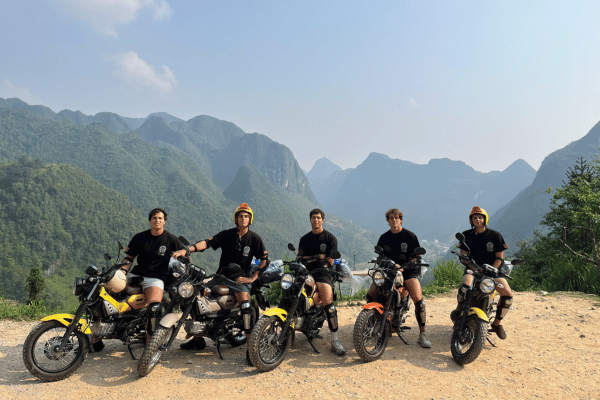
You ride from Cao Bang City through Bao Lac, into Meo Vac, over Ma Pi Leng Pass, through Dong Van, and back down to Ha Giang City. Two days is the comfortable minimum, three is better. Sleep at Bao Lac, then either Meo Vac or Dong Van the second night, then arrive in Ha Giang City fresh.
Renting a bike in Cao Bang and dropping it in Ha Giang is the logistics question to ask early. Some operators allow it; some require you to return the bike to the original location. We can arrange one-way bike rentals between Ha Giang and Cao Bang in either direction; if you’re doing the trip yourself, check our Ha Giang motorbike rental page or message us about Cao Bang pickup options.
If you’re already on a bike from a Cao Bang Loop trip and you want to extend west into Ha Giang, that’s the cleanest version of this. You’re already on the right vehicle. You don’t need to coordinate handovers.
The simplest option for travelers who want to skip the planning. Tour operators run Cao Bang to Ha Giang as part of combo itineraries, usually 5 or 6 days covering both provinces with transport, accommodation, guide, food, and permits handled.
Most tours run Ha Giang to Cao Bang as the default direction (it’s the slightly more popular sequence), but reverse direction is offered too. If you’ve already done Cao Bang independently and only want to add Ha Giang, look for a 3 days Ha Giang Loop tour with pickup from Cao Bang as a custom add-on rather than a full combo. We do this kind of arrangement on request.
Doing the trip in one go? Our Ha Giang Cao Bang combo tour handles everything from pickup to drop-off, in either direction, with motorbike, easy rider, or jeep options. If you’re already in Cao Bang and want to ride west, message us and we’ll customize the start point.
The boring but reliable option. You take a bus or private transfer from Cao Bang to Hanoi (around 7 to 8 hours), spend a night in Hanoi if needed, and then take another bus or transfer from Hanoi to Ha Giang (another 6 to 7 hours).
It sounds inefficient because it is inefficient, geographically. But schedules are reliable, options are plentiful, and you don’t have to ride or organize private transport. For travelers who don’t have time for the mountain crossing, who don’t ride, and who don’t want to splurge on a private car, this is the path of least resistance.
The trade-off: you skip what’s arguably the best two days of riding in northern Vietnam.

Learn more: Ha Giang Cao Bang Ba Be Lake 6 Days 5 Nights
Since this is the route most travelers researching “Cao Bang to Ha Giang” actually want to know about, here’s what the road looks like in detail.
You leave Cao Bang City heading west on QL34. The first few hours are gentle: river valleys, rice terraces, Tay villages with their stilted wooden houses. The road is paved, traffic is light outside of Cao Bang’s immediate suburbs, and the scenery shifts gradually from open valley to tighter mountain country.
By the time you approach Bao Lac, you’re properly in the mountains. Bao Lac itself is a small town that doesn’t show up on most travel itineraries but works well as a midpoint stop. There’s a basic guesthouse network, a few decent local restaurants, and just enough infrastructure to recover for a night before the next stretch.
From Bao Lac west, the road climbs into the karst plateau that defines the Ha Giang side of this corridor. The transition is gradual at first, then dramatic. By the time you reach Meo Vac, you’re in the limestone landscape that the Ha Giang Loop is famous for: jagged peaks, narrow stone fields, Hmong villages tucked into impossible slopes.
Out of Meo Vac, you climb Ma Pi Leng Pass. Going west to east (which is the Cao Bang to Ha Giang direction), you start on the lower side and work up through the switchbacks to the famous viewpoint above the Nho Que River. The view is the same regardless of direction; the riding feel is slightly different because you’re climbing rather than descending the most dramatic stretch.
After Ma Pi Leng, you continue through Dong Van, then the road eases as you head south through Yen Minh, Quan Ba, and back to Ha Giang City. The last stretch is gentler, more rolling country, with fewer dramatic stops. Most travelers cover this final section quickly because the headline scenery is behind them.
Total: roughly 280 to 330 km, 2 days minimum, 3 days for a comfortable pace.

Learn more: Ha Giang in September & October
A few situations where the Bao Lac mountain route is the wrong choice.
You don’t ride and you don’t want to spend on a private car. The bus options are too fragmented to be a good experience. Take the Hanoi detour instead.
You’re traveling in heavy wet season (June and July). The Bao Lac road is paved but landslides happen in heavy weeks. Roads stay rideable most of the time, but if you’re on a tight schedule and a multi-day storm hits, you’ll be stuck. The Hanoi detour is more weather-resilient.
You have a flight to catch from Hanoi within 36 hours of leaving Cao Bang. Don’t risk the mountain route. The detour through Hanoi gives you predictable transit and a buffer.
You’ve already done the Ha Giang Loop and only want to get back to Hanoi. The mountain route doesn’t help you here. You’re better off going Cao Bang to Hanoi directly.
You hate motorbikes and don’t enjoy long car rides. Even by private car, the direct route is 9 to 11 hours of mountain driving. Some travelers find that exhausting regardless of whether they’re driving. Hanoi detour is shorter on each individual leg.
For everyone else, the direct route is the better trip.

Learn more: Cao Bang Loop 3 Days best kept secret
The same seasonal logic applies as it does for the Ha Giang Loop and the Cao Bang Loop. The Bao Lac corridor connects the two, so its weather mirrors both ends.
October to early December. The best window. Dry, cool, scenery at its peak. October catches the rice harvest gold on the Ha Giang side. November brings the buckwheat blooms around Lung Cu and Sung La, and the Cao Bang side stays green. By early December, mornings are cold but skies are usually clear.
December to February. Cold, sometimes very cold on the high passes. Mornings near freezing at Ma Pi Leng. Some travelers love the misty, atmospheric quality this brings; others find it uncomfortable on a bike. Tet (Lunar New Year) usually falls in late January or early February and many homestays close for the week, which matters if you’re sleeping in Bao Lac.
March to April. Underrated. Pink wild peach blossoms, mild temperatures, dry roads. Strong second-best option after October-November.
May to early September. Wet season. Rice fields beautiful, especially in late August. Roads can flood briefly, landslides happen in heavy weeks. If you’re doing the direct mountain route in this window, build in a buffer day. The Hanoi detour is the lower-risk option in heavy rain weeks.
Mid September. A transition month that can swing wet or dry. Late September often delivers the season’s first dry stretches.
If you’re picking dates: aim for mid October through mid November. That’s our recommendation for first-time travelers on this route.
Learn more: Ha Giang Road Conditions 2026
The honest version, no marketing.
Cao Bang to Bao Lac. Paved, generally in good condition. Some sections have been resurfaced in recent years. Traffic is light outside of immediate town areas. Wider, gentler corners than the Ha Giang side.
Bao Lac to Meo Vac. This is the section that’s improved the most over the past few years. There are still patches that get rough after heavy rain, especially the climb out of Bao Lac, but it’s a long way from the muddy goat track some old blog posts describe. Mobile signal drops in places. Don’t ride after dark on this stretch.
Meo Vac to Ma Pi Leng to Dong Van. This is the famous Ha Giang Loop section, paved and in good condition for the most part. Tight switchbacks, beautiful pavement, occasional traffic from tour groups going the other direction. Construction zones come and go. The section right at the Ma Pi Leng viewpoint can get backed up with parked vehicles in peak season.
Dong Van to Ha Giang City. Paved, fast, less scenic than the upper plateau. Gentle valleys and rolling country. The easiest riding of the trip.
Traffic patterns. Trucks on the main highways, scooters in towns, occasional buffalo in rural sections. Watch blind corners on Ma Pi Leng, where overtaking trucks coming the other way is the main risk. Don’t ride after dark on any of this. Rural roads have no street lighting and animals on the road are common at dusk.
Road conditions can change with weather and construction. Check current conditions in the week before you ride, or book a tour and let the operator handle it.

Learn more: Tu San Canyon & Nho Que River Boat Trip
If you’re doing the direct route, these are the stops that earn the time. We’re not listing every minor village.
The natural midpoint stop. A small Tay-and-Nung town with a few decent guesthouses and family-run restaurants. There’s not a long list of attractions, which is part of what makes it work as a halfway point. You arrive late afternoon, have dinner, sleep, leave the next morning. It’s also worth a short walk along the river running through town.
The headline. Meo Vac itself is a small town at the bottom of the pass, with a Sunday market that’s worth timing your trip around if you can. The pass climbs out of town to the famous viewpoint above the Nho Que canyon, where most travelers stop for 30 to 60 minutes. There’s a small cafe at the viewpoint; the drinks are overpriced but the bench is the best seat in the country.
Optional but strongly recommended. From Meo Vac (or from a viewpoint along Ma Pi Leng), you can take a boat trip on the Nho Que River through the canyon you’re riding above. It’s about an hour on a small motorboat. Coming up from the river, looking up at the cliff face you just rode along, recalibrates your sense of scale for the rest of the trip. Cheap, worth it.
A small ochre-walled enclave in the middle of an otherwise modern town. Sunday morning has the famous Dong Van market with traders from across the plateau. Even on non-market days, the old quarter at dusk is atmospheric, with lanterns lighting the main square. Worth at least a night here, longer if your schedule allows.
Other smaller stops (Lung Cu, Sa Phin Hmong King’s Palace, Sung La) are worth fitting in if you have a third day on the route.
Learn more: Ha Giang Jeep Tours
The right way to do this corridor, in our opinion.
A 3 days, 2 nights itinerary that we run regularly:
Day 1: Cao Bang to Bao Lac.
Roughly 130 km. 4 to 5 hours of riding with stops. Easy first day, mostly to get out of Cao Bang and onto the mountain road. Sleep in Bao Lac.
Day 2: Bao Lac to Dong Van via Meo Vac and Ma Pi Leng.
Roughly 110 km. 5 to 7 hours with stops. The big day. You climb into the karst plateau, ride Ma Pi Leng, do the Nho Que boat trip if your group has time, eat lunch in Meo Vac, and arrive in Dong Van mid-to-late afternoon. Sleep in Dong Van.
Day 3: Dong Van to Ha Giang City.
Roughly 140 km. 5 to 6 hours with stops. The easier final stretch through Yen Minh, Tham Ma Pass, and Quan Ba back to Ha Giang City. You arrive by mid-afternoon, with time to clean up and either stay a night or catch the night transfer to Hanoi.
This is the format that lets you do the corridor properly. If you have only 2 days, you can compress it (Cao Bang to Meo Vac on Day 1, Meo Vac to Ha Giang on Day 2), but the days get long and you skip the full Dong Van experience.

Learn more: Ha Giang Loop Price
Real talk, no fabricated quotes. Prices change. We’re talking ranges.
By bus (piecing it together). Cheapest option. The combined ticket cost across multiple legs is generally low. The cost is your time and your tolerance for waiting at small terminals.
By private car or transfer. The most expensive option per person if you’re solo or a couple. Fairer cost-per-head if you’re a group of 3 or 4. Includes the driver, the car, and fuel. Doesn’t include accommodation if you stop overnight.
By motorbike (DIY). Bike rental for 2 to 3 days, fuel, accommodation along the way (1 to 2 homestay or guesthouse nights), food, and any permits. The variable cost depends mostly on your accommodation choice and whether you do the Nho Que boat trip.
By tour. Includes everything: guide or driver, transport, all accommodation, most meals, permits, fuel. Sits between the private car cost and the DIY motorbike cost on a per-day basis. Less to plan, less to worry about.
Hanoi detour by bus. Two bus tickets (Cao Bang to Hanoi, Hanoi to Ha Giang) plus one night of Hanoi accommodation if needed. Reliable, predictable, the lowest-effort option.
For a current quote on a guided trip or a one-way motorbike rental, message us with your dates and group size. We’ll send back itemized numbers and confirm what’s available on your travel window.

Learn more: Ha Giang Packing list
Same packing list as for any northern Vietnam mountain trip. A few specifics for the Cao Bang to Ha Giang direction.
Essentials
Documents
Things you don’t need
If you’re picking up a rental motorbike in Cao Bang and dropping it in Ha Giang, double-check the drop-off arrangement before you leave. One-way rentals require coordination, and confirming the pickup details twice saves headaches at the other end.
Learn more: Ha Giang Safety Tips
The Cao Bang to Ha Giang corridor passes close to the Chinese border in places. A few logistical points.
Permits. Lung Cu Flagpole and certain border-adjacent areas in Ha Giang province require a permit for foreign travelers. If you take a guided tour, the operator handles this. If you’re going independently and want to detour up to Lung Cu (recommended if you have the time), you’ll need to apply at the immigration office in Ha Giang City. Doing it from Cao Bang side requires planning ahead.
Driving licenses. Vietnam law on foreign motorbike drivers has been tightening over recent years. The general expectation is that you should hold a valid motorbike license from your home country plus an International Driving Permit covering the right category (typically A1 for bikes up to 175cc). Rules and enforcement can change. Check the latest before you travel, and don’t rely on outdated forum posts. If in doubt, easy rider with a licensed local driver removes the question.
Insurance. Most travel insurance excludes motorbike riding by default, or limits cover by engine size. Read the fine print before you ride. Some policies upgrade for a small additional fee.
Accommodation registration. Hotels and guesthouses register foreign guests by passport. Smaller homestays are sometimes less formal about this. For your own peace of mind, keep your passport on you; for theirs, having it scanned at check-in is normal.
Helmets. Mandatory by law, provided by every reputable rental shop and tour. Wear it. Police checks happen, especially around larger towns.
If any of this sounds like a hassle to coordinate yourself, that’s literally what an operator handles when you book a tour.
Learn more: Ha Giang Loop Mistake to Avoid
Patterns we see often.
Trying to do the direct route in one day. Possible by private car. Not enjoyable. The scenery deserves at least 2 days, and you’ll regret cramming it.
Booking a private car with a Hanoi-based driver who doesn’t know the Bao Lac road. Some Hanoi drivers will accept the job and then realize halfway in that Google Maps is sending them down a dirt track. Confirm the driver has run the route before you book.
Underestimating the cold at altitude. Cao Bang is lower; Ma Pi Leng and Dong Van are higher. The temperature drop on the second day catches travelers off guard, especially in winter. Bring a warm layer regardless of your start city’s weather.
Assuming there’s a daily public bus running end-to-end. There isn’t, reliably. If you’re trying to budget travel, plan for bus segments, not a single ticket.
Treating Bao Lac as just a transit stop. It’s a quiet, atmospheric small town in its own right. If you arrive in late afternoon and have a beer at the river, you’ll remember it.
Skipping the Nho Que boat trip. This shows up on every “what I wish I’d done” list from travelers who rushed through.
Booking the wrong direction for your priorities. If you’re doing the Ha Giang side first and Cao Bang second (the more common direction), the corridor logic reverses. Don’t apply this article verbatim to the Ha Giang to Cao Bang trip; the road is the same but the rhythm of the days flips.
Taking the Hanoi detour and then complaining you missed the scenery. The detour is a real choice, not a failure. If you pick it, own it, and plan a separate trip for the mountain crossing later.
Learn more: Ha Giang Loop Easy Rider
Quick decision frame.
You’re already on a motorbike from a Cao Bang Loop trip and want to extend. Ride the direct mountain route over 2 to 3 days. This is the cleanest version. Message us if you need a one-way bike rental or accommodation pre-booked. Our Cao Bang loop tours can be extended into Ha Giang on request.
You don’t ride, you have time, and you want to see the corridor properly. Book a private car with a driver familiar with the route, over 2 days with a Bao Lac overnight. Or book a combo tour that handles the whole corridor for you.
You don’t ride and you have a fixed schedule. Take the bus or transfer back to Hanoi, then a separate bus or transfer up to Ha Giang. It’s not glamorous but it works.
You ride at home, you have your own license, and you want freedom. Rent a motorbike and ride it yourself. Confirm one-way drop-off in advance.
You’re traveling as a couple where one rides and one doesn’t. Book a jeep version of the combo, or a private car with the Bao Lac route. Both partners see the same scenery, no one negotiates the saddle.
You only have 1 to 2 days and you don’t want to give them all to transit. Skip the direct mountain route this trip. Take the Hanoi detour, and come back for the Bao Lac crossing on a future trip.
Make it easy. Message our team on WhatsApp with your dates, your start point, and what mode you’re leaning toward (motorbike, easy rider, jeep, or private car). We’ll come back with an itinerary draft and a clear quote, usually within a few hours. Plan your Cao Bang to Ha Giang trip with LoopTrails here.
The trip is one of the more underrated routes in northern Vietnam. The travelers who do it properly tend to come back saying the Bao Lac stretch was the part they remember most, even after Ma Pi Leng. The road is quiet, the country is real, and the corridor is exactly as long as it needs to be.
Learn more: Ha Giang Loop by Jeep for Families & Groups
The direct mountain route via Bao Lac is roughly 280 to 330 km and takes 2 to 3 days at a comfortable pace. By private car it can be done in 9 to 11 hours of driving. The detour via Hanoi totals around 13 to 15 hours of bus travel split across 2 legs, usually with an overnight in Hanoi.
There’s no reliable daily public bus running end-to-end on the direct mountain route. Buses cover individual segments (Cao Bang to Bao Lac, Bao Lac toward Meo Vac, Meo Vac to Ha Giang), but timings rarely align cleanly. Most independent travelers either ride a motorbike, book a private car, or take the longer route via Hanoi.
For most travelers, the answer is either a 2 to 3 days motorbike trip (or guided tour) on the direct mountain route, or a private car if you don’t ride. The Hanoi detour by bus is the simplest if you’re on a tight schedule.
One-way rentals between the two provinces are possible with operators that run both ends. We arrange this on request. Most generic rental shops only offer same-location returns, so confirm one-way availability before you commit to the route.
The main route is paved and in generally good condition. The riskier sections are the climbs out of Bao Lac and the switchbacks on Ma Pi Leng Pass. Ride conservatively, don’t overtake into corners, and don’t ride after dark. After heavy rain there can be mud and occasional landslides. Check current conditions before you go.
Mid October to mid November is the standout window: dry weather, cool temperatures, peak scenery on both sides. March and April are an underrated alternative. Avoid heavy wet season weeks (June and July) on the direct mountain route if you can.
Slightly more travelers do Ha Giang first and Cao Bang second, ending the trip in Cao Bang City with a bus to Hanoi. Reverse direction (Cao Bang first, Ha Giang second) works equally well and ends the trip on Ha Giang’s higher-altitude scenery. Pick based on which side of the trip you want to peak with.
The route itself doesn’t require special permits. Some specific stops (like Lung Cu Flagpole and certain border-adjacent areas) do. Tour operators handle the permits as part of bookings. Independent travelers need to apply at the relevant immigration offices. Rules can change, so check current requirements.
Yes. Combo tours covering both provinces run regularly in either direction. Some operators specialize in 5 to 6 days combo trips with motorbike, easy rider, or jeep options. If you’ve already done one province independently, you can usually arrange a partial tour starting from your current location.
Bao Lac is a small Tay and Nung town with basic guesthouses, a few restaurants, and a pleasant river running through it. There’s no major tourist attraction, but it works as the natural overnight stop on the direct mountain route. Most travelers arrive late afternoon, eat dinner, sleep, and leave the next morning.
Yes, the road is open year-round. Heavy wet season weeks can bring brief landslides or surface damage, which usually clear within a day or two. In winter, the road stays open but high passes get cold and occasionally misty. Check current conditions before any trip outside the dry season.
The Ha Giang Loop is a 3 days circuit through Ha Giang province only, returning to Ha Giang City. The Cao Bang to Ha Giang route is a one-way corridor connecting two provinces, so it includes the eastern half of the Ha Giang Loop (Ma Pi Leng, Meo Vac, Dong Van) plus the Bao Lac transition stretch. Many travelers combine both, doing a full combo tour that covers each province properly.
Contact information for Loop Trails
Website: Loop Trails Official Website
Email: looptrailshostel@gmail.com
Hotline & WhatSapp:
+84862379288
+84938988593
Social Media:
Facebook: Loop Trails Tours Ha Giang
Instagram: Loop Trails Tours Ha Giang
TikTok: Loop Trails
Office Address: 48 Nguyen Du, Ha Giang 1, Tuyen Quang
Address: 48 Nguyen Du, Ha Giang 1, Tuyen Quang
Facebook X Reddit Table of Contents Learn more: Ha Giang Loop Tours Most people drive past the Quan Ba area twice on

Facebook X Reddit Table of Contents Learn more: Ha Giang Loop Tours The Ha Giang Loop has a reputation problem with older