
Ha Giang in November: Buckwheat, Cool Air, Fewer Crowds
Facebook X Reddit Table of Contents Learn more: Ha Giang Loop Tours If you could pick one month to see the Ha

Thúy Kiều (Grace) is a travel blogger and content contributor for Loop Trails Tours Ha Giang. She holds a bachelor’s degree in Sustainable Tourism from Vietnam National University, Hanoi, and has a strong passion for exploring and promoting responsible travel experiences in Vietnam’s northern highlands.
Learn more: Ha Giang Loop Tours
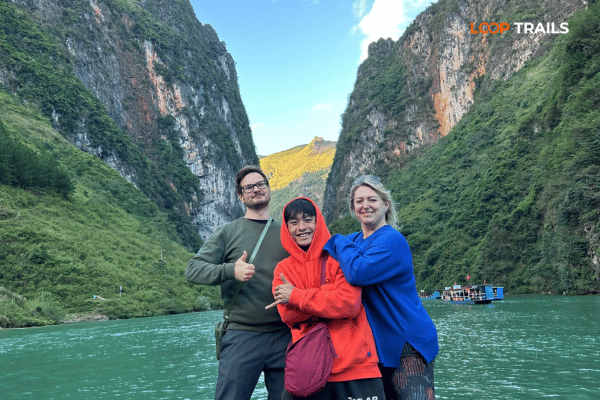
The Ha Giang Loop is famous for the things that earn photographs: Ma Pi Leng Pass, the Nho Que River far below, Lung Cu Flag Tower against a clear sky. These are the moments people come for, and they deliver.
But the loop also has a different kind of moment, the kind that does not make it onto the highlight reel because it cannot be reduced to a single image. Duong Thuong valley in Ha Giang is one of those moments. It is a mountain valley, quiet and unhurried, home to H’Mong families who have farmed these slopes for generations. You pass through it on the final morning of the 4 days 3 nights Ha Giang Loop, between Du Gia village and Thai An, on a stretch of road that has no famous pass and no famous viewpoint.
That is exactly why it is worth knowing about.
Learn more: Ha Giang Loop 2 Days 1 Night
Duong Thuong is a valley in the mountain terrain of Ha Giang province, tucked between the ridges on the return route toward Ha Giang city. It is H’Mong country: the kind of place where the village sits at the bottom of a slope and the terraced fields rise up the hillside in steps, and where the morning mist has usually not entirely lifted by the time you arrive.
The name does not appear on most tourist maps and very few travel blogs mention it. That is partly because it is a transitional stop rather than a destination in its own right: the 4 days 3 nights loop passes through it, not to it. And it is partly because the valley does not have one dramatic feature that makes for an easy photo caption. It has something harder to photograph: a sense of place, the feeling of a community living in and from the landscape around it.
H’Mong villages in this part of Ha Giang typically centre on a small cluster of earthen or wooden houses, with corn racks drying under the eaves and gardens growing in every available space. Children play in the lanes. Women carry loads along the path with the kind of unhurried efficiency that comes from doing the same walk every day for years. Men tend the terraces or work on the irrigation channels that keep the rice fields watered through the dry months.
None of this is performance. It is just life, and you are passing through it on a motorbike or in a jeep, as a respectful observer rather than a destination visitor.
Learn more: Ha Giang Loop 3 Days 2 Nights
Duong Thuong valley is a Day 4 stop on the Ha Giang Loop 4 days 3 nights itinerary. After breakfast at the Du Gia homestay and a morning swim at Du Gia waterfall, the route heads south and west back toward Ha Giang city. The valley comes around 10:00 in the morning, after the waterfall stop and before lunch in Thai An at around 12:30.
Day 4 route in sequence:
The valley is not a long stop: you ride through it over the course of perhaps 20 to 30 minutes, depending on the road and how often you slow down to look. But the character of the drive changes noticeably. After the drama of the previous three days, the valley feels like a breath out.
Learn more: Ha Giang Loop 4 Days 3 Nights
Ha Giang’s terrain is defined by limestone karst: sharp ridges, steep valley walls, and narrow gorges. Duong Thuong valley sits within this geology but has a slightly gentler character than the most dramatic sections of the loop. The valley floor is wide enough to allow rice and corn terracing, and the river or stream that runs through it has not cut down to the depths of the Nho Que.
In the growing season, from late May through September, the terraces are vivid green. In October, the rice turns gold before harvest. By the time the last harvest is finished and the fields lie fallow through November and into spring, the valley has a quieter, more skeletal beauty: the terrace walls visible in their geometry, the mountains above them bare and grey.
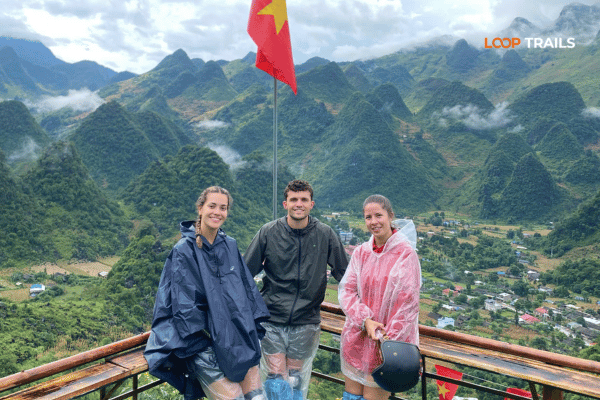
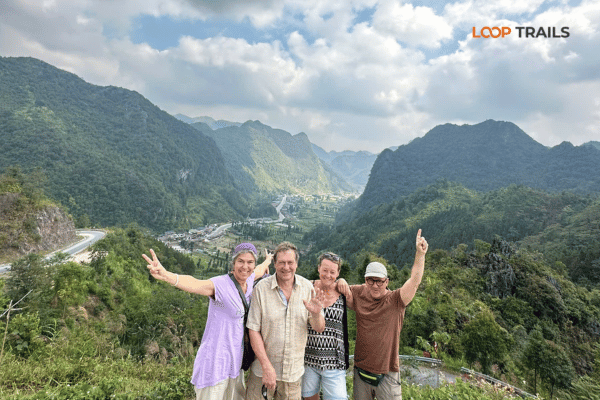
The road through the valley follows the natural contour of the terrain, dipping into the valley floor and rising again along the hillside. At certain points you get a view across the full width of the valley: the terraces on the opposite slope, the village below, the ridges behind. It is not the view from Ma Pi Leng, but it is real and unadorned and genuinely lovely.

Learn more: Ha Giang Cao Bang 5 Days 4 Nights
Ha Giang province is home to more than twenty ethnic minority groups, and the H’Mong are the most numerous and the most visible on the loop. They inhabit the high plateau around Dong Van and Meo Vac, the valleys around Yen Minh, and the lower slopes of the range that extends toward Quan Ba and Thai An.
The H’Mong of Duong Thuong, like H’Mong communities throughout this area, practise a mixed subsistence economy: wet rice on the valley floor, corn on the steeper terraces, supplemented by vegetables, pigs, chickens, and in some households, hemp for weaving. The women are recognisable by their traditional dress: dark indigo fabric with bright embroidery at the cuffs and collar, the patterns varying subtly by sub group and village.
The H’Mong have a reputation for reserve with outsiders, and that reputation is not entirely wrong. The communities on the main tourist route, in Dong Van and around the Vuong Palace, have had decades of visitor contact and are more accustomed to being photographed and talked to. In quieter valleys like Duong Thuong, the interaction is more mutual: you watch them go about their day, they watch you pass through, and there is a kind of respectful acknowledgement in both directions.
If you stop and you have a guide, a brief conversation is possible. Many of the older women in these villages have little or no Vietnamese, let alone English, so a guide who speaks H’Mong or who can bridge in Vietnamese is genuinely useful here. Without one, a nod and a smile is the right register. Do not point a camera at someone without asking first.
Learn more: Ha Giang Cao Bang 6 Days 5 Nights
Travel writing about Ha Giang tends to focus on the same set of locations: the passes, the geological park, Lung Cu, Vuong Palace, the Nho Que. These are the places that photograph well and that have enough infrastructure to support large numbers of visitors. They are also, honestly, the places where your time and energy are best spent if you have only two or three days.
Duong Thuong does not appear in the standard Ha Giang guide because it has no single thing to do there. No cave to enter, no tower to climb, no boat to board. It is a valley you drive through, and that is not the kind of experience that fits neatly into a listicle.
What it offers instead is context. After three days on the high plateau, riding through Duong Thuong gives you a different angle on Ha Giang. The drama of the karst and the passes is real, but so is this: the quiet agricultural life of the valleys, the terraced fields shaped by centuries of work, the villages where the loop passes by but does not change everything.
The travellers who most appreciate this stop tend to be the ones who were already paying attention: noticing the different textures of the landscape, wondering about the people who live in the houses they pass, curious about how the farming works on these slopes. For that kind of traveller, Duong Thuong is a small gift on the last morning of the tour.
Learn more: M Pass & Lung Ho Viewpoint
The Duong Thuong valley stop is included exclusively in the Ha Giang Loop 4 days 3 nights tour. It falls on Day 4, the return day.
The 3 days 2 nights and 2 days 1 night versions of the loop use a different return route and do not pass through the valley. If this kind of quiet, off the radar stop matters to you, the 4 days 3 nights tour is the one to book.
Ha Giang Loop 4 days 3 nights: tour prices
| Tour type | Price per person |
|---|---|
| Easy Rider | 5,690,000 VND |
| Self Drive | 4,890,000 VND |
| Jeep: 1 person | 21,990,000 VND |
| Jeep: 2 people | 27,490,000 VND |
| Jeep: 3 people | 33,490,000 VND |
| Jeep: 4 people | 39,990,000 VND |
Prices include dormitory accommodation, all meals on the itinerary, guide fees, and entrance fees. Private room upgrades and bus transfers are priced separately. Foreign visitors require a border area permit (260,000 VND per person), which your operator arranges.
Is the 4 days 3 nights tour worth it over the 3 days 2 nights?
The extra day adds the full Dong Van experience, Lung Cu Flag Tower, Lo Lo Chai village, and the Du Gia section including the waterfall swim and the Duong Thuong valley pass. If you have the time, the 4 days 3 nights tour is the more complete version of the loop, and the final day on the quieter return route is a genuinely different experience from the high intensity plateau riding of Days 2 and 3.
Learn more: Ma Pi Leng Pass
The valley is a riding stop, not a walking stop. You experience it from the saddle or the seat, watching the landscape unfold rather than exploring it on foot. That is a different kind of engagement than a cave visit or a boat trip, and it suits some travellers more than others.
If you are on a guided tour, your guide can slow down or stop for a moment if you ask. Finding a good view across the valley and taking five minutes to sit with it is entirely possible. What is not built into the standard itinerary is a structured walk through the village or a visit to a specific household: the valley is part of the transition, not the destination.
For people who want more time in the valley or in the surrounding area, the independent motorbike rental option gives you that flexibility. You can linger as long as you want, take detours, and come back through at a different time of day. The tradeoff is that you are navigating on your own and you will not have a guide to explain what you are seeing or bridge the language gap if you want to interact with the community.
Learn more: Ha Giang Loop Photography Guide
The Ha Giang Loop 4 days 3 nights itinerary is designed to show you as much variation as possible within a coherent route. Days 1 and 2 build from the initial scenery through the karst plateau. Day 3 is the most intense: Ma Pi Leng Pass, the Tu San Canyon, the Nho Que River boat trip, the M Pass, the overnight at Du Gia. Day 4 is deliberately quieter.
The swim at Du Gia waterfall is a physical reset. The drive through Duong Thuong is a visual one. The stop at Lung Tam weaving village adds a craft and cultural dimension that you have not encountered in the same form anywhere else on the route. And the final section along the Mien river valley road back into Ha Giang city gives you time to process four days of experience before the ride ends.
That rhythm is not accidental. The final day of the loop is as carefully considered as the passes, it just operates at a different frequency.

Learn more: Ha Giang Loop by Wrangler Rubicon Jeep
The same tour runs in three formats and the format affects how you experience a place like Duong Thuong.
Easy Rider: You ride behind a local guide on a motorbike. This is the most popular format and the best for people who want the full sensory experience of the road without having to manage the driving. In Duong Thuong, your guide can stop, explain what you are looking at, and add context from their knowledge of the valley and the people. This is the richest version of the experience.
Self Drive: You ride your own motorbike, your guide leads on a separate bike. This is the right choice if you hold a valid motorcycle licence and want the physical engagement of riding the loop yourself. In Duong Thuong, you control your own pace completely. The tradeoff is that you are focused on the road, so some of the observation happens later in retrospect rather than in the moment.
Jeep Wrangler Rubicon: You ride as a passenger in a Jeep with a driver and guide. This is the most comfortable option, particularly good for couples, families, or travellers who want to focus entirely on looking. In Duong Thuong, the elevated seating position in the Jeep gives a slightly different vantage point, and you can roll down the windows and take in the air of the valley without worrying about the road.
All three formats see the same valley. How you receive it depends on how you travel.
Learn more: Tu San Canyon & Nho Que River Boat Trip
The drive from Du Gia to Thai An through Duong Thuong is part of the Ha Giang Loop return route and the road quality is generally good, though mountain conditions apply: some sections can be affected by rain, and the morning can be cool at altitude even in the warmer months.
Bring a light jacket for the morning section, even if the forecast looks warm. Valley mornings in Ha Giang often start cool and mist covered, brightening into something warmer by mid morning.
Photography from a moving bike or jeep is satisfying in this part of the route because the landscape changes continuously and there is no single crowded viewpoint competing for position. Keep your camera or phone accessible.
If you are on a self drive tour, check your fuel before leaving Du Gia. There are fuel stops in the larger towns along the route, but the valley sections between have fewer options.
Learn more: Ha Giang City Guide
For most travellers, the loop ends at Ha Giang city in the late afternoon of Day 4, with the option of taking a night bus back to Hanoi or continuing to another destination. Options from Ha Giang city at the end of the tour include:
A night bus back to Hanoi, departing Ha Giang in the evening and arriving in Hanoi in the early morning.
A connection onward to Sapa, for travellers who want to continue through the northwest.
An extension to Cao Bang for the full Ha Giang and Cao Bang combined tour, which adds another three to four days and includes Ban Gioc waterfall, Nguom Ngao cave, and God’s Eye Mountain.
If you have been on the 4 days 3 nights loop and found that you wanted more of the quieter, off track moments like Duong Thuong, the Ha Giang and Cao Bang 5 days 4 nights or 6 days 5 nights combined tour is worth considering. The Cao Bang section of that tour has a similar quality: less famous than the Ha Giang plateau, more remote, and full of landscape and community that most tourists never see.
Thinking about the 4 days 3 nights Ha Giang Loop? The Duong Thuong valley stop is one of several reasons it is the most complete version of the route. Choose Easy Rider for a local guide and full cultural context, Self Drive if you want the riding experience and hold a valid licence, or the Jeep Wrangler Rubicon for maximum comfort and the best view from the vehicle.
Learn more: Ha Giang Motorbike Rental
Duong Thuong is a mountain valley in Ha Giang province, inhabited by H’Mong people. It is a relatively quiet and little known stop on the Ha Giang Loop, passed through on Day 4 of the 4 days 3 nights itinerary. The valley has rice terraces, traditional H’Mong villages, and a calm character that contrasts with the more dramatic high plateau sections of the loop
The valley is included only in the Ha Giang Loop 4 days 3 nights tour. It falls on Day 4, between the Du Gia waterfall stop and lunch in Thai An. The 3 days 2 nights and 2 days 1 night tours take a different return route and do not pass through the valley.
The valley is a riding section rather than a structured stop, taking around 20 to 30 minutes to pass through. Your guide can stop for photos or a short break if you ask. It is not a destination with a specific activity, but part of the morning drive back toward Ha Giang city
Yes, if you are renting a motorbike or driving independently. The valley is on the route between Du Gia and Thai An in Ha Giang province. Having a guide is helpful for language and context, but the drive is accessible on your own
The valley has rice and corn terraces stepped up the hillsides, traditional H’Mong villages on the valley floor or lower slopes, and mountain ridges on both sides. In the growing season the terraces are green; in October they turn gold for harvest. The morning light in the valley is typically soft and misty
The valley changes with the agricultural seasons. The rice harvest period in September and October is particularly beautiful, with golden terraces and active village life. The green season from May through August is lush and vivid. November through April is drier and quieter, with the terraces fallow and the mountains more visible
Most travel guides focus on the well known landmarks: Ma Pi Leng, Dong Van, Lung Cu, Vuong Palace. Duong Thuong is a riding section rather than a named attraction and does not have a single dramatic feature that is easy to describe or photograph in one image. It is known primarily to travellers on the 4 days 3 nights loop who have been paying attention to the whole route, not just the highlights
For most travellers, yes. The extra day adds the complete Dong Van and Lung Cu section, the Du Gia waterfall, Duong Thuong valley, and Lung Tam weaving village. The final day also has a quieter, more reflective character that balances the intensity of the plateau riding. If your time allows, the 4 days 3 nights tour is the more complete version of the route
On Easy Rider, you ride as a passenger behind a local guide who can explain the valley, stop when you want to look, and provide context on the community and landscape. On Self Drive, you ride your own motorbike at your own pace with your guide leading. Both see the same scenery; the difference is whether you are driving or observing. Easy Rider is better for first time visitors and for anyone who wants the full cultural commentary
Yes. The Ha Giang and Cao Bang 5 days 4 nights combined tour continues from Ha Giang to Cao Bang, covering the route through Bao Lac and Ha Quang with similarly remote and little visited passes and valleys before reaching Ban Gioc waterfall. If you found that the quieter, less touristy moments of the loop were the most interesting, the Cao Bang extension has that quality throughout
Contact information for Loop Trails
Website: Loop Trails Official Website
Email: looptrailshostel@gmail.com
Hotline & WhatSapp:
+84862379288
+84938988593
Social Media:
Facebook: Loop Trails Tours Ha Giang
Instagram: Loop Trails Tours Ha Giang
TikTok: Loop Trails
Office Address: 54A Tran Phu, Ha Giang 2, Tuyen Quang
Address: 54A Tran Phu, Ha Giang 2, Tuyen Quang
Facebook X Reddit Table of Contents Learn more: Ha Giang Loop Tours If you could pick one month to see the Ha

Facebook X Reddit Table of Contents Ha Giang in August does not look like the photos most people have in their heads.
Facebook X Reddit Table of Contents Most of the Ha Giang Loop is about the landscape: passes, canyons, karst peaks that go