
Thúy Kiều (Grace) is a travel blogger and content contributor for Loop Trails Tours Ha Giang. She holds a bachelor’s degree in Sustainable Tourism from Vietnam National University, Hanoi, and has a strong passion for exploring and promoting responsible travel experiences in Vietnam’s northern highlands.
The passes get the photos. The homestay nights get the stories.
Ask anyone who’s done the Ha Giang Loop what they remember best, and the answers split roughly in half between the landscape and the evenings. A dinner table in someone’s kitchen, a rice wine game going badly for someone, a grandmother who appeared from nowhere to refill the bowl you didn’t finish: these are the things people describe when they tell their friends about the Loop.
This guide is about what a homestay night on the Loop actually looks like, from the moment you arrive dusty and tired to the moment you wake up to the sound of someone cooking breakfast. No rose tinting, no warnings that get in the way of the experience.
Learn more: Ha Giang Loop Tours
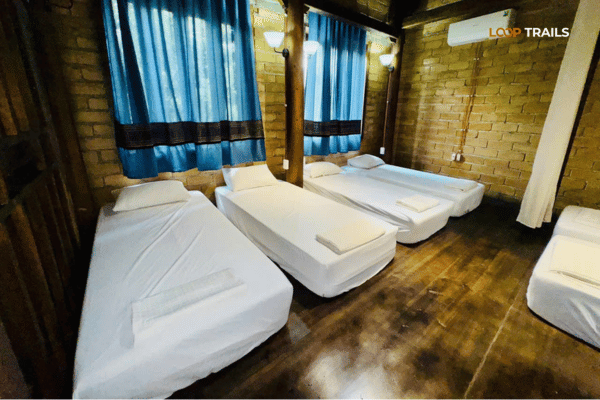
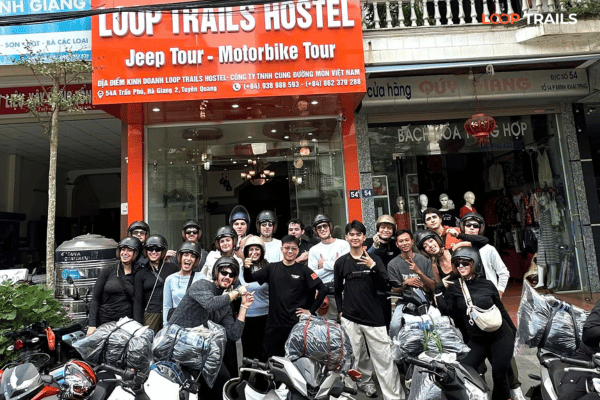
Loop homestays are ordinary family homes that have been adapted to host riders. You sleep in a dorm room (mattresses on the floor or wooden platforms, mosquito nets), eat dinner with everyone else at a shared table, and leave the next morning on the road again. The bathroom works. The food is very good. The conversation, such as it is across language barriers, is the best part of the day.
It’s not a hotel. It’s better.
Learn more: Ha Giang Loop 2 Days 1 Night
The homestays on the Loop are not boutique accommodations that have been given a folksy name. They’re houses where families live, with extra rooms built or cleared for riders. In the evenings, the family is there: someone is cooking, children are doing homework or watching a phone, an older family member is sitting somewhere nearby.
This matters because it changes how you behave as a guest, and it changes what you get out of staying there. You’re not checking into a service; you’re being welcomed into someone’s house. The difference is real and it affects the whole experience.
The exact homestays vary by operator and sometimes by night. On the standard 4 day Ha Giang Loop, the three homestay nights fall roughly at Yen Minh, Dong Van and Du Gia. These are working communities on the route, not tourist villages built for accommodation.
Different operators use different households. The quality of the homestay, its position in the village, the family running it, and how well looked after it is can vary considerably between operators. This is one of the things worth asking when you book: “Which homestays do you use?” and “Can you describe what the accommodation is like?”
Learn more: Ha Giang Loop 3 Days 2 Nights
You arrive in the late afternoon, after several hours of riding. The first thing that happens is usually a glass of water and somewhere to sit. After a full day on the passes, you want exactly that, nothing more complicated.
Leave your boots at the entrance or wherever the household does. Follow the family’s lead. You’ll figure out within about thirty seconds where the bathrooms are and where your room is.
The room is usually small and usually full of the day’s accumulated riding gear. Bags get dumped, wet layers come off, showers happen. This is the unglamorous twenty minutes that makes the glamorous dinner possible.
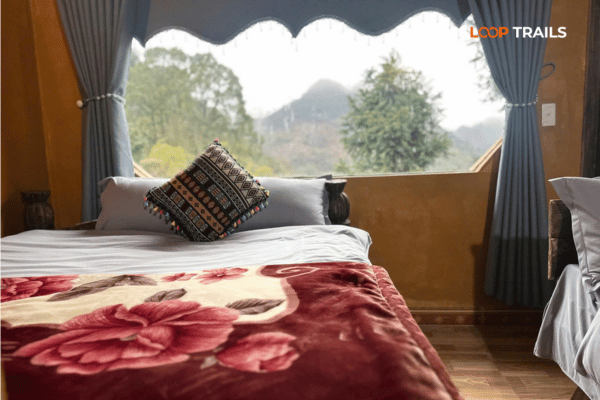
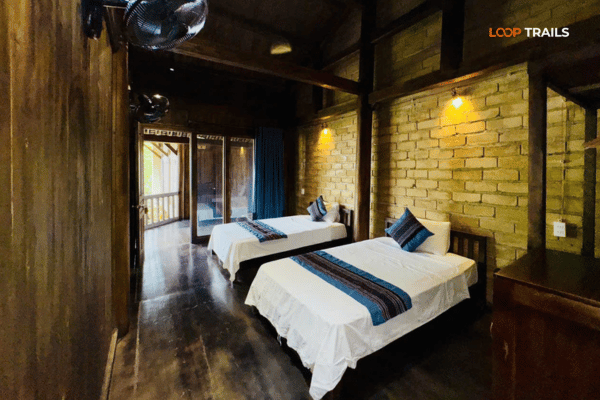
Homestay rooms on the Loop range from simple to comfortable. The floor is the floor: wooden boards or tile, sometimes with a raised wooden sleeping platform. The mattresses are firm, sometimes very firm. The mosquito nets drop from the ceiling and you tuck them under the mattress edges.
Walls may or may not be insulated. In October and November on the Dong Van plateau, the temperature drops significantly at night and the walls are thin. This is normal and it’s one of the reasons a fleece in your daypack matters.
The common area where dinner happens is usually larger: a long table, low benches or stools, a wood or gas cooking area behind or nearby, a television or music somewhere in the house.
The default accommodation on group tours is shared. Multiple guests in one room, mattresses arranged close together. On a small tour this might be four people. On a larger tour it could be more.
Private rooms exist at many homestays and can usually be arranged for an extra fee. They’re a small improvement in privacy and noise, but they’re not a fundamentally different experience. The shared dinner and the shared morning are the same either way.
Curious how homestay accommodation is priced? All our Ha Giang Loop tours include dorm accommodation in local homestays as the base. Private room upgrades are available at extra cost. For the full inclusions breakdown, message us on WhatsApp and ask.
Learn more: Ha Giang Loop 4 Days 3 Nights
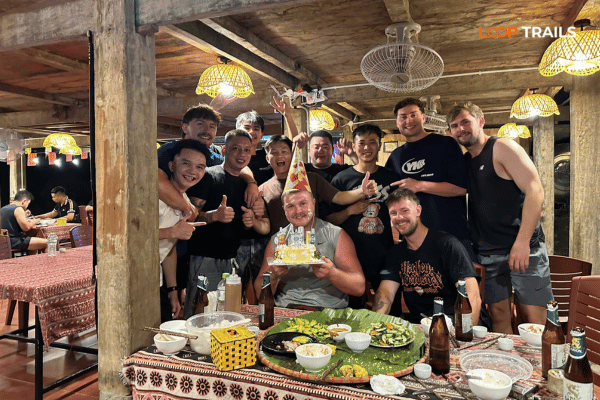
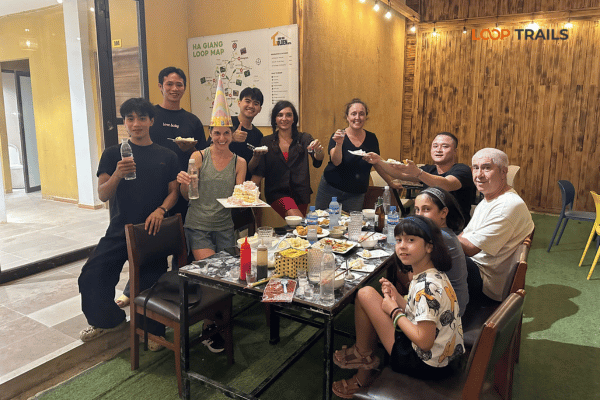
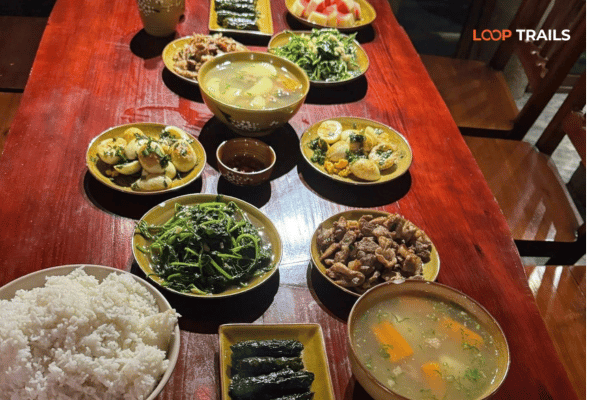
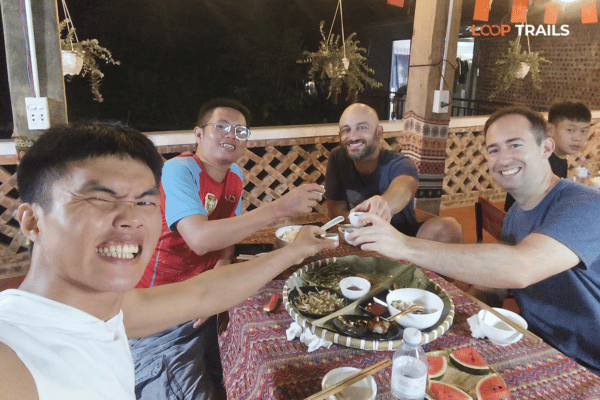
Dinner is the main event. It comes out all at once, family style: bowls and plates in the centre of the table that everyone reaches for and passes around. The food is almost always very good: stir fried vegetables with pork and herbs, a river fish braised with ginger, steamed rice, soup, pickles. Simple in the best sense.
The cooking is done by the household, often by one person who is running the whole operation. If the cook is your host’s grandmother, the food will almost certainly be exceptional.
Dinner generally happens at around 6 or 7pm. If you have dietary requirements, the household needs to know in the morning of that day at the latest, since they shop for the evening meal during the day. Vegetarians can eat very well at Loop homestays; vegans have a slightly narrower time but a good guide will communicate in advance.
Happy water is the Loop’s phrase for the rice wine or corn wine that appears at dinner in most homestays. It’s strong, it’s warming, it’s poured generously, and it’s the social lubricant for an evening at a table of people from five different countries who don’t share a language.
The typical format is a small cup, a toast, and a game. The game varies from household to household and group to group, but it involves counting in Vietnamese, a hand gesture, and someone drinking when they lose. The specifics are less important than the effect, which is that people who arrived as strangers are laughing together within about fifteen minutes.
You do not have to drink. A polite “no thank you” is respected. If you have a reason not to drink (medical, personal, riding early the next day), say so early and the household will leave your cup alone. Nobody is pressured.
After the food and the initial happy water rounds, the evening at a good homestay develops into something less structured. Someone has a guitar. Someone from the household knows a song. The guide translates something badly and it’s funnier for being badly translated.
This is not a performance or a scheduled cultural event. It’s what happens when people eat together and have a little wine and nothing pressing to do. Some evenings are quieter; some become full group singalongs. You can’t predict it, which is part of why it’s good.
The Loop is early to bed by default, because the rides are long and the morning starts early. Most evenings wind down naturally by nine or ten. If you’re up for longer, the household will usually accommodate it, but the consensus in most groups is to sleep, especially after the first hard day.
A word on the bathroom situation after dark: bring a small torch or make sure your phone has battery. Not all homestay bathrooms are brightly lit at night.
Learn more: Ha Giang Cao Bang 5 Days 4 Nights
Mountain households start early. Roosters exist. By 6am the kitchen is active, someone is moving around, and the smells of breakfast have started.
This is a feature rather than a bug. The best hour of the day on the Loop is often the first one: mist in the valley, nobody on the road yet, the light coming up over the karst. You need to be awake and riding to see it.
Departure on most Loop days is around 8am, sometimes earlier. The schedule depends on the distance that day.
Breakfast at a Loop homestay is simpler than dinner: sticky rice or noodle soup, eggs, bread and jam, fruit, instant coffee or a local coffee that varies in quality. It’s enough to get you to the lunch stop.
Breakfast is also the meal where conversations happen with less noise and more directness than the night before. Your guide asks how you slept. You find out what’s on the road today. Someone asks about the pass coming up.
The last homestay night on the 4 day Loop, at Du Gia, is worth singling out because the morning there is special. Du Gia sits in a valley with rice terraces on the surrounding hills. Breakfast with that view in the morning light, whether it’s harvest gold or summer green depending on the season, is genuinely one of the best moments of the Loop.
After breakfast, on the 4 day tour, there’s usually time for a swim in the Du Gia waterfall before the return road begins. This is the morning where nobody is in a hurry to leave
Learn more: Ha Giang Loop Mistake to Avoid
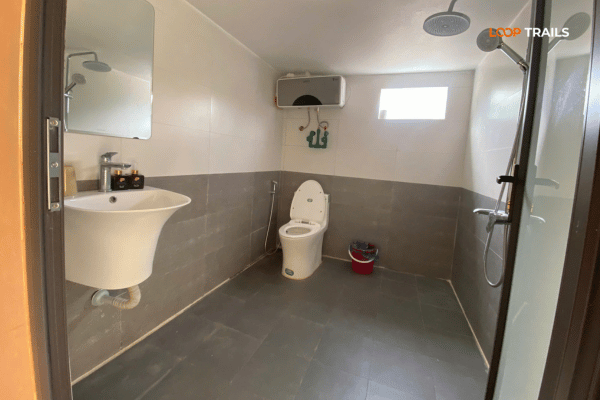
Each homestay has a bathroom. The range is: a tiled room with a flush toilet and a hot shower, through to a cold water bucket shower and a squat toilet. The most common configuration in 2025 and 2026 is somewhere in the middle: a proper bathroom with a warm shower that runs off a small on demand heater, and a western style toilet.
Cold water showers in October or November on the Dong Van plateau are unpleasant. Most people adjust by being quick about it, or by washing in the morning rather than at night when the cold is more tolerable.
Ask your guide before you book which homestays they use and what the bathroom situation is like. It’s a fair question and a good operator will answer it.
Power is available. Most homestays have at least one or two power points in the main room and sometimes in the sleeping room. Charging space is often competitive on a large group tour: charge your devices early in the evening rather than waiting until midnight.
A small travel power strip is one of the most practical things you can bring on the Loop.
WiFi is available at many homestays along the route, though reliability varies. The most consistent connectivity on the Loop comes from a Vietnamese SIM on the Viettel network, which has the strongest mountain coverage. Even with that, expect stretches of no signal in the high areas.
Download anything you need (offline maps, saved content) before you leave Ha Giang city. Don’t count on streaming at the homestay.
Loop homestays are not quiet in the hotel sense. Other guests, household activity, the road outside, animals and the general sounds of a working village are all present. If you sleep lightly, bring earplugs.
Learn more: Ha Giang Homestay Guide
The practical differences:
| Dorm bed | Private room | |
|---|---|---|
| Privacy | Shared with other guests | Your own room |
| Noise | Dependent on roommates | Quieter from other guests |
| Cost | Included in tour price | Extra fee per night |
| Availability | Always available | Limited, book early or ask on arrival |
| Experience difference | Minimal for most guests | Noticeable if you prefer solitude |
Most travelers on the Loop sleep fine in the dorm. The evenings are social by nature, the rides are physically tiring, and by the time you’re in the sleeping room most people are out within minutes. If you’re a very light sleeper or traveling as a couple who values privacy, a private room is worth the upgrade.
Confirm private room availability with your operator in advance, especially in peak season when the good rooms fill first.
Learn more: Ha Giang Packing list
Keep the overnight bag light. Your main bag is in storage at the hostel in Ha Giang City. For three or four homestay nights, you need:
The total should fit in a 25 to 30 litre daypack, which is what rides with you while the big bag waits.
Learn more: Ha Giang Loop Photography Guide
The household has agreed to host you, but that doesn’t mean every part of their home is a photo opportunity. The common areas and food are usually fine to photograph. Altars, ancestral shrines, private rooms and the household’s own personal effects are not.
Ask before pointing a camera at household members. A smile and a questioning gesture is understood without language. Accept a no.
Dietary requirements need to be communicated at booking and again at the morning meal of that day. The household shops for the evening during the day; last minute requests aren’t always possible.
Vegetarians and people avoiding pork can almost always be accommodated if the guide communicates it early. Seafood allergies in mountain homestays are rarely relevant. Gluten and nut allergies are more complex in shared kitchen situations and worth discussing directly with your operator before booking.
Learn more: Ha Giang Food guide
The first homestay night on the 3 and 4 day Loop is usually in or near Yen Minh, the town before the karst plateau begins properly. The homestay here tends to be more accessible and sometimes slightly more tourist adjusted than the later stops, since it’s the first point where riders have arrived from Ha Giang in one day and the area sees a lot of traffic.
The evening here is the first introduction to the Loop homestay rhythm: the communal dinner, the happy water, the early morning departure. Many people are tired from the first day’s riding and ready to sleep.
Dong Van sits in the heart of the Dong Van Karst Plateau Geopark, at altitude, with a 19th century old town of stone houses and a character that’s different from anywhere else on the route. The homestays here are often in or near the old town, and the evening at Dong Van is the one most associated with the Loop’s social reputation: a sunset, dinner, happy water, the party dynamic that comes from the most scenic stop of the trip.
Cold nights here in October through February are real. Layers in the sleeping room are not optional; they’re necessary.
Du Gia is the quietest of the three. A small farming village in a valley, famous among Loop riders for the waterfall, the rice fields and the morning mist. The homestay at Du Gia is often the most traditionally domestic: a family home that happens to have a guest room, cooking that happens in the family kitchen, a morning view from the breakfast table that most hotel views would embarrass themselves trying to match.
If you’re on a 2 day Loop, you miss Du Gia. This is the main reason we’d push you toward the 3 or 4 day option if you have the time.
The 5 and 6 day routes add homestay nights on the Cao Bang side, typically around the Bao Lac or Ha Quang areas and near Ban Gioc before the last day. These have a different character from the Ha Giang stops: the families are predominantly Tay rather than H’Mong, the food is different, and the pace of the evening tends to be slightly calmer.
Learn more: Corn wine “Happy Water” in Ha Giang
There’s a version of this trip where you see every pass and viewpoint but stay in guesthouses in towns. Some operators offer it. You’d have better wifi, more consistent bathrooms and probably quieter nights.
What you’d miss is the thing that most people who’ve done the Loop say they didn’t expect: the sense of being somewhere rather than passing through it.
Staying in someone’s home in a village on the Dong Van plateau, eating food they cooked that morning, watching their children do homework while your guide translates a joke, and waking up to their rooster at 5am, these are not inconveniences of the trip. They’re the whole point of the trip.
The Loop passes are world class. The landscape is extraordinary. But plenty of places have extraordinary landscapes. The homestay evenings are specific to this.
Want to know more about which homestays our tours use? Message us on WhatsApp and we’ll describe the typical accommodation on each night for your tour length. Or go straight to our 4 day Ha Giang Loop, which includes three homestay nights across Yen Minh, Dong Van and Du Gia.
Learn more: Ha Giang Loop Easy Rider
On an Easy Rider tour, your driver accompanies you to the homestay and usually stays nearby or in the household. They’re your connection to the family, your translator at dinner and the person who knows whether tonight’s happy water is the strong version or the mild version. The Easy Rider experience at the homestay is more embedded than any other option.
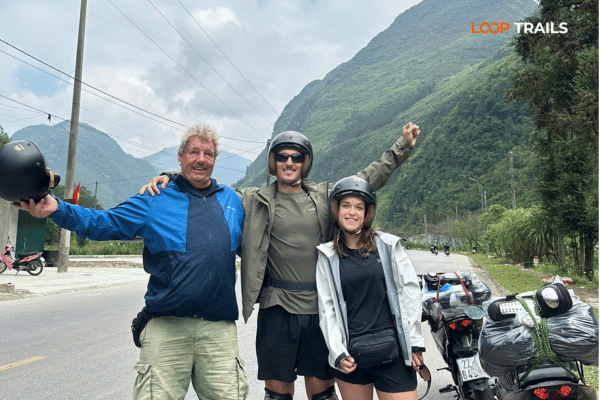
You arrive at the homestay having ridden yourself all day. The shared dinner and the evening are the same; the guide is there. Some self drive riders find the evening more social than the riding, since the conversation at the table is when the group actually connects.
Self drive requires a home motorcycle licence and an International Driving Permit under the 1968 convention. IDPs issued under the 1949 convention are not valid in Vietnam. Riding without the correct documents can mean fines, reported in the range of 2,000,000 to 6,000,000 VND. Some ASEAN licences are recognised here under a regional agreement. Check your own situation before you travel.
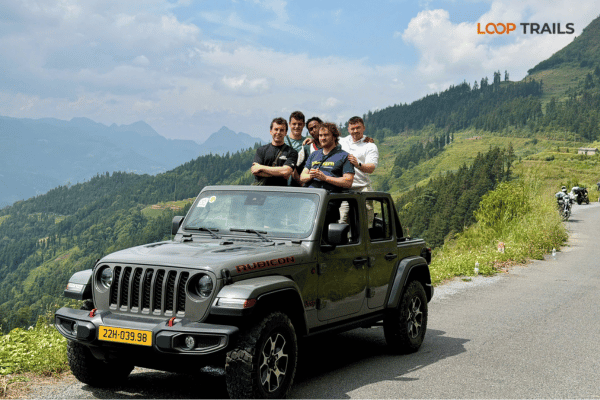
The jeep guests arrive at the homestay in the same condition as everyone else: dusty, tired and glad to be somewhere. The shared dinner table includes the jeep group and any motorbike groups staying that night, and the evening is the same experience.
For families with children, the jeep homestay night has one additional dimension: children in the household and children in your group often find each other immediately, and the language barrier disappears completely.
Learn more: Ha Giang Loop by Wrangler Rubicon Jeep
Jeep prices are the total for your group in one vehicle. Motorbike prices are per person. All tours include dorm accommodation and the homestay evenings described above. Private room upgrades and bus tickets to and from Ha Giang are extra.
| Tour | Jeep, 1 guest | Jeep, 2 guests | Jeep, 3 guests | Jeep, 4 guests | Easy Rider (per person) | Self Drive (per person) |
|---|---|---|---|---|---|---|
| Ha Giang Loop 2D1N | 12,990,000 VND | 15,990,000 VND | 19,990,000 VND | 22,990,000 VND | 3,490,000 VND | not available |
| Ha Giang Loop 3D2N | 15,990,000 VND | 19,990,000 VND | 23,990,000 VND | 25,990,000 VND | 4,490,000 VND | 3,790,000 VND |
| Ha Giang Loop 4D3N | 19,990,000 VND | 25,990,000 VND | 30,990,000 VND | 34,990,000 VND | 5,890,000 VND | 4,990,000 VND |
| Ha Giang and Cao Bang 5D4N | 27,990,000 VND | 36,990,000 VND | 41,990,000 VND | 46,990,000 VND | 10,990,000 VND | 10,590,000 VND |
| Ha Giang and Cao Bang 6D5N | 36,990,000 VND | 44,990,000 VND | 49,990,000 VND | 54,990,000 VND | 13,990,000 VND | 13,490,000 VND |
| Cao Bang Loop 3D2N | 14,990,000 VND | 19,990,000 VND | 24,990,000 VND | 31,990,000 VND | 6,490,000 VND | 5,990,000 VND |
Prices are in Vietnamese dong. Jeep tours use a Jeep Wrangler Rubicon, except the Cao Bang Loop, which runs in an army style jeep.
Learn more: Ha Giang Motorbike Rental
Loop homestays are not for everyone. If you need a good wifi connection, a guaranteed hot shower, silence at 9pm and a western style hotel breakfast, a Loop tour is going to involve some adjustment.
If you can meet the experience on its own terms, a family home in a mountain village, food cooked by the household, an evening that goes wherever it goes, you’ll finish the Loop and wonder why you’ve ever stayed anywhere else.
The passes are the reason you come. The homestay nights are the reason you come back.
They’re ordinary family homes adapted to host riders, with dorm style accommodation, shared bathrooms and communal dinners. They’re not guesthouses or boutique hotels. The experience is domestic and social rather than service oriented.
Most do, usually via a small on demand water heater. Quality varies. Cold showers at altitude in October through February are a real possibility at some stops. Ask your operator which homestays they use and what the bathroom situation is.
The default on group tours is a shared dorm room with other guests. Private rooms are available at most homestays for an extra fee. Confirm availability in advance, especially in peak season.
The name Loop riders use for the rice wine or corn wine that appears at almost every homestay dinner. It’s strong, served in small cups, and usually comes with a group drinking game. You don’t have to drink it; a polite no is always accepted.
Family style Vietnamese highland food: several shared dishes with rice, typically including vegetables, meat (pork, chicken or river fish), soup and pickles. The food is almost universally good and often very good.
Yes, with advance notice. Tell your operator at booking and remind your guide that morning. The household can prepare vegetarian dishes if they know in time.
Flip flops or sandals for the homestay, a change of clothes for each evening, a headtorch for night bathroom trips, earplugs, a light evening layer and a charger plus a small travel power strip.
Usually by 9 or 10pm, since the Loop runs on early mornings and long riding days. Some evenings go longer if the energy is there, but the natural rhythm of the route encourages early nights.
Early. Breakfast is usually between 7 and 8am and departure is typically around 8am. Mountain households start earlier than that, so light sleepers will be aware of activity before their alarm.
At many, but not reliably. A Viettel SIM gives the best mountain coverage. Download offline maps and anything you need before leaving Ha Giang city.
Usually not, or very little. Your guide translates at dinner and handles communication with the household. This is one of the reasons having a good guide matters so much on the Loop.
The 2 day Loop includes one homestay night, which gives you the dinner and morning experience once. The 3 and 4 day options include two and three nights respectively, which is when the rhythm of the homestay routine really settles in.
Contact information for Loop Trails
Website: Loop Trails Official Website
Email: looptrailshostel@gmail.com
Hotline & WhatSapp:
+84862379288
+84938988593
Social Media:
Facebook: Loop Trails Tours Ha Giang
Instagram: Loop Trails Tours Ha Giang
TikTok: Loop Trails
Office Address: 54A Tran Phu, Ha Giang 2, Tuyen Quang
Address: 54A Tran Phu, Ha Giang 2, Tuyen Quang
Facebook X Reddit Table of Contents Learn more: Ha Giang Loop Tours The Ha Giang Loop has a reputation problem with older

Facebook X Reddit Table of Contents Before you book, you want to know what you’re actually paying for. That’s a reasonable thing