
Ha Giang in November: Buckwheat, Cool Air, Fewer Crowds
Facebook X Reddit Table of Contents Learn more: Ha Giang Loop Tours If you could pick one month to see the Ha

Thúy Kiều (Grace) is a travel blogger and content contributor for Loop Trails Tours Ha Giang. She holds a bachelor’s degree in Sustainable Tourism from Vietnam National University, Hanoi, and has a strong passion for exploring and promoting responsible travel experiences in Vietnam’s northern highlands.
Learn more: Ha Giang Loop Tours
The first time you roll into a Hmong village on the Ha Giang Loop, you might not know what to do. Someone’s grandmother is drying corn on a wooden rack by the road. Children are sprinting toward the jeep. A woman sits in her doorway working the embroidery she started before sunrise. It is beautiful. It is also someone’s home.
Visiting ethnic villages in Ha Giang is one of the most memorable and genuinely moving parts of the loop. It is also the part where many travelers, through no bad intention, get it wrong. Not dramatically wrong. Just slightly careless in ways that add up over thousands of visitor days, slowly shifting how communities feel about tourists and how tourists feel about themselves.
This guide is not here to lecture you. It is here to give you real context and practical tools so that when you arrive at Lao Xa, Lo Lo Chai, Lung Tam, or Du Gia, you show up well, make a genuine connection, and leave the kind of impression that makes the next traveler welcome.
Learn more: Ha Giang Loop 2 Days 1 Night
Ha Giang is not a theme park. The plateau was not developed for tourism. The ethnic minority communities living here have been farming these valleys and passes for centuries, long before the first backpacker showed up with a camera phone.
Tourism on the loop grew fast. After the route opened to international visitors, it went from a trickle of adventurous travelers to a serious volume of visitors in just a few years. That growth brought real economic benefits: local homestays now provide steady income for families who previously relied entirely on subsistence farming. Local guides earn good wages. Artisan cooperatives have new markets for their textiles and crafts.
But rapid growth also brought friction. Some villages near Dong Van started to feel like outdoor exhibitions. Residents reported strangers walking into their homes without asking. Children were photographed constantly. Families started to feel watched rather than met.
None of that happened because tourists are bad people. It happened because most visitors simply did not know the norms.
When done thoughtfully, tourism is genuinely good for Ha Giang’s communities. A family run homestay earning income from your visit has a reason to maintain their traditional architecture, serve local food, and share their culture. When tourism treats communities as scenery rather than people, the incentive shifts: communities start adapting for visitors rather than preserving what is actually theirs.
The choices you make on the loop matter. Here is how to make the right ones.
Learn more: Ha Giang Loop 3 Days 2 Nights
Ha Giang has one of the highest concentrations of ethnic minority groups in Vietnam. Before you arrive, it helps to know something about who lives where and what that means for how you engage.
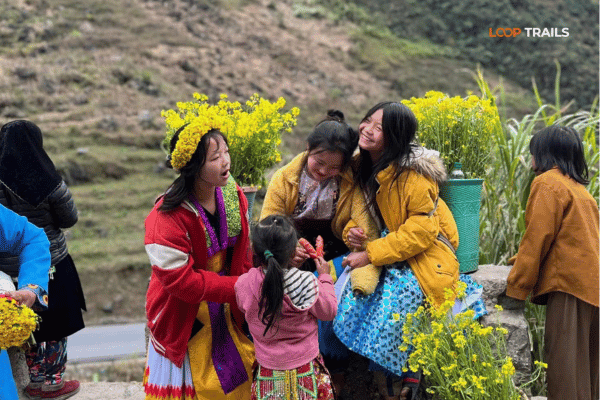
The H’Mong are the largest ethnic minority group on the plateau. They make up most of the population around Dong Van, Meo Vac, and the high passes. Within the H’Mong there are several distinct groups: Black Hmong, Flower Hmong, White Hmong, and others, each with different clothing traditions, dialects, and customs.
Traditional H’Mong women wear indigo dyed fabric decorated with hand embroidered detail. The embroidery work is extraordinary and time consuming. A single collar can take weeks of evenings.
H’Mong spiritual life is built around ancestor worship and animism. The household altar is the most sacred space in the home. Village rituals, particularly around Tet and harvest season, involve ceremonies that are genuinely private.
Villages on the loop where you are likely to meet H’Mong communities include Lao Xa (a compact village close to the Chinese border), Sung La (in the Dong Van valley), and many smaller hamlets along the route.
The Lo Lo are a smaller community concentrated around Lung Cu and the village of Lo Lo Chai, which sits just below the flag tower at the northern tip of Vietnam. They are considered among the original inhabitants of the Dong Van Karst Plateau and have a cultural tradition distinct from the H’Mong.
Lo Lo homes are typically built from earth and stone, with thick walls and a low profile against the wind. Their clothing features distinctive geometric patchwork in bright reds, blacks, and whites. Lo Lo ritual life involves elaborate ancestor ceremonies, and the community maintains strong oral traditions.
If you visit Lo Lo Chai specifically, the community is accustomed to respectful visitors. They are not, however, accustomed to being treated as a living museum.
The loop also passes through areas inhabited by the Dao (or Yao), who are known for their red headpieces and medicinal herb knowledge; the Giay, who live mostly in the lower valleys around Dong Van; and the Tay and Nung, who are common in the Du Gia area and along the river valleys heading back toward Ha Giang city.
Each group has distinct architecture, clothing, language, and customs. Do not assume the etiquette that applies in one village automatically applies in another. When in doubt, follow your guide’s cues.
Learn more: Ha Giang Loop 4 Days 3 Nights
The best thing you can do before visiting any village on the loop is adjust your expectations.
You are not attending a cultural performance. Village life is not organized around your arrival. If you show up at a family’s home during planting season, they are busy. If you arrive during a ceremony, you may not be welcome inside.
A few practical points before you go:
Some villages close to the Chinese border fall within a designated border zone. Foreigners visiting these areas need a border zone permit, which your tour operator should arrange in advance. Loop Trails handles this automatically for guests on guided tours.
Bring small but genuine gestures rather than cash handouts. Buying a cup of corn tea from a family stall, purchasing a small piece of embroidery from a roadside vendor, or simply greeting people warmly before pointing a camera at them all go a long way.
Learn a few words of Vietnamese. Even basic greetings like “xin chào” (hello) or “cảm ơn” (thank you) are appreciated everywhere on the loop. If you’re visiting a specific ethnic community, ask your guide how to say hello in the local language. The reaction is almost always genuine delight.
Lower the pressure on yourself to have a perfect cultural experience. Some visits will feel awkward. Some families will not want to interact. That is completely normal and entirely their right.
Learn more: Ha Giang Cao Bang 5 Days 4 Nights
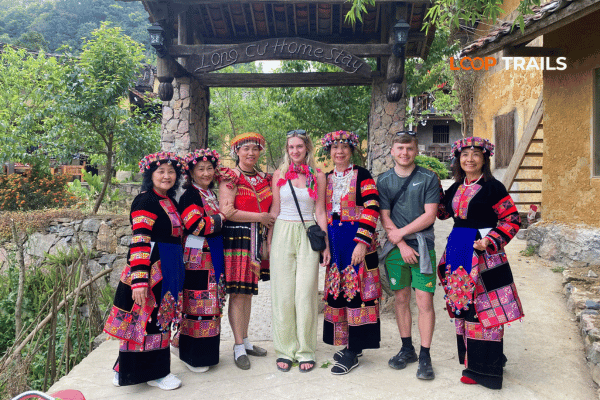
Dress practically and modestly. This is not a complicated rule, but it makes a real difference.
Cover your shoulders and knees when entering homes or attending any kind of community gathering. Light, long clothing works better anyway in Ha Giang’s climate: the passes are cool, the sun is strong at altitude, and the evenings drop fast.
Avoid anything too revealing: strapless tops, very short shorts, or see through fabrics are not appropriate in most village settings. This applies to both men and women.
Bright colors are generally fine and sometimes appreciated. The ethnic groups of the plateau love color. Wearing something vibrant is not offensive; wearing something that mimics traditional ethnic dress as a costume is.
A light scarf or sarong is a practical item to pack. It works as a layer in the highlands and as an instant modesty cover when you need it.
If you are visiting a specific religious or ceremonial space, your guide will tell you if there are additional requirements. Follow them without asking for a full explanation.
Learn more: Ha Giang Loop Photography Guide
Photography is where most tourist and community tensions on the loop originate. The rules are not complicated. The challenge is following them when everyone around you has a camera out.
Always ask permission before photographing a person. The mime gesture works across language barriers: point at your camera, then at the person, then raise your eyebrows in a questioning expression and wait for a response.
A nod or a smile means yes. A wave away, turning the face, or walking off means no. Accept the answer immediately and move on. Do not try to get a quick shot as someone turns away.
After taking a photo, offer to show it to the person on your screen. This is almost always a moment of genuine warmth. People are curious. It creates a small connection.
If you are traveling with a guide, ask them to request permission in the local language. This makes an enormous difference. A stranger pointing a camera at someone is an imposition. A local person asking politely on your behalf is a conversation.
Delete photos if someone asks you to, even after the fact. It costs you nothing and means something.
Do not photograph household altars or spirit houses. These are sacred spaces. Even if you are standing in someone’s home and the altar is clearly visible, do not point a camera at it without being explicitly invited to do so.
Do not photograph funerals, mourning ceremonies, or any gathering that is visibly solemn. If you encounter one on the road, slow down, be quiet, and pass with respect.
Do not photograph military installations, border markers, or soldiers. This applies particularly in the areas near the Chinese border around Lung Cu and Meo Vac.
Do not photograph people in obviously private moments: bathing, nursing, eating in what is clearly a private family setting.
Be careful about photographing children extensively, especially for social media. Even if a child is happy to perform for your camera, their parents may not be comfortable with their image being shared with an unknown audience. Think before posting.

Learn more: Ha Giang Border Area Permit 2026
If you are invited into a home, accept. A genuine invitation from a local family on the Ha Giang Loop is not something that happens to every traveler.
Take off your shoes before entering, even if no one reminds you. If you see shoes by the door, remove yours.
In H’Mong homes, the altar at the far end of the main room is a sacred space. Do not approach it, touch anything near it, or point a camera at it. Sit where you are shown or where it is clearly appropriate to sit.
Do not sit in a seat that belongs to the head of the household unless you are specifically invited. When in doubt, let your host lead.
Keep your voice at a respectful level. Loud conversations in a quiet household feel intrusive.
Do not open doors to storage areas, side rooms, or sleeping areas. If a door is closed, treat it as closed.
Do not touch ritual objects: drums, gongs, ancestor tablets, any items on or near the altar. Curiosity is understandable. Keep your hands to yourself.
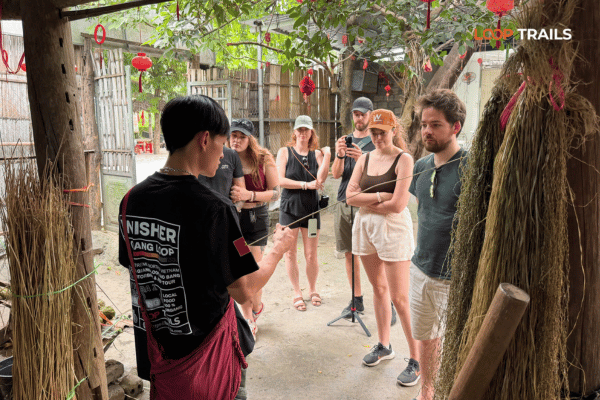
If you are on a Loop Trails tour, your local guide will manage the entry and will let you know what is appropriate in each specific household. Follow their lead.

Learn more: Lo Lo Chai Village
This section matters more than many travelers expect.
Do not give candy, pens, money, or small gifts directly to children who approach you on the street or on the road. This habit, common among well meaning tourists, creates a dynamic that is bad for the children and bad for the community over time. Children learn that approaching tourists pays off, which pulls them away from school, chores, and normal social development. Families start expecting handouts from every group that passes.
If you want to give something: buy from a family shop, eat at a local homestay, pay fairly for handicrafts. The money reaches the household without creating dependency.
Engage genuinely with children who approach you. Play, laugh, make faces, teach them a word in your language. This is completely fine and often wonderful. Just do not follow it up with a handful of sweets.
Be thoughtful about photographing children. A child saying yes to a photo does not mean their parents are comfortable with that image being shared widely. Use your judgment.
Avoid any tour that is specifically marketed on the basis of “meeting local children” or that involves visits to schools where the students are clearly performing for tourists. This dynamic is uncomfortable and not what the loop is about.
Learn more: Lung Tam Linen Village
Ha Giang’s ethnic minority communities produce some of the most beautiful textiles in northern Vietnam. If you want to support what you are visiting, buy directly from the people making things.
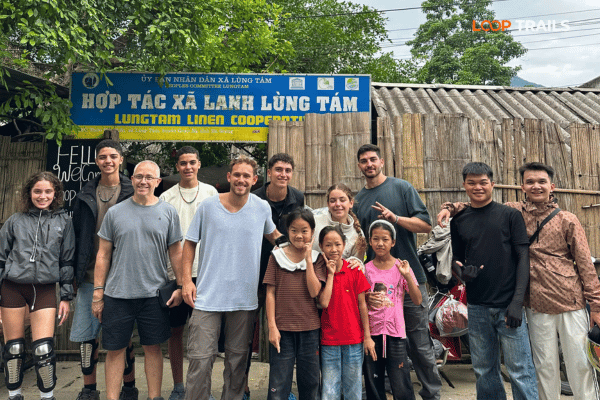
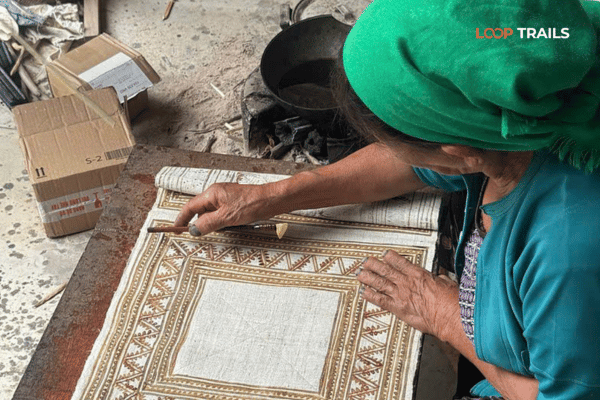
The Lung Tam linen village, which Loop Trails visits on the final day of the four day loop, is a good example. Women here grow flax, process the fiber by hand, and weave it into fabric using traditional wooden looms. When you buy a piece of fabric or a finished item directly from a weaver, the full price goes to the household.
H’Mong embroidery is worth buying if you find genuine handwork. Turn the piece over: machine made embroidery has uniform stitches on the back, while hand embroidery has irregular loops and thread ends. The hand stitched version took far longer to make and costs more. Pay it.
Bargaining is part of market culture in Ha Giang, but keep a sense of proportion. A piece of work that took two weeks of evenings to complete should not be negotiated down to a figure that embarrasses the maker. If the price feels fair and the work is beautiful, pay it without negotiating.
Sunday markets in Dong Van and Saturday markets in Meo Vac are genuine community gatherings, not tourist markets. They happen whether or not you show up. Buying there is a good experience.
Watch out for factory produced items sold with an “ethnic” appearance in tourist facing shops. If the stitching is uniform and the item is identical to ten others on the same shelf, it was not made in a village.
Learn more: Ha Giang Food guide
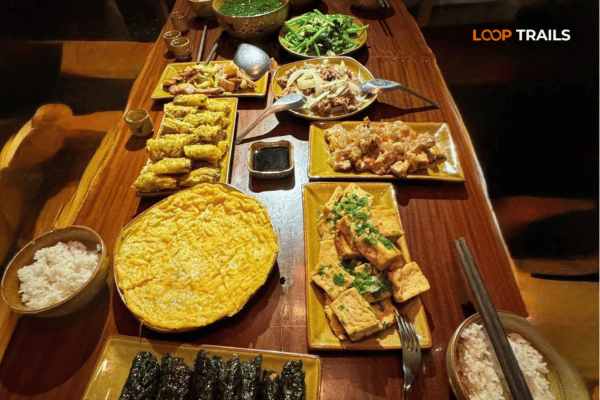
If a family invites you to eat with them, say yes. This rarely happens by accident. It means you have been welcomed.
Common foods you will encounter in H’Mong homes and homestays include thắng cố (a stew traditionally made with horse or pork organs), smoked buffalo or pork, corn rice, and pickled vegetables. Everything is local. Everything is seasonal.
Take a small portion first and try everything. You can take more. It is better to go back for seconds than to pile food on your plate and not finish it.
Corn wine, known on most Loop Trails tours as “happy water,” is offered generously at most homestays. It is genuinely strong. One cup is enough to participate. If you want to slow down or stop, hold your cup with both hands and say “đủ rồi” (enough) with a smile. No one will be offended.
Do not make a production of photographing every dish before you eat. A quick photo is fine. Five minutes of food photography while your hosts wait is rude.
If you have dietary restrictions, mention them in advance to your tour operator. Local families cook what they have. Giving notice allows them to prepare something appropriate without waste.
Learn more: Cao Bang Travel
A good local guide is not just a translator. On the Ha Giang Loop, a guide who has real relationships with the communities along the route is the single most important factor in whether your village visits feel genuine or awkward.
Loop Trails works with local guides, many of whom grew up in or near the communities you will visit. They know when a family is in mourning. They know which ceremonies are private this week. They know the village elder’s name and the right way to greet them. That knowledge is not something you can replicate from a guidebook.
When your guide says “wait here,” wait. When they say “do not enter this room,” do not enter it. When they handle a conversation with a family before you approach, let them finish before you start taking photos.
Trust their judgment over your own curiosity. The guide’s job is to make sure you have an extraordinary experience and that the community is treated well in the process. These things are not in conflict.
If you are planning to ride self drive on the loop without a guide, you gain flexibility and independence. You also lose this layer of cultural navigation. For travelers who are particularly interested in community visits and cultural depth, a guided tour with a local guide makes a real difference.
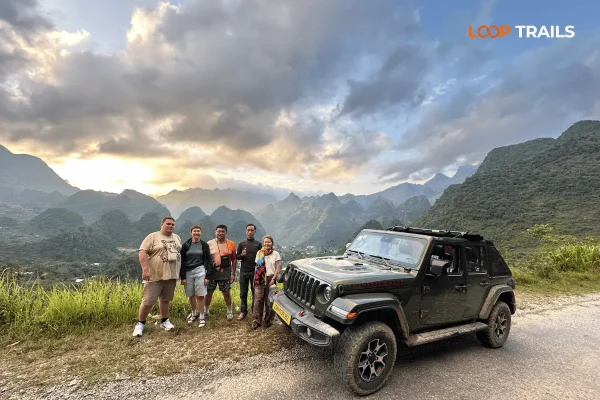
Loop Trails offers easy rider tours where your guide rides alongside you and handles all cultural introductions along the route. The jeep tours include a guide as standard. If cultural engagement matters to you, see the Ha Giang Loop tour options on our tours page and get in touch to talk through what fits.
Lean more: Ha Giang in October
Responsible tourism on the Ha Giang Loop is not a checklist. It is a habit of thinking about impact before convenience.
It means choosing to stay at a family run homestay over a tourist focused guesthouse, because the money reaches the family directly. It means eating meals cooked by local people rather than stopping only at restaurants built for the loop crowd.
It means buying a piece of embroidery for a fair price rather than bargaining it down to something that feels like a trophy. It means photographing with permission, interacting with children thoughtfully, and entering homes as a guest rather than as an audience member.
It also means saying something when you see other travelers getting it wrong. If a group is pushing into a home uninvited or photographing someone who has clearly said no, it is okay to say something quietly. You do not need to make a scene. A simple word is usually enough.
Ha Giang Loop tourism is still young compared to the more saturated circuits in Vietnam. The norms that form now will shape what this region looks and feels like in ten years. That is a genuine opportunity.
Loop Trails was built on the idea that great adventure travel and genuine community respect are not opposites. We work with local guides, local homestays, and local artisan communities because that is what makes the loop worth doing. If you want to experience Ha Giang’s ethnic villages in a way that is both deeply memorable and genuinely good for the people you meet, we would love to have you on a tour.
Send us a message on WhatsApp and we will help you find the right option: easy rider, self drive, or jeep, whatever fits your style and your group.
Learn more: Ha Giang Loop by Wrangler Rubicon Jeep
Yes. Many villages along the loop are accessible to independent travelers, and some are accustomed to self drive visitors stopping in. That said, without a local guide you lose the cultural context and introductions that make village visits genuinely meaningful. If you do go independently, follow the etiquette in this guide closely and read up on the specific community you are visiting before you arrive
Yes, in certain areas. Villages in the official border zone, particularly around Lung Cu and parts of the Dong Van area, require a border zone permit for foreign visitors. The cost for foreigners is 260,000 VND per person. If you are on a Loop Trails tour, your guide handles all of this in advance. If you are traveling independently, check with your accommodation in Ha Giang before heading north
Cover your shoulders and knees. Light, breathable long clothing is comfortable anyway on the plateau, where the wind is strong and the sun is intense at altitude. Avoid very revealing clothing. A light scarf or layer is useful when entering homes
Yes, with their permission. Always ask before shooting. Mime the question: point at your camera, then at the person, raise your eyebrows and wait. This works across language barriers. If someone says no or turns away, accept that immediately. After taking a photo, offer to show it to the person. Never photograph altars, ceremonies, or private moments without explicit invitation
No, not directly. Giving cash, candy, or small gifts to children on the road creates dependency dynamics that are bad for communities over time. If you want to support the people you meet, buy from family shops, pay fairly for meals and accommodation, and purchase handicrafts directly from artisans
Each ethnic group has its own language. H’Mong, Lo Lo, Dao, Giay, and Tay are all distinct languages, mutually unintelligible with Vietnamese. Vietnamese is used as a common language between communities and with outsiders, but older residents in remote villages may have limited Vietnamese. A local guide who speaks the community language is genuinely valuable here
Generally yes, though comfort varies. Expect clean, simple sleeping arrangements, shared bathrooms, and home cooked meals. Loop Trails uses vetted homestays that offer a genuine family experience without compromising basic comfort standards. If you have specific accessibility needs or health requirements, mention them when booking so we can find the best fit
Turn textiles over and look at the back. Genuine hand embroidery has irregular stitches and thread ends on the reverse. Machine embroidery looks uniform. For woven pieces, ask where and by whom the item was made. Buying directly at a linen village, an artisan cooperative, or a family market stall is the most reliable way to get the real thing
Vietnamese “xin chào” is widely understood and always appreciated. Ask your guide for the H’Mong or Lo Lo equivalent and try it at your first stop. The reaction is usually laughter and genuine warmth. Even a simple gesture of respect in someone’s own language signals that you are there as a guest, not just passing through
Apologize simply and genuinely. Most communities on the Ha Giang Loop are accustomed to visitors who are well meaning but uninformed. A sincere apology and a correction of behavior is enough in almost every situation. You do not need to overthink it. The key is to be responsive to feedback rather than defensive.
Contact information for Loop Trails
Website: Loop Trails Official Website
Email: looptrailshostel@gmail.com
Hotline & WhatSapp:
+84862379288
+84938988593
Social Media:
Facebook: Loop Trails Tours Ha Giang
Instagram: Loop Trails Tours Ha Giang
TikTok: Loop Trails
Office Address: 54A Tran Phu, Ha Giang 2, Tuyen Quang
Address: 54A Tran Phu, Ha Giang 2, Tuyen Quang
Facebook X Reddit Table of Contents Learn more: Ha Giang Loop Tours If you could pick one month to see the Ha
Facebook X Reddit Table of Contents Ha Giang in August does not look like the photos most people have in their heads.
Facebook X Reddit Table of Contents Most of the Ha Giang Loop is about the landscape: passes, canyons, karst peaks that go