
IDP 1968 vs 1949: Which Licence Works in Vietnam?
Facebook X Reddit Table of Contents Learn more: Ha Giang Loop Tours A lot of people arrive in Vietnam knowing they need

Thúy Kiều (Grace) is a travel blogger and content contributor for Loop Trails Tours Ha Giang. She holds a bachelor’s degree in Sustainable Tourism from Vietnam National University, Hanoi, and has a strong passion for exploring and promoting responsible travel experiences in Vietnam’s northern highlands.

Learn more: Ha Giang Loop Tours
There’s a moment somewhere on the road between Yen Minh and Dong Van when you pull over, cut the engine, and just look. Limestone peaks stacking up into low clouds, a river threading through a valley so far below it looks painted. No traffic. No notifications. Just the kind of silence that makes your brain remember it exists.
Then your phone buzzes. Client email.
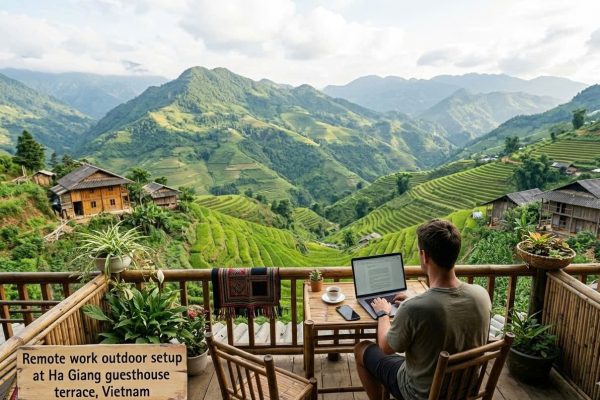
This is the Ha Giang Loop for digital nomads. It’s not the most obvious remote work destination in Southeast Asia. It doesn’t have co-working spaces with cold brew on tap or a reliable fiber connection in every café. But for a certain kind of traveler who needs to work and still wants to feel genuinely alive, it works surprisingly well. You just have to know how to approach it.
This guide is for people who are genuinely trying to make the Loop happen around a real schedule. Not “I’ll check Slack once a day” but actual deadlines, calls, and deliverables. We’ll cover connectivity, base camps, daily rhythms, ride options, and how to plan a trip that doesn’t blow up your week.

Learn more: Ha Giang Loop 2 Days 1 Night
Ha Giang province sits in the far north of Vietnam, sharing a border with China’s Yunnan province. For a long time, it was off the mainstream tourist radar, visited mostly by serious motorcycle travelers who had done the rest of Vietnam and were looking for something harder and more raw.
That changed. The “Ha Giang Loop” — a roughly 350km circuit through the Dong Van Karst Plateau Geopark, past places like Ma Pi Leng Pass, Meo Vac, Lung Cu, and Du Gia — became one of the most talked-about routes in Southeast Asia. Word spread through travel forums, Instagram, and YouTube. By the time the pandemic cleared out, it had developed a genuine infrastructure of homestays, budget guesthouses, and small local tour operators.
For digital nomads, a few things make it appealing that don’t apply to more typical nomad hubs:
The cost is very low, even compared to the rest of Vietnam. Accommodation, food, and transport can run well under $30 a day if you’re not splurging. There’s almost no tourist fatigue here — locals are genuinely welcoming, not worn down by years of overtourism. The scenery is some of the most dramatic in the country. And because the Loop naturally creates a rhythm of riding days and rest days, it lends itself to a work-travel structure better than people expect.
The catch is connectivity. That’s the main thing nomads need to understand before booking, and it’s exactly where this guide starts.

Learn more: Ha Giang Loop 3 Days 2 Nights
Let’s not sugarcoat this: the Ha Giang Loop is not Chiang Mai. You are not going to find fast, stable WiFi in every location. Parts of the route pass through remote valleys with limited signal, and some homestays in smaller villages have slow or nonexistent internet.
But the situation is better than most people assume, and it’s improving year by year.
A Vietnamese SIM card with a 4G data plan is the most reliable tool you have on the Loop. The main networks operating in Ha Giang are Viettel and Vietnamobile, with Viettel generally having the strongest coverage in remote mountain areas. You can buy a tourist SIM in Hanoi before departing, or pick one up in Ha Giang city.
4G signal is available in the main towns: Ha Giang city, Yen Minh, Dong Van, Meo Vac. On the roads between these towns, signal comes and goes. The stretch along the Nho Que River approaching Meo Vac, and areas around Ma Pi Leng Pass, are notoriously patchy.
What this means practically: you can probably handle most of your work during scheduled stops in towns, not while riding. Plan your connectivity around your accommodation at the end of each day, and treat the riding time as offline.
For calls and video meetings, test your connection before the meeting and have a backup plan (WhatsApp audio often works on weaker data than video). Hotspot from your phone to your laptop is a common setup among nomads doing the Loop.
Most established homestays in Yen Minh, Dong Van, and Meo Vac now offer WiFi. The quality ranges from “good enough for email and Slack” to “fast enough for a video call” depending on the specific place and time of day. Peer guesthouses run by local families who’ve invested in the tourist infrastructure tend to have better setups.
Before booking a homestay, check reviews specifically for WiFi mentions. Platforms like Booking.com and Google Maps reviews from the last 12 months will tell you more than any general guide. Ask the property directly via WhatsApp or Messenger: “Is WiFi reliable enough for video calls?” Most owners respond quickly and honestly.
Avoid making critical video calls during power-cut windows, which can still happen in remote areas, especially after heavy rain. Download important files before you leave a reliable connection point.
Learn more: Ha Giang Loop 4 Days 3 Nights
Most tourists do the Ha Giang Loop in 3 to 4 days, moving every day, covering ground quickly. For a digital nomad, this pace is difficult. You’re arriving at a new homestay at 5pm, dealing with fatigue, and expected to work the next morning before getting back on the road.
A smarter approach involves two things: a longer timeline and strategic “anchor nights.”
A 4-day loop is the absolute floor for doing this without completely burning out. Six days is genuinely comfortable and allows you to:
Seven days is ideal if your schedule allows it. The towns of Dong Van and Du Gia both justify a two-night stay, and spending extra time in Meo Vac gives you a proper base without rushing.
Here’s what a productive day on the Loop can look like for a nomad:
6:00am Wake up, coffee, check emails and messages while connection is fresh and before other guests clog the WiFi.
7:00 to 9:00am Focused work block. Handle anything time-sensitive: emails, short deliverables, scheduling.
9:30am Breakfast, pack up, get on the road.
9:30am to 1:00pm Riding. Offline mode. Let the mountains do their thing.
1:00 to 2:00pm Lunch stop in next town. Check messages, respond to anything urgent.
2:00 to 4:00pm Continue riding or arrive at next destination early.
4:00 to 6:30pm Check in, shower, second work block. Handle anything that came in during the riding window.
7:00pm Dinner, decompress. You’ve earned it.
This rhythm only works if you set expectations with clients or employers in advance. Tell them you’re in a remote area of northern Vietnam, you’ll respond to everything within a few hours but aren’t available for back-to-back calls. Most people are fine with this if you communicate it upfront.
Learn more: Ha Giang Cao Bang 5 Days 4 Nights
Not every stop on the Loop is equally viable for remote work. Here’s an honest breakdown of the main towns.
Yen Minh is often the first overnight stop after Ha Giang city, about 100km into the route. It’s a market town with decent infrastructure, multiple guesthouses, a few cafés, and reliable mobile data in the centre. It doesn’t have the dramatic scenery of Dong Van, but it’s functional and comfortable.
For nomads: good enough for a working base for one or two nights. A few guesthouses have decent WiFi and there are small local cafés where you can set up and work. It’s also quieter than Dong Van in terms of tourist traffic, which can be useful if you need to concentrate.
Dong Van is the most developed town on the Loop proper, and it sits in the middle of the Dong Van Karst Plateau Geopark. The old quarter has atmospheric stone houses, a night market, and a handful of comfortable guesthouses that have invested in good facilities for travelers who stay multiple nights.
For nomads: the best single base on the entire Loop. Mobile data (Viettel) is relatively strong. Several guesthouses have WiFi that’s been described in recent reviews as fast enough for video calls. You’re close to the most dramatic scenery on the route (Ma Pi Leng Pass, the descent to Meo Vac) but can do it as a day ride and return to Dong Van, which removes the stress of moving accommodation every day.
Meo Vac sits at the base of Ma Pi Leng Pass, overlooking the Nho Que River gorge. It’s smaller and more rural than Dong Van. The market town vibe is real here, and the scenery around it especially if you’re getting up early for light on the river is stunning.
WiFi is patchier here than in Dong Van. Mobile data works but fluctuates. For nomads with light-touch work days (email checks, async tasks), Meo Vac is fine. For anything requiring a stable connection for extended periods, Dong Van is the safer base.
Du Gia is on the return leg of the Loop, known for its waterfall, rice fields, and slower pace. It’s genuinely beautiful and a popular two-night spot for travelers who don’t want to rush the last section. WiFi at homestays here is hit or miss. If you have light work needs on the final days of your trip, it can work fine. If you’re expecting to have a demanding final stretch of work before flying out, budget a half-day back in Ha Giang city (which has solid connectivity) before your bus or car to Hanoi.

Learn more: Ha Giang Safety Tips
Remote work on a motorbike loop creates gear logistics that a café-hopping nomad in Chiang Mai doesn’t think about. Here’s what matters:
Power bank (high capacity): A 20,000mAh power bank is worth the weight in your pack. On long riding days, your phone is working hard (maps, hotspot, music) and may not make it to the evening with enough charge to be useful.
Universal travel adapter: Vietnamese sockets are mostly Type A (flat two-pin) or Type C (round two-pin). A universal adapter covers you for any destination.
Laptop with good battery life: If your laptop dies after 4 hours, you’re going to struggle. Prioritize your morning work block and use low-power mode when riding.
Offline documents: Download everything you might need to work on. Google Drive has offline mode. Notion pages can be synned. If you’re relying on cloud access only, a patchy connection will cost you hours.
Dry bag or waterproof case for your laptop: Rain comes suddenly in Ha Giang, especially between May and October. Your laptop bag is not waterproof. A dry bag or a quality waterproof laptop sleeve is essential, not optional.
Headphones with noise cancellation: For the inevitable call you take from a guesthouse dining room with a group of backpackers at the next table.
Learn more: Ha Giang Motorbike Rental
This is where the trip planning actually diverges for nomads versus regular tourists. How you get around the Loop has a direct effect on your daily energy, flexibility, and ability to structure work time.
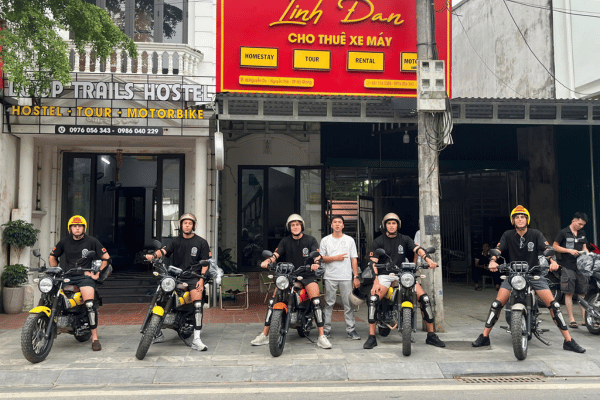
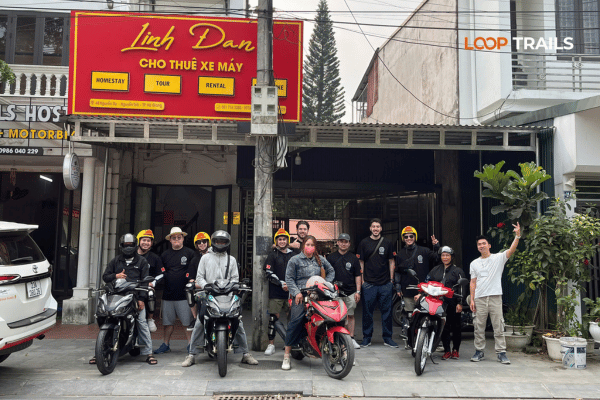
If you haven’t looked at the tour options yet, it’s worth pausing here. Loop Trails offers Ha Giang Loop tours in three formats: Easy Rider (guided, you ride pillion behind a local guide), Self-Drive (you ride your own motorbike, with support available), and Jeep Tour (you’re a passenger in a 4WD vehicle). Each one has a very different implication for a nomad.
[CTA 1: Not sure which format fits your schedule? Check out the Ha Giang Loop tour options on Loop Trails and see which style matches your pace and work needs.]
Learn more: Ha Giang Loop Easy Rider
Self-Drive is popular with experienced riders who want total freedom. You set your own pace, stop when you want, leave when you want. For nomads, the flexibility is attractive. The trade-off is that you are responsible for navigation, bike issues, and road decisions. This is not a good option if you’re going to be mentally divided between the road and work stress. Riding in northern Vietnam requires real attention, especially on narrow mountain roads.
Easy Rider removes the riding burden entirely. Your guide handles the bike; you sit pillion, take photos, and think about whatever you want. For a nomad managing a demanding work week, this is often the smartest choice. You arrive at each stop less physically drained, and you’ve had time on the road to clear your head without burning cognitive energy on navigation. The guides are also a fantastic local resource — they know where to stop, what’s good to eat, and can adjust pace if you need to rest.
Jeep Tour is ideal for nomads who aren’t confident on two wheels, are traveling with a partner who has different comfort levels with motorbikes, or want the most comfortable and weatherproof transport option. The Jeep covers the same stunning routes and viewpoints, with more comfort and more space for gear. It’s also a more natural choice for couples or small groups combining the Loop with extending into Cao Bang for the Ban Gioc waterfall circuit.
A quick framework:
[CTA 2: Ready to figure out your setup? Reach out to Loop Trails on WhatsApp to get a personalised recommendation based on your travel dates and work situation. No pressure, just practical advice.]
Learn more: Ha Giang Cao Bang Ba Be Lake 6 Days 5 Nights
One of the genuine advantages of Ha Giang for digital nomads is that it won’t wreck your budget. The numbers below are approximate and should be verified locally, since prices shift seasonally and year to year.
Accommodation: Basic homestays run roughly $8 to $15 per person per night. Mid-range guesthouses with private rooms and reliable WiFi are typically $15 to $30. In Dong Van, a comfortable private room at a well-reviewed guesthouse is usually in the $20 to $35 range.
Food: Street food and local restaurants are very affordable. A bowl of pho or a rice dish at a local spot is often $1.50 to $3. Cafés serving Western-style food in Dong Van may be $5 to $8 per meal. Budget $10 to $15 per day for food if you’re eating locally.
Transport/Tour cost: This varies significantly by format. Guided Easy Rider tours, motorbike rentals for self-drive, and Jeep tours all have different pricing structures. Check the Loop Trails tour pages for current rates, as these are updated more reliably than any blog guide.
Mobile data SIM: A tourist data SIM in Vietnam costs very little, often under $10 for a multi-week plan with several GB of data. Worth buying the best plan available given how much you’ll be relying on it.
Overall daily budget: A digital nomad managing their costs carefully can do the Ha Giang Loop on $30 to $50 per day including accommodation, food, and any incidentals. A comfortable budget with a mid-range guesthouse and guided tour factored in is closer to $60 to $90 per day.

Learn more: Ha Giang in September & October
Ha Giang has two windows that most experienced travelers and local guides recommend: spring (March to May) and autumn (September to November). These are the periods with the most reliable riding conditions, clearest views, and in the case of autumn, the famous buckwheat flower season when the hills around Dong Van turn pink and purple.
March to May is excellent. Temperatures are mild. Roads are generally dry. Visibility on the passes is good. This is when the landscape is green and the light is soft.
September to November is the most popular period, especially October, when the terraced rice fields are being harvested and the buckwheat flowers are in bloom. Crowds are higher than spring but the scenery is at its peak.
June to August is monsoon season in northern Vietnam. Heavy rain can make mountain roads genuinely difficult and dangerous, cause landslides, and cut visibility on the passes to near zero. Some sections of the Loop can become impassable. This is not the time to do the route if you have a firm itinerary and work commitments you cannot miss. If you travel during this period, allow extra buffer days and be prepared for route changes.
December to February is the dry but cold season. Temperatures at altitude (Dong Van is above 1,000m) can drop close to freezing at night. Roads are generally clear, and the lack of vegetation means the karst landscape is more exposed and dramatic. Some travelers love this period. Just pack warm layers.
For nomads, the practical takeaway: plan your Loop during spring or autumn if you can. You want predictable weather so you’re not losing riding days or work days to weather uncertainty.

Learn more: Ha Giang Loop Mistake to Avoid
Underestimating riding days. Even experienced riders find the mountain roads of Ha Giang more demanding than expected. The combination of tight switchbacks, steep grades, and altitude means 100km can take 4 to 5 hours. Factor this into your daily work schedule.
Overpacking electronics. Every kilo matters on a motorbike. If you’re self-driving or on Easy Rider, your bag goes on the bike. A heavy laptop bag, extra monitor, or bulky gear is genuinely inconvenient. Trim to essentials.
Booking back-to-back video calls. Even with a good SIM, the Loop is not reliable enough for a day of back-to-back client video calls. Don’t schedule demanding call days during riding days. Reserve calls for mornings at a confirmed well-connected location.
Not accounting for permit logistics. Foreigners riding in Ha Giang province need to hold a valid Vietnamese driver’s license or an international driving permit recognized in Vietnam. Requirements and enforcement can change — check the current situation locally and with your tour operator before you go. This is not something to assume or guess.
Expecting café culture. Ha Giang is not Hoi An. There are a handful of local cafés in Dong Van and Yen Minh where you can set up for a few hours, but café-hopping nomad culture doesn’t really exist here. Your guesthouse or homestay is your primary workspace.
Rushing to keep up with faster travelers. The Loop attracts a mix of people: some are racing through in 3 days, some are doing it in 10. Don’t let the pace of others push you to compress your own schedule. A rushed Loop is a stressful Loop for a nomad.
Learn more: Ha Giang Loop Hidden Gems
To legally operate a motorbike in Vietnam, you need a valid Vietnamese driver’s license or an international driving permit (IDP) that is recognized locally. Rules and enforcement can vary. Check with your tour operator and local authorities before your trip, as regulations can and do change.
Viettel is generally recommended as having the strongest coverage in rural northern Vietnam, including Ha Giang. Buy a SIM with a data add-on before leaving Hanoi or in Ha Giang city. Check for the latest plan options when you arrive, as data packages change frequently.
Yes, and it’s a smart idea. Several guesthouses in Dong Van are set up for multi-night stays. Two or three nights in Dong Van gives you flexibility to work mornings, do day rides to nearby viewpoints (including Ma Pi Leng Pass), and not feel like you’re constantly packing and moving.
With careful planning, yes. The key is scheduling calls during confirmed high-connectivity windows (mornings at a good guesthouse in Dong Van or Yen Minh), using Viettel mobile data as a hotspot, and setting client expectations about your schedule in advance. Don’t rely on it for back-to-back or time-critical video calls.
The Ha Giang and Cao Bang circuit is one of the best extended loops in northern Vietnam, including highlights like the Ban Gioc waterfall, Phia Oac National Park, and Nguom Ngao Cave. Allowing 10 to 14 days for the combined route gives a nomad enough flexibility to work and ride without feeling rushed. Loop Trails offers combined Ha Giang and Cao Bang tours that handle the logistics.
October is peak season for scenery (buckwheat flowers, harvest light). March and April are excellent for clear weather and fewer crowds. Avoid June to August if you have a tight schedule, as monsoon conditions can disrupt plans significantly.
Absolutely. A Jeep tour removes all the physical demands of riding, keeps you comfortable on long road days, and gives you time in the vehicle to rest or work offline on documents. It’s a particularly good choice for nomads doing the combined Ha Giang and Cao Bang route or anyone traveling with a non-rider partner.
Yes. Ha Giang city has motorbike rental options for self-drive travelers. Loop Trails offers motorbike rental as a standalone service. If you go this route, ensure you have the correct license documents, understand the route, and have a plan for breakdowns or emergencies. A guided tour removes most of these variables.
Essentials: lightweight laptop, high-capacity power bank, Viettel SIM, waterproof dry bag for electronics, warm layers for night temperatures at altitude, rain gear, noise-cancelling headphones, and all important files downloaded offline.
For peak season (October, late March to April), booking 4 to 8 weeks in advance is advisable, especially for specific guesthouse preferences and guided tour spots. Off-peak, a few weeks is usually sufficient. Contact Loop Trails directly to check availability.
Yes, with appropriate preparation. Easy Rider tours with a local guide are particularly safe for solo travelers, as you have local knowledge, language support, and navigation handled. Solo self-drive is possible but requires real riding experience and good preparation
There is no commercial airport in Ha Giang. The nearest airports are Noi Bai International Airport in Hanoi. Most travelers take a sleeper bus or private car from Hanoi to Ha Giang city, which takes approximately 5 to 6 hours depending on route and traffic. Check current bus schedules and transport options as these change.
Contact information for Loop Trails
Website: Loop Trails Official Website
Email: looptrailshostel@gmail.com
Hotline & WhatSapp:
+84862379288
+84938988593
Social Media:
Facebook: Loop Trails Tours Ha Giang
Instagram: Loop Trails Tours Ha Giang
TikTok: Loop Trails
Office Address: 48 Nguyen Du, Ha Giang 1, Tuyen Quang
Address: 48 Nguyen Du, Ha Giang 1, Tuyen Quang
Facebook X Reddit Table of Contents Learn more: Ha Giang Loop Tours A lot of people arrive in Vietnam knowing they need

Facebook X Reddit Table of Contents Learn more: Ha Giang Loop Tours This is the question that sits in almost every Ha

Facebook X Reddit Table of Contents Learn more: Ha Giang Loop Tours Most people drive past the Quan Ba area twice on