

Thúy Kiều (Grace) is a travel blogger and content contributor for Loop Trails Tours Ha Giang. She holds a bachelor’s degree in Sustainable Tourism from Vietnam National University, Hanoi, and has a strong passion for exploring and promoting responsible travel experiences in Vietnam’s northern highlands.

Learn more: Ha Giang Loop Tours
Most people come to Ha Giang for the scenery. The karst towers of Dong Van, the vertigo-inducing bends of Ma Pi Leng Pass, the turquoise ribbon of the Nho Que River far below. All of that is real and worth every kilometer.
But somewhere between the mountain passes and the roadside pho stops, there is a quieter kind of discovery waiting. A small village where women still sit at wooden looms every morning, pulling thread by thread through cloth made from plants they grew themselves. No performance, no tourist schedule. Just work that has been done the same way for generations.
That village is Lung Tam, and it is one of the most genuinely rewarding stops on the Ha Giang Loop.
This guide covers everything you need: where it is, what you will see, what is worth buying, and how to make it fit your itinerary whether you are riding solo, joining a group tour, or somewhere in between.
Learn more: Ha Giang Loop 2 Days 1 Night
Lung Tam is a small village in Quan Ba district, roughly 45 kilometers north of Ha Giang city. It sits in a valley that feels tucked away even by Ha Giang standards, which is saying something. The surrounding landscape is green and relatively gentle compared to the dramatic rock formations further north near Dong Van and Meo Vac, but that contrast is part of what makes this area feel so livable, so inhabited.
The village is home primarily to the Lo Lo ethnic minority group, with some H’mong families nearby. Both communities have long traditions of textile craftsmanship, but Lung Tam has become particularly associated with linen weaving, a craft using fiber from the flax plant that is woven, boiled, dyed, and finished entirely by hand.
Lung Tam is not directly on the main QL4C highway that most riders take north through Yen Minh and Dong Van. It sits just off the route, close to Quan Ba town and the famous Twin Mountains (also called the Fairy Bosom peaks). If you are doing the loop from Ha Giang city, this village typically falls on day one or day two depending on your pace and starting point.
The proximity to Quan Ba makes it an easy addition to your first morning on the road. You can stop, spend an hour or two, and still reach Yen Minh or Du Gia comfortably by late afternoon.
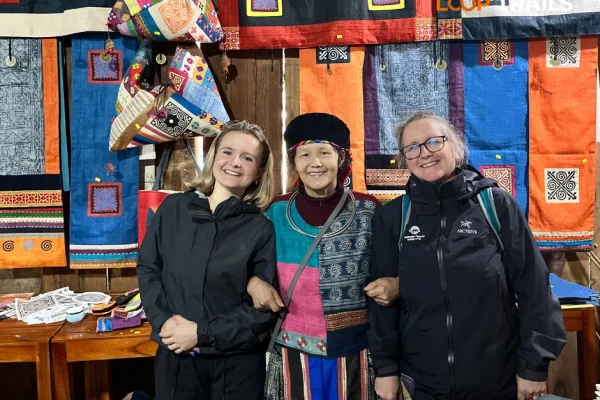
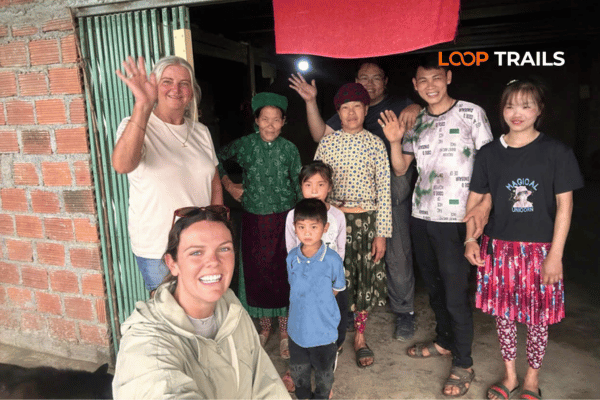
What sets Lung Tam apart from similar craft villages you might see in Sapa or around Hoi An is the level of continuity. The women here are not demonstrating a craft for tourists. They are producing goods they sell, using techniques they learned from their mothers and grandmothers, in workshops that are part of their actual homes.
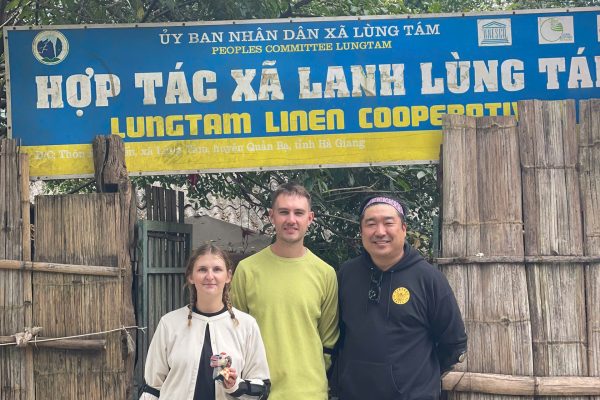
A weaving cooperative has been active here for years, giving local women a more stable income and a place to sell directly to visitors. But it does not feel like a theme park version of a village. The looms are in actual houses. Children run around outside. There are chickens. The smell of indigo dye hangs in the air from the dyeing sheds out back.
That authenticity is rare, and it is worth protecting. More on that in the etiquette section below.
Learn more: Ha Giang Loop 3 Days 2 Nights
If you have never watched traditional linen weaving up close, Lung Tam is a genuinely educational stop even if you have zero interest in textiles. The process is more involved than most people expect.
The whole process starts months before you see anything resembling cloth. Flax plants are grown in fields around the village. Once harvested, the stalks are dried, stripped, and the fibers are extracted by hand, a process that is labor-intensive enough that you start to understand why handmade linen costs what it costs.
The raw fiber gets spun into thread, which is then wound onto spools. Before it hits the loom, the thread is often boiled multiple times in ash water to soften it and prepare it for dyeing. The loom itself is a wooden foot-pedal device that looks simple until you watch someone operate it at speed. The back-and-forth rhythm of the shuttle, the precise timing of the foot pedals, the way the cloth grows row by row — it is hypnotic.
If you ask (or if the cooperative has an English speaker available), you can get a brief explanation of each stage. Do not expect a scripted tour. This is a working village, not a museum.
The colors you will see at Lung Tam, deep blues and blacks in particular, come from indigo plants grown nearby. The dyeing process involves soaking cloth in fermented indigo liquid repeatedly over days or weeks. Each dip adds depth. The most saturated pieces have been dyed dozens of times.
Other natural dyes come from local plants and tree bark, producing earthy greens, browns, and ochres. These are not the bright synthetic colors you see in mass-produced textiles from tourist markets. They are muted, complex, and they age well. A piece of Lung Tam linen that you buy today will soften and deepen in color over years of use, which is part of the appeal if you are buying something to actually live with rather than display on a shelf.
It is worth being direct about this: the craft here is almost entirely kept alive by women. The men in Lo Lo and H’mong communities tend to be involved in farming and construction. Weaving is women’s work in the most literal sense, passed from mother to daughter, providing income that is controlled by the women themselves.
The cooperative model at Lung Tam was set up specifically to strengthen that economic position. When you buy something here, you are buying from the person who made it or from an organization that pays her directly. That matters, and it is worth keeping in mind when you are comparing the price of a scarf here to the price of a “handmade” scarf at a souvenir shop in Ha Giang city.

Learn more: Ha Giang Loop 4 Days 3 Nights
Getting there is straightforward once you know what to look for, but Lung Tam is not always marked clearly on Google Maps or basic tourist maps of the loop. Here is what you need to know.
From Ha Giang city, Lung Tam is roughly 45 to 50 kilometers heading north on QL4C toward Quan Ba. The road is paved and generally in decent condition, though conditions can change especially after heavy rain in the wet season. Budget around 60 to 90 minutes of driving depending on stops and traffic.
The village is located near Quan Ba town, and signs in the area may point toward the Lung Tam weaving cooperative or the Quan Ba area cultural sites. If you are unsure, ask locally when you reach Quan Ba town, which has a small market and enough foot traffic that someone will point you in the right direction.
From Dong Van heading south, Lung Tam is roughly 70 to 80 kilometers depending on your route, making it a natural stop on the return leg of the loop if you saved it for coming back down.
From Du Gia, another popular loop variation that takes you through the Du Gia waterfall and rice terrace areas before heading north, Lung Tam is accessible but requires some route planning. If you are on a guided tour, your guide will handle this. If you are self-driving, check your route carefully the night before.
Learn more: Ha Giang Cao Bang 5 Days 4 Nights
The weaving cooperative at Lung Tam is typically open in the mornings, which is also when you are most likely to see active weaving happening. Afternoons can be quieter. There is no fixed tourist schedule, and because this is a working cooperative, you might arrive to find one woman weaving alone or six women working simultaneously. It varies.
Check for the latest opening hours before your visit, as schedules can shift with seasons, local festivals, or in the event the cooperative has adjusted its structure. Your tour guide or guesthouse in Ha Giang city should have current information.
Visiting the cooperative itself is typically free or involves a very small entry contribution that goes directly to the village. The main “cost” is what you choose to buy, and there is no obligation to purchase anything.
Expect to spend between 30 minutes and 2 hours depending on your interest level. Travelers who are genuinely into textiles or cultural history tend to stay longer. People who are passing through on a packed day of sightseeing might do a quick look, pick up a small souvenir, and move on. Both approaches are fine. Nobody will pressure you.
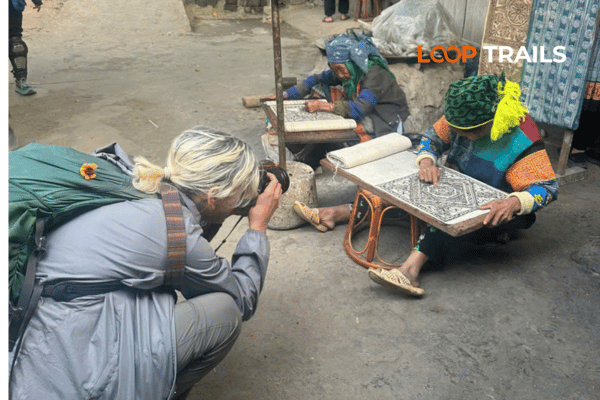
If you want to take photos inside the workshops, ask first. Most women are accustomed to visitors and cameras, but a quick gesture asking permission is both polite and usually results in better, more relaxed photos.
Thinking about visiting Lung Tam as part of the Ha Giang Loop? It sits perfectly within a guided loop itinerary, especially if you want your stops planned around what is actually worth seeing rather than just what is easy to find on the roadside. Check out our Ha Giang Loop tours to see how we build cultural stops like Lung Tam into the route easy rider, self-drive, and jeep options available.
Learn more: Ha Giang Cao Bang Ba Be Lake 6 Days 5 Nights
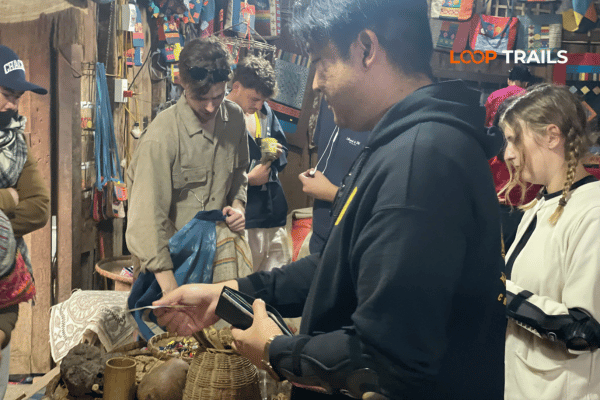
Let’s be practical about this. You will probably want to buy something. The textiles here are genuinely good quality and genuinely handmade, but not everything at every stall in the vicinity falls into that category. Here is how to navigate it.
The cooperative at Lung Tam sells its own products, which are made on-site by cooperative members. These include scarves, table runners, small bags, pillow covers, and yardage of raw linen fabric. The weaving is visible in the texture, the slight irregularities that machine production cannot replicate. Hold the cloth up to the light and you can see it.
As you move further from the cooperative itself toward roadside stalls near Quan Ba town or further south, the quality drops sharply and the likelihood of machine-made fabric increases. This is not unique to Lung Tam — it happens around craft villages all over Southeast Asia. The safest approach is to buy directly from the cooperative or from women you have actually watched weaving.
A few quick checks:
When in doubt, ask which items were made here versus elsewhere. The cooperative workers tend to be straightforward about this.
This is not a haggling situation in the same way as a city market. Prices at the cooperative are generally fixed or close to it, and they reflect the actual labor involved. A scarf that took several days to weave and dye is not something you should expect to buy for a dollar or two.
Gentle negotiation is okay if you are buying multiple pieces. Aggressive bargaining at a cooperative where women are earning their primary income is not a good look and not necessary. The prices here are fair relative to what is being produced.
If you see something at a price that feels genuinely too high, you can politely ask if there is any flexibility. But start from a position of respecting the labor rather than trying to minimize the cost.
Learn more: Ha Giang Loop Weather
Ha Giang has two distinct seasons that affect the experience significantly, and Lung Tam is no exception.
October to April is generally considered the better half of the year for the Ha Giang Loop. Skies are clearer, road conditions are more predictable, and temperatures are cooler. October in particular is famous for buckwheat flower season, when the landscape near Dong Van turns pink and purple. This is also when Ha Giang sees the most visitors.
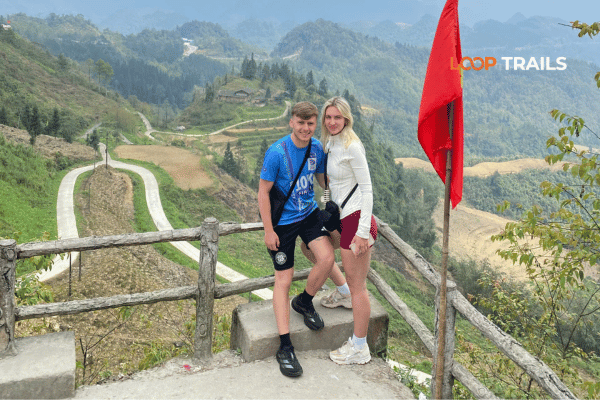
May to September is the rainy season. The mountains are dramatically green, mist fills the valleys in the mornings, and rice terraces near Du Gia and along the loop are at their most photogenic. But roads can be affected by rain and occasional landslides, especially in heavier weather months. Check conditions before you ride.
For Lung Tam specifically, the weaving cooperative operates year-round. The craft is not seasonal in the way that some agricultural festivals are. You are not visiting to see something that only happens once a year — you are visiting to see work that happens every day, which means any season works.
If you are traveling in peak months (October to December, late January to March), book your Ha Giang accommodation and tours in advance. The loop has become significantly more popular in recent years and good guesthouses in Dong Van and Meo Vac fill up fast.
Learn more: Quan Ba Heaven Gate
Lung Tam works best as part of a full loop itinerary rather than a standalone day trip from Ha Giang city. The distances involved make it inefficient to go just for this one stop, and the surrounding area has enough to keep you occupied for at least a full day.
If you are spending your first full day heading north from Ha Giang, a natural morning sequence looks like this:
This gives you a morning of scenery and culture before the longer driving stretch in the afternoon. It is also a good pacing reset before the more intense riding days around Ma Pi Leng Pass and Meo Vac.
For the Du Gia route variation: some loop itineraries include a detour east from Yen Minh down to Du Gia before heading back up to Dong Van. If yours does, you might visit Lung Tam on the outbound leg and hit Du Gia waterfall and the rice paddies on the return.
Not sure which loop variation suits your schedule? Our guided tours cover multiple route options including Du Gia, and we can help you figure out the right pace based on your available days. See our Ha Giang Loop tour options or reach out on WhatsApp if you want a quick conversation before booking.
Learn more: Ha Giang Motorbike Rental
This is a question worth thinking about before you hit the road, because Lung Tam is the kind of stop that plays out differently depending on how you travel.
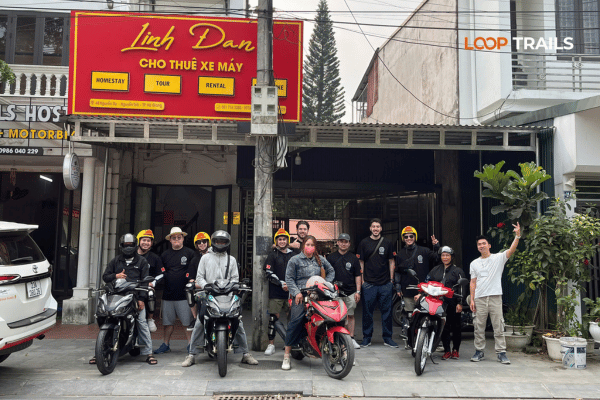
Easy Rider (guided motorbike, you ride pillion): This is the most relaxed option for a stop like Lung Tam. Your guide will know exactly where to turn off, will handle any language gaps with the cooperative women, and can give you context about the Lo Lo community and the weaving tradition while you are there. If cultural depth matters as much as the scenery, easy rider gives you both without the cognitive load of navigating.
Self-Drive (you ride your own bike, guided or independently): You have more control over how long you stay. If you find yourself genuinely absorbed by the workshop, you can linger as long as you want without feeling like you are holding up a group. The trade-off is that you might miss some of the contextual storytelling. If you have a guide following along on their own bike, the best of both worlds is available to you.
Jeep tours: These make the most sense for travelers who prefer not to ride at all, or for groups that include people with different physical comfort levels. A jeep can stop at Lung Tam just as easily as a motorbike, and it means you have more flexibility with luggage and rain gear. The views are slightly different from inside a vehicle versus on a bike, but the village stop itself is identical.
Independent/no guide: Totally possible. Lung Tam is accessible by motorbike or even by car with the right map references. The cooperative is visible enough that you will find it without too much searching. The only thing you lose is any real-time explanation of what you are seeing. A good travel guide or this article can partially fill that gap.

Learn more: Ha Giang Loop Mistake to Avoid
A few things worth knowing before you arrive.
Dress appropriately. You are visiting people’s homes and a working community space. This is not a strict dress code situation, but covering shoulders and avoiding very short shorts or skirts is respectful and aligns with local norms. If you have been riding in gear, you are probably fine.
Ask before photographing people. The women at the cooperative are generally accustomed to visitors and cameras. Most will not mind if you ask with a gesture or a smile. A small number will decline, and that is completely valid. Do not photograph children without parental acknowledgment nearby.
Do not touch the looms or materials without invitation. The equipment is real, in use, and sometimes mid-project. If someone invites you to try a few passes on the loom, that is a lovely experience. Grabbing the shuttle without asking is not.
Support the cooperative, not the middlemen. If you are going to buy something, buy from the cooperative or directly from a weaver. Purchasing the same style of item from a roadside stall down the road, where you cannot verify origin, undercuts the very people the cooperative was set up to support.
Carry small denominations of Vietnamese dong. Not all locations accept card or QR payment. Check the current accepted payment methods when you arrive. Smaller bills make transactions easier and avoid the awkward “do you have change for 500,000” moment.
Give yourself more time than you think you need. The loop has a way of running behind schedule, especially on days when the scenery is compelling enough to stop every ten minutes. Lung Tam is better as a relaxed visit than a rushed one. Build the buffer in.

Learn more: Tu San Canyon & Nho Que River Boat Trip
Lung Tam is in Quan Ba district, Ha Giang Province, around 45 to 50 kilometers north of Ha Giang city on the road heading toward Dong Van. It sits near Quan Ba town and the famous Twin Mountains viewpoint.
Yes, particularly if you want your loop experience to include something beyond scenery. It is one of the few places in Ha Giang where you can observe a living craft tradition in a genuinely working setting, not a re-enactment. Most travelers who stop here consider it one of the more memorable parts of the trip.
The village is known for its linen weaving tradition, maintained primarily by Lo Lo women through a local cooperative. The process uses locally grown flax fiber, natural dyes including indigo, and traditional wooden looms. The finished textiles include scarves, bags, table runners, and raw fabric.
Visiting the cooperative itself is generally free or involves a minimal entry contribution. The main expenditure is anything you choose to buy. Prices reflect the labor involved in hand-weaving and natural dyeing, so expect to pay more than you would for machine-made alternatives.
Scarves, pillow covers, table runners, small tote bags, and yardage of linen fabric are the most common purchases. Quality is generally high for items made and sold directly at the cooperative. Check whether items were made on-site before purchasing.
Head north on QL4C toward Quan Ba, the same road used for the Ha Giang Loop. Lung Tam is roughly 45 to 50 kilometers from the city. The road is paved. Allow 60 to 90 minutes of travel time, more if you stop at Quan Ba Heaven Gate along the way.
Yes. The village and cooperative are accessible by motorbike or car. Google Maps may not pinpoint the cooperative exactly, so asking locally near Quan Ba town is a reliable backup. A guide adds cultural context but is not required for access.
No strict dress code applies, but modest clothing (covered shoulders, not very short shorts or skirts) is respectful in this community setting. Standard riding gear is completely appropriate.
Yes. There is nothing physically demanding about the visit, and children often find the weaving process genuinely interesting to watch. It is a calm environment with interesting things to look at and potentially small items to buy as souvenirs.
Morning is generally better because weaving activity tends to be more active before midday. Afternoon visits are possible but may be quieter. There is no fixed performance schedule since this is a working cooperative.
Budget 45 minutes to 2 hours. Where you land in that range depends on your interest in the craft and how much you want to browse and potentially buy. Most travelers on a standard loop schedule find that an hour feels natural without feeling rushed.
Yes. It typically falls on day one of the loop, alongside Quan Ba Heaven Gate and the Twin Mountains viewpoint. Even on a compressed two-day itinerary it can be a morning stop on the way north, though you might need to limit your time to 30 to 45 minutes.
Contact information for Loop Trails
Website: Loop Trails Official Website
Email: looptrailshostel@gmail.com
Hotline & WhatSapp:
+84862379288
+84938988593
Social Media:
Facebook: Loop Trails Tours Ha Giang
Instagram: Loop Trails Tours Ha Giang
TikTok: Loop Trails
Office Address: 48 Nguyen Du, Ha Giang 1, Tuyen Quang
Address: 48 Nguyen Du, Ha Giang 1, Tuyen Quang
Facebook X Reddit Table of Contents Learn more: Ha Giang Loop Tours This is the question that sits in almost every Ha

Facebook X Reddit Table of Contents Learn more: Ha Giang Loop Tours Most people drive past the Quan Ba area twice on