


Thúy Kiều (Grace) is a travel blogger and content contributor for Loop Trails Tours Ha Giang. She holds a bachelor’s degree in Sustainable Tourism from Vietnam National University, Hanoi, and has a strong passion for exploring and promoting responsible travel experiences in Vietnam’s northern highlands.
Learn more: Ha Giang Loop Tours
Most days on the Ha Giang Loop go exactly the way you hoped. The bike hums along, the passes open up one after another, and the biggest decision you make is where to stop for coffee. Then there’s the other kind of day. The one where your engine coughs on a climb, or you feel that sick wobble of a flat tire halfway between two towns with nothing around but limestone and goats.
Here’s the good news: a motorbike breakdown on the Ha Giang Loop is almost never the disaster it feels like in the moment. The whole region runs on motorbikes. Every village has someone who can fix a chain or patch a tube, and help is usually closer than you think. What separates a smooth recovery from a ruined afternoon is knowing what to do in the first few minutes, who to call, and what you can sort out yourself.
This guide walks through all of it: the common breakdowns, the roadside fixes actually worth attempting, how repair shops work up here, rough costs, and the small habits that stop most problems before they start. Whether you are riding self drive or thinking about a guided option, you will finish this knowing how to handle whatever the road throws at you.
Learn more: Ha Giang Loop 2 Days 1 Night
The single most important thing when something goes wrong is to not panic and not stop in a bad spot. Mountain roads are narrow, blind corners are everywhere, and a stalled bike on the wrong bend is far more dangerous than the mechanical problem itself.
If you feel something go wrong, ease off the throttle, check your mirrors, and roll to the widest, safest place you can reach. A flat tire, a slipping clutch, a rattling chain: none of these need an emergency stop. Coast to a pullout, a village shopfront, a flat patch of gravel, anywhere a truck rounding the corner can see you in time.
Once you are stopped and out of the traffic line, take a breath. You have more time than your adrenaline is telling you.
Your first 60 seconds checklist:
If it’s getting dark or you are on a genuinely exposed stretch like a section of Ma Pi Leng Pass, prioritize getting to the next safe pullout even if you have to push the bike a short distance. Visibility and a flat surface matter more than fixing anything on the spot.
Learn more: Ha Giang Loop 3 Days 2 Nights
After enough seasons on these roads, you start to see the same handful of problems again and again. None of them are mysterious. Most come down to rough roads, loaded bikes, and the occasional tired machine. Here’s what tends to go wrong and why.
This is the number one breakdown on the Loop, and it isn’t close. Construction zones, broken tarmac, sharp stone chips, and the odd nail outside a building site all take their toll. You might hear nothing and just feel the back end go vague and heavy, or you might get a slow leak that only shows up after an hour. Rear tires go far more often than fronts, because that’s where your weight and the engine’s drive sit.
Loose, dry, or slipping chains are common, especially on rental bikes that have done a lot of kilometers. A chain that’s too loose can jump off the sprocket entirely, usually when you snap the throttle on a climb or hit a pothole. You will know it instantly: the engine revs but the bike doesn’t pull, and you might hear a clatter. A dry, neglected chain also wears faster and can seize a link.
Sometimes you stop for photos at the Nho Que River viewpoint, come back, and the bike just clicks or does nothing at all. The usual suspects are a flat battery, a loose connection shaken free by the rough roads, a kill switch knocked to the off position, a kickstand sensor, or a fuel issue. On semi automatic and manual bikes, a flooded engine from too much choke is also common on cold mornings up high.
Long descents off the high passes put real heat into your brakes. Spongy levers, squealing, or brakes that feel weak usually mean worn pads or, occasionally, overheated fluid. This is one you do not ignore. Brakes are the system most worth checking before you ride and most worth stopping for the moment they feel off.
It sounds silly until it happens to you. The stretches between fuel stops can be long, and small village pumps are not always open or stocked. Plenty of riders coast into Meo Vac or Dong Van running on fumes, and a few don’t make it. Roadside vendors sometimes sell fuel from bottles, but you cannot count on finding one exactly when you need it.
Less common on the cooler high sections, but on hot days, in slow traffic, or on long lower altitude stretches, air cooled engines can run hot, especially if the bike is overloaded or low on oil. You might smell it before you see any warning.
Not strictly a mechanical breakdown, but worth including. A low speed drop on gravel can snap a mirror, bend a lever, crack a turn signal, or fold a foot peg. The bike often still runs fine, but a broken clutch or brake lever can stop your ride cold until it’s replaced.
Learn more: Ha Giang Loop 4 Days 3 Nights
Let’s be honest about this. You are not going to rebuild a gearbox on the side of Ma Pi Leng, and you shouldn’t try. But there are a handful of problems where a calm rider with basic sense can get moving again, or at least limp to the next shop. Here’s the realistic list.
If your chain has slipped off the rear sprocket but isn’t snapped, this is often fixable in a few minutes. Put the bike on its center stand if it has one, or have a friend hold it steady. Roll the rear wheel backward by hand while guiding the chain back onto the sprocket teeth. Once it catches, slowly turn the wheel forward to seat it. If the chain came off because it’s badly loose, ride gently to the nearest shop to get it tensioned rather than pushing your luck.
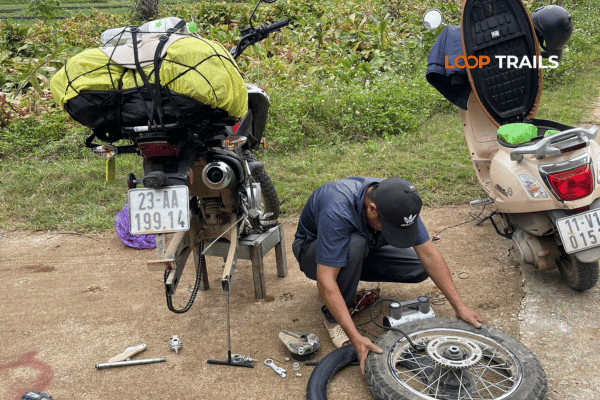
Properly patching or plugging a tube takes tools and tire levers most riders don’t carry, and tubed wheels in particular are fiddly. What you can do is stop riding immediately. Riding on a flat shreds the tube and can wreck the rim and tire, turning a cheap repair into an expensive one. If you are close to a town, walk the bike. If you are far out, this is a phone call situation. Some experienced riders carry a plug kit and a small pump for tubeless tires, which can buy enough air to reach help.
Run through the simple stuff before you assume the worst:
The Loop’s roads shake everything loose. A multi tool in the right sizes lets you snug up mirrors, tighten a wobbling number plate or rack, and reseat anything rattling. It’s not glamorous, but a loose bolt left alone can become a real problem later.
One rule worth keeping: don’t start taking apart anything you are not confident you can put back together. A half disassembled bike on a roadside with no spare parts is worse than the original problem. When in doubt, stop and call for help.
Riding self drive and want backup if this happens? Every motorbike we rent at Loop Trails goes out checked and road ready, and you ride with our number already in your phone. One message and we help you sort a breakdown wherever you are on the Loop. [Check our Ha Giang motorbike rental]
Learn more: Ha Giang Loop 4 Days 3 Nights
There is no shame in calling for help. Locals do it, guides do it, and it’s almost always faster than struggling alone. The trick is knowing who to call and in what order.
If you rented your bike or booked through a company, they are your first call, always. A good operator has a network of mechanics and contacts across the Loop and can either talk you through a fix, send someone, or arrange a replacement bike. This is exactly what you are paying for, and it’s the single biggest reason to rent from a real company rather than the cheapest bike you can find. Keep their number saved and, ideally, on WhatsApp, so you can send a photo and a pinned location.
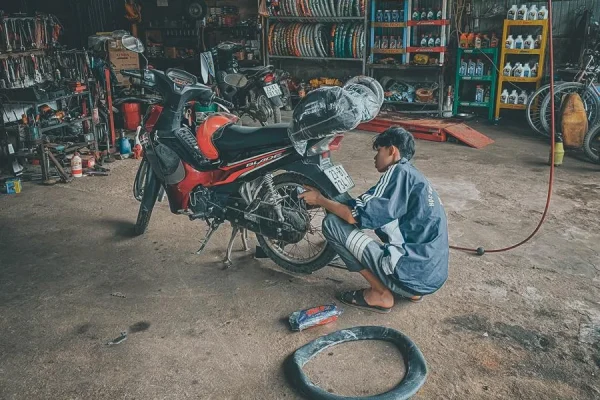
Look for signs that read “sửa xe” (motorbike repair) or “sửa xe máy.” They are scattered through every town and many villages: Ha Giang city, Tam Son, Yen Minh, Dong Van, Meo Vac, and the smaller settlements in between. These are not chain dealerships, they are local mechanics who fix bikes all day, and they are fast and resourceful with the common problems. Many also sell fuel, oil, and basic spares.
On busier stretches you will sometimes find a mechanic working out of a shed or even a home. If your operator can’t reach you quickly, a local can often point you to the nearest person who fixes bikes. Vietnamese hospitality runs deep up here, and people genuinely help.
The Loop has a strong rider community. If you are stuck, flag down other travelers or local riders. Someone may have a tool you need, a plug kit, or simply the knowledge to get your chain back on. Pay it forward when it’s your turn.
A note on the language barrier: Most mountain mechanics speak little or no English, and that’s completely fine. Point at the problem. Use a translation app with the camera or voice feature. Learn a few words: xe (bike), bánh xe (tire or wheel), xích (chain), xăng (fuel), phanh (brake). A photo and some gestures get you a long way. Settle the price by writing the number down or showing it on a phone before they start.
Learn more: Ha Giang Cao Bang 5 Days 4 Nights
Where you break down matters as much as what breaks. Some parts of the Loop are dense with help. Others are gloriously, inconveniently empty. Knowing the pattern helps you make smart calls about whether to limp on or sit tight.
Towns and larger villages are where the shops cluster. You will find mechanics, fuel, and spares without much trouble in and around the main stops. The long connecting stretches, the high passes, and the most scenic empty roads are where you are on your own for a while.
Here’s a rough sense of it:
| Where you are | Getting help is… |
|---|---|
| Ha Giang city | Easy. Plenty of shops, parts, and dealerships. |
| Tam Son / Quan Ba area | Manageable. Several shops in town. |
| Yen Minh | Manageable. A reliable mid Loop stop for repairs and fuel. |
| Dong Van | Good. Tourist town with mechanics and fuel. |
| Meo Vac | Good. Another solid base with repair options. |
| Du Gia | Limited. Smaller, fewer options, plan ahead. |
| Ma Pi Leng Pass | Hard. Stunning and remote, very little between Dong Van and Meo Vac. |
| Long rural connectors | Variable. Villages have someone, but it may be a wait. |
The practical takeaway: top up fuel in every town even if you are not low, and do not start a remote section like Ma Pi Leng with a bike that’s already giving you trouble. Sort small issues in town while help is easy, rather than gambling that they will hold across the empty bits.
Learn more: Ha Giang Motorbike Rental
We are not going to print prices here, because they change, they vary by shop, and the last thing you want is to quote a number from a blog and feel cheated when reality differs. What we can tell you is the shape of it.
Routine fixes in this part of Vietnam are genuinely cheap by Western standards. Patching a tube, putting a chain back on, tightening and lubing a chain, swapping a lever or mirror, topping up oil: these are small jobs and small money. A new tire or tube costs more but is still modest. Bigger work, like clutch or electrical repairs, costs more again, but is rarely the kind of bill that ruins a trip. Always ask the price before the mechanic starts, ideally with the number written down or shown on a phone screen so there’s no confusion later.
A few sensible habits keep things smooth and fair:
The vast majority of riders find mountain mechanics honest, fast, and reasonable. Going in with cash, a price agreed up front, and a friendly attitude makes the whole thing painless.
Learn more: Ha Giang Cao Bang Ba Be Lake 6 Days 5 Nights
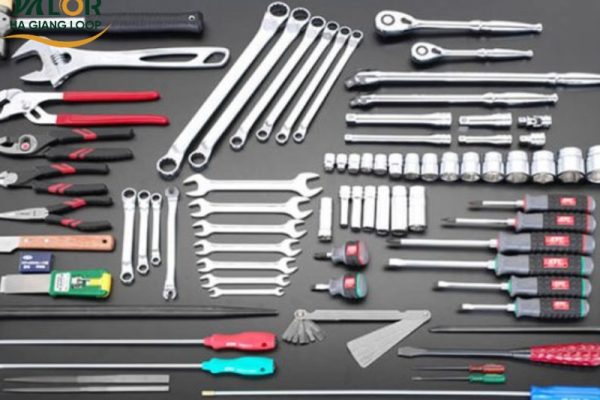
You do not need to turn into a traveling workshop. But a small, light kit covers most of what actually goes wrong and can turn a long wait into a five minute fix. Here’s a sensible packing list.
Worth carrying:
What rental bikes usually include, and what they don’t:
Most rental bikes come with the basics in working order, but spares and tool kits vary a lot. Some include a small under seat toolkit and a pump, many don’t. Do not assume. Before you ride off, ask your rental company exactly what’s on the bike, whether there’s a toolkit, and what they want you to do if something goes wrong. A company worth renting from will answer all of this clearly and give you a contact for help.

Learn more: Ha Giang Loop Mistake to Avoid
Most breakdowns on the Loop are preventable, or at least catchable before they strand you. None of this takes long, and it’s the difference between a trip that flows and one that keeps stopping.
Every morning, before you set off, run your eyes and hands over the bike:
A huge share of trouble comes from pushing too hard for conditions. The Loop is not a race. Roads are rough, weather turns fast, and fog can sit on the high passes. Ride within your ability, brake early on descents, and give yourself time so you are not riding tired or in the dark. Rushing is how chains jump, tires get punished, and drops happen. It also helps to read up on the season you are riding in and pack accordingly before you arrive.
Adopt one simple rule: fill up in every town, every time, whether you need it or not. It costs you two minutes and removes one of the most common and most avoidable problems on the Loop entirely.
Two big riders plus full luggage on a small bike is hard on tires, chain, brakes, and engine. Pack light, keep the weight low and central, and if you are two up, be realistic about the bike’s limits, especially on climbs and in the heat.
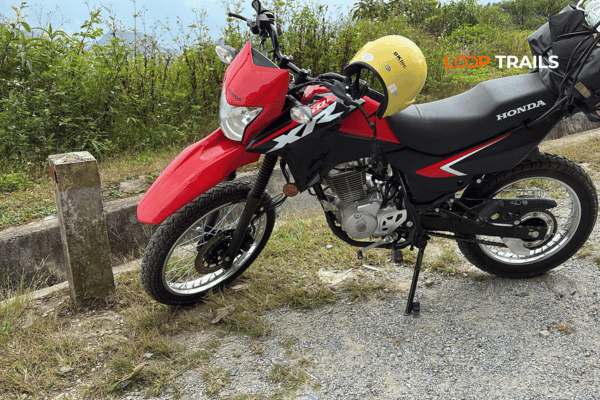
This is the one that matters most, and the one you control before you even arrive. A tired, poorly maintained rental that’s done a hundred hard Loops is far more likely to let you down than a bike that’s properly looked after. Where and who you rent from is the biggest single factor in whether you break down at all.
Learn more: Ha Giang Loop Self-Drive
Occasionally something happens that no roadside fix and no village mechanic can sort quickly: a serious mechanical failure, a bad crash, an electrical problem that needs parts from a city. This is the situation that separates a good operator from a cheap rental shack.
With a proper company behind you, this is a phone call and a wait, not a catastrophe. They arrange a replacement bike, organize getting you and your luggage onward, and make sure you are not left stranded on a mountain road working it out in a language you don’t speak. With the cheapest possible rental and no real support, you can be genuinely stuck.
So the question to ask yourself before the trip is simple: if the worst happens out there, who is coming to help me? If you have a clear answer, you are in good shape. If you don’t, that’s worth fixing before you ride.

Learn more: Ha Giang Loop Easy Rider
Not everyone wants to be their own mechanic on a mountain pass, and that’s completely valid. How you choose to do the Loop changes how much breakdown risk lands on your shoulders. Here’s the honest breakdown so you can pick what fits you.
Self drive (you ride your own motorbike). Maximum freedom and the full adventure, but the bike is your responsibility. You stop when something goes wrong, you make the calls, you handle the roadside moments. With a well maintained rental and a company on call, it’s very manageable, and most riders love it. Best for confident riders who want independence and don’t mind dealing with the occasional hiccup.
Easy rider (you ride on the back, a local driver rides). You sit behind an experienced local driver who knows these roads and these bikes inside out. If something goes wrong mechanically, it’s their problem to solve, not yours, and they can usually fix or arrange things in minutes. You get all the scenery, none of the mechanical stress, and a local who handles every logistical bump. Best for travelers who want the motorbike experience without riding themselves, or who aren’t confident on rough mountain roads.
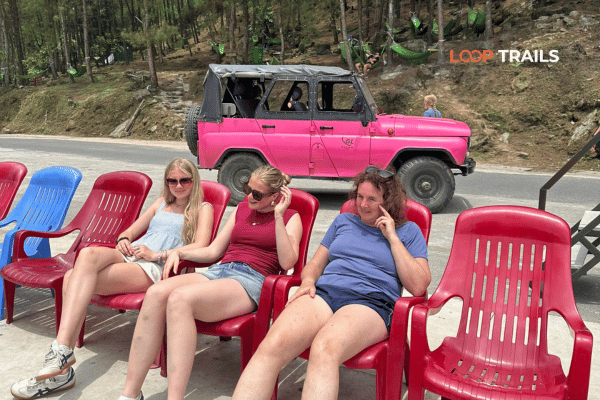
Jeep (you ride in a vehicle with a driver). The most comfortable, all weather option, and breakdowns essentially stop being something you think about. Same stops, same views, same villages, just from inside a vehicle with a driver who handles everything. Great for couples, families, non riders, and anyone who wants the Loop without the exposure. Comfort without the exhaustion.
There’s no wrong answer here, only the one that matches how you want to experience the Loop. Plenty of riders who broke down once on a cheap self drive bike come back the next time on an easy rider or jeep trip and love it. And if you are planning to extend into Cao Bang, the same logic applies, just over more road, so the right bike and the right support matter even more.
Want the Ha Giang Loop without the breakdown stress? Whether you ride self drive on a checked, road ready bike, or let us handle everything on an easy rider or jeep tour, Loop Trails has you covered with real support on the road. [See our Ha Giang Loop tours] or [message us on WhatsApp] and we’ll help you pick the right option.
Learn more: Ha Giang Loop by Jeep for Families & Groups
To make all this concrete, here are the kinds of situations that come up regularly, and how a prepared rider handles them.
The slipped chain on a climb. You snap the throttle to power up a steep section and suddenly the engine roars but the bike loses drive, with a clatter from the back. You coast to the side, find the chain has jumped the sprocket, and either guide it back on yourself in a few minutes or roll gently to the next shop to get it reseated and tensioned. Annoying, quick, cheap.
The flat outside town. You feel the back end go heavy and vague on a rough patch an hour from anywhere. You stop immediately rather than riding on and wrecking the tube. A message to your operator with your location, and either a mechanic comes to you or you walk the bike to the nearest village shop. An hour later you are rolling again on a patched or new tube.
The bike that won’t wake up. You park at a viewpoint, soak in the Nho Que River below, and come back to a bike that won’t start. Before panicking, you check the kill switch, the kickstand, and the fuel tap. Nine times out of ten it’s one of those. If it’s a flat battery, a friendly bump start or a push from another rider gets you going.
The empty tank. You skipped a fuel stop thinking you had plenty, and now you are coasting toward Meo Vac on fumes. Lesson learned. You make it, just, or you flag someone who knows where a roadside vendor sells fuel from a bottle. Next time, you fill up in every town.
None of these are trip enders. They are the texture of riding in the mountains, and handling them well is part of what makes the Loop feel like a real adventure rather than a theme park ride.

Learn more: Ha Giang Loop by Army Jeep Tours
A breakdown on the Ha Giang Loop is rarely the story you think it’s going to be. It’s usually a short delay, a friendly mechanic, a small bill, and a slightly better story to tell later. The riders who have a hard time are almost always the ones who started on a tired bike with no support and no plan. The riders who barely notice are the ones who did a quick check each morning, kept fuel topped up, rode within themselves, and knew who to call.
Get those basics right and the Loop opens up exactly the way it should: passes, rivers, villages, and the kind of freedom that’s hard to find anywhere else. The mechanical stuff fades into background noise.
If you want that freedom without rolling the dice on a sketchy bike, start with the right ride and the right people behind you. We are happy to help you get on the road properly, whether that’s a checked self drive bike with our support already in your pocket, or a fully handled easy rider or jeep trip where breakdowns simply aren’t your problem.

Learn more: Cao Bang Loop 3 Days best kept secret
Flat tires are by far the most common, thanks to rough roads, construction zones, and the occasional sharp object. Loose or slipped chains come a close second, especially on rental bikes that have done a lot of kilometers. Both are usually quick and cheap to fix at any village mechanic.
Yes, in every town and many villages. Look for signs reading “sửa xe” or “sửa xe máy.” They cluster in Ha Giang city, Tam Son, Yen Minh, Dong Van, and Meo Vac, while the long passes and remote connectors have far fewer, so it pays to sort small issues while you are still in town.
Ease off the throttle, check your mirrors, and coast to the widest, safest spot you can reach, off the road and visible to traffic. Switch off the engine, get clear of any blind corners, then assess calmly. You almost always have more time than the adrenaline suggests.
Managing it is easier than fully fixing it. Stop riding immediately so you don’t shred the tube and damage the rim. If you carry a plug kit and pump for tubeless tires you may get enough air to reach help, otherwise walk the bike to the nearest shop or call your operator.
Routine fixes like patching a tube, sorting a chain, or swapping a lever are cheap by Western standards, and even a new tire is modest. Bigger jobs cost more but rarely ruin a trip. Always agree the price before the mechanic starts, with the number written down to avoid confusion.
A basic multi tool, cable ties, tape, a phone mount, and a power bank cover most situations. If you are on tubeless tires and confident, add a plug kit and a compact pump. A spare clutch or brake lever for your model is smart, since snapped levers are a common drop casualty.
Call your rental company first. A proper operator arranges a replacement bike and gets you and your luggage onward, which is exactly why renting from a real company beats the cheapest bike you can find. With no support behind you, a serious failure can leave you genuinely stranded.
Usually little or none, and that’s fine. Point at the problem, use a translation app’s camera or voice feature, and learn a few words like xích (chain), bánh xe (wheel), and xăng (fuel). Showing the price as a number on your phone keeps everything clear.
Do a five minute check each morning of tires, chain, brakes, lights, and fuel. Ride within your ability on the rough roads, brake early on descents, and don’t overload the bike. Most importantly, start with a well maintained bike from a company that supports you.
Yes, plenty of people do. If the idea of roadside repairs worries you, consider an easy rider trip where a local driver handles all the mechanical side, or a jeep tour where breakdowns essentially stop being a concern. You get the same scenery and stops either way.
Definitely, in small notes. Village shops rarely take cards and ATMs are scarce once you leave the bigger towns. Keep enough for fuel and a repair or two, and you will never be caught out by a small bill in a place with no card machine.
This is one of the most remote and spectacular stretches, with very little between Dong Van and Meo Vac, so help can be a wait. Don’t start it on a bike that’s already giving you trouble, carry a charged phone with offline maps, and message your operator with your location. If you can safely reach a pullout, do that first.
Contact information for Loop Trails
Website: Loop Trails Official Website
Email: looptrailshostel@gmail.com
Hotline & WhatSapp:
+84862379288
+84938988593
Social Media:
Facebook: Loop Trails Tours Ha Giang
Instagram: Loop Trails Tours Ha Giang
TikTok: Loop Trails
Office Address: 48 Nguyen Du, Ha Giang 1, Tuyen Quang
Address: 48 Nguyen Du, Ha Giang 1, Tuyen Quang

Facebook X Reddit Table of Contents Learn more: Ha Giang Loop Tours Most people drive past the Quan Ba area twice on

Facebook X Reddit Table of Contents Learn more: Ha Giang Loop Tours The Ha Giang Loop has a reputation problem with older