
Ha Giang in November: Buckwheat, Cool Air, Fewer Crowds
Facebook X Reddit Table of Contents Learn more: Ha Giang Loop Tours If you could pick one month to see the Ha
Thúy Kiều (Grace) is a travel blogger and content contributor for Loop Trails Tours Ha Giang. She holds a bachelor’s degree in Sustainable Tourism from Vietnam National University, Hanoi, and has a strong passion for exploring and promoting responsible travel experiences in Vietnam’s northern highlands.

Learn more: Ha Giang Loop Tours
Ask most people when the Ha Giang flower season is and they will say November: buckwheat, pink fields, the photo everyone has seen. They are right about November, but that is only one month. Something is flowering or ripening in Ha Giang almost all year. White plum blossom on the karst in January. Peach blossom around Lunar New Year. Pear in March. Flooded terraces in May, gold rice in September, buckwheat and wild sunflowers in autumn, yellow mustard in winter.
This calendar goes through the year month by month: what is blooming or growing, what the weather feels like, how busy the roads are, and which part of the loop shows it best. We run tours on these roads in every season, so we have also been honest about the months that look less impressive in photos.
One thing to know before you plan around a particular field: flowers keep their own schedule, not ours.
Learn more: Ha Giang Loop 2 Days 1 Night
Treat every month below as a window, not a promise. Three things move the dates around from one year to the next.
Weather. A long rainy season delays the corn harvest on the plateau. Buckwheat is planted after the corn comes in, so a late harvest pushes the whole flower season back. A sharp cold snap can end a bloom early.
Altitude. The Dong Van plateau sits far higher than Ha Giang city and the river valleys. The same flower can open at different times in the valley and up on the plateau, so a “finished” report from one place does not mean the whole region is finished.
Farming decisions. Many of the most photographed fields are now planted for visitors, and families choose what to grow each year based on the season before. A field that was pink last November might be cabbage this November.
So use this calendar to pick your rough window, then check the latest updates a week or two before you travel. Bloom dates on blogs, including this one, are a guide, not a timetable. If you are booking one of our Ha Giang Loop tours, we will tell you what our guides saw on their last trip.

Learn more: Ha Giang Loop 3 Days 2 Nights
| Month | What is in bloom or in the fields | Weather feel | Crowds |
|---|---|---|---|
| January | Plum blossom, mustard flowers, early peach | Cold, dry, foggy mornings | Low, rising toward Tet |
| February | Peach and plum blossom, Lunar New Year | Cold to cool, some drizzle | High over Tet, moderate otherwise |
| March | Pear blossom, red kapok in the valleys | Mild, hazy at times | Moderate |
| April | Corn planting on the karst, fresh green | Warm days, cool nights | Moderate, busy around 30 April |
| May | Flooded terraces, young corn | Warm, first heavy rains | Low to moderate |
| June | Green terraces, rice planting | Hot in the valleys, frequent rain | Low |
| July | Deep green corn and rice | Hot, often wet | Low |
| August | Corn harvest on the plateau, rice heading | Hot, rain easing late in the month | Low |
| September | Golden rice in the valleys | Warm, drier | Moderate, busy around 2 September |
| October | First buckwheat, rice harvest, wild sunflowers starting | Clear and cool | High |
| November | Broadest buckwheat bloom, wild sunflowers, mustard | Clear, cold mornings | High, busiest at weekends |
| December | Last buckwheat, mustard fields | Cold, dry, clear | Moderate |
If you only remember one line from this table: the busiest and most colourful stretch is late October through November. The quietest is summer, when the landscape is greenest and the weather is least predictable.
Not sure which month fits your dates? Message us on WhatsApp with your travel window and we will tell you honestly what to expect on the plateau that week, including if the answer is “the flowers will be over”.
Learn more: Ha Giang Loop 4 Days 3 Nights
January is the coldest month in Ha Giang, and the plateau looks it. Fields are mostly bare after the autumn crops, stone walls show their full geometry, and morning fog often fills the valleys until the sun burns it off.
What is flowering:
What it feels like: cold and dry, with mornings that can feel close to freezing up on the plateau during strong cold spells. On the highest ground, frost is possible in a hard cold snap, but it is never guaranteed. Midday sun can be pleasant when the sky is clear.
On the road: this is the month where riding comfort matters most. Wind chill on a motorbike at altitude is the real challenge, more than the roads themselves. If you ride, you need proper layers, gloves and something to cover your neck and face. This is also the month where a lot of travellers choose the jeep, simply to stay out of the wind between viewpoints.
Crowds: quiet for most of the month, building toward the end as families travel home for Tet.
Learn more: Ha Giang Cao Bang 5 Days 4 Nights
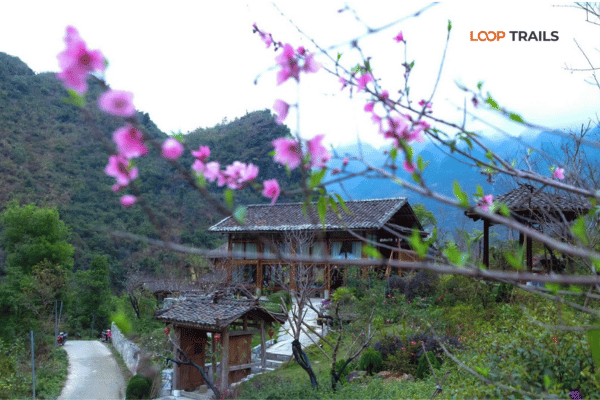
February belongs to the peach blossom (hoa đào), and to Tet. Lunar New Year moves between late January and the middle of February depending on the lunar calendar, so check the date for your year before you lock anything in.
What is flowering:
Tet and festivals: the days before Tet are some of the most interesting of the year to be in the mountains. Markets are full, families are preparing food, and houses are being cleaned and decorated. After Tet, H’Mong communities hold spring gatherings and games, including Gau Tao celebrations in some areas, with timing that varies by community.
The practical side of Tet: some family run restaurants and homestays close for the first days of the new year, buses fill up quickly in both directions, and Vietnamese travellers head to the mountains in large numbers in the days after. If you want to travel over Tet, book early and confirm that your accommodation is open on your dates. We can tell you which of our departures run over the holiday.
What it feels like: cold to cool, with grey drizzly days mixed in with clear ones. Pack for winter.
Lean more: Ha Giang in October
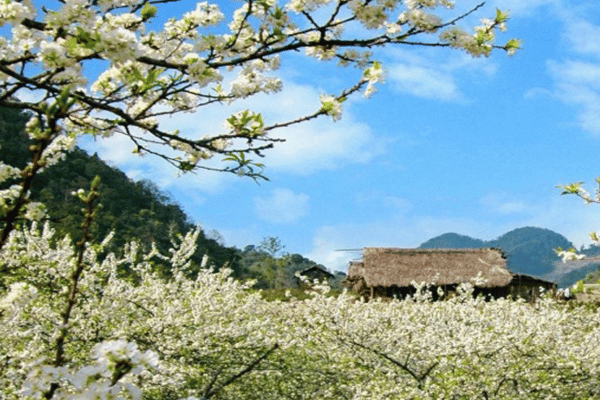
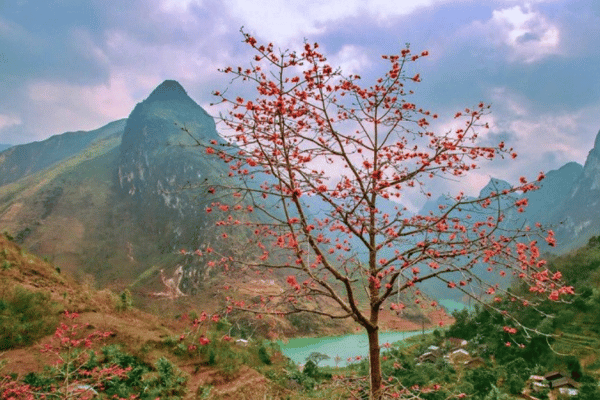
March is the quietly good month that many people overlook. The peach fades, the pear takes over, and the weather starts to soften.
What is flowering:
What it feels like: mild days, cool nights, and fewer cold snaps. Spring haze can soften the long views, partly from the weather and partly from smoke where farmers are clearing fields for planting. Distant ridges at viewpoints like Ma Pi Leng may look softer than in autumn.
Crowds: moderate. Far calmer than October or November, and comfortable for riding.
Learn more: Ha Giang Motorbike Rental
April is not really a flower month. It is a farming month, and on the Dong Van plateau that is a remarkable thing to see.
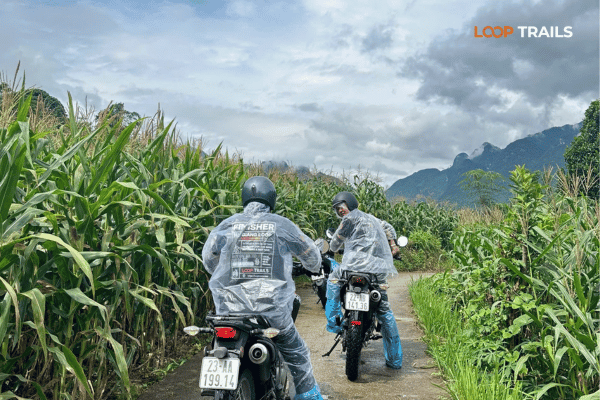
The karst here is mostly bare limestone with soil caught in pockets and cracks between the rocks. In spring, H’Mong families plant corn in those pockets, sometimes a few plants at a time, on slopes that look impossible to farm. Riding through the plateau in April, you see people working fields that are more stone than soil. It gives you a sense of how hard life up here is, and why corn matters so much: it feeds families and animals, and it becomes the corn wine you will be offered at the homestay in the evening.
What is in the fields: newly planted corn, fresh green in the valleys, and the last of the pear blossom on higher ground early in the month.
Khau Vai love market: this famous gathering in Meo Vac happens on the 27th day of the third lunar month, which lands in April or May depending on the year. It draws big crowds, so if you want to be there, plan well ahead.
What it feels like: warm days and cool nights, with the first showers arriving later in the month.
Crowds: moderate, with a sharp rise around the 30 April and 1 May holidays when Vietnamese travellers fill the roads and homestays.
Learn more: Tu San Canyon & Nho Que River Boat Trip
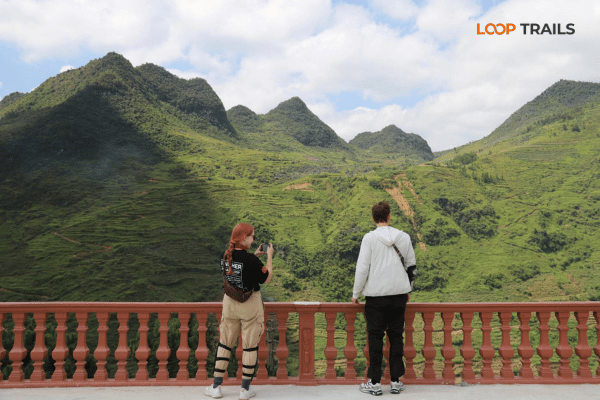
May is when the terraces in the valleys are flooded for rice planting. In Quan Ba, Yen Minh and especially around Du Gia, the fields turn into steps of water that reflect the sky. It is a completely different look from the gold of autumn, and far fewer people come to see it.
The trade off is weather. May is hot in the valleys and the first heavy rains arrive, usually as afternoon storms. Hoang Su Phi, west of Ha Giang city, is famous for its water season, but it is outside the standard loop.
We have a full guide to Ha Giang in May covering the water season, heat and rain in detail
Learn more: Ha Giang Cao Bang 6 Days 5 Nights
These are the wet months, and they divide people. Some travellers would never ride the loop in summer. Others think it is the best time of all. Both are right, depending on what you want.
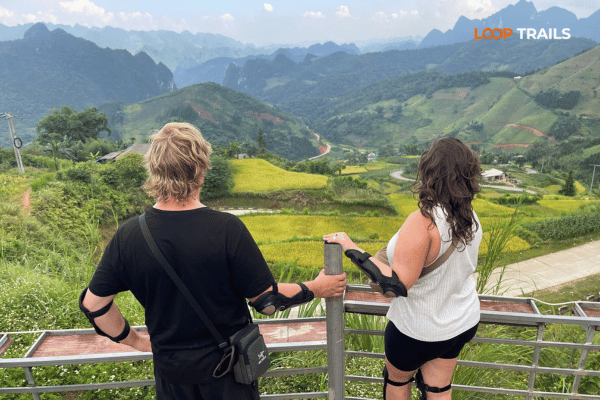
The rice is planted and the terraces turn green, the corn on the plateau is growing tall, and the whole landscape is about as lush as it gets. Rain is frequent and often heavy. For the full picture, read our Ha Giang in June guide.
July is usually the hottest and one of the wettest stretches of the year. The scenery is deep green from the valley floor to the ridges, waterfalls are full, and the roads are quiet. Clouds can sit on the passes and hide views for part of the day, then clear completely an hour later.
The corn harvest starts on the plateau in late summer. You will see corn drying under the eaves of H’Mong houses and piled on rooftops, a supply that has to last the family through the year. In the valleys, the rice starts to head, and toward the end of the month the rain usually begins to ease.
The reward is a loop with green everywhere, fewer people at every viewpoint, and the feeling of having it mostly to yourself.
Learn more: Ha Giang Loop Photography Guide
September is the rice month. As the rains ease, the terraces in the valleys turn from green to yellow to gold, and harvest begins.
Where to see it on the loop: the valley floors around Quan Ba, the fields along the road through Yen Minh, and the Du Gia valley, where the homestay looks out over rice fields. The rice harvest timing differs between valleys, so you may see gold in one place and green in another on the same day.
Off the loop: Hoang Su Phi is the best known golden terrace area in Ha Giang, usually around the second half of September into early October. It is a separate trip from the loop.
On the Ha Giang Cao Bang route: this is one of the best months for the combined tour. The fields in Xuan Truong valley turn gold, and the rice around Ban Gioc waterfall ripens while the waterfall is still carrying plenty of water from the rains. If Ban Gioc is on your list, look at our Ha Giang Cao Bang 5 days 4 nights tour or the shorter Cao Bang Loop.
What it feels like: warm, drier than summer, with occasional rain in the first half of the month.
Crowds: moderate, with a busy spell around the 2 September National Day holiday
Learn more: Buckwheat Flowers Season
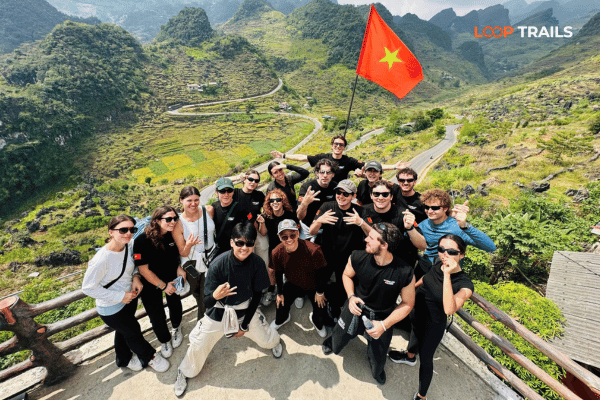
October is when Ha Giang’s peak season starts. The rice harvest finishes in the valleys, the skies clear, and the first buckwheat fields come into flower on the plateau, usually from the middle of the month onward, after the corn has been harvested and the fields replanted. Wild sunflowers start to appear along the roadsides toward the end of the month.
It is also when the weekend crowds arrive, and the best viewpoints get busy in the middle of the day.
Everything about the October bloom, the festival and the crowds is in our Ha Giang in October guide.
Learn more: Ha Giang Loop Hidden Gems
If you have seen one photo of the Ha Giang flower season, it was probably taken in November. In most years, this is when buckwheat covers the widest area of the plateau, the roadsides are lined with yellow wild sunflowers, and the sky is at its clearest.
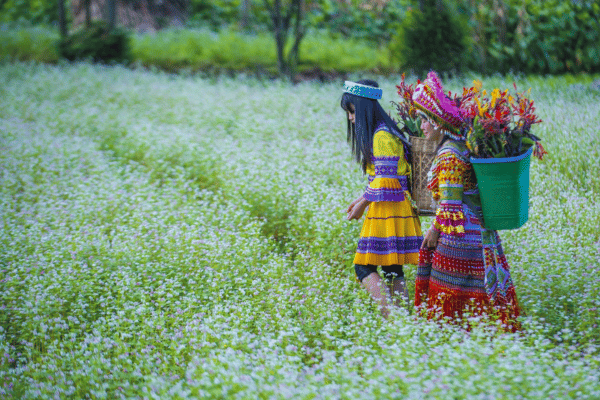
Buckwheat is a grain crop, not a decorative flower. H’Mong families have grown it for generations as food, and it is planted on the plateau fields once the corn is harvested. The small flowers grow in dense clusters, and fields at different stages show different shades, from white to soft pink to deeper pink. A hillside where several families planted on different days can look striped.
Where to see it on the loop:
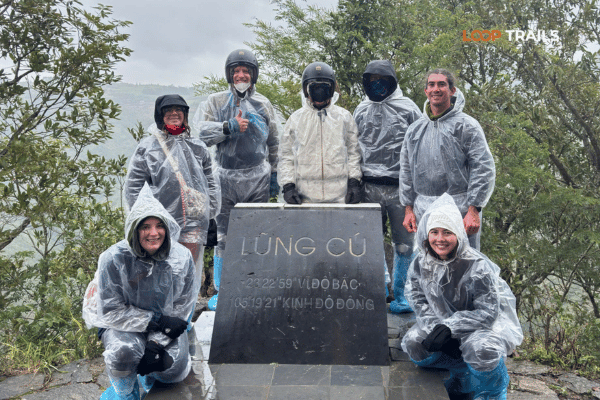
The 4 days 3 nights loop spends a full day in this zone, with Sung La, Vuong Palace, Lung Cu and Lo Lo Chai all on Day 2. The 3 days 2 nights and 2 days 1 night tours cross the plateau through Tham Ma Pass and Lao Sa into Dong Van, so you still ride through buckwheat country, just with less time to stop.
Paying to enter fields: many of the best looking fields are planted with visitors in mind, and the families who own them may ask a small fee to walk in or take photos. Pay it. It is their crop and their income, and walking into a field without asking damages the plants.
Buckwheat as food: look for buckwheat cake (bánh tam giác mạch) at markets and roadside stalls on the plateau. It is a simple, slightly nutty flat cake, best eaten warm.
The buckwheat festival: in most years, a buckwheat flower festival is held around the bloom, usually in October or November. Dates are announced locally each year, so check the latest updates rather than trusting an old date online.
The yellow flowers lining the roads in November are wild sunflowers, a tough, shrubby plant that grows on banks and verges. You see them on the climb from Ha Giang city toward Quan Ba and along many sections of the loop. They are at their brightest for only a few weeks, and they look even better against a clear blue November sky.
Yellow mustard (hoa cải) starts to appear in the fields toward the end of the month, overlapping with the last of the buckwheat.
November weekends are the busiest days of the year on the loop, mostly with Vietnamese travellers driving up from Hanoi and other cities. Weekdays are noticeably calmer. Whatever day you travel, the fields are quietest early in the morning, which is also when the light is softest. Accommodation and buses sell out on peak weekends, so this is not the month to leave booking until the last minute.
What it feels like: cold mornings and evenings, especially in Dong Van and Lung Cu, and bright, comfortable days. A fleece or light down layer earns its place in your bag.

Learn more: Cao Bang Loop 3 Days best kept secret
The buckwheat usually fades in the first part of December, and the plateau changes to yellow mustard fields, bare stone and very clear air. Long views are often at their best this month, and after the November crowds, the roads feel quiet again.
It is cold, and getting colder through the month. Around the end of the year you may also notice orange stalls along the road on the drive up from Hanoi, as the orchards in the lower areas south of Ha Giang city come into season.
The full winter picture, from weather to packing, is in our Ha Giang in December guide.

Learn more: Ha Giang Loop by Wrangler Rubicon Jeep
| If you want to see | Go in | Notes |
|---|---|---|
| Buckwheat fields | Late October to November | Broadest bloom is usually November |
| Peach and plum blossom | Late January and February | Around Tet, so book early |
| Pear blossom | March | Calmer and milder than autumn |
| Flooded terraces | May | Hot, with afternoon storms |
| Deep green and empty roads | June to August | Rain gear essential |
| Golden rice | September into early October | Valleys on the loop, Xuan Truong in Cao Bang |
| Clearest long views | October to December | Cold mornings |
| Quietest roads | Summer weekdays and December | Fewer people at every viewpoint |
There is no single best month. There is only the best month for you, and that depends on whether you care most about flowers, weather, crowds or light.
Learn more: Ha Giang Loop Easy Rider
The season you choose changes which way of travelling makes the most sense. All three tour types follow the same route and stop at the same places. The difference is how you experience the road in between.
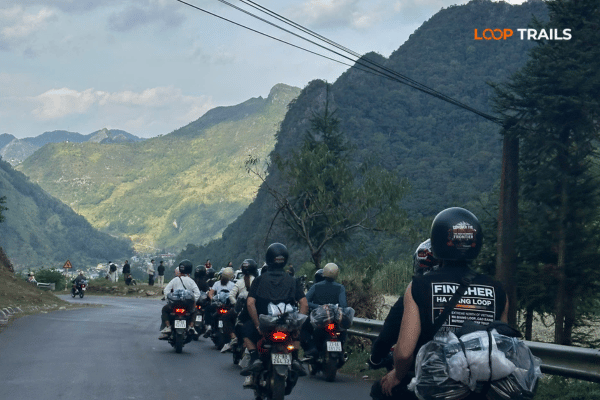
Easy Rider: you ride on the back of a motorbike with a local driver who knows every bend. This works in any month and is the safest motorbike choice in the rainy season, when wet roads punish inexperience. Your driver also knows which fields are worth stopping at and which families welcome visitors.
Self Drive: you ride your own bike behind a guide. This is at its best in the dry months, October through April, when roads are dry and you can enjoy the riding. You must carry your passport, your home motorcycle licence and an International Driving Permit under the 1968 Convention. A 1949 IDP is not valid in Vietnam. Riding without the correct documents can mean fines of 2,000,000 to 6,000,000 VND, and we do not take self drive guests without them. Rules can change, so check the latest requirements before you travel.
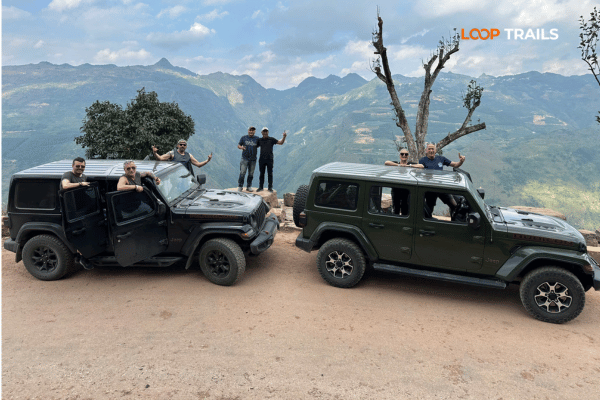
Jeep (Wrangler Rubicon): you ride in the vehicle with a driver and guide. This is the comfortable choice in the cold months and the wet months, good for couples, families and anyone carrying camera gear. In flower season it has one more advantage: you can stop anywhere it is safe to pull over, get out, and spend as long as you like at a field without worrying about the cold.
Motorbike rental: if you are an experienced rider and want to chase flowers on your own schedule, motorbike rental in Ha Giang gives you full freedom. The same licence rules apply, and in peak season you should plan your accommodation in advance.
How many days for flowers? If flowers are the main reason for your trip, the Ha Giang Loop 4 days 3 nights gives you the most time on the plateau, with a full day around Sung La, Lung Cu and Lo Lo Chai, plus the Du Gia valley on the way back. It also gives you a buffer if weather hides a viewpoint on one day.

Learn more: Ha Giang Cao Bang Loop Cost
These are our current prices. They include VAT, dormitory accommodation and everything listed in the itinerary. Private room upgrades, round trip bus tickets, and the border area permit for foreign visitors (260,000 VND per person) are extra.
Motorbike tours (price per person):
| Tour | Easy Rider | Self Drive |
|---|---|---|
| Ha Giang Loop 2 days 1 night | 3,490,000 VND | Not available |
| Ha Giang Loop 3 days 2 nights | 4,290,000 VND | 3,690,000 VND |
| Ha Giang Loop 4 days 3 nights | 5,690,000 VND | 4,890,000 VND |
| Ha Giang Cao Bang 5 days 4 nights | 10,990,000 VND | 10,590,000 VND |
| Ha Giang Cao Bang 6 days 5 nights | 13,990,000 VND | 13,490,000 VND |
Jeep Wrangler Rubicon tours (total price per vehicle, shared between passengers):
| Tour | 1 passenger | 2 passengers | 3 passengers | 4 passengers |
|---|---|---|---|---|
| Ha Giang Loop 2 days 1 night | 12,990,000 VND | 16,490,000 VND | 19,990,000 VND | 23,990,000 VND |
| Ha Giang Loop 3 days 2 nights | 17,490,000 VND | 20,990,000 VND | 24,990,000 VND | 28,490,000 VND |
| Ha Giang Loop 4 days 3 nights | 21,490,000 VND | 26,990,000 VND | 32,990,000 VND | 38,990,000 VND |
| Ha Giang Cao Bang 5 days 4 nights | 32,990,000 VND | 40,990,000 VND | 46,990,000 VND | 54,990,000 VND |
| Ha Giang Cao Bang 6 days 5 nights | 37,990,000 VND | 46,990,000 VND | 54,990,000 VND | 63,990,000 VND |
When to book: for peak flower weeks in October and November, and for travel around Tet, book as early as you can. For jeep tours in particular, most guests book one to three months ahead, because jeep availability is limited and early booking lets us arrange everything properly. We can also book your bus from Hanoi, Ninh Binh, Ha Long, Cat Ba or Sapa, with sleeper, cabin, limousine and private car options.

Learn more: Ha Giang Packing list
December to February (cold):
March and April (spring):
May to September (rainy season):
October and November (peak):
Learn more: Ha Giang Loop Mistake to Avoid
Trusting a date from an old blog. Bloom timing shifts every year. A post saying “peak buckwheat is the second week of October” describes one year, not every year.
Walking into fields without asking. Fields are crops and income. Ask, pay the fee if there is one, and stay on the edges and paths.
Leaving bookings too late in November. Peak weekends fill buses, homestays and jeeps. Book transport and your tour together, early.
Underestimating the cold on a motorbike. Clear November and December days at altitude feel very different at speed. A warm layer you can reach quickly makes a big difference.
Planning the whole trip around one viewpoint. Fog, cloud or rain can hide a view for a morning. A longer tour gives you more chances to see it in good light.
Ready to plan your trip around the season? Tell us your travel dates and we will match you with the right tour for that month: Easy Rider if you want to ride without driving, Self Drive if you hold the right licence and want the handlebars, or the Jeep Wrangler Rubicon if you want comfort, warmth and the freedom to stop at every field. Check our Ha Giang Loop tours or message us on WhatsApp to ask what is blooming right now.
Learn more: Ha Giang Border Area Permit 2026
Something is flowering in Ha Giang in most months. Plum and peach blossom come in January and February, pear in March, golden rice in September, and buckwheat and wild sunflowers in late October and November. Yellow mustard follows in December and January
The first fields usually flower in October, and the broadest bloom is typically in November. The timing depends on when the corn harvest finished and when families planted, so it shifts every year. Check the latest updates a week or two before you travel
For clear weather and flowers, October and November are the most popular months. March is a calmer alternative with pear blossom and mild weather. If you want green scenery and empty roads and do not mind rain, summer has its own appeal
Peach blossom usually appears from late January through February, around Lunar New Year. Sung La valley and Lo Lo Chai village are two of the best places to see it. The exact timing follows the weather and the date of Tet that year
It can be, if you prepare for it. June to August brings deep green scenery, full waterfalls and very few other travellers. You also get heavy rain, possible landslide delays and cloud at some viewpoints, so an easy rider or jeep tour is the better choice than self drive
The valleys on the loop usually turn gold in September, with harvest running into early October. Hoang Su Phi, which is outside the standard loop, is famous for golden terraces in the second half of September. On the Ha Giang Cao Bang route, Xuan Truong valley turns gold around the same time
Yes. All loop tours cross the Dong Van plateau, where most buckwheat is grown. The 4 days 3 nights tour spends the most time there, with Sung La, Vuong Palace, Lung Cu and Lo Lo Chai on Day 2.
Sometimes. Families who plant fields for visitors may ask a small fee to enter or take photos. Paying it supports the farmers, and you should never walk into a field without asking
Weekends in November are the busiest days of the year, mostly with domestic travellers. Weekdays are much calmer. Visiting fields early in the morning helps avoid the crowds and gives you the best light
From December to February, mornings on the Dong Van plateau can feel close to freezing during strong cold spells, and frost is possible on the highest ground. Days are often clear and pleasant in the sun. Riders need proper winter layers and gloves
The jeep tour is the easiest for photography because you can stop wherever it is safe and keep your gear dry and close. For time on the plateau, the 4 days 3 nights loop gives you the most chances at good light. Easy rider drivers also know the best fields and will stop when you ask
Yes. The combined tour covers the same plateau as the loop, then continues into Cao Bang. In September the rice in Xuan Truong valley and around Ban Gioc waterfall turns gold, and in late autumn you can see buckwheat in Cao Bang too
Contact information for Loop Trails
Website: Loop Trails Official Website
Email: looptrailshostel@gmail.com
Hotline & WhatSapp:
+84862379288
+84938988593
Social Media:
Facebook: Loop Trails Tours Ha Giang
Instagram: Loop Trails Tours Ha Giang
TikTok: Loop Trails
Office Address: 54A Tran Phu, Ha Giang 2, Tuyen Quang
Address: 54A Tran Phu, Ha Giang 2, Tuyen Quang
Facebook X Reddit Table of Contents Learn more: Ha Giang Loop Tours If you could pick one month to see the Ha

Facebook X Reddit Table of Contents Ha Giang in August does not look like the photos most people have in their heads.
Facebook X Reddit Table of Contents Most of the Ha Giang Loop is about the landscape: passes, canyons, karst peaks that go