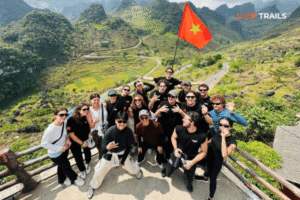


Thúy Kiều (Grace) is a travel blogger and content contributor for Loop Trails Tours Ha Giang. She holds a bachelor’s degree in Sustainable Tourism from Vietnam National University, Hanoi, and has a strong passion for exploring and promoting responsible travel experiences in Vietnam’s northern highlands.
Learn more: Ha Giang Loop Tours
There’s a specific moment on Day 3 of the Ha Giang Loop where most people go quiet. You’ve been riding for maybe forty minutes out of Dong Van, the road has been carved directly into the face of a cliff, and then you round a corner and the entire Nho Que River gorge opens up below you. The water is the kind of turquoise that looks edited. The canyon walls drop several hundred meters straight down. And the road you’re on — the one that clings to the rock like it was stitched on — is Ma Pi Leng Pass.
Day 3 is the day the Ha Giang Loop earns its reputation. This guide covers everything: the route from Dong Van to Meo Vac, what to expect at the pass itself, the Tu San Canyon boat ride, lunch in Meo Vac, and how to plan your time so you don’t rush what deserves to be taken slowly.
Learn more: Ha Giang Loop 2 Days 1 Night
The Ha Giang Loop has no shortage of dramatic landscapes. Quan Ba Twin Mountains on Day 1, the Dong Van Karst Plateau Geopark on Day 2, the terraced rice fields stretching across every horizon. But Day 3 is different it’s concentrated. In roughly 50 kilometers between Dong Van and Meo Vac, you pass through some of the most dramatic terrain in Southeast Asia.
Ma Pi Leng Pass is the centrepiece. Officially recognized as one of Vietnam’s four great mountain passes, it sits at around 1,500 meters above sea level and traces the edge of a limestone massif that was formed over 400 million years ago. Below it runs the Nho Que River, its colour the result of mineral-rich water flowing down from the Yunnan plateau in China. Tu San Canyon, carved by the river, reaches depths of nearly 800 meters in places making it one of the deepest canyons in Southeast Asia.
What this means practically: Day 3 is not a day to be rushed. It’s a day to leave early, ride slowly, stop often, and let it take as long as it needs.
Learn more: Ha Giang Loop 3 Days 2 Nights
The main stretch on Day 3 runs from Dong Van town to Meo Vac, following Provincial Road 4C (the road that Ma Pi Leng Pass sits on) and then continuing onward depending on your itinerary.
Total distance from Dong Van to Meo Vac: roughly 23 kilometers. That number is deceptively small. The road demands full attention, and the stops along the way the viewpoint platform, the canyon lookouts, the boat pier mean most groups take 3 to 5 hours to cover it properly.
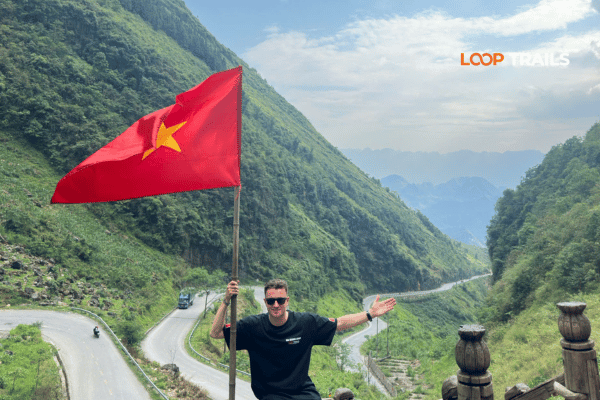
You leave Dong Van heading northeast on the main road out of town. The first stretch climbs gradually through a rocky valley before the terrain starts to tighten. The road narrows, the cliffs come closer, and within 10 to 15 kilometers you’ll reach the Ma Pi Leng viewpoint: a concrete observation platform built on the outer edge of the pass with a direct sightline down into the gorge.
This is the stop that appears in every Ha Giang photo. It gets busy between 8 and 10 in the morning when tour groups and motorbike riders all tend to arrive at the same time. If you want the platform quieter, aim to arrive before 8am or after 11am, though conditions vary. There’s no fee to access the viewpoint platform itself.
A few kilometers past the main viewpoint, the road begins its descent toward the river. Along this stretch, several informal pullout points give you elevated views of Tu San Canyon from above. These spots are unmarked but obvious: you’ll see other travelers stopped with cameras. The canyon is deepest and most dramatic when viewed from these elevated positions before you descend to river level.
The road continues down in a series of switchbacks. The surface is paved, though sections can be affected by landslips during or after heavy rain — ask locally or check with your tour operator if you’re riding during the wet season (roughly May through September). Rules around road access can change, particularly after weather events, so always confirm current conditions.
At the bottom of the descent, the road runs close to the Nho Que River for a short stretch. This is where the boat pier sits, and where you can arrange the canyon boat ride if you’re planning to do it (more on that below).
From the river level, the road continues west into Meo Vac town. The final approach into Meo Vac passes through a widening valley with views back toward the karst ridgeline you just crossed a good spot for a last look before the road flattens out and the town appears.
Learn more: Ha Giang Loop 4 Days 3 Nights
For experienced motorbike riders, Ma Pi Leng Pass is challenging but manageable. The road is paved throughout but narrow, with sections wide enough for roughly one and a half vehicles. Drop-offs on the outer edge are unfenced in places. The switchbacks require slow, deliberate riding.
For self-drive travelers who haven’t ridden much in Vietnam before: this is the section of the Loop that deserves honest assessment. If you’ve been comfortable on Days 1 and 2, Day 3 is more of the same but more exposed. Many first-time riders find the pass easier than expected if they stay slow and take breaks. Others find the exposure unsettling. An Easy Rider guide on the back of your bike — or switching to a jeep — removes that variable entirely.
Road regulations in Vietnam can change, and some sections of the Loop have at times required permits or had temporary restrictions. Check with your guide or tour operator the evening before for the current situation. Nothing in this article should substitute for local, up-to-date information on the day.
Three spots are worth planning a stop:
The main viewpoint platform (the one with the concrete observation deck) is the classic shot. Morning light hits the gorge well — the canyon faces roughly east, so earlier is usually better.
The informal pullouts on the descent into Tu San Canyon give higher and wider angles than the platform. These spots aren’t built for tourists; they’re just places where the guardrail ends and the view opens. Watch your footing.
The river level, near the boat pier, gives you the inverted perspective: looking up at the canyon walls from below. If you’re doing the boat ride, you’ll get this automatically.
Allow at minimum 2 hours from Dong Van to Meo Vac if you’re treating it as a drive-through. To do it properly — proper stop at the viewpoint, a couple of canyon overlooks, and the boat ride — plan for 4 to 5 hours. Most LoopTrails itineraries build Day 3 around this section specifically, so your schedule should already reflect it. If you’re on a self-drive trip, this is not the day to have a late start.
Learn more: Ha Giang Cao Bang 5 Days 4 Nights
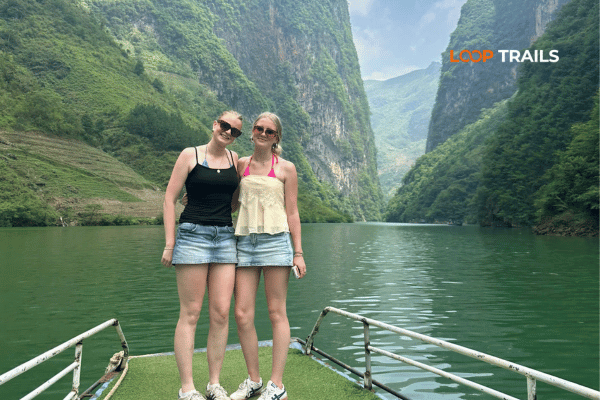
The boat ride on the Nho Que River runs through the lower section of Tu San Canyon, taking you between the canyon walls at water level. Boats are small: typically flat-bottomed vessels that seat 6 to 10 passengers. The ride goes upriver for a stretch, passes under rock faces that tower directly overhead, then returns to the pier. The water is calm in dry season; conditions change in rainy season when the river level rises.
The ride lasts around 30 to 45 minutes. The canyon walls close in tightly in places, and the colour of the water — that famous blue-green is most vivid in dry conditions, roughly October through April. In wetter months, the river can run murkier and the visual effect is less dramatic.
Honestly: yes, with one caveat. The view from above the canyon (the road, the viewpoint platform) is more visually dramatic in photos. But the boat ride gives you something the road doesn’t — a sense of scale you can only feel from inside the gorge. Looking up at limestone walls that rise 700-plus meters directly overhead is an experience that doesn’t translate to a photograph.
If you’re short on time or visiting in wet season when the river is less scenic, it’s a reasonable skip. If you have 40 minutes and dry-season clarity, do it.
The boat pier is located at the base of the road descent, roughly 10 to 15 kilometers from Dong Van. Boats depart when enough passengers are available — there’s no fixed schedule. Pricing is typically set locally and shared between passengers on the same boat. Rates can change; confirm current prices at the pier rather than relying on any figure published online, including here.
If you’re on an Easy Rider or jeep tour with LoopTrails, your guide will coordinate the boat stop. If you’re self-driving, follow the signs to the pier from the main road.
Learn more: Ha Giang Cao Bang Ba Be Lake 6 Days 5 Nights
Meo Vac is the endpoint for Day 3 and the main town in this part of Ha Giang province. It’s smaller than Dong Van, with a more local feel fewer tourist guesthouses, more working-town atmosphere. After the drama of the pass, the town comes as a gentle landing.
Meo Vac’s Sunday market is one of the most authentic ethnic minority markets in the north of Vietnam. Hmong, Dao, Giay and other groups come down from surrounding villages to trade: livestock, produce, textiles, tools. If your Day 3 falls on a Sunday, plan to spend at least an hour here. The market runs through the morning and starts winding down by early afternoon.
If you’re not arriving on a Sunday: Meo Vac still has a smaller daily market near the town centre, though the scale and atmosphere are incomparable to the weekly one. Worth a walk-through regardless
The main street running through the town centre has a cluster of local restaurants serving standard northern Vietnamese food: pho, bun bo, com ga, thang co (a local stew made with horse meat — an acquired taste but authentic to the region).
For a practical lunch, any restaurant with a visible kitchen and local customers is a safe choice. Avoid anywhere that’s been left specifically as a “tourist trap” (these tend to have laminated English menus at double the price). Your guide will know the current reliable options. The meal won’t be elaborate, but you’re not stopping in Meo Vac for a restaurant experience — you’re stopping because you’ve just ridden one of the most dramatic roads in Asia and you’ve earned a sit-down.
Learn more: Ha Giang Motorbike Rental
This is the section most people skip and then regret not reading. Day 3 specifically is the place where your choice of tour format matters most, because Ma Pi Leng Pass is the most exposed and demanding section of the Loop.
Easy Rider (motorbike with guide driver) You ride as a passenger behind an experienced local driver who knows the pass. You get the open-air experience and the road-level perspective without any of the responsibility for navigating exposed switchbacks. This is the most popular format and the one most first-time Loop travelers choose. You can focus entirely on looking around.
Self-Drive Motorbike You ride your own bike, at your own pace, with complete freedom to stop wherever you want. On Day 3, this means you need to be genuinely comfortable with the road conditions described above. Most capable riders find it deeply satisfying. If there’s any doubt in your mind before the day starts, talk to your guide the evening before. No amount of landscape is worth an accident.
Jeep Tour The jeep option follows the same route but from a vehicle. You won’t feel the wind the same way, but you’ll see everything, and the views from a raised open jeep on the Ma Pi Leng cliff road are genuinely excellent. For travelers who don’t ride motorbikes, for couples where one person is nervous, for anyone who wants to take in the scenery without managing a vehicle in an exposed mountain environment, the jeep is the right call. Not a compromise just a different (and very comfortable) way to experience the same road.
Not sure which fits you? Our tour pages break down each option in detail including group sizes, what’s included, and departure schedules. If you’re weighing it up, feel free to send us a message on WhatsApp and we’ll help you figure out what makes sense for your trip.
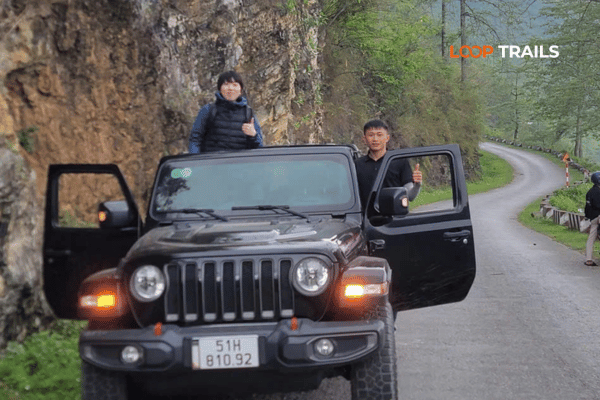
Learn more: Ha Giang Loop by Army Jeep Tours
Aim to be on the road by 7:30 to 8am. This gets you to the Ma Pi Leng viewpoint before the mid-morning rush, gives you the best light for photography, and means you have the full morning to move slowly through the pass before arriving in Meo Vac for a late lunch.
Leaving after 9am isn’t a disaster, but you’ll hit the viewpoint platform at its most crowded and lose the early-morning softness of the light.
Layers matter on Day 3. Even in the dry season, the pass sits at altitude and can be cold in the early morning, then warm by mid-morning once you descend. Pack a windproof layer you can remove easily. Sunscreen is important the reflection off limestone at altitude burns faster than expected.
A bag or dry bag for your camera and phone is worth having regardless of season. Mist and occasional light rain can appear on the pass without warning, even in months that are technically dry. Fingerless gloves are useful for riders who don’t want sweaty palms on the handles.
One practical note: there are no ATMs on the route between Dong Van and Meo Vac. Carry enough cash for the boat ride, any snacks on the pass, and your lunch in Meo Vac before you leave Dong Van in the morning.
Day 3 is at its best in the dry season (roughly October through April). Clear mornings give you the turquoise water, the sharp canyon walls, the unobstructed views from the pass. In these months, the window between 7 and 10am is typically the clearest.
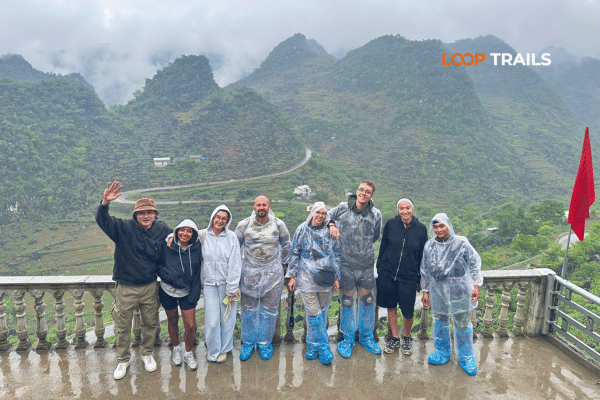
In the wet season (May through September), cloud and mist can sit across the pass for much of the morning. This isn’t always a problem mist over a limestone gorge has its own atmosphere but it can obscure the key views. If you’re specifically coming for the photography, dry season is significantly better.
The Ha Giang weather guide on the blog covers month-by-month conditions in more detail if you’re still planning your timing.

Learn more: Cao Bang Loop 3 Days best kept secret
After Meo Vac, your route depends on your tour format:
On a 3 days 2 nights Loop, Day 3 typically ends in Meo Vac or continues south toward Bao Lac and then back toward Ha Giang city, arriving by late afternoon or evening. The return route through the Du Gia area has its own scenic value: lower elevation, lusher forest, waterfalls close to the road.
On a 4 days 3 nights Loop, there’s more flexibility. Some itineraries spend a night in Meo Vac and use the extra time to explore local villages, visit the Sunday market if timing allows, or extend the Nho Que experience. Others route through Lung Cu flagpole on Day 4 before heading south.
On a Ha Giang to Cao Bang combo tour (5 or 6 days), Day 3 ends in Meo Vac and Day 4 continues east toward Bao Lac and the Cao Bang province. This is the extended route for travelers who want to combine the Loop with Ban Gioc Waterfall, Nguom Ngao Cave, and the Phia Oac National Park area.
Whichever format you’re on: Day 3 is the midpoint, and what comes after is worth planning as carefully as what you’ve just done. If you haven’t looked at the full itinerary options yet, the tour pages on the LoopTrails website lay out all the formats side by side.
Learn more: Ha Giang Loop Mistake to Avoid
The pass itself, from the start of the exposed cliff section to Meo Vac, is roughly 15 to 20 kilometers. Riding time without stops is around 45 minutes to 1 hour. With a proper stop at the viewpoint and a canyon overlook or two, most riders take 2 to 3 hours for this section alone. Budget the full morning.
It depends on your definition of beginner. The road is paved and not technically complex there are no off-road sections. The main challenge is the exposure: the outer edge of the road in places has no barrier, and the drop is significant. Most riders who’ve been comfortable on Days 1 and 2 find Day 3 manageable if they ride slowly and take breaks. If you’re genuinely uncertain, the Easy Rider format removes all risk from the equation — you ride as a passenger with a local driver.
Yes. The boat pier is accessible on foot from the road, so riders, Easy Rider passengers, and jeep tour guests can all access it. The stop is included or available on all LoopTrails tour formats. If you’re self-driving, there’s space to park near the pier.
October through April for clear skies and the turquoise river colour at its most vivid. The buckwheat flower season in October to November adds pink and white hillside colour to the landscape. March is popular for mustard flowers in the valleys. May through September brings green terraces but also cloud, mist, and occasional landslips on mountain roads — manageable but less photogenic.
There are a few small stalls near the Ma Pi Leng viewpoint platform selling drinks, instant noodles, and snacks. Options are limited. Have a proper breakfast in Dong Van before leaving, carry water, and plan on a full lunch in Meo Vac. Don’t count on a restaurant on the road.
Permit and license requirements for riding in Ha Giang and on specific roads in the province can change. At the time of writing, standard requirements apply, but rules around border-zone areas and mountain passes are subject to revision. Check with your tour operator for the current requirements before your trip — this is not the kind of thing to rely on outdated blog posts for.
It runs in the morning from roughly 6am to early afternoon. Ethnic minority groups from surrounding villages — Hmong, Dao, Giay and others — bring livestock, produce, clothing, and tools. It’s working market, not a tourist market: prices are for locals, the atmosphere is busy and functional, and it’s one of the most authentic cultural stops on the entire Loop. If your tour falls on a Sunday, don’t skip it.
Yes, and it’s worth considering. A 4 days 3 nights Loop itinerary can include an overnight in Meo Vac, which gives you time to explore the town properly, do an evening walk, and wake up for the market if it’s a Sunday. This is one of the reasons the 4-day format appeals to travelers who don’t want to rush.
A misty pass is atmospheric and still worth experiencing, but the signature views — the turquoise river, the canyon walls — require clear air. If cloud is heavy at departure time, it’s worth waiting an hour in Dong Van for conditions to change. Your guide will advise. In wet season, if conditions are unsafe (heavy rain, reported landslips), your operator may adjust the route or timing — safety always takes priority over schedule.
If you’re riding as a passenger (Easy Rider or jeep), Day 3 is not physically demanding at all you’re sitting and looking. If you’re self-driving, it’s mentally more taxing than physically, because the road requires full attention. Stamina-wise, the distance is short. The experience is intense not because of effort but because of exposure to an extraordinary landscape.
Contact information for Loop Trails
Website: Loop Trails Official Website
Email: looptrailshostel@gmail.com
Hotline & WhatSapp:
+84862379288
+84938988593
Social Media:
Facebook: Loop Trails Tours Ha Giang
Instagram: Loop Trails Tours Ha Giang
TikTok: Loop Trails
Office Address: 48 Nguyen Du, Ha Giang 1, Tuyen Quang
Address: 48 Nguyen Du, Ha Giang 1, Tuyen Quang
Facebook X Reddit Table of Contents Learn more: Ha Giang Loop Tours Most people drive past the Quan Ba area twice on

Facebook X Reddit Table of Contents Learn more: Ha Giang Loop Tours The Ha Giang Loop has a reputation problem with older