
Thúy Kiều (Grace) is a travel blogger and content contributor for Loop Trails Tours Ha Giang. She holds a bachelor’s degree in Sustainable Tourism from Vietnam National University, Hanoi, and has a strong passion for exploring and promoting responsible travel experiences in Vietnam’s northern highlands.
Learn more: Ha Giang Loop Tours
There is a particular kind of quiet that settles over a Hmong village in Ha Giang in the early afternoon. The market has finished, the motorbikes have gone, and if you sit long enough near a doorstep or a wooden bench outside a shop, you will almost certainly see a woman pull out a piece of fabric and begin to stitch. Not because you are there. Because this is just what happens when there are a few spare minutes.
Hmong embroidery in Ha Giang is not a craft preserved for tourists. It is an active, living tradition, practiced by girls from childhood and carried through life as both cultural expression and practical skill. The textiles it produces indigo cloth covered in geometric patterns, batik-work borders, and intricate cross-stitch are among the most distinctive handmade objects in Southeast Asia. And unlike many craft traditions in Vietnam, it has not been heavily industrialized or cheapened into airport-souvenir versions (though that risk exists, and this guide will help you navigate it).
This is a practical guide for travelers on or around the Ha Giang Loop who want to understand what they are seeing, know where to find genuine workshop experiences, make smart decisions when buying textiles, and come away with a real appreciation for what goes into every piece.
Learn more: Ha Giang Loop 2 Days 1 Night
Vietnam has many textile traditions: the silk weaving of Hoi An, the brocade of the Muong in Hoa Binh, the woven patterns of the Red Dao in Sapa. Hmong embroidery is distinct from all of these in both technique and intent.
The method is primarily cross-stitch embroidery worked onto hemp or cotton cloth, often first treated with indigo dye. The patterns are almost entirely geometric: diamonds, triangles, spirals, stylized flowers, and interlocking border sequences that require counting and spatial precision rather than freehand drawing. There is no tracing, no template pinned to the fabric experienced embroiderers work entirely from memory and muscle knowledge built over decades.
The Flower Hmong (a subgroup of the broader Hmong ethnic community) are particularly associated with elaborate embroidered dress in Ha Giang. Their traditional clothing is visually striking enough that you will notice it from thirty meters away at a market: deep indigo or black base cloth layered with densely stitched panels of red, orange, yellow, and green geometric work, often finished with appliqué borders and pleated skirts. The embroidery is not decorative in a casual sense. Each piece of a woman’s traditional outfit represents months of work and communicates things about her identity, her family, and her status that a casual observer cannot read but that members of the community understand.
What you see sold at markets and in craft shops is typically a simplified version of this tradition: smaller items produced more quickly, sometimes with synthetic thread rather than naturally dyed cotton. The skill involved is still real. But the full-complexity pieces a complete traditional jacket, a ceremonial textile meant for family use are rarely for sale at all.
Learn more: Ha Giang Loop 3 Days 2 Nights
The Ha Giang Loop road passes through the heart of Hmong highland culture. You will encounter women doing embroidery at roadside stops, homestays, and village markets throughout the circuit. A few places are worth flagging specifically.
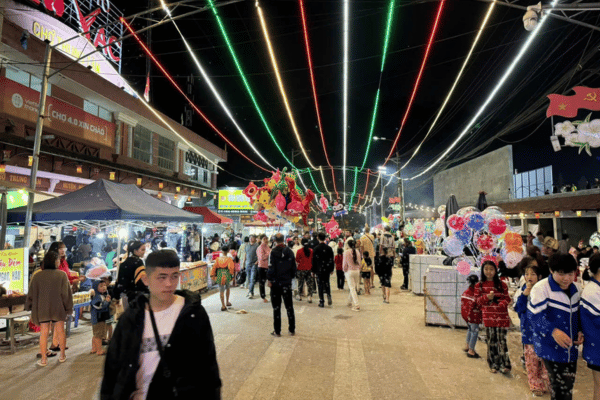
Dong Van is one of the most historically layered towns on the Loop: French colonial-era stone houses, a Sunday market, and a position deep in the Dong Van Karst Plateau Geopark. The market here (held on Sundays, though the surrounding streets stay lively on other days) brings in Hmong, Nung, Tay, and Lo Lo communities from the surrounding mountains.
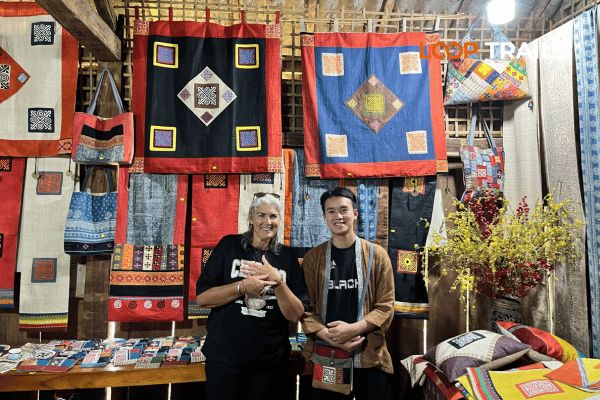
Embroidered textiles are sold at stalls near the market’s edge and in small permanent shops along the main street. This is one of the better places on the Loop to see a range of pieces in one location: finished garments, panels of raw embroidered cloth sold by the meter, bags, pillow covers, and decorative panels cut from larger pieces of traditional clothing.
One thing to be aware of: some stalls in Dong Van sell mass-produced or machine-embroidered items alongside handmade pieces. Look for irregular stitching (consistent but not machine-perfect), slightly uneven thread tension on the reverse side, and the small imperfections that come from hand work. A handmade piece and a machine-printed one can look similar from a distance; they look very different up close.
Learn more: Ha Giang Loop 4 Days 3 Nights
Meo Vac sits at the far end of the Meo Vac valley, below the famous Ma Pi Leng Pass on the road from Dong Van. The town has its own Sunday market and it draws a different demographic than Dong Van: more remote, less tourism infrastructure, and a higher proportion of Hmong communities from genuinely isolated mountain villages.
The embroidery sold here tends to be less curated for tourist tastes and more oriented toward what local women actually produce and trade among themselves. If you are looking for authentic textile work with less tourist markup, Meo Vac’s market is worth planning your itinerary around. The tradeoff is that English is essentially non-existent here, and haggling, if any occurs, happens entirely through gesture, calculators, and goodwill.
The drive from Dong Van to Meo Vac via the Ma Pi Leng Pass is one of the great road experiences in Southeast Asia in its own right: a narrow mountain road carved into the cliff above the Nho Que River canyon, with views that make every passenger instinctively reach for their camera. Combining the pass with the Meo Vac market is a natural half-day on most Ha Giang Loop itineraries.
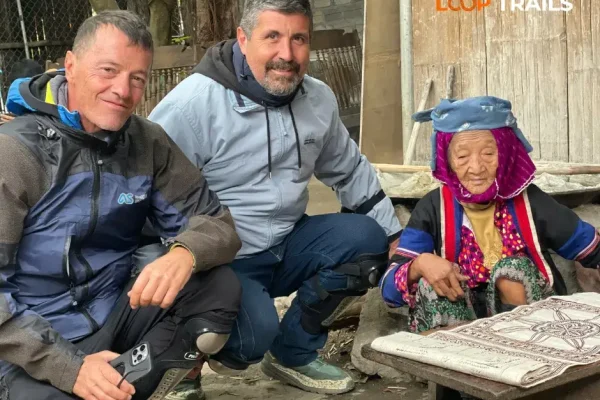
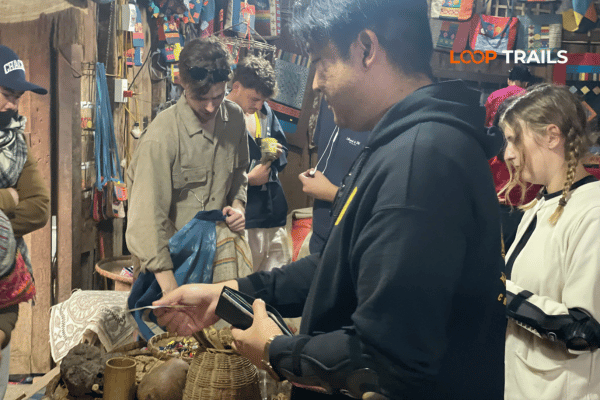
The most genuine embroidery encounters happen not at markets but in villages, particularly if you are staying at a homestay rather than a hotel in town. In many Hmong villages along the Loop, evening hours after dinner are when embroidery gets done. Women sit outside in the last light or under a single bulb, working on whatever project is currently on the go.
If you are staying at a homestay, your host family or guide can often facilitate a conversation or an impromptu demonstration. These moments are not workshops — there is no curriculum, no “traditional craft experience” structure. They are just what happens when you are a respectful guest in someone’s home and show genuine interest in what they are doing.
The villages around Du Gia, on the longer 4 days version of the Ha Giang Loop, are particularly known for this kind of encounter. The area sees fewer visitors than the main Dong Van to Meo Vac circuit and has a quieter, less commercialized feel.
Learn more: Ha Giang Cao Bang 5 Days 4 Nights
The short answer is yes, though “workshop” covers a wide range of experiences, from a 20-minute supervised stitching session to a multi-hour introduction that actually teaches you something.
Formal embroidery workshops in Ha Giang are not as established as, say, cooking classes in Hoi An or weaving workshops in Chiang Mai. The infrastructure is still developing. What exists tends to fall into a few categories:
A genuine embroidery workshop as opposed to a quick demonstration will involve some or all of the following:
You will start with an explanation of the fabric and thread materials. Traditional pieces use hemp cloth and naturally dyed thread; most workshops today use cotton and pre-dyed commercial thread, which is easier to source and more consistent. If the workshop uses natural indigo-dyed cloth, that is a meaningful indicator of quality.
The instructor will show you the basic cross-stitch technique on a prepared piece, then guide you through a simple pattern on your own small piece of fabric. Do not expect to produce anything impressive in a 1 to 2 hour session even the simplest traditional patterns require a level of repetition that takes weeks to internalize. What you will come away with is a respect for the labor involved that you cannot get from watching or buying.
Some workshops include a discussion of pattern symbolism and cultural context. This is the part that distinguishes a good workshop from a craft-souvenir experience, and it is worth seeking out specifically.
Bring: patience, a willingness to look foolish at something you cannot do well, and an open-ended schedule. Good craft workshops do not work well when you are watching the clock.
Learn more: Ha Giang Cao Bang Ba Be Lake 6 Days 5 Nights
The honest advice here is to ask your tour guide or homestay host rather than booking through a website. The workshop scene in Ha Giang is local, informal, and changes faster than any website can track. A guide who knows the Loop well will know which villages have active embroidery programs and which market cooperatives have English-speaking facilitators.
If you are traveling independently, asking at your homestay the evening before you want to do a workshop gives enough lead time for hosts to arrange something meaningful. Tipping the embroiderer directly not just paying the homestay is standard and appreciated.
One caution: be skeptical of any workshop that charges a high price, runs in a hotel lobby, and produces a laminated certificate at the end. These are usually designed around a tourist-experience model that extracts maximum payment for minimum genuine cultural exchange. The best embroidery encounters in Ha Giang tend to happen in someone’s kitchen or on someone’s front step.
Learn more: Cao Bang Loop 3 Days best kept secret
Buying embroidered textiles in Ha Giang is one of the more ethically straightforward souvenir decisions in Vietnam, provided you pay attention to what you are actually buying.
The genuine article: Handmade embroidery produced by Hmong women using traditional or near-traditional techniques. These pieces take real time a small bag panel might represent 10 to 20 hours of work; a larger garment panel, 40 or more. Prices that reflect this are not gouging; they are accurate. If something handmade looks suspiciously cheap, it probably is not what it claims to be.
Machine-produced imitations: A growing number of items sold at markets and shops in tourist areas are printed or machine-embroidered. The patterns can look similar at a glance. Check the reverse side of any textile: hand embroidery shows the working threads on the back, which look irregular and deliberate; machine work shows perfectly uniform thread paths or a backing fabric that hides the reverse entirely. Also run your fingers across the stitches; machine embroidery sits flat and smooth, hand embroidery has a slight texture and depth from the individual stitch pulls.
Items worth considering:
Items to approach carefully:
On bargaining: Hard bargaining with a Hmong woman selling at a market for a piece she has spent 15 hours making is not a good look. Polite negotiation is fine. Walking away because you want to pay a quarter of the asking price for something genuinely handmade is not. The margins in traditional craft are not large.
If you are buying directly from a cooperative, prices are typically fixed. This is actually a feature, not a problem.
Learn more: Ha Giang Motorbike Rental
Most travelers walk away from Ha Giang with a textile in their bag and a vague sense that the patterns mean something. They do but the meanings are not always simple to translate, and some are not meant for outsider consumption at all.
Some broad points that are widely shared and not sensitive to discuss:
Geometric patterns as clan and family markers: Hmong embroidery patterns vary by sub-group (Black Hmong, Flower Hmong, White Hmong, Green Hmong) and by family or clan lineage. A woman from one group looking at the clothing of a woman from another can identify regional origin, family background, and social status from the pattern combination. These patterns are not decorative choices; they are inherited.
Color symbolism: Red is associated with luck, strength, and vitality. Black and dark indigo are the base colors because indigo-dyed hemp is the traditional cloth material. Greens and yellows appear in Flower Hmong embroidery with meanings that vary by region ask locally if this interests you specifically.
Ceremonial versus everyday: The most elaborate embroidery appears on clothing worn for New Year celebrations (Hmong New Year falls in November or December depending on the village and the lunar calendar), weddings, and funerals. The everyday clothing that women wear to markets and while working is embroidered but at a lower density. The full ceremonial dress of a Flower Hmong woman can represent years of accumulated work.
The practice itself as identity: Among Hmong communities in northern Vietnam, a woman’s embroidery skill is not a hobby it is a central marker of competence, industriousness, and cultural knowledge. Young women learn from their mothers and grandmothers; the transmission of specific patterns from mother to daughter is a form of inheritance that has no monetary value and cannot be purchased at a market stall.
This is worth keeping in mind when you watch someone embroider on a doorstep. You are not watching a craft demonstration. You are watching a lifelong practice.
Learn more: Ha Giang Loop by Army Jeep Tours
If embroidery and Hmong textile culture are a genuine interest rather than a passing curiosity, here is how to think about structuring your visit:
If you have 3 days on the Loop: The standard 3 days 2 nights Ha Giang Loop circuit passes through Dong Van and Meo Vac, which means you will have natural market opportunities. Ask your guide or tour operator specifically about embroidery cooperative stops. This is the minimum itinerary for someone who wants to see genuine textile work in context.
If you have 4 days: The 4 days 3 nights version adds time around Du Gia and off-route villages, which is where the most unhurried, least commercialized encounters happen. If you want a hands-on workshop experience rather than a market visit, this is the format to choose. The extra day makes the difference between rushing past craft culture and actually sitting with it.
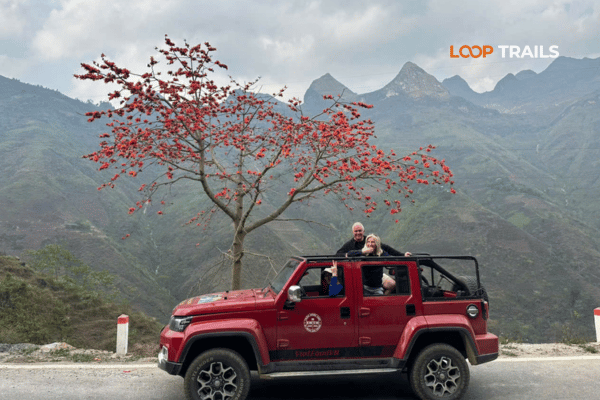
If you are not a motorbike rider: You can cover exactly the same villages and markets on a jeep tour. The advantage of a jeep for craft-focused travelers is that you can stop more spontaneously, carry more back (textiles are not the lightest things), and have more energy at the end of the day for an evening embroidery session at the homestay. If the idea of riding a motorbike for three days in the mountains is less appealing than the idea of exploring village craft culture in comfort, the jeep format is the more sensible choice.
If you want to combine Ha Giang embroidery culture with a longer northern Vietnam trip: The Ha Giang to Cao Bang combination itinerary takes 5 days and extends the cultural exposure significantly. Tay and Nung textile traditions in Cao Bang are different from Hmong embroidery woven brocade rather than cross-stitch and seeing both in sequence gives you a much richer picture of northern Vietnamese textile culture as a whole.
Loop Trails runs the Ha Giang Loop in 3 days and 4 days formats, in easy rider, self-drive, and jeep modes. The Ha Giang to Cao Bang combination is also available. [Check the Ha Giang Loop tour options here link to tour page.] If you want to ask about building a craft-focused itinerary specifically, [reach out on WhatsApp link to contact page] and we can help you plan around the market days and village access points that matter most for this kind of travel.
Learn more: Ha Giang Loop Mistake to Avoid
Time your visit around market days. The major markets on the Loop rotate through the week: Dong Van’s main market is Sunday, Meo Vac’s is also Sunday (though smaller daily activity continues all week). Yen Minh has a market on Sundays and Thursdays. Check your specific itinerary dates arriving at Dong Van on a Wednesday instead of a Sunday changes the textile experience significantly.
Bring cash in small denominations. Market vendors and cooperative sellers rarely have change for large bills. Having a stack of 20,000 and 50,000 VND notes makes transactions smoother and avoids the awkward moment of accidentally overpaying because change is unavailable.
Photography at markets is a sensitive matter. Hmong women at Dong Van and Meo Vac markets are frequently photographed by tourists, and reactions range from indifferent to uncomfortable to actively unwilling. The rule of thumb that applies everywhere in travel applies here: ask first, accept no gracefully, and never push a camera into someone’s face to capture a “traditional” moment. Women who are actively selling crafts are usually more comfortable with photos than women who are simply going about their morning.
Washing and care for embroidered textiles. Genuine hemp or cotton embroidery with natural dyes should be hand-washed cold and dried flat in shade. Machine washing and hot water will fade natural dyes and stress the thread. Ask the seller for care instructions; the answer will also tell you something about the materials used.
What to bring to a workshop:
Language: Almost no English in village contexts. Your tour guide is invaluable here, both for translation and for knowing which families and cooperatives are genuinely welcoming versus commercially motivated. If you are traveling independently, a Vietnamese-speaking travel companion or a good phrasebook makes the difference between a surface-level encounter and a real conversation.
The best souvenir you can take home is not a bag or a wall hanging. It is a photograph of your own clumsy first stitches next to the work of the woman who taught you, and a realistic sense of how long the beautiful piece you bought actually took to make.
Learn more: Ha Giang Loop Easy Rider
Hmong embroidery is a traditional textile craft practiced by the Hmong ethnic communities of northern Vietnam, southern China, Laos, and Thailand. It involves geometric cross-stitch patterns worked onto hemp or cotton cloth, often using indigo-dyed fabric as the base. Ha Giang is one of the primary areas of Hmong settlement in Vietnam and the Ha Giang Loop passes through the heartland of Flower Hmong and Black Hmong communities, making it the most accessible location in Vietnam to encounter this craft in its living cultural context.
Yes, though they are more informal than in other Vietnamese craft destinations. Homestay-organized sessions, women’s cooperative workshops, and guide-facilitated village encounters are all available. The most authentic experiences tend to be arranged locally rather than booked online, often through your tour guide or homestay host. Ask specifically when booking your tour if a hands-on embroidery session is a priority.
Check the reverse side of the textile. Hand embroidery shows irregular thread paths on the back, with individual stitch knots visible; machine embroidery has perfectly uniform reverse threads or a solid backing fabric hiding the mechanics entirely. Running your fingers across the stitched surface also helps: hand work has a slight uneven texture from individual needle pulls; machine work sits uniformly flat. Genuine hand-embroidered pieces also take real time to produce, so prices that seem very low for a complex pattern are a warning sign.
Dong Van has its largest market on Sundays. Meo Vac also holds its main market on Sundays. Yen Minh has markets on Sundays and Thursdays. Planning your Loop itinerary so that you arrive at Dong Van or Meo Vac on a Sunday significantly increases both the volume and variety of embroidered textiles available, and the general market atmosphere is worth experiencing regardless of craft interest.
Polite negotiation is acceptable and expected at market stalls. However, it is worth calibrating what you are asking for. Handmade Hmong embroidery represents significant skilled labor time. Pushing a seller below a reasonable price for something that took days to produce is not the kind of travel most people want to look back on. Fixed-price cooperatives are often the most straightforward option if bargaining feels awkward.
Small framing panels, embroidered bags and pouches, and pillow cover panels are practical purchases that travel well. Larger garment sections and complete traditional clothing pieces are beautiful but require more knowledge to evaluate correctly. Avoid any seller who cannot tell you clearly whether an item is handmade or machine-produced.
These are distinct subgroups of the broader Hmong ethnic community, differentiated by geography, dialect, and traditional clothing style. Flower Hmong women are particularly recognizable for their elaborate, densely embroidered and pleated traditional dress. Black Hmong (more associated with Sapa) wear dark indigo clothing with simpler embroidery accents. In Ha Giang, Flower Hmong and White Hmong communities are both present. The embroidery patterns and color palettes differ significantly between subgroups, and women within the community can read this information at a glance.
Most workshop settings in Ha Giang are designed around adult attention spans and fine motor skills, but simple embroidery is genuinely accessible to older children (10 and up) who are interested. Check with the workshop facilitator in advance. The village context is generally family-friendly, and children curious about the craft tend to be welcomed.
Not strictly, but it helps significantly. At tourist-oriented market stalls in Dong Van, basic price negotiation happens through calculators and gesture. At village workshops and cooperative settings, having a Vietnamese-speaking guide or companion opens up the cultural explanation component that makes the experience worthwhile beyond the craft itself. If you are on a guided tour, your guide handles this; if you are traveling independently in rural areas, a translation app with offline Vietnamese downloaded is a practical minimum.
The 4 days 3 nights format is the best choice for travelers who want both market access and a village workshop experience. It includes time in the Dong Van and Meo Vac area (for Sunday markets, if the dates align) as well as the Du Gia valley and off-route village access that makes genuine craft encounters more likely. The 3 days 2 nights version covers the key market towns but leaves less margin for spontaneous stops or evening activities.
Yes, though the specifics vary by community and are not all openly discussed with outsiders. Certain patterns and textile types are associated with funeral rites, wedding gifts, and New Year ceremonies. The full ceremonial dress of a Hmong woman is among the most embroidery-intensive objects in her life and carries specific cultural significance that decorative tourist items do not share. If you encounter ceremonial clothing for sale, approach the purchase with that context in mind.
Contact information for Loop Trails
Website: Loop Trails Official Website
Email: looptrailshostel@gmail.com
Hotline & WhatSapp:
+84862379288
+84938988593
Social Media:
Facebook: Loop Trails Tours Ha Giang
Instagram: Loop Trails Tours Ha Giang
TikTok: Loop Trails
Office Address: 48 Nguyen Du, Ha Giang 1, Tuyen Quang
Address: 48 Nguyen Du, Ha Giang 1, Tuyen Quang
Facebook X Reddit Table of Contents Learn more: Ha Giang Loop Tours Most people drive past the Quan Ba area twice on

Facebook X Reddit Table of Contents Learn more: Ha Giang Loop Tours The Ha Giang Loop has a reputation problem with older