


Thúy Kiều (Grace) is a travel blogger and content contributor for Loop Trails Tours Ha Giang. She holds a bachelor’s degree in Sustainable Tourism from Vietnam National University, Hanoi, and has a strong passion for exploring and promoting responsible travel experiences in Vietnam’s northern highlands.
Learn more: Ha Giang Loop Tours
The first time most people open a Ha Giang Loop map, they expect a tangle of roads and a navigation headache. The reality is calmer than that, and also more interesting. The Loop is built around one main mountain road, but the moment you climb onto the passes your phone signal starts dropping in and out, and that is where a good offline setup quietly saves your trip. This guide walks you through the route, the apps that actually work up there, the pins worth saving before you leave, and how to plan your days so the map serves the ride instead of the other way around.
We run trips on these roads every week, so the advice here comes from watching what trips people up in practice, not from a generic checklist.

Learn more: Ha Giang Loop 2 Days 1 Night
Short answer: you need a plan more than you need turn by turn directions. The core Loop follows one primary road, QL4C, looping north out of Ha Giang City through the highlands and back. For long stretches there is simply nowhere else to go, and the route is reasonably signed between the main towns.
So why does navigation still catch people out? Because the interesting parts of the Loop are rarely the main road. The detours are where the trip lives, and detours are where people get turned around.
A few spots account for most of the wrong turns:
None of this is hard. It just means a map you can trust without signal is the difference between a relaxed ride and a stressful one.
Learn more: Ha Giang Loop 3 Days 2 Nights
Here is the part nobody tells you clearly enough. In Ha Giang City and the larger towns, mobile data usually works fine. Out on the passes, it does not. Coverage in the highlands is patchy by nature, you are riding through deep valleys and over high ridges, and a live map that needs the internet to load tiles will leave you staring at a grey screen exactly when you want to check a turn.
The fix is simple and free: download your maps before you ride, so the app works fully in airplane mode if it has to.
You will likely see your bars drop or vanish around:
This is not a reason to worry. It is a reason to prepare once, at the start, and then forget about it. An offline map does not care whether you have signal, and that is the whole point.
Learn more: Ha Giang Loop 4 Days 3 Nights
There is no single perfect app, so the honest recommendation is to carry two. One for clean routing, one as a detailed backup. Here is how the main options stack up for this specific region.
Both are built on OpenStreetMap data, both work fully offline once the region is downloaded, and both show small tracks and trails that bigger apps sometimes miss. Organic Maps is the actively maintained, ad free successor to Maps.me, so if you are installing fresh, start there. The interface is plain, the download is light, and it shows you where a tiny road actually goes when other apps just give up.
The trade off: routing can be quirky on minor roads, and the place names are sometimes in Vietnamese only. For a region like Ha Giang, that detail level is a feature, not a bug.
Google Maps lets you select and download an offline area for the whole Ha Giang region. It is familiar, the search is strong, and lots of homestays, fuel stops, and viewpoints are already pinned by other travelers. For most riders this is the main map.
The catch: offline routing in remote terrain can be optimistic. Google sometimes suggests a “shortcut” that is really a dirt track, a riverbed, or a road that no longer connects. Use it for the big picture and the named places, but sanity check any route that wants to pull you off the obvious main road.
If you are the kind of rider who likes a recorded track to follow, apps that read GPX files, like OsmAnd or Gaia GPS, let you load a route line and ride along it. This is overkill for most people on a standard Loop, but if you are planning a longer or more remote variation, a GPX track gives you a visible line to stay on even with zero signal.
For a standard Loop, this combination covers almost everyone:
| App | Best for | Watch out for |
|---|---|---|
| Google Maps (offline area) | Searching named places, fuel, food, homestays | Bad “shortcut” reroutes off the main road |
| Organic Maps or Maps.me | Detailed offline backup, tiny roads, detours | Place names sometimes Vietnamese only |
| OsmAnd or Gaia GPS (GPX) | Following a fixed route line on remote variations | More setup than most riders need |
Install Google Maps and Organic Maps, download both for the region, and you have a primary plus a backup that fail in different ways. That redundancy is what keeps you moving.
Learn more: Ha Giang Cao Bang 5 Days 4 Nights
Do this on solid wifi, ideally at your hotel in Hanoi or Ha Giang City the night before you ride. It takes ten minutes and saves you an afternoon.
For Google Maps:
For Organic Maps or Maps.me:
A quick tip that people forget: also screenshot or save your homestay locations and your day by day plan somewhere offline, so even if an app glitches you still know roughly where you are headed.
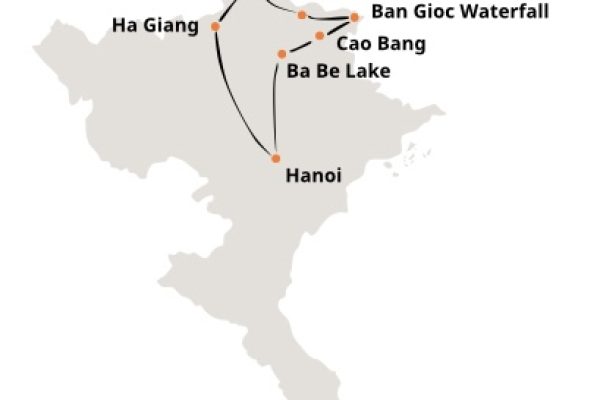
Learn more: Ha Giang Cao Bang Ba Be Lake 6 Days 5 Nights
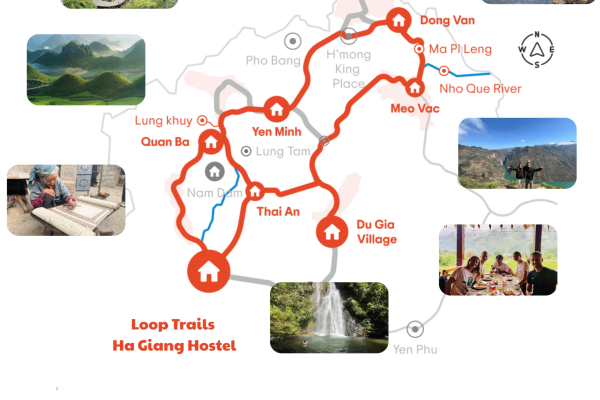
Now the part you came for. Here is how the Loop actually lays out on the map, so the place names stop being a blur and start making sense.
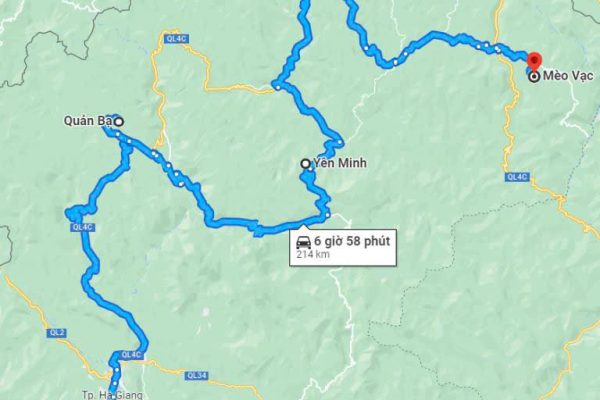
The circle starts and ends in Ha Giang City, which is where you collect your bike or meet your guide. From there the classic route climbs north, swings through the far northern highlands near the Chinese border, crosses the famous pass, and curves back south to the city.
Both directions work and you will not see fewer mountains either way. Most riders go roughly clockwise: north to Quan Ba and Yen Minh first, then Dong Van, Ma Pi Leng, and Meo Vac, then the southern return. The main reason to follow the crowd here is simple, you will pass other travelers and homestays in a predictable rhythm, which is reassuring on your first time.
Leaving Ha Giang City, the first big landmark is Quan Ba Heaven’s Gate, a viewpoint over the Twin Mountains near the town of Tam Son. From there the road winds to Yen Minh, a common lunch or fuel stop, then on through limestone country toward Dong Van.
This northern stretch is where the rewarding detours hide: Sung La Valley with its old H’mong village, the Vuong Palace area near Sa Phin, and Pho Bang, a quiet old town just off the main line. The spur up to Lung Cu Flag Tower, the northernmost point of Vietnam, also branches from here. On the map these look like small wiggles. On the ground they are some of the best riding of the trip.
Between Dong Van and Meo Vac sits Ma Pi Leng Pass, the section that ends up on everyone’s camera roll. The road clings to the cliffside high above the Nho Que River and Tu San Canyon. It is a short stretch by distance, but you will stop often. This is also the part of the map where your signal is most likely to disappear, so your offline maps earn their keep right here.
After Meo Vac, you have a choice. The shorter way loops back toward Yen Minh and down to Ha Giang City. The longer, more scenic option swings south through Mau Due and over to Du Gia, a relaxed village known for its waterfall and easygoing homestays, before the final run back to the city.
Here is a rough sense of the segments. Treat these as approximate, because the exact distance depends on which detours you take, and always confirm in your own app:
| Segment | Approximate distance |
|---|---|
| Ha Giang City to Quan Ba (Tam Son) | around 45 km |
| Quan Ba to Yen Minh | around 50 km |
| Yen Minh to Dong Van | around 50 km |
| Dong Van to Meo Vac (over Ma Pi Leng) | around 25 km |
| Meo Vac to Du Gia (via Mau Due) | around 70 km |
| Du Gia to Ha Giang City | around 70 km |
The core circle lands somewhere around 350 km depending on your choices, which is why most people spread it over three days rather than racing it.
Not sure you want to be the one reading the map at every junction? That is exactly why a lot of our guests pick an easy rider seat or a jeep, so they can watch the canyon instead of the screen. More on choosing your option further down.

Learn more: Ha Giang Motorbike Rental
The smartest thing you can do with your offline map is drop your own pins before you leave wifi. We are not going to publish exact coordinates here, because pins move and small errors send people down the wrong track. Instead, search each place by name in your map app while you still have internet, then save it. That way the location comes from live, current data, not from a number that might be stale.
Save pins in these categories:
A practical habit: name your saved pins clearly, like “Night 1 homestay” or “Fuel before Ma Pi Leng”, so a glance tells you what you are looking at without zooming around.

Learn more: Ha Giang Loop by Army Jeep Tours
How the map breaks into daily chunks depends on how many days you have. Here is the realistic version.
A 2 days plan is the fast version. You hit the headline sights, Quan Ba, the run to Dong Van, and Ma Pi Leng, but you ride longer each day and skip most detours. On the map this means a tight loop with few side branches. It works if your time is short, but you will be moving more than stopping.
This is the sweet spot and what most people choose. Three days lets you split the Loop into comfortable segments: north to the Dong Van area on day one, the Ma Pi Leng and Meo Vac stretch on day two, and the southern return, often through Du Gia, on day three. Your map has room for the good detours without any single day feeling rushed.
Four days is for travelers who want to slow down and add the off the main road villages, an extra waterfall, or a longer stop at Lung Cu and Du Gia. On the map it looks like the 3 days route with more wiggles and a couple of extra overnight pins. If you want the highlands to feel like an experience rather than a checklist, this is the one.
Whichever length you pick, the map planning principle is the same: anchor each day on a town with fuel and a homestay, and treat everything between as bonus riding.

Lear more: Ha Giang Loop Internetn Phone Signal
Even with offline maps, having data when you do get signal is genuinely useful, for messages, live weather, and re routing if a road is blocked.
A few practical notes, with the honest caveat that providers and plans change, so check the latest before you buy:

Learn more: Ha Giang Loop Mistake to Avoid
Most navigation trouble on the Loop is self inflicted and easy to dodge once you know the pattern.
The theme across all of these is simple: trust the main road, build in time, and keep your navigation tools charged.

Learn more: Ha Giang Loop Photography Guide
It happens, and it is rarely a crisis. Here is the calm sequence:
If you genuinely want to remove this entire category of stress, that is a fair reason to ride with a guide, which brings us to the last decision.

Learn more: Ha Giang Loop Self-Drive
All of the navigation advice above assumes you are the one steering. You might not want to be, and that is a completely valid choice. Here is how the options compare on the navigation front specifically.
A quick way to decide: if reading a route by yourself sounds like part of the adventure, go self drive. If it sounds like a chore standing between you and the scenery, an easy rider seat or a jeep hands the whole job to someone who does it every week.
If you want a hand matching the right setup to your group and dates, message us and we will point you to the option that fits. We would rather you ride the Loop the way that suits you than push you into a seat that does not.

Learn more: Cao Bang Loop 3 Days best kept secret
No, and you should not rely on it. Signal drops out on the passes, so the right approach is to download offline maps before you ride. With offline maps your app works fully even in airplane mode.
There is no single winner, so carry two. Google Maps with a downloaded offline area is great for searching named places, and Organic Maps or Maps.me is a strong offline backup that shows small roads. Install both and download the region before you leave wifi.
Yes, if you download the offline area for the region first. Just be careful with its routing, because it sometimes suggests a shortcut that is really a dirt track or a road that no longer connects. Use it for the big picture and check any route that pulls you off the main road.
Probably not for long. The core Loop follows one main road, so even if you take a wrong turn, backtracking to the main artery resets your navigation. The detours are where confusion happens, so plan those in advance.
In the towns, usually yes. On the high passes and in remote valleys, often no. Treat data as a bonus for the towns and rely on offline maps for the riding.
Only if you want a fixed line to follow, usually for longer or more remote variations. For a standard Loop, offline Google Maps plus Organic Maps is enough. GPX apps like OsmAnd or Gaia GPS are more setup than most riders need.
You can, especially with a guide. On an easy rider seat or a jeep, navigation is handled for you and you do not need a map. If you self drive, at least an offline map is strongly recommended.
A local Vietnamese SIM from a major carrier gives the widest highland coverage, and Viettel is generally seen as having the strongest reach in remote areas. A Vietnam eSIM is a convenient alternative if your phone supports it. Plans change, so check current options before buying.
The core circle is roughly 350 km depending on which detours you add. That is why most riders spread it over three days rather than rushing it. Always confirm distances in your own map app.
Not really, you see the same mountains either way. Most riders go roughly clockwise, north first, which keeps you in a predictable rhythm of towns and homestays. First timers often find that reassuring.
This is why a power bank and a handlebar mount matter. If your phone does die, backtrack to the main road and ask a local using the town names on your map. Keeping the phone charged removes almost all of this risk.
It is not essential if you have two offline apps and a power bank, but a simple paper overview never hurts. Some riders like having the whole Loop visible at a glance. At minimum, save your day by day plan somewhere offline.
Contact information for Loop Trails
Website: Loop Trails Official Website
Email: looptrailshostel@gmail.com
Hotline & WhatSapp:
+84862379288
+84938988593
Social Media:
Facebook: Loop Trails Tours Ha Giang
Instagram: Loop Trails Tours Ha Giang
TikTok: Loop Trails
Office Address: 48 Nguyen Du, Ha Giang 1, Tuyen Quang
Address: 48 Nguyen Du, Ha Giang 1, Tuyen Quang

Facebook X Reddit Table of Contents Learn more: Ha Giang Loop Tours Most people drive past the Quan Ba area twice on

Facebook X Reddit Table of Contents Learn more: Ha Giang Loop Tours The Ha Giang Loop has a reputation problem with older